Tuesday, November 28, 2017

Gorilla Radio with Chris Cook, James Jeffrey, Dave Lindorff, Janine Bandcroft November 30, 2017

This Week on GR

by C. L. Cook - Gorilla-Radio.com


November 30, 2017

Twenty people were killed last week in renewed fighting between the ethnic Oromo and Somali people of Ethiopia. Though the groups have lived harmoniously for generations, tensions have been on the rise in recent months, culminated in bloody clashes and a mass exodus of tens of thousands in September.

Violence and intimidation in camps set up to shelter displaced members of both Oromo and Somali minorities chased from their respective homes is also reported. But why the fighting; and why now?

Listen. Hear.

James Jeffrey is a freelance journalist who's worked for various international media outlets, filing stories on business, political unrest, humanitarian crises, and the cultural pursuits of the people of Ethiopia, and throughout the Horn of Africa, since 2013.

James Jeffrey in the first half.

And; earlier this month, legendary academic, economist, author and media critic, Edward S. Herman died. Herman was best-known perhaps for his collaboration with Noam Chomsky on the 1988 book, and source of the tour de force documentary film, 'Manufacturing Consent'. Herman's passing comes at a time of unprecedented technological upheaval in America's mass media, but how much has the corporate ethos driving the newsroom he and Chomsky wrote about changed?

Dave Lindorff is an award-winning journalist, author, broadcaster, and founder of the award-winning web news site, This Can’t Be Happening.net. Lindorff and Edward Herman were friends, and collaborators for a while at Herman's website, Inkywatch. Dave's book titles include: ‘This Can’t Be Happening! Resisting the Disintegration of American Democracy,’ ‘Marketplace Medicine: The Rise of the For Profit Hospital Chains,’ ‘Killing Time: An Investigation into the Death Row Case of Mumia Abu-Jamal,’ You can tune in Dave’s This Can’t Be Happening radio program Wednesdays at the Progressive Radio Network.

Dave Lindorff and Edward S. Herman's accounting for the mass media in the second half.

And; Victoria-based activist, and CFUV Radio broadcaster at-large, Janine Bandcroft will be here at the bottom of the hour with the Left Coast Events bulletin of good things to get up to in and around our town for the coming week. But first, James Jeffrey and Ethnic Violence in Ethiopia Amid Shadowy Politics.

Chris Cook hosts Gorilla Radio, airing live every Thursday between 11-Noon Pacific Time. In Victoria at 101.9FM, and on the internet at: http://cfuv.uvic.ca.  He also serves as a contributing editor to the web news site, http://www.pacificfreepress.com. Check out the GR blog at: http://gorillaradioblog.blogspot.ca/

Dark Rumours and Shadowy Politics: Ethnic Tensions Rise in Ethiopia

Ethnic Violence in Ethiopia Amid Shadowy Politics

by James Jeffrey - IPS


Nov 21 2017

NEAR THE OROMIA-SOMALI REGIONAL BORDER, Ethiopia,

Ethnic animosity unleashed in Ethiopia has displaced hundreds of thousands as well as rendering all manner of usually sacrosanct loyalties obsolete. Both regional governments deny their special police were involved while accusing the other of Machiavellian plots.

“I was making my husband dinner in the evening but an hour after he returned from work he kicked me out of our home,” says Zahala Shekabde, a Somali married to an Oromo.
“I pleaded with him, told him I loved him and that I have nothing else, but he said he didn’t want to listen and I must go otherwise he would hurt me.”

She left with nothing other than three children from a former marriage—her husband wouldn’t let her take her youngest child from their marriage.

Other displaced ethnic Somali with Zahala from all over Ethiopia’s Oromia region say there was no warning and explanation given for their evictions, other than the local Oromo where they lived, including local officials, telling them it was revenge for what had happened to Oromo in Jijiga, the capital of the Somali region.

Upwards of 50,000 ethnic Oromo had to leave the Somali region and beyond (officials from the opposing Oromia and Somali regions dispute whether the sum applies just to the Somali region or to the Horn of Africa—Oromo have also left Djibouti and Somaliland, where two Ethiopians were reportedly killed in the capital, Hargeisa).
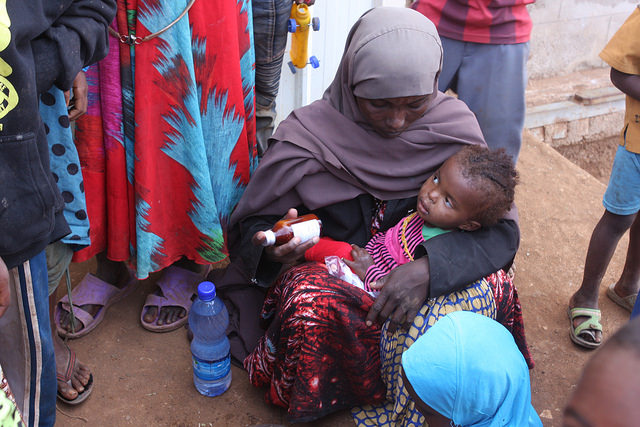
Displaced Somali at a camp on the outskirts
 of the city of Dire Dawa in eastern Ethiopia.
Credit: James Jeffrey/IPS

This sequence of tit-for-tat ethnic-based violence and evictions was sparked after Oromo protests on Sept. 12 in the town of Aweday, between the cities of Harar and Dire Dawa near the border between the two regions, led to rioting that left 18 dead, according to official figures, the majority being Somali traders of khat, the plant that when chewed acts as a mild stimulant. Somali who fled Aweday say it was closer to 40 killed.

Following Aweday, the Somali regional government began evicting Oromo from Jijiga and the region. Officials say this was for the Oromo’s own safety, and that not one Oromo died from ethnic violence in the region—a fact disputed by displaced Oromo.

“My husband was sick at home when I left for work on Sept. 20,” says Fateer Shafee from a village near Jijiga.
“Later I got a call from him saying to come and collect the children as there was conflict nearby. When I got back I found the children but our home was burnt with my husband still inside. Everyone was running and hadn’t been able to get him out.”

 Displaced Oromo sheltering on an industrial park on the outskirts of 
the city of Harar in eastern Ethiopia. Credit: James Jeffrey/IPS

In the numerous camps that have popped up and public buildings commandeered to absorb the displaced, Oromo and Somali tell equally convincing stories of ethnic violence, primarily carried out, they claim, by each region’s special police, while exhibiting even more convincing physical wounds of that violence.

Meanwhile, both regional governments deny their special police were involved while accusing the other of Machiavellian plots. At the federal level, the government faces accusations ranging from not doing enough to turning a blind eye to even abetting violence for political ends. Another option is it may simply not have the capacity to do enough, so widespread is the violence.

“It’s very difficult to tell if there have been acts of omission or commission at all levels,” says the head of one international humanitarian organization in Ethiopia, who spoke on condition of anonymity.

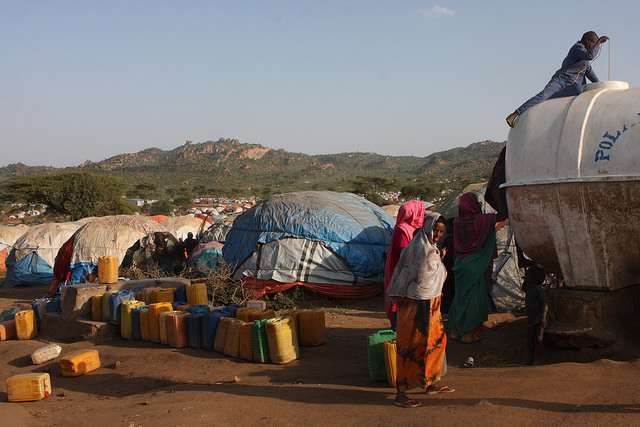
The scale of what’s happened becomes clearer 80km east of Dire Dawa, just over the regional border in the Somali Region, where two giant camps for displaced Somalis are co-located in the lee of the Kolechi Mountains.

In the older camp are 5,300 Somali households—household size varies from 6 to 10 people—displaced by a mixture of drought and ethnic violence since 2015. In the newer camp are 3,850 households displaced by the recent violence.

“It’s uniformed police carrying out the bloodshed,” says one Somali man at the camps.

Another man had to flee Oromia’s Bale zone, hundreds of kilometers to the southwest, though he says that 500 Somali households remain there under constant harassment.

“They are rich farmers and are attacked each day,” he says.
“The local Oromo tell the Ethiopian soldiers there one thing and then do another—it’s the worst example of conflict as the farmers are totally isolated and surrounded, and have no way of getting away.”

Displaced Somali at giant camps surrounded by the Kolenchi hills 
in Ethiopia’s most eastern Somali region. Credit: James Jeffrey/IPS

Inhabitants in both camps pull back clothing to reveal old bullet wounds, scars and lesions from burns, broken bones that never healed, and more.

A number of displaced Somali say they survived thanks to the intervention of soldiers from the national Ethiopian Defense Force. But it wasn’t enough to allow them to remain, or to return.

“If the federal government sends forces to keep the peace they stay for a week or a month and then after they leave it happens again,” says one Somali man.
“We can’t risk staying.”

Oromia and Somali are the two largest regions in the country by area size, sharing a border of more than 1,400 km (870 miles). The Oromo constitute the largest proportion of Ethiopia’s population, numbering about 35 million, a factor Ethiopia’s other ethnic groups remain deeply conscious of—especially its 6.5 million Somalis.

Ethnic conflict along the border between the two regions and in the regional rural hinterlands has long occurred, and can be traced to grievances and still standing tensions from the Ethio-Somali war of the 1970s and further back to historical tensions over Oromo migration due to their significant numbers.

But ethnic violence in urban areas well removed from the border is particularly rare. Many say the violence is all the more shocking within communities that integrated peacefully for centuries, and within which intermarriage between Oromo and Somali was the norm.

In 2004, a referendum to decide the fate of more than 420 kebeles around the border—Ethiopia’s smallest administrative unit—gave 80 percent of them to the Oromia Region. This led to thousands of Somalis leaving areas for fear of repercussions.

The referendum still hasn’t been fully resolved, which some say could be one factor behind the current conflict, as may be the on-going drought putting further pressure on pasture and resources—but only to a degree.

“There’s been drought before and no violence happened,” says the vice administrator of one of the Somali regional zones badly hit by the drought.
“The main reason is politics and is hidden—this is all man-made.”

Ethiopia’s ethnic federalist system devolves power to regional states. Some observers note how this leaves the government in a quandary of respecting that devolution while also protecting the constitutional rights of Ethiopians, especially minorities, as regions increasingly flex their devolved muscles.

Recent trouble primarily occurred where notable minorities existed: Somali in Aweday, for example, and Oromo in Jijiga. More diverse cities such as Dire Dawa, with a less clear majority, have escaped violence for now.

Meanwhile, accusations go beyond political machinations by regional powerbrokers and the federal government to include the Ethiopian diaspora opposition and social media.  

“The Oromo are being directed from Minnesota in America,” says one Somali official.
“The Oromo in government don’t have enough respect or influence to coordinate this.”

Monday, November 27, 2017

Adults at State Win One in Lebanon Ouster Fiasco

Did Kushner Keep Tillerson in the Dark on Saudi-Lebanon Move?

by Mark Perry  - The American Conservative


November 27, 2017

Efforts by Prince Salman to start a regional crisis backfired, but the drama has left the secretary of state seething.

Saudi Crown Prince Mohammad bin Salman has accomplished the impossible: he’s actually united Lebanon, though perhaps only briefly.

The tale of how the 32-year-old bin Salman (or MbS, as he’s called), accomplished this is a tad complex, but it’s worth the telling.


Credit: Flickr/creativecommons/European External Action Service/
US Department of State

Earlier this month, on November 2, Lebanese Prime Minister Saad Hariri, the scion of the wealthy Hariri family (and the son of the much-admired Rafiq Hariri, who was assassinated in a car bombing in Beirut in 2005), received a telephone call in Beirut from a senior Saudi official directing him to fly immediately to Riyadh to meet with the Saudi Crown Prince.

Hariri could hardly refuse: a dual Lebanese-Saudi citizen, Hariri’s family fortune (and funding for his Lebanese political party, the Future Movement) depended on Saudi largesse—so off he went.

The next day, Hariri cooled his heels for four hours waiting for MbS to meet with him, before being ushered into His Presence, where he was peremptorily directed to read a television statement announcing his resignation as Lebanon’s prime minister and blaming Iran and its Lebanese proxy, Hezbollah, for plotting to destabilize his country and murder him. This was high drama, but lousy theatre: Hariri’s eyes shifted uncomfortably during his address, as if seeking approval from off-camera handlers that he was performing as expected. Hariri then popped up in Abu Dhabi, where he met with Crown Prince Mohammed bin Zayed al Nahyan, before returning to Riyadh, where he reassured the Lebanese public that he was sincere about resigning, hadn’t been detained against his will by the Saudis, and would soon return to Beirut.

Unfortunately for the Saudis, no one in Lebanon was buying it. 


Within hours of Hariri’s address, officials of his Sunni-dominated Future Movement speculated that the prime minister was being held against his will, expressed doubts that his resignation was voluntary and pushed for his return. Several days later, Lebanese President Michel Aoun (a Maronite Christian), said that he believed the Saudis had “kidnapped” Hariri while Hassan Nasrallah, the Shiite leader of the Iranian-aligned Party of God (Hezbollah), publicly described Hariri’s resignation as a “Saudi-imposed decision.”

Banners began appearing in Beirut (“We Want Our PM Back”), and festooned the jerseys of runners participating in a Beirut marathon: “Running For Hariri.”

Hariri was suddenly Lebanon’s poster boy, a martyr-in-the-making. Which is to say that, within days of his resignation, it was clear that Saudi Arabia’s attempt to paint Hezbollah as “destabilizing Lebanon” had backfired: Mohammad bin Salman’s insistence that Hariri take a tougher stance against Iran and Hezbollah had made unlikely allies of Lebanon’s squabbling factions. Those plotting against Lebanon weren’t in Tehran, the Lebanese public decided, they were in Riyadh. But the Lebanese weren’t the only ones who weren’t buying the Saudi line. Neither was the U.S. State Department.

Secretary of State Rex Tillerson, who was accompanying the president during his Asia tour at the time of the Saudi-engineered initiative, was “completely blindsided” by the move, as several senior Middle East diplomats confirmed to TAC.

While Tillerson would later be accused of being “totally disengaged” from the crisis, several former and current U.S. diplomats have told us that just precisely the opposite was the case. Tillerson, they say, had a “long and pointed discussion” on the Hariri situation with Saudi Foreign Minister Adel al-Jubeir on November 7, after having directed Acting Assistant Secretary for Near East Affairs, David Satterfield, to “walk point” on the issue. Satterfield talked with Hariri’s aides in Beirut and told Christopher Henzel, the U.S. charge d’affaires in Saudi Arabia, to meet with Hariri in Riyadh.

In Beirut, meanwhile, U.S. Ambassador Elizabeth Richard was gathering information on the crisis from Lebanese officials and passing it back to Washington.

Tillerson’s initial reaction to the Hariri resignation was in keeping with his low-key approach. He gathered the facts, solicited advice, advised calm and held his temper. In private, however, Tillerson was seething.

This was the second time in six months that the Saudis had taken a major diplomatic initiative without issuing a heads-up to the U.S.—a violation of the unwritten “no surprises” rule that is standard courtesy among close allies.

The first surprise had come in June, when the Saudis broke off relations with Qatar and placed it under an economic embargo. The anti-Qatar move embarrassed the U.S., split the Gulf Cooperation Council and shattered U.S. efforts to forge a united anti-Iran Sunni bloc. And, as was the case with the Saudi-engineered Hariri resignation, the Qatar crisis had come with nary a warning from the Saudis to their most important ally.

But according to a senior Middle East diplomat with whom TAC spoke, Tillerson wasn’t only angered by Saudi Arabia’s failure to give the U.S. a heads-up on their Lebanon plans, he suspected that the White House knew of the plan for Hariri ahead of time, but failed to tell him. The culprit, as had been the case of the Qatar crisis, was Jared Kushner, the president’s 36-year-old son-in-law, whose official role in the White House is described by an avalanche of titles that rivals anything given a Saudi royal: Senior Advisor to the President, Deputy National Security Advisor for Strategy, and Special Representative for International Negotiations. More crucially, Kushner is close to MbS, who Kushner had met with (ostensibly about the Israeli-Palestinian peace process), during an under-the-radar trip to the region at the end of October.

“Kushner and MbS aren’t just close, they’re very, very close,” the senior Middle East diplomat told TAC.

“I suppose there’s an outside possibility that Kushner was as surprised about the Hariri move as Tillerson, but I really doubt it. It’s unimaginable that bin Salman didn’t tell Kushner what he was planning.” 

But this same diplomat dismissed the notion that bin Salman asked for Kushner’s approval of the Saudi initiative—that Kushner “green lighted” it. “That’s not the way this works,” he said.

“I doubt that the Saudis needed a green light. They don’t think they need anyone’s permission to do what they want, they take it for granted that Kushner supports them. Their calculation is that he has more influence with the president than Rex Tillerson.”

In truth, this diplomat says, neither the U.S. nor Tillerson should have been surprised by the Saudi move—or MbS distaste for Saad Hariri. Tensions between the Lebanese prime minister and the Saudis had been festering since mid-May, when a Hariri-backed delegation of bankers arrived in Washington to lobby the Congress against imposing tough new sanctions on Lebanese financial institutions suspected of being affiliated with Hezbollah. Lebanese officials told members of Congress that increased regulatory pressure would damage Lebanon’s fragile banking sector and endanger its financial stability. Hariri himself appeared in Washington in July to buttress these efforts. As a result, Congress carefully dampened the impact of the proposed sanctions, fearing that any attempt to target Hezbollah would undermine the fragile Lebanese economy.

“That was a final straw for the Saudis,” this diplomat says.

“They were absolutely disgusted. As far as they were concerned, Hariri was caving in to the Iranians.” 

By the end of the summer, the Saudis were determined to get rid of the prime minister and replace him with his older brother, Bahaa, a Saudi resident and Saad competitor who has long wanted to replace his brother as head of the Future Movement.

“This was a plot and months in the making,” a senior aide to Lebanese President Michel Aoun told The American Conservative in an email.

“Saad refused to fall in line with Saudi Arabia’s plan to confront the Iranians. So MbS decided to make him pay.”

But Hariri had not only run afoul of Mohammed bin Salman, he’d also crossed Thamer Al Sabhan, Saudi Arabia’s Minister of Gulf State Affairs, a fervid, and MbS partisan. At key points in the crisis, and even as Mohammed bin Salman remained silent, Al Sabhan had issued threats against Iran, Hezbollah—and Saad Hariri. His most outspoken public statement came in the midst of the Hariri crisis, on November 7—and was aimed at the Lebanese prime minister.

“We will treat the government in Lebanon as a government declaring war on Saudi Arabia due to the aggression of Hizbollah,” Al Sabhan told Al Arabiya, the Saudi owned news channel. It was an astonishing statement, and read in Washington as an “or else” threat against Hariri—he would resign his position and toe the Saudi line, “or else.”

The problem for Al Sabhan, and for the Saudis, is that the more reckless their rhetoric became, the more the Lebanese dug in their heels. “The Saudi mistake was in thinking that we’d roll over,” this officials says. “We didn’t.”

Nor did Rex Tillerson. On November 10, the State Department issued a press statement under Tillerson’s name (“On The Situation In Lebanon”), supporting Hariri (“We respect Lebanese Prime Minister Saad Al-Hariri as a strong partner of the United States.”), at the same time that it took a swipe at Iran—and the Saudis.

“The United States cautions against any party, within or outside Lebanon,” the statement read, “using Lebanon as a venue for proxy conflicts or in any manner contributing to instability in that country.”

November 10, as it turns out, marked the most significant moment in the Hariri crisis. On the day the Tillerson statement was issued, Tillerson’s point man on the issue, David Satterfield, had a meeting with Thamer Al Sabhan at the State Department. Al Sabhan was in Washington for meetings, which included one at the White House. The Satterfield-Al Sabhan meeting did not go well, according to the senior diplomat with whom we spoke. In fact, the description is an understatement.

“The meeting was ugly, confrontational,” a former ambassador who received a “read out of the meeting” explained to us.

“Satterfield laid down the law—the U.S. did not support the Saudi initiative, thought that what the Saudis were doing was destabilizing, wanted Saad to remain as prime minister and would not support Bahaa as his replacement.” 

This senior diplomat says that Satterfield was “dismissive” of the Saudi attempt to shift the mantle of the Future Movement onto Bahaa’s shoulders. “Satterfield made it clear that the U.S. didn’t think that Bahaa was up to the job,” then added his own judgment: “He’s unpredictable, lazy.”

In the days following the Satterfield-Al Sabhan meeting, the Hariri crisis has subsided.Denying that he was detained against his will by the Saudis, Hariri arrived in Paris on Saturday, where met with French President Emmanuel Macron, then made his way to Beirut via Cairo on Wednesday. His return was triumphant. He appeared at a military parade marking his country’s independence, spoke to cheering crowds outside of his home – and all but renounced his Riyahd decision to resign as Lebanon’s prime minister.

“I offered my resignation to President Aoun and he asked me to delay presenting it, to allow for more consultations and deliberations, and I agreed to his request,” Hariri said.

The unlikely hero in all of this might well be Rex Tillerson, who quietly engineered a U.S. policy at odds with the views of Donald Trump—and his son-in-law.

The exact details of how Tillerson pulled this off remain unknown (“I think Tillerson just told Trump what he was going to do,” the senior diplomat with whom we spoke speculates, “and then just did it.”), even as the odds against him mount: he remains the target of former and current State Department officials for failing to fill empty Foggy Bottom offices, remains the object of rumors that he will be replaced, is widely disliked by reporters covering the State Department for his detachment (and for refusing to approve reporters’ requests to travel with him), and is regularly dismissed in the diplomatic community for his style—for what is described as his “vanishing act” on foreign policy issues.

More crucially, Tillerson’s views are sharply at odds with a White House that has shown a willingness to take Saudi claims at face value.

Which means that what was obvious in June, when the Saudis purposely shattered the Arab world’s united Sunni front against Iran, is even more obvious now—in the midst of the Hariri crisis.

“The U.S. is running two foreign policies in the Middle East,” the senior diplomat with whom we spoke says.

“There’s a White House foreign policy that’s in the hands of Jared Kushner and another that is being engineered by Rex Tillerson.” 

And which foreign policy will prevail? The question brought a laugh from the senior diplomat. It’s not really that hard to figure out,” he said.

“Rex Tillerson will be secretary of state until he decides not to be—or gets fired. But Jared Kushner will probably be the president’s son-in-law forever.”

Mark Perry is a foreign policy analyst, a regular contributor to The American Conservative and the author of The Pentagon’s Wars, which was released in October. He tweets @markperrydc

Coast Guard Helpless as Oil Laden Barge Poised to Spill into Queen Charlotte Sound

Canadian Coast Guard on scene after fuel-loaded barge splits away from tug in Queen Charlotte Sound

by Charlie Smith - The Strait


November 26th, 2017

An articulated tug barge carrying 3.5 million litres of diesel oil is adrift in the ecologically sensitive waters of Queen Charlotte Sound north of Vancouver Island.

The Canadian Coast Guard has tweeted that one of its vessels is on the scene after the Jake Shearer became separated from its tug south of Goose Island. The marinetraffic.com website identifies the Jake Shearer as a U.S.- flagged pusher tug with a gross tonnage of 497. It's 34 metres by 11 metres in size.

The Joint Rescue Co-ordination Centre says the vessel broke free before 4 p.m. Sunday.


This incident is of great concern to members of the Heiltsuk First Nation, whose traditional shellfish harvesting was seriously marred a year ago when another boat, the Nathan E. Stewart, sank last year in waters near Bella Bella.

Queen Charlotte Sound has thriving populations of of marine birds, marine mammals, fish, and shellfish. Humpback whales have even returned to the area in recent years.

Sunday, November 26, 2017

BREAKING: Oil Barge Loose in Hecate Straits: Another Nathan E. Stewart Disaster in the Making?

American ATB tanker, "Jake Shearer," fully loaded with 10,000 deadweight tons of oil product, appears to be in trouble 

by Ingmar Lee - 10,000 Ton Tanker


November 26, 2017

There appears to be an EMERGENCY developing in in Hecate Straits, just off the Goose Group. The American ATB tanker, "Jake Shearer," fully loaded with 10,000 deadweight tons of oil product, appears to be in trouble about 2 nautical miles south of the Goose Islands.

Reports say that it has lost all power, and is adrift. It is currently blowing 50 knots in Hecate Strait.

Canadian Coast Guard ship, "Gordon Reid" tasked and is steaming towards the stricken vessel via Fitzhugh Channel and Hakai Pass at 15 knots

Update: 17:27 CCG 47', "Cape St. James" underway in Lama Pass at 19 knots


Update: 19:02

I have an unconfirmed report that the "Jake Shearer" has managed to get 2 personnel onto the drifting oil barge, and that they have been able to deploy 2 anchors.

They are currently about 1/2 mile off the Gosling Rocks With the CCG ship Gordon Reid fast approaching...

Update:  19:34

The "Jake Shearer" is now circling its stricken, loaded 10,000 deadweight ton oil barge about 1/2 mile off the Gosling Rocks.

It is reported that 2 personnel from the tug were able to get onto the barge and have deployed 2 anchors with approx 1000 ft of cable. The CCG "Gordon Reid" is nearly there. Nevertheless, this remains an extremely precarious and dangerous situation...

Update: 22:57

It's a terrifying, busy night for the crew of the "Jake Shearer" as they continue circling their stricken oil-tanker barge. The barge, with 2 crew members aboard, is now anchored, with 1000 ft of anchor line, a stones throw from the Gosling Rocks. It's blowing and there are heavy seas. The CCG vessels, "Gordon Reid" and "Cape St. James" are on scene, but are helpless to offer a tow.

The American tug, "Norma H," currently anchoring its own barge in Rivers Inlet, has apparently been tasked to assist, but is about 6 hrs away.

Although it would be expected that the Prime Minister himself has been notified, there is no sign whatsoever that any of Canada's "World Class" spill response service, the "Western Canada Marine Response Corporation" has been tasked or is on its way. If that anchor lets go, and that barge runs aground, 1/4 of the spill volume of the Exxon Valdes willrun amok all over the Goose Islands and Hecate Strait.

Questioning the Messenger: Do CNN and the BBC Really Now Care About Black African Lives?

CNN Breaks Story on Slave Trade in Libya; French Government Voices Concern for African Migrants

by Gerald A. Perreira  - Global Research

 via Countercurrents

 November 26, 2017

The world we find ourselves in is complex and full of contradictions. It is easy to fall for rudimentary textbook propaganda based on simplistic dichotomies, such as ‘the good guys versus the bad guys’. If we are not aware of the complexities and nuances facing us, we can fall for this type of propaganda, whose sole aim is to keep us apart and destroy any type of unity that could strengthen our ability to defeat the enemy.

When examining and assessing the latest information fed to us by one of imperialism’s mouthpieces, CNN, there are important things for us, as revolutionary Pan-Africanists, to keep in mind. The first thing to note is the clear hypocrisy and insincerity which is nowhere more stark than CNN’s recent expose of “Libyan crimes against humanity” and French President, Emmanuel Macron’s call for a special meeting of the UN Security Council to demand immediate action against this heinous “Libyan” crime.

I know this much for sure, as an African revolutionary I do not look to the devil for the truth. I know that the devil does not lie some of the time; he lies and deceives all of the time. In whatever form the devil manifests himself, I do not deal with him. He can come in the guise of the imperialists and White Supremacists themselves, or their mouthpieces such as CNN, BBC, Fox News or any of the mainstream corporate media outlets.

We should never forget their role as cheerleaders and purveyors of the fake news that laid the groundwork for the invasion and destruction of the Libyan Jamahiriya. Therefore, let us ask ourselves the burning question, why are they providing us with this information, and why now? Why are the imperialists suddenly feigning concern for the plight of Africans?

In my first article on the invasion of Libya, published March 2nd, 2011, titled, Libya, Getting it Right: A Revolutionary Pan-African Perspective, I said that

“the conflict in Libya is not a revolution, but a counter-revolution. The struggle is fundamentally a battle between Pan-African forces on the one hand, who are dedicated to the realization of Qaddafi’s vision of a united Africa, and reactionary, racist Libyan Arab forces who reject Qaddafi’s vision of Libya as part of a united Africa.”

Events have proved this analysis correct. Muammar Qaddafi and the Revolutionary Committees Movement of the Al Fateh Revolution had a monumental task on their hands: to conscientize and reposition the Libyan peoplefor a significant role in the revolutionary Pan-African project for a United States of Africa. This is a battle for all African revolutionaries. In Sub-Saharan African countries, where almost the entire population comprises Black Africans, we face the same battle. Here in the Caribbean, it is no different. So, when Qaddafi urged his people to look towards a United States of Africa and a revolutionary Pan-African perspective, he had to face Libyans who rejected this program in favor of Libya and the entire North African region joining the Barcelona Project, a Mediterranean-European alliance, whose aim is to take North Africa out of Africa.

Prejudice against dark-skinned Africans exists all over planet earth. Even in countries where the population is almost 100% Black African, we have to contend with ‘shadism’, a hangover from colonialism and plantation culture, where Africans with lighter skin shades are held in higher esteem than Africans with darker skin shades. However, to say that “Arab Libyans” are selling “Africans” is overly simplistic and deliberately misleading. There is a hidden agenda here – beware. The objective is to ignite hostilities between so-called Arab-Africans and so-called Sub-Saharan-Africans. There is a debate amongst Africans about who is an African. On the one hand, there are those who limit the definition of African to Black Africans in the Sub-Saharan region of the continent. On the other hand, there are those of us who believe that Africa is one, and we will resist any attempt by the imperialists to redefine and further balkanize Africa. Rather than becoming part of the European Community, North Africans promoting the Barcelona Project would be better off seeking out their African roots. This is what Muammar Qaddafi told all Libyans.

Those who today call themselves “Arabs” have a historical, ancestral and moral duty to recognize their Africanity. Those “Arabs” who live in countries on the African continent and those who live in the region outside of the continent, need to explore and reexamine their history. The region they inhabit, erroneously named “Middle-East”and “Levant” by the European colonizers cannot be divorced from Africa. I agree with Islamic theologian and historian, Dr. Wesley Muhammad, that the area known as “Middle-East” or “Levant” is more aptly named ‘Afrabia’.

Anyone interested in more information on this and the Aryanization of Christianity and Islam, should refer to the brilliant works of Dr. Wesley Muhammad, especially his book ‘Black Arabia and the African Origins of Islam’.

The North Atlantic Tribes Organization (NATO) deeply fear this type of awakening and the unity of purpose and action it could lead to in this oil rich and wealthiest region of the world.

Minister Farrakhan said many years ago, reflecting on periods of unity in our history, “we did it before and we can do it again”. Muammar Qaddafi persistent struggle to forge a United States of Africa was starting to pay off. He was on the verge of creating an African currency that would have shifted the global economic imbalance, preparing the way for Africa to take its rightful place in the world. Laurent Gbagbo, former president of Ivory Coast, was openly supporting Qaddafi with this radical move. Gbagbo believed that those who were serious should declare a United States of Africa and the others could follow. Fear of this emerging African unity, especially between countries in the north and south of the continent, prompted France to orchestrate Gbagbo’s removal from power at the same time as the NATO led invasion of Libya. Genuine African unity, resulting in anything more than talk, will always be opposed, no matter what the cost, by the forces of White Supremacy.

As we now know, even those Libyans who opposed Qaddafi’s drive for a United States of Africa, did not support the overthrow of the Jamahiriya. It is a well-substantiatedfact that the rag-tag and opportunistic conglomerate of reactionaries, including monarchists, Arab supremacists and al-Qaeda linked Islamists, such as those from the Libyan Islamic Fighting Group, constituted an insignificant minority. The Libyan Revolutionary Armed Forces could have easily contained these retrograde forces, if NATO had not bombed them into power. Without the backing of France, the US, Britain, Italy, the Netherlands and their satellites, Saudi Arabia, Qatar and the UAE, the so-called Libyan rebels amounted to nothing when confronted with the overwhelming support of the majority of Libyans for Muammar Qaddafi and the Al Fateh Revolution. This revolution brought dignity, stability, prosperity and liberation from foreign domination to all Libyans, from the fairest to the darkest in complexion. One thing you knew as soon as you stepped off the plane at Tripoli Airport was that the Libyans – all Libyans – were in control of their country!It was people power, seemingly chaotic and misunderstood by outsiders, but a truly participatory democracy to those who lived it and experienced it. The majority of Libyans were aware of this and supported Al Fateh.

Knowing who the so-called rebels truly are, it came as no surprise to me,thatin addition to the long list of crimes against humanity attributed to these scoundrels, they would auction Black Africans as slave labor.

Following the heroic battle of Sirte, back in December 2011, in an article titled, “Demons Unleashed in Libya: NATO’s Islamists Continue Program of Ethnic and Ideological Cleansing”, I wrote about the horror that was taking place. A horror that was instigated by the Anglo-Franco-American Imperialists, under the watchful eye of the UN – all of whom are now shedding crocodile tears over the sale of African migrants in Libya. In that article, I wrote about the“complete whiteout by the corporate media regarding all news from Libya”. I stated that,“Even the United Nations, an architect of the nation’s destruction, says 7,000 prisoners are held without trial or charge, most of them Black, many of them tortured. Any known Qaddafi loyalists who have not been able to get out of Libya have to stay underground. Death squads scour the land. Truckloads of bodies are being carted away, as the now feuding armed gangs, each with their own command structure, and none adhering to anything the Western installed NTC says, introduces the only policy they ever had – exterminate Qaddafi and all those loyal to him.”

These are NATO’s thugs.

I went on to note that,

“In addition to loyalty to the Leader, and defense of their country against foreign invaders, having black skin and asserting one’s Africanity has become a crime in the new Libya. Ethnic cleansing is continuing unabated. Every day Black Africans from Libya and other parts of Africa are hunted down. Thousands have been brutally tortured and executed. Rape of Black women is a favored weapon of NATO’s Islamists. Many of the female bodies found show signs of rape, beatings and torture. Large numbers of Black Africans make up the ranks of the Green Resistance.”

I quoted one Tripoli resident as saying:

“Everyone is terrified of the NTC and their armed gangs. We have seen with our own eyes what they are capable of – they are animals. All around us people are being rounded up and imprisoned. We have no way of knowing how many have been murdered. Anyone who is associated with Qaddafi or suspected of loyalty to him is at risk. Even people who have worked for people who are known supporters of the leader have been rounded up and tortured. I personally know of many persons who were just working for people associated with the leader who have been taken away and never seen again. If you are black you are an immediate suspect – these rebels call black Libyans “abd” means slave and they are rounding them up just because they are black – it is making me sick and ashamed.”

“…What these rebels have done to their own people is disgusting – some of the acts of torture I can’t even speak about. There has been a lot of rape. I wept when I learned of what these animals did to the leader’s female bodyguards – they are not human and that is why there is so much fear. Any known Qaddafi loyalists who have not been able to get out of Libya have to stay underground. Libyans are afraid to talk to other Libyans – anyone could be an informer. It feels like the last days are upon us – Libya has been turned into a living hell.”

The imperialist media, including CNN was completely silent regarding all of these crimes against humanity,despite the fact that genocide in the form of an ethnic and ideological cleansing pogrom was unfolding right before our eyes. There was no outcry from the UN or the North Atlantic Tribes. No time or motive for outcry – having shared the spoils, these callous warlords had already moved on to their next victim – Syria.

So why now?


Could it be that the Green Resistance is gaining ground? Could it be that although they killed Qaddafi and buried him in an unmarked grave (they know why), his dangerous (for them) ideas are better known now than before? Could it be that Muammar Qaddafi’s vision for a United States of Africa could once again re-surface?

Prior to the overthrow of the Jamahiriya, thousands of Africans traveled to Libya to work, and they prospered. Employment opportunities existed across a range of occupations, including teachers, librarians, nurses, hotel workers, chefs, mechanics, electricians, construction workers and unskilled laborers. They were able to send money home to their families. African businesses and companies also traded extensively in Libya. There was zero tolerance in the Jamahiriya for the mistreatment of Libyan or migrant workers or anyone for that matter. I know of many foreigners who received favorable judgments in employment disputes.

The destruction of this most prosperous and just African country was led by France, who now dares to call for a special meeting of the UN Security Council to discuss the crimes committed against African migrants “by Libyans”. This is devil-speak. The same devil who, in the words of the Honorable Minister Farrakhan, “unleashed the demons” that are now committing these and other heinous crimes, is trying to sow more discord by talking about “Libyan crimes”. Where was CNN and the French government when these same gangs of demons were committing the atrocities described above?

We have known since the first day of NATO’s invasion that this was perhaps one of the most racist and atrocious crimes of the 21st century. The question that we must ask ourselves is why CNN, the French government and others who led the charge in 2011, are all of a sudden concerned about the plight of Africans in Libya. Minister Farrakhan calls it “deceptive intelligence”, and warns us that, “every time the serpent raises its head it should be decapitated”.

Let us resist this crude attempt to divide and ruin us yet again. Let us not be distracted and misled by imperialist propaganda. Let us make sure that our enemies do not set our agenda, causing us to react to their devious attempts to pit us against each other. Let us set our own agenda for our second liberation. Crimes against Black Africans and Qaddafi loyalists, of every complexion, began in Libya in 2011, and continue to this day, unabated. Thousands languish in detention centers, Libyans of every complexion and migrants from all over Africa. Those carrying out these crimes on the ground are the foot soldiers and thugs of the criminal masterminds of the hell that is now Libya. Arrest warrants should be issued immediately for Nicolas Sarkozy, Barack Obama, Hillary Clinton, David Cameron, King Salman bin Abdulaziz Al Saud and Emir Tamin bin Hamad Al Thani to name but a few.

I end with a message to “All our Brothers and Sisters in Africa and the Diaspora” from long time Revolutionary Committee Movement member, Dr. Salem Zubeidy:

“This letter is addressed to our brothers, officials, and residents of the sub-Saharan African countries, who are characterized by dark features….

There have been many reactions and statements by African leaders, politicians, organizations and institutions following an investigation published by CNN that there are markets for the selling of Africans of dark skin in Libya …

No one stopped to question the validity of this report, and where is the market? When did this happen? Where do the (alleged) slaves go?

Then, no one asked how the channel got to the supposed market, and how was it able to video the “auction”? What is the purpose of the American channel to broadcast such a program that distorts an entire people, and accuses them of committing a heinous crime that is not accepted by a reasonable mind and not approved by any logic?

We can find explanations and justifications for a US channel harboring suspicious purposes in fueling separation and instigating seditions.

As an answer to the voices and forces that see in this an opportunity to falsify the facts, and play down the Libyan people’s accomplishments, side by side with their African brothers and sisters in the golden times of the al-Fateh Revolution, it behooves us to clarify some points:
  1. Libya, which you know has been hijacked since the Fall of 2011, and its capabilities are being controlled by criminal gangs that had been enabled by means of the Western war machine of NATO, after destroying the foundations of the state.
  2. Libya was the Bureau of the liberation movements, which trained, armed and equipped thousands of young people in the southern regions of Africa, Rhodesia, South Africa, Namibia, Mozambique, Zambia and Angola, and enabled them to return with their full military gear, with Libyan advisers, to fight the battles of liberation.
  3. Libya offered total support to the struggle of Cabral in Guinea Bissau and Cape Verde and dispatched Libyan officers as volunteers to fight alongside him, some of whom are still living witnesses amongst us.
  4. Libya presented absolute support for revolutionary and progressive regimes in African countries seeking liberation from imperialism and neo-colonialism in the Congo, Ghana, Burkina Faso, Chad, and others.
  5. Libya alone has resisted the Barcelona process, which had as an objective the separation of the light-skinned in the north of the continent linking them with the Mediterranean in the so-called “Mediterranean Organization” and established the CEN-SAD in response to the Barcelona process, to prove the unity of the continent.
  6. Libya fought the battle for the unification of the continent and the affirmation of its freedom, identity, and dignity through pressing for the establishment of the African Union.
  7. Libya embraced African political opposition movements, supporting their programs and bringing many of their leaders to power.
  8. Libya represented the ongoing battle for peace, development, and construction. It convened dozens of meetings, organized dozens of mediation affairs and reconciliations. It also invested huge sums in important projects in most countries of the continent …

We can go on in more detail, but we just want to tell you and the world that your Libyan brothers and sisters cannot accept to disassociate themselves from their continent, no matter how the enemies of Africa try.”

A full statement from Libyan People’s National Movement (LPNM) can be found here.

Gerald A. Perreira is chairperson of the Guyanese organizations Black Consciousness Movement Guyana (BCMG) and Organization for the Victory of the People (OVP),International Secretary for ARM (African Revolutionary Movement) and executive member of the Caribbean Chapter of the Network for Defense of Humanity.He lived in Libya for many years, served in the Green March, an international battalion for the defense of the Al Fatah Revolution, and was an executive member of the World Mathaba based in Libya.
He can be reached at mojadi94@gmail.com.

Featured image is from the author.
The original source of this article is Countercurrents

Saturday, November 25, 2017

America's Lengthening Enemies List

America’s Enemies, Who’s On the List? Prospects and Perspectives

by Prof. James Petras - ICH


November 24, 2017

For almost 2 decades, the US pursued a list of ‘enemy countries’ to confront, attack, weaken and overthrow. This imperial quest to overthrow ‘enemy countries’ operated at various levels of intensity, depending on two considerations: the level of priority and the degree of vulnerability for a ‘regime change’ operation. The criteria for determining an ‘enemy country’ and its place on the list of priority targets in the US quest for greater global dominance, as well as its vulnerability to a ‘successfully’ regime change will be the focus of this essay.

We will conclude by discussing the realistic perspectives of future imperial options.

Prioritizing US Adversaries


Imperial strategists consider military, economic and political criteria in identifying high priority adversaries.

The following are high on the US ‘enemy list’:


1) Russia, because of its military power, is a nuclear counterweight to US global domination. It has a huge, well-equipped armed force with a European, Asian and Middle East presence. Its global oil and gas resources shield it from US economic blackmail and its growing geo-political alliances limit US expansion.

2) China, because of its global economic power and the growing scope of its trade, investment and technological networks. China’s growing defensive military capability, particularly with regard to protecting its interests in the South China Sea serve to counter US domination in Asia.

3) North Korea, because of its nuclear and ballistic missile capability, its fierce independent foreign policies and its strategic geo-political location, is seen as a threat to the US military bases in Asia and Washington’s regional allies and proxies.

4) Venezuela, because of its oil resources and socio-political policies, challenge the US centered neo-liberal model in Latin America.

5) Iran, because of its oil resources, political independence and geo-political alliances in the Middle East, challenge US, Israeli and Saudi Arabia domination of the region and present an independent alternative.

6) Syria, because of its strategic position in the Middle East, its secular nationalist ruling party and its alliances with Iran, Palestine, Iraq and Russia, is a counterweight to US-Israeli plans to balkanize the Middle East into warring ethno-tribal states.

US Middle-level Adversaries


1) Cuba, because of its independent foreign policies and its alternative socio-economic system stands in contrast to the US-centered neo-liberal regimes in the Caribbean, Central and South America.

2) Lebanon, because of its strategic location on the Mediterranean and the coalition government’s power sharing arrangement with the political party, Hezbollah, which is increasingly influential in Lebanese civil society in part because of its militia’s proven capacity to protect Lebanese national sovereignty by expelling the invading Israeli army and helping to defeat the ISIS/al Queda mercenaries in neighboring Syria.

3) Yemen, because of its independent, nationalist Houthi-led movement opposed to the Saudi-imposed puppet government as well as its relations with Iran.

Low Level Adversaries


1) Bolivia, because of its independent foreign policy, support for the Chavista government in Venezuela and advocacy of a mixed economy; mining wealth and defense of indigenous people’s territorial claims.

2) Nicaragua, because of its independent foreign policy and criticism of US aggression toward Cuba and Venezuela.

US hostility to high priority adversaries is expressed through economic sanctions military encirclement, provocations and intense propaganda wars toward North Korea, Russia, Venezuela, Iran and Syria.

Because of China’s powerful global market linkages, the US has applied few sanctions. Instead, the US relies on military encirclement, separatist provocations and intense hostile propaganda when dealing with China.

Priority Adversaries, Low Vulnerability and Unreal Expectations


With the exception of Venezuela, Washington’s ‘high priority targets’ have limited strategic vulnerabilities. Venezuela is the most vulnerable because of its high dependence on oil revenues with its major refineries located in the US, and its high levels of indebtedness, verging on default. In addition, there are the domestic opposition groups, all acting as US clients and Caracas’ growing isolation within Latin America due to orchestrated hostility by important US clients, Argentina, Brazil, Colombia and Mexico.

Iran is far less vulnerable: It is a strong strategic regional military power linked to neighboring countries and similar religious-nationalist movements. Despite its dependence on oil exports, Iran has developed alternative markets, like China, free from US blackmail and is relatively safe from US or EU initiated creditor attacks.

North Korea, despite the crippling economic sanctions imposed on its regime and civilian population, has ‘the bomb’ as a deterrent to a US military attack and has shown no reluctance to defend itself. Unlike Venezuela, neither Iran nor North Korea face significant internal attacks from US-funded or armed domestic opposition.

Russia has full military capacity – nuclear weapons, ICBM and a huge, well-trained armed force – to deter any direct US military threat. Moscow is politically vulnerable to US-backed propaganda, opposition political parties and Western-funded NGO’s. Russian oligarch-billionaires, linked to London and Wall Street, exercise some pressure against independent economic initiatives.

To a limited degree, US sanctions exploited Russia’s earlier dependence on Western markets, but since the imposition of draconian sanctions by the Obama regime, Moscow has effectively counteredWashington’s offensive by diversifying its markets to Asia and strengthening domestic self-reliance in its agriculture, industry and high technology.

China has a world-class economy and is on course to become the world’s economic leader. Feeble threats to ‘sanction’ China have merely exposed Washington’s weakness rather intimidating Beijing. China has countered US military provocations and threats by expanding its economic market power, increasing its strategic military capacity and shedding dependence on the dollar.

Washington’s high priority targets are not vulnerable to frontal attack: They retain or are increasing their domestic cohesion and economic networks, while upgrading their military capacity to impose completely unacceptable costs on the US for any direct assault.

As a result, the US leaders are forced to rely on incremental, peripheral and proxy attacks with limited results against its high priority adversaries.

Washington will tighten sanctions on North Korea and Venezuela, with dubious prospects of success in the former and a possible pyrrhic victory in the case of Caracas. Iran and Russia can easily overcome proxy interventions. US allies, like Saudi Arabia and Israel, can badger, propagandize and rail the Persians, but their fears that an out-and-out war against Iran, could quickly destroy Riyadh and Tel Aviv forces them to work in tandem to induce the corrupt US political establishment to push for war over the objections of a war-weary US military and population. Saudi and Israelis can bomb and starve the populations of Yemen and Gaza, which lack any capacity to reply in kind, but Teheran is another matter.

The politicians and propagandists in Washington can blather about Russia’s interference in the US’s corrupt electoral theater and scuttle moves to improve diplomatic ties, but they cannot counter Russia’s growing influence in the Middle East and its expanding trade with Asia, especially China.

In summary, at the global level, the US ‘priority’ targets are unattainable and invulnerable. In the midst of the on-going inter-elite dogfight within the US, it may be too much to hope for the emergence of any rational policymakers in Washington who could rethink strategic priorities and calibrate policies of mutual accommodation to fit in with global realities.

Medium and Low Priorities, Vulnerabilities and Expectations


Washington can intervene and perhaps inflict severe damage on middle and low priority countries. However, there are several drawbacks to a full-scale attack.

Yemen, Cuba, Lebanon, Bolivia and Syria are not nations capable of shaping global political and economic alignments. The most the US can secure in these vulnerable countries are destructive regime changes with massive loss of life, infrastructure and millions of desperate refugees . . . but at great political cost, with prolonged instability and with severe economic losses.

Yemen


The US can push for a total Saudi Royal victory over the starving, cholera-stricken people of Yemen. But who benefits? Saudi Arabia is in the midst of a palace upheaval and has no ability to exercise hegemony, despite hundreds of billions of dollars of US/NATO arms, trainers and bases. Colonial occupations are costly and yield few, if any, economic benefits, especially from a poor, geographically isolated devastated nation like Yemen.

Cuba


Cuba has a powerful highly professional military backed by a million-member militia. They are capable of prolonged resistance and can count on international support. A US invasion of Cuba would require a prolonged occupation and heavy losses. Decades of economic sanctions haven’t worked and their re-imposition by Trump have not affected the key tourist growth sectors.

President Trump’s ‘symbolic hostility’ does not cut any ice with the major US agro-business groups, which saw Cuba as a market. Over half of the so-called ‘overseas Cubans’ now oppose direct US intervention.

US-funded NGOs can provide some marginal propaganda points but they cannot reverse popular support for Cuba’s mixed ‘socialized’ economy, its excellent public education and health care and its independent foreign policy.

Lebanon


A joint US-Saudi economic blockade and Israeli bombs can destabilize Lebanon. However, a full-scale prolonged Israeli invasion will cost Jewish lives and foment domestic unrest. Hezbollah has missiles to counter Israeli bombs. The Saudi economic blockade will radicalize Lebanese nationalists, especially among the Shia and the Christian populations. The Washington’s ‘invasion’ of Libya, which did not lose a single US soldier, demonstrates that destructive invasions result in long-term, continent-wide chaos.

A US-Israeli-Saudi war would totally destroy Lebanon but it will destabilize the region and exacerbate conflicts in neighboring countries – Syria, Iran and possibly Iraq. And Europe will be flooded with millions more desperate refugees.

Syria


The US-Saudi proxy war in Syria suffered serious defeats and the loss of political assets. Russia gained influence, bases and allies. Syria retained its sovereignty and forged a battle-hardened national armed force. Washington can sanction Syria, grab some bases in a few phony ‘Kurdish enclaves’ but it will not advance beyond a stalemate and will be widely viewed as an occupying invader.

Syria is vulnerable and continues to be a middle-range target on the US enemy list but it offers few prospects of advancing US imperial power, beyond some limited ties with an unstable Kurd enclave, susceptible to internecine warfare, and risking major Turkish retaliation.

Bolivia and Nicaragua


Bolivia and Nicaragua are minor irritants on the US enemy list. US regional policymakers recognize that neither country exercises global or even regional power. Moreover, both regimes rejected radical politics in practice and co-exist with powerful and influential local oligarchs and international MNC’s linked to the US.

Their foreign policy critiques, which are mostly for domestic consumption, are neutralized by the near total US influence in the OAS and the major neo-liberal regimes in Latin America. It appears that the US will accommodate these marginalized rhetorical adversaries rather than risk provoking any revival of radical nationalist or socialist mass movements erupting in La Paz or Managua.

Conclusion


A brief examination of Washington’s ‘list of enemies’ reveals that the limited chances of success even among vulnerable targets. Clearly, in this evolving world power configuration, US money and markets will not alter the power equation.

US allies, like Saudi Arabia, spend enormous amounts of money attacking a devastated nation, but they destroy markets while losing wars. Powerful adversaries, like China, Russia and Iran, are not vulnerable and offer the Pentagon few prospects of military conquest in the foreseeable future.

Sanctions, or economic wars have failed to subdue adversaries in North Korea, Russia, Cuba and Iran. The ‘enemy list’ has cost the US prestige, money and markets – a very peculiar imperialist balance sheet. Russia now exceeds the US in wheat production and exports. Gone are the days when US agro-exports dominated world trade including trade with Moscow.

Enemy lists are easy to compose, but effective policies are difficult to implement against rivals with dynamic economies and powerful military preparedness.

The US would regain some of its credibility if it operated within the contexts of global realities and pursued a win-win agenda instead of remaining a consistent loser in a zero-sum game.

Rational leaders could negotiate reciprocal trade agreements with China, which would develop high tech, finance and agro-commercial ties with manufacturers and services. Rational leaders could develop joint Middle East economic and peace agreements, recognizing the reality of a Russian-Iranian-Lebanese Hezbollah and Syrian alliance.

As it stands, Washington’s ‘enemy list’ continues to be composed and imposed by its own irrational leaders, pro-Israel maniacs and Russophobes in the Democratic Party – with no acknowledgement of current realities.

For Americans, the list of domestic enemies is long and well known, what we lack is a civilian political leadership to replace these serial mis-leaders.

James Petras is a Bartle Professor (Emeritus) of Sociology at Binghamton University, New York. https://petras.lahaine.org

Puerto Rico: "America's" Refugee Crisis

Puerto Rico: Ruined Infrastructure and a Refugee Crisis

by Vijay Prashad - CounterPunch


November 24, 2017

Hurricanes Irma and Maria struck Puerto Rico in September-October 2017. The impact of these storms was great, but greater still are the convulsions on the island long after the storms had passed over.

Puerto Rico’s infrastructure remains in tatters, with the power grid still largely dysfunctional and basic institutions such as schools and hospitals on life support.

Not surprisingly, large numbers of Puerto Ricans—who are citizens of the United States—have moved to the mainland. The Centre for Puerto Rican Studies (Hunter College, New York) estimates that of a population of 3.5 million, hundreds of thousands of Puerto Ricans will make this journey. Already, 130,000 Puerto Ricans have arrived in Florida since October.

Photo: NASA Earth Observatory | CC BY 2.0

 Towns and States in the mainland U.S. that are already home to Puerto Ricans have welcomed thousands more since the storms of this year. In Holyoke, Massachusetts, for instance, hundreds of Puerto Ricans have already arrived to join their families. There is little indication that these people will return to the island. Betty Medina Lichtenstein of Enlace de Familias says that it is the elderly who are likely to return, while the younger families seem to want to stay on.

The arrival of thousands of families into a State such as Massachusetts has meant that a thousand additional students have already been enrolled in Massachusetts’ public schools. School officials say that they are sympathetic to the plight of these refugees who have fled a devastated island with its educational infrastructure in a shambles.

Schools yet to reopen


Of Puerto Rico’s 1,113 schools, only 119 have reopened. The teachers’ union, Federación de Maestros de Puerto Rico, has suggested that the government has slowed down rebuilding of schools in order to push for their privatisation. They say that the plans for the rebuilding of Puerto Rico are similar to what was done in New Orleans after the devastation of Hurricane Katrina in 2005, when schools fired teachers and created a network of private charter schools. The Federación worries that much the same will happen in Puerto Rico. The failure to reopen schools is one sign of such a plan.

In early November, U.S. Education Secretary Betsy DeVos met Puerto Rico’s Education Secretary Julia Keleher in San Juan. Members of the Federación marched outside the Department of Education to demand a seat at the table. It was not offered to them. Betsy DeVos and Julia Keleher did not talk to the teachers. Julia Keleher had already been pushing a plan to privatise the island’s schools, and the storms gave her and Betsy DeVos the opportunity to do so with minimal resistance. The storm, said Julia Keleher, gave the island a “real opportunity to press the reset button”. Privatisation, she suggested to a local paper, “makes sense”. About the teachers’ unions, she said that “they can go out and protest in the streets, but that doesn’t change the fact that we can’t go back to life being the same as it was before the hurricane”.

Puerto Rico and Cuba

Two U.S. Congressmen, Kevin McCarthy and Steny Hoyer, visited Puerto Rico in November to assess the situation. They found Puerto Rico “in a state of frenzied recovery”, but with people cut off by destroyed roads and fallen electric lines, with little food and little medicine and “hope for a swift recovery even scarcer”.

They pledged to fight for more resources for the island to ensure not only that it can be rebuilt but also that it can withstand the next storm. Meanwhile, a United Nations team went to Cuba at around the same time to assess the damage and recovery there. It found that the devastation was comparable to that experienced by Puerto Rico, but that the recovery had been swift.

Voluntary teams rushed in to rebuild the collapsed infrastructure and the state provided insurance to agriculturalists and homeowners who had suffered damage. A decade ago, Cuba had rebuilt its power system into a series of 1,800 decentralised diesel and fuel-oil fired electric plants. The microgrid was quickly restored to full power a week after the hurricane. It is a system that has been opposed by private monopoly power companies.

Power grid collapse


In the second week of November, when the power grid should have been functional, it went down completely. The blackout was indication enough that matters could get worse for the residents. Reports from the Puerto Rico Electric Power Authority (PREPA) suggested that 40 per cent of the grid had been repaired. But after this blackout, the grid collapsed to 18 per cent, later recovering to 47 per cent in a few days. For nearly seven weeks, the residents of Puerto Rico have been living on generators and solar panels. This includes the few schools that are open. The Puerto Rican government had chosen a small firm from Montana that had close connections to U.S. Interior Secretary Ryan Zinke. This sweetheart contract earned Whitefish, the Montana firm, $300 million to repair the collapsed grid. It turned out that Whitefish had no experience in such matters. It charged Puerto Rico $319 per hour for the work of a lineman but paid the workers only $63 per hour, the rest going to the coffers of Whitefish. When news broke of such malfeasance, the government had to break its contract with Whitefish.

Death toll


Meanwhile, controversy continues over the death toll from the storm. The government says that the total death toll is 55. However, Puerto Rican officials now say that the number is likely to be 472. But even this is a deflated figure, since there is now evidence that the government encouraged the cremation of bodies of people who died during the storm. The reason given was that without power, the bodies could not be refrigerated. But they were not all tallied towards the storm and post-storm death. High temperatures, lack of clean water and spreading bacteria have taken hundreds of lives that have not been registered as part of the death toll for the storm and its aftermath. Funeral home managers point out that the numbers given by the government are not correct. Given their own challenges, hospitals have few resources to provide accurate counts.

Doctors are worried about the particularly vulnerable population of the elderly and the newborn. With stagnant water around the island and with widespread power failure, there are worries about the Zika virus spread by mosquitoes as well as leptospirosis that would have a dangerous impact on pregnant women and newborn children. Generators from the U.S. government and solar arrays from Tesla have been able to help the hospitals in certain areas, but health clinics and hospitals in the rural interior remain in distress.

Decline in population


Puerto Rico’s population has been declining over the past two decades. From 2005 to 2015, a staggering 10 per cent of the population—446,000 people—moved to the U.S. mainland. There is an expectation that an equal number will leave the island over the next few months. The same thing happened to New Orleans after Hurricane Katrina. The city has since been remoulded as a playground for tourists and the rich. The U.S. government’s Federal Emergency Management Agency (FEMA) has created a programme to transport Puerto Ricans to the mainland. The island, cynics say, is being prepared to be converted into a tourist resort, with “excess” inhabitants relocated.
 
Vijay Prashad’s most recent book is No Free Left: The Futures of Indian Communism (New Delhi: LeftWord Books, 2015).
More articles by:Vijay Prashad

This story originally appeared in Frontline (India).

US Role Airbrushed from CBS Yemen Expose

Why is US Complicity in Yemen's Crisis Ignored? 

by TRNN


November 24, 2017


After a lengthy "60 Minutes" report fails to even mention the vital US support for the devastating Saudi-led war on Yemen, Shireen Al-Adeimi says Americans are largely hidden from their government's complicity.


History, Atrocity, Pain, and Remembrance

History, Law and Ratko Mladić

by Binoy Kampmark - Dissident Voice


November 23rd, 2017

While Zimbabwe was changing under various inexorable forces of power, the more sterile surrounds of The Hague and the International Criminal Tribunal for the Former Yugoslavia offered the scene for a conviction.

The “Serb Warlord” or the “Butcher of Bosnia”, as he has been termed in various circles, had finally received a verdict few were doubting. One of the doubters was, naturally, the man himself, Ratko Mladić, who accused the judicial officers of incurable mendacity.

Of the 11 charges levelled at Ratko Mladić, he was acquitted of one – genocide in Bosnian municipalities outside Srebrenica. Others covered genocide, war crimes and crimes against humanity which took place while he was Chief Commander of the Army of Republika Srpska between 1992 and 1995 in Bosnia and Herzegovina.

Judicial deliberations are rarely the stuff of fine history. Verdicts are, by their very nature, judgmental, giving false finality and coherence to muddy narratives. In the Balkans, muddy narratives have met and parted; others have been forged in the blood of memories constructed and confected.

Bodies have been heaped over these generational accounts – the wars, the murders, the ecstatic patriotism and genocidal enthusiasm, and in time, the descendants pursue the task, less of living for the future than inhabiting the unchanging past.

The politicians have been attempting to make do with the verdict. The Serbian president, Aleksandar Vučić, is mindful that anything less than solemn acceptance of the ruling is bound to be met with stares of disbelief throughout Europe. This is hardly the view within the Bosnian Serb entity of Republika Srpska.

“I would like to call on everyone [in the region] to start looking into the future and not to drown in the tears of the past… we need to look to the future… so we finally have a stable country.”

Stability, that cherished dream, an ambition long frustrated in the region, and ever precarious.

Bosnia itself is a divided creature barely on political life support. Rather than promoting reconciliation, one of the proclaimed aims of the ICTY’s judgments, the opposite is true. Ed Vuilliamy, who spent much time covering instances of camp brutality and atrocity during the Yugoslav wars insists that Mladić may have lost his case, but won, at least in a part of Bosnia.

His consternation is the customary one that insists that Serbia and Serbian policies should have been brought to the fore as culprit and villain, rather than atomised through individual verdicts. Again, such are the limits of law and its false didactic worth.

Accordingly, “for all the back-slapping by human rights organisations and lawyers, there is a dark cloud under which the majority of those who survived Mladić’s hurricane of violence etch out their lives, and that shrouds the memory of those killed, or are still ‘missing’.”

Niđara Ahmetašević enlarges that black cloud, accusing Europeans, notably in the west, for hypocrisy and wilful blindness.

“By not reacting on time to stop mass crimes being committed, Western leaders sent a message to everybody in the world that it is OK to kill other people, and to promote dangerous, ultranationalist ideas.”

With little surprise, survivors of the conflict find little in terms of satisfactory proportion. Sead Numanović of the Sarajevo daily, Dnevni Avaz, felt “some kind of emptiness.” Ajša Umirović went so far as to see such a verdict as futile. “Even if he lives 1,000 times and is sentenced 1,000 times to life in prison, justice would still not be served.” That’s what losing 42 relatives to massacre does.

As with all matters to do with trauma, memory lingers as poisoned, selective and singular. It banishes other accounts and plights, becoming self-referential, a sort of infirmary consciousness. These sufferings and tendencies are not confined to the Bosnian Muslims.

When Yugoslavia fractured in the spirit of hypernationalism, it split the groups making up the entity. Jungle retributions, territorial seizures, expulsions, took place as a matter of historical account keeping. Elephantine memories were triggered and enacted upon.

Mladić insisted on purging the old remnants of the Ottoman Empire, a historic mission he dedicated himself to with conspicuous enthusiasm. He was fortunate to be quick off the mark in the aftermath of the independence referendum held by Muslims and Croats. Others, given the same opportunity, would have exploited it, given the men and material put at his disposal.

That the main fighting, slaughter and ethnic cleansing took place in Bosnia on, it is important to note, all sides, is a point judgments of law can only imperfectly consider. What rendered the killings in Srebrenica so fundamental was the scale and avid dedication of the butchers – some 8,000 Muslim men and boys dispatched – and the question of abandonment by the international community.

Mladić himself furnished a sense of how the law remains, in some instances, the least capable of resolving what are, essentially, social and political problems that linger with vicious obstinacy. “I am here,” he told a pre-trial hearing in 2011, “defending my country and people, not Ratko Mladić.” He is far from the only one to persist holding this view, nor will he be the last.

Binoy Kampmark was a Commonwealth Scholar at Selwyn College, Cambridge. He lectures at RMIT University, Melbourne and can be reached at: bkampmark@gmail.com.
Read other articles by Binoy.

Friday, November 24, 2017

"Linking" Iran

How US Tries to Link Iran to Al Qaeda

by Gareth Porter - Consortium News

via The American Conservative

November 23, 2017

The U.S. propaganda campaign against Iran has tried to tie it somehow to Al Qaeda, including exploitation of a newly released document, but a close reading shows a very different story, says Gareth Porter at The American Conservative.

For many years, major U.S. institutions ranging from the Pentagon to the 9/11 Commission have been pushing the line that Iran secretly cooperated with Al Qaeda both before and after the 9/11 terror attacks. But the evidence for those claims remained either secret or sketchy, and always highly questionable. In early November, however, the mainstream media claimed to have its “smoking gun” — a CIA document written by an unidentified Al Qaeda official and released in conjunction with 47,000 never-before-seen documents seized from Osama bin Laden’s house in Abbottabad, Pakistan.

Iran’s Supreme Leader Ali Khamenei visiting the holy
city of Qom in January 2013. (Iranian government photo)

The Associated Press reported that the Al Qaeda document “appears to bolster U.S. claims that Iran supported the extremist network leading up to the September 11 terror attacks.” The Wall Street Journal said the document “provides new insights into Al Qaeda’s relationship with Iran, suggesting a pragmatic alliance that emerged out of shared hatred of the United States and Saudi Arabia.”

NBC News wrote that the document reveals that, “at various points in the relationship … Iran offered Al Qaeda help in the form of ‘money, arms’ and ‘training in Hezbollah camps in Lebanon in exchange for striking American interests in the Gulf,’” implying that Al Qaeda had declined the offer.

Former Obama National Security Council spokesman Ned Price, writing for The Atlantic, went even further, asserting that the document includes an account of “a deal with Iranian authorities to host and train Saudi-Al Qaeda members as long as they have agreed to plot against their common enemy, American interests in the Gulf region.”

But none of those media reports were based on any careful reading of the document’s contents. The 19-page Arabic-language document, which was translated in full for The American Conservative, doesn’t support the media narrative of new evidence of Iran-Al Qaeda cooperation, either before or after 9/11, at all.

It provides no evidence whatsoever of tangible Iranian assistance to Al Qaeda. On the contrary, it confirms previous evidence that Iranian authorities quickly rounded up those Al Qaeda operatives living in the country when they were able to track them down, and held them in isolation to prevent any further contact with Al Qaeda units outside Iran.

Taken by Surprise


What it shows is that the Al Qaeda operatives were led to believe Iran was friendly to their cause and were quite taken by surprise when their people were arrested in two waves in late 2002. It suggests that Iran had played them, gaining the fighters’ trust while maximizing intelligence regarding Al Qaeda’s presence in Iran.


 Iranian President Mahmoud Ahmadinejad 
(from 2005 to 2013)

Nevertheless, this account, which appears to have been written by a mid-level Al Qaeda cadre in 2007, appears to bolster an internal Al Qaeda narrative that the terror group rejected Iranian blandishments and were wary of what they saw as untrustworthiness on the part of the Iranians. The author asserts the Iranians offered Saudi Al Qaeda members who had entered the country “money and arms, anything they need, and training with Hezbollah in exchange for hitting American interests in Saudi Arabia and the Gulf.”

But there is no word about whether any Iranian arms or money were ever actually given to Al Qaeda fighters. And the author acknowledges that the Saudis in question were among those who had been deported during sweeping arrests, casting doubt over whether there was ever any deal in the offing.

The author suggests Al Qaeda rejected Iranian assistance on principle. “We don’t need them,” he insisted. “Thanks to God, we can do without them, and nothing can come from them but evil.”

That theme is obviously important to maintaining organizational identity and morale. But later in the document, the author expresses deep bitterness about what they obviously felt was Iranian double-dealing in 2002 to 2003.

“They are ready to play-act,” he writes of the Iranians.
“Their religion is lies and keeping quiet. And usually they show what is contrary to what is in their mind …. It is hereditary with them, deep in their character.”

The author recalls that Al Qaeda operatives were ordered to move to Iran in March 2002, three months after they had left Afghanistan for Waziristan or elsewhere in Pakistan (the document, by the way, says nothing of any activity in Iran before 9/11). He acknowledges that most of his cadres entered Iran illegally, although some of them obtained visas from the Iranian consulate in Karachi.

Among the latter was Abu Hafs al Mauritani, an Islamic scholar who was ordered by the leadership shura in Pakistan to seek Iranian permission for Al Qaeda fighters and families to pass through Iran or to stay there for an extended period. He was accompanied by middle- and lower-ranking cadres, including some who worked for Abu Musab al Zarqawi. The account clearly suggests that Zarqawi himself had remained in hiding after entering Iran illegally.

Strict Conditions


Abu Hafs al Mauratani did reach an understanding with Iran, according to the Al Qaeda account, but it had nothing to do with providing arms or money. It was a deal that allowed them to remain for some period or to pass through the country, but only on the condition that they observe very strict security conditions: no meetings, no use of cell phones, no movements that would attract attention. The account attributes those restrictions to Iranian fears of U.S. retribution — which was undoubtedly part of the motivation. But it is clear Iran viewed Al Qaeda as an extremist Salafist security threat to itself as well.


Iranian President Hassan Rouhani addresses the United Nations 
General Assembly on Sept. 22, 2016. (UN Photo)

The anonymous Al Qaeda operative’s account is a crucial piece of information in light of the neoconservatives’ insistence that Iran had fully cooperated with Al Qaeda. The document reveals that it was more complicated than that.

If Iranian authorities had refused to receive the Abu Hafs group traveling with passport on friendly terms, it would have been far more difficult to gather intelligence on the Al Qaeda figures who they knew had entered illegally and were hiding. With those legal Al Qaeda visitors under surveillance, they could identify, locate and ultimately round up the hidden Al Qaeda, as well as those who came with passports.

Most of the Al Qaeda visitors, according to the Al Qaeda document, settled in Zahedan, the capital of Sistan and Baluchistan Province where the majority of the population are Sunnis and speak Baluchi. They generally violated the security restrictions imposed by the Iranians. They established links with the Baluchis — who he notes were also Salafists — and began holding meetings. Some of them even made direct contact by phone with Salafist militants in Chechnya, where a conflict was rapidly spiraling out of control. Saif al-Adel, one of the leading Al Qaeda figures in Iran at the time, later revealed that the Al Qaeda fighting contingent under Abu Musab al Zarqawi’s command immediately began reorganizing to return to Afghanistan.

Waves of Arrests


The first Iranian campaign to round up Al Qaeda personnel, which the author of the documents says was focused on Zahedan, came in May or June 2002 — no more than three months after they have had entered Iran. Those arrested were either jailed or deported to their home countries. The Saudi Foreign Minister praised Iran in August for having transferred 16 Al Qaeda suspects to the Saudi government in June.

In February 2003, Iranian security launched a new wave of arrests. This time they captured three major groups of Al Qaeda operatives in Tehran and Mashad, including Zarqawi and other top leaders in the country, according to the document. Saif al Adel later revealed in a post on a pro-Al Qaeda website in 2005 (reported in the Saudi-owned newspaper Asharq al-Awsat), that the Iranians had succeeded in capturing 80 percent of the group associated with Zarqawi, and that it had “caused the failure of 75 percent of our plan.”

The anonymous author writes that the initial Iran policy was to deport those arrested and that Zarqawi was allowed to go to Iraq (where he plotted attacks on Shia and coalition forces until his death in 2006). But then, he says, the policy suddenly changed and the Iranians stopped deportations, instead opting to keep the Al Qaeda senior leadership in custody—presumably as bargaining chips. Yes, Iran deported 225 Al Qaeda suspects to other countries, including Saudi Arabia, in 2003. But the Al Qaeda leaders were held in Iran, not as bargaining chips, but under tight security to prevent them from communicating with the Al Qaeda networks elsewhere in the region, which Bush administration officials eventually acknowledged.

After the arrests and imprisonment of senior al Qaeda figures, the Al Qaeda leadership became increasingly angry at Iran. In November 2008, unknown gunmen abducted an Iran consular official in Peshawar, Pakistan, and in July 2013, al Qaeda operatives in Yemen kidnapped an Iranian diplomat. In March 2015, Iran reportedly released five of the senior al Qaeda in prison, including Said al-Adel, in return for the release of the diplomat in Yemen.

In a document taken from the Abbottabad compound and published by West Point’s Counter-Terrorism Center in 2012, a senior Al Qaeda official wrote,

“We believe that our efforts, which included escalating a political and media campaign, the threats we made, the kidnapping of their friend the commercial counselor in the Iranian Consulate in Peshawar, and other reasons that scared them based on what they saw (we are capable of), to be among the reasons that led them to expedite (the release of these prisoners).”

There was a time when Iran did view Al Qaeda as an ally. It was during and immediately after the war of the mujahedin against Soviet troops in Afghanistan. That, of course, was the period when the CIA was backing bin Laden’s efforts as well. But after the Taliban seized power in Kabul in 1996 — and especially after Taliban troops killed 11 Iranian diplomats in Mazar-i-Sharif in 1998 — the Iranian view of Al Qaeda changed fundamentally.

Since then, Iran has clearly regarded it as an extreme sectarian terrorist organization and its sworn enemy. What has not changed is the determination of the U.S. national security state and the supporters of Israel to maintain the myth of an enduring Iranian support for Al Qaeda.

Gareth Porter is an independent journalist and winner of the 2012 Gellhorn Prize for journalism. He is the author of numerous books, including Manufactured Crisis: The Untold Story of the Iran Nuclear Scare (Just World Books, 2014).
[This article originally appeared at The American Conservative.]