Thursday, May 02, 2019

Strains of Another Arab Spring

Spring Stirrings and Misgivings: Of Autocrats and Uprisings in the Middle East and North Africa

by Rebecca Gordon - TomDispatch


May 2, 2019  

Al-Shebab,” said my student Jerry early in the fall 2010 semester. “We’re calling our small group al-Shebab. It means ‘The Youth.’” From his name alone, I wouldn’t have guessed his background, but he was proud of his family’s Egyptian roots and had convinced his classmates to give their group an Arabic name.

As usually happens when the semester ends and my dozens of students scatter, Jerry and I lost touch. The following April, however, we ran into each other at a rally organized by students at my university to support the Arab Spring. 
Like many others around the world, I’d watched transfixed as brave unarmed civilians faced down riot police on the bridges leading to Cairo’s Tahrir Square.

I’d celebrated on February 11, 2011, when the corrupt and authoritarian Egyptian president Hosni Mubarak resigned as the military took control of that country.

Jerry’s eyes sparkled when he saw me. “Isn’t it amazing?” he shouted. Yes, it was amazing... until it wasn’t.

This spring, eight years later, there has been a new set of popular uprisings in northern Africa, from Algeria to Morocco, to Sudan. Let’s hope they have more lasting success than Egypt’s Arab Spring. 
Tomgram: Rebecca Gordon, Autocrats R Us

[Note for TomDispatch Readers: Consider this a small reminder that you can get a signed, personalized copy of Rebecca Gordon’s superb American Nuremberg: The U.S. Officials Who Should Stand Trial for Post-9/11 War Crimes by visiting the TD donation page and contributing $100 ($125 if you live outside the USA). Available there as well: Frostlands, the second volume of John Feffer’s riveting Splinterlands series of novels, and Alfred McCoy’s prescient In the Shadows of the American Century: The Rise and Decline of U.S. Global Power, among other books. Do check it all out and, while you're at it, keep this website floating above the Trumpian waves. Tom]

It started with “Fort Trump.” Last September, while visiting the White House, Polish president Andrzej Duda only half-jokingly suggested that very name for the new U.S. base he was proposing the Pentagon set up in his country (and was offering more than $2 billion to support). In other words, he grokked this American president perfectly. If it works for golf courses, why not forts? And perhaps you won’t be surprised to learn that the administration of the man who had long promoted friendlier relations with Russia now seems to be forging ahead with Fort Trump, ensuring that thousands more U.S. military personnel will be stationed near the Russian border.

And Duda wasn’t the only foreign leader to note a presidential proclivity for spreading that name far and wide. What about, for instance, giving it to an Israeli community to be built in the once-Syrian Golan Heights that Donald Trump only recently ceded to his old friend Bibi Netanyahu? The Israeli prime minister, as the New York Times reported, recently suggested that “he would ask his government to approve naming a new Jewish settlement in the Golan Heights for President Trump, in appreciation of the American leader’s proclamation recognizing Israel’s authority over the long-disputed territory.”

There might, in fact, be quite a future in such gestures. For instance, as TomDispatch regular Rebecca Gordon points out today while taking us on a whirlwind tour of the latest upheavals in the Greater Middle East and northern Africa, the president only recently countermanded his secretary of state by making a personal call to Libyan warlord Khalifa Hifter and offering his support for the general’s push to take his country’s capital, Tripoli. Obviously, the least Hifter could do in return, should that city fall to him (still a question mark), would be to rename it Trumpoli. It not only makes sense, but fits perfectly with the famed U.S. Marine Corps hymn (“From the gates of Mar-a-Lago to the shores of Trumpoli...”)

Ah, the glories of a president who likes to see his name writ in vast golden letters across the planet! Think about that as you embark on Gordon’s tour of parts of that same globe where other autocrats have already found themselves imperiled for their “high crimes and misdemeanors.” Tom

Spring Stirrings and Misgivings: Of Autocrats and Uprisings in the Middle East and North Africa

by Rebecca Gordon


It’s All About the Military


The victory over Hosni Mubarak was indeed amazing, perhaps too amazing to last, since the real arbiter of events in Egypt was then, and continues to be, its military. In the parliamentary elections of November 2011, the long-suppressed Muslim Brotherhood took almost half that body’s seats. In June 2012, the Brotherhood’s candidate, Mohammed Morsi, became the country’s first elected president, winning a runoff race with just under 52% of the vote.

That August, Morsi made the move that would eventually doom him, replacing his defense minister with Lieutenant General Abdel Fattah el-Sisi. He also quickly turned in an increasingly autocratic direction, issuing decrees granting himself more power and proposing a new constitution that would do the same (which was approved by more than 60% of the voters in a low-turnout referendum).

By June 2013, many Egyptians were frustrated both with Morsi’s increasingly authoritarian rule and the stagnation of the economy. Once again, millions of people gathered in Cairo, this time to call for his removal, at which point the military pushed him out, installing the head of the constitutional court, Adly Mansour, as interim president. Muslim Brotherhood supporters responded with violent attacks, burning police stations and government buildings. The government repression that followed was fierce enough that, in October 2013, the Obama administration suspended the further transfer of U.S. military equipment to Egypt. Eventually, new elections were held and, in May 2014, Morsi’s Defense Minister, el-Sisi, won the presidency with a suspicious 96.9% of the vote. By then, the Muslim Brotherhood had been outlawed and would soon be declared a terrorist organization.

In April of this year, el-Sisi, running essentially unopposed, was reelected. Never one to slight an authoritarian ruler, President Trump immediately called to congratulate him and then invited him to the White House to discuss “robust military, economic, and counterterrorism cooperation” between the two countries. A few weeks later, in a “snap referendum,” the Egyptian constitution was altered to allow el-Sisi to retain the presidency until at least 2030 -- essentially, that is, for life. That move also cemented the country’s military, long its dominant economic power, as its sole political power, too.

Trump Goes A-Wooing in the Middle East and North Africa


From Russia’s Vladimir Putin to Brazil’s Jair Bolsonaro, the American president who “fell in love” with North Korea’s Kim Jong-un has rarely met an autocrat he didn’t take to (though his bromance with Kim may finally be souring). So, it's no surprise that el-Sisi’s trip to Washington was a success and his country is now on course to remain the second-largest recipient of U.S. aid after Israel. Ninety-four percent of that aid goes to “peace and security” -- in other words, to Egypt’s military and police.

Trump is, however, distinctly polyamorous when it comes to Middle Eastern and North African (MENA) autocratic types, as his long-standing love affair with Israel’s recently reelected prime minister, Benjamin (Bibi) Netanyahu, indicates. Given Trump’s own history of racism, Bibi’s embrace of Israel’s 2018 “Nation-State” law undoubtedly only turned up the heat on their relationship. This infamous legislation moves Israel further in the direction of apartheid. It legalizes Jewish-only communities, demotes Arabic from its status as an official language, and states that “the right to exercise national self-determination” in Israel is “unique to the Jewish people.”

While the world waits less than breathlessly for Jared Kushner’s long-promised Israel-Palestine peace plan, President Trump keeps gift-wrapping pieces of disputed territory and handing them directly to Bibi in his own spontaneous version of an Israel First peace plan. In December 2017 came the announcement of his administration’s decision to move the U.S. embassy in Israel from Tel Aviv to Jerusalem. Trump claimed that “recognizing Jerusalem as Israel’s capital would advance the peace process and make a permanent status agreement between the two sides easier.” Maybe he saw this as a move towards peace because it unilaterally took the ultimate status of Jerusalem, one of the pieces in any such plan, off the Israeli-Palestinian playing board.

Next up came the Golan Heights, a slice of territory on Syria’s western border, captured by Israel in 1967 during the Six Day War between Israel and Jordan, Syria, and Egypt. In 1981, Israel passed a law annexing the area, an act rejected by the U.N. Security Council, whose resolution stated that “the Israeli decision to impose its laws, jurisdiction, and administration in the occupied Syrian Golan Heights is null and void and without international legal effect.” As a permanent member of the Security Council, the United States joined that unanimous vote. Nonetheless, this spring, just before a very close Israeli election, President Trump reversed longstanding policy and announced his recognition of Israel’s annexation of the Heights. Happy Birthday, Bibi.

In the days before the election, Netanyahu then doubled down on annexation, proclaiming his intention to make Jewish settlements on the West Bank a permanent part of Israel along with the Golan Heights. In so doing, he’ll be fulfilling Ariel Sharon’s decades-old boast about Israel’s intentions for the Palestinians:

“We’ll make a pastrami sandwich out of them. We’ll insert a strip of Jewish settlements in between the Palestinians, and then another strip of Jewish settlements right across the West Bank, so that in twenty-five years’ time, neither the United Nations nor the United States, nobody, will be able to tear it apart.”

Meanwhile, Trump seems to have developed a new crush, this time on a Libyan military figure the New York Times calls a “would-be strongman”: 75-year-old self-styled “Field Marshal” Khalifa Hifter. Based in the eastern part of Libya, where he has been aligned with one of that divided land’s several rival governments, Hifter, a former CIA asset, launched an attack on the capital, Tripoli, on April 5th. Though not successful so far, his assault has already caused hundreds of deaths, with more likely to follow.

A Mediterranean port in the northwestern corner of the country, Tripoli houses Libya’s internationally recognized government headed by Prime Minister Fayez Sarraj, which doesn’t actually do much governing. Ever since the Obama administration and NATO intervened to topple autocrat Muammar al-Gaddafi, power in Libya has been divided among multiple militias, including Hifter’s military, and Islamist groups like ISIS.

When the field marshal attacked Tripoli, the initial Trump administration response was swift and negative. Secretary of State Mike Pompeo issued a statement indicating the opposition of “the administration at the highest levels,” announcing that “we oppose the military offensive.” He urged Hifter to immediately “halt... these military operations.” His reaction accorded with that of “most Western governments and the United Nations,” which, according to the New York Times, “have also condemned the attack and demanded a retreat.”

Hours later, however, President Trump personally called Hifter (as National Security Advisor John Bolton had done earlier) and essentially encouraged him to keep up his assault on Tripoli. According to a White House statement:

“The President recognized Field Marshal Hifter’s significant role in fighting terrorism and securing Libya’s oil resources, and the two discussed a shared vision for Libya’s transition to a stable, democratic political system.”

Why is Donald J. Trump supporting a Libyan warlord, even as his move to take Tripoli seems to be failing? Perhaps because Hifter also has the support of Trump’s other MENA buddies, Egypt’s el-Sisi, the Saudi Arabian government of Crown Prince Mohammed bin Salman -- which only recently executed 37 people (36 beheaded and one crucified), including several who confessed under torture and were minors at the time of their alleged crimes -- and the leaders of the United Arab Emirates. Those Arab powers are betting that Hifter can suppress any Libyan version of the Muslim Brotherhood. 
And there’s one more autocrat backing Hifter, Trump’s old flame Vladimir Putin. Indeed, for once Russia and the United States find themselves on the same side in the U.N. Security Council, where they joined to block a resolution demanding a ceasefire and condemning Hifter’s military moves. Meanwhile, in a gesture of love for the Saudis, Trump vetoed a resolution passed with rare bipartisan congressional support that would have ended U.S. backing for the Kingdom's brutal war in Yemen.

For all his love of authoritarians, there is, however, one Middle Eastern nation that hasn’t won Trump’s affections: Iran. In May 2018, he pulled the United States out of the Joint Comprehensive Plan of Action (JCPA), an international accord under which Iran had agreed not to develop nuclear weapons. In return, economic sanctions on that country were eased, while it was allowed to resume selling oil on the international market, and regained access to billions of dollars in frozen assets overseas.

The JCPA’s other signatories included Russia, France, Great Britain, and China, along with Germany and the European Union. None of them followed Trump’s lead. Only recently, his administration has threatened sanctions against any country buying oil from Iran after May 1st, a move mainly affecting China, India, Japan, South Korea, and Turkey. This attempt to economically starve Iran into submission comes even as his administration declared that country’s Revolutionary Guards a “ foreign terrorist organization.” As the hardliners in both lands face off, further escalation becomes increasingly, and dangerously, likely.

Spring Stirrings


As we brace for a possible future conflict with Iran (what could possibly go wrong?), it’s sometimes easy for those of us who have spent our lives opposing U.S. military actions to forget that Washington isn’t, in fact, behind every world event. Other peoples have their own struggles and their own agency -- on display this spring in two MENA countries that have long suffered under corrupt and authoritarian governments: Algeria and Sudan. (And there appear to be stirrings in Morocco, as well.)

Algeria: Every semester I show the students in my Ethics: War, Torture, and Terrorism class The Battle of Algiers. Director Gillo Pontecorvo’s classic film depicts the first urban uprising against French colonial power by Algeria’s National Liberation Front (FLN), brutally suppressed by France’s paratroopers between 1954 and 1957. It contains enough war, torture, and terrorism to fuel a semester’s worth of conversation. Inevitably, students want to know what happened in Algeria after the French were finally driven out in 1962.
“That,” I tell them, “is a sad story.”

Indeed it is. After leading Algerians to victory over France, the FLN ruled the country for almost two decades, mostly under military control after a 1965 coup. Following popular uprisings in 1988, a new constitution opened political space for other parties, while reducing the army’s role in government. The most popular of those parties turned out to be the Islamic Salvation Front (FIS), which was devoted to a fundamentalist version of political Islam. When it appeared clear that the FIS would win both local and national elections, the FLN and the military stepped in to prevent it, resulting in a series of coups and an ongoing civil war.

Eventually, a new FLN leader, Abdelaziz Bouteflika, came to power in 1999 and never left. Earlier this year, he announced through intermediaries -- he has not been seen in public since 2014 -- that he would seek a fifth term. Evidently suffering from stomach cancer, he had a stroke in 2013 and has been out of the country much of the time since for medical treatment, most recently in Switzerland.

The latest announcement finally provoked a full-scale popular uprising, led by -- and this should sound familiar to readers of this piece -- al-shebab, the youth, many of whom had known no other president. ("Youth" is attractive, which is probably why a terror group in Somalia has also taken that name.) In an oil-rich country where a quarter of those under 30 are out of work, the younger generation is fed up with behind-the-scenes military rule, a sick autocrat, and the pervasive corruption that goes with it all.

For weeks this spring, Algerians in their millions poured into the streets, demanding that Bouteflika leave office. On April 2nd, facing this massive, determined, non-violent resistance -- and with a push from the military -- he resigned. Seventy-seven-year-old Abdelkader Bensalah, like Bouteflika a veteran of the war of independence, has replaced him until new elections in July.

The protesters haven’t, however, let up, arguing that Bouteflika may be gone but the power structure that kept him in office -- “le pouvoir” -- is still running the government. Perhaps as a sop to the movement, on April 22nd, the police detained five of the country’s most powerful businessmen on accusations of corruption. It remains to be seen whether the strength of this new resistance can be converted into a political version of people’s power for the long term.

Sudan: Meanwhile in Sudan, weeks of similarly massive popular uprisings have dislodged another autocrat, forcing that country’s military to remove President Omar al-Bashir. He is now reportedly in prison, while a search of his home turned up bags containing more than $100 million in cash.

As in Algeria, many of the demonstrators are young and in Sudan a majority of them appear to be women. The most organized among them is a group of doctors, other health workers, and lawyers known as the Sudanese Professionals Association. As in Algeria, the key question is whether this movement will be able to hold out against the power of the military until a genuinely civilian government can be installed.

The original Arab Spring -- Tunisia possibly excluded -- ended in bloodshed and autocratic or military rule. Still, the youth in parts of the region clearly remain both dissatisfied and hopeful enough to take to the streets to try to bring democracy and clean government to their countries.

An American Spring?


Speaking of aging autocrats, we’ve got one of our own in Washington, D.C. So where are the American millions in the streets? Where is our American Spring? Admittedly, we were there when he first took office, but two years of constant outrage seem to have worn us down or out. As a whirlwind tour of the MENA region suggests, the death and destruction Donald Trump has had a hand in producing extends far beyond our own borders. And we can add to the list of horrors perhaps the greatest one of all: his apparent determination to hasten the collapse of civilization by pulling the U.S. out of the Paris climate accords and doubling down on fossil fuels.

And then there’s the question of our own quaint constitution with its attachment to the rule of law. Now that we have the (redacted) Mueller report, isn’t it time for Americans to stand up for democracy and clean government here at home? I can understand Nancy Pelosi’s reluctance to begin impeachment proceedings, given the unlikelihood of a conviction by a Republican Senate. But if we don’t want to end up like so many other countries, replacing one autocrat with another, we have to find a way to hold the one we now have accountable for his high crimes and misdemeanors.

Rebecca Gordon, a TomDispatch regular, teaches at the University of San Francisco. She is the author of American Nuremberg: The U.S. Officials Who Should Stand Trial for Post-9/11 War Crimes. Her previous books include Mainstreaming Torture: Ethical Approaches in the Post-9/11 United States and Letters from Nicaragua.

Follow TomDispatch on Twitter and join us on Facebook. Check out the newest Dispatch Books, John Feffer’s new dystopian novel (the second in the Splinterlands series) Frostlands, Beverly Gologorsky's novel Every Body Has a Story, and Tom Engelhardt's A Nation Unmade by War, as well as Alfred McCoy's In the Shadows of the American Century: The Rise and Decline of U.S. Global Power and John Dower's The Violent American Century: War and Terror Since World War II.

Copyright Rebecca Gordon 2019

Blown Back: Canada Beds with US Imperialism, Wakes with China Hangover

American Imperialism and China’s May 4th Movement 

by Christopher Black - NEO


May 1, 2019

Six days after China celebrated the 70th anniversary of the founding of the Peoples’ Liberation Army Navy with an impressive parade of its ships, including the now operational Liaoning aircraft carrier, the new type 055 destroyers and a new type of nuclear submarine, a parade in which Russia, Vietnam, and India took part, and on the same day as Russian naval ships arrived in Qingdao to begin the joint Russian-Chinese naval Joint Sea Exercise 2019, two American destroyers entered the Taiwan Straights that lie between the coast of China proper and its island province of Taiwan thereby provoking an already tense situation.

The series of Chinese and Russian naval exercises are designed to test the ability of the two nations to operate together to counter common security threats.

Both Russia and China claim no other nation is identified as a threat but everyone knows the threat is the United States and its allies. And the threat is real. For not only have the Americans been continually harassing China in the South China Sea by sending naval vessels with hostile intent into Chinese territorial waters around the Spratly Islands under the claim of free right of passage, they are also doing the same against Russia. The Kerch incident in which the Ukrainian navy was used as a proxy by the US to test a Russian response to an incursion into Russian waters near Crimea is part of a pattern shown again in December 2018 when they sent a destroyer into Peter the Great Bay near Vladivostok, entering Russian territorial waters, and threatening the Russian naval base there under the same pretext.

American ships have stepped up their show of strength in the Taiwan Straights from once a year before October to almost every month since October and they vow to keep up the pressure against Russia in the Baltic, Black Sea and Pacific and against China all along its coasts. The Americans recently committed an amphibious marine unit to Australia which has the purpose of “patrolling,” that is threatening to control, the Malacca Straights through which a large volume of Chinese shipping passes. The French have joined in the provocations by sending one of their war ships through the Straight on April 6, an action which China declared to be illegal. The Chinese, rightly convinced the US instigated the incident revoked France’s invitation to the PLA Navy celebrations. Britain has also rattled its sabres by stating its intention to send its aircraft carrier and support ships to the region to support the American threat.

The harassment of China by the US and its allies continues in other spheres with Trump’s trade war against China continuing, with the attempt to cut off Iranian oil supplies to China, and with the continued illegal detention by Canada of Huawei’s Chief Financial Officer, Meng Wanzhou, seized by Canadian authorities last December on a bogus US extradition request.

She next appears in a Vancouver court on May 8 to set a date for the extradition hearings to take place. In retaliation China has stepped up its response to Canada’s action by blocking not only imports of Canadian canola, which has caused several billion dollars in export losses to Canadian farmers this winter, but this week, in advance of the May 8th hearing, has blocked imports of Canadian soybeans, peas and other agricultural products.

The ban on these Canadian products is clearly timed to send a signal ahead of the court appearance by Meng, and it will not be the end.

The Global Times of China reported on April 30th that,

“There are growing calls in China for the government to take tough measures against Canada”

Wang Jun, deputy director of the Department of Information at the China Center for International Economic Exchanges stated, “If we start imposing sanctions on each other, I think it will hurt Canada more than it will China.”

Mei Xinyu, a research fellow at the Chinese Academy of International Trade and Economic Cooperation said,

“I think Canadians have only themselves to blames. China wants to resolve disputes without causing any turbulence. But if forced, China will take action. I think Canadians have misjudged the whole thing.
They thought they would do the US a favor by arresting Meng. But they have found themselves increasingly forced to the wall because China and the US are now resolving their disputes and further escalation would not be in Canada’s interest because China is capable of taking more action, especially after we resolve the trade tensions with the US.”

There are now calls for the Chinese government to prohibit Chinese students from attending Canadian universities and private schools that depend on Chinese students for revenue.

But the Canadian government and opposition parties, instead of trying to solve the issue, to do the right thing, by releasing Meng Wanzhou and apologizing, are pushing for more confrontation with China, stating that they will search for measures to counter China, though what the Trudeau government can do is not clear. The Canadian Conservative Party leader Andrew Scheer has called for the Canadian government to take China before the World Trade Organisation and to withdraw from the Asian Infrastructure Investment bank. Other Canadian diplomats have called for cessation of all bilateral trade talks and for kicking out Chinese athletes training in Canada for the 2022 Winter Olympics in Beijing. All of these would hurt Canada more than China and the suggestions reveal the complete moral and intellectual bankruptcy of the Canadian leadership.

The American pressure on China in the economic and military spheres, the French and British threats to add to it by sending their war ships to the South China Sea, the Canadian action in arresting Meng Wanzhou, these are all expressions of the neo-colonial mindset of the western leaders and what Chinese leaders referred to as “white racism.” Their actions signal that they still see China as nation to be brought under their control and exploited instead of respected and treated as an equal.

But they forget that China threw off the colonial straight jacket with the May 4th Movement that began on May 4th 1919 in response to the Versailles negotiations after World War I at which the western leaders, led by US President Wilson, handed former German occupied lands of China to Japan instead of restoring them to Chinese sovereignty.


Chinese students and intellectuals rose up and protested this act of colonialism, called for resistance to all forms of colonialism and imperialism and to the sellout government that allowed it to happen. A series of general strikes followed.

Out of this movement arose a tide of nationalism and cultural and political renewal that has made China the great nation it is today.

The 4th of May Movement was the manifestation of the refusal of the Chinese people to ever again be controlled by foreigners. It gave birth to both the Chinese Communist Party that succeeded in throwing off the yoke of colonialism and capitalism, as well as the Kuomintang nationalists who, locked in the past, ended by selling themselves to the interests of the United States and whose counter-revolutionary remnants are contained in Taiwan.

But as the 100th anniversary of the May 4th Movement is being celebrated across China to encourage the young generation to connect their own destiny with the destiny of China and contribute their share to social development, the west seems to have forgotten that it took place or acts like it never took place. But the China of 2019 is not the China of 1919. American gunboats can no longer sail up the Yangtze and impose their will. China is a nuclear power, a world economic power. Yet the United States and Canada act as if they are living in the past, as if history has passed them by, as if they have learned nothing and forget everything, for the American and Canadian provocations leading up to the May 4th celebration must be seen as a slap in the face to the Chinese people, as a denial of their aspirations and achievements.

The act of sending American ships through the Taiwan Straights is seen by China, not as an “exercise in right of passage through international waters,” as the Americans claim, but as an act of colonialism and imperialism by which the American ships, acting as a floating wall of steel, declare Taiwan to be there protectorate. The illegal arrest of Meng Wanzhou by Canada is a throwback to the Canadian anti-Chinese racism of the 19th century. Both nations are on the wrong side of history. They are aging anachronisms in a multipolar world, bereft of ideas, or of a future except what they can steal from others. But they don’t seem to learn except the hard way and if they keep pushing, China will teach them a very hard lesson indeed.

Christopher Black is an international criminal lawyer based in Toronto. He is known for a number of high-profile war crimes cases and recently published his novel “Beneath the Clouds. He writes essays on international law, politics and world events, especially for the online magazine “New Eastern Outlook.”

Wednesday, May 01, 2019

Gaza: The Logical Culmination of a Sanctions Ethos

Gaza’s Economic Crisis Sends Territory Into Poverty and Chaos

by TRNN


May 1, 2019

Life and the economy in Gaza are in a shambles. In 2018, the World Bank warned the economy of the Gaza Strip had shrunk by eight percent. They’re facing a major crisis that also deepens the Palestinian-Israeli crisis. This has all occurred despite the reality that Israel dismantled and removed its settlements from Gaza.

The Palestinians in Gaza are now living through the longest pause between Israeli invasions though Israel’s economic war and blockade and sanctions have continued with a devastating effect. While the Israeli invasions of 2008, 2012, and 2014 killed thousands and destroyed property and infrastructure, the World Bank report shows that the economic damage inflicted on Gaza has intensified when the tanks have stopped rolling.


Dr. Omar Shaban discusses the World Bank report on the shrinking Gaza economy and how Israeli sanctions and restrictions have destroyed a once thriving economy.

Why America's "Left" Hates Julian Assange

“Clinton Foundation and IS Funded from the Same Sources”

Julian Assange interview with John Pilger

via ruptly

November 2016 

WikiLeaks founder Julian Assange stated that Hillary Clinton’s Clinton Foundation and the self-proclaimed Islamic State (IS, formerly ISIL/ISIS) are funded from the same sources.

He was speaking about the organisation’s latest release of Clinton emails, during an interview on the John Pilger Special show that is to be exclusively broadcast by RT, courtesy of Dartmouth Films.

[Note to readers: please click the share buttons below. Forward this article to your email lists. Crosspost on your blog site, internet forums. etc.]


The original source of this article is Ruptly
Copyright © Julian Assange and John Pilger, Ruptly, 2019


The interview took place in the Ecuadorian Embassy in London where Assange has been residing since August 2012. The footage was released in November 2016


Mandatory Credit: Dartmouth Films

Fairly Unbalanced: US Media Consensus on Venezuela Overthrow

Zero Percent of Elite Commentators Oppose Regime Change in Venezuela 

by Teddy Ostrow - FAIR


April 30, 2019


Featured image: New York Times cartoon by Patrick Chappatte 
(1/31/19) featuring Nicolás Maduro and Juan Guaidó.


A FAIR survey of US opinion journalism on Venezuela found no voices in elite corporate media that opposed regime change in that country. Over a three-month period (1/15/19–4/15/19), zero opinion pieces in the New York Times and Washington Post took an anti–regime change or pro-Maduro/Chavista position. Not a single commentator on the big three Sunday morning talkshows or PBS NewsHour came out against President Nicolás Maduro stepping down from the Venezuelan government.

Of the 76 total articles, opinion videos or TV commentator segments that centered on or gave more than passing attention to Venezuela, 54 (72 percent) expressed explicit support for the Maduro administration’s ouster. Eleven (14 percent) were ambiguous, but were only classified as such for lack of explicit language. Reading between the lines, most of these were clearly also pro–regime change. Another 11 (14 percent) took no position, but many similarly offered ideological ammo for those in support.


From the beginning, elite media have worked strenuously to narrow the options available for consideration (New York Times, 4/3/19).

The Times published 22 pro–regime change commentaries, three ambiguous and five without a position. The Post also spared no space for the pro-Chavista camp: 22 of its articles expressed support for the end to Maduro’s administration, eight were ambiguous and four took no position. Of the 12 TV opinions surveyed, 10 were pro-regime change and two took no position.

(The Times and Post pieces were found through a Nexis search for “Venezuela” between 1/15/19–4/15/19 using each paper as a source, narrowed to opinion articles and editorials. The search was supplemented with an examination of each outlet’s opinion/blog pages. The TV commentary segments were found through Nexis searches for “Venezuela” and the name of the talkshow during the same time period, in the folders of the corresponding television network: NBC News/CBS News transcripts, ABC News transcripts, and PBS NewsHour. Non-opinion TV news segments were omitted. The full list of items included can be found here.)

Corporate news coverage of Venezuela can only be described as a full-scale marketing campaign for regime change. If you’ve been reading FAIR recently (1/25/19, 2/9/19, 3/16/19)—or, indeed, since the early 2000s (4/18/02; Extra!, 11–12/05)—the anti-Maduro unanimity espoused in the most influential US media should come as no surprise.

This comes despite the existence of millions of Venezuelans who support Maduro—who was democratically elected twice by the same electoral system that won Juan Guaidó his seat in the National Assembly—and oppose US/foreign intervention. FAIR (2/20/19) has pointed out corporate media’s willful erasure of vast improvements to Venezuelan life under Chavismo, particularly for the oppressed poor, black, indigenous and mestizo populations. FAIR has also noted the lack of discussion of US-imposed sanctions, which have killed at least 40,000 Venezuelans between 2017–18 alone, and continue to devastate the Venezuelan economy.

Many authors in the sample eagerly championed the idea of the US ousting Maduro, including coup leader Juan Guiadó himself, in the Times (1/30/19) and Post (1/15/19), and on the NewsHour (2/18/19).

The Times made its official editorial opinion on the matter crystal clear at the outset of the attempted coup (1/24/19): “The Trump administration is right to support Mr. Guaidó.” Followed by FAIR’s favorite Times columnist, Bret Stephens (1/25/19):

“The Trump administration took exactly the right step in recognizing National Assembly leader Juan Guaidó as Venezuela’s constitutionally legitimate president.

It’s generally a nation’s supreme court that has the final say on who is constitutionally legitimate, but in this case they can apparently be overruled by a foreign government—or a foreign newspaper columnist.

The Post editorial board also joined Team Unelected President (1/24/19):

“The [Trump] administration’s best approach would be to join with its allies in initiatives that would help Venezuelans while bolstering Mr. Guaidó.


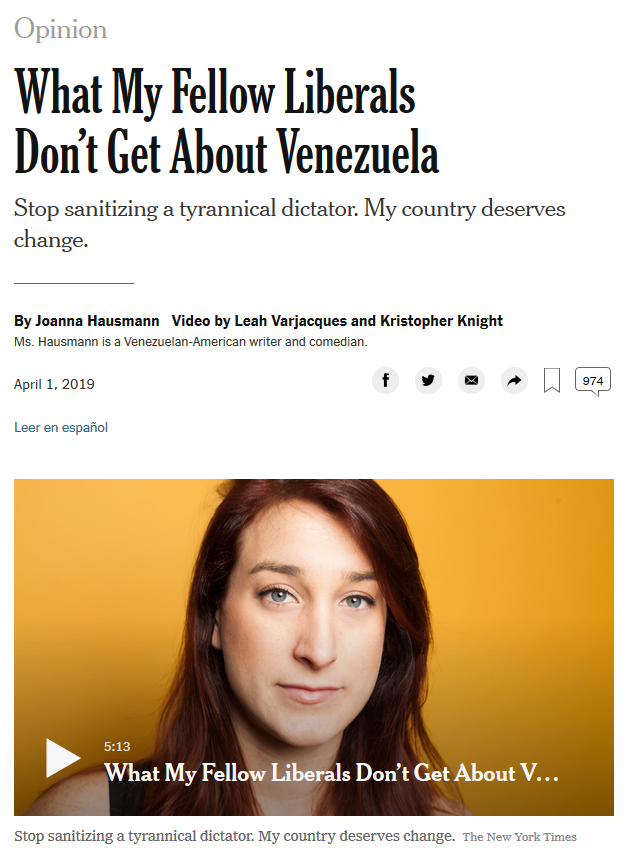
The New York Times (4/1/19) neglected to mention that, unlike most of her “fellow liberals,” Joanna Hausmann is the child of an official in the Venezuelan coup government.

The Times even produced an opinion video (4/1/19) with Joanna Hausmann, “a Venezuelan American writer and comedian,” as she is described in her Times bio.

Between sarcastic stabs at Venezuela’s “tyrannical dictator” and cute animations of “Ruth Bader Ginsburg in workout clothes”—Hausmann’s self-described “spirit animal”—come more serious declarations about the nation’s political situation:

“Juan Guiadó is not an American right-wing puppet leading an illegitimate coup, but a social democrat appointed by the National Assembly, the only remaining democratically elected institution left in Venezuela…. Let’s provide humanitarian aid and support efforts to restore democracy.

Odd that the Times didn’t find it necessary to note a blaring conflict of interest: Hausmann’s father is Ricardo Hausmann, Juan Guaidó’s appointed Inter-American Development Bank representative. Mint Press News (3/19/19) bluntly described him as the “neoliberal brain behind Juan Guaidó’s neoliberal agenda.”

It would be ludicrous to think the Times would withhold as blatant a connection to Maduro if one of his aides’ daughters made a snarky opinion video calling Juan Guaidó a would-be “brutal dictator”—even if our theoretical commentator was “an independent adult woman who has built a popular following on her own,” as Times opinion video producer Adam Ellick said in defense of the omission. Such a crucial relationship to a powerful Chavista politician would never go undisclosed—in the unlikely event that such a perspective would be tolerated in the opinion pages of an establishment paper.

These are just a few of many media pundits’ endorsements of Guaidó—someone whose name most of the Venezuelan population did not even recognize before he declared himself interim president. Put more accurately, they are endorsements of a US-backed coup attempt.

One of the more muddled regime change endorsements came from Rep. Ro Khanna’s Post op-ed (1/30/19), in which he says no! to military intervention, no! to sanctions, yet yes! to… “diplomatic efforts”:

“The United States should lend its support to diplomatic efforts to find some form of power-sharing agreement between opposition parties, and only until fair elections can take place, so that there is an orderly transition of power.

“Diplomatic” is a reassuring term, until you realize that US diplomacy, as FAIR’s Janine Jackson explained on Citations Needed podcast (3/20/19), is “diplomacy where we try to get other countries to do what we want them to do”—in this case, effecting a “transition of power” in another country’s government.


By viewing Venezuela through the lens of Russiagate, Fareed Zakaria (Washington Post, 3/28/19) was able to present backing an attempted coup as a pro-Resistance™ position.

Francisco Rodríguez and Jeffrey D. Sachs (New York Times, 2/2/19) envision similar efforts for a “peaceful and negotiated transition of power,” and Khanna made sure to characterize Maduro as “an authoritarian leader who has presided over unfair elections, failed economic policies, extrajudicial killings by police, food shortages and cronyism with military leaders.”

In other words, Maduro the Dictator must be overthrown—but don’t worry, the US would be diplomatic about it.

Those that didn’t take explicit positions nonetheless wrote articles blaming all or most of Venezuela’s woes on Maduro and Chávez. Economics wiz Paul Krugman (New York Times, 1/29/19) gave his spiel:

“Hugo Chávez got into power because of rage against the nation’s elite, but used the power badly. He seized the oil sector, which you only do if you can run it honestly and efficiently; instead, he turned it over to corrupt cronies, who degraded its performance. Then, when oil prices fell, his successor tried to cover the income gap by printing money. Hence the crisis.

Note that Krugman failed to mention the 57 percent reduction in extreme poverty that followed Chávez’s replacement of management of the state-owned oil industry (which has been nationalized since 1976, long before Chavismo). Nor does he acknowledge the impact of US sanctions, or any other sort of US culpability for Venezuela’s economic crisis.

Caroline Kennedy and Sarah K. Smith (Washington Post, 2/5/19) did not explicitly blame Maduro and Chávez for Venezuela’s “spiral downward,” but similarly ignored evidenced US involvement in that spiral. There are only so many places where you can point fingers without naming names.

Dictatorship-talk—writers lamenting the horrific and helpless situation under an alleged “dictator”—characterized many of the ambiguous and no-position articles. In the Post (1/24/19), Megan McArdle asked:

“You have to look at Venezuela today and wonder: Is this what we’re seeing, the abrupt end of Venezuela’s years-long economic nightmare? Has President Nicolás Maduro’s ever-more-autocratic and incompetent regime finally completed its long pilgrimage toward disaster?

By simply describing the declining situation of a country (Times, 2/12/19, 4/1/19) and using words like “regime” (Times, 2/14/19), “authoritarian” (Post, 1/29/19) and, of course, “dictatorship” (Post, 1/23/19; Times, 2/27/19) in reference to government officials, commentators create the pretext for regime change without explicitly endorsing it.

The Sunday talkshows and NewsHour also couldn’t find a single person to challenge the anti-Maduro narrative. They did find room, however, for three of the most passionate advocates of regime change in Venezuela: Sen. Marco Rubio (Meet the Press, 1/27/19), Donald Trump (Face the Nation, 2/3/19) and Guaidó himself (NewsHour, 2/18/19).

Other TV regime change proponents included Florida Sen. Rick Scott (Meet the Press, 2/3/19), 2020 Democratic presidential hopefuls Peter Buttigieg (This Week, 2/3/19) and Amy Klobuchar (Meet the Press, 3/17/19), Sen. Tim Kaine (Face the Nation, 3/17/19), and Guaidó-appointed, Mike Pence-approved “chargé d’affaires” Carlos Vecchio (NewsHour, 3/4/19).

But leave it to Nick Schifrin of the NewsHour (1/30/19) to bring on “two views” of the US intervention question that are both pro-regime change and pro-US intervention. View No. 1 came from Isaias Medina, a former Venezuelan diplomat who resigned from his post in protest against Maduro. Medina made the unlikely claim that 94 percent of the Venezuelan population—or 129 percent of the population over the age of 14—support US intervention to overthrow the Maduro government:

Not only I, but 30 million people, support not only the US circumstance, but also the Latin American initiative to restore the rule of law, democracy and freedom in Venezuela.


The PBS NewsHour (1/30/19) had a debate over intervention in Venezuela where the “anti” side saw the US’s goal as “assist[ing] the Venezuelan people [to] promote a peaceful transition in Venezuela.”

View No. 2, the ostensibly anti-regime change take, came from Benjamin Gedan, who served on the Obama administration’s National Security Council as director for Venezuela and the Southern Cone.

When asked if he supported Trump’s moves to sanction Maduro and possibly use US troops to oust him, Gedan responded:

“I think both of those steps are problematic. I think the sense of urgency that the United States administration has shown is absolutely correct…. The question is, how can we assist the Venezuelan people [to] promote a peaceful transition in Venezuela, without harming the people themselves, or fracturing the coalition that we have built over two administrations?

In other words, how can we overthrow the Venezuelan government without destroying the country—or “fracturing the coalition we have built”? The US has many options on the table, but none of them involve not pursuing the overthrow of Maduro.

In the “no position” camp for TV news, New York Times chief Washington correspondent David Sanger (Face the Nation, 1/27/19) noted that the problem with US support for Guaidó is one of “both history and inconsistency”:

“Our history in Latin America of intervening is a pretty ugly one, and the inconsistency of not applying the same standards to places like Saudi Arabia and Egypt, where the president has embraced strong men, I think may come back to make the United States look pretty hypocritical, not for the first time.

Sanger indulged in the popular “hypocrisy takedown”: The problem, as presented, isn’t that the US disrupts democracies, destroys economies and kills people, but rather that it does so inconsistently. While vaguely acknowledging the US’s horrific track record of Latin American interventions, and Trump’s cherry-picking of governments worthy of regime change, Sanger didn’t take the logical next step of calling for the US to keep its hands off Venezuela.

Instead, he called Maduro’s supporters—defined as “China, Russia and Cuba”—“not a great collection,” and failed to push back against the claim that Maduro “fixed the last” election. Without a formal declaration, Sanger did all the ideological preparation for foreign-backed regime change.

That elite media didn’t find a single person to vouch for Maduro or Chavismo, and that almost all the opinions explicitly or implicitly expressed support for the ouster of Venezuela’s elected president, demonstrates a firm editorial line, eerily obedient to the US government’s regime change policy.

This isn’t the first time that FAIR (e.g., 3/18/03, 4/18/18) has found a one-sided debate in corporate media on US intervention. When it comes to advocating the overthrow of the US government’s foreign undesirables, you can always count on opinion pages to represent all sides of why it’s a good thing. And the millions of people who beg to differ? Well, they’re just out of the question.

Victorian Justice: British Court Doubles Down on Assange Bail Sentence

Assange Sentenced 50 Weeks For Bogus Bail Charge

by Caitlin Johnstone - Rogue Journalist


May 2, 2019

Following seven years of imprisonment at the Ecuadorian embassy fighting US extradition, WikiLeaks founder Julian Assange has been sentenced to 50 weeks behind bars for an entirely bogus bail charge. Sky News reporter Jordan Milne live-tweeted events as they unfolded, reporting that Assange’s defense argued that his fears of rendition and torture at the hands of the US government were well-founded.

His life in the Ecuadorian embassy and the physical and psychological detriments which came with it were described, including deteriorated health and depression.

The judge rejected his entire defense and delivered nearly the harshest sentence possible.

“Your continued residence in the Embassy has necessitated a concentration of resources, and expenditure of £16 million of taxpayers’ money in ensuring that when you did leave, you were brought to justice,” Judge Deborah Taylor told Assange upon his sentencing.

This is bullshit. Assange’s residency at the embassy never cost taxpayers a penny; it was the British government’s decision to pour money into patrolling the embassy around the clock with police who had orders to arrest Assange on sight over a petty bail charge. It was the British government’s decision to persuade the Swedish government not to drop its investigation in 2013 so that it could pursue the agenda to arrest Assange for US extradition.

Assange’s residency didn’t cost British taxpayers anything; the agenda to imprison and extradite a journalist for publishing facts is what cost taxpayers £16 million. There is one reason and one reason only that the British government saw fit to spend £16 million of taxpayers’ money patrolling that embassy, and it wasn’t because they really, really hate bail violations.

No, the one and only reason the UK government found it reasonable to invest £16 million in patrolling the Ecuadorian embassy is because it had an agenda to help the US war machine punish someone who embarrassed it. And now the cost of that UK government agenda is being used to justify nearly a year behind bars after years of arbitrary detention.

“Julian Assange’s sentence, for seeking and receiving asylum, is twice as much as the sentencing guidelines,” WikiLeaks tweeted.
“The so-called speedboat killer, convicted of manslaughter, was only sentenced to six months for failing to appear in court.”

The bail charge itself is entirely illegitimate. As scholar and WikiLeaks advocate Simon Floth explains, under British law bail is only legally breached if there’s a failure to meet bail “without reasonable cause”, which the human right to seek asylum certainly is. The UK itself was clearly unconvinced of its own authority to charge someone who was under political asylum for jumping bail, waiting a full nine days before issuing an arrest warrant in 2012.

After the Swedish government decided to drop its sexual assault investigation in 2017 without issuing any charges, Assange’s legal team attempted last year to get the warrant dropped. The judge in that case, Emma Arbuthnot, just happens to be married to former Tory junior Defence Minister and government whip James Arbuthnot, who served as director of Security Intelligence Consultancy SC Strategy Ltd with a former head of MI6. Arbuthnot denied Assange’s request with extreme vitriol, despite his argument that British law does have provisions which allow for the time he’d already served under house arrest to count toward far more time than would be served for violating bail.

All this of course pales in comparison to the far more grave threat Assange faces tomorrow, when his hearing for US extradition begins.

The US charge accompanying Assange’s extradition request is even more bogus than the bail charge; a re-interpretation of standard journalistic practices like source protection to create a charge which the Obama administration declined to prosecute based on the same evidence for fear of endangering press freedoms.

Assange is charged with “conspiring” to help Chelsea Manning avoid detection while leaking evidence of US war crimes and malfeasance, which is something any investigative journalist who publishes leaks would do. The charge is a bunch of words designed to twist standard journalistic practices into just enough of a crime to get Assange onto US soil for “non-political” reasons.

As Pentagon Papers lawyer James Goodale explains, “Under the U.S.-U.K. extradition treaty, one cannot be extradited from the United Kingdom if the extradition is for ‘political purposes.'” Once he’s on US soil, far more serious charges may be added that are of a very political nature indeed. If that happens, Assange will not be spending the five years behind bars for computer offenses that his current charge allows, he’ll be spending decades.

“I don’t think Julian is looking at five years in prison, I think he’s probably looking at 50 years in prison,” said CIA whistleblower John Kiriakou, adding, “I think that there are many more charges to be considered for Julian. I would expect a superseding indictment, possibly to include espionage charges.”


There is simply no such thing as a fair national security trial in the Eastern District of Virginia, which is where Assange will be heading if extradited to the US.

“No national security defendant has ever won a case in the EDVA,” Kiriakou told RT upon Assange’s arrest.

“In my case, I asked Judge Brinkema to declassify 70 documents that I needed to defend myself. She denied all 70 documents. And so I had literally no defense for myself and was forced to take a plea.”

“He will not, he cannot get a fair trial,” Kiriakou said on a Unity4J vigil when Assange was still at the embassy.

“It’s impossible, because the deck is stacked. And everybody knows what’s gonna happen if he comes back to the Eastern District of Virginia. This is the same advice I gave Ed Snowden: don’t come home, because you can’t get a fair trial here. Julian doesn’t have the choice, and that’s what frightens me even more.”

This is why it’s imperative for everyone who stands for truth, press freedoms or government accountability to oppose this extradition request tooth and claw, wherever they’re at in the world. Australians should be pushing their government to intercede against US extradition, Britons should be doing the same, and Americans should be pushing their government not to extradite. It’s too late to keep Assange from being pried loose from the embassy and imprisoned by the UK, so now we need to put all our energy into keeping Assange out of the clutches of the same government which tortured Chelsea Manning.

Go to demonstrations, make phone calls to your local representatives, donate get posters spread around Australia, write letters to the editor, and share information about what’s going on with your friends and family and anyone you can. We can’t rely on the legal system to sort this one out, because, as we’ve seen today, the legal system can very easily be manipulated to serve the interests of the powerful.

________________________

Everyone has my unconditional permission to republish or use any part of this work (or anything else I’ve written) in any way they like free of charge. My work is entirely reader-supported, so if you enjoyed this piece please consider sharing it around, liking me on Facebook, following my antics on Twitter, throwing some money into my hat on Patreon or Paypal, purchasing some of my sweet merchandise, buying my new book Rogue Nation: Psychonautical Adventures With Caitlin Johnstone, or my previous book Woke: A Field Guide for Utopia Preppers. The best way to get around the internet censors and make sure you see the stuff I publish is to subscribe to the mailing list for my website, which will get you an email notification for everything I publish. For more info on who I am, where I stand, and what I’m trying to do with this platform, click here.


Bitcoin donations:
1Ac7PCQXoQoLA9Sh8fhAgiU3PHA2EX5Zm2

Coup de Farce: The Venezuelan Uprising That Did Not

A Desperate Empire Crashes in Venezuela

by Maximilian C. Forte - ZeroAnthroplogy


May 2, 2019

The April 30, 2019, coup attempt in Venezuela has come and gone. The coup has failed


Failed state” theory just got a lot more complicated. No longer can the “failed state” designation apply only to those states targeted for recolonization after a prolonged period of destabilization and foreign intervention. Now “failed state” theory has to apply to a degenerate imperial state at its wit’s end, and to the failure of its proxies on the ground, as well as the failure of its invented political fictions to materialize.

Even worse than any “failed state,” is the failure of aspirants to power who pretend to have power—namely, the incompetent Venezuelan opposition activist, Juán Guaidó. It’s time that even the few critical media outlets left stop dignifying Guaidó, opposition activist, with the title of self-declared “interim president,” because even that is too grandiose.

This so-called “interim president” is, by the tortured logic of Elliot Abrams, the president of an interim that has not yet begun. So that means he is not the interim president even. Or, he was the interim president, but his 30-day term (as specified by the Constitution), expired months ago. Or, he is still the interim president, but only if a defunct opposition body, that calls itself the National Assembly, believes it has the authority to unilaterally overwrite the Constitution—it does not, so he is still not even a self-declared interim president. This is what the US wants the world to recognize as “interim president”: a total fiction that cannot be sustained without reference to other fictions.

This bundle of fictions has not even been wielded by people who have the good sense to know when it’s time to shut up. No, instead the authors of these inventions spin even more, as if wanting to be spotted in all their foolishness.

So we had the US government almost triumphantly declaring that it was withdrawing US diplomats from Venezuela—when Venezuela’s government was the one that ordered them out.

Then we had US officials rejoice that Venezuela’s representatives had been expelled from the Organization of American States—when Venezuela already declared it was withdrawing from the OAS two years ago, and this month marked the final step in the process.

Then we had the US State Department pretend that it could hand the Venezuelan Embassy in Washington, DC, over to representatives of an interim president of an interim that had not even started, or that already ended. One has to really have faith in the stupidity of audiences, and be unflinching about treating everyone as idiots, to mount such an absurd production in public. It also means that they literally have no shame.


Impressive “uprising” you have there.

As a bad work of fiction, Guaidó could not mount even a lame imitation of a military-backed coup on April 30, which is just the latest in a long line of his failures this year. This character, unknown to 80% of Venezuelans a few months ago, leader of a minority party in a defunct parliament, who never campaigned for the presidency and was never elected to it—this same character posed in front of cameras and claimed military backing which he never had. So he calls on the resources of a hostile foreign power in the vain hope it make his fiction reality, clearly showing he understands nothing at all. Even worse: it shows a total lack of any care for all those who would suffer and die in war—Guaidó is ready to sacrifice them all. It’s an ill bird that fouls its own nest.

The response to Guaidó’s call? A few hundred violent protesters showed up, traded rocks with the Bolivarian National Guard, and then stood around talking to each other for hours on end. John Bolton, pushing US intervention in the name of keeping Venezuela free of external dominance (he knows no irony), even tried to nudge Venezuelans in a pitiful attempt at bribery, promising US economic relief if Guaidó took power. As far as attempted coups go, this was fortunately among the most pathetic, lame farces.

There is now no resemblance between Venezuela 2019 and Libya 2011, where in the latter case opponents actually seized towns and cities and mounted protests that lasted days on end. What remains the same in the two cases is the determination of the US to implement through violent proxies a fiction of rule.

One also has to wonder how John Bolton, Mike Pompeo, and Elliot Abrams still have jobs today. Trump is not a tower of managerial business acumen after all—if one ever believed the fiction constituting his performance on The Apprentice. Bolton, who was most prominent during the April 30 coup farce, could not even keep himself from tripping over his own excremental attempt at a “narrative”.

First, John Bolton called on the Venezuelan military to side with Guaidó—but then invalidated his call, turning around and asserting that, in any case, Venezuela was under (imaginary) Cuban occupation, and it was Cuban troops who were really in charge. So everything fell apart…because of Cuba, and thus Trump threatened Cuba with an embargo, which it has already been under for six decades. Cuba was the fiction used to mask another fiction—the only thing that was real here was how utterly ridiculous US empire has become.


All the action, caught live on camera.

On the night of April 30, as I often do I listened to live radio from Caracas, where the assembled panelists spent a good amount of time engaged in the healthiest, most robust guffawing I have heard in ages. The subject of their laughter? Erik Prince, the war criminal who headed BlackWater and is now begging Trump for cash in return for a “plan”—a plan to send a grand total of 5,000 mercenaries to Venezuela.

On RNV radio they wondered if the Americans had really become so stupid and psychotic to think that 5,000 clowns could take and hold so much as a bakery in a country which has 2,000,000 armed citizens in militias alone, not counting the hundreds of thousands in the armed forces and the paramilitary police. Apparently Prince mixed up Venezuela with Grenada—and even in Grenada it took US Marines a week to subdue armed opposition from a comparatively tiny group of diehard patriots.

Nothing is working for the US, not even what might be the most extreme sanctions ever imposed, and weeks of power outages. Certainly, none of the “humanitarian” theatre worked, whether it was the forced “aid” stunt, or the myth that Venezuelan troops set their fake aid on fire. The US was forced to imagine and fantasize about Maduro fleeing the country: witness Mike Pompeo’s bout of deranged lying about Maduro getting on a plane to Cuba, until Russia stopped him.

Fictions, lies, propaganda, disinformation, fake news. To top it all off, the news came: this was not even a coup, you see. The real problem here, with such a monumental loss of face, in such a magnificent failure as April 30, is that the US will turn to even more desperate and thus more dangerous measures. However, that comes at a real cost: if the US invades, Trump has to go into an electoral contest with a new war on his back, and it’s not like such a war would come even close to a “cake walk”.

One has to wonder: will those national leaders who—without the authorization of their citizens—unilaterally “recognized” Guaidó as this so-called “interim president” thing, now take stock finally? Or will they cling to this science-fiction that there is a popular movement opposing Nicolás Maduro’s legitimate and very real government?

Clearly, very clearly as it was televised live worldwide all day on April 30 for all to see, Guaidó does not lead a popular movement. He has no authority, no legitimacy, and only a paltry amount of futile support. This so-called “uprising” was an embarrassing failure for his own image as a supposed leader. Then he takes shelter and says “tomorrow, more protests”—yes, junior, that will do the trick. Remember, sport, more always works, and besides, “there’s always tomorrow”. Keep at it, son.

This is what practice without theory looks like. This is what a “movement” without support looks like. This is what science-fiction looks like when it tries to escape the theatre and mingle with real people in the street.

Meanwhile, members of the Lima Group such as Canada, and those members of the European Union that have called for a “peaceful transition” in Venezuela, there is a lot for which they must answer. What “democracy” do they think it is where someone, not elected by the people, marshals the forces of violence in an effort to impose a government on a country?


If this were to be done in their countries, would they accept it as democracy? This is the other outrageous fiction that we face: that we in North America live in democratic polities. Democracy should recognize itself in democracy—but when you instead recognize your partner in a violent clutch of putschists, then what are you?