Wednesday, January 01, 2014

Crisis and Democracy: Hogtown Getting the Politics It Deserves

Crisis and Democracy: Hogtown Getting the Politics It Deserves

by C. L. Cook - Gorilla-Radio.com

One of the biggest stories in Canada this year is one continuing even now. The effects of the massive ice storm in Ontario are still being felt in Toronto and environs. The Greater Toronto Area is what we hear most about; but the true extent of the pre-Christmas arctic blast is being felt much farther afield than the GTA. Across eastern Ontario, Quebec, the Maritimes, Michigan and Maine millions are discovering what life without electricity is like; and how miserable and dangerous life without electricity can be in the winter.

In Toronto, the disgraced Mayor Ford, whose fall is a prominent story on other year just past round-up shows itself, has seen his office by-passed for the response to the disaster; a prescient move made by city council just weeks before the storm. Instead, Deputy Mayor, Norm Kelly and the city's emergency management program committee are in charge. It is for Mayor Ford to be the media face for the GTA, and to issue a 'state of emergency' where necessary, something he has so far failed to do.

Ford's nemesis, the Toronto Star newspaper has been busy despite the darkness, asking questions benighted citizens want answered. An article by Star staffers addresses five of those questions; such as: Why were so many people - more than 750,000 estimated in the GTA alone - left in the dark after the storm? And: Why are so many people still without power? Readers also question whether Ice Storm 2013 qualifies as an official "disaster"; and when, if ever, was the last time Toronto was blacked out like this; and who's going to pick up the mounting piles of garbage - especially organic garbage, like spoiled food?

The answers in short are: This is the largest, longest power outage in the city's history; why so many were effected is due to the architecture of the power grid and the increased numbers of people and households in the region, many requiring time-intensive single line repair service, since the last great incident in 1965; and yes, extra crews will be deployed for garbage pick-up, and special provisions will be made for organic household waste.


But is it a disaster?


The Star reports Public Safety Canada's Canadian Disaster Database saying, the disaster designation criterion are: "10 or more people killed; 100 or more people affected/injured/infected/evacuated or homeless; an appeal for national/international assistance; [and] historical significance and significant damage/interruption of normal processes such that the community affected cannot recover on its own." According to these criteria, only the 1999 snowstorm, and a deadly 1944 blizzard that killed 21 people have merited the disaster designation in Toronto's history.

Every year Torontonians freeze to death on the streets of the city. The Star reported the storm's supposed first homeless person killed Friday. Five days previous, a man identified as 'Richard' was found dead outside the doors of the Carlton and Church street Loblaw's. According to the Ontario Coalition Against Poverty, Richard lay on the sidewalk frozen dead even as holiday shoppers walked past him, eager to get the last minute trimmings for Christmas celebrations. OCAP held services for Richard Monday, December 30th in Toronto, and they provide some sobering statistics for the citizens of this northern country, Canada to mull over. OCAP says;

“The average life expectancy of a person who is homeless in Canada is a shocking 39 years old for women, and 46 years old for men. Homeless men are 8 times more likely to die than men of the same age in the general population. These deaths of people well before their time are preventable. The chronic lack of affordable, accessible and safe housing, the lack of an adequate income, the lack of sufficient programs and services, all contribute to the high mortality rates among homeless and underhoused people. As a result of these government decisions to prioritize profit over human lives, our communities experience loss at a rapid rate.”

City councillor Kristyn Wong-Tam believes the city has failed in its response to homelessness, saying;

“We have had so many opportunities to respond, and I don’t think that we have done a good job.”

“We know that the homeless population in Toronto is getting larger and older, so there is a social tsunami coming our way and we need to be much more proactive as we try to address it.” Adding;
“We have a very wealthy city, and yet we have people who are living on our streets. It’s tough, [and] obviously, we can’t look the other way, and yet, thousands of people do. (This man) is our responsibility.”

Toronto averages 2 homeless deaths per week, and the wall of The Homeless Memorial at Church of the Holy Trinity chronicles more than 700 names of those who have died on the city's streets. Certainly enough of these Canadians have been "affected/injured/infected and necessarily evacuated," and many more than 100 have died. And yet, there's no emergency declared here, no disaster designation appeal made nationally or internationally by the powers that be. Meanwhile, Mayor Ford remains adamant in his refusal to declare a state of emergency, saying;

“This is not a state of emergency.” “State of emergency is basically when the whole city is paralyzed, business can’t open, people can’t get out of their houses. We’re not in that situation. We’ve discussed this numerous times and we’re not even close to a state of emergency.”

Clearly, Toronto's crisis goes beyond an ice storm, or a mayor lacking the necessary empathic skills to perform public service; its failing is a citizenry who remain on the sidelines while demagogues play the system like a cheap violin.

When the Laughter Stops: French Gesture to Black Out Dieudonné M’Bala M’Bala

The Bête Noire of the French Establishment

by Diana Johnstone - CounterPunch

Paris - French mainstream media and politicians are starting off the New Year with a shared resolution for 2014: permanently muzzle a Franco-African comedian who is getting to be too popular among young people.

In between Christmas and New Year’s Eve, no less than the President of the Republic, François Hollande, while visiting Saudi Arabia on (very big) business, said his government must find a way to ban performances by the comedian Dieudonné M’Bala M’Bala, as called for by French Interior Minister, Manuel Valls.

The leader of the conservative opposition party, UMP, Jean-François Copé, immediately chimed in with his “total support” for silencing the unmanageable entertainer.

In the unanimous media chorus, the weekly Nouvel Observateur editorialized that Dieudonné is “already dead”, washed up, finished. Editors publicly disputed whether it was a better tactic to try to jail him for “incitement to racial hatred”, close his shows on grounds of a potential “threat to public order”, or put pressure on municipalities by threatening cultural subsidies with cuts if they allow him to perform.

The goal of national police boss Manuel Valls is clear, but the powers that be are groping for the method.

The dismissive cliché heard repeatedly is that “nobody laughs at Dieudonné any more”.

In reality, the opposite is true. And that is the problem. On his recent tour of French cities, videos show large, packed theaters roaring with laughter at their favorite humorist. He has popularized a simple gesture, which he calls the “quenelle”. It is being imitated by young people all over France. It simply and obviously means, we are fed up.

To invent a pretext for destroying Dieudonné, the leading Jewish organizations CRIF (Conseil Représentatif des Institutions Juives de France, the French AIPAC) and LICRA (Ligue internationale contre le racisme et l’antisémitisme, which enjoys special privileges under French law) have come up with a fantasy to brand Dieudonné and his followers as “Nazis”. The quenelle is all too obviously a vulgar gesture roughly meaning “up yours”, with one hand placed at the top of the other arm pointing down to signify “how far up” this is to be.

But for the CRIF and LICRA, the quenelle is “a Nazi salute in reverse”. (You can never be too “vigilant” when looking for the hidden Hitler.)

As someone has remarked, a “Nazi salute in reverse” might as well be considered anti-Nazi. If indeed it had anything to do with Heil Hitler. Which it clearly does not.

But world media are taking up this claim, at least pointing out that “some consider the quenelle to be a Nazi salute in reverse”. Never mind that those who use it have no doubt about what it means: F— the system!

But to what extent are the CRIF and LICRA “the system”?

France Needs All the Laughter It Can Get


French industry is vanishing, with factory shutdowns week after week. Taxes on low income citizens are going up, to save the banks and the euro. Disillusion with the European Union is growing. EU rules exclude any serious effort to improve the French economy. Meanwhile, politicians on the left and the right continue their empty speeches, full of clichés about “human rights” – largely as an excuse to go to war in the Middle East or rant against China and Russia. The approval rating of President Hollande has sunk to 15%. However people vote, they get the same policies, made in EU.

Why then are the ruling politicians focusing their wrath on “the most talented humorist of his generation” (as his colleagues acknowledge, even when denouncing him)?

The short answer is probably that Dieudonné’s surging popularity among young people illustrates a growing generation gap. Dieudonné has turned laughter against the entire political establishment. This has led to a torrent of abuse and vows to shut down his shows, ruin him financially and even put him in jail. The abuse also provides a setting for physical attacks against him. A few days ago, his assistant Jacky Sigaux was physically attacked in broad daylight by several masked men in front of the city hall of the 19th arrondissement – just opposite the Buttes Chaumont Park. He has lodged a complaint.

But how much protection is to be expected from a government whose Interior Minister, Manuel Valls – in charge of police – has vowed to seek ways to silence Dieudonné?

The story is significant but is almost certain to be badly reported outside France – just as it is badly reported inside France, the source of almost all foreign reports. In translation, a bit of garbling and falsehoods add to the confusion.

Why Do They Hate Him?


Dieudonné M’Bala M’Bala was born in a Paris suburb nearly 48 years ago. His mother was white, from Brittany, his father was African, from Cameroun. This should make him a poster child for the “multiculturalism” the ideologically dominant left claims to promote. And during the first part of his career, teaming up with his Jewish friend, Elie Simoun, he was just that: campaigning against racism, focusing his criticism on the National Front and even running for office against an NF candidate in the dormitory town of Dreux, some sixty miles West of Paris, where he lives. Like the best humorists, Dieudonné always targeted current events, with a warmth and dignity unusual in the profession. His career flourished, he played in movies, was a guest on television, branched out on his own. A great observer, he excels at relatively subtle imitations of various personality types and ethnic groups from Africans to Chinese.

Ten years ago, on December 1, 2003, as guest on a TV show appropriately called “You Can’t Please Everybody”, dedicated to current events, Dieudonné came on stage roughly disguised as “a convert to Zionist extremism” advising others to get ahead by “joining the American-Israeli Axis of Good”. This was in the first year of the US assault on Iraq, which France’s refusal to join had led Washington to rechristen what it calls “French fries” (Belgian, actually) as “Freedom fries”. A relatively mild attack on George W. Bush’s “Axis of Evil” seemed totally in the mood of the times. The sketch ended with a brief salute, “Isra-heil”. This was far from being vintage Dieudonné, but nevertheless, the popular humorist was at the time enthusiastically embraced by other performers while the studio audience gave him a standing ovation.

Then the protests started coming in, especially concerning the final gesture seen as likening Israel to Nazi Germany.

“Anti-Semitism!” was the cry, although the target was Israel (and the United States as allies in the Middle East). Calls multiplied to ban his shows, to sue him, to destroy his career. Dieudonné attempted to justify his sketch as not targeting Jews as such, but, unlike others before him, would not apologize for an offense he did not believe he had committed. Why no protests from Africans he had made fun of? Or Muslims? Or Chinese? Why should a single community react with such fury?

Thus began a decade of escalation. LICRA began a long series of lawsuits against him (“incitement to racial hatred”), at first losing, but keeping up the pressure. Instead of backing down, Dieudonné went farther in his criticism of “Zionism” after each attack. Meanwhile, Dieudonné was gradually excluded from television appearances and treated as a pariah by mainstream media. It is only the recent internet profusion of images showing young people making the quenelle sign that has moved the establishment to conclude that a direct attack would be more effective than trying to ignore him.

The Ideological Background


To begin to understand the meaning of the Dieudonné affair, it is necessary to grasp the ideological context. For reasons too complex to review here, the French left – the left that once was primarily concerned with the welfare of the working class, with social equality, opposition to aggressive war, freedom of speech – has virtually collapsed. The right has won the decisive economic battle, with the triumph of policies favoring monetary stability and the interests of international investment capital (“neo-liberalism”). As a consolation prize, the left enjoys a certain ideological dominance, based on anti-racism, anti-nationalism and devotion to the European Union – even to the hypothetical “social Europe” that daily recedes into the cemetery of lost dreams. In fact, this ideology fits perfectly with a globalization geared to the requirements of international finance capital.

In the absence of any serious socio-economic left, France has sunk into a sort of “Identity Politics”, which both praises multiculturalism and reacts vehemently against “communitarianism”, that is, the assertion of any unwelcome ethnic particularisms. But some ethnic particularisms are less welcome than others. The Muslim veil was first banned in schools, and demands to ban it in adult society grow. The naqib and burka, while rare, have been legally banned. Disputes erupt over Halal foods in cafeterias, prayers in the street, while cartoons regularly lampoon Islam. Whatever one may think of this, the fight against communitarianism can be seen by some as directed against one particular community. Meanwhile, French leaders have been leading the cry for wars in Muslim countries from Libya to Syria, while insisting on devotion to Israel.

Meanwhile, another community is the object of constant solicitude. In the last twenty years, while religious faith and political commitment have declined drastically, the Holocaust, called the Shoah in France, has gradually become a sort of State Religion. Schools commemorate the Shoah annually, it increasingly dominates historical consciousness, which in other areas is declining along with many humanistic studies. In particular, of all the events in France’s long history, the only one protected by law is the Shoah. The so-called Gayssot Law bans any questioning of the history of the Shoah, an altogether unprecedented interference with freedom of speech. Moreover, certain organizations, such as LICRA, have been granted the privilege of suing individuals on the basis of “incitement to racial hatred” (very broadly and unevenly interpreted) with the possibility of collecting damages on behalf of the “injured community”. In practice, these laws are used primarily to prosecute alleged “anti-Semitism” or “negationism” concerning the Shoah. Even though they frequently are thrown out of court, such lawsuits constitute harassment and intimidation. France is the rare country where the BDS (Boycott, Divestment, Sanctions) movement against Israeli settlement practices can also be attacked as “incitement to racial hatred”.

The violence-prone Jewish Defense League, outlawed in the United States and even in Israel, is known for smashing books shops or beating up isolated, even elderly, individuals. When identified, flight to Israel is a good way out. The victims of the JDL fail to inspire anything close to the massive public indignation aroused when a Jewish person falls victim to wanton violence. Meanwhile, politicians flock to the annual dinner of the CRIF with the same zeal that in the United States they flock to the dinner of AIPAC – not so much for campaign funds as to demonstrate their correct sentiments.

France has the largest Jewish population in Western Europe, which actually largely escaped the deportation during German occupation that expelled Jewish immigrants to concentration camps. In addition to an old, established Jewish population, there are many newcomers from North Africa. All this adds up to a very dynamic, successful population, numerous in the more visible and popular professions (journalism, show business, as well as science and medicine, among others).

Of all French parties, the Socialist Party (especially via the Israeli Labor Party of Shimon Peres in the Socialist International) has the closest historic ties with Israel. In the 1950s, when France was fighting against the Algerian national liberation movement, the French government (via Peres) contributed to the Israeli project of building nuclear weapons. Today it is not the Labor Party that rules Israel, but the far right. Hollande’s recent cozy trip to Benjamin Netanyahu showed that the rightward drift of policy in Israel has done nothing to strain relations – which seem closer than ever.

Yet this Jewish community is very small compared to the large number of Arab immigrants from North Africa or black immigrants from France’s former colonies in Africa. Several years ago, a leading Socialist Party intellectual, Pascal Boniface, cautiously warned party leaders that their heavy bias in favor of the Jewish community could eventually cause electoral problems. This statement in a political assessment document caused an uproar which nearly cost him his career.

But the fact remains: it is not hard for French people of Arab or African background to feel that the “communitarianism” that really has clout is the Jewish community.

The Political Uses of the Holocaust


Norman Finkelstein showed some time ago that the Holocaust can be exploited for less than noble purposes: such as extorting funds from Swiss banks. However, in France the situation is very different. No doubt, constant reminders of the Shoah serve as a sort of protection for Israel from the hostility aroused by its treatment of the Palestinians. But the religion of the Holocaust has another, deeper political impact with no direct relation to the fate of the Jews.

More than anything else, Auschwitz has been interpreted as the symbol of what nationalism leads to. Reference to Auschwitz has served to give a bad conscience to Europe, and notably to the French, considering that their relatively small role in the matter was the result of military defeat and occupation by Nazi Germany. Bernard-Henri Lévy, the writer whose influence has grown to grotesque proportions in recent years (he led President Sarkozy into war against Libya), began his career as ideologue by claiming that “fascism” is the genuine “French ideology”. Guilt, guilt, guilt. By placing Auschwitz as the most significant event of recent history, various writers and speakers justify by default the growing power of the European Union as necessary replacement for Europe’s inherently “bad” nations. Never again Auschwitz! Dissolve the nation-states into a technical bureaucracy, free of the emotional influence of citizens who might vote incorrectly. Do you feel French? Or German? You should feel guilty about it – because of Auschwitz.

Europeans are less and less enthusiastic about the EU as it ruins their economies and robs them of all democratic power over the economy. They can vote for gay marriage, but not for the slightest Keynesian measure, much less socialism. Nevertheless, guilt about the past is supposed to keep them loyal to the European dream.

Dieudonné’s fans, judging from photographs, appear to be predominantly young men, fewer women, mostly between the ages of twenty and thirty. They were born two full generations after the end of World War II. They have spent their lives hearing about the Shoah. Over 300 Paris schools bear a plaque commemorating the tragic fate of Jewish children deported to Nazi concentration camps. What can be the effect of all this? For many who were born long after these terrible events, it seems that everyone is supposed to feel guilty – if not for what they didn’t do, for what they supposedly might do if they had a chance.

When Dieudonné transformed an old semi-racist “tropical” song, Chaud Cacao, into Shoah Ananas, the tune is taken up en masse by Dieudonné fans. I venture to think that they are not making fun of the real Shoah, but rather of the constant reminders of events that are supposed to make them feel guilty, insignificant and powerless. Much of this generation is sick of hearing about the period 1933-1945, while their own future is dim.

Nobody Knows When to Stop


Last Sunday, a famous football player of Afro-Belgian origin, Nicolas Anelka, who plays in the UK, made a quenelle sign after scoring a goal – in solidarity with this friend Dieudonné M’Bala M’Bala. With this simple and basically insignificant gesture, the uproar soared to new heights.

In the French parliament, Meyer Habib represents “overseas French” – some 4,000 Israelis of French origin. On Monday he twittered: “Anelka’s quenelle is intolerable! I will introduce a bill to punish this new Nazi salute practiced by anti-Semites.”

France has adopted laws to “punish anti-Semitism”. The result is the opposite. Such measures simply tend to confirm the old notion that “the Jews run the country” and contribute to growing anti-Semitism. When French youth see a Franco-Israeli attempt to outlaw a simple gesture, when the Jewish community moves to ban their favorite humorist, anti-Semitism can only grow even more rapidly.

Yet in this escalation, the relationship of forces is very uneven. A humorist has words as his weapons, and fans who may disperse when the going gets rough. On the other side is the dominant ideology, and the power of the State.

In this sort of clash, civic peace depends on the wisdom of those with most power to show restraint. If they fail to do so, this can be a game with no winners.

Diana Johnstone can be reached at diana.johnstone@wanadoo.fr

'Cast Lead' Five Years After: Gaza Writes Back

Five Years After the Cast Lead Operation, Gaza Writes Back

by M. Lynx Qualey - ArabLit

It was five years ago that Cast Lead began. Now a book of short stories, Gaza Writes Back, marks the anniversary. The book’s editor, Refaat Alareer, answers questions about the collection:

ArabLit: How did the idea for this collection come about? How did you put out the call for submissions? Did you tell the writers it was to commemorate Cast Lead?

Refaat Alareer: I’ve been teaching World Literature and Creative Writing at the Islamic University-Gaza (IUG), and at other Gaza training centres, ever since I finished my MA in Comparative Literature from UCL, UK in 2007. And I always had the idea of collecting the best pieces written by my students in a book. Going global became a necessity after the hateful Israeli Offensive of 2008-09.

I met Helena Cobban in Gaza and threw the idea of a book of young talents into her lap, and later, thanks to Annie Robbins of Mondoweiss.net, Helena saw the potential in the project. In October 2012, Helena and I discussed a number of possible book projects and later decided a book of short fiction is the best place to start.

Since many of the writers are my own students (and friends), I contacted them and informed them of the idea of a book to mark the fifth anniversary of Cast Lead. We had a couple of fruitful workshops, and I took many of their suggestions into consideration. Later, I announced the project through Facebook, Twitter, local universities in Gaza, and personal contacts.

You should know that maybe only four stories were written in order to be submitted to the book. Many had already been written a year, two, or even three before I asked for submissions. But all pieces were written after the Cast Lead Operation.

I received tens of submissions (around 70!), and with the help of Sarah Ali, Sameeha Elwan, and Diana Ghazzawi, we managed, with difficulty, to narrow them down to 23 stories by 15 writers. Choosing the 23 stories was one of the toughest things I have ever done, because there were many more stories with strong potential.

AL: You say, in the introduction, that you wanted this collection to be “without the mediation or influences of translation or of non-Palestinian voices.” Why without translation? Are there particular effects of translation (on literature) that you’ve seen that you were trying to avoid?

RA: As much as I believe in the importance of translation, when it comes to literature I strongly believe many things get lost in translation, no matter how accurate. Therefore, our efforts were directed at improving the English creative writing skills. So that the writers think in English and express themselves in English. Also, the book comes to encourage and give a nudge to those who write in English, as that will enable them to write more and be in touch and in dialogue with the whole world. Maybe in the future we can work on a book of stories originally written in Arabic.

AL: Why young writers?

RA: Because they have a lot to say. Because they are doing most of the work these days. Because they are leading all the campaigns to make the world aware of the ills and pains Israeli occupation is bringing on Palestinians. Because young people have their worldviews and visions that are worthy of being heard. Because there are many more young Palestinians who write in English that old ones. And because the young have largely been marginalised from mainstream discussions.

AL: It’s interesting that so many of the young writers are women. Do you think this is particular to those who write in English?

RA: This is particular to those who write in English and in Arabic as well. In Palestine, we have more women joining universities than men, more women journalists than men, more women activists than men. Women are in many ways taking the lead, in writing, in activism, and in struggle.

AL: You quoted Sameeha Elwan, in the introduction, in saying that the Internet has changed the storytelling process among Palestinians (who have been fragmented since ’48). Will this collection somehow make use of the Internet? Will any of the stories appear online?
The encouragement the writers received from people in Palestine and all over the world was a catalyst for more writing. That means without the internet, many of the pieces could have been forgotten or not written in the first place.

RA: Much of the support for the young writers came through the internet. They first started by posting their creative pieces in forums, and personal blogs, and Facebook, and then Mondoweiss, the Electronic Intifada, the Palestine Chronicle and other websites. The encouragement the writers received from people in Palestine and all over the world was a catalyst for more writing. That means without the internet, many of the pieces could have been forgotten or not written in the first place. Social media platforms have been the major battlefields in the recent years. Facebook pages, YouTube Videos, and Twitterstorms have brought awareness about the Israeli occupation and human rights violation and about the suffering of Palestinians in Jerusalem/Gaza areas occupied in 1948 and the West Bank. Currently, we are very much depending on social media to promote the book and raise awareness about Palestine.

I think with permission from the publisher, certain extracts from the stories can appear online (some already did).

But other than that, we hope that some of the pieces can be made into films or short videos.

AL: One of the PalFest authors, who has taught workshops in both Gaza (by video link) and the West Bank, has said that — because of life, and life-and-death issues — it’s generally been difficult for talented young authors to follow through on writing projects. Do you find that’s true of young authors in Gaza?

RA: To some extent, when it comes to online courses or tutoring, it’s true. Imagine yourself not having electricity for most of the day! However, in the many courses I held in Gaza, there were a lot who joined and benefited from the creative writing sessions such as short story writing, poetry writing, and general creative-writing skills.

Israel is making it very difficult for Palestinians to live a decent life. Israel has caused every possible hindrance to prevent Palestinians from being. Still, that very same thing was the very cause that led many to write back. For many of us, writing is an act of resistance, but it is also an act of life, meaning writing happens no matter who we are and where we are. We write, therefore we exist.

AL: Most of the selections are very short. Some of them are powerful snapshots — the pain and embarrassment in Sameeha Elwan’s “Toothache in Gaza” and Muhammad Suliman’s “Bundles” — but they’re more like “flash fiction” than short stories. Did you ask for very-short pieces, or is this how the writers turned in their work?
The micro-stories, in my opinion, suit the atmosphere they came to life in and reflect many aspects of Palestinian life.

RA: When the book was announced, I asked for “short stories/short fiction stories.” No word limit was imposed. The micro-stories, in my opinion, suit the atmosphere they came to life in and reflect many aspects of Palestinian life. The stories, by zooming so closely into a very precise moment, show how brief life, hope, and dreams under occupation can be. Even the abruptness that characterises some of the pieces tells of a promising story suddenly coming to an end because the main character is killed. Because of Israel. Because there is occupation. It is true many of the stories begin in medias res, but at the end no resolution is made, as the suffering, the pain, and the deprivation continue to linger, haunting readers for a long time after reading the story. In other words, the story still ends in medias res.

Writing longer pieces is something I started working on with a couple of the writers. Although this might require a lot of time, effort, and training, some told me that the idea of writing longer stories, even novels, is lurking in their minds. Hopefully, the attention of this anthology will receive will encourage them to write more and write longer pieces.

AL: What comes after Gaza Writes Back?

RA: I am hoping the stories will get the attention of film producers. I know at least a couple of the stories can be made into great movies, or at least short movies.

Helena Cobban and I have several plans for other book projects to follow. The focus will also be to bring young voices to forefront. At the same time we will work on translating the book into Arabic, French, Spanish, Malay, among other languages.

Tuesday, December 31, 2013

Russia's Move on Terror

The Russian-Saudi Showdown at Sochi

by Robert Parry  - Consortium News

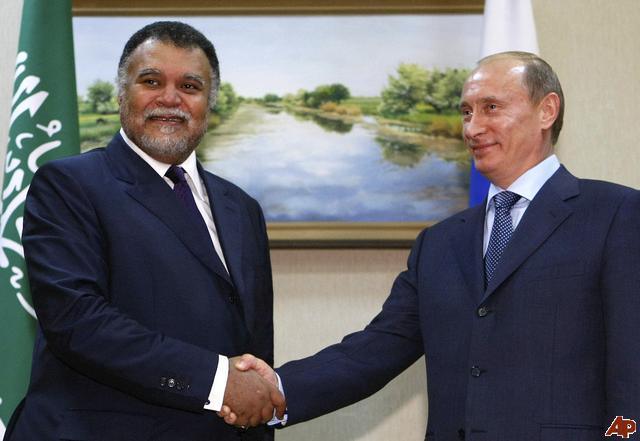
Last summer, Saudi intelligence chief Prince Bandar reportedly offered Russian President Putin a deal: if Russia abandons Syria, Saudi Arabia would protect the Sochi Olympics from Islamic terrorists. 

Prince Bandar bin Sultan, Saudi Arabia’s 
intelligence chief, meeting with Russian 
President Vladimir Putin. 

Putin is said to have angrily rebuffed the offer. Now, with two terrorist attacks, it’s Putin’s move.

Monday’s terrorist bombings only 400 miles away from the site of the Winter Olympics in Sochi, Russia, have a geopolitical back story involving implied threats from Saudi Arabia’s intelligence chief Prince Bandar bin Sultan to Russian President Vladimir Putin last summer when Bandar was pressing Putin to withdraw his backing for the Syrian government.

According to a diplomatic leak detailing the Bandar-Putin meeting in Moscow on July 31, Bandar suggested that Putin’s agreement to abandon the Syrian regime of Bashar al-Assad would lead Saudi Arabia to restrain its Chechen terrorist clients who have been attacking Russia targets for years. Putin reportedly grew furious, interpreting Bandar’s offer as a warning that the Sochi games would be threatened by terrorism if Putin didn’t comply.

At the time, I was even told that Putin warned Saudi Arabia of potentially severe consequences – suggesting military retaliation – if Bandar’s implied warning was followed up by actual terrorist attacks like the ones in Volvograd on Monday, killing more than 30 people.

Of course, it is always hard to trace specific terrorist acts back to their origins and many terrorist cells operate with much autonomy. But Putin has staked much of his prestige on a successful Olympics in Sochi, and he also would risk losing face if it were perceived that Bandar had executed a terrorist plan to disrupt the Winter Olympics and that Putin was powerless to stop it.

According to the leaked diplomatic account of last summer’s meeting, Bandar sought Russia’s cooperation on several Mideast concerns, including Syria, and told Putin, “I can give you a guarantee to protect the Winter Olympics in the city of Sochi on the Black Sea next year. The Chechen groups that threaten the security of the games are controlled by us.”

Putin reportedly responded, “We know that you have supported the Chechen terrorist groups for a decade. And that support, which you have frankly talked about just now, is completely incompatible with the common objectives of fighting global terrorism that you mentioned. We are interested in developing friendly relations according to clear and strong principles.”

Besides safety for the Sochi Olympics, Bandar raised the potential of Saudi cooperation with Russia on oil and other investment matters, saying, “Let us examine how to put together a unified Russian-Saudi strategy on the subject of oil. The aim is to agree on the price of oil and production quantities that keep the price stable in global oil markets,” according to the diplomatic account.

I was told by a source close to the Russian government that this mix of overt inducements and implied threats infuriated Putin who barely kept his anger in check through the end of the meeting with Bandar. Putin viewed Bandar’s offer to protect the Sochi Olympics as something akin to a Mafia don shaking down a shopkeeper for protection money by saying, “nice little business you got here, I’d hate to see anything happen to it.”

Putin then redoubled his support for the Syrian government in response to Bandar’s blend of bribes and warnings. The source said Russia also issued its own thinly veiled threats against the Saudis. The Saudis may have substantial “soft power” – with their oil and money – but Russia has its own formidable “hard power,” including a huge military, the source said.

Bandar and Terrorism


Over the years, Bandar has often treated the issue of “terrorism” as a situational ethic, an ambivalence well-honed since the days when Saudi Arabia and the Reagan administration teamed up to pour billions of dollars into the Afghan mujahedeen and their Arab jihadist allies fighting Soviet troops in the 1980s.

The anti-Soviet effort in Afghanistan brought to prominence Saudi national Osama bin Laden and the terrorists who later consolidated themselves under the global brand, al-Qaeda. In the 1980s, these roving jihadists were hailed as brave defenders of Islam and even “freedom fighters,” but – in the 1990s – they began targeting the United States with terrorist attacks, leading up to 9/11 in 2001.

At the time of the 9/11 attacks on New York and Washington, Bandar was the Saudi ambassador to the United States and was so close to the Bush family that he was nicknamed “Bandar Bush.” Bandar was also very close to the bin Laden family. After the attacks, Bandar even acknowledged having met Osama bin Laden in the context of bin Laden thanking Bandar for his help financing the Afghan jihad project.

“I was not impressed, to be honest with you,” Bandar told CNN’s Larry King about bin Laden. “I thought he was simple and very quiet guy.”

However, immediately after 9/11, Bandar undermined the FBI’s opportunity to learn more about the connections between Osama bin Laden’s relatives and the perpetrators of 9/11 when Bandar arranged for members of the bin Laden family to flee the United States on some of the first planes allowed back into the air – after only cursory interviews with FBI investigators. The only segment of the 9/11 Commission’s report to be blacked out was the part dealing with alleged Saudi financing for al-Qaeda.

Now, as chief of Saudi intelligence, Bandar appears to be back in the game of coercive geopolitics, arranging weapons for some of the most brutal Syrian rebels and Arab mercenaries operating inside Syria, while offering carrots-and-sticks to foreign leaders who are seen are malleable toward Saudi regional interests. The technique may have failed with Putin but had greater success in lining up the French behind Saudi opposition to a negotiated agreement with Iran on its nuclear program.

As a repressive monarchy that preaches the ultra-conservative Wahhabi version of Sunni Islam, Saudi Arabia is bitterly opposed to the democratic reforms of the Arab Spring and the growing influence of Shiite Islam, which now stretches from Iran through Iraq and Syria to the Hezbollah enclaves of Lebanon.

Saudi Arabia backed the military coup in Egypt that ousted the elected Muslim Brotherhood government of Mohamed Morsi. The Saudis also have stepped up assistance to Sunni-dominated rebels in Syria seeking to overthrow the Assad dynasty that is based in the Alawite religion, a branch of Shiite Islam.

The commonality of interests between Saudi Arabia and Israel has given rise to a de facto alliance between the Saudi monarchy and the Jewish government of Israel. Though historically enemies, Israel and Saudi Arabia are now on the same page in backing Egypt’s military regime, in viewing Iran as their principal adversary, and in wanting a rebel victory in Syria.

The shifting sands of Middle East interests also have pushed the United States and Russia closer together, with the former Cold War rivals sharing an interest in tamping down disorder across the region. President Putin and President Barack Obama cooperated in reaching a tentative nuclear deal with Iran and in convincing Syria’s Assad to surrender his chemical weapons. Putin and Obama are pressing for Syrian peace talks, too.

Now, however, a new complication has been introduced: Islamist terrorist attacks aimed at undermining the Sochi Olympics. If Putin concludes that the Saudis are behind these bombings – that the attacks are the equivalent of a Mafia don having a store torched after the owner rebuffed an offer of “protection” – then the issue of Russian retaliation could suddenly be on the table.

Investigative reporter Robert Parry broke many of the Iran-Contra stories for The Associated Press and Newsweek in the 1980s. You can buy his new book, America’s Stolen Narrative, either in print here or as an e-book (from Amazon and barnesandnoble.com). For a limited time, you also can order Robert Parry’s trilogy on the Bush Family and its connections to various right-wing operatives for only $34. The trilogy includes America’s Stolen Narrative. For details on this offer, click here.

Leaving 2013: Just Where Are We?

A Review of 2013: No Platitudes, Please

by Ray Grigg - Shades of Green

Platitudes are wholly incompatible with our present environmental situation on planet Earth, so saccharine pleasantries would be quite inappropriate to summarize the events of 2013. The natural world continues to be under ominous assault. The collective awareness of humanity and its political leadership has still not registered the urgency of the problem with enough clarity to effect the required changes in our behaviour.

Global remedial action has been halting at best, leaving limited initiatives to be taken by communities, cities and a few countries. However heroic these efforts may be, they are insufficient to address the magnitude of the challenge.

If modern science is correct, the opportunity for avoiding critical ecological instability is rapidly shrinking — if it's not already too late — and the pressure is building for corrective measures. So 2014 arrives with an anxious dread brought by a sense of impending inevitability, and a sense of frail hope inspired by remote possibility.

The dread presently exceeds the hope because none of the major ecological problems facing the planet are being successfully addressed. Greenhouse gas emissions continue to rise, so temperatures are increasing in tandem — albeit more slowly for unknown reasons — and ocean acidification worsens. Species extinction is in free-fall due to climate change, habitat loss and biological homogenization. Soil, water and forest resources are either threatened or in decline almost everywhere.

Shortages in oil and gas supplies has been alleviated by extensive fracking but this has exacerbated the carbon dioxide problem, abetted by increases in global coal consumption. Glaciers and ice sheets are melting so ocean levels continue to rise. Industrial ocean fisheries are still ravaging most of the world's marine stocks while mercury toxicity contaminates the remaining large fish. Coral reefs are dying and oceanic dead zones are proliferating. The threatening health effects of chemical and plastic pollution have become ubiquitous. Climate change refugees are a new and growing challenge to social, economic and political stability. Even our world-wide financial system is showing signs of vulnerability.

Optimism is shrinking as we encounter complexities that seem beyond our character, resolve and ability to address. Yes, we are making notable advances in technology, biology, physics, medicine, communication and general knowledge. But these accomplishments are occurring with the dawning realization that we may have a fundamental defect in the structure of civilization itself, together with our inability to recognize, confront, accept or alter its course. As the momentum of global industrialization leaves nature in tatters, we have so far avoided a predicted collision with the law of limits. But a haunting and collective nervousness is beginning to emerge as our human population soars, as the speed of our technological and consumer enthusiasm spreads, and as the ominous wall of limits seems to loom closer.

Even an assessment of our social ecology is sobering. A economic philosophy continues to widen the gap between rich and poor, threatening the civic adhesives of justice, fairness and opportunity that keep societies contented and peaceful. Serious questions are being asked about the ability of free-market capitalism to function within the bounds of nature's imperatives. The folly of 2008's gross financial irresponsibility in international monetary dealings continues to cause worldwide personal and collective strife. Constraining regulations have been vigorously resisted by financial institutions, underscoring the danger of combining human greed with unfettered financial markets as a viable model for managing humanity's economic interests. And finally, global demographic changes are unsettling many social ecologies.

Humanity's population continues to rise, although a few countries are now dealing with the social and economic problems posed by falling populations — a measure of the degree to which perpetual growth has been equated to our sense of progress. Adjusting to an eventually stable human population is going to be difficult enough; adjusting to unequal demographic changes among countries is going to be even more difficult.

Perhaps the most subtle, powerful and discernible development during 2013 has been the penetrating insights about our human character arising from sophisticated thinkers. They are now articulating their serious doubts about our ability to manage a civilization that is rising exponentially in complexity. Neuroscience has added considerably to our understanding of the individual and collective psychology that motivates and governs our behaviour. The indications are not reassuring. We are not, for example, as rational, pragmatic or foresighted as we like to think we are. Our confidence usually overshadows our competence. Our survival strategies as individuals are more evolved than they are as groups — this is why we have persisted as a species but most human civilizations have not. The high opinion we have of ourselves is constantly being lowered by the honesty of self-examination. Our relative status continues to decline as we learn of the other marvellous living creatures that are indispensable components of the incredible intricacy of life on Earth. If we are any more amazing than ants and elephants or mosses and lichen, if we have any uniquely commendable attributes, it would seem to be the range of our awareness and our capacity to be reflectively conscious.

If this is the case, then our abusive treatment of the miracle of a living Earth would be all the more abject, deprived and inexcusable, our squandering and pillaging of its treasures even worse than wanton. Our present behaviour not only diminishes the planet but it also diminishes us. As our tiny measure of time ticks off another year, we need to weigh our small gains and accomplishments against our great failings and losses. Maybe 2014 will be a wiser year.

Saudi Hand in Terror Attacks Hiding in Plane Sight

Saudi ‘Gift’ to Hide its Terror Hand

by Finian Cunningham - PressTV

Saudi largesse is throwing money again – in a bid to cover up its bloodstained hands in violence hitting the Middle East and beyond.

The latest public relations gimmick is the “donation” of $3 billion to the Lebanese army made by Saudi King Abdullah at the weekend.

The Saudi cash – twice the national military budget of Lebanon – is being regaled in the Western media as a noble offer to secure Lebanon from recent terror attacks.

The announcement was made during a visit to Riyadh by French President Francois Hollande, who met the Saudi king and the latter’s Lebanese proxy, Saad Hariri.

The new Saudi military aid to Lebanon is tied to the condition that it must be spent on purchasing French weaponry.

Already, the outlines of a sleazy deal are emerging. The above political actors have done much to destabilize Lebanon with violence, which is now being blamed on the wrong people – Shia Hezbollah – thanks to the deft finger work of billionaire Paris-exile Hariri.

One of the main protagonists of terrorism – Saudi Arabia – now steps in with a military aid “gift” that will allow it to influence the Lebanese army to go after Saudi enemy Hezbollah.

Such an insidious interference by Saudi Arabia in the internal affairs of Lebanon can only but incite further sectarian tensions between Sunni and Shia in that country, which is still recovering from a 15-year civil war.

On top of this, the other main advocate of regional subversion and terrorism – France – stands to receive a handsome payback in weapons sales to the tune of $3 billion.

And all the while, the Western media give this despicable charade a veneer of respectability. It really is astounding how Western media can get away with such distortion.

Saudi blood money and sponsorship of terrorism are carrying out demonic work in Syria, Iraq, Lebanon, Yemen, Pakistan and even it could be added in Iran’s peripheral southeast region.

Moreover, the Saudi terror connection can also be traced to the weekend double bombing in the southern Russian city of Volgograd where more than 30 people were killed.

In October, a suicide bomber killed six also in a bus attack in Volgograd. Other cities have also been hit with deadly attacks in Russia’s Dagestan in recent months.

The likely Chechen perpetrators behind those attacks – led by Saudi-linked Doku Umarov – are also involved in waging the Saudi-financed terror war in Syria.

Recall, too, that Saudi spymaster Prince Bandar only a few months ago made veiled threats to Russian leader Vladimir Putin that the Sochi Winter Olympic Games were at risk to acts of sabotage. The Games are set to open on 7 February 2014.

Nevertheless, against this appalling background of provable Saudi-sponsored mayhem – stretching from the Mediterranean to the Russian Caucasus – we have this latest ridiculous Saudi public relations stunt.

Saudi King Abdullah, we are told, is to “grant” $3 billion to “help” the Lebanese army to “beef up its security”. France 24, among others, reported that the military boost “would help the Lebanese army fight ... groups like Hezbollah, which has caused a wave of violence in the country.”

The latter claim by France 24 is a risible distortion of the facts. Lebanon has indeed witnessed a wave of violence in recent months, but the main victims of the attacks have been Hezbollah and Shia communities in southern Beirut and Baalbek in the east of the country.

The primary source of this bloodshed in Lebanon is groups linked to Saudi, Israeli and Western intelligence.

For example, the double suicide bombing of the Iranian embassy in Beirut on 19 November, which killed at least 23 including Iranian cultural attaché [to Beirut Hojjatoleslam] Ebrahim Ansari, was claimed by the Saudi-backed al-Qaeda group known as Abdullah Azzam Brigade.

The Saudi king’s act of generosity to “improve security” in Lebanon should therefore be scoffed at by media instead of praised. But this is the Western media performing its dutiful function of inverting reality.

King Abdullah’s show of magnanimity came two days after a prominent Lebanese Sunni politician, Mohamad Shatah, was assassinated in a massive bomb blast that targeted his car in the capital Beirut on Friday morning.

Western media were quick to highlight claims by Saudi-backed Lebanese political leader Saad Hariri that the perpetrators of Shatah’s murder were Hezbollah. The Syrian government of President Bashar al Assad was also implicated for the killing.

There is no evidence to attribute Shatah’s murder to Hezbollah, other than politicized conjecture. Hezbollah and its Syrian and Iranian allies all categorically condemned the killing.

However, there is strong circumstantial evidence that Shatah may have been liquidated by his geopolitical allies as a nefarious means of triggering further sectarian violence inside Lebanon.

The execution of his murder would have required split-second timing and confidential information of his itinerary. He was on his way to meet members of the Hariri-led March 14 group.

This pattern of fomenting sectarian conflict between Sunni and Shia, as well as Christian, has been a staple of Saudi, Israeli and Western intelligence operating to destabilize Syria and Iraq over the past three years.

The splurging of $3 billion by Saudi Arabia to “increase Lebanon’s security” is merely cynical public relations to cover up the real source of violence in that country, as well as providing Riyadh military leverage to go after Hezbollah within Lebanon.

It follows the much bigger precedent of $100 million that Saudi Arabia doled out to the United Nations Anti-Terrorism Center last August.

That donation was made at the end of the Holy Muslim Month of Ramadan as “a gift from the Custodian of the Two Holy Mosques of Islam”.

In the previous four weeks before that “gift”, some 1,000 Iraqis were killed in terror attacks mainly committed by the Saudi-bankrolled al-Qaeda franchise known as the Islamic State of Iraq and Levant.

This same group has been engaging in similar atrocities in neighboring Syria, along with [so-called] al-Nusra Front, [so-called] Liwa al-Tawhid and [so-called] Ahrar al-Sham – all of them Saudi-sponsored.

The simple fact is that the sectarian bloodshed inundating Syria and Iraq, and increasingly now in Lebanon, as well as in countries as far apart as Yemen and Russia, would not be happening if it were not for the blood money flowing from Saudi Arabia.


Finian Cunningham (born 1963) has written extensively on international affairs, with articles published in several languages. He is a Master’s graduate in Agricultural Chemistry and worked as a scientific editor for the Royal Society of Chemistry, Cambridge, England, before pursuing a career in journalism. He is also a musician and songwriter. For nearly 20 years, he worked as an editor and writer in major news media organisations, including The Mirror, Irish Times and Independent.

This article was originally published at Press TV

Swanson: Fighting War with Truth

Lies and War - David Swanson on Reality Asserts Itself (1/3)

by TRNN

On RAI with Paul Jay, David Swanson, author of "War is a Lie", talks about becoming a full time activist for peace.

David Swanson's books include: War Is A Lie (2010), When the World Outlawed War (2011), and The Military Industrial Complex at 50 (2012).  He is the host of  Talk Nation Radio. He has been a journalist, activist, organizer, educator, and agitator.  Swanson helped plan the nonviolent occupation of Freedom Plaza in Washington DC in 2011.  Swanson holds a master's degree in philosophy from the University of Virginia. He has worked as a newspaper reporter and as a communications director, with jobs including press secretary for Dennis Kucinich's 2004 presidential campaign, media coordinator for the International Labor Communications Association, and three years as communications coordinator for ACORN, the Association of Community Organizations for Reform Now. He blogs at http://davidswanson.org and http://warisacrime.org and works as Campaign Coordinator for the online activist organization http://rootsaction.org  Swanson also works on the communications committee of Veterans For Peace, of which he is an associate (non-veteran) member. Swanson is Secretary of Peace in the Green Shadow Cabinet.

Monday, December 30, 2013

Gorilla Radio's 2013 Year-Ender

This Week on GR

by C. L. Cook - Gorilla-Radio.com

Welcome to GR, etc. And welcome to GR's annual year-end show. We'll leave the regular weekly format to feature the year's news highlights and low. Mostly though, the idea is to bring some of the years most interesting stories, and more importantly its non-stories, those conveniently forgotten or undelivered by the state and corporate media nexus.

We will too tonight feature a veritable musical melange along with the expected compendium of mine own bloviation.

Sadly, we'll miss Janine Bandcroft's weekly contribution, as she's in transit even now.

Listen. Hear.


5:11:00 7:00 Electricity: A Tale of Two Cities (900 wds) - (b/g audio Fire This Time)

One of the year's biggest stories in Canada this year is one continuing even now. The effects of the massive ice storm in Ontario are still being felt in Toronto and environs. The Greater Toronto Area is what we hear most about; but the true extent of the pre-Christmas arctic blast is being felt much farther afield than the GTA. Across eastern Ontario, Quebec, the Maritimes, Michigan and Maine millions are discovering what life without electricity is like; and how miserable and dangerous life without electricity can be in the winter.

In Toronto, the disgraced Mayor Ford, whose fall is a prominent story on other year just past round-up shows itself, has seen his office by-passed for the response to the disaster, a prescient move made by city council just weeks before the storm. Instead, Deputy Mayor, Norm Kelly and the city's emergency management program committee are in charge. It is for Mayor Ford to be the media face for the GTA, and to issue a 'state of emergency' where necessary, something he has so far not done. Ford's nemesis, the Toronto Star newspaper has been busy despite the darkness, asking question benighted citizens want answered.

An article by Star staffers answers five of those questions; a couple being : Why were so many people - more than 750,000 estimated in the GTA alone - left in the dark after the storm? and: Why are so many people still without power? Readers also question whether Ice Storm 2013 qualifies as an official "disaster"; and when, if ever, was the last time Toronto was blacked out like this; and who's going to pick up the mounting piles of garbage - especially organic garbage, like spoiled food?

The answers in short are: This is the largest, longest power outage in the city's history; why so many were effected is due to the architecture of the power grid and the increased numbers of people and households in the region, many requiring time-intensive single line repair service, since the last great incident in 1965; and yes, extra crews will be deployed for garbage pick-up, and special provisions will be made for organic household waste.

But is it a disaster?


The Star reports Public Safety Canada's Canadian Disaster Database saying, the disaster designation criterion is: "10 or more people killed; 100 or more people affected/injured/infected/evacuated or homeless; an appeal for national/international assistance; [and] historical significance and significant damage/interruption of normal processes such that the community affected cannot recover on its own." According to these criteria, only the 1999 snowstorm, and a deadly 1944 blizzard that killed 21 people have merited the disaster designation in Toronto's history.

Every year Torontonians freeze to death on the streets of the city. The Star reported the storm's supposed first homeless person killed Friday. Five days earlier, a man identified as 'Richard' was found dead outside the doors of the Carlton and Church street Loblaws. But death by exposure is nothing novel in the nation's richest city. According to the Ontario Coalition Against Poverty, Richard lay on the sidewalk frozen dead even as holiday shoppers walked past him, eager to get the last minute trimmings for Christmas celebrations. OCAP held services for Richard today in Toronto, and they provide some sobering statistics for the citizens of this northern country, Canada to mull over. OCAP says;

"The average life expectancy of a person who is homeless in Canada is a shocking 39 years old for women, and 46 years old for men. Homeless men are 8 times more likely to die than men of the same age in the general population. These deaths of people well before their time are preventable. The chronic lack of affordable, accessible and safe housing, the lack of an adequate income, the lack of sufficient programs and services, all contribute to the high mortality rates among homeless and underhoused people. As a result of these government decisions to prioritize profit over human lives, our communities experience loss at a rapid rate."

City councillor Kristyn Wong-Tam believes the city has failed in its response to homelessness, saying;

“We have had so many opportunities to respond, and I don’t think that we have done a good job.”

“We know that the homeless population in Toronto is getting larger and older, so there is a social tsunami coming our way and we need to be much more proactive as we try to address it.” Adding;
“We have a very wealthy city, and yet we have people who are living on our streets. It’s tough, [and] obviously, we can’t look the other way, and yet, thousands of people do. (This man) is our responsibility.”

Toronto averages 2 homeless deaths per week, and the wall of The Homeless Memorial at Church of the Holy Trinity chronicles more than 700 names of those who have died on the city's streets. Certainly these enough of these Canadians have been "affected/injured/infected and necessarily evacuated," and many more than 100 have died. And yet, there's no emergency declared here, no disaster designation appeal made nationally or internationally by the powers that be. Meanwhile, Mayor Ford remains adamant in his refusal to declare a state of emergency, sayings;

“This is not a state of emergency.” “State of emergency is basically when the whole city is paralyzed, business can’t open, people can’t get out of their houses. We’re not in that situation. We’ve discussed this numerous times and we’re not even close to a state of emergency.”

5:18:00 4:10 Music - Christian Doscher - Straight Lines - GasCD [Continuous play]
5:22:10 3:48 Music - DJ Serious (D.Yan/Sourav Deb) - Trap Doors - GasCD
5:24:58 1:02 Cart(s)
5:26:00 3:00 Remembering 2013 - Iraq and Imperialism

Welcome back to GR, etc. Tonight we've left the usual show format to bring you the annual GR Year-Ender Extravaganza. Joining me musically, in the background is again, Grant Wakefield and his compilation disc(s) 'The Fire This Time.' Grant is a UK-based documentary filmmaker, and works as a technician in the industry. He put together this audio collage in homage to those killed by the first American military invasion of Iraq in 1991. The so-called Operation Desert Storm was George H. W. Bush's nod to keeping world oil supplies suppressed for the benefit of his friends in Saudi Arabia. Of course, it also benefited the Ayatollah's of Iran, a bitter pill America and her Middle East ally Israel are still trying to avoid swallowing. Since Bush senior's war against the late Saddam Hussein, Iraq, and the region, has been in continuous turmoil.

Just this week past, car bombings throughout Iraq killed scores, and the US quietly announced its intention of supplying Hellfire missiles, those drone deployed munitions, commonly used to blow up wedding parties, farmers' markets, and community gatherings of all description throughout the Arc of Instability created by America and her allies in an effort to reign in the "terrorists" still fighting from the rubble it has made of the region; to eradicate those still resisting its imperial hegemony.

When background to the wars in the region are reported in the state/corporate media, an inexcusably rare occurrence, it is almost exclusively framed in the false context of the September 11th attacks of 2001. The exclusion of events in the middle east preceding 9/11 make it difficult for citizens of the United States, Britain, Canada, Australia and Western Europe to grasp the full scope of the current situation there, and let slip into obscurity the continual criminality of the Anglo-American Axis powers. Conveniently excised from the narrative is the 8 years-long Iran/Iraq war fomented by the US; the more than decade-long sanctions campaign against the subsequently war ravaged Iraq; and the formative role America and Israel played in Lebanon's civil war; and this list is by no means definitive. What it amounts to though is a concerted effort by Western governments and their allies in media and academia to erase inconvenient facts from popular discourse. It is in effect a war on history, a debasement of truth, and a deliberate obliteration of the past; a memory war.

5:29:00 4:44 Memory War - Asian Dub Foundation - Community Music
5:33:44 2:00 Remembering 2013 - Defend our Coast Rally Nov 16, 2013 (stick)

Denial of the historical and continuing genocide against the First Peoples of this continent, North America and the erasure of what's left of the wilderness and its natural inhabitants here is a necessary forgetting, a collective amnesia required for the plans of those who would sacrifice for all time the real treasures still abiding here for personal and transitory profits. Remembering the truth of what this means is the battle that will dominate local politics in British Columbia and Canada for the year and years to come. In November, I went down to the Defend Our Coast demonstration, held as so many before it on the grounds of the Legislature here in Victoria.

5:35:44 10:50 Defend Our Coast Rally, Victoria - (Stick)
5:46:36 3:20 Music - Kinny Starr - Rise - Sun Again
5:50:00 3:00 Remembering 2013 - Bringing it home

During last year's Year-Ender show, I wrote:

"You may too recall, the Daiichi plant's six nuclear reactors were damaged in varying degrees by the massive earthquake and subsequent tsunami that struck off the coast of Japan in March of 2011. So why, you may ask, would that ancient event still be making un-news in 2012? Well, the Daiichi plant meltdown was never fixed. Nearly two years after the fact, several of the plants nuclear reactors are still busy melting away, releasing unknown amounts, or at least unreleased to the world's media, of Cesium -137 into the atmosphere. Even as millions of gallons of sea water, desperately dumped into the smouldering cooling tanks runs off contaminated back to the sea, the message motif coming from the company and its cohorts in the Japanese government is "No problemo!""

Not a lot has changed this year, excepting for the untold amounts of Cesium-137 that has entered the atmosphere and the millions of gallons of contaminated coolant water that has entered the Pacific Ocean since then. After several revisions of what constitutes safe radiation exposure levels for humans and sea creatures still harvested by Japan's fishing fleets, the nub of the issue remains: Nobody yet knows how to fix Fukushima.

I spoke a couple weeks ago to Mimi German of the Oregon-based citizen activist group No Nukes Northwest. She's also a founder of Radcast.org, a collection of concerned citizens doing the job both the American and Canadian governments seem unwilling to do, monitoring radiation levels coming from the stricken plant here on the west coast of North America. I also spoke recently with physician, author, and lecturer Dr. Helen Caldicott and she expressed extreme concern about allowing Japanese utility Tepco, the company responsible for Daiichi solely in charge of efforts to rescue the contaminated rods remaining in the wreckage of the facility. She says, though the radioactive pollution being released by Fukushima will remain in the biosphere for the next million years, "No container lasts more than a hundred years." See ya next year Fukushima.

5:53:00 4:15 Music - Funk Asylum - The Dinner is Ruined - GasCD
5:57:15 1:00 Remembering 2013 - Hugo Out

That's it for this year's show. Of course, there were a lot more un and under-reported stories out there; the ongoing targeting of Gaza's civilian population not least. You think it's hard going a week without electricity Hogtown...and we saw the end of Venezuela's extraordinary reformist president, Hugo Chavez. I happened to be in Cuba in January, while Hugo was there being treated for cancer. The people of Cuba will miss him almost as much as Venezuela's underclass. Thanks to Janine Bandcroft, and the staff that keep the wheels turning up here. Stay tuned for Arnold...This is for you, Commandante.

5:58:00 4:00 Music - Nathalie Cordone - Hasta Siempre
6:00:00 --:-- -0-

Every Stroke You Make: NSA Spying More Deeply Embedded than Previously Believed

Glenn Greenwald: The NSA Can "Literally Watch Every Keystroke You Make"

by DemocracyNow!

The German publication Der Spiegel has revealed new details about a secretive hacking unit inside the National Security Agency called the Office of Tailored Access Operations, or TAO. The unit was created in 1997 to hack into global communications traffic. Hackers inside the TAO have developed a way to break into computers running Microsoft Windows by gaining passive access to machines when users report program crashes to Microsoft. In addition, with help from the CIA and FBI, the NSA has the ability to intercept computers and other electronic accessories purchased online in order to secretly insert spyware and components that can provide backdoor access for the intelligence agencies.


American Civil Liberties Union Deputy Legal Director Jameel Jaffer and journalist Glenn Greenwald join us to discuss the latest revelations, along with the future of Edward Snowden.

What Rights Remain After Losing Privacy?

Is Anything Left? Privacy Rights

by Franklin Lamb - sssp-lb.org

Beirut - The answer to this question is being pondered across America in light to the two seeming mutually contradictory US Federal Court decisions handed down this month from Courts in Washington DC and New York.

The legal issue of what rights are left to American citizens that can prevent governmental intrusions into their privacy and also governmental invasions using heavy handed searches and seizures following the launching of the Bush administrations ‘war of terrorism’ has gained new impetus following disclosures by former National Security Agency analyst turned whistle blower, Edward Snowden. Without Snowden’s patriotic leaks, no legal challenge could have been brought to the NSA practices.

Now that two US Federal District Courts, with identical powers under the US Constitution have seemingly reached opposite results on the same legal issue involving the right of the NSA to conduct ‘metadata’ searches and store the information of scores of millions of unknowing Americans the issue is likely going to have to be decided by the US Supreme Court. As predicted, appeals were immediately filed from the Trial Courts decision in both cases.

Initially, civil libertarians were encouraged earlier this month when in light of the Snowden revelations of massive US government spying on Americans and millions of foreigners, Federal Description: Judge Richard Leon of the United States District Court for the District of Columbia ruled on 12/16/13 that the bulk collection by the National Security Agency of cell phone data (everyone you called, when you called them and where you were when you called them) of Americans violates the Fourth Amendment to the Constitution and is “Orwellian”.

Judge Leon explained that we now use our smartphones for a wide variety of personal activities in which we have the expectation of privacy, and probably we have more expectation of privacy from our phones now than we did from a pay phone in the 1980s. He made the point that cell phones today includes a citizens, location when one makes a call and becomes a GPS made the call, functioning essentially as a GPS. He wrote: 

“It’s one thing to say that people expect phone companies to occasionally provide information to law enforcement; it is quite another to suggest that our citizens expect all phone companies to operate what is effectively a joint intelligence-gathering operation with the Government.”

Judge Leon focused on whether the NSA massive surveillance violated the 4th Amendment which provides:

“The right of the people to be secure in their persons, houses, papers, and effects,against unreasonable searches and seizures, shall not be violated, and no warrants shall issue, but upon probable cause, supported by oath or affirmation, and particularly describing the place to be searched, and the persons or things to be seized.”

He writes:

“The threshold issue that I must address, then, is whether plaintiffs have a reasonable expectation of privacy that is violated when the Government indiscriminately collects their telephony metadata along with the metadata of hundreds of millions of other citizens without any particularized suspicion of wrongdoing, retains all of that metadata for five years, and then queries, analyzes and investigates that data without prior judicial approval of the investigative targets. If they do – and a Fourth Amendment search has thus occurred– then the next step of the analysis will be to determine whether such a search is ‘reasonable.’”

Judge Leon found that the NSA when it demands citizens telephone metadata is conducting a search, and that it is most likely an unreasonable search of our personal effects according to the Fourth Amendment, since there is no specific suspicion of wrongdoing by any individual whose records are demanded. He immediately granted the Plaintiffs request for an injunction that blocks the collection of phone data for the plaintiffs and orders the government to destroy any of their records that have been gathered. As is common Federal Court practice, the judge stayed action on his ruling pending a government appeal, recognizing in his 68-page opinion the “significant national security interests at stake in this case and the novelty of the constitutional issues.”

No sooner had the Judge Leon decision been published and was encouraging civil libertarians to argue that the US Constitution still protects some citizen rights against government abuse than US Federal District Judge William H. Pauley III in New York ruled that a National Security Agency program that collects enormous troves of phone records is legal, making the latest contribution to an extraordinary debate among courts and a presidential review group about how to balance security and privacy in the era of big data. In just 11 days, the two judges and the presidential panel reached the opposite of consensus on every significant question before them, including the intelligence value of the program, the privacy interests at stake and how the Constitution figures in the analysis.

The latest decision could not have been more different from one issued by Judge Richard J. Leon in Washington, who ruled that the program was “almost Orwellian” and probably unconstitutional.

Judges Leon and Pauley have starkly differing understandings on how legal that program is. Judge Pauley, whose courtroom is just blocks from where the World Trade Center towers stood, endorsed arguments made in recent months by senior government officials — including the former F.B.I. director Robert S. Mueller III — that the program might have caught the Sept. 11, 2001, hijackers had it been in place before the attacks. Wrote Judge Pauley: “While robust discussions are underway across the nation, in Congress and at the White House, the question for this court is whether the government’s bulk telephony metadata program is lawful,” Judge Pauley wrote on Friday. “This court finds it is.”

Judge Pauley decided to ignore several compelling US Constitutional issues and applications of its provisions to the NSA case. He chose to avoid 4th Amendment prohibitions on unreasonable government searches of private papers and effects. As Professor Juan Cole recently reminded us, the 14th Amendment was the basis for a recent Supreme Court ruling forbidding law enforcement from using GPS tracking without a warrant. The courts decided that following someone around 24/7 as a “search” because such intensive monitoring of a person’s movements goes beyond just glimpsing the individual in public. NSA collection of metadata from cell phones track individuals just as a GPS devices do.

Other applicable US Constitutional provisions ignored by Judge Pauley include the 1789 Federalist promoted 9th Amendment, which a majority of the Founding Fathers wanted as guarantees that “The enumeration in the Constitution, of certain rights, shall not be construed to deny or disparage others retained by the people.” The 9th Amendment is clearly designed to block the government from constraining people’s private behavior. As Cole points out, not only are they protected from specific violations of their rights (attempts to curb speech, the press, religious belief or peaceable assembly) but they are also protected as a free people from government intrusions.

There are additional provisions in the constitution and in the history of court rulings that prescribe privacy for individuals from government intrusion. In fact, although “privacy” is not mentioned in the US constitution, the Supreme Court found in Connecticut v. Griswold that American citizens had a constitutional right to use birth control and that the state could not arbitrarily come into the bedroom and prohibit it. Some of the justices referred to the 9th Amendment, which says “The enumeration in the Constitution, of certain rights, shall not be construed to deny or disparage others retained by the people.” That is, the government can’t just wake up in the morning and decide to constrain people’s private behavior. Not only are they protected from specific violations of their rights (attempts to curb speech, the press, religious belief or peaceable assembly) but they are protected in general as a free people from government intrusions.

Judge Pauley also ignored the relevant application of the 14th Amendment. In Griswold v. Connecticut, 381 U.S. 497 (1965) a landmark case in which the Supreme Court ruled that the Constitution protected a right of privacy, justices referenced the due process clause of the 14th amendment, which commands that:

“No state shall make or enforce any law which shall abridge the privileges or immunities of citizens of the United States; nor shall any state deprive any person of life, liberty, or property, without due process of law; nor deny to any person within its jurisdiction the equal protection of the laws.”

The late great Justice William O. Douglas argued that the Bill of Right’s specific guarantees have “penumbras,” created by “emanations from these guarantees and that these penumbras help give the Bill of Rights life relevance to today’s struggle to protect our civil rights. It was Douglas’ interpretation of the US Constitution that, the “spirit” of the First Amendment (free speech), Fourth Amendment (freedom from searches and seizures), Fifth Amendment (freedom from self-incrimination), and Ninth Amendment (other rights), as applied against the states by the Fourteenth Amendment, creates a general right to privacy that cannot be unduly infringed.” In his view there exists as part of the US Constitution a penumbra of privacy.

Judge Pauley ignored these and other Constitutional applications in order to uphold the NSA informational gathering project in spite of the fact that the NSA, every minute for the past 7 years and until today, is abridging the privileges and immunities of a free citizenry. They are depriving us of liberty without due process of law, for the reason that they have failed to obtain a judicial warrant based on grounds of specific evidence of wrong-doing.

Judge Leon, in Washington, took the opposite view, saying the government had failed to make the case that the program is needed to protect the nation. “The government does not cite a single instance in which analysis of the N.S.A.’s bulk metadata collection actually stopped an imminent attack, or otherwise aided the government in achieving any objective that was time-sensitive in nature,” he wrote.

Where these conflicting US Constitutional decisions leave the American public concerned with civil liberties and the disappearance of privacy is in a profound quandary with respect to the issues raised by Edward Snowden. Snowden described in his Christmas address, carried by British Channel 4 and widely aired on the internet the legitimate concern of all people who values individual liberty and privacy: A child born today might “never know what it means to have a private moment to them, an unrecorded, unanalyzed thought.” People walk around with a tracking device in their pockets, he noted, and as we now know, the NSA is collecting the metadata of those phones, which includes location information.

With words likely to become part of Law School curriculum, Mr. Snowden said that “this disappearance of privacy is important because privacy is what allows us to determine who we are and who we want to be.”

Franklin Lamb is a former Democratic National Committee Member representing Oregon. He volunteers with the Sabra-Shatila Scholarship Program (sssp-lb.org)

Don't: Let Kinder Morgan Drive Your Energy Focus

Don't: Let Kinder Morgan Public Relations Drive/Focus Your Energy

by David Ellis

I want to respectfully submit at this point, that the most urgent issue to be addressed in the New Year, is working closely with the highly capable research/media (not all are "bought" this is not a time to be cynical) on the the DETAILED REASONS why Kinder Morgan lacks a "social licence" to continue pipeline operations in B.C, TO SHOW TO THE PUBLIC that:

a) They secretly sent HUGE volumes of super heavy tar oil, down a 61 year OLD PIPE old pipe (the many more pumping stations greatly increase the odds of local pressure burst points)

b) Obvious poor maintenance of the OLD PIPE, as witnessed/documented by Pipe Up and others

These issues are amplified by the huge number of schools, homes, businesses, and highways, that this rotting old pipe, now runs under. THIS IS NOT ACCEPTABLE, IT SHOULD BE EXPOSED AS A CRIME, THAT PUTS US ALL, AND THE ENVIRONMENT, AT GREAT RISK, AND SHOULD BE EXPOSED AS SUCH.

In short, their past lack of past "due diligence", alone, means that their new "twinning" propaganda papers now on the internet, should be treated like offensive spam, and ignored.

Energy of all should go to: slow, social learning, by all, including the remaining rational press, of: stress corrosion cracking, Cathodic Protection (CP) overgrown right of way, right of way infringing on public safety (100s of photos of pipe going under schools, homes, businesses need to be e-published, You-tubed, press circulated) the abandonment issue (this a National policy issue that MUCH change).

Also: careful documentation of under funded and poor on ground oversight/regulation by the National Energy Board; this alone can be shown, to be a reason why pipelines are huge threats especially as they age; Also: low training standards for pipe workers. Also: We also need dozens of people hiking the pipe, area by area, and getting these data and especially photos, for the upcoming hearings. We also need 100s of Access to Info requests at this time, and public/press-accessible archiving of all data.

The First Nations are hiring capable tech people and there is a need to share data/learning so energy is not wasted and the process is cumulative and efficient. Co-operation must be the goal, NEVER competition between researchers.

1000's of pages need to be brought together on these issues: let's call them the "OLD PIPE" crimes, they are many Wasting energy on the outrageous and not-worth-reading, "twinning" propaganda proposal, this is just letting the propaganda, take over I also hope that many more marches and public demonstrations can be
held, always friendly, social, and law-abiding with close work WITH the RCMP, they have all your data and a file on you all anyway, so be seen to be PUBLICLY educating them also on the civil defences issues/details they often do not have time to catch up on, they are busy and your legal/constitutional friends also, HELP THEM TO LIVE UP TO THEIR CIVIL DEFENCE RESPONSIBILITIES, and expedite the EARLY engagement of their massive resources; they will after all end up being the first responders as the 100s of pipeline breaks occur in future years as the old pipes increasingly burst and start on fire under schools, highways, etc.

With due respect

David Ellis
Independent Pipeline Critic

PS: At my book event yesterday, I found myself talking to a retired
Terasen (owned TransM up till a few years ago) worker, who noted past
welding care and integrity, and especially Cathodic Protection (CP),
must be paramount. When I noted to him that many Cathodic Protection
testing stations had now been wiped out by snowmobiles, and have not
been replaced, he was concerned. He also noted to me, that training
standards for pipeline workers, are very low in Canada.


Sunday, December 29, 2013

Car Bombs Back in Beirut: Getting Dirty Down in the Levant

Beirut Murder: Dirty Tricks Get Dirtier

by Finian Cunningham -Press TV

The latest deadly attack in Lebanon’s capital Beirut is yet another desperate attempt to destabilize not only that country, but the entire Middle East to precipitate all-out sectarian war.

The murder of senior Lebanese Sunni political figure, Mohamad Shatah, on Friday in a massive bomb blast that hit his motorcade as it drove through downtown Beirut was aimed at implicating the Shia Hezbollah and closely allied Syrian and Iranian governments.

Syria’s government of President Bashar al-Assad, along with Hezbollah and Iran, swiftly condemned the assassination of Shatah, who was formerly Lebanon’s finance minister between 2008 and 2011.

But the condemnations didn’t stop anti-Syria politicians within Lebanon and various Western media outlets from pointing the finger.

“Anti-Assad ex-minister killed in Beirut bomb,” was the headline carried by Reuters and Britain’s Daily Telegraph, among others.

This contrived innuendo betrays who the real perpetrators are.

Mohamad Shatah, a senior political adviser to Lebanese opposition leader Saad Hariri, was indeed a strident critic of Hezbollah and Syria’s Assad, accusing them of fuelling bloodshed in Syria and also sectarian tensions inside Lebanon. His political views were consistent with the narrative of the pro-Zionist Western media, as well as Saudi Arabia.

Shatah could therefore be considered an ally of the West, Saudi Arabia and the Zionist Israeli regime. But that very profile may have been what made him a prime target, not for Hezbollah or Syria, but for his so-called allies.

The day before his killing, Shatah had reiterated criticism of Hezbollah, claiming that the group was using Syria to consolidate its military strength in Lebanon.

Within minutes of Shatah’s murder, the Saudi-backed Lebanese opposition leader Saad Hariri implicated Hezbollah for the attack. “Shatah’s murderers are the same ones who assassinated former premier Rafik Hariri.” This was a reference to the bomb-blast killing of his father, Rafik, also a former prime minister, in 2005.

A United Nations-backed Lebanese tribunal has indicted five members of Hezbollah for that 2005 murder. The trial is set to open in the coming weeks in a Hague court. For the past eight years Hariri’s group have accused Hezbollah as well as Syrian intelligence over that assassination, without the accusations gaining much credibility.

Both Hezbollah and Syria have strenuously denied any involvement, saying that there is no evidence, and that the tribunal is politically driven. Hence, they have refused to cooperate with the forthcoming trial.

That is why Saad Hariri said of the latest killing: “The accused… are the same ones who are running away from international justice.”

Shatah’s assassination this week comes at a sensitive time, which strongly suggests who the real perpetrators might be.

First, the atrocity serves to re-ignite the accusations against Hezbollah, and its regional allies, in the murder of Rafik Hariri just when the case is being re-opened in an international court.

Secondly, there is the forthcoming Geneva II political talks organized to find a peaceful solution to the nearly three-year Syrian crisis. If Hezbollah, and by extension Syria and Iran, can be linked by sensational media claims of involvement in the murder of high-profile Lebanese politicians, then that would have a damaging impact on the Assad government during the Geneva negotiations.

Thirdly, and this is more to the point of who are the likely perpetrators, the murder of Mohamad Shatah comes at a time of mounting sectarian tensions and violence across the region. Lebanon has witnessed a wave of deadly bomb attacks and assassinations in recent months, which have mainly targeted Shia areas of Beirut.

Earlier this month, a senior Hezbollah commander was shot dead. And at the end of last month, a twin suicide bomb attack on the Iranian embassy in Beirut killed 29, including Iran’s cultural attaché, Ebrahim Ansari. Back in August, a bomb outside a Sunni mosque in Sidon reportedly butchered 40 people.

This violence replicates the pattern of sectarian bloodshed unleashed in neighboring Syria and Iraq. There is ample evidence to show that that violence is being systematically fuelled by Saudi Arabia, working in collusion with Israeli and Western intelligence.

Israel in particular has a long track record of sabotaging Lebanon from within, having invaded that country in 1978, 2000 and 2006. There is also evidence that its agents were the real authors of the assassination of Rafik Hariri in 2005.

Lebanon is particularly vulnerable to sectarian strife. The country’s communal wounds are still raw from the 15-year-old civil war between its Sunni, Shia, Christian and Druze communities, which ended in 1990. There have been renewed sectarian clashes between Sunni and Shia/Alawite groups in Sidon, Tripoli and several other towns over the past year. Saudi-backed Sunni clerics have been prominent in agitating sharper tensions in Lebanon.

This pattern of sectarian destabilization within Lebanon and across the Middle East by external forces is consistent with the latest murder of Mohamad Shatah in Beirut. The massive blast is believed to have come from a 50-60 kg bomb wired in a booby-trapped car. Wreckage was scattered 100 meters away and some 40 other cars were damaged, some of them upended. This was a professional hit with a devastating message.

In the grand nefarious scheme of geopolitics it matters little that Shatah was a prominent Sunni figure who was an ardent critic of Hezbollah and Syria. Indeed, from the viewpoint of the agents of subversion and destabilization, Shatah’s political and religious affiliation would have made him a prime target for their purpose of trying to explode sectarian war.

The heinous role played by Saudi, Israeli and Western intelligence in inflicting untold suffering on civilians across the Middle East, whether Shia, Sunni or Christian, means that their capability of using the dirtiest tricks knows no limits. The murder of Mohamad Shatah would be viewed by these dark forces as merely an expendable sacrifice if that means achieving the bigger aim of inciting all-out sectarian war in Lebanon; and engulfing the entire region in internecine flames.

The powers that gain from this atrocity are those that sow division and thrive on conflict in order to shore up their illegitimate hegemony over the region and over the mass of its ordinary, decent people.

Finian Cunningham (born 1963) has written extensively on international affairs. He is a Master’s graduate in Agricultural Chemistry and worked as a scientific editor for the Royal Society of Chemistry, Cambridge, England, before pursuing a career in journalism. He worked as an editor and writer in major news media organisations, including The Mirror, Irish Times and Independent.

© Copyright 2012 Press TV. All rights reserved