Monday, March 09, 2015

It's Unanimous, Canadian Media Majors Back Ukraine Fascists

Extolling Ukraine’s Extreme-Right

by Roger Annis - CounterPunch


Writers at the largest national daily newspaper in Canada, the Globe and Mail, have lately joined writers at the Toronto Star in publishing articles extolling the fundraising efforts in Canada of Ukraine’s extreme-right.

This comes in the form of two recent news articles in the Globe, including one by its long-standing correspondent in Europe, Mark MacKinnon.

MacKinnon reported on Feb. 27 in the Globe and Mail from the warehouse in Kyiv where ‘Army SOS’ gathers the military supplies that it purchases or receives and then provides to the extreme-right battalions fighting Ukraine’s war against its citizens in the east of the country.

As an article by me on Feb. 20 reported, writers at the Toronto Star have also been promoting ‘Army SOS’. The military equipment provided by financial or direct donations has included technology for improving the accuracy of Ukrainian rocket and artillery attacks against the towns and cities of eastern Ukraine.

MacKinnon describes ‘Army SOS’ as “a volunteer organization that aids Ukraine’s warriors in the field”. He writes, “Ukraine’s myriad volunteer battalions are famed for their bravery, as well as for their sometimes-extreme nationalism. Along the front line, they are often the ones engaged in the toughest fighting against the rebel army that Kiev and NATO say is armed by Moscow.”

Actually, MacKinnon’s “warriors” are mostly “famed” for their extreme-right or neo-Nazi views. The most well-known among them, including the ‘Donbass’, ‘Aidar’, Azov and Dniper battalions, have been cited by journalists and human rights organizations, including Amnesty International, for kidnappings, torture and executions. They have been condemned for blockading humanitarian shipments into eastern Ukraine.

The rightists do not limit their crimes to warmaking in Ukraine’s east. They are also organized politically, including as members of Ukraine’s Parliament (Rada). Some are represented through their own political parties, such as the openly fascist ‘Right Sector’, while others have entrenched themselves in the ‘parties’ (actually, electoral machines) of President Petro Poroshenko and Prime Minister Arseniy Yatsenyuk.

Across Ukraine today, free expression is severely curtained. The extreme right conducts vigilante attacks against public expressions of concern about the war or the disastrous state of Ukraine’s economy and national finances. The rightists are at the forefront of advocating draconian laws and pushing them through the Rada. Newspaper and television stations have already been closed or attacked. New laws would allow the government to control internet publishing and monitor electronic communication more closely. A law currently before the Rada would authorize lengthy jailing of those protesting the government’s war in the east or its economic policies. Several prominent journalists have been jailed in Ukraine, even before the adoption of any new laws.

The violence and crackdown in Ukraine is couched in the language of fighting “separatism” and “pro-Russian separatism”. To close down an uncomfortable idea in Ukraine, it is enough to shout “separatism” loudly enough. The word refers to the demands of Russian-speaking and other nationally-distinct Ukrainians who want a voice in their political and economic destiny.

Fundraising in Toronto for Ukrainian rightists


A second Globe and Mail article along the same lines as that of MacKinnon was published on March 2 by commissioned writer Sahar Fatima. She reported on a fundraising dinner for ‘Army SOS’ in Toronto on February 28 that raised $52,000.

The young journalist wrote, “Throughout Saturday’s event, speakers and organizers tried to drill home the message that Ukraine is a David fighting a malicious Goliath, Russia, bent on snatching its freedom and autonomy. The only way Ukraine stands a chance is if organizations such as Army SOS help level the playing field using donations from the public, attendees heard.”

A keynote speaker at the event was Ihor Kozak, a “defence and security expert” and a retired Canadian military officer. He wants the NATO confrontation with Russia to be escalated, the Globe article reports, including by providing more advanced weapons to Ukraine, extending the economic sanctions in place against Russia, and more bankrolling of the Ukrainian government and its military.

The ‘all-out war’ theme was also cited by MacKinnon when he quoted Lenna Koszarny. She is the head of the Kiev arm of the extremist Ukrainian Canadian Congress (UCC). He reported:

“Is the [Ukrainian] diaspora at war with Russia? Absolutely,” says Ms. Koszarny, 45. “The diaspora is helping Ukraine defend itself. How do we do that? In any which way we can.”

MacKinnon neglected to mention an interesting fact about Koszarny. She is Chief Executive Officer and a founding partner in 2006 of the Horizon Capital investment firm in Ukraine. Another of the founding partners is none other than Natalie Jaresko, the U.S. citizen who was appointed late last year to be Ukraine’s minister of finance.

Jaresko is currently embroiled in legal battles for her handling of an investment fund that was created in 1994 with $150 million from the U.S. Agency for International Development. The fund was earmarked for spurring capitalist business activity in Ukraine. Horizon Capital took over the managing of it when the firm was created.

Another of the rightist fundraising efforts in Canada mentioned in both the Globe and Mail and Toronto Star is ‘Patriot Defense’.

A prominent player in the rightist fundraising efforts and in the pages of the Globe and Star, is the Ukrainian Canadian Congress. Recently, the organization co-organized and sponsored a speaking tour to Canada and the United States of one of the extremist members of the Ukrainian Rada, Andriy Paruiby.

Parubiy was feted by the Conservative Party government in Ottawa on February 23. He met with Minister of Foreign Affairs Rob Nicholson and with members of Parliament. His message to the government, reported in the Globe and Mail, is that he wants Canada to use its influence in Washington to convince the U.S. government to provide more lethal and advanced weaponry to Ukraine.

Parubiy is one of the founders of modern-day, extreme-right politics in Ukraine. He founded the Social-National Party of Ukraine (SNPU) in 1991. It went on to spawn other fascist or extreme-right formations, including the large, present-day Svoboda Party. Svoboda’s leader, Oleh Tyahnybok, was a founder with Parubiy of the SNPU.

Parubiy has sought to moderate his image in recent years, but he wrote in 2008: “I was one of the founders of SNPU and since that time, my political views and ideology haven’t changed.” During the EuroMaidan protest movement in 2013/early 2014, he was a commander of the extreme-right shock troops that battled police and closed off Maidan Square to political forces with less extreme, pro-Europe views.

In a briefing note to the Canadian government on Feb. 9, 2015, the UCC listed four things it wants the government to do “in order to assist the people of Ukraine as they fight bravely to protect their country from foreign aggression”:

1. Provide lethal, defensive military weapons, intelligence, equipment and military advisors.

2. Enact decisive sectoral economic sanctions against the Russian Federation’s military.

3. Ensure the political isolation of the Putin regime.

4. Declare the so-called Donetsk and Luhansk “Peoples’ Republics” as terrorist organizations, and designate the Russian Federation as a state sponsor of terrorism.

The UCC note says, “Thousands of regular and irregular Russian troops are in Ukraine along with tanks, missiles, heavy artillery, and are directly engaged in an invasion of sovereign Ukrainian territory”.

This paranoid, detached-from-reality description is also sounded in a lobbying document in early 2015 co-authored by the very influential, neo-conservative and pro-NATO Atlantic Council, in the United States. The document is titled ‘ Preserving Ukraine’s independence, resisting Russian aggression: What the United States and NATO must do’. It argues vigorously in favour of arming Ukraine to the teeth. It says, “The West has the capacity to stop Russia. The question is whether it has the will.”

The ceasefire which Kyiv and its backers were obliged to accept last month should be serving as a time to address the underlying political issues in the conflict in Ukraine, notably the demands of the people in eastern Ukraine and other regions of the country for a real say in the running of the country–or even for the right to a future independent of Ukraine, should they so choose.

Instead, there is the danger that the pause in fighting may serve merely as an occasion for Ukraine’s government and extremist paramilitaries to regroup and re-arm, while NATO presses ahead with its sanctions and other threats against Russia. Unfortunately, that’s the message coming from the ‘war parties’ in NATO capitals—in government and from mainstream editorial boards.

It is disturbing, to say the least, to see the extreme right in Ukraine being extolled in the pages of the leading newspapers of Canada. And if anyone in the Parliament in Ottawa is opposed to the drive to war against Russia and the feting of extremists, they are not making their voices heard. Progressive-minded Canadians need to push back against all this. Encouragingly, the torrent of critical commentary by readers of the Globe and Mail in response to the articles it published soft-pedaling Ukraine’s extreme-right is a strong indicator that Canadians are wanting to do just that.

Roger Annis is an editor of the website ‘The New Cold War: Ukraine and beyond‘.

Nuland's War Ukraine War Harangue Has Allies Worried

Berlin Rumbles Washington’s Hidden War Agenda

Finian Cunningham - SCF


Washington’s reckless attempts to scuttle the shaky ceasefire in Ukraine are unnerving Germany. The German government feels, with good reason, that the Americans are trying to undermine its recent efforts to mediate a political solution to the nearly year-old conflict, which has caused at least 6,000 deaths and up to one million refugees.

Neo-Con Nuland at centre of Ukraine plotting.

Not only that but the violence between the ultranationalist regime in Kiev and the pro-Russian separatists in the east is threatening to spillover into a wider war that could involve Russia and the rest of Europe.

According to a report this past week in Der Spiegel, Berlin is increasingly alarmed at continuing bellicose statements by American supreme commander of NATO, General Philip Breedlove. The German publication notes that "hawks in Washington seem determined to torpedo Berlin’s [diplomatic] approach" over the Ukraine conflict.

Berlin has also lately adopted the view that General Breedlove and US State Department official Victoria Nuland are "working hand-in-hand" to undermine the Minsk ceasefire. That ceasefire was brokered on February 12 after marathon negotiations led by Russian President Vladimir Putin, along with German Chancellor Angela Merkel and French President Francois Hollande. While the truce has so far been breached on numerous occasions, it nevertheless appears to be largely holding. The widespread violence and shelling of civilian centres by Kiev’s forces have substantially halted. So, as EU foreign policy chief Frederica Morgherini noted this week at a summit in Riga, Latvia, progress is being made, albeit far from perfectly.

Washington, which remarkably was absent in the brokering of the Minsk ceasefire last month, has gone out of its way to deprecate the truce. US General Breedlove has been warning that the situation in Ukraine is «becoming worse by the day» – in stark contrast to the assessment of numerous observers, including the Organisation for Security and Cooperation in Europe. Breedlove has also repeated hoary claims that the Russian military has invaded Ukraine with "thousands" of armoured vehicles, combat forces, anti-aircraft batteries and artillery. "Putin is upping the ante," he added, implying that Moscow was sneakily using the truce to re-group forces on the ground for a future offensive – an assessment that the OSCE, the official observers of the ceasefire, has not even considered, much less speculated upon.

These tendentious unfounded claims from the American General were reiterated in recent days by Victoria Nuland, the US State Department official for European and Asian affairs. She alleged without any proof that "thousands of Russian troops were in east Ukraine."

It is clear therefore that Washington’s policy is to stack up obstacles against the Minsk accord working. That will then pave the way for the delivery of more weapons to Ukraine, as Washington had promised last month. That delivery was pre-empted by the Minsk ceasefire brokered by the shuttle diplomacy of Putin, Merkel and Hollande. What the Americans are trying to do is set the grounds for diplomatic failure and for the resumption of hostilities.

Der Spiegel notes: "When it comes to the goal of delivering weapons to Ukraine, Nuland and Breedlove work hand-in-hand."

On hearing Breedlove’s doom-laden assessment of Ukraine "getting worse by the day," German officials were "stunned", according to Der Spiegel.

The magazine wrote:

German leaders in Berlin were stunned. They didn't understand what Breedlove was talking about. And it wasn’t the first time. Once again, the German government, supported by intelligence gathered by the Bundesnachrichtendienst (BND), Germany's foreign intelligence agency, did not share the view of NATO’s Supreme Allied Commander Europe (SACEUR).

The article continued with an acerbic tone:

The pattern has become a familiar one. For months, Breedlove has been commenting on Russian activities in eastern Ukraine, speaking of troop advances on the border, the amassing of munitions and alleged columns of Russian tanks. Over and over again, Breedlove’s numbers have been significantly higher than those in the possession of America’s NATO allies in Europe. As such, he is playing directly into the hands of the hardliners in the US Congress and in NATO.

This sober judgement is exactly what Moscow and a wide range of international independent journalists have been maintaining all along – namely that the NATO alliance under American command, along with European governments, have been been recklessly misled with baseless claims of Russian invasion and aggression.

However, it seems now that Berlin and other European NATO members are beginning to wake up to the «dangerous propaganda» that Washington has been peddling over the Ukraine crisis. Germany’s Foreign Minister Frank-Walter Steinmeier reportedly was compelled to complain of Breedlove’s bellicose statements with NATO general secretary Jens Stoltenberg. Furthermore, according to Der Spiegel, "Breedlove’s public appearances were an official item on the agenda of the North Atlantic Council's weekly lunch meeting [last week]. Several ambassadors present criticised Breedlove and expressed their incredulity at some of the commander's statements".

The German chancellery has noted the «conspicuous» pattern that Breedlove, Nuland and other Washington officials have a marked tendency to ratchet up offensive rhetoric against Russia precisely at sensitive times where quiet optimism for diplomacy working would be a much more pragmatic and appropriate response.

In other words, the Germans and other Europeans are concluding that Washington is not interested in finding a mutual settlement to the Ukraine war. Washington’s logic is to escalate war, even if that risks plunging the continent of Europe into a conflagration with Russia.

This corresponds to a fundamental divergence in geopolitical objectives. While Berlin and the EU might have entertained a path of economic association with Ukraine and perhaps eventual integration into the bloc, it seems that the Europeans are certainly not prepared to risk an all-out confrontation with Russia over that prospect. Already the conflict has gone too far and is exacting a heavy toll on EU-Moscow relations as well as on their respective economies.

Washington, on the other hand, has much more than Ukraine in its geopolitical cross-hairs. It wants to use the conflict in that country as a bridgehead to destabilise Russia and to elicit regime-change against Vladimir Putin. That covert policy is amply documented, as well as fully anticipated by Moscow. And Washington is trying to use its leverage over Europe via the NATO military alliance to corral the EU into following its hidden hostile agenda – an agenda that is far from being in Europe’s best interest.

It should be glaringly obvious by now that General Philip Breedlove is not acting as a responsible commander of a presumed "alliance" between the US and Europe. He literally wears two hats: one as Supreme Commander of NATO; and, secondly, as the US Commander of America’s European Command.

It is the second role that is evidently dominating his behaviour and statements over the past year. He is serving his political masters in Washington, not European allies. However, Breedlove cynically invokes his NATO role as a way of deceptively corralling Europe under the banner of the Stars and Stripes.

And by doing so, Breedlove and other Washington officials are pushing Europe further and more precipitously towards a catastrophic war with Russia.

This month sees hundreds of US troops arriving in western Ukraine to begin «training and military exercises» with Kiev’s armed forces, including the criminal National Guard units who have terrorised the civilian population of Donbas over the past year. Washington appears to be preparing for the Minsk ceasefire to fail and for its Congressionally-approved supply of weapons to Kiev to proceed.

But Berlin and other European capitals are beginning to rumble the American game plan, with its preposterous propaganda claims and reckless interventions.

Nonetheless, Berlin and the rest of Europe need to move fast to underpin diplomacy with Russia and to head off Washington’s death-wish plunge into the abyss.

Yahoos Hoot for Netanyahu: Reichstag on the Potomac or 'Planet of the Apes'?

Hooting Yahoos on the Benches and a Racist Israeli Demagogue on the Podium: Reichstag on the Potomac or 'Planet of the Apes'? 

by Dave Lindorff  - This Can't Be Happening

There are some famous film clips of the US Congress that stand the test of time. One is of attorney Joseph Welch as s subpoenaed witness denouncing the redbaiting charlatan Sen. Joseph McCarthy during his hearings into alleged Communist infiltration of the military and the government [1]. “Have you no sense of decency, sir, at long last?” Welsh says angrily, as the senator from Wisconsin uses lies and innuendo to assassinate the character of a junior member of Welch’s law firm who had shown the temerity to join the “commie front” National Lawyers Guild as a Harvard Law student.

Another such famous clip was the 1973 testimony of White House lawyer John Dean [2] admitting to his knowledge of the criminal acts of President Nixon and his key advisors in the so-called Watergate scandal that led to Nixon’s impeachment and resignation from office.

A third unforgettable clip shows when Sen. Mike Gravel (D-Alaska), in a packed Senate hearing room, read out the text of the Pentagon Papers [3], which the Nixon administration was trying to get a federal court block the New York Times from publishing.

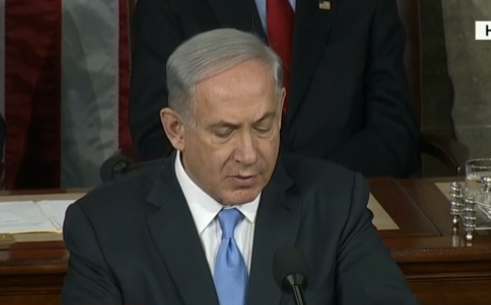
Now to that venerable list we must add the appalling video of a foreign leader, invited as a speaker by the Republican leadership of the House, denouncing the current negotiations of the State Department aimed at preventing Iran from developing a nuclear weapon [4], and in effect telling the US it should prepare instead to launch a catastrophic war against Iran. Whatever one may think of President Obama, the image of a packed House chamber, filled with slathering, mindlessly applauding Republicans and a majority of the feckless Democrats of the House and Senate (only 40 Democrats chose to boycott this treasonous address by Israeli Prime Minister Benyamin Netanyahu), leaping up and down and clapping to Netanyahu’s verbal garbage, is shocking. It also exposes the extent to which a tiny apartheid nation based upon a tribal ethic and a long history of genocide, has hijacked the foreign policy of the world’s most powerful country.

As Uri Avnery, an Israeli peace advocate and former Knesset member, writes in his article titled "The Speech," [5] the unseemly image of Republican members of Congress leaping up as one and hooting rabidly at almost every line uttered by Netanyahu reminded him of nothing so much as the Reichstag members in the 1930s leaping up to cheer and salute each applause line of Chancellor Adolph Hitler.

Years or decades from now, if the US still exists as even a nominal democracy, this video will surely shock any citizens who view it every bit as much as do the above listed iconic videos.

 
Two images, two legislatures, two speeches, same ugly reality

It is evident that the invitation by House Speaker John Boehner (R-Ohio) to Prime Minister Netanyahu was meant as a deliberate slap at President Obama, and a brazenly partisan attempt by Republicans in Congress to undermine the nuclear treaty the US, along with five other leading nations (France, the UK, Russia, China and Germany) have been trying to negotiate with Iran. But the inability of Democrats to respond by simply boycotting the staged event demonstrates the truth of the charge made by Avneri and many others that Israel, through its US lobbying arm, the America Israel Public Affairs Committee (AIPAC), effectively owns the Congress of the United States.

It is hard to imagine another allegedly democratic country in the world with a politics so dysfunctional that such a thing -- inviting a foreign political leader to address the nation’s legislature to criticize the actions of the country’s own government and head of state --could happen.

It bodes ill for America’s future if this kind of brazen manipulation of US politics and US foreign policy in the interest of ginning up a catastrophic war can be successful in substituting the perceived interests of some small and belligerent foreign state like Israel (or of one political faction within that state) for the interests of this nation itself.

One might hope that the long-term impact of this outrage would be an immediate weakening of Israeli influence over US politics. This would surely be the case if it were to lead to revulsion by average Americans at this gross interference in US affairs by a foreign leader. But given the number of gutless Democrats who, instead of boycotting Netanyahu’s talk en masse, slithered quietly into the House Chamber to listen to the Israeli leader’s bluster and lies, fearful that staying away could make them targets of AIPAC’s wrath in the next election, this outcome seems unlikely.

Unless the Obama administration -- not one known for its intestinal fortitude -- moves ahead and reaches a mutually acceptable nuclear deal with Iran in short order, there is a real risk that Israel could get its way, with the US instead switching to a default war footing and an attack on Iran’s (completely legal!) nuclear processing facilities. The results of such an illegal war on Iran -- a country of 70 million people -- are impossible to predict. These could range from a wider war, including nuclear weapons (Iran is backed by both Russia and China, and -- who knows? -- may, as a fail-safe measure, have even quietly obtained already functioning nuclear weapons on the black market to defend itself if attacked, while Israel itself is known to have over 200 nuclear weapons), to asymmetrical attacks on US interests around the globe and within the US itself. The impact of even a limited conflict with Iran on the US and global economy would be disastrous, with most experts predicting that it would shut down the Persian Gulf to oil tanker traffic indefinitely, raising oil prices astronomically.

And don’t forget that Israel has some 200 nuclear weapons itself – a point that Netanyahu carefully failed to mention, and that the sycophantic US corporate media obligingly also ignored, though clearly the easiest way to get Iran to shut down its nuclear fuel enrichment program would be for Israel and Iran to sign onto a program making the Middle East a nuclear-free zone – and for Israel to stop calling for a war on Iran.

Comparisons to Hitler and the Nazis are not to be made lightly of course, but when we see a whole legislative chamber filled with ignorant, hooting political yahoos calling for a rejection of negotiations with Iran and for a commitment to bomb that country if its leaders don’t simply cave in and unilaterally dismantle their nuclear enrichment program, it’s time to admit that we are witnessing the ugly reality of fascism. Either that or real-life version of “Planet of the Apes,” that Pierre Boulle short story in which the ape legislature features hooting representatives swinging from the chandeliers. The only odd thing about the Netanyahu speech as a farcical replay of Hitler’s address to the Reichstag is that this time the speaker being cheered isn’t this country’s Supreme Leader. It’s the leader of a tiny country half a world away.

And we have a video to prove it.


Source URL: http://thiscantbehappening.net/node/2679

Links:
[1] https://www.youtube.com/watch?v=Po5GlFba5Yg
[2] http://thiscantbehappening.net/www.youtube.com/watch?v=-cVdsMJ-nEg
[3] https://www.youtube.com/watch?v=xBrNFBabayo
[4] http://thiscantbehappening.net/www.wbur.org/2015/03/03/watch-live-netanyahu-congress-iran
[5] http://www.counterpunch.org/2015/03/06/the-speech/

Anti-Drone Activists Arrested Outside Vegas

34 Arrested while Protesting Drone Killing at Creech AFB

by ShutDownCreech

 
Organizers pledge to return twice yearly until Drone Killing Operations are Shut Down


A 5 day anti-drone protest at Creech Air Force Base near Las Vegas, Nevada, last week culminated in a massive blockade on Friday of the 2 gates leading into the base, repeatedly blocking traffic for an extended time during the early morning commute.

Over 150 activists from at least 18 states participated. 34 were arrested and charged with trespassing or blocking the roadway into Creech AFB, the most critical U.S. armed drone base in the country.

Among those arrested included Col. Ann Wright, a 29 year army veteran and former U.S. diplomat, whose inspiration last November led to the massive anti-drone protest at the base, after months of grassroots organizing. Wright said, "it is our duty as citizens to challenge government actions that not only are illegal, but also jeopardize national security-and the U.S. assassin drone policies do both."

Following the event, organizers and participants pledged to turn their effort into a twice a year campaign to put a halt to the illegal drone program. "We're going to keep coming back until we SHUT DOWN CREECH!," chanted the protesters as they were being hand-cuffed and detained.

Creech drone base is the site of control for CIA and Pentagon targeted drone killings that terrorize communities and remotely kill civilians in Afghanistan, Pakistan, Yemen, Iraq, Somalia and elsewhere. A recent independent study indicated that the identity of 28 out of 29 people executed by U.S. drone missiles are unknown, thus providing strong evidence that drone killings are primarily indiscriminate assassinations.

http://www.reprieve.org/us-drone-strikes-kill-28-unknown-people-for-every-intended-target-new-reprieve-report-reveals.html

After being arrested by Las Vegas Metropolitan police, arrestees were driven in a bus 150 feet across Highway 95 and released at "Camp Justice," a three day, 24/7 encampment where many protesters had stayed in below freezing night time temperatures. On Thursday, when protesters were making final plans and preparations for Friday's resistance action, the U.S. Air Force Thunderbird precision jet team flew six jets at extremely low altitudes over Camp Justice, making it nearly impossible to have discussions because of the noise of the jets. In spite of the purposeful interruption, creative plans were made and organizers were extremely pleased with the overall success of interrupting business as usual at the drone base;.

Traffic was backed up the highway and on frontage roads to the base multiple times in the morning, as waves of "affinity groups" staged independently planned actions at the gates to fulfill the intent to have a sustained interruption of base activities. These separate actions included a 40 person Veterans For Peace contingent that delivered a letter addressed to drone operators calling on them to not participate in war crimes related to targeted killing and to refuse to obey illegal orders. Another contingent blocked one gate with yellow crime scene tape, temporarily impeding traffic.

A third group marched in a long procession along the highway holding large colored photographs of drone victims, many of them children, passing along the backed up cars trying to enter the base, and ultimately laying down on the roadway in a "die-in" while doing a mass wailing to dramatize the grief and suffering experienced by victims. A fourth group carrie larged hand painted panels that depicted children, representing the young victims killed in Pakistan and Yemen, and created another wave of resistance to stop traffic.

These coordinated multi-wave efforts took the local law enforcement off guard, and plugged up traffic into both gates for some time.

Meanwhile, earlier in the week, in a completely independently sponsored effort, national anti-drone activists privately paid for an anti-drone ad to be aired on regional Nevada television, that criticized drone attacks and showed graphic images of mutilated children killed by drone attacks. The ad, (http://youtu.be/dP4vYOUDjQ8), was aired on CNN, MSNBC and other networks and was sponsored by KnowDrones.com.

The U.S.A.F. is having great difficulty keeping pilots in the drone program, as outlined in this article:
http://www.thenation.com/article/200337/american-drone-operators-are-quitting-record-numbers#

Nonetheless, U.S. government officials are ignoring the many signs that illustrate the failure of the very nature of drone assassinations and refuse to listen to the will of the people. Killler Drones make enemies.

During the protests, highway US-95 leading from Las Vegas to the base, renamed the Drone Victims Memorial Highway, was lined with nearly 100 tombstones, with the names and ages of children killed by U.S. drones. The Drone Victims Memorial Highway underscores the dark side of drone warfare and highlights Creech Drone Base as the criminal site where these unlawful killings are executed and from where drone pilots, following illegal orders, have caused the deaths of over 200 Pakistani children alone.

Activists will return to Creech Drone Base twice annually as a national mobilization until the last armed drone is grounded for good.

For more info: http://shutdowncreech.blogspot.com


CODEPINK: Women for Peace
Nevada Desert Experience (NDE)
Veterans For Peace (VFP)
Women’s International League for Peace and Freedom (WILPF)
Voices for Creative Nonviolence (VCNV)

Sunday, March 08, 2015

What Lies Behind the Apparent Power Israel Wields Over the US Congress?

Netanyahu: He Came, He Saw, He Conquered: The Power of Israel over the United States

by James Petras

How is it that the ruler (Benjamin Netanyahu) of a puny country (Israel) of 8.2 million (6.2 million Jews) with the 37th biggest economy (GDP in current prices) in the world dictates war policy and secures the willing submission of the legislature of the largest economy and most powerful military empire in the world?

What significance does Netanyahu’s speech to the US Congress have, beyond the fact that he uses it as a platform to attack the elected President of the US, to denounce US peace negotiations and to demand that Congress adopt policies designed to precipitate a war with Iran?

There have been times when history has played tricks with man and...has magnified the features of essentially small persons into a parody of greatness. - Rabindranath Tagore(on Benito Mussolini)

Netanyahu’s Dominant Presence in the US


There is only one reason that Netanyahu is received as a Viceroy overseeing and dictating strategic policy to what clearly is a servile colonial legislature: over the past quarter of a century, Israel’s proxy in the US, an entire panoply of Zionist political organizations, government officials, propaganda mills, media moguls, billionaires and millionaires, have deeply penetrated the legislature, executive and administrative centers of decision making. Netanyahu’s arrogance and “brazen” presumption (Financial Times, 3/4/15, p. 6) to dictate policy to the US Congress is rooted in the pre-existing power base created by the proxy Zionist power configuration.

Netanyahu can sneer, with a crooked smile, at the US President, because, after several decades of Zionist permeation of the US state, he knows that he comes not as an outside power but as a leader and spokesperson of an inside power.

His presence was hailed by all the mass media as a major event, as international news, for over a month in advance. With Napoleonic presumption he dared to announce in advance that he would advance a war thesis in the fashion of any head of state. He can act as an unelected dictator because the elected officials have been converted into docile and complicit subjects by his proxy power structure. Netanyahu follows the political precept of his predecessor Ariel Sharon, who faced with Israeli worrywarts criticizing his obstreperous intervention in US politics, once stated “Don’t worry. We lead the US by the nose”.

The crucial theoretical point is that the conditions, that enabled Netanyahu to come, to see and to conquer, were not of his doing. His presence in the US Congress and his message is derived from the power of his supporters, deeply embedded in the structure of political power in the US.

Otherwise, who would take serious his delusional military fantasies, his clinically paranoid vision of peaceful adversaries, conspiring to “nuke Israel” and then the world, without a single nuclear bomb!

Prominent among Netanyahu’s financial backers are a group of prominent Zionist lumpen-bourgeoisie, billionaires who lent to millions of borrowers at extortionate rates(between 1400 and 4000% ) and played a leading role in the fraudulent mortgage induced crises of 2009-forward.They include Al Goldstein co-founder of AvantCredit and CashNetUSA; Sasha Orloff and Jacob Rosenberg founders of Lendup; Daniel Gilbert founder of QuickenLoans - a predator subprime lender; Ronald Arnall owner of Ameriquest... They used part of their ill-gotten gains to ease their consciences by donating millions to Israeli and US Jewish causes. Being generous to Israel provides a sort of perverse “absolution” for screwing millions of Americans.

One does not need much imagination to envision them cheering Netanyahu’s AIPAC and Congressional diatribes. It is not surprising that the lumpen-bourgeoisie backs a lumpen-prime minister.

The best and the brightest among the Zionist phalanx of pundits, professors, lawyers, economists and financiers have created an aura of gravitas and profundity around this vulgar beerhall brawler.

This raises a basic question: Why do upwardly mobile, prosperous and elite-educated Zionist majorities enthusiastically pledge unconditional loyalty to a crude authoritarian foreign ruler who humiliates their country of birth?

Why did ten thousand American-born Zionist professionals stand and cheer, as they did the day before his congressional speech, as Netanyahu dictated his rabid bellicose political line to them at the AIPAC conference?

Is it because they believe he is their Chosen Leader of their Chosen Fatherland?


Netanyahu, with all his vulgarity and mediocrity, strikes a deep and abiding chord in the soul of his Zionist followers. They believe they are the collective geniuses of a superior species, who need not abide by the legal norms of non-Zionist states and international laws which hinder his colonial rule over millions of Palestinians.

What else but that identity of superiority allows the educated and prosperous, the humane and the cruel, to bond and welcome Netanyahu, as a modern secular Moses crossing the Potomac, delivering “the Jews” (for the messianic Netanyahu claims to speak for “all Jews”) from the mortal threats (Iran) cultivated by gentile politicians. The great majority of Zionist activists are deaf, dumb and blind to those who criticize and refute his infantile and grotesque lies, the scrofulous screeds about non-existing “existential threats” which infest his speeches. Worse they will terrorize and cow any critic, demand that their employers fire them, as they have done over the past two decades. They believe that the Palestinians, who Israel bombed into the Stone Age, are threats to Israel. They believe that nuclear weapon-less Iranians, facing hundreds of Israeli nuclear bombs, are a threat to Israel. They believe there is one “truth”: that all measures, speeches and actions, which enhance the power and glory of Israel, are virtuous. It is this “truth” that motivates hundreds of thousands of “virtuous” Zionists to donate hundreds of millions of dollars to buy and/or intimidate presidents and congresspeople, governors and mayors, university presidents and faculty, police informers and academic thugs. It is this Zionist power configuration, which allows a political low-life like Netanyahu to enter and dominate the legislative chamber and tell US citizens where and when their next war should take place. It is for this power configuration that Congressmen and women “perform” - applauding and jumping up on cue for each and every one of Netanyahu’s emotional ejaculations.

Broad sectors of the Israeli public were immensely impressed by Netanyahu’s capacity to humiliate the President, by his willingness to dictate policy to the US and by the hyperkinetic docility and submissiveness of US Congress people. But this is not surprising: After all, Israelis are used to dominating Palestinians and torturing them into submission and colonizing a whole people. Why shouldn’t they gloat and puff up with pride when Netanyahu speaks and acts as a colonial viceroy to the US? After all, their leader is dominating a so-called ‘world power’!

No doubt the Israeli empire loyalists will overwhelmingly vote for Netanyahu, even if the “opposition” claims they also denounce the US-Iranian peace negotiations. Opposition leaders Isaac Herzog and Tzipi Livni don’t have Netanyahu’s gangster look, that crooked smile that says to the US leaders: “We lead you by the nose and you love it!” What the rest of the world thinks of a braying donkey in Washington led by the nose is not hard to imagine: US world leadership certainly is not foremost in their minds…

There is much idle chatter from liberals, leftists and progressives, claiming that Netanyahu’s ‘brazen intervention’ would backfire; that it would damage relations with the US; that it would weaken and undermine US-Israeli relations and allow Iran to secure nuclear weapons. Liberal Zionists claim that Netanyahu’s speech would weaken support for Israel among Democratic congress people. Liberal Zionists claim that Netanyahu’s speech would weaken US support for Israel (God forbid!).

These lamentations have no substance; they are mendacious concoctions of minds which lack any capacity to understand power especially the permanent power of the Zionist power configuration.

Even a cursory reading of the political facts which preceded, accompanied and followed Netanyahu’s Congressional dictates, demonstrates the exact opposite.

Immediately after Netanyahu’s intervention, Congressional leaders moved ahead to fast track legislation to heighten Iranian sanctions, to veto any Executive agreement. The Republication majority and over half of the Democrats chose to back the “foreign Viceroy” on policies of war and peace.

Far from “prejudicing” relations with the Obama regime, the Administration in the person of Secretary of State John Kerry vetoed a measure passed by the UN Human Right Commission condemning Israel’s savage war crimes against Palestinians… Obama’s United Nations Ambassador Samantha Power did her usual belly crawl for Israel at the AIPAC conference following Netanyahu’s rousing diatribe. US-Iranian “negotiations” in Switzerland increasingly turned on exactly the issues Netanyahu demanded. US Secretary of State Kerry insisted on on-going intrusive inspections of Iran’s entire nuclear and military installations; retaining most sanctions for a decade; eliminating most enriched uranium …In a word disarming Iran, increasing its military vulnerability to an Israeli nuclear attack, without any deterrence or retaliatory capacity! Iran is formally negotiating with Kerry on behalf of the 5 plus 1, but the agenda and demands are set by the raucous over-voice of Netanyahu, who is the most influential invisible presence.

In other words, there is ample evidence that Netanyahu’s intervention, far from ‘damaging’ US-Israeli relations, further reinforced Israel’s power over the US. By securing the Administration’s declarations of unconditional loyalty while humiliating the President and seizing executive prerogatives, Israel demonstrates to the world that it can and will dictate US strategic policy and denounce its President with total impunity.

Netanyahu is far from being ostracized. He has a global platform from which to spew his rabid chauvinist diatribes against peace and negotiations. His speech, its content and style, received front page and extended prime time coverage. His war-mongering resonated with the editorial pages of the Wall Street Journal, the Washington Post and US News and World Report.

Netanyahu’s political line inspired AIPAC’s ten thousand ultra-Zionists, who stormed Capital Hall and demanded Congress people and Congressional staff act on His message. Not a single dissenting voice emanated from the Presidents of the 52 Major American (sic) Jewish organizations whose first loyalty continued to be toward Israeli interests as defined by their Prime Minister.

The voices of dissent among the few dozen Jews on Capitol Hill, and outside the AIPAC conference hall, did not register in Congress or among the vast majority of Jewish community leaders or in the mass media.

Contrary to the lamentations and claims that Netanyahu has “weakened” Israel, the facts on the ground demonstrate that he has strengthened his “leadership” among the billionaires who buy US Congressional leaders. He has demonstrated that US officials, even ones who he insults and attacks, will continue to support Israeli war crimes in international forums; regale Israel with $3 billion a year in military aid to enhance its military supremacy in the Middle East; and incorporate its demands in any strategic negotiations with ‘Islamic’ countries like Iran, even if it undermines the basis of any negotiated agreement.

Conclusion


Clearly Netanyahu alienated a minority of US Congressional Democrat but mostly on procedural issues of protocol rather than on the more substantive issues of mongering for war and sanctions against Iran. Netanyahu’s messianic claim to speak for “all Jews” did arouse over 2,000 American Jews and non-Jews to sign a paid advertisement denying his status as the Second Coming of Moses.

But as the rousing welcome and conclusion to his speech by the Congressional majority and the unanimity of AIPAC’s thousands demonstrate, Israel’s formidable Zionist power configuration still dominates US policy in the Middle East.

The ‘debate’ over Netanyahu’s episodic presence in the US Congress and humiliation of the US President is misplaced. What really needs to be debated is the more fundamental question of the permanent presence, power and prerogatives of the Zionist power configuration in the making of US Middle East policy.

No other visiting Prime Minister or President will be received with so much media attention and political fanfare as Netanyahu because none possess the formidable, organized, well-financed and disciplined political apparatus which Israel possess. This is an apparatus which defends and promotes US wars on behalf of Israel, Israel’s war crimes, land seizures and torture of Palestinians. That they support Netanyahu’s gross humiliation of Obama is not surprising – it merely confirms the “Law of the Return”: that for American Zionists there is only one true state of the Jews –and that is Israel; and that their only “true” leaders are Israelis… As it happens, today he is called Benjamin Netanyahu. And that any US policy, negotiations or agreements in the Middle East have to be in accord with their leader.

Congress knows that.

The “52” know that.

Only the majority of the American electorate, who still believe they live in a free and independent country, is not privy to that reality, even though Netanyahu’s intervention in the US Congress and gross humiliation of the President should tell them otherwise.

But then we live in a peculiar sui generis ‘meritocracy’ in which the opinions of the 2%, the so-called chosen people, counts more than that of 98% of our citizens.

The critics, Jews and non-Jews, must realize that their problem with Netanyahu requires them to delve deeper, and that their opposition needs to become more systematic and more directly confrontational with the Zionist power configuration. Otherwise, there is no basis for believing that the US can end national humiliations and regain its status as a free and democratic republic.

James Petras is the author of four volume study of US – Israeli relations. The most recent is The Politics of Empire: The US, Israel and the Middle East (Atlanta: Clarity Press 2014).           

Is It Just Hubris? Why the West Wishes War with Russia

Why Is the West Spoiling for a Fight with Russia?

by Murray Dobbin - New Cold War

What are the consequences when elected governments make policy based on faith and imperial hubris instead of science and expertise? It’s a question that is forcing itself on the world as we watch the United States, Britain, NATO and the Harper [Canada] government continue to up the ante in the confrontation with Russia over the Ukraine. There are real enough geo-political dangers in the world without actually creating them out of arrogance and ignorance but that is where we are right now and the consequences could be catastrophic.

Canada, Britain, the U.S. and the boys with their toys in NATO headquarters are looking for a fight with Russia. Throughout the confrontation and provocations these protagonists treat Russia as if it is some insignificant middle power that can be provoked with impunity. That is just dangerously stupid and stupidity is something the West can ill-afford given all its internal problems — economic stagnation, unsustainable inequality, collapsing infrastructure.

It is almost a truism that most politicians are, if not stupid, then woefully uninformed about the myriad of complex issues they have to deal with on a daily basis. Traditionally (going back millennia), it has been the job of the civil services to make them look smarter than they are — and they do that by rooting public policy in science and history. It is the job of professionals to bring to bear all the facts, nuances and consequences of policy initiatives. This is especially true of foreign policy and the nuanced determination of the national interest.

As I watch the Ukraine/Russia disaster unfold I am reminded of George W. Bush’s approach to formulating foreign policy. It was revealed in an article by Ronald Suskind in the New York Times magazine in April 2005. It was titled “Faith, Certainty and the Presidency of George W. Bush” and in it, Suskind quoted an unnamed aide to George W. Bush (later revealed to be the sinister Karl Rove). He wrote:

The aide said that guys like me were ‘in what we call the reality-based community,’ which he defined as people who ‘believe that solutions emerge from your judicious study of discernible reality.’ … ‘That’s not the way the world really works anymore,’ he continued. ‘We’re an empire now, and when we act, we create our own reality. And while you’re studying that reality… we’ll act again, creating other new realities, which you can study too, and that’s how things will sort out. We’re history’s actors… and you, all of you, will be left to just study what we do.’

They did, of course, create their own reality — the hideous Iraq war and all that followed from it including, now, the crazed and spreading “discernible reality” of ISIS. Rove’s madness is a chilling description of the anti-intellectual roots of U.S. policy-making, which continues under Obama.

‘Faith based’ foreign policy


While Canada is hardly an empire, Stephen Harper clearly sees himself and his government as junior partners — indeed in terms of rhetoric Canada often goes beyond the U.S., rattling sabres it doesn’t have. Rove was referring to his own community as “faith-based.” Stephen Harper could be a charter member.

But the problem with faith is that it leads you down a single road without the possibility of reassessment — it provides a false certainty in a world where there is none. The consequence with respect to the Russia-Ukraine conflict is obvious — and was revealed in a British House of Lords investigation.

The report accused both the U.K. and the EU of a “catastrophic misreading of the mood in the Kremlin in the run-up to the crisis in Ukraine” which led to them “sleepwalking” into the crisis.

How could they have misread Putin so badly? How was it possible that senior politicians could have been unaware of the centuries-long relationship between Russia and Ukraine? Of the EU and U.S. promise in the 1990s that they would not expand NATO eastward? Of the fact Russia, too, has “national interests”? Faith in their own vision and disdain for their own advisors seems to have something to do with it.

According to the BBC’s report on the Lords’ study:

It blamed Foreign Office cuts, which it said led to fewer Russian experts working there, and less emphasis on analysis. A similar decline in EU foreign ministries had left them ill equipped to formulate an ‘authoritative response’ to the crisis. The result was a failure to appreciate the depth of Russian hostility when the EU opened talks aimed at establishing an ‘association agreement’ with Ukraine in 2013.

British Prime Minister Cameron immediately rejected the conclusion of the report and doubled down on his crusader policy: “What we need to do now is deliver the strongest possible message to Putin and to Russia that what has happened is unacceptable.”

The crusader rhetoric doesn’t come just from the fevered minds of Harper, Cameron and Obama — the media and the punditry are mostly hands on deck, too. Even the normally rational, establishment magazine, Foreign Affairs (the publication of the Council on Foreign Relations — the unofficial custodian of U.S. foreign policy) has abandoned its role as rational foreign policy guidebook, according to economist Paul Craig Roberts, former treasury secretary under Ronald Reagan. In an article entitled “Washington Has Resurrected the Threat of Nuclear War”, Roberts is almost apoplectic in reviewing a Foreign Affairs article by a rabid Ukrainian nationalist who suggested Putin was about be brought down by internal revolt or, if not, then by an alliance of “North Caucasus, Chechnya, Ingushetia, Dagestan, and the Crimean Tatars.”

Ukraine needs billions


Canadian rhetoric is scarcely any more rational or in any way reflective of Canada’s national interests. It is all bellicose stupidity disguised as concern for democracy and sovereignty. And it’s mostly talk. Ukraine will need tens of billions in economic aid every year for a decade just to survive but the West has no intention of providing such largesse. We constantly encourage Ukrainian nationalism, mislead the Ukrainian people as to what we are willing to contribute and promote the false notion that Putin can be easily intimidated.

Talk of providing advanced weapons to the Ukrainian military is frighteningly irresponsible but the war-talk continues. We might expect that Canada would listen to others closer to the scene — like Germany’s Angela Merkel who is clearly alarmed at her English-speaking NATO partner’s recklessness. She stated on Feb. 7:

“I cannot imagine any situation in which improved equipment for the Ukrainian army leads to [Russian President Vladimir] Putin being so impressed that he believes he will lose militarily.”

Harper and his senior partners seem to project the consequences of their pronouncements no more than a few hours into the future. They seem barely cognizant that there will be consequences to their actions and rhetoric. If the West and the corrupt and inept Ukrainian government (watch the parliamentary fist fight here) ever did end up in a war with Russia it would be over in two weeks. Then what would Harper, Obama and Cameron do? Will NATO invade to free the Ukraine and confront nuclear-armed Russia? Do our “leaders” have any long-term policy at all? Do they think it’s all just a game?

We rarely hear from military intelligence on these matters because by its nature only the government has access to it. But it would be fascinating to know what they think of this endless provocation of Russia. We now have, thanks to David Pugliese of the Ottawa Citizen, a window onto how the military felt about another reckless Canadian enterprise — the overthrow of Libya’s Moammar Gadhafi… According to Pugliese, just days before Canadian planes began bombing, the military warned the government:

“There is the increasing possibility that the situation in Libya will transform into a long-term tribal/civil war. This is particularly probable if opposition forces received military assistance from foreign militaries.” 

They further warned that removing Gadhafi (a staunch ally in the fight against Al Qaeda) would “play into the hands of” Islamic militants.

The warnings were ignored. Then foreign affairs minister John Baird demonstrated the Harper government’s contempt for professional analysis and advice in his prediction of the future, declaring: “The one thing we can say categorically is that they couldn’t be any worse than Col. Gadhafi.” If by “worse” we mean a failed state, dozens of heavily armed militias fighting for control and ISIS now planning to use Libya as a launch pad for attacks on Europe then I guess Mr. Baird was wrong.

We are left to speculate what warnings the Canadian military are giving the Harperium regarding sophisticated weapons for the Ukrainian government.

You know things are really dangerous when one of America’s pre-eminent warmongers is worried about U.S. policy. Henry Kissinger recently wrote in The Huffington Post, “Far too often the Ukrainian issue is posed as a showdown: whether Ukraine joins the East or the West. But if Ukraine is to survive and thrive, it must not be either side’s outpost against the other — it should function as a bridge between them.”

Hubris and a contempt for analysis and history played out quickly in Libya. There is still a chance that the world can step back from the brink in Europe. If it doesn’t we will know who to blame.

Intellectual Underside of The Insecurity State


Rationalizing Lunacy: The Intellectual as Servant of the State

by Andrew J. Bacevich  - TomDispatch


Policy intellectuals -- eggheads presuming to instruct the mere mortals who actually run for office -- are a blight on the republic. Like some invasive species, they infest present-day Washington, where their presence strangles common sense and has brought to the verge of extinction the simple ability to perceive reality.

A benign appearance -- well-dressed types testifying before Congress, pontificating in print and on TV, or even filling key positions in the executive branch -- belies a malign impact. They are like Asian carp let loose in the Great Lakes.

It all began innocently enough. Back in 1933, with the country in the throes of the Great Depression, President Franklin Delano Roosevelt first imported a handful of eager academics to join the ranks of his New Deal. An unprecedented economic crisis required some fresh thinking, FDR believed. Whether the contributions of this “Brains Trust” made a positive impact or served to retard economic recovery (or ended up being a wash) remains a subject for debate even today. At the very least, however, the arrival of Adolph Berle, Raymond Moley, Rexford Tugwell, and others elevated Washington’s bourbon-and-cigars social scene. As bona fide members of the intelligentsia, they possessed a sort of cachet.

Then came World War II, followed in short order by the onset of the Cold War. These events brought to Washington a second wave of deep thinkers, their agenda now focused on “national security.” This eminently elastic concept -- more properly, “national insecurity” -- encompassed just about anything related to preparing for, fighting, or surviving wars, including economics, technology, weapons design, decision-making, the structure of the armed forces, and other matters said to be of vital importance to the nation’s survival. National insecurity became, and remains today, the policy world’s equivalent of the gift that just keeps on giving.

Tomgram: Andrew Bacevich, How to Create a National Insecurity State

[Note for TomDispatch Readers: Given that, in his piece today, Andrew Bacevich has such good things to say about American Reckoning: The Vietnam War and Our National Identity, Chris Appy’s new history of the American fallout from Vietnam, here’s a last reminder that, for a contribution of $100 (or more), you can get your own signed, personalized copy of that must-read book. Just check out our donation page for the details, as well as for other books we’re offering, including my own Shadow Government: Surveillance, Secret Wars, and a Global Security State in a Single Superpower World. Tom]

In our era in Washington, whole careers have been built on grotesque mistakes. In fact, when it comes to our various conflicts, God save you if you’re right; no one will ever want to hear from you again. If you’re wrong, however... well, take the invasion of Iraq. Given the Islamic State, that creature of the American occupation, can anyone seriously believe that the invasion that blew a hole in the heart of the Middle East doesn’t qualify as one of the genuine disasters of our time, if not of any time? In the mad occupation that followed, Saddam Hussein’s well-trained army and officer corps were ushered into the chaos of post-invasion unemployment and, of course, insurgency. Meanwhile, at a cost of $25 billion, a whole new military was trained that, years later, summarily collapsed when faced with insurgents led by some of those formerly out-of-work officers.

But the crew who pushed it all on Washington has never stopped yakking (or being listened to). They’ve been called back at every anniversary of the invasion to offer their wisdom in the New York Times and elsewhere, while those who counseled against such an invasion have been nowhere in sight. Some of the planners of the invasion and occupation are now advisers to Jeb Bush as he heads into the 2016 election campaign, while the policy wonks who went off to war with the generals (taking regular VIP tours of America’s battle zones) couldn’t be better thought of in Washington today.

Take Michael O’Hanlon of the Brookings Institution. When it comes to American war, you can count on one thing: he’s a ray of sunshine on any gloomy day. It hardly matters what year you’re talking about -- 2003, 2007, 2009, 2013, Iraq or Afghanistan -- and “our odds of success” are invariably “rather good” (if the U.S. military just pursues the path O’Hanlon advocates). Things always seem to be trending in the right direction; there’s invariably “progress,” always carefully qualified; Washington’s troops remain forever steadfast; chances are good that... you fill it in: the invasion will be successful, the occupation a smash, the surge a triumph of an unconventional sort, the latest Afghan election a positive step forward in a tough world. And here’s the amazing thing: year after year, op-ed after op-ed, he never seems to end up on the right side of anything, which seems to work like a charm in Washington.

In recent years, he’s made himself into an op-ed tag team with his former Princeton classmate David Petraeus. He began plugging General Petraeus as a “superb commander” back when and, despite the former CIA director’s recent misdemeanor plea deal for “providing his highly classified journals to a mistress,” he’s still touting him as a “national hero.” (“To my mind, what he did in Iraq was probably the greatest complex accomplishment by any American general since Washington in the Revolutionary War.”)

Since 2013, on op-ed pages nationwide, he and Petraeus have been promoting the idea that these aren’t the years of America’s decline, but of its rise to greater glory as the leader of a new North American Century (a line that Republicans are passionately running with for campaign 2016). If this came from anyone else, perhaps it would be a debatable position, but not with the O’Hanlon guarantee attached to it. Let’s just say it: if he thinks America is ascending, there’s only one possibility: it’s going down.

So many words and what are the odds that none of them would work out? Still, you might think that O’Hanlon is small potatoes in our large world. If so, think again. As TomDispatch regular Andrew Bacevich, author most recently of Breach of Trust: How Americans Failed Their Soldiers and Their Country, makes clear, O’Hanlon is part of a roiling mass of “policy intellectuals” who have given this country a distinctly hard time. Tom

Rationalizing Lunacy: 

The Intellectual as Servant of the State

by Andrew J. Bacevich

People who specialized in thinking about national insecurity came to be known as “defense intellectuals.” Pioneers in this endeavor back in the 1950s were as likely to collect their paychecks from think tanks like the prototypical RAND Corporation as from more traditional academic institutions. Their ranks included creepy figures like Herman Kahn, who took pride in “thinking about the unthinkable,” and Albert Wohlstetter, who tutored Washington in the complexities of maintaining “the delicate balance of terror.”

In this wonky world, the coin of the realm has been and remains “policy relevance.” This means devising products that convey a sense of novelty, while serving chiefly to perpetuate the ongoing enterprise. The ultimate example of a policy-relevant insight is Dr. Strangelove’s discovery of a “mineshaft gap” -- successor to the “bomber gap” and the “missile gap” that, in the 1950s, had found America allegedly lagging behind the Soviets in weaponry and desperately needing to catch up. Now, with a thermonuclear exchange about to destroy the planet, the United States is once more falling behind, Strangelove claims, this time in digging underground shelters enabling some small proportion of the population to survive.

In a single, brilliant stroke, Strangelove posits a new raison d'être for the entire national insecurity apparatus, thereby ensuring that the game will continue more or less forever. A sequel to Stanley Kubrick’s movie would have shown General “Buck” Turgidson and the other brass huddled in the War Room, developing plans to close the mineshaft gap as if nothing untoward had occurred.

The Rise of the National Insecurity State


Yet only in the 1960s, right around the time that Dr. Strangelove first appeared in movie theaters, did policy intellectuals really come into their own. The press now referred to them as “action intellectuals,” suggesting energy and impatience. Action intellectuals were thinkers, but also doers, members of a “large and growing body of men who choose to leave their quiet and secure niches on the university campus and involve themselves instead in the perplexing problems that face the nation,” as LIFE Magazine put it in 1967. Among the most perplexing of those problems was what to do about Vietnam, just the sort of challenge an action intellectual could sink his teeth into.

Over the previous century-and-a-half, the United States had gone to war for many reasons, including greed, fear, panic, righteous anger, and legitimate self-defense. On various occasions, each of these, alone or in combination, had prompted Americans to fight. Vietnam marked the first time that the United States went to war, at least in considerable part, in response to a bunch of really dumb ideas floated by ostensibly smart people occupying positions of influence. More surprising still, action intellectuals persisted in waging that war well past the point where it had become self-evident, even to members of Congress, that the cause was a misbegotten one doomed to end in failure.

In his fine new book American Reckoning: The Vietnam War and Our National Identity, Christian Appy, a historian who teaches at the University of Massachusetts, reminds us of just how dumb those ideas were.

As Exhibit A, Professor Appy presents McGeorge Bundy, national security adviser first for President John F. Kennedy and then for Lyndon Johnson. Bundy was a product of Groton and Yale, who famously became the youngest-ever dean of Harvard’s Faculty of Arts and Sciences, having gained tenure there without even bothering to get a graduate degree.

For Exhibit B, there is Walt Whitman Rostow, Bundy’s successor as national security adviser. Rostow was another Yalie, earning his undergraduate degree there along with a PhD. While taking a break of sorts, he spent two years at Oxford as a Rhodes scholar. As a professor of economic history at MIT, Rostow captured JFK’s attention with his modestly subtitled 1960 book The Stages of Economic Growth: A Non-Communist Manifesto, which offered a grand theory of development with ostensibly universal applicability. Kennedy brought Rostow to Washington to test his theories of “modernization” in places like Southeast Asia.

Finally, as Exhibit C, Appy briefly discusses Professor Samuel P. Huntington’s contributions to the Vietnam War. Huntington also attended Yale, before earning his PhD at Harvard and then returning to teach there, becoming one of the most renowned political scientists of the post-World War II era.

What the three shared in common, apart from a suspect education acquired in New Haven, was an unwavering commitment to the reigning verities of the Cold War. Foremost among those verities was this: that a monolith called Communism, controlled by a small group of fanatic ideologues hidden behind the walls of the Kremlin, posed an existential threat not simply to America and its allies, but to the very idea of freedom itself. The claim came with this essential corollary: the only hope of avoiding such a cataclysmic outcome was for the United States to vigorously resist the Communist threat wherever it reared its ugly head.

Buy those twin propositions and you accept the imperative of the U.S. preventing the Democratic Republic of Vietnam, a.k.a. North Vietnam, from absorbing the Republic of Vietnam, a.k.a. South Vietnam, into a single unified country; in other words, that South Vietnam was a cause worth fighting and dying for. Bundy, Rostow, and Huntington not only bought that argument hook, line, and sinker, but then exerted themselves mightily to persuade others in Washington to buy it as well.

Yet even as he was urging the “Americanization” of the Vietnam War in 1965, Bundy already entertained doubts about whether it was winnable. But not to worry: even if the effort ended in failure, he counseled President Johnson, “the policy will be worth it.”

How so? “At a minimum,” Bundy wrote, “it will damp down the charge that we did not do all that we could have done, and this charge will be important in many countries, including our own.” If the United States ultimately lost South Vietnam, at least Americans would have died trying to prevent that result -- and through some perverted logic this, in the estimation of Harvard’s youngest-ever dean, was a redeeming prospect. The essential point, Bundy believed, was to prevent others from seeing the United States as a “paper tiger.” To avoid a fight, even a losing one, was to forfeit credibility. “Not to have it thought that when we commit ourselves we really mean no major risk” -- that was the problem to be avoided at all cost.

Rostow outdid even Bundy in hawkishness. Apart from his relentless advocacy of coercive bombing to influence North Vietnamese policymakers, Rostow was a chief architect of something called the Strategic Hamlet Program. The idea was to jumpstart the Rostovian process of modernization by forcibly relocating Vietnamese peasants from their ancestral villages into armed camps where the Saigon government would provide security, education, medical care, and agricultural assistance. By winning hearts-and-minds in this manner, the defeat of the communist insurgency was sure to follow, with the people of South Vietnam vaulted into the “age of high mass consumption,” where Rostow believed all humankind was destined to end up.

That was the theory. Reality differed somewhat. Actual Strategic Hamlets were indistinguishable from concentration camps. The government in Saigon proved too weak, too incompetent, and too corrupt to hold up its end of the bargain. Rather than winning hearts-and-minds, the program induced alienation, even as it essentially destabilized peasant society. One result: an increasingly rootless rural population flooded into South Vietnam’s cities where there was little work apart from servicing the needs of the ever-growing U.S. military population -- hardly the sort of activity conducive to self-sustaining development.

Yet even when the Vietnam War ended in complete and utter defeat, Rostow still claimed vindication for his theory. “We and the Southeast Asians,” he wrote, had used the war years “so well that there wasn’t the panic [when Saigon fell] that there would have been if we had failed to intervene.” Indeed, regionally Rostow spied plenty of good news, all of it attributable to the American war.

”Since 1975 there has been a general expansion of trade by the other countries of that region with Japan and the West. In Thailand we have seen the rise of a new class of entrepreneurs. Malaysia and Singapore have become countries of diverse manufactured exports. We can see the emergence of a much thicker layer of technocrats in Indonesia.”

So there you have it. If you want to know what 58,000 Americans (not to mention vastly larger numbers of Vietnamese) died for, it was to encourage entrepreneurship, exports, and the emergence of technocrats elsewhere in Southeast Asia.

Appy describes Professor Huntington as another action intellectual with an unfailing facility for seeing the upside of catastrophe. In Huntington’s view, the internal displacement of South Vietnamese caused by the excessive use of American firepower, along with the failure of Rostow’s Strategic Hamlets, was actually good news. It promised, he insisted, to give the Americans an edge over the insurgents.

The key to final victory, Huntington wrote, was “forced-draft urbanization and modernization which rapidly brings the country in question out of the phase in which a rural revolutionary movement can hope to generate sufficient strength to come to power.” By emptying out the countryside, the U.S. could win the war in the cities. “The urban slum, which seems so horrible to middle-class Americans, often becomes for the poor peasant a gateway to a new and better way of life.” The language may be a tad antiseptic, but the point is clear enough: the challenges of city life in a state of utter immiseration would miraculously transform those same peasants into go-getters more interested in making a buck than in signing up for social revolution.

Revisited decades later, claims once made with a straight face by the likes of Bundy, Rostow, and Huntington -- action intellectuals of the very first rank -- seem beyond preposterous. They insult our intelligence, leaving us to wonder how such judgments or the people who promoted them were ever taken seriously.

How was it that during Vietnam bad ideas exerted such a perverse influence? Why were those ideas so impervious to challenge? Why, in short, was it so difficult for Americans to recognize bullshit for what it was?

Creating a Twenty-First-Century Slow-Motion Vietnam


These questions are by no means of mere historical interest. They are no less relevant when applied to the handiwork of the twenty-first-century version of policy intellectuals, specializing in national insecurity, whose bullshit underpins policies hardly more coherent than those used to justify and prosecute the Vietnam War.

The present-day successors to Bundy, Rostow, and Huntington subscribe to their own reigning verities. Chief among them is this: that a phenomenon called terrorism or Islamic radicalism, inspired by a small group of fanatic ideologues hidden away in various quarters of the Greater Middle East, poses an existential threat not simply to America and its allies, but -- yes, it’s still with us -- to the very idea of freedom itself. That assertion comes with an essential corollary dusted off and imported from the Cold War: the only hope of avoiding this cataclysmic outcome is for the United States to vigorously resist the terrorist/Islamist threat wherever it rears its ugly head.

At least since September 11, 2001, and arguably for at least two decades prior to that date, U.S. policymakers have taken these propositions for granted. They have done so at least in part because few of the policy intellectuals specializing in national insecurity have bothered to question them.

Indeed, those specialists insulate the state from having to address such questions. Think of them as intellectuals devoted to averting genuine intellectual activity. More or less like Herman Kahn and Albert Wohlstetter (or Dr. Strangelove), their function is to perpetuate the ongoing enterprise.

The fact that the enterprise itself has become utterly amorphous may actually facilitate such efforts. Once widely known as the Global War on Terror, or GWOT, it has been transformed into the War with No Name. A little bit like the famous Supreme Court opinion on pornography: we can’t define it, we just know it when we see it, with ISIS the latest manifestation to capture Washington’s attention.

All that we can say for sure about this nameless undertaking is that it continues with no end in sight. It has become a sort of slow-motion Vietnam, stimulating remarkably little honest reflection regarding its course thus far or prospects for the future. If there is an actual Brains Trust at work in Washington, it operates on autopilot. Today, the second- and third-generation bastard offspring of RAND that clutter northwest Washington -- the Center for this, the Institute for that -- spin their wheels debating latter day equivalents of Strategic Hamlets, with nary a thought given to more fundamental concerns.

What prompts these observations is Ashton Carter’s return to the Pentagon as President Obama’s fourth secretary of defense. Carter himself is an action intellectual in the Bundy, Rostow, Huntington mold, having made a career of rotating between positions at Harvard and in “the Building.” He, too, is a Yalie and a Rhodes scholar, with a PhD. from Oxford. “Ash” -- in Washington, a first-name-only identifier (“Henry,” “Zbig,” “Hillary”) signifies that you have truly arrived -- is the author of books and articles galore, including one op-ed co-written with former Secretary of Defense William Perry back in 2006 calling for preventive war against North Korea. Military action “undoubtedly carries risk,” he bravely acknowledged at the time. “But the risk of continuing inaction in the face of North Korea's race to threaten this country would be greater” -- just the sort of logic periodically trotted out by the likes of Herman Kahn and Albert Wohlstetter.

As Carter has taken the Pentagon’s reins, he also has taken pains to convey the impression of being a big thinker. As one Wall Street Journal headline enthused, “Ash Carter Seeks Fresh Eyes on Global Threats.” That multiple global threats exist and that America’s defense secretary has a mandate to address each of them are, of course, givens. His predecessor Chuck Hagel (no Yale degree) was a bit of a plodder. By way of contrast, Carter has made clear his intention to shake things up.

So on his second day in office, for example, he dined with Kenneth Pollack, Michael O’Hanlon, and Robert Kagan, ranking national insecurity intellectuals and old Washington hands one and all. Besides all being employees of the Brookings Institution, the three share the distinction of having supported the Iraq War back in 2003 and calling for redoubling efforts against ISIS today. For assurances that the fundamental orientation of U.S. policy is sound -- we just need to try harder -- who better to consult than Pollack, O’Hanlon, and Kagan (any Kagan)?

Was Carter hoping to gain some fresh insight from his dinner companions? Or was he letting Washington’s clubby network of fellows, senior fellows, and distinguished fellows know that, on his watch, the prevailing verities of national insecurity would remain sacrosanct? You decide.

Soon thereafter, Carter’s first trip overseas provided another opportunity to signal his intentions. In Kuwait, he convened a war council of senior military and civilian officials to take stock of the campaign against ISIS. In a daring departure from standard practice, the new defense secretary prohibited PowerPoint briefings. One participant described the ensuing event as “a five-hour-long college seminar” -- candid and freewheeling. “This is reversing the paradigm,” one awed senior Pentagon official remarked. Carter was said to be challenging his subordinates to “look at this problem differently.”

Of course, Carter might have said, “Let’s look at a different problem.” That, however, was far too radical to contemplate -- the equivalent of suggesting back in the 1960s that assumptions landing the United States in Vietnam should be reexamined.

In any event -- and to no one’s surprise -- the different look did not produce a different conclusion. Instead of reversing the paradigm, Carter affirmed it: the existing U.S. approach to dealing with ISIS is sound, he announced. It only needs a bit of tweaking -- just the result to give the Pollacks, O’Hanlons, and Kagans something to write about as they keep up the chatter that substitutes for serious debate.

Do we really need that chatter? Does it enhance the quality of U.S. policy? If policy/defense/action intellectuals fell silent would America be less secure?

Let me propose an experiment. Put them on furlough. Not permanently -- just until the last of the winter snow finally melts in New England. Send them back to Yale for reeducation. Let’s see if we are able to make do without them even for a month or two.

In the meantime, invite Iraq and Afghanistan War vets to consider how best to deal with ISIS. Turn the op-ed pages of major newspapers over to high school social studies teachers. Book English majors from the Big Ten on the Sunday talk shows. Who knows what tidbits of wisdom might turn up?

Andrew J. Bacevich, a TomDispatch regular, is a professor of history and international relations emeritus at Boston University’s Pardee School of Global Studies. He is writing a military history of America’s War for the Greater Middle East. His most recent book is Breach of Trust: How Americans Failed Their Soldiers and Their Country.

Follow TomDispatch on Twitter and join us on Facebook. Check out the newest Dispatch Book, Rebecca Solnit's Men Explain Things to Me, and Tom Engelhardt's latest book, Shadow Government: Surveillance, Secret Wars, and a Global Security State in a Single-Superpower World.

Copyright 2015 Andrew Bacevich

Cheering Hate, US Congress Hails Netanyahu

Congress Cheers Netanyahu’s Hatred of Iran

by Robert Parry - Consortium News

 March 3, 2015

Addressing Congress in the style of a State of the Union speech, Israeli Prime Minister Benjamin Netanyahu won 41 rounds of applause as U.S. lawmakers eagerly enlisted in the Israeli-Saudi conflict against Iran and its allies – an enthusiasm that may well entangle the U.S. military in more wars in the Middle East.


Israeli Prime Minister Benjamin Netanyahu speaking
to a joint session of the U.S. Congress on March 3, 2015.

Speaking to a joint session of Congress for the third time – tying British Prime Minister Winston Churchill for the record – Netanyahu went far beyond excoriating President Barack Obama’s negotiations with Iran to restrict but not eliminate its nuclear program. He portrayed Iran as a dangerous enemy whose regional influence must be stopped and reversed, a position shared by Israel’s new ally, Saudi Arabia.

Netanyahu declared: “In the Middle East, Iran now dominates four Arab capitals, Baghdad, Damascus, Beirut and Sanaa. And if Iran’s aggression is left unchecked, more will surely follow. So, at a time when many hope that Iran will join the community of nations, Iran is busy gobbling up the nations. We must all stand together to stop Iran’s march of conquest, subjugation and terror.”

Netanyahu’s reference to “Iran’s aggression” was curious since Iran has not invaded another country for centuries. In 1980, Saddam Hussein’s Iraq – at the urging of Saudi Arabia – invaded Iran. During that bloody eight-year war, Israel – far from being an enemy of Iran – became Iran’s principal arms supplier. Israel drew in the Reagan administration, which approved some of the Israeli-brokered arms deals, leading to the Iran-Contra scandal in 1986.

In other words, Israel was aiding Iran after the Islamic revolution overthrew the Shah in 1979 and during the time when Netanyahu blamed Iran for the attack on the U.S. Marine barracks in Beirut in 1983 and various acts of terrorism allegedly committed by Hezbollah, a Shiite militia in Lebanon. Israel only shifted toward hostility against Shiite-ruled Iran in the 1990s as Israel gradually developed a de facto alliance with Sunni-ruled and oil-rich Saudi Arabia, which views Iran as its chief regional rival.

Netanyahu’s choice of Arab cities supposedly conquered by Iran was strange, too. Baghdad is the capital of Iraq where the U.S. military invaded in 2003 to overthrow Saddam Hussein and his Sunni-dominated government — on Netanyahu’s recommendation. After the invasion, President George W. Bush installed a Shiite-dominated government. So, whatever influence Iran has in Baghdad is the result of a U.S. invasion that Netanyahu personally encouraged.

More recently, Iran has supported the embattled Iraqi government in its struggle against the murderous Islamic State militants who seized large swaths of Iraqi territory last summer. Indeed, Iraqi officials have credited Iran with playing a crucial role in blunting the Islamic State, the terrorists whom President Obama has identified as one of the top security threats facing the United States.

Netanyahu cited Damascus, too, where Iran has helped the Syrian government in its struggle against the Islamic State and Al-Qaeda’s Nusra Front. In other words, Iran is assisting the internationally recognized government of Syria hold off two major terrorist organizations. But Netanyahu portrays that as Iran “gobbling up” a nation.

The Israeli prime minister also mentioned Beirut, Lebanon, and Sanaa, Yemen, but those were rather bizarre references, too, since Lebanon is governed by a multi-ethnic arrangement that includes a number of religious and political factions. Hezbollah is one and it has close ties to Iran, but it is stretching the truth to say that Iran “dominates” Beirut or Lebanon.

Similarly, in Sanaa, the Houthis, a Shiite-related sect, have taken control of Yemen’s capital and have reportedly received some help from Iran, but the Houthis deny those reports and are clearly far from under Iranian control. The Houthis also have vowed to work with the Americans to carry on the fight against Yemen’s Al-Qaeda affiliate.

Leading the Battle


Indeed, Iran and these various Shiite-linked movements have been among the most effective in battling Al-Qaeda and the Islamic State, while Israel’s Saudi friends have been repeatedly linked to funding and supporting these Sunni terrorist organizations. In effect, what Netanyahu asked the Congress to do – and apparently successfully – was to join Saudi Arabia and Israel in identifying Iran, not Al-Qaeda and the Islamic State, as America’s chief enemy in the Middle East.

That would put the U.S.-Iranian cooperation in combating Al-Qaeda and the Islamic State in jeopardy. It could lead to victories by these Sunni terrorists in Syria and possibly even Iraq, a situation that almost surely would force the U.S. military to return in force to the region. No U.S. president could politically accept Damascus or Baghdad in the hands of openly terrorist organizations vowing to carry the fight to Europe and the United States.

Yet, that was the logic — or lack thereof — in Netanyahu’s appeal to Congress. As he put it, “when it comes to Iran and ISIS, the enemy of your enemy is your enemy.” He also argued that Iran was a greater threat than the Islamic State, a position that Israel’s Ambassador to the United States Michael Oren has expressed, too.

“The greatest danger to Israel is by the strategic arc that extends from Tehran, to Damascus to Beirut. And we saw the Assad regime [in Syria] as the keystone in that arc,” Oren told the Jerusalem Post in a 2013 interview
“We always wanted Bashar Assad to go, we always preferred the bad guys who weren’t backed by Iran to the bad guys who were backed by Iran” – even if the “bad guys” were affiliated with al-Qaeda.

In June 2014, then speaking as a former ambassador at an Aspen Institute conference, Oren expanded on his position, saying Israel would even prefer a victory by the brutal Islamic State over continuation of the Iranian-backed Assad in Syria. “From Israel’s perspective, if there’s got to be an evil that’s got to prevail, let the Sunni evil prevail,” Oren said.

Netanyahu made a similar point: “The difference is that ISIS is armed with butcher knives, captured weapons and YouTube, whereas Iran could soon be armed with intercontinental ballistic missiles and nuclear bombs.”

Of course, Iran has disavowed any interest in developing a nuclear bomb — and both the U.S. and Israeli intelligence communities agree that Iran has not been working on a bomb. Further, the negotiated agreement between Iran and leading world powers would impose strict oversight on Iran’s civilian nuclear program, leaving little opportunity to cheat.

Instead, Netanyahu wants the United States to lead an aggressive campaign to further strangle Iran’s economy with the goal of forcing some future “regime change.” The principal beneficiary of that strategy would likely be Saudi Arabia, which has served as the proselytizing center for the reactionary Wahabbi version of Sunni Islam, which inspired Osama bin Laden and Al-Qaeda.

Elements of the Saudi royal family also have long been known to support Islamist militants, including forces associated with bin Laden. Earlier this year, the New York Times reported that convicted al-Qaeda operative Zacarias Moussaoui identified leading members of the Saudi government as financiers of the terrorist network.

According to the story, Moussaoui said in a prison deposition that he was directed in 1998 or 1999 by Qaeda leaders in Afghanistan to create a digital database of the group’s donors and that the list included Prince Turki al-Faisal, then Saudi intelligence chief; Prince Bandar bin Sultan, longtime Saudi ambassador to the United States; Prince al-Waleed bin Talal, a prominent billionaire investor; and many leading clerics.

Moussaoui also said he discussed a plan to shoot down President George W. Bush’s Air Force One with a Stinger missile with a staff member at the Saudi Embassy in Washington, at a time when Bandar was the ambassador to the United States and considered so close to the Bush family that his nickname was “Bandar Bush.”

Moussaoui claimed, too, that he passed letters between Osama bin Laden and then Crown Prince Salman, who recently became king upon the death of his brother King Abdullah.

While the Saudi government denied Moussaoui’s accusations, Saudi and other Persian Gulf oil sheikdoms have been identified in recent years as financial backers of Sunni militants fighting in Syria to overthrow Assad’s largely secular regime, with al-Qaeda’s Nusra Front the major rebel force benefiting from this support.

Shared Israeli Interests


The Israelis also have found themselves on the side of these Sunni militants in Syria because the Israelis share the Saudi view that Iran and the so-called “Shiite crescent” – reaching from Tehran to Beirut – is the greatest threat to their interests.

That attitude of favoring Sunni militants over Assad has taken a tactical form with Israeli forces launching attacks inside Syria that benefit Nusra Front. For instance, on Jan. 18, 2015, Israel attacked Lebanese-Iranian advisers assisting Assad’s government in Syria, killing several members of Hezbollah and an Iranian general. These military advisers were engaged in operations against Nusra Front.

Meanwhile, Israel has refrained from attacking Nusra militants who have seized Syrian territory near the Israeli-occupied Golan Heights. One source familiar with U.S. intelligence information on Syria told me that Israel has a “non-aggression pact” with Nusra forces, who have even received medical treatment at Israeli hospitals.

Israel and Saudi Arabia have found themselves on the same side in other regional struggles, including support for the military’s ouster of the elected Muslim Brotherhood government in Egypt, but most importantly they have joined forces in their hostility toward Shiite-ruled Iran.

I first reported on the growing relationship between Israel and Saudi Arabia in August 2013 in an article entitled “The Saudi-Israeli Superpower,” noting that the complementary strengths of the two countries made their alliance a potentially powerful influence in the world. Israel wields enormous political and media clout — and possesses nuclear weapons — while the Saudis use their oil, money and investments. [For more details, see Consortiumnews.com’s “Saudis Said to Aid Israeli Plan to Bomb Iran.”]

What the world saw in Netanyahu’s bravura performance on Tuesday before the wildly applauding members of the U.S. Congress was him proving his value to his Saudi cohorts, demonstrating how he can make some of America’s most powerful politicians behave like trained seals, bouncing up and down to cheer him even when he openly seeks to undermine the sitting U.S. President.

Some of the loudest applause came when Netanyahu told the Congress, “My friends, for over a year, we’ve been told that no deal is better than a bad deal. Well, this is a bad deal. It’s a very bad deal. We’re better off without it.”

Netanyahu’s enthusiastic reception signaled to President Obama that he has little political support for a negotiated agreement with Iran and signaled to Iran that all their concessions are unlikely to lead to any meaningful easing of sanctions from the U.S. Congress.

Investigative reporter Robert Parry broke many of the Iran-Contra stories for The Associated Press and Newsweek in the 1980s. You can buy his latest book, America’s Stolen Narrative, either in print here or as an e-book (from Amazon and barnesandnoble.com). You also can order Robert Parry’s trilogy on the Bush Family and its connections to various right-wing operatives for only $34. The trilogy includes America’s Stolen Narrative. For details on this offer, click here.