Sunday, July 05, 2015

False Flag: The Short History of the Stars and Bars

False Flag Op: Heritage and Hokum in Rebel Banner Row

by Chris Floyd - Empire Burlesque

And now, an important message from the Hon. Ambrose Calhoun Merriweather, former governor of South Carolina: “My fellow Americans, as we gather to celebrate the birth of our nation, I am saddened to see how some people are trying to sow dissension and division among us, stirring up needless controversy over the Confederate battle flag that flies at the capital of our great state of South Carolina, and at some of our sister states across the South. How it pains me to see that flag cast down in the dirt as an emblem of dishonor.

This is wrong, my friends. For that flag represents heritage, not hatred. It has flown proudly at our capital since, uh, 1961, when it was first raised during the great Negro tribulation that was stirred up by that King fellow and his outside agitators. It was raised at state capitols by our brethren in Alabama in 1963 and in Georgia in 1965, in response to that same tribulation.

But in truth, the flying of our noble flag is more ancient than that. I remember as a boy in the 1940s, you could hardly see that beautiful banner anywhere. People didn’t even think about it. Why, it was almost as if the Civil War had ended generations before, and that the South had contributed many, many of its sons to fight in two World Wars on behalf of the nation their grandfathers had fought against. It was as if the same Federal government once led by Abraham Lincoln had spent decades building up the South, with roads, bridges, dams, levees, military bases and a never-ending stream of government contracts and other pork flowing to the states and districts of powerful Southern congressmen. Back then, you’d see a thousand American flags before you’d run across a Confederate flag anywhere.

But then came that first Tribulation, in the late Forties, when our Negroes were stirred up by Harry Truman and his so-called “anti-discrimination” laws. He even wanted to outlaw lynching. That’s when this little Southern boy began to see Confederate flags springing up everywhere — raised as a banner of defiance in defense of our non-hateful heritage of segregation, and our steadfast religious belief in the eternal wisdom of God in separating the races, and giving one of them the burden of leadership and dominion over all the others. This was the heritage the Federal government was trying to overthrow, and it was at this time that the battle flag used by the Army of Tennessee in the last 16 months of the war, and then by the Confederate navy, somehow became the emblem of all Southern heritage, although it never represented the Confederate nation nor was given any official recognition, nor did it ever fly at any Southern capital during the Civil War.

But after the Federal assault on segregation — and its godless attempt to destroy the benevolent white stewardship of the less fortunate races — this flag began to spread like kudzu, after rarely being seen for the best part of a century.

My friends, that was nearly 70 years ago. That's how ancient the heritage of this flag is. What it stands for is the valiant and violent attempt to defend the divinely appointed principles of segregation and supremacy. That’s what this flag represents.

It does not and cannot represent the entirety of Southern heritage, unless that heritage is reduced to nothing but four years of a war for slavery. It cannot and does not represent the Southerners who fought in the Revolutionary War. It cannot and does not represent the 400,000 white Southerners who fought for the Union in the Civil War. It cannot and does not represent all the Southerners who died fighting for the United States in WWI and WWII. And it most assuredly cannot and does not represent the millions upon millions of black Southerners who helped build this nation and have contributed beyond measure to the development of our economy, our culture and our values.

No sir, it doesn’t represent any of that. It was not raised across the South in the past few decades in order to honor the bravery and sacrifice of the Confederate dead. Most Confederate soldiers didn’t even fight under that particular flag. No, it was raised to honor the bravery and sacrifice of politicians and power-brokers in the 20th century who fought to deny their fellow citizens equal rights under the law. It was raised to honor those in the 20th century who fought to preserve the notion of white superiority. It was raised in the 20th century to say to meddling Yankees — and to the myriad of white Southern ‘race traitors’ who worked for equality — that nobody can tell our Southern elites what to do with our Negroes.

This is the heritage being supported by all those who today defend the flying of a flag used by the Army of Tennessee for 16 months some 150 years ago. This is what they are saying: remember those who fought for segregation and supremacy in the middle decades of the 20th century. That is what we are honoring when we fly that flag today. Long may it wave!”

Grexit to a New Western Civilization

Greece's Downfall and Redemption

by Finian Cunningham - Sputnik

Decades of exorbitant military spending account for Greece’s present downfall under an Olympian-sized debt. European governments and news media portray the problem of Greece’s financial woes as public spending profligacy.

The truth is that Greece’s debt mountain has been incurred from years of wasteful military splurging. That is the tragic downfall of the country, which European creditor governments and the mainstream news media tellingly ignore.

But in this understanding of Greece’s modern tragedy, there is hope for democratic renewal and redemption. Because that realisation permits a radically different option to restore Greece’s economy in a way that is rational and achievable, without piling up more debt and misery for the population. Instead of more austerity imposed on workers and pensioners, the solution is for Greece to embark on a massive disarmament programme to overturn decades of reckless militarism.

Greece’s outstanding total debt is around $320 billion – or 175 per cent of its national economic output (GDP). Its creditors – the Troika of European Union, European Central Bank and the International Monetary Fund – are insisting that the Athens government must oversee more public cuts.

The reality is that austerity is only driving the Greek economy into further depression and debt.

That inevitably means more and more of the Greek people’s sovereign rights whittled away to the point of becoming a vassal state dictated to by foreign governments and finance capital.

As a foreboding sign of things to come, Greek Prime Minister Alexis Tsipras’ latest offer of raising corporation taxes in place of cutting pensions was slapped down last week by the Troika.


Poll

The Greek bailout referendum is set for July 5. What do you think the outcome will be?


  • The Greeks will vote 'No', and an immediate Grexit will follow
  • The Greeks will vote 'Yes', and the austerity policy will remain
  • The Troika will finally agree to work out a reasonable compromise and Greece won't have to leave the EU

All pollsThe imperious demand for more austerity has now forced the Greek government to put the choice to the public in the form of a proposed referendum on the EU’s bailout terms, to be held on July 5.

Greece’s debt crisis appears to be heading to an even sharper crisis point. But the Greek origin of that word “krisis” also has a positive connotation of decisive event. The Greek people should reject the never-ending debt addiction that the EU creditors and IMF have hooked the country on. For that way only foreshadows increasing austerity and anti-democratic dictate.

What the Greek people can turn to is a realistic and altogether more democratic and humane option – of demanding their country slash its monstrous military spend.

Even after five years of economic catastrophe, Greece’s annual military budget amounts to $4 billion, according to the Stockholm International Peace Research Institute. That translates to 2.2 per cent of the nation’s GDP – a colossal drain on the economy.

To put Greece’s military spend into perspective, it is double the ratio that most other EU countries currently spend on defence. For example, Germany spends 1.2 per cent of GDP, Italy 1.1 per cent, Netherlands 1.2 per cent and Belgium 1.1 per cent.


If Greece were to cut its outsized military budget by half that would generate $2 billion in one year alone, which would pay off its immediate bill to the IMF and help the country reach a 1 per cent budget surplus that the Troika has set for 2015. In other words, that source of finance would obviate any further need for cutting pensions and workers’ salaries.

Why the Syriza government of Alexis Tsipras, which claims to be a radical socialist coalition, does not pursue this more imaginative and democratic alternative is a curious question. Last week, Tsipras offered to cut the military budget by $200 million – or a mere 5 per cent. But the offer was rebuffed by the IMF because it stated that its rules do not permit interference in a country’s defence policy. To which Tsipras and the Greek electorate should respond with their own rebuff of IMF absurdity – especially evident with the IMF’s throwing billions of dollars to the regime in Kiev which is waging war on the eastern Ukrainian population.

But that’s only a trifling start to addressing the Greek tragedy. The Greek people have legal and moral grounds to repudiate the entire debt mountain as illegitimate or, as economists would say, “odious debt”.

During the decade up to the onset of crisis in 2010, Greece was regularly spending 7 per cent of its GDP on military. Some estimate that during that decade the country spent a total of $150 billion on defence – or half of the current debt pile.

As Greek economist Angelos Philippides told the Guardian back in April 2012: “For a long time Greece spent 7 per cent of its GDP on defence when other European countries spent an average 2.2 per cent. If you were to add up that compound 5 per cent [difference]… there would be no debt at all.”

Moreover, Greece’s past military expenditure was mired in corruption.

In October 2013, ex-defence minster Akis Tsochatzopoulous of the previous PASOK government was jailed for 20 years in a bribery case involving $75 million in kickbacks.

And here is an ironic twist in this Greek tragedy. The biggest European weapons dealers to Greece are German and French companies. In the Tsochatzopoulous scandal, German company Ferrostaal paid a fine of $150 million for its part in using bribes to clinch the sale of four submarines.

It was an open secret that Greece’s military largesse was for years stinking with corruption. Yet the German and French authorities did nothing to derail this gravy train. The Berlin and Paris governments continued to ply Greece with loans because the country was using the money to buy massive amounts of weapons from their manufacturers.

Today, the single biggest institutional creditors to Greece are Germany and France. Those countries stand accused of criminal irresponsibility in racking up Greece’s debt precisely because so much of the money was being spent to prop up the German and French economies through lucrative arms sales.

It is a monumental irony that German leader Angela Merkel is most vehement in lecturing Greece about “living within its means”. Rather than directing corrective action at the source of the problem, it is Greek workers, pensioners, the young and infirm who are being made to pay for the largesse that they actually never saw.

If the Greek people repudiate the entirely artificial debt crisis, it would restore their country’s economy on a sound footing. Of course, the country’s bloated military will not be happy with that. The danger of a military coup is a real threat given the country’s history of fascist dictatorship during the US-backed “regime of the colonels” between 1967-1974. Perhaps this is what the Syriza government is afraid of.

And, to be sure, the Troika of EU leadership, ECB and IMF will be intensely displeased if the Greek people go for the radical alternative of rejecting debt and austerity.However, in the battle shaping up, the Greek people have natural justice on their side. They should and can reject debt slavery and dictate. By doing so, Greece may redeem the meaning of “Demos Kratia” – People Power. And what a beautiful denouement in the Greek tragedy that would be, not only for the people of Greece but right across all the debt-ridden Western countries.

Greece is hailed as the ancient birthplace of democracy. Two millennia on, it could also be the very place for its renaissance.

Saturday, July 04, 2015

Forever War: Pentagon Version 20.15

The Pentagon’s “2015 Strategy” For Ruling the World

by Mike Whitney - Counterpunch

On Wednesday, the Pentagon released its 2015 National Military Strategy, a 24-page blueprint for ruling the world through military force. While the language in the report is subtler and less incendiary than similar documents in the past, the determination to unilaterally pursue US interests through extreme violence remains the cornerstone of the new strategy. Readers will not find even a hint of remorse in the NMS for the vast destruction and loss of life the US caused in countries that posed not the slightest threat to US national security. Instead, the report reflects the steely resolve of its authors and elite constituents to continue the carnage and bloodletting until all potential rivals have been killed or eliminated and until such time that Washington feels confident that its control over the levers of global power cannot be challenged. 

As one would expect, the NMS conceals its hostile intentions behind the deceptive language of “national security”. The US does not initiate wars of aggression against blameless states that possess large quantities of natural resources. No. The US merely addresses “security challenges” to “protect the homeland” and to “advance our national interests.” How could anyone find fault with that, after all, wasn’t the US just trying to bring peace and democracy to Afghanistan, Iraq, Libya and now Syria? 

In the Chairman’s Forward, Joint Chiefs of Staff Gen. Martin Dempsey attempts to prepare the American people for a future of endless war:

“Future conflicts will come more rapidly, last longer, and take place on a much more technically challenging battlefield. … We must be able to rapidly adapt to new threats while maintaining comparative advantage over traditional ones … the application of the military instrument of power against state threats is very different than the application of military power against non state threats. We are more likely to face prolonged campaigns than conflicts that are resolved quickly … that control of escalation is becoming more difficult and more important.” (Document: 2015 U.S. National Military Strategy, USNI News) 

War, war and more war. This is the Pentagon’s vision of the future. Unlike Russia or China which have a plan for an integrated EU-Asia free trade zone (Silk Road) that will increase employment, improve vital infrastructure, and raise living standards, the US sees only death and destruction ahead. Washington has no strategy for the future, no vision of a better world. There is only war; asymmetrical war, technological war, preemptive war. The entire political class and their elite paymasters unanimously support global rule through force of arms. That is the unavoidable meaning of this document. The United States intends to maintain its tenuous grip on global power by maximizing the use of its greatest asset; its military. 

And who is in the military’s gunsights? Check out this excerpt from an article in Defense News: 

“The strategy specifically calls out Iran, Russia and North Korea as aggressive threats to global peace. It also mentions China, but notably starts that paragraph by saying the Obama administration wants to “support China’s rise and encourage it to become a partner for greater international security,” continuing to thread the line between China the economic ally and China the regional competitor.

“None of these nations are believed to be seeking direct military conflict with the United States or our allies,” the strategy reads. “Nonetheless, they each pose serious security concerns which the international community is working to collectively address by way of common policies, shared messages, and coordinated action.” (Pentagon Releases National Military Strategy, Defense News) 

Did you catch that last part? “None of these nations are believed to be seeking direct military conflict with the United States or our allies. Nevertheless, they each pose serious security concerns.” 

In other words, none of these countries wants to fight the United States, but the United States wants to fight them. And the US feels it’s justified in launching a war against these countries because, well, because they either control vast resources, have huge industrial capacity, occupy an area of the world that interests the US geopolitically, or because they simply want to maintain their own sovereign independence which, of course, is a crime. According to Dempsey, any of these threadbare excuses are sufficient justification for conflict mainly because they “pose serious security concerns” for the US, which is to say they undermine the US’s dominant role as the world’s only superpower. 

The NMS devotes particular attention to Russia, Washington’s flavor-of-the-month enemy who had the audacity to defend its security interests following a State Department-backed coup in neighboring Ukraine. For that, Moscow must be punished. This is from the report: 

“Some states, however, are attempting to revise key aspects of the international order and are acting in a manner that threatens our national security interests. While Russia has contributed in select security areas, such as counternarcotics and counterterrorism, it also has repeatedly demonstrated that it does not respect the sovereignty of its neighbors and it is willing to use force to achieve its goals. Russia’s military actions are undermining regional security directly and through proxy forces. These actions violate numerous agreements that Russia has signed in which it committed to act in accordance with international norms.” (2015 NMS) 

Russia is an evildoer because Russia refused to stand by while the US toppled the Ukrainian government, installed a US stooge in Kiev, precipitated a civil war between the various factions, elevated neo Nazis to positions of power in the security services, plunged the economy into insolvency and ruin, and opened a CIA headquarters in the Capital to run the whole shooting match. This is why Russia is bad and must be punished. 

But does that mean Washington is seriously contemplating a war with Russia? 

Here’s an excerpt from the document that will help to clarify the matter: 

“For the past decade, our military campaigns primarily have consisted of operations against violent extremist networks. But today, and into the foreseeable future, we must pay greater attention to challenges posed by state actors. They increasingly have the capability to contest regional freedom of movement and threaten our homeland. Of particular concern are the proliferation of ballistic missiles, precision strike technologies, unmanned systems, space and cyber capabilities, and weapons of mass destruction (WMD) technologies designed to counter U.S. military advantages and curtail access to the global commons.” (2015 NMS) 

It sounds to me like the Washington honchos have already made up their minds. Russia is the enemy, therefore, Russia must be defeated. How else would one “counter a revisionist state” that “threatens our homeland”? 

Why with Daisy Cutters, of course. Just like everyone else. 

The NMS provides a laundry list of justifications for launching wars against (imaginary) enemies of the US. The fact is, the Pentagon sees ghosts around every corner. Whether the topic is new technologies, “shifting demographics” or cultural differences; all are seen as a potential threat to US interests, particularly anything related to the “competition for resources.” In this skewed view of reality, one can see how the invasion of Iraq was justified on the grounds that Saddam’s control of Iraq’s massive oil reserves posed a direct challenge to US hegemony. Naturally, Saddam had to be removed and over a million people killed to put things right and return the world to a state of balance. This is the prevailing view of the National Military Strategy, that is, that whatever the US does is okay, because its the US. 

Readers shouldn’t expect to find something new in the NMS. This is old wine in new bottles. The Pentagon has merely updated the Bush Doctrine while softening the rhetoric. There’s no need to scare the living daylights out of people by talking about unilateralism, preemption, shrugging off international law or unprovoked aggression. Even so, everyone knows that United States is going to do whatever the hell it wants to do to keep the empire intact. The 2015 National Military Strategy merely confirms that sad fact.

Mike Whitney lives in Washington state. He is a contributor to Hopeless: Barack Obama and the Politics of Illusion (AK Press). Hopeless is also available in a Kindle edition. He can be reached at fergiewhitney@msn.com.

Creating Islamic "Terrorism" at Home: A CIA How To

The CIA's Creation of "Islamic Terrorism" on American Soil

by Dr. Paul L. Williams - Global Research

Islamic paramilitary camps have been set up in the United States and Canada to train African American Muslims in guerilla warfare. After months of training on firing ranges and obstacle courses, the black Muslims are sent to Pakistan where they receive advanced training in explosives. Many never return.

Stories about these camps are not new. They have been reported by the main stream media, including Fox News.

The origin of these compounds for would-be jihadis dates back to 1979, when the Agency sent hundreds of radical Islamic clerics to the United States in an effort to recruit African American Muslims for the holy war against the Soviets in Afghanistan.

The Tablighi Missionaries


By and large, these missionaries hailed from Pakistan and belonged to Tablighi Jamaat, a Muslim movement with 150 members in 213 countries.[1] Upholding a strict interpretation of Islamic law (shariah), the Tablighi were united in their resistance to Western culture; their insistence that Muslims should avoid contact with all those who do not share their beliefs; and their approval of jihad by sword (jihad bin saif).[2] Members of the movement gathered every year for three days in the small Pakistani town ofRaiwind.

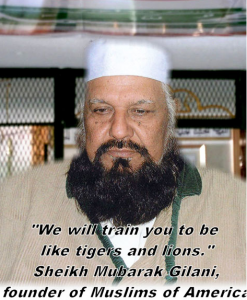
In 1979, Sheikh Mubarek Ali Gilani, a Tablighi missionary from Lahore, Pakistan, arrived in Brooklynwhere he called upon members of Dar ul-Islam, a notoriously violent street gang, to take arms in the great jihad. Scores answered his call and were headed off to Pakistan with payments of thousands of dollars in cash and promises of seventy houris in seventh heaven, if they were killed in action.[3]

Welcome To Islamberg


By 1980, the Agency realized that considerable expense could be saved by setting up paramilitary camps under the supervision of Shiekh Gilani in a rural area of the country. An ideal location was located near Hancock New York at the base ofPointMountain, where the east and west branches of the Delaware River converge to form the headwaters that flow throughPennsylvania and New Jersey to theAtlantic Ocean. The rocky terrain was infested with rattlesnakes, and the woods were home to black bears, coyotes, wolves, and a few bobcats. Islamberg, a seventy acre complex, came into existence.

Firing ranges and obstacle courses were set up in Islamberg along with a massive underground bunker and a landing strip. The residents lived in single-wide trailers that lined the hillside. The settlement contained a small shack that served as a laundry facility; a claptrap community center; a tiny grocery store, and a masjid. A sentry post was placed at the entranceway.[4]


The sound of gunfire and explosions emanating from the property alarmed local residents, who filed complaints with local and state law enforcement agencies. But a marked law enforcement vehicle never appeared at the compound.[5] Islamberg was off-limits to police inspection on the spurious grounds of “national security.”

The camp also came to contain an illegal cemetery where bodies were buried in unmarked graves.[6] This alone should have warranted a raid by the New York State Police. But not even dead bodies could prompt a police investigation.

When Islamberg was established, Gilani presented himself as an employee of the CIA and the future jihadis, who resided in the compound, called themselves CIA operatives.[7] Few in law enforcement doubted the professed credentials of the Muslim newcomers.

Communities of the Impoverished


Islamberg was a great success. Hundreds of African American Muslims made their way to Afghanistanand joined the ranks of the mujahedeen. Several were killed in action.[8] Others, including Clement Rodney Hampton-El, returned to the U.S. to plot the 1993 bombing of the World Trade Center in New York.[9]

Under the CIA’s directions, a host of other paramilitary camps were established in such places as Red House, Virginia; Commerce, Georgia; York, South Carolina; Dover, Tennessee; Buena Vista, Colorado; Macon, Georgia; Squaw Valley, California; Marion, Alabama; Talihina, Oklahoma; and Toronto, Ontario.[10]

Gilani placed Islamberg and the other camps under a governing organization called “Jamaat ul-Fuqra” or “the community of the impoverished.” He established the headquarters of this “charity” in Lahore. The American arm of Jamaat ul-Fuqra became the Muslims of the Americas,” a tax-exempt corporation with Gilani’s mosque in Brooklynas its address.[11]

Increased Need of Radicals


The Soviet withdrawal from Afghanistan in 1989 did not spell an end to the CIA’s support of radical Islam. Throughout the 1990s, Dr. Ayman Zawahiri, al Qaeda’s second in command, travelled at the expense and bidding of the CIA throughout Central Asia, where he cultivated new armies of jihadis to destabilize the newly created republics. His efforts resulted in the uprising of the Chechens against the Russian Federation, the attempted toppling of the government in Uzbekistan, and the insurgence of the Uigurs in the Xinjiang provinceof China.[12]

A dutiful operative, Dr. Zawahiri met regularly with U.S.military and intelligence officials at the U.S.embassy in Baku, Azerbaijanto plan the Balkan operations in which the CIA worked with al Qaeda to overthrow the government of Slobodan Milosevic for the creation of “Greater Albania,” encompassing Albania, Kosovo, and parts of Macedonia. [13]

These operations, particularly in the Balkans, required the recruitment of more and more jihadis. Gilani’s camps continued to prosper. And more and more of his African American recruits appeared among the rank and file mujahedeen in various theaters of warfare throughout the world.

Dr. Zawahiri’s help was so valuable that he was granted permanent U.S.residence by the U.S. Immigration and Naturalization Service in January 2000.[14]

The Rise of ISIS


After 9/11, the Agency continued to cultivate Islamic holy warriors to maintain the “strategy of tension” in the Middle East, the Balkan states, and Central Asia and to mount new uprisings in Africa to expandU.S.hegemony. The grand purpose of these enterprises wasUSeconomic and political control ofEurasia. Zbigniew Brzezinski, former Secretary of State and leading strategist for the Council on Foreign Relations, writes:

For America, the chief geopolitical prize is Eurasia. . . . Now a non-Eurasian power is preeminent in Eurasia – - – and America’s global primacy is directly dependent on how long and how effectively its preponderance on the Eurasian continent is sustained. . . . To put it in a terminology that harkens back to the more brutal age of ancient empires, the three great imperatives of imperial geostrategy are to prevent collusion and maintain security dependence among the vassals, to keep the tributaries pliant and protected, and to keep the barbarians from coming together.[15]

In accordance with the strategy of keeping “the barbarians from coming together,” ISIS forces were and are trained at a secret U.S. military base in the Jordanian town of Safawi.[16] The weapons for ISIS came, compliments of the Agency, from the arsenal of deposed Libyan dictator Muammar Qadhafi. The shipment of these weapons to ISIS in Syria was supervised in 2012 by David Petraeus, the CIA director who would soon resign when it was alleged that he was having an affair with his biographer.[17]

Supply and Demand


In response to the increased demand, Gilani continued to churn out more and more African American jihadis. More and more training camps opened, including one in Texas.[18] More and more bodies were buried in unmarked graves. More and more complaints were made to law enforcement officials. And more and more graduates from the training camps made their way toPakistan.

Blowback


Of course, there was blowback to the CIA’s establishment on Islamic paramilitary camps on American soil. Over the years, numerous members of Jamaat ul Fuqra have been convicted in U/S. court of such crimes as conspiracy to commit murder, firebombing, gun smuggling, and workers’ compensation fraud. Others remain leading suspects in criminal cases throughout the country, including ten unsolved assassinations and seventeen firebombings between 1979 and 1990.[19]

In 2001, a resident of the ul-Fuqra camp in California was charged with first-degree murder in the shooting of a sheriff’s deputy; another was charged with gun-smuggling; and twenty-four from the camp in Red House, Virginia were convicted of firearms violations.[20]

By 2004 investigators uncovered evidence that purportedly linked both the Washington, DC “sniper killer” John Allen Muhammad and “Shoe Bomber” Richard Reid to Gilani’s group and reports surfaced that Wall Street Journal reporter Daniel Pearl had been captured and killed in the process of attempting to gain an interview with Sheikh Gilani in Pakistan.[21]

By 2015, Jamaat ul-Fuqra had been involved in more terror attacks on America soil (30 and counting) than all the other terrorist groups combined. Despite these attacks, the group has never been placed on the official US Terror Watch List, and the Muslims of the Americascontinues to operate as a legitimate non-profit, tax-exempt organization.[22]

The Warning


Investigators, including Patrick Walsh and William Krayer, who have visited Islamberg and other paramilitary settlements, believe that the next major attack on US soil will emanate from Gilani’s jamaats of homegrown terrorism. Based on the history of the CIA’s involvement in the creation of these camps, such an attack may occur in accordance with the Agency’s own design.

Dr. Paul L. Williams is the author of Operation Gladio: The Unholy Alliance between the Vatican, The CIA, and the Mafia.

Notes

[1] Alex Alexiev, “Tablighi Jamaat: Jihad’s Stealthy Legion,” Middle East Quarterly, no. 1 (Winter 2005)

[2] Jane I. Smith, Islam in America (New York: Columbia University Press, 1999), p. 161.
[3] Robert Dannin, Black Pilgrimage to Islam (New York:OxfordUniversity Press, 2002),
[4] Douglas J. Hagmann, “Special Report: Jamaat ul-Fuqra Training Compound Inside the U.S.,” Northeast Intelligence Network, February 28, 2006.
[5] Ibid.
[6] Paul L. Williams, Crescent Moon Rising: The Islamic Transformation of America (Amherst,New York: Prometheus Books, 2013), p. 134.
[7] “Afghanistan Update,” Daily Telegraph (London), August 5, 1983; Los Angeles Times, August 5, 1983.
[8] Ibid
[9] Zachary Crowley, “Jamaat ul-Fuqra Dossier,” Center for Policing Terrorism, March 16, 2005.
[10] Gordon Gregory and Sonna Williams, “Jamaat ul-Fuqra,” Special Research Report, Regional Organized Crime Information Center, 2006.
[11] Ibid.
[12] Nafeez Mosaddeq Ahmed, “Whistleblower: Al Qaeda Chief Was US Asset,” Huffington Post, May 21, 2013.
[13] Sibel Edmonds, “Know Your Terrorists: Ayman al-Zawahiri,” Boiling Frogs Post, February 16, 2013.
[14] Rory McCarthy, “The Real Ayman al-Zawahiri,” The Guardian, August 5, 2005. See also Michel Chossudovsky, The Globalization of War (Montreal: Global Research Rublishers, 2015), p. 111.
[15] Zbigniew Brzezinski, The Grand Chessboard: American Primacy and Its Geostrategic Imperative (New York: Basic Books, 1997), pp. 20, 40.
[16] “Americans Are Training Syria Rebels in Jordan,” Reuters, March 10, 2013.
[17] Ibid.
[18] Ryan Mauro, “Islamic Terror Enclave Discovered in Texas,” The Clarion Project, February 18, 2014.
[19] “Jamaat ul-Fuqra: Terror Group ofPakistan,”Institute ofContact Management, 2001.
[20] Ibid.
[21] “The Jamaat ul-Fuqra Threat,” Stratfor, Security Consulting Intelligence Resources, June 3, 2005.
[22] Patrick B. Briley, “AL Fuqra: U.S. Islamic Terror Network Protected by FBI, U.S. State Department, Liberty Post, July 28, 2006.

Who Can Liberate Palestine? Who Will?

If ISIS Doesn't Liberate Palestine, Who Will?

by Franklin Lamb - CounterPunch

Ein el Helwe Palestinian camp, Lebanon.

This is one of the questions ricocheting between Palestinians in Syria and Lebanon, posed also by ISIS (Da’ish) operatives, as the hot summer months and plummeting quality of existence raise tensions in the refugee camps and social gatherings.

With its resilience, on-the-ground “achievements”, adaptability, global franchising, copy-cat knock-offs, chameleon-like adaptations, combinations and permutations, and slick honing of medium and message, ISIS is offering oppressed and desperate populations in this region both hope and fantasy for escaping their deepening misery. The dream is to escape abject poverty and indignity by any means necessary, and joining ISIS or other like-minded cash-flush groups, which seem to appear out of thin air these days, is the most promising way to do it.

Some people in Lebanon and Syria are wondering why it took ISIS so long to present a detailed plan to Palestinian refugees to liberate their country, now in its 67th year of brutal Zionist occupation. This subjugation has has created an Apartheid state that, according to South African leader Bishop Desmond Tutu and others, exceeds even the crimes of the Afrikaner National Party. And like the Israelis, the ANP also began their racist occupation of a majority-indigenous “less civilized” population in 1948. South African apartheid ended in 1994, but in Palestine it continues to metastasize. ISIS representatives in the camps are pledging to destroy the Zionist occupation and boast about opening up Palestine to Full Return within two years.

Who is listening to Da’ish (ISIS)?


In the early days of the crisis in Syria, many Palestinians fleeing to Lebanon quickly returned to whatever fate held back in Syria after they saw the conditions in Lebanon’s camps. But as the fighting between Syrian rebels and government forces intensified in Damascus, they became trapped in the camps. Alongside their fellow Palestinians in Lebanon, these new refugees sank ever more deeply into dire poverty.

During recent discussions with a sampling of refugees from several camps in Lebanon and Syria, it’s not surprising that the main part of the conversation quickly moves to subjects long familiar to those of us who have lived among Palestinians in this region. The list of grievances is ever-expanding and ISIS supporters and recruiters take advantage of this in order to round up recruits and sympathizers to join their growing ranks.

These grievances include frustration and anger over the perceived pervasive corruption among political and religious “leaders” who basically speak gibberish while urging patience for the next life, or promise the fruits of countless ‘dialogue’ sessions among sworn political enemies that to date have achieved absolutely nothing to help those most in need. Lebanon’s Parliament has recently ruled against the right to work and home ownership, and this now ranks near the top of any list of refugee grievances. One could also add: severe camp overcrowding, lack of hygienic infrastructures, declining health care, rising illnesses among children due to respiratory diseases and more than a dozen easily preventable communicable illnesses, shortages of medicines, drugs and drug gang violence, increasing tension and gun battles among militia (this is almost weekly – most recently in the Ein el Helwe camp in Saida and this week, in the infamous Shatila camp), domestic violence, petty crime, increase in school dropout rates, and the almost total inability of UNWRA to fulfill its mandate. Typical of the latter, is the closure of some 700 schools in Gaza, which will impact UNRWA’s work in Jordan, Gaza, the West Bank, and Syria. There are also worries here that some UNWRA schools, even those now operating on two shifts, may soon close in Lebanon and Syria.

One of the most urgent crises in Lebanon’s camps is the fact that the few remaining Palestinian hospitals are also nearing collapse, particularly Haifa Hospital in South Beirut’s Burj al Barajneh camp. The two main Palestine Red Crescent Hospitals, Gaza and Akka, closed decades ago. These problems are just a sampling of what life has become for Palestinians currently living in Lebanon, and for almost 50,000 more that have come from Syria and are still stuck here.

Da’ish – ISIS – has started to capitalize on these problems, as pressures mount under the long hot summer days and adequate water and electricity becomes ever more scarce. Some camp residents speculate about what kind of ‘explosion’ will happen during or after Ramadan begins…

What is Da’ish (ISIS) offering Palestinians?


First and foremost, Da’ish pledges Full Return for the nearly 12 million Palestinian refugees scattered around the world. Approximately 6.4 million Palestinians had their homes and lands occupied in 1948 (55% of the total population), 4.5 million now live outside historic Palestine, and some 1.8 million live in the West Bank and Gaza Strip. Da’ish is also offering an alternative to the half-century of fake “peace processes” and an alternative what increasing numbers of refugees claim is the quisling position of the current PLO leadership.

Understandably, jihadist appeals are finding an audience. The reason for this was best expressed recently by Dr. Mohsen Saleh, of the Zaytona Center in Beirut: “The refugee issue is the core of the Palestinian issue… the issue of a people who were uprooted from the land in which they lived for thousands of years. These people existed before the Israelites came to Palestine, and were present during their existence in Palestine and after they were gone. The Zionist project could only materialize after destroying the social fabric of these people, destroying more than 400 (531 villages: Ed.) of their villages and cities, confiscating most of their land, and usurping their properties, buildings, factories, and endowments.”

On 29/10/2013, the London-based al-Hayat newspaper published a report, based on Zionist sources, documenting that the Palestinian ‘negotiating team’ had given its Israeli counterpart a “position paper” on the core issues of the conflict. Eyewitness accounts claim that the Palestinian team actually offered to waive the right of return for Palestine refugees to their land, stolen in 1948. The Palestinian ‘negotiating team’ would give the refugees several choices: return to the West Bank and Gaza Strip, accept cash reparations, move to a third country, or stay put in one of the 59 camps and three dozen settlements.

On 8/23/2013, Palestinian President Mahmoud Abbas, speaking to an Israeli delegation from the Meretz Party that visited him in Ramallah, reassured and guaranteed the Israelis that the PLO will not ask to return to Jaffa, Acre (on a clear day visible from villages, including Maron al Ras, in South Lebanon) and Safad (home for one third of the 1948 Nakba refugees who were forced to leave to Syria and Lebanon).

ISIS is making plain to all who will listen that they reject this ‘sellout position’ and that every Palestinian on this planet has the inalienable right of Full Return. This right can never be ceded by any leader and the Zionist regime which has put colonials from the West on their land has no right to even one grain of Palestinian soil.

There is fierce competition between Jabhat al Nusra and ISIS to woo Palestinians. Both groups vow that soon “the Zionist invaders will experience Allah’s wrath until they have been destroyed and Palestine is liberated.”

Meanwhile, Anthony Glees, Director of the Center for Security and Intelligence Studies at the University of Buckingham, is warning that Zionists will be among the jihadis’ main targets in the coming days. Daesh spokesman Abu Mohammed al-Adnani predicts that Ramadan will be a “calamity for kuffars.”

Peter Neumann, director of International Center for the Study of the Radicalization and Political Violence at King’s College London claimed this week that Jewish institutions in Europe and in Occupied Palestine will also pay the price for the growing battle for influence between Al Qaeda (al Nusra) and ISIS.

Jobs for all who need them?


Young, fit Palestinians are at last being offered a job in a country where they are forbidden by law to work or own a home. Da’ish is reportedly paying an average of $300 a month, promising two and sometimes three days off each week to visit one’s family, cash bonuses for marriage and one-time child subsidies of $400 per child. Subsidies for food of $70 a month are also being offered, in the face of the fact that UNWRA has just reduced monthly cash for food stipends to a mere $30 per month. One can imagine what some of the camp residents are thinking: which horse is the best bet for an improved life and for full return to our own country?

Based on conversations with recently-arrived Palestinian refugees from Syria, as well as old friends in Lebanon’s camps, this observer is confident that today only a small percentage of Palestinians are responding to the siren-call of ISIS.

But tomorrow?

Franklin Lamb’s most recent book, Syria’s Endangered Heritage, An international Responsibility to Protect and Preserve is in production by Orontes River Publishing, Hama, Syrian Arab Republic. Inquires c/o orontesriverpublishing@gmail.com. The author is reachable c/o fplamb@gmail.com

Friday, July 03, 2015

Wikileaks Strikes Again - TISA Trade Deal Secrets Revealed


TISA Exposed: 'Holy Grail' of Leaks Reveals Detailed Plot for Corporate Takeover

by Diedre Fulton - CommonDreams


Fifty-two-nation Trade in Services Agreement uses trade regulations 'as a smokescreen to limit citizen rights,' says labor leader

Days ahead of another round of secret international negotiations, WikiLeaks on Wednesday released what it described as "a modern journalistic holy grail: the secret Core Text for the largest 'trade deal' in history."

That deal is the Trade in Services Agreement, or TISA, currently being negotiated by 52 nations that together account for two-thirds of global GDP. Those nations are the United States, the 28 members of the European Union, and 23 other countries, including Turkey, Mexico, Canada, Australia, Pakistan, Taiwan, and Israel. According to WikiLeaks, TISA "is the largest component of the United States' strategic neoliberal 'trade' treaty triumvirate," which also includes the Trans Pacific Partnership (TPP) and the TransAtlantic Trade and Investment Pact (TTIP).

"Together, the three treaties form not only a new legal order shaped for transnational corporations, but a new economic 'grand enclosure,' which excludes China and all other BRICS countries," declared WikiLeaks publisher Julian Assangein a press statement. 

What's more, it adds, "[a]ll three treaties have been subject to stringent criticism for the lack of transparency and public consultation in their negotiation processes."

The texts published Wednesday cover everything from financial services to telecommunications to migrant labor protections.

"TISA is exposed as a developed countries' corporate wish lists for services which seeks to bypass resistance from the global South to this agenda inside the WTO, and to secure an agreement on services without confronting the continued inequities on agriculture, intellectual property, cotton subsidies, and many other issues."
—Our World Is Not For Sale

Overall, the leak provides further evidence of how "a self-selected group of mainly rich countries" plans to "bypass other governments in the World Trade Organization (WTO) and rewrite its services agreement in the interests of their corporations," reads an expert analysis penned by University of Auckland law professor Jane Kelsey. "It also makes the new risks from TISA to governments' right to regulate in their national interest much clearer."

Or, as the Our World is Not For Sale network said in a statement: "TISA is exposed as a developed countries’ corporate wish lists for services which seeks to bypass resistance from the global South to this agenda inside the WTO, and to secure an agreement on services without confronting the continued inequities on agriculture, intellectual property, cotton subsidies, and many other issues." The group has been sounding the alarm on TISA since 2013.

As Common Dreams reported last month, previous leaks demonstrated TISA is aimed at further privatizing and deregulating vital services, from transportation to healthcare, with a potentially devastating impact for people of the countries involved in the deal, and the world more broadly.

For example, the Government Procurement (GP) annex, which covers purchasing by all government agencies of services such as construction or infrastructure maintenance, "creates an international legal regime which aims to deregulate and privatize the supply of services—which account for the majority of the economy across TISA countries," according to WikiLeaks.

In her analysis of that section, Third World Network legal adviser Sanya Reid Smith states that the GP text aims to "undermine the deliberate government policies of a number of developed and developing TISA countries which try to promote their domestic services companies and hence local employment including for Indigenous peoples, etc. through GP laws and policies."

Another section leaked Wednesday is TISA's Transparency Annex—but the "transparency" covered in the text has nothing to do with increasing public awareness about the corporate-friendly trade deal.

"There is deep irony whenever governments make commitments to 'transparency' in contemporary pro-corporate treaties that are negotiated under conditions of extraordinary secrecy."
—WikiLeaks

In fact, WikiLeaks explains, "[t]he draft Annex aims to make governments more transparent to global commercial actors, creating obligations to notify and consult with transnational corporations on decisions and measures which may affect their interests."

"There is deep irony whenever governments make commitments to 'transparency' in contemporary pro-corporate treaties that are negotiated under conditions of extraordinary secrecy," the WikiLeaks analysis reads.

It continues:

"Transparency" in this TISA text means ensuring that commercial interests, especially but not only transnational corporations, can access and influence government decisions that affect their interests—rights and opportunities that may not be available to local businesses or to national citizens.

Larry Cohen, president of the Communications Workers of America (CWA), spoke to that irony in a statement published alongside the TISA leak. "Once again WikiLeaks reveals what we cannot learn from our own government, a government that defaults to prefer giant trade deals that effect generations of Americans shrouded in secrecy until they are virtually adopted," he said.

Referencing the Trade Promotion Authority bill signed by President Barack Obama on Monday—which will allow Obama to ram the TISA, TPP, and TTIP through Congress with minimal input from lawmakers—Cohen added: "Today's leaks...reveal once again how dangerous Fast Track authority is when it comes to protecting citizen rights vs. corporate rights. This TISA text again favors privatization over public services, limits governmental action on issues ranging from safety to the environment using trade as a smokescreen to limit citizen rights... TISA is as big a blow to our rights and freedom as the Trans Pacific Partnership and in both cases our governments secrecy is the key enabler."

Deborah James of the OWINFS network doubled-down on that sentiment: "Given the added dangers of the recently-approved Fast Track provisions which would apply to a potential TISA, we call on governments to abandon negotiations on this corporate wish list and focus on strengthening public interest regulation and the democratic process."


This work is licensed under a Creative Commons Attribution-Share Alike 3.0 License

Where's the Cash, Stephen? Harper Gov't's Missing $800 Million

Harper government and the missing $800 million pledged to BC Interior communities

by Peter Ewart  - 250 News


July 3, 2015

In the lead up to the 2006 federal election, the pledge to the communities of the BC Interior was unmistakable. “Conservative leader Stephen Harper announced earlier this week a long-term commitment of $1 billion to battle the pine beetle devastation”, the news stories read. But Harper also had a warning. The funds would be forthcoming only “if his party were to win the next federal election.”1

Harper, who was then in Opposition, scoffed at the federal Liberal government’s funding contribution of just $140 million to address the pine beetle problem, dismissing it as “paltry.” He further said that “B.C.s forestry communities need help and so far they haven’t received the assistance you would expect from a federal government.”

The Harper Conservatives then went on to win the 2006 election. After the election, BC Interior communities were assured by Cariboo-Prince George Conservative MP Dick Harris that his government would make good on its pine beetle funding commitments, claiming “that’s the attitude we want to bring to government – if you say something, you’d better be prepared to back it up.”2

Fast forward to 2015. The pine beetle has wiped out most of the region’s lodge pole pine forests and the forest industry is suffering a severe timber shortage. More mill closures and cutbacks loom on the horizon for communities like Quesnel, Williams Lake, 100 Mile House and Prince George, all of which, over many decades, have provided lucrative revenues for both the federal and provincial governments, as well as corporate interests. Now these highly productive wood manufacturing centres face extremely difficult times.

So, what about the Harper government’s $1 billion funding promise to the region which was supposed to be released at a rate of $100 million a year for ten years? Where does it stand now? Unfortunately, something happened not long after the 2006 election. Only two installments (amounting to $200 million) were actually paid out before the tap was turned off and the funding was folded into other programs. In other words, $800 million is still owed.

Given the scale of the pine beetle destruction, this $200 million doesn’t look much different than what Harper called the former Liberal government’s “paltry” amount of $140 million. So much for receiving the assistance you would expect from a federal government. And so much for the Conservatives backing up their promises.

This issue has been raised before in 250 News,3 as well as by the Stand Up for the North Committee, Quesnel mayor Bob Simpson, and others in the region. Now, Prince George City Council and the Regional District of Bulkley-Nechako have passed a resolution calling on the federal government to pay up the $800 million still owing. As city councilor Albert Koehler has said, “we would like to have [the funding] flowing through the north somehow.”4

This resolution is a positive development and should be supported by everyone in the region, irrespective of their politics. And it, as well as what communities can do to grapple with this looming crisis, should be made a major federal election issue.

A promise is a promise.

Peter Ewart is a columnist and writer based in Prince George, British Columbia. He can be reached at: peter.ewart@shaw.ca

1. “Harper commits $1billion.” Kamloops This Week. Sept 16, 2005 http://www.kamloopsthisweek.com/harper-commits-1-billion/
2. Prince George Free Press. May 5, 2006.
3. Ewart, Peter. “Conservative MPs … What about the promised $1 billion in pine beetle funding?” 250 News. August 29, 2012. http://old.250news.com/blog/view/25464/7/conservative+mps+…+what+about+the+promised+$1+billion+in+pine+beetle+funding%3F?id=&st=30
4. Macdonald–Meisner, Elaine. “Call for Feds to deliver promised funding.” June 30, 2015. http://www.250news.com/2015/06/30/call-for-feds-to-deliver-promised-funding/

Thursday, July 02, 2015

Hotting Up the Sixth Extinction: 2015 As the Beginning of the End for Humanity


Sixth Great Mass Extinction Event Begins; 2015 on Pace to Become Hottest Year on Record

by Dahr Jamail - Truthout


At the end of May, a few friends and I opted to climb a couple of the larger volcanoes in Washington State. We started on Mount Adams, a 12,280-foot peak in the southern part of the state.

We were able to drive to the Cold Springs Campground at 5,600 feet, where the climb would begin. This itself was an anomaly for late May, when the dirt road tended to still be covered with snowpack. But not this year, one in which Washington's Gov. Jay Inslee has already declared a statewide drought emergency, given this year's record-low snowpack.

In fact, we hiked up bare earth until around 7,500 feet before we even had to don our crampons (metal spikes that attach to climbing boots to improve traction), itself another anomaly. During a short visit to the Forest Service ranger station the day before, the ranger had informed us that we were already experiencing mid- to late-August conditions, though it wasn't yet June.

A few days later and much further north on Mount Baker, a 10,781-foot glacial-clad volcano not far from the border of Canada, we experienced the same thing. We camped on terra firma at around 5,500 feet, in an area that normally would have found us camping on several feet of snowpack. When we headed up the peak, the route was already in late season (August) conditions. We found ourselves having to navigate around several large open crevasses where snow bridges that had offered access had already collapsed due to rising temperatures and melting snow.

During our descent after visiting the summit, two of my climbing partners punched through snow bridges over crevasses, and the lower part of the route was more like a Slurpee than a glacier. I would not have wanted to be on the mountain a day later than we were.

The signs of the increasing rapidity and intensification of our warming planet are all around us. And bigger-picture reports, studies and warnings are multiplying every day.

If current rates of ACD continue, "Life would take many millions of years to recover, and our species itself would likely disappear early on."

NASA recently released its global temperature data for the month of May, and it was 1.3 degrees Fahrenheit above the norm. The agency's data also revealed that 2015 has had the hottest five months of any year ever recorded. As of right now, 2015 is already hotter than last year, according to NASA; in fact, if it stays on the same track, it will be the hottest year ever recorded for the planet.

Things are bad enough that President Obama's science adviser issued a warning that anthropogenic climate disruption (ACD) is currently barreling forward so quickly that the entire state of California could be "overwhelmed": The state's efforts to adapt will be unable to keep pace with the rapidly intensifying developments on the ground. Essentially, this means the state does not have the financial nor physical resources to keep pace with rising seas, drought and wildfires that are all becoming the norm there.

Scientists like Bill Nye ("the Science Guy") are warning us to expect even more weather extremes as ACD progresses. For example, they predict the recent deluge of rain and flooding in Texas will become the norm for that state going forward.

A study recently published in Nature Climate Change has shown that if carbon dioxide and methane emissions are not dramatically cut extremely rapidly, ACD is set to bring about the most dramatic and encompassing rearrangement of ocean species in at least the last 3 million years. For example, the study shows that by 2100, the polar regions, which currently host some of the most diverse and widespread sea life on the planet, will likely be drained of much of their marine life.

It's not news that Arctic sea ice is melting at a record-breaking pace and that the odds of there being summer ice-free periods by next year are high. But an interesting twist resulting from this development is that this thinning Arctic ice, along with a lack of air support, has officially forced an end to trekking expeditions to the North Pole this year ... and quite likely, forever.

All of these changes are portentous.

However, the most important development this month is clearly a recently published study in Science that states, unequivocally, that the planet has officially entered its sixth mass extinction event. The study showed that species are already being killed off at rates much faster than they were during the other five extinction events, and warned ominously that humans could very likely be among the first wave of species going extinct.

The lead author of the study, Gerardo Ceballos of the Universidad Autónoma de México, told reporters that if current rates of ACD, deforestation and pollution are allowed to continue, "Life would take many millions of years to recover, and our species itself would likely disappear early on."

Another alarming feature of the study is that it is admittedly conservative. On page three it states: "We emphasize that our calculations very likely underestimate the severity of the extinction crisis."

Study co-author Paul Ehrlich, a Bing professor of population studies in biology and a senior fellow at the Stanford Woods Institute for the Environment, told Stanford News, "[The study] shows without any significant doubt that we are now entering the sixth great mass extinction event. There are examples of species all over the world that are essentially the walking dead."

As we explore ACD's impact upon the four quadrants of the planet this month, we see developments that certainly confirm the aforementioned report's findings.

Earth


As warming from ACD continues to fuel increases in diseases and pests, moose in North America are dying by the thousands, according to a recent scientific report.

Another report revealed recently that the warming waters in Long Island Sound are dramatically altering fish populations, as summer flounder and sea bass that usually prefer warm water are now appearing in the northern locale.

As California's mega-drought lumbers on, redwoods and other iconic trees in that state are now dying in record numbers. As one example, Monterey pines - in one area that covers nearly 15 square acres - are already as much as 90 percent dead.

Even more disturbing is a recent report that polar bears have been seen killing and eating dolphins. That in itself isn't news, but the fact that it happened this spring, instead of during the warmer summer months, has never been seen before.

Water


Recent NASA data has given us some remarkable graphics that show how the world's aquifers are losing their water at "alarming" rates, according to scientists. The data shows that more than half of the planet's 37 largest aquifers are being depleted. Given that the groundwater reserves take thousands of years to accumulate, one of the scientists described the situation as "critical."

São Paulo, Brazil, a mega-city of over 20 million people, has been pushed to the verge of severe water rationing, as its largest water reservoir is on pace to dry up completely by August.

In Chile, most of the ski areas have completely bare slopes. Santiago, which sits below all the ski resorts, has seen a scant 1.2 centimeters of rain this year, which is a jaw-dropping 86 percent less than normal.

North Korea is facing its worst drought in recorded history, which has sparked fears of a worsening of already severe food shortages.

The worst regional drought in nearly 10 years is hammering southern Africa, causing Zimbabweans to go hungry as crop failure has become rampant. The drought threatens to persist.

Meanwhile Nicaragua, the country with the most abundant water sources in its region (it even has the word "agua" as part of its very name), is experiencing one of its worst water shortages in five decades.

California's drought has taken at least a $2.7 billion toll on the state's agriculture.

In the United States, a record drought in Oklahoma has given wheat farmers there a glimpse of what is to come, although recent wet weather has ended the drought for now. Scientists are warning that the region should brace itself for a growing number of hotter, drier days in the future.

Farms in Utah are being wracked by drought, as officials in that state have begun rationing water, causing farmers there to worry about even more cutbacks as summer progresses.

In California, the Salton Sea - the largest lake in the state - is drying out of existence, giving us another indicator of how deep the drought is now embedded in the state's climate.

In monetary terms, a recent report shows that California's drought has taken at least a $2.7 billion toll on the state's agriculture. Obviously, that number is sure to continue to rise.

As is happening globally now, residents in some towns in central California are suffering from a health crisis that stems from not having running water and breathing increasingly dusty air, due to the drought. Respiratory problems are becoming rampant throughout the state.

In Canada, John Pomeroy, the director of the Centre for Hydrology at the University of Saskatchewan, recently spent time high up in the Rocky Mountains, along the British Columbia-Alberta divide. He witnessed clear signs of the highly damaging drought plaguing his country. Due to record dry spells, dramatically decreased river flows and the shortage of runoff water, Pomeroy said that western Canada is likely in the midst of a long-term drought.

The flip side of the water climate coin is flooding. In the United States, unprecedented amounts of rainfall across Texas and Oklahoma recently are evidence of what happens when a warming atmosphere becomes saturated with more water vapor than it used to be able to hold: yet another harbinger of our future.

By the end of the century, it is feasible that Mount Everest could be entirely without glaciers.

Thus, it comes as no surprise that the latest National Oceanic and Atmospheric Administration report showed that this May was the wettest month ever recorded in the United States, despite the mega-drought in California and the West. Obviously, scientists have linked these phenomena to ACD.

Dramatic changes are happening in most of the planet's highest places, given the rapidly accelerating melting of glaciers. Even Mount Everest, the highest point on earth, is witnessing massive changes. A recent report in the journal The Cryosphere found that thousands of glaciers across the Himalayas will likely shrink by 70 to 99 percent by 2100.

Thus, by the end of the century, it is feasible that Mount Everest could be entirely without glaciers.

Another recent study linked intensifying weather events - like the extreme cold that wracked the eastern United States last winter and spring, along with the record flooding that hit Britain - to the rapid loss of Arctic ice. This doesn't bode well, as the Arctic summer sea ice will likely begin to vanish entirely for short periods, starting as early as next summer.

A unique photography project in Alaska has captured ACD impacts over time in a stunning way. The photos are hard to look at, but everyone should see them. They represent a kind of before-and-after view of what ACD is doing to one of the most beautiful areas on the planet. The project shows dramatically reduced glacial coverage in multiple areas of Alaska, including areas that used to be heavily glaciated, which are now completely ice-free.

The project became even more relevant when a recent report was published that shows how glaciers in Alaska have lost 75 gigatons (75 billion metric tons) of ice per year, from 1994 through 2013.

In comparison, this number is roughly half of the amount of ice loss for all of Antarctica (159 billion metric tons). This new data also indicates that the Alaska region alone likely contributed several millimeters to the global sea level rise in the past few decades.

Air


The changing chemistry of the planet's atmosphere is causing new positive feedback loops to occur. For example, in Mexico City, warmer temperatures are exacerbating the already horrible smog in that mega-city, as higher temperatures mean that industrial pollutants are released more rapidly into the air.

Another recent report from NASA begins with this worrisome observation: "In the third week of May, it was warmer in Fairbanks, Alaska, than in Washington, DC. The small town of Eagle, Alaska, was hotter on May 23 than it has been on any day in Houston or Dallas this year. In what has become a frequent occurrence in the past few years, temperature profiles in North America appeared to be upside down."

The report, titled "Baked Alaska," includes a fascinating temperature anomaly map, and notes:

On May 23, the air temperature at Fairbanks International Airport reached 86 degrees Fahrenheit (30 degrees Celsius), breaking the record of 80°F (26.7°C) from 2002. That same day, thermometers hit 91°F (32.8°C) in Eagle, marking the earliest 90-degree day in state history. The town had nine consecutive days above 80°F. In Barrow, Alaska, on the shores of the Arctic Ocean, temperatures climbed to 47°F on May 21, close to 18°F above normal. Temperatures normally do not reach that high until mid-June.

Thus, not surprisingly, Alaska had its hottest May in recorded history.

India, ranked as the third-largest emitter of greenhouse gasses, recently had to cope with one of the single deadliest heat waves to ever have hit the country, which killed over 2,500 people. The heat wave was at least the fourth deadliest in world history.

"Let us not fool ourselves that there is no connection between the unusual number of deaths from the ongoing heat wave and the certainty of another failed monsoon," Harsh Vardhan, India's earth sciences minister, told Reuters.

"It's not just an unusually hot summer; it is climate change."

As the heat and death toll continued to rise in India, scientists asked if this was really a glimpse of earth's future: a planet rife with skyrocketing temperatures and the human impacts to match.

Lastly in this section, a recent study published in Geophysical Research Letters shows that the warming generated by carbon dioxide released by burning coal exceeds the heat generated by said combustion in a mere 34 days. In other words, ACD does not take years or decades for its impacts to be felt, as was previously believed: Changes can happen alarmingly quickly.

Fire


As wildfires burn out of control from southern California all the way up the West Coast of the United States and across Alaska, a report from the Union of Concerned Scientists is worth highlighting. The group has warned of the direct links between ACD and drier soil, less moisture, changing precipitation levels and patterns, droughts, and the increasing frequency and severity of wildfires. Scientists emphasize that the connection between the fires and ACD must be recognized and confronted.

Denial and Reality


This month, the voices of climate denial did not fail to disappoint.

Not surprisingly, shareholders of the top two largest US oil companies, Exxon and Chevron, recently rejected proposals to add directors with expertise in studying ACD to their boards. It'd be bad for profits, of course.

The oil giants got some help from the US House of Representatives, which this month passed a bill that would make funding cuts to climate research done by the National Oceanic and Atmospheric Administration.

On the other hand, Pope Francis let loose on ACD deniers in his recently released encyclical, in which he stated unequivocally that "the bulk of global warming" is anthropogenic, and called on everyone to take steps to mitigate the damage by reducing consumption and reliance upon fossil fuels.

Meanwhile, another recently published report has shown that as carbon dioxide levels continue to increase over time, the planet will become progressively less able to sequester carbon dioxide in the soil or deep in the oceans, as both carbon sinks become supersaturated.


"If all of the carbon of permafrost was released, at that point, this is not going to be a habitable planet for humans."

A climate researcher with the Woods Hole Research Center, Susan Natali, recently told a reporter that as global temperatures continue to increase, thawing permafrost is releasing larger amounts of carbon dioxide and methane, which of course cause temperatures to warm even further. Thus, the positive feedback loop feeds upon itself, a phenomenon that underpins runaway ACD.

"If all of the carbon of permafrost was released, at that point, this is not going to be a habitable planet for humans," Natali warned.

All of this information, taken together, paints an increasingly bleak scene for the planet and its species - including, of course, humans.

This could be why James Lovelock, the celebrated scientist and environmentalist who created the Gaia hypothesis, recently stated, "Saving the planet is a foolish, romantic extravagance."

He added that as climate disruption spins further out of control, "The civilizations of the northern hemisphere would be utterly destroyed, no doubt about it. But it would give life elsewhere a chance to recover. I think actually that Gaia might heave a sigh of relief."


Copyright, Truthout. May not be reprinted without permission.

Vox Not Populi: Slick Propaganda Effort on Ukraine Misses the Point

Vox Publication Warns of World War Danger But Its Explanation Is a Tired Refrain

by New Cold War.org

July 2, 2015

The online, corporate publication Vox.com has published a lengthy analysis of the growing war danger in the conflict between the countries of the NATO military alliance and Russia, including the threat of nuclear weapons.


Vox feature warns the world of the Russian war threat

The article is titled ‘How World War Three became possible’ and was published on June 29.

A great many analysts and writers are warning of precisely the danger of generalized and even nuclear war as NATO expands eastward in Europe. The imperialist alliance is expanding its bases and its list of potential country members closer and closer to the Russian border. Key writings of these analysts are compiled on a special page on the New Cold War.org website: Nuclear war danger.

Their warnings are confirmed by the news reports that the U.S. has embarked on a trillion-dollar “modernization” of its nuclear weapons arsenal and delivery systems. It is developing a new generation of hyper-sonic missiles where early detection of a firing is more difficult and is considering redeploying medium-range nuclear missiles to Europe. The U.S. nuclear weapons arsenal in Europe has declined in the past several decades due to European citizen protests and some international agreements, such as the 1987 Intermediate-Range Nuclear Forces Treaty between the United States and the Soviet Union.

But the conflict with Russia over Ukraine is serving as a pretext for the U.S. and NATO to reverse the course of a lessening of nuclear tensions and raise the spectre of new deployments.

Never mind all that and more, reports Vox. It begins its article with a familiar refrain, “It was in August 2014 that the real danger began and we heard the first warnings of war. That month, unmarked Russian troops covertly invaded eastern Ukraine, where the separatist conflict had grown out of its control…”

And further, “Western nations worry, with reason, that Russia could use the threat of war, or provoke an actual conflict, to fracture NATO and its commitment to defend Eastern Europe.”

Just in case the message isn’t clear, “Should the warnings prove right and a major war breaks out in Europe between Russia and the West, then the story of that war, if anyone is still around to tell it, will begin with Russian President Vladimir Putin trying to solve a problem. That problem is this: Putin’s Russia is weak.”

“Knowing his military is outmatched against the Americans, he is blurring the distinction between war and peace, deploying tactics that exist in, and thus widen, the gray between: militia violence, propaganda, cyberattacks, under a new rubric the Russian military sometimes calls ‘hybrid war’.” (For the record, the concept ‘hybrid war’ is a Western invention and obfuscation.)

Vox employs an interesting ruse to convince its readers. A crude, anti Russia argument would look unconvincing. Crude argumentation is losing credibility. Even Western governments are now openly admitting that their propaganda war over Ukraine is losing ground amongst their skeptical public. Alternative news sources, notably RT.com, are gaining favour. No, the war danger, we read, is due to the excessive zeal of Russian political or military leaders in which they might inadvertently stumble their way into war. Add that to a too-clever-by-half scheming that Russia can get around the nuclear weapons dominance of the U.S. by playing with less-than-all-out war plans which nonetheless involve deadly nuclear weapons and, voila, the new danger of world war.

“The Western side believes it is playing a game where the rules are clear enough, the stakes relatively modest, and the competition easily winnable. The Russian side, however, sees a game where the rules can be rewritten on the fly, even the definition of war itself altered.”

Then we enter the territory of SCARY HISTORICAL ANALOGY. “Today’s Russia, once more the strongest nation in Europe and yet weaker than its collective enemies, calls to mind the turn-of-the-century German Empire, which Henry Kissinger described as ‘too big for Europe, but too small for the world’.

“Now, as then, a rising power, propelled by nationalism, is seeking to revise the European order. Now, as then, it believes that through superior cunning, and perhaps even by proving its might, it can force a larger role for itself. Now, as then, the drift toward war is gradual and easy to miss — which is exactly what makes it so dangerous.”

Following that foray, Vox describes four scenarios of “How it could happen”, that is, a new world war could break out. Each scenario is founded on an initial act of Russian aggression.

Then we arrive at the ‘accident’ thesis: “If an accident or miscalculation were to lead to a border skirmish, all it would take is for the Kremlin to misperceive the fighting as the beginning of an assault toward Moscow and its own doctrine would call for using nuclear weapons. Indeed, it would be the only way to avoid total defeat.” There you have it: ‘It’s not that we here at Vox are clumsy, anti-Russia propagandists. No, no, we’re genuinely concerned that “something” untoward could happen.’

Part nine of the 12-part article returns us to the original theme: “The nuclear dangers: How Putin is pushing us back to the brink”. From there to the end it is full-on ‘Putin is playing with nuclear fire and, gosh, we folks here at Vox think you should know about it.’

As we wrote at the outset of this commentary, go to the many serious writers at the Nuclear war danger web page to read about today’s war danger in Europe. If you want slick propaganda and have a lurid interest in hypothetical war games scenarios, Vox is a recommended read.

Say Anything: Can Canada Believe Trudeau's Promise?

Meet Canada’s Latest Liberal Man-Boy

by Murray Dobbin - CounterPunch

Here we go again — the Red Book 3.0. Yet another build-up of Liberal election promises just like the ones we’ve seen before (though I admit the one about changing the voting system might be hard to dodge).

The most infamous, of course, was Jean Chretien’s, which he held high and waved at every opportunity in the 1993 election. Co-authored by Paul Martin, it promised the world as we would like it: strong communities, enhanced Medicare, equality, increased funding for education, an end to child poverty. You could almost hear the violins playing. But what turned out to be the most remarkable thing about the book of promises was the record number that were ultimately broken: all of them.

The only time you can trust the federal Liberal Party is when they don’t have a majority — and even with a minority government they have to dragged kicking and screaming to do anything that does not please Bay Street. This fact needs to be repeated over and over again in the next few months leading up to the election as political amnesia is a dangerous condition to take with you into the voting booth.

It’s been 10 years since we had a Liberal government and even longer since we had a majority Liberal regime. A trip down memory lane might serve as a curative.

The effect of amnesia as it relates to the Chretien regime (actually the Martin regime) leaves most Canadians recalling Martin as the deficit dragon-slayer, saving us from our profligate, self-indulgent, entitlement culture and getting us back on the road to solvency. A few will actually recall that Martin chopped 40 per cent off the federal contribution to social programs — but even that memory is diluted by another one: the legendary “debt wall” built exclusively of hyperbole and hysteria over the three years preceding the 1993 election.

But few today would credit the fact, documented in my book Paul Martin: CEO for Canada?, that the 1990s under Martin’s guidance was the worst decade of the century (except for the 1930s) in terms of growth, productivity, productive investment, employment and standard of living.

Unemployment was higher during almost all of Martin’s reign than it was as a result of the 2008 financial crisis.

But what is worse, this so-called liberal actually made it happen. It was a deliberate strategy, fancied up in policy terms as a commitment to “labour flexibility.” The social and economic carnage and the increased personal misery (an additional 300,000 unemployed) was staggering.

Yet because it was all couched in double-speak, Martin and the Liberals were never held to account. The finance ministry’s senior officials convinced Martin that the principal cause of unemployment was not low demand but unmotivated workers. The solution — make them more “flexible.” The best way to do that was to ensure that unemployment remained high. The finance department’s operating policy assumption (radical compared to the U.S. and other G7 nations) was that the “natural” level of unemployment was eight per cent — much higher than the five to six per cent that conventional theory suggested. But the spin never mentioned this number. It was always about keeping inflation below two per cent, extremely low given the country was barely out of a recession. The Bank of Canada worked closely with the government, increasing interest rates whenever unemployment went below about nine per cent.

The cost to the economy was brutal. The federal Human Resources Development Department calculated that Martin’s excessive unemployment cost the country’s GDP $77 billion just in 1993. Pierre Fortin, a distinguished economist at the Université du Québec à Montréal, calculated the radical policy cost the economy $400 billion between by 1996. A Canadian Centre for Policy Alternatives (CCPA) study calculated the total loss to all levels of government in foregone revenue and increased social security costs at $47 billion.

Martin pounded labour in other ways. He slashed UI eligibility and eliminated the federal government’s role in maintaining decent social assistance rates.

At the same time, he was making the largest cuts to federal spending in the country’s history — including a massive 40 per cent cut to Medicare, education and social assistance.

Throughout this period the Liberal a government and its cheerleaders in the media framed the exercise as “deficit fighting.” But according to then CAW economist Jim Stanford, had Martin simply frozen federal spending and allowed unemployment to drop to six per cent, the deficit would have disappeared just one year later than it did. Martin knew all of this but two years after launching his “labour flexibility” program he proudly revealed his actual goal in his 1995 budget speech to Parliament, announcing the massive cuts. He never mentioned the word deficit — because that was not his target.

All those cuts by Martin were intended, in his words, to “redesign the very role and structure of government itself. [A]s far as we are concerned, it is [the] redefinition of government itself that is the main achievement of this budget. This budget overhauls not only how government works but what government does.”

Martin’s biggest boast? “Relative to the size of our economy, program spending will be lower in 1996-97 than at any time since 1951.”

To guarantee his handiwork would not be challenged by any future government, Martin, in 2000, introduced the country’s largest ever tax cuts: $100 billion over five years with the vast majority of the total going to high income individuals and corporations.

Why is Paul Martin’s appalling record relevant today? Because Liberal and Conservative politicians with rare exceptions (like Stephen Harper) are largely at the mercy of their bureaucracies and the agenda of the economic elite at the moment. In Martin’s case he was easily manipulated by his deputy minister David Dodge, in spite of the fact that Martin had a reputation for being supportive of activist government. His first, 1993, budget actually increased spending.

One of the Liberals’ main election planks in the 1993 election was job creation. Supporting this goal was Martin’s junior finance minister Doug Peters — an exceptional economist with excellent standing on Bay Street having worked for the TD bank as its senior economist for many years before jumping into politics. But in the end Martin, a long-time corporate CEO, could not have made any other choice. Dodge just made it easy for him. Martin was a Liberal finance minister at a time of unprecedented corporate power and its merger with the state. His role was assigned to him before he even got there. (Dodge actually lobbied Chretien to appoint him.)

Liberal politicians, with few exceptions, are captive to their neoliberal advisors, bureaucratic apparatchiks and senior corporate power brokers as soon as they actually get into power. This political capture is a likely prediction for Justin Trudeau if he ever becomes prime minister. Martin was not a blank slate — he was sophisticated, self-confident, with strong personality and a well developed liberal vision. He lasted a year.

Justin Trudeau, the man/boy, seems to have never had an original idea in his life nor any discernible vision of the country that drives his politics. No matter how long he is on the scene as a potential PM I cannot get past reacting to him as if he is an MC at a high school prom.

He is all artifice. More than any Liberal party leader in the past 35 years Trudeau is an empty vessel with little choice but to be filled up by his party’s corporate brain trust.

Bay Street desperately wants back into the game and the Liberals are their only option. While they have been given lots of goodies by Harper, they have been cut off from their historic role as the principal source of federal policy making. (Harper doesn’t care what they think.) In addition, the federal bureaucracy has been made to reflect the ideology of pro-business “efficiency” to such an extent over the past 20 years a genuine small-l liberal would have to replace most of it to get any advice contrary to the status-quo.

Justin doesn’t have a chance. The promises he makes will not be his to keep.


MURRAY DOBBIN, now living in Powell River, BC has been a journalist, broadcaster, author and social activist for over forty years. He now writes a bi-weekly column for the on-line journals the Tyee and rabble.ca. He can be reached at murraydobbin@shaw.ca

Wednesday, July 01, 2015

Getting 'To The Ends of the Earth' Made

To the Ends of the Earth

by WhiteGoldProductionsInc.

To the Ends of the Earth follows a group of concerned citizens and experts as they bear witness to humanity’s descent further down the “resource pyramid.”

At the top of the pyramid, energy is easy to find and cheap, and it requires minimal labour and has the highest capital and energy return on investment, as in the case of Saudi oil. In the middle of the pyramid, resources are more difficult and costly to extract, as in the case of the Alberta tar sands and shale gas:


“Drill, baby, drill” has become “mine, baby, mine,” “steam, baby, steam,” and “frack, baby, frack.”


At the bottom of the pyramid there are resources such as Utah’s oil shale, the economic feasibility of which, despite billions in investments, remains uncertain. After ten years of rather intensive global development, “unconventional resources” now comprise 42% of the planet’s energy mix.

We meet some fascinating people along the way. A petroleum geologist trying to hold his industry accountable for its practices, a university professor who risks losing her home to fight a pipeline, a woman who has already lost her home to a flood, an environmental lawyer who has switched from defending the fracking industry to fighting against it, a seal hunter worried about gargantuan oil spills in his home- one of the most pristine places on earth. All of these people give us a window into the new energy age we have stumbled unwittingly into.

Given that 95% of all economic transactions in our globalized economy bear the footprint of fossil fuels, does this spell the end of economic growth for our civilization?

To the Ends of the Earth brings forward the voices of those who not only denounce the rise of extreme energy, but also envision the new world that is taking shape in its stead: a future beyond the resource pyramid, a post-growth economy.