Wednesday, May 03, 2017

Rise of the Algorithms: NYT Welcomes Robo-Censorship

NYT Cheers the Rise of Censorship Algorithms

by Robert Parry  - Consortium News


May 2, 2017

Just days after sporting First Amendment pins at the White House Correspondents Dinner – to celebrate freedom of the press – the mainstream U.S. media is back to celebrating a very different idea: how to use algorithms to purge the Internet of what is deemed “fake news,” i.e. what the mainstream judges to be “misinformation.”

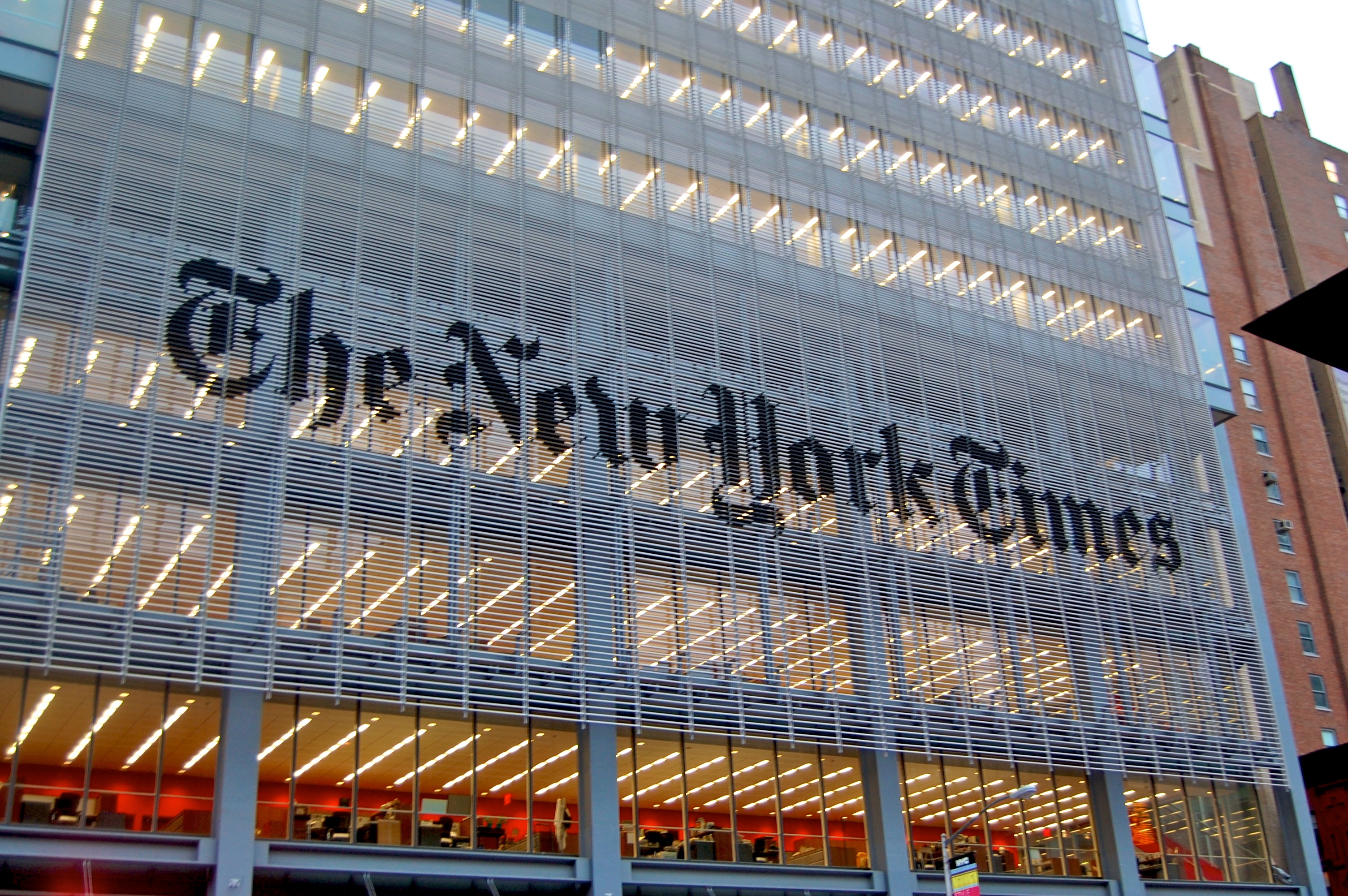
New York Times building in New York City. 
(Photo from Wikipedia)

The New York Times, one of the top promoters of this new Orwellian model for censorship, devoted two-thirds of a page in its Tuesday editions to a laudatory piece about high-tech entrepreneurs refining artificial intelligence that can hunt down and eradicate supposedly “fake news.”

To justify this draconian strategy, the Times cited only a “fake news” report claiming that the French establishment’s preferred presidential candidate Emmanuel Macron had received funding from Saudi Arabia, a bogus story published by a Web site that mimicked the appearance of the newspaper Le Soir and was traced back to a Delaware phone number.

Yet, while such intentionally fabricated articles as well as baseless conspiracy theories are a bane of the Internet – and do deserve hearty condemnation – the Times gives no thought to the potential downside of having a select group of mainstream journalistic entities feeding their judgment about what is true and what is not into some algorithms that would then scrub the Internet of contrary items.

Since the Times is a member of the Google-funded First Draft Coalition – along with other mainstream outlets such as The Washington Post and the pro-NATO propaganda site Bellingcat – this idea of eliminating information that counters what the group asserts is true may seem quite appealing to the Times and the other insiders. After all, it might seem cool to have some high-tech tool that silences your critics automatically?

But you don’t need a huge amount of imagination to see how this combination of mainstream groupthink and artificial intelligence could create an Orwellian future in which only one side of a story gets told and the other side simply disappears from view.

As much as the Times, the Post, Bellingcat and the others see themselves as the fount of all wisdom, the reality is that they have all made significant journalistic errors, sometimes contributing to horrific international crises.

For instance, in 2002, the Times reported that Iraq’s purchase of aluminum tubes revealed a secret nuclear weapons program (when the tubes were really for artillery); the Post wrote as flat-fact that Saddam Hussein was hiding stockpiles of WMD (which in reality didn’t exist); Bellingcat misrepresented the range of a Syrian rocket that delivered sarin on a neighborhood near Damascus in 2013 (creating the impression that the Syrian government was at fault when the rocket apparently came from rebel-controlled territory).

These false accounts – and many others from the mainstream media – were countered in real time by experts who published contrary information on the Internet. But if the First Draft Coalition and these algorithms were in control, the information scrubbers might have purged the dissident assessments as “fake news” or “misinformation.”

Totalitarian Risks


There also should be the fear – even among these self-appointed guardians of “truth” – that their algorithms might someday be put to use by a totalitarian regime to stomp out the last embers of real democracy.

However, if you’re looking for such thoughtfulness, you won’t find it in the Times article by Mark Scott. Instead, the Times glorifies the creators of this Brave New World.


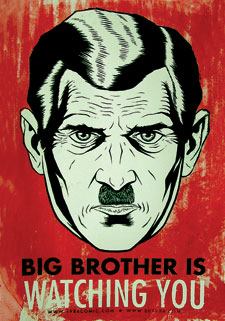
Big Brother poster illustrating George Orwell’s novel about modern propaganda, 1984.

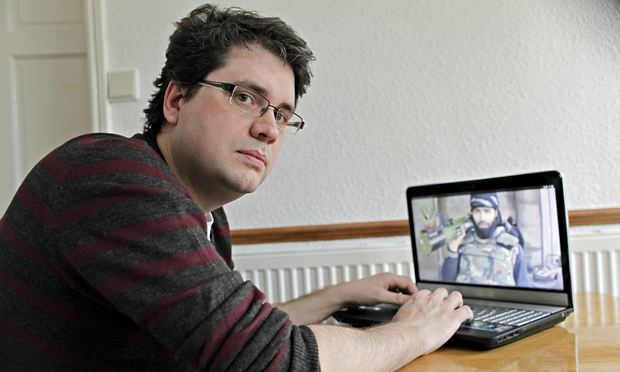
“In the battle against fake news, Andreas Vlachos — a Greek computer scientist living in a northern English town — is on the front lines,” the article reads. “Armed with a decade of machine learning expertise, he is part of a British start-up that will soon release an automated fact-checking tool ahead of the country’s election in early June. He also is advising a global competition that pits computer wizards from the United States to China against each other to use artificial intelligence to combat fake news. …

“As Europe readies for several elections this year after President Trump’s victory in the United States, Mr. Vlachos, 36, is one of a growing number of technology experts worldwide who are harnessing their skills to tackle misinformation online. … Computer scientists, tech giants and start-ups are using sophisticated algorithms and reams of online data to quickly — and automatically — spot fake news faster than traditional fact-checking groups can.”

The Times quotes the promoters of this high-tech censorship effort without any skepticism:

“‘Algorithms will have to do a lot of the heavy lifting when it comes to fighting misinformation,’ said Claire Wardle, head of strategy and research at First Draft News, a nonprofit organization that has teamed up with tech companies and newsrooms to debunk fake reports about elections in the United States and Europe. ‘It’s impossible to do all of this by hand.’”

The article continues:

“So far, outright fake news stories have been relatively rare [in Europe]. Instead, false reports have more often come from Europeans on social media taking real news out of context, as well as from fake claims spread by state-backed groups like Sputnik, the Russian news organization.”

Little Evidence Needed


Though providing no details about Sputnik’s alleged guilt, the Times article links to another Times article from April 17 by Andrew Higgins that accuses Russia’s RT network of “fake news” because it detected a surge in opinion polls for Francois Fillon, who stands accused in the mainstream media of having a positive relationship with Russian President Vladimir Putin. Oddly, however, further down in the story, Higgins acknowledges that “lately, Mr. Fillon has seen a bump in real opinion polls.”

(Ultimately, Fillon finished a strong third with 20 percent of the vote, one percentage point behind National Front’s Marine Le Pen and four points behind Emmanuel Macron, the two finalists. It’s also curious that the Times would fault RT for getting poll results wrong when the Times published predictions, with 90 percent or more certainty – and 85 percent on Nov. 8 – that Hillary Clinton would win the U.S. presidential election.)

Beyond failing to offer any evidence of Russian guilt in these “fake news” operations, Tuesday’s Times story turns to the NATO propaganda and psychological warfare operation in Latvia, the Strategic Communications Center of Excellence, with its director Janis Sarts warning about “an increased amount of misinformation out there.”

The Stratcom center, which oversees information warfare against NATO’s perceived adversaries, is conducting “a hackathon” this month in search of coders who can develop technology to hunt down news that NATO considers “fake.”

Sarts, however, makes clear that Stratcom’s goal is not only to expunge contradictory information but to eliminate deviant viewpoints before too many people can get to see and hear them. “State-based actors have been trying to amplify specific views to bring them into the mainstream,” Sarts told the Times.

As the Times reports, much of the pressure for shutting down “fake news” has fallen on American tech giants such as Facebook and Google – and they are responding:

“After criticism of its role in spreading false reports during the United States elections, Facebook introduced a fact-checking tool ahead of the Dutch elections in March and the first round of the French presidential election on April 23. It also removed 30,000 accounts in France that had shared fake news, a small fraction of the approximately 33 million Facebook users in the country.”

A Growing Movement


And, according to the Times, this censorship movement is spreading:

“German lawmakers are mulling potential hefty fines against tech companies if they do not clamp down on fake news and online hate speech. Since last year, Google also has funded almost 20 European projects aimed at fact-checking potentially false reports. That includes its support for two British groups looking to use artificial intelligence to automatically fact-check online claims ahead of the country’s June 8 parliamentary election. … 


Bellingcat founder Eliot Higgins 

“David Chavalarias, a French academic, has created a digital tool that has analyzed more than 80 million Twitter messages about the French election, helping journalists and fact-checkers to quickly review claims that are spread on the social network.

“After the presidential election in the United States last year, Dean Pomerleau, a computer scientist at Carnegie Mellon University in Pittsburgh, also challenged his followers on Twitter to come up with an algorithm that could distinguish fake claims from real news.

“Working with Delip Rao, a former Google researcher, he offered a $2,000 prize to anyone who could meet his requirements. By early this year, more than 100 teams from around the world had signed on to Mr. Pomerleau’s Fake News Challenge. Using a database of verified articles and their artificial intelligence expertise, rival groups — a combination of college teams, independent programmers and groups from existing tech companies — already have been able to accurately predict the veracity of certain claims almost 90 percent of the time, Mr. Pomerleau said. He hopes that figure will rise to the mid-90s before his challenge ends in June.”

So, presumably based on what the Times, the Post, Bellingcat and the other esteemed oracles of truth say is true, 90 percent or more of contrary information could soon be vulnerable to the censorship algorithms that can quickly detect and stamp out divergent points of view. Such is the Orwellian future mapped out for Western “democracy,” and The New York Times can’t wait for this tightly regulated – one might say, rigged – “marketplace of ideas” to take over.

Investigative reporter Robert Parry broke many of the Iran-Contra stories for The Associated Press and Newsweek in the 1980s. You can buy his latest book, America’s Stolen Narrative, either in print here or as an e-book (from Amazon and barnesandnoble.com).

image_pdf

Don't Drill, Baby: Why Arctic Drilling Is a Disaster Waiting

Drill Baby Drill: Why Drilling In The Arctic Is A Terrible Idea

by Greg Palast - GregPalast.com


April 29, 2017

President Trump aims to roll back the Obama administration’s attempts to ban oil drilling off the southeastern Atlantic and Alaskan coasts.


I was in the Arctic where Trump wants to drill baby drill. Drilling means the ethnic cleansing of the Inuit speakers who still live there. Whales won't swim in hydrocarbon. I noticed Trump did not OK drilling off Mar-a-Lago.


For more on this watch my movie, The Best Democracy Money Can Buy — available to stream worldwide from just $2.99!

Greg Palast (Rolling Stone, Guardian, BBC) is the author of The New York Times bestsellers, The Best Democracy Money Can Buy and Billionaires & Ballot Bandits, now out as major motion non-fiction movie.

Stay informed, rent or buy the film on Amazon or get the signed DVD, a signed copy of the book companion or better still - get the Book & DVD combo.

Visit the Palast Investigative Fund store or simply make a tax-deductible contribution to keep our work alive!

Or support the The Palast Investigative Fund (a project of The Sustainable Markets Foundation) by shopping with Amazon Smile. AmazonSmile will donate 0.5% of your purchases to the Palast Fund and you get a tax-deduction! More info.

The Africa Famine Engineers

70 Million Africans In Danger of Famine 

by TRNN


May 3, 2017

We tend to believe that famine is primarily the result of natural disaster, but the African countries affected by famine are all ones that have all been severely affected by political instability and war.


Tuesday, May 02, 2017

Zombie Myths: Lies of Nazi Era Live On in Ukraine

The Lie That Will Not Die: Zombie Myths of Nazi Era Resurrected in Ukraine

by Chris Floyd - Empire Burlesque


May 2, 2017

A Facebook friend posted a link to a story about a 94-year-old Jewish WWII hero being investigated for killing a Nazi collaborator in Ukraine decades ago. Someone responded to his post with a defense of Ukrainian nationalists, including this phrase:

“the memory of the mass executions and starvation inflicted upon the Ukrainian People by the Soviets (largely led by Jews) is not forgotten.” 

I responded to the comment — with admirable self-restraint, I like to think — thusly:

The Soviets were "largely led by Jews"? This is a historically erroneous statement, although it certainly echoes a fertile line of propaganda down through the ages. Stalin and his henchman in charge of Ukraine, Krushchev, were the prime movers of the worst Soviet crimes and atrocities against the Ukrainian people; neither of them were Jews. Stalin, of course, was a notorious anti-Semite.

It is true that many Ukrainians viewed the Germans as liberators at first, and not without reason. Many came to regret it later, as the Germans made no differentiation between Slavic peoples, regarding them all as subhumans to be killed or enslaved in the Nazis' Generalplan Ost, which called for the extermination of up to 40 million Slavs to make room for German colonists.

Some Ukrainians did continue to collaborate with the Germans, despite the horrific Nazi atrocities in Ukraine. The history and nature of Ukrainian nationalism is indeed a complex subject -- the post-war situation saw new layers and complexities added to the mix -- and cannot be reduced to simplistic binaries, as you rightly note: “one man's hero is another man's villain,” which has been true throughout history. But there is no need to bring specious and unfactual assertions into the argument.

There were people of many ethnicities among the Bolsheviks, Jews included. But to say the Soviets were "largely led by Jews" -- Stalin? Krushchev? Dzherzinsky, founder of the Cheka? Yezhov, head of the NKVD during the height of the Terror? Molotov? Lenin? (Lenin was not Jewish, despite fanatical propaganda to the contrary; his maternal grandfather had been a Jewish convert to Christianity; his father's family were serfs.) -- is false.

For example, the Politburo during the worst period of Stalin's repression, 1934-1939, had 84 members: 12 were of Jewish origin. The original Bolshevik central committee at the time of the Revolution had 21 members; 6 were of Jewish origin. (Of course, these Bolsheviks would not have considered themselves as Jews at all, but saw themselves as militant atheist internationalists.)

It is a plain historical fact that the Soviets were not "largely led by Jews." Considering the kind of people who have made this assertion in the past -- and the horrific uses they made of this falsity -- it would probably be best to avoid it in any future debates about the nuances of Ukrainian nationalism.

Torquing the Trump/Putin Trope

How the Russia Spin Got So Much Torque

by Norman Solomon  - Information Clearing House 


May 02, 2017

A new book about Hillary Clinton’s last campaign for president -- “Shattered,” by journalists Jonathan Allen and Amie Parnes -- has gotten a lot of publicity since it appeared two weeks ago.

But major media have ignored a revealing passage near the end of the book.

Soon after Clinton’s defeat, top strategists decided where to place the blame.

“Within 24 hours of her concession speech,” the authors report, campaign manager Robby Mook and campaign chair John Podesta “assembled her communications team at the Brooklyn headquarters to engineer the case that the election wasn’t entirely on the up-and-up...
For a couple of hours, with Shake Shack containers littering the room, they went over the script they would pitch to the press and the public. Already, Russian hacking was the centerpiece of the argument.”

Six months later, that centerpiece of the argument is rampant -- with claims often lurching from unsubstantiated overreach to outright demagoguery.

A lavishly-funded example is the “Moscow Project,” a mega-spin effort that surfaced in midwinter as a project of the Center for American Progress Action Fund. It’s led by Neera Tanden, a self-described “loyal solider” for Clinton who also runs the Center for American Progress (where she succeeded Podesta as president). The Center’s board includes several billionaires.

The “Moscow Project” is expressly inclined to go over the top, aiming to help normalize ultra-partisan conjectures as supposedly factual. And so, the homepage of the “Moscow Project” prominently declares:

“Given Trump’s obedience to Vladimir Putin and the deep ties between his advisers and the Kremlin, Russia’s actions are a significant and ongoing cause for concern.”

Let’s freeze-frame how that sentence begins: “Given Trump’s obedience to Vladimir Putin.” It’s a jaw-dropping claim; a preposterous smear.

Echoes of such tactics can be heard from many Democrats in Congress and from allied media. Along the way, no outlet has been more in sync than MSNBC, and no one on the network has been more promotional of the Russia-runs-Trump meme than Rachel Maddow, tirelessly promoting the line and sometimes connecting dots in Glenn Beck fashion to the point of journalistic malpractice.

Yet last year, notably without success, the Clinton campaign devoted plenty of its messaging to the Trump-Russia theme. As the “Shattered” book notes, “Hillary would raise the issue herself repeatedly in debates” with Trump. For example, in one of those debates she said:

“We have 17 -- 17 -- intelligence agencies, civilian and military, who have all concluded that these espionage attacks, these cyber attacks, come from the highest levels of the Kremlin and they are designed to influence our election.”

After Trump’s election triumph, the top tier of Clinton strategists quickly moved to seize as much of the narrative as they could, surely mindful of what George Orwell observed:

“Who controls the past controls the future; who controls the present controls the past.” 

After all, they hardly wanted the public discourse to dwell on Clinton’s lack of voter appeal because of her deep ties to Wall Street. Political recriminations would be much better focused on the Russian government.

In early spring, the former communications director of the 2016 Clinton presidential campaign, Jennifer Palmieri, summed up the post-election approach neatly in a Washington Post opinion article:

“If we make plain that what Russia has done is nothing less than an attack on our republic, the public will be with us. And the more we talk about it, the more they’ll be with us.”

The inability of top Clinton operatives to identify with the non-wealthy is so tenacious that they still want to assume “the public will be with us” the more they talk about Russia Russia Russia. Imagine sitting at a kitchen table with average-income voters who are worried sick about their financial futures -- and explaining to them that the biggest threat they face is from the Kremlin rather than from U.S. government policies that benefit the rich and corporate America at their expense.

Tone deaf hardly describes the severe political impairment of those who insist that denouncing Russia will be key to the Democratic Party’s political fortunes in 2018 and 2020. But the top-down pressure for conformity among elected Democrats is enormous and effective.

One of the most promising progressives to arrive in Congress this year, Rep. Jamie Raskin from the Maryland suburbs of D.C., promptly drank what might be called the “Klinton Kremlin Kool-Aid.” His official website features an article about a town-hall meeting that quotes him describing Trump as a “hoax perpetrated by the Russians on the United States of America.”

Like hundreds of other Democrats on Capitol Hill, Raskin is on message with talking points from the party leadership. That came across in an email that he recently sent to supporters for a Democratic Congressional Campaign Committee fundraiser. It said:

“We pull the curtain back further each day on the Russian Connection, forcing National Security Adviser Michael Flynn to resign, Attorney General Sessions to recuse, and America to reflect on who's calling the shots in Washington.”

You might think that Wall Street, big banks, hugely funded lobbyists, fat-check campaign contributors, the fossil fuel industry, insurance companies, military contractors and the like are calling the shots in Washington. Maybe you didn’t get the memo.

Norman Solomon is the coordinator of the online activist group RootsAction.org and the executive director of the Institute for Public Accuracy. He is the author of a dozen books including “War Made Easy: How Presidents and Pundits Keep Spinning Us to Death.”

Gorilla Radio with Chris Cook, Jamie Swift, Ariel Martz-Oberlander, Janine Bandcroft May 3, 2017

This Week on GR

by C. L. Cook - Gorilla-Radio.com


May 3, 2017

Irregardless of the fireworks and red serge cavalry, the story of Canada's creation is a total yawner. The essence of this year's, and every July 1st, celebration is the marking of the day a foreign queen in a faraway capital signed into law the articles of our Confederation.

No "Into the breach, boys" heroics, or tales of gallantry done to share with grandchildren yet unborn; merely a mannered, polite ceremony, presumably with tea and cut sandwiches to follow; and Bob's your uncle.

For nearly all of our 150 years that's been good enough. Some of us even take a measure of pride our beginnings are a genteel, dare we say more civilized, affair than that of our flamboyant cousins south.

Listen. Hear.

But, in this new and bloodied century, where the prosecution of warmaking is more perpetual profession than momentous event, circumscribed by neither remorse nor temporality, the warrior ethos requires vigorous reaffirmation, and there our placid foundational trumpet is wanting steel.

Happily, as it happens, Canada's 2017 sesquicentennial coincides with the hundred year anniversary of the Battle of Vimy Ridge. Just the blood and guts grist needed to render from the horror and gore of trench warfare a narrative of glory and progress for an overly effete nation; or so our marshal myth-makers would have it. But are Canadians ready to accept militarism as national mantle?

Jamie Swift is an award-winning journalist, activist, educator, and author whose body of work is focused largely on issues of social justice, economy, environment, globalization, and politics. Among his other book titles, he co-authored, with Ian McKay, 'Warrior Nation: Rebranding Canada in an Age of Anxiety' and teamed up again with McKay for the recently released, 'The Vimy Trap: Or, How We Learned to Stop Worrying and Love the Great War'. The Michener-Deacon Fellowship for Public Service Journalism awardee is also the keynote speaker for the inaugural, 'Provincial Peace and Disarmament Summit', to be held here at the University of Victoria May 12-13.

Jamie Swift in the first half.

And; with less than a week before the provincial poll, which issues are you focused on? Though it's difficult to narrow down to just a few the missteps of the current government, there is a single exemplar of all that is wrong with the BCLiberals, regardless of your political bent. Whether fiscal conservative, Libertarian, enviro, anarcho-communist, social democrat, political agnostic, or miscellaneous the Site C Dam project has something to outrage you. And, the folks at Just the Dam Facts argue, there's a lot more than just one disastrous thing about this white elephant everyone can oppose.

Ariel Martz-Oberlander is with Just the Dam Facts, and she joins us in the second segment.

And, CFUV Radio broadcaster, Janine Bandcroft will be here at the bottom of the hour to bring us up to speed with some of what's good to do planned in and around our town for the coming week. But first, Jamie Swift and The Vimy Trap, a ridge too far.

Chris Cook hosts Gorilla Radio, airing live every Wednesday, 1-2pm Pacific Time. In Victoria at 101.9FM, and on the internet at: http://cfuv.ca.  He also serves as a contributing editor to the web news site, http://www.pacificfreepress.com. Check out the GR blog at: https://gorillaradioblog.blogspot.ca/

G-Radio is dedicated to social justice, the environment, community, and providing a forum for people and issues not covered in the corporate media.

Can You Trust WHO?

Hidden Radiation Secrets of the World Health Organization

by Robert Hunziker - CounterPunch


May 2, 2017

Imagine the following hypothetical: The World Health Organization (“WHO”) is deeply involved in a high level cover up of the human impact and dangers of ionizing radiation, intentionally hiding the facts from the public, a chilling storyline!

After all, the world community depends upon WHO as an independent org to forewarn the general public of health dangers and to help in times of crises, not hide pivotal health facts from public eye.

As it happens, that nightmarish hypothetical comes to life in an interview with Alison Katz, who claims:

“We are absolutely convinced that if the consequences of nuclear radiation were known to the public, the debate about nuclear power would end tomorrow. In fact, if the public knew, it would probably be excluded immediately as an energy option.”

Alison Katz heads a NGO known as Independent WHO, and she spends a lot of time arranging sandwich boards with messages like: “Complicity in Scientific Crime” or “Crime of Chernobyl – WHO Accomplice” in front of WHO headquarters/Geneva. For 10 years now on a daily vigil from 8:00-to-6:00 she and/or other protestors expose alleged misbehavior committed by WHO, right outside of the headquarters building. Imagine this: Ten years on the same street corner every working day. It’s commitment and determination sans pareil.

“The aim of the silent vigil is to remind the World Health Organisation of its duties. It was Hippocrates who formulated the ethical rules for health practitioners. The World Health Organisation ignores these rules, when it comes to protecting the health of the victims of the consequences of the nuclear industry”.

Which brings forth: Ten years of hard work combating a difficult and challenging issue warrants public adulation beyond carrying posters back and forth, come rain or shine, trudging away in the heat of the sun or the freezing cold and snow in front of WHO Hdqs. Hopefully, this article serves that purpose for Alison Katz.

The mission of Independent WHO is to expose WHO’s failings whilst calling for WHO independence away from influence by the worldwide nuclear syndicate: According to WHO Independence’s Web Site: “The World Health Organization (WHO) is failing in its duty to protect those populations who are victims of radioactive contamination.”

Ms Katz worked inside the WHO for 18 years. She insists that WHO, in cahoots with IAEA (International Atomic Energy Agency), dangerously misrepresents the inherent dangers of ionizing radiation, an insinuation that smacks in the face with egregiousness galore.

Ms Katz’s April 2017 interview, which this article is based upon, can be heard here in its entirety.

This article condenses and summarizes her one-hour interview. As such, according to Ms Katz: “The health consequences of nuclear activity, whether they are civil or military, are not known to the public… There has been a very high level cover up… including the WHO.”

For over 50 years WHO provided “a clean bill of health for nuclear power.” However, according to Ms Katz, that clean bill of health is not based upon independent science. It’s based upon “pseudo science” manipulated and largely controlled by the nuclear lobby and International Atomic Energy Agency, the Queen Bee of the pro-nuke Hive.

Furthermore, within the “United Nations family hierarchy,” WHO is entirely subservient to IAEA. In turn, IAEA reports to the Security Council of the UN or the very top echelon of the power hierarchy of the world, including France, China, UK, U.S., and the Russian Federation. Far and away, these are the world’s biggest nuke heads.

Connecting the dots leaves one breathless within a telling trail of pro-nuke advocacy of the highest order… hm-m-m, thus raising the question: How is it humanly possible for WHO to objectively, impartially, squarely and soberly analyze and recommend ionizing radiation issues on behalf of the general public?

Is it at all possible, even a little bit?

As it goes, the IAEA has two mandates, which sound innocent enough: (1) to prevent proliferation of nuclear power and (2) promotion of the use of the atom on a peaceful basis, ah-ah-ah… oh well, never mind. In reality, IAEA is a commercial lobbying org promoting use of the atom, yet at the same time, it dictates WHO procedures, standards, and published articles on the matter of nuclear radiation, prompting a very pregnant question: Is this a conflict of interest for WHO? Answer: Yes, it is! WHO is a creature of the dictates of IAEA, which is the world’s largest promoter of the atom. Whereas, WHO is supposed to “independently serve the public interest,” not kowtow to a nuclear advocacy powerhouse that reports to nuclear powerhouse countries that have a deepening love affair with nuclear power, warts and all.

For example, sixty (60) reactors are currently under construction in fifteen countries. In all, one hundred sixty (160) power reactors are in the planning stage and three hundred (300) more have been proposed. That’s a love affaire.

Meanwhile, as for WHO’s mandate: It serves as the leading authority of standards for public health, coordinating research, advising member states, and formulating ionizing radioactivity health policies. However, IAEA has been usurping WHO’s mandate for the past 50 years. In fact, a 1959 Agreement (WHA 12-40) between the two says WHO needs prior approval of IAEA before taking any action or publishing material dealing with nuclear, period!

As a result of this 50-year conflict of interest, which is deeply embedded by now, Ms Katz claims WHO must, absolutely must, become independent, thus breaking the stranglehold of numero uno promoter of nuclear power over WHO, which is mandated to serve the public, not IAEA.

Not only is there a serious conflict of interest, Katz claims WHO fails, time and again, to meet its mandate to the public, as for example:

1) WHO remained absent from Chernobyl for five years even though the WHO mandate requires it to be present the “day after a catastrophe” to evaluate and provide assistance. But, WHO was MIA for 5 years.

2) WHO does not issue independent reports on radiation issues. All nuclear-related reports are written by IAEA but published “in the name of the WHO.”

3) Following Chernobyl, there were two international conferences held to analyze the implications of the catastrophe; one held in Geneva in 1995 and the second in Kiev in 2001. The “Proceedings of the Conferences” were never published by WHO; thus, never made public even though WHO claims the proceedings are publicly available. Confusing? Yes! To this day, the relevant question remains: What did “the analyses” show?

As a result of WHO’s egregious conflicts, the world community has no independent arms-length source on nuclear radiation. That is a situation fraught with conflict and extremely difficult to accept, sans grimacing with a lot of teeth grinding.

Once again, with emphasis: There is no independent international authority reporting to the public on nuclear radiation…. none whatsoever. All information about nuclear radiation ultimately comes from the primary users/promoters of nuclear power even though they have a very big heavy axe to grind.

Of course, there are independent scientists, but they face enormous obstacles in coming forward with the truth, thereby risking monetary grants and risking personal positions, as well as family livelihood.

Not only that, but over the years all departments within WHO that dealt with nuclear radiation have been highly compromised. Even worse, according to Ms Katz, no senior radiation scientists work for WHO, none… nada.

What constitutes the “nuclear establishment” is a fair question; it consists of the major governments of the world like France and the U.S but led by the International Commission on Radiological Protection (ICRP), the top dog, establishing standards for the world. Strangely enough, there are no health experts at ICRP, prompting a logical question: Why not?

There is more to be concerned about, e.g., another shocking fact regarding ICRP, as if there are not already enough shockers with the thread that runs throughout nuclear power’s closely-knit network: Even though “ionizing radiation is mutagenic and always causes mutations, causing damage at the cellular level, there are no molecular biologists working in the ICRP” (Katz). Thus, the world’s largest institution for determination of radiation standards for the public has no molecular biologists on staff. That fact is beyond belief, an eye-opener beyond all other eye-openers.

It’s almost as if the regulators don’t give a damn about the effects of radiation on the general public. Do they?

Fukushima


Just after Fukushima in 2011, Ms Katz met with the Director General and five of the highest-ranking officials of WHO. The mayor of Geneva also attended the meeting; curiously, the City of Geneva, where WHO is headquartered, has an anti-nuclear provision in its city code.

The outcome of that meeting clearly demonstrated to Katz, and to the mayor of Geneva, that WHO abdicated its responsibilities for Fukushima.

However, a small victory ensued during the meetings as some solace was found when the Director General did admit, “there is no safe threshold of radiation.” And, she admitted to differences between internal and external radiation, which was a change of heart.

Remarkably, the Director General also confessed a shocking level of incredulity that only 50 people died from Chernobyl, widely claimed by the Director General’s own organization, WHO. That is the final number (50) of deaths that WHO attributes to Chernobyl. Howbeit, it’s a fabricated number w/o any meaning whatsoever and not supported by observational data.

Consequences of Chernobyl


WHO held a Chernobyl Forum in 2004 designed to “end the debate about the impact of Chernobyl radiation” whilst WHO maintains that 50 people died.

Here’s the final conclusion of that Chernobyl Forum ‘04: The mental health of those who live in the area is the most serious aftereffect, leading to strong negative attitudes and exaggerated sense of dangers to health and of exposure to radiation. Mental health was thus identified as the biggest negative aftereffect.

Because that conclusion is so brazenly bizarre, the Chernobyl Forum ‘04 must’ve been part of an alternative universe, way out there beyond the wild blue yonder, maybe the Twilight Zone or maybe like entering a scene in Jan Švankmajer’s Alice, a dark fantasy film loose adaptation of Lewis Carroll’s Alice in Wonderland.

Here’s reality: Chernobyl Liquidators fought the Chernobyl disaster. Eight hundred thousand (800,000) Liquidators from the former USSR, largely recruits from the army, with average age of 33, fought the Chernobyl disaster.

According to an interview (2016) with a Liquidator,

“We were tasked with the deactivation of the third and fourth reactors, but we also helped build the containment sarcophagus. We worked in three shifts, but only for five to seven minutes at a time because of the danger. After finishing, we’d throw our clothes in the garbage” (Source: Return to Chernobyl With Ukraine’s Liquidators, Aljazeera, April 25, 2016).
“Estimates of the number of liquidators who died or became ill as a result of their work vary substantially, but the men of the 633rd say that out of the 259 from their group, 71 have died. Melnik says that 68 have been designated as invalids by a state committee, which investigates their health and determines whether or not their diseases are attributable to Chernobyl… Dr Dimitry Bazyka, the current director-general of the National Research Centre for Radiation Medicine in Kiev, says that approximately 20,000 liquidators die each year,” Ibid.

As for total deaths, the Chief Medical Officer of the Russian Federation reported that 10% of its Chernobyl Liquidators were dead by 2001. The disaster occurred in 1986 with 80,000 dead within 16 years. Authorities out of Ukraine and Belarus confirmed Russian death numbers. Yet, WHO claims 50 died.

Eighty-thousand (80,000) Liquidators, as of 16 years ago, dead from Chernobyl, and that body count, according to Ms Katz, leaves out the people most contaminated by Chernobyl, meaning evacuees and also 57% of the fallout for Chernobyl came down outside of the USSR, Belarus, and Ukraine, and in 13 European countries 50% of the countryside was dangerously contaminated.

As for studies of the radiation impact of Chernobyl:

“Thousands of independent studies in Ukraine, Belarus, and the Russian Federation and in many other countries, that were contaminated to varying degrees by radionuclides, have established that there has been significant increase in all types of cancer, in diseases of the respiratory, gastrointestinal, urogenital, endocrine immune, lymph node nervous systems, prenatal, perinatal, infant child mortality, spontaneous abortions, deformities and genetic anomalies….” (Katz)

Hence, WHO’s handling and analysis and work on Chernobyl leaves the curious-minded speechless, open-mouthed, agape, and confounded.

WHO’s Flawed Fukushima Report


WHO issued two reports on Fukushima:

1) Evaluation of exposure
2) Likely health effects

Alex Rosen of Int’l Physicians for the Prevention of Nuclear War critiqued the two WHO Fukushima reports, found to be extremely problematic, and once again, similar to Chernobyl, shoddy work that sweeps way too much dirt under the carpet.

Here’s the problem: WHO’s estimates of Fukushima radioactive exposure are at least 50% less than any other estimates, including estimates provided by TEPCO (Tokyo Electric Power Company, the plant operator) itself. But, WHO is supposed to be the guardian of public health concerns, not TEPCO.

Also, two critical population studies are ignored in the WHO reports, i.e., all of the residents within the 20 km exclusion zone are eliminated, even though their radiation exposure would be very high, actually highest. The second group ignored is workers on site… ahem!

Additionally, WHO cavalierly approved the Japanese government’s drastic change in annual maximum radiation exposure allowed for the general population up to 20 mSv per year.

Effects of Radiation


The genetic effects of radiation likely exceed anything understood by the general public, as WHO and other health orgs do not properly educate the public about radiation’s risks:

“The genetic effects, far from diminishing with time, increase” (Katz), which is extra bad.

Years of research around Chernobyl show that the genetic impact of radiation to the human body becomes much, much worse as time passes. Thus, “radiation is both a continuing and a worsening catastrophe as time passes” (Katz). Radiation’s impact gets worse over time; it does not heal, does not dissipate, does not go away; it grows progressively worse, like the film sequels to Godzilla, which was conceived as a metaphor for nuclear weapons in the early 1950s.

Indisputably, all organ systems of the human body are affected by radioactive contamination. Cancer is not the only nasty result of radiation exposure. Radioactive contamination affects the entire human immune system from head to toe, thus impacting every organ system in the body, e.g. musculoskeletal, etc. This damage to organs is in addition to the various cancer risks.

After all, consider this, 30 years after the fact, horribly deformed Chernobyl Children are found in over 300 asylums in the Belarus backwoods deep in the countryside.

Equally as bad but maybe more odious, as of today, Chernobyl radiation, since 1986, is already affecting 2nd generation kids.

According to a USA Today article, Chernobyl’s Legacy: Kids With Bodies Ravaged by Disaster, April 17, 2016: “There are 2,397,863 people registered with Ukraine’s health ministry to receive ongoing Chernobyl-related health care. Of these, 453,391 are children — none born at the time of the accident. Their parents were children in 1986. These children have a range of illnesses: respiratory, digestive, musculoskeletal, eye diseases, blood diseases, cancer, congenital malformations, genetic abnormalities, trauma.”

It’s taken 30 years for the world, via an article in USA Today, to begin to understand how devastating, over decades, not over a few years, radiation exposure is to the human body. It is a silent killer that cumulates in the body over time and passes from generation to generation to generation, endless destruction that cannot be stopped.

Where is WHO is kinda like Where is Waldo, but sadly the effects of ionizing radiation are not part of a game. It is deadly serious, forevermore. In the meanwhile, Fukushima irradiates and irradiates, limitlessly and so far, unstoppable. Where does its radiation go?

Robert Hunziker lives in Los Angeles and can be reached at roberthunziker@icloud.com
More articles by Robert Hunziker

Behind the Palestinian Hunger Strike

The Prisoners’ Revolt: The Real Reasons behind the Palestinian Hunger Strike

by Ramzy Baroud  - Ramzybaroud.net


May 2, 2017

Gaza is the world’s largest open air prison. The West Bank is a prison, too, segmented into various wards, known as areas A, B and C. In fact, all Palestinians are subjected to varied degrees of military restrictions. At some level, they are all prisoners. East Jerusalem is cut off from the West Bank, and those in the West Bank are separated from one another.


Banksy in Gaza - Wall Swing

Palestinians in Israel are treated slightly better than their brethren in the Occupied Territories, but subsist in degrading conditions compared to the first-class status given to Israeli Jews, as per the virtue of their ethnicity alone.

Palestinians 'lucky' enough to escape the handcuffs and shackles are still trapped in different ways.

Palestinian refugees in Lebanon's Ein el-Hilweh, like millions of Palestinian refugees in ‘shattat’ (Diaspora), are prisoners in refugee camps, carrying precarious, meaningless identification, cannot travel and are denied access to work. They languish in refugee camps, waiting for life to move forward, however slightly - as their fathers and grandfathers have done before them for nearly seventy years.

This is why the issue of prisoners is a very sensitive one for Palestinians. It is a real and metaphorical representation of all that Palestinians have in common.

The protests igniting across the Occupied Territories to support 1,500 hunger strikers are not merely an act of 'solidarity' with the incarcerated and abused men and women who are demanding improvements to their conditions.

Sadly, prison is the most obvious fact of Palestinian life; it is the status quo; the everyday reality.

The prisoners held captive in Israeli jails are a depiction of the life of every Palestinian, trapped behind walls, checkpoints, in refugee camps, in Gaza, in cantons in the West Bank, segregated Jerusalem, waiting to be let in, waiting to be let out. Simply waiting.

There are 6,500 prisoners in Israeli jails. This number includes hundreds of children, women, elected officials, journalists and administrative detainees, who are held with no charges, no due process. But these numbers hardly convey the reality that has transpired under Israeli occupation since 1967.

According to prisoners' rights group, ‘Addameer’, more than 800,000 Palestinians have been imprisoned under military rule since Israel commenced its occupation of Palestinian territories in June 1967.

That is 40 percent of the entire male population of the Occupied Territories.

Israeli jails are prisons within larger prisons. In times of protests and upheaval, especially during the uprisings of 1987-1993 and 2000-2005, hundreds of thousands of Palestinians were subjected to prolonged military curfews, sometimes lasting weeks, even months.

Under military curfews, people are not allowed to leave their homes, with little or no breaks to even purchase food.

Not a single Palestinian who has lived (or is still living) through such conditions is alien to the experience of imprisonment.

But some Palestinians in that large prison have been granted VIP cards. They are deemed the 'moderate Palestinians', thus granted special permits from the Israeli military to leave the Palestinian prison and return as they please.

While former Palestinian leaders Yasser Arafat was holed up in his office in Ramallah for years, until his death in November 2004, current Palestinian Authority President Mahmoud Abbas is free to travel.

While Israel can, at times, be critical of Abbas, he rarely deviates far from the acceptable limits set by the Israeli government.

This is why Abbas is free and Fatah leader, Marwan Barghouti, (along with thousands of others) is jailed.

The current prisoners’ hunger strike began on April 17, in commemoration of 'Prisoner Day' in Palestine.

On the eighth day of the strike, as the health of Marwan Barghouti deteriorated, Abbas was in Kuwait meeting a group of lavishly dressed Arab singers.

The reports, published in ‘Safa News Agency’ and elsewhere, generated much attention on social media. The tragedy of the dual Palestinian reality is an inescapable fact.

Barghouti is far more popular among supporters of Fatah, one of the two largest Palestinian political movements. In fact, he is the most popular leader amongst Palestinians, regardless of their ideological or political stances.

If the PA truly cared about prisoners and the well-being of Fatah’s most popular leader, Abbas would have busied himself forging a strategy to galvanize the energy of the hungry prisoners, and millions of his people who rallied in their support.

But mass mobilization has always scared Abbas and his Authority. It is too dangerous for him, because popular action often challenges the established status quo, and could hinder his Israeli-sanctioned rule over occupied Palestinians.

While Palestinian media is ignoring the rift within Fatah, Israeli media is exploiting it, placing it within the larger political context.

Abbas is scheduled to meet US President Donald Trump on May 3.

He wants to leave a good impression on the impulsive president, especially as Trump is decreasing foreign aid worldwide, but increasing US assistance to the PA. That alone should be enough to understand the US administration’s view of Abbas and its appreciation of the role of his Authority in ensuring Israel's security and in preserving the status quo.

But not all Fatah supporters are happy with Abbas’ subservience. The youth of the Movement want to reassert a strong Palestinian position through mobilizing the people; Abbas wants to keep things quiet.

Amos Harel argued in ‘Haaretz’ that the hunger strike, called for by Barghouti himself, was the latter's attempt at challenging Abbas and “rain(ing) on Trump's peace plan.”

However, Trump has no plan. He is giving Israeli Prime Minister, Benjamin Netanyahu, carte blanche to do as he pleases. His solution is: one state, two states, whichever ‘both parties like.’ But both sides are far from being equal powers. Israel has nuclear capabilities and a massive army, while Abbas needs permission to leave the Occupied West Bank.

In this unequal reality, only Israel decides the fate of Palestinians.

On his recent visit to the US, Netanyahu articulated his future vision.

"Israel must retain the overriding security control over the entire area west of the Jordan River," he said.

Writing in the ‘Nation’, Professor Rashid Khalidi expounded the true meaning of Netanyahu's statement.

By uttering these words, "Netanyahu proclaimed a permanent regime of occupation and colonization, ruling out a sovereign independent Palestinian state, whatever fiction of 'statehood' or 'autonomy' are dreamed up to conceal this brutal reality," he wrote.

"Trump’s subsequent silence amounts to the blessing of the US government for this grotesque vision of enduring subjugation and dispossession for the Palestinians."

Why then, should Palestinians be quiet?


Their silence can only contribute to this gross reality, the painful present circumstances, where Palestinians are perpetually imprisoned under an enduring Occupation, while their 'leadership' receives both a nod of approval from Israel and accolades and more funds from Washington.

It is under this backdrop that the hunger strike becomes far more urgent than the need to improve the conditions of incarcerated Palestinians.

It is a revolt within Fatah against their disengaged leadership, and a frantic attempt by all Palestinians to demonstrate their ability to destabilize the Israeli-American-PA matrix of control that has extended for many years.

"Rights are not bestowed by an oppressor," wrote Marwan Barghouti from his jail on the first day of the hunger strike.

In truth, his message was directed at Abbas and his cronies, as much as it was directed at Israel.

Dr. Ramzy Baroud has been writing about the Middle East for over 20 years. He is an internationally-syndicated columnist, a media consultant, an author of several books and the founder of PalestineChronicle.com. His books include “Searching Jenin”, “The Second Palestinian Intifada” and his latest “My Father Was a Freedom Fighter: Gaza’s Untold Story”. His website is www.ramzybaroud.net.

Monday, May 01, 2017

May BC Peace & Disarmament Summit

BC Peace and Disarmament Summit on May 12-13

Co-sponsored by - UVic Centre for Global Studies, Social Environmental Alliance, Nonviolence International, Between the Lines Publishing and Level Ground Coffee


May 1, 2017

Two weeks away! Please help spread the word, share the Facebook events and put up a poster!

This provincial summit aims to inspire action for a culture of peace and nonviolence and policies for  disarmament. Themes: Canadian foreign policy and defence policy, nuclear disarmament, gender and militarism, peace education, art and activism!

Register now for our inaugural PROVINCIAL PEACE AND DISARMAMENT SUMMIT May 12-13: www.vipdn.org


Don’t miss it!

PREMIERE SCREENING OF THE AWARD-WINNING FILM “A BOLD PEACE”

Friday, May 12 from 7:00-9:00 pm
David Strong Building, C118
University of Victoria

An inspiring documentary about Costa Rica’s path of demilitarization. The screening will be followed by a discussion led by representatives of the Canadian Department of Peace Initiative and Nonviolence International.

Free. All welcome.

Facebook event: https://www.facebook.com/events/1669377776701265/

SUMMIT CONFERENCE: SPEAKERS, PANELS AND WORKSHOPS

Saturday, May 13 from 10:00am-5:30 pm
David Strong Building, C118, 
University of Victoria


Key note speaker: Jamie Swift, co-author of the new book The Vimy Trap, or, How We Learned to Stop Worrying and Love the Great War, which has been short-listed for the Sir John A. MacDonald Prize in Canadian history and the Shaughnessy Cohen Prize for Political Writing.

This year marks the 100th anniversary of the Battle of Vimy Ridge, author Jamie Swift provides a critical examination at Canada’s participation in the bloody First World War and confronts our history of militarism, and the myth that Canada came of age by warfighting.

Swift is also the  co-author of the book Warrior Nation: Rebranding Canada in the Age of Anxiety and a co-founder of Peace Quest.

Other featured speakers include former seaman *Nicola Peffers* author of *Refuge in the Black Deck* about military sexual violence and US Army veteran *Bill Geimer* author of *Canada: The Case for Staying Out of Other People’s Wars*.

Books will be available for sale.


Register now! Free. Donations Appreciated. Organized by the Vancouver Island Peace and Disarmament Network: *www.vipdn.org


Co-sponsored by the UVic Centre for Global Studies, the Social Environmental Alliance, Nonviolence International, Between the Lines Publishing and Level Ground Coffee.

Facebook Event: https://www.facebook.com/events/1844764159118951/

Sunday, April 30, 2017

This Song Is About Site C

Site C Video

by Cultivated Corner


23 Apr 2016

This video is about Site C (song circa 1976). 


Are They Safe: Who to Trust?

The Existential Question of Whom to Trust

by Robert Parry  - Consortium News


April 30, 2017

The looming threat of World War III, a potential extermination event for the human species, is made more likely because the world’s public can’t count on supposedly objective experts to ascertain and evaluate facts. Instead, careerism is the order of the day among journalists, intelligence analysts and international monitors – meaning that almost no one who might normally be relied on to tell the truth can be trusted.

Secretary of State Colin Powell addressed the United Nations 
on Feb. 5. 2003, citing satellite photos which supposedly proved 
that Iraq had WMD, but the evidence proved bogus. CIA 
Director George Tenet is behind Powell to the left.

The dangerous reality is that this careerism, which often is expressed by a smug certainty about whatever the prevailing groupthink is, pervades not just the political world, where lies seem to be the common currency, but also the worlds of journalism, intelligence and international oversight, including United Nations agencies that are often granted greater credibility because they are perceived as less beholden to specific governments but in reality have become deeply corrupted, too.

In other words, many professionals who are counted on for digging out the facts and speaking truth to power have sold themselves to those same powerful interests in order to keep high-paying jobs and to not get tossed out onto the street. Many of these self-aggrandizing professionals – caught up in the many accouterments of success – don’t even seem to recognize how far they’ve drifted from principled professionalism.

A good example was Saturday night’s spectacle of national journalists preening in their tuxedos and gowns at the White House Correspondents Dinner, sporting First Amendment pins as if they were some brave victims of persecution. They seemed oblivious to how removed they are from Middle America and how unlikely any of them would risk their careers by challenging one of the Establishment’s favored groupthinks. Instead, these national journalists take easy shots at President Trump’s buffoonish behavior and his serial falsehoods — and count themselves as endangered heroes for the effort.

Foils for Trump


Ironically, though, these pompous journalists gave Trump what was arguably his best moment in his first 100 days by serving as foils for the President as he traveled to Harrisburg, Pennsylvania, on Saturday and basked in the adulation of blue-collar Americans who view the mainstream media as just one more appendage of a corrupt ruling elite.

Breaking with tradition by snubbing the annual press gala, Trump delighted the Harrisburg crowd by saying: “A large group of Hollywood celebrities and Washington media are consoling each other in a hotel ballroom” and adding: “I could not possibly be more thrilled than to be more than 100 miles away from [the] Washington swamp … with much, much better people.” The crowd booed references to the elites and cheered Trump’s choice to be with the common folk.

Trump’s rejection of the dinner and his frequent criticism of the mainstream media brought a defensive response from Jeff Mason, president of the White House Correspondents’ Association, who complained: “We are not fake news. We are not failing news organizations. And we are not the enemy of the American people.” That brought the black-tie-and-gown gathering to its feet in a standing ovation.

Perhaps the assembled media elite had forgotten that it was the mainstream U.S. media – particularly The Washington Post and The New York Times – that popularized the phrase “fake news” and directed it blunderbuss-style not only at the few Web sites that intentionally invent stories to increase their clicks but at independent-minded journalism outlets that have dared question the elite’s groupthinks on issues of war, peace and globalization.

The Black List


Professional journalistic skepticism toward official claims by the U.S. government — what you should expect from reporters — became conflated with “fake news.” The Post even gave front-page attention to an anonymous group called PropOrNot that published a black list of 200 Internet sites, including Consortiumnews.com and other independent-minded journalism sites, to be shunned.

But the mainstream media stars didn’t like it when Trump began throwing the “fake news” slur back at them. Thus, the First Amendment lapel pins and the standing ovation for Jeff Mason’s repudiation of the “fake news” label.

Yet, as the glitzy White House Correspondents Dinner demonstrated, mainstream journalists get the goodies of prestige and money while the real truth-tellers are almost always outspent, outgunned and cast out of the mainstream. Indeed, this dwindling band of honest people who are both knowledgeable and in position to expose unpleasant truths is often under mainstream attack, sometimes for unrelated personal failings and other times just for rubbing the powers-that-be the wrong way.

Perhaps, the clearest case study of this up-is-down rewards-and-punishments reality was the Iraq War’s WMD rationale. Nearly across the board, the American political/media system – from U.S. intelligence analysts to the deliberative body of the U.S. Senate to the major U.S. news organizations – failed to ascertain the truth and indeed actively helped disseminate the falsehoods about Iraq hiding WMDs and even suggested nuclear weapons development. (Arguably, the “most trusted” U.S. government official at the time, Secretary of State Colin Powell, played a key role in selling the false allegations as “truth.”)

Not only did the supposed American “gold standard” for assessing information – the U.S. political, media and intelligence structure – fail miserably in the face of fraudulent claims often from self-interested Iraqi opposition figures and their neoconservative American backers, but there was minimal accountability afterwards for the “professionals” who failed to protect the public from lies and deceptions.

Profiting from Failure


Indeed, many of the main culprits remain “respected” members of the journalistic establishment. For instance, The New York Times’ Pentagon correspondent Michael R. Gordon, who was the lead writer on the infamous “aluminum tubes for nuclear centrifuges” story which got the ball rolling for the Bush administration’s rollout of its invade-Iraq advertising campaign in September 2002, still covers national security for the Times – and still serves as a conveyor belt for U.S. government propaganda.

The Washington Post’s editorial page editor Fred Hiatt, who repeatedly informed the Post’s readers that Iraq’s secret possession of WMD was a “flat-fact,” is still the Post’s editorial page editor, one of the most influential positions in American journalism.

Hiatt’s editorial page led a years-long assault on the character of former U.S. Ambassador Joseph Wilson for the offense of debunking one of President George W. Bush’s claims about Iraq seeking yellowcake uranium from Niger. Wilson had alerted the CIA to the bogus claim before the invasion of Iraq and went public with the news afterwards, but the Post treated Wilson as the real culprit, dismissing him as “a blowhard” and trivializing the Bush administration’s destruction of his wife’s CIA career by outing her (Valerie Plame) in order to discredit Wilson’s Niger investigation.

At the end of the Post’s savaging of Wilson’s reputation and in the wake of the newspaper’s accessory role in destroying Plame’s career, Wilson and Plame decamped from Washington to New Mexico. Meanwhile, Hiatt never suffered a whit – and remains a “respected” Washington media figure to this day.

Careerist Lesson


The lesson that any careerist would draw from the Iraq case is that there is almost no downside risk in running with the pack on a national security issue. Even if you’re horrifically wrong — even if you contribute to the deaths of some 4,500 U.S. soldiers and hundreds of thousands of Iraqis — your paycheck is almost surely safe.

The same holds true if you work for an international agency that is responsible for monitoring issues like chemical weapons. Again, the Iraq example offers a good case study. In April 2002, as President Bush was clearing away the few obstacles to his Iraq invasion plans, Jose Mauricio Bustani, the head of the Organization for the Prohibition of Chemical Weapons [OPCW], sought to persuade Iraq to join the Chemical Weapons Convention so inspectors could verify Iraq’s claims that it had destroyed its stockpiles.

The Bush administration called that idea an “ill-considered initiative” – after all, it could have stripped away the preferred propaganda rationale for the invasion if the OPCW verified that Iraq had destroyed its chemical weapons. So, Bush’s Undersecretary of State for Arms Control John Bolton, a neocon advocate for the invasion of Iraq, pushed to have Bustani deposed. The Bush administration threatened to withhold dues to the OPCW if Bustani, a Brazilian diplomat, remained.

It now appears obvious that Bush and Bolton viewed Bustani’s real offense as interfering with their invasion scheme, but Bustani was ultimately taken down over accusations of mismanagement, although he was only a year into a new five-year term after having been reelected unanimously. The OPCW member states chose to sacrifice Bustani to save the organization from the loss of U.S. funds, but – in so doing – they compromised its integrity, making it just another agency that would bend to big-power pressure.

“By dismissing me,” Bustani said, “an international precedent will have been established whereby any duly elected head of any international organization would at any point during his or her tenure remain vulnerable to the whims of one or a few major contributors.” He added that if the United States succeeded in removing him, “genuine multilateralism” would succumb to “unilateralism in a multilateral disguise.”

The Iran Nuclear Scam


Something similar happened regarding the International Atomic Energy Agency in 2009 when Secretary of State Hillary Clinton and the neocons were lusting for another confrontation with Iran over its alleged plans to build a nuclear bomb.


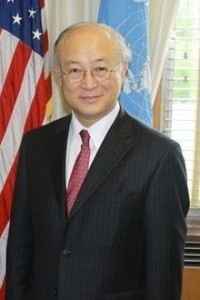
Yukiya Amano, a Japanese diplomat
and director-general of the International
Atomic Energy Agency.

According to U.S. embassy cables from Vienna, Austria, the site of IAEA’s headquarters, American diplomats in 2009 were cheering the prospect that Japanese diplomat Yukiya Amano would advance U.S. interests in ways that outgoing IAEA Director General Mohamed ElBaradei wouldn’t; Amano credited his election to U.S. government support; Amano signaled he would side with the United States in its confrontation with Iran; and he stuck out his hand for more U.S. money.

In a July 9, 2009, cable, American chargé Geoffrey Pyatt said Amano was thankful for U.S. support of his election. “Amano attributed his election to support from the U.S., Australia and France, and cited U.S. intervention with Argentina as particularly decisive,” the cable said.

The appreciative Amano informed Pyatt that as IAEA director-general, he would take a different “approach on Iran from that of ElBaradei” and he “saw his primary role as implementing safeguards and UNSC [United Nations Security Council] Board resolutions,” i.e. U.S.-driven sanctions and demands against Iran.

Amano also discussed how to restructure the senior ranks of the IAEA, including elimination of one top official and the retention of another. “We wholly agree with Amano’s assessment of these two advisors and see these decisions as positive first signs,” Pyatt commented.

In return, Pyatt made clear that Amano could expect strong U.S. financial assistance, stating that “the United States would do everything possible to support his successful tenure as Director General and, to that end, anticipated that continued U.S. voluntary contributions to the IAEA would be forthcoming. Amano offered that a ‘reasonable increase’ in the regular budget would be helpful.”

What Pyatt made clear in his cable was that one IAEA official who was not onboard with U.S. demands had been fired while another who was onboard kept his job.

Pandering to Israel


Pyatt learned, too, that Amano had consulted with Israeli Ambassador Israel Michaeli “immediately after his appointment” and that Michaeli “was fully confident of the priority Amano accords verification issues.” Michaeli added that he discounted some of Amano’s public remarks about there being “no evidence of Iran pursuing a nuclear weapons capability” as just words that Amano felt he had to say “to persuade those who did not support him about his ‘impartiality.’”


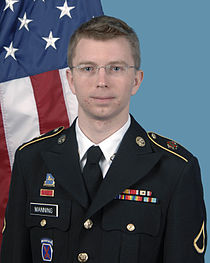
U.S. Army Pvt. Chelsea (formerly Bradley) Manning.

In private, Amano agreed to “consultations” with the head of the Israeli Atomic Energy Commission, Pyatt reported. (It is ironic indeed that Amano would have secret contacts with Israeli officials about Iran’s alleged nuclear weapons program, which never yielded a single bomb, when Israel possesses a large and undeclared nuclear arsenal.)

In a subsequent cable dated Oct. 16, 2009, the U.S. mission in Vienna said Amano “took pains to emphasize his support for U.S. strategic objectives for the Agency.

Amano reminded ambassador [Glyn Davies] on several occasions that he was solidly in the U.S. court on every key strategic decision, from high-level personnel appointments to the handling of Iran’s alleged nuclear weapons program.

“More candidly, Amano noted the importance of maintaining a certain ‘constructive ambiguity’ about his plans, at least until he took over for DG ElBaradei in December 2009”.

In other words, Amano was a bureaucrat eager to bend in directions favored by the United States and Israel regarding Iran’s nuclear program. Amano’s behavior surely contrasted with how the more independent-minded ElBaradei resisted some of Bush’s key claims about Iraq’s supposed nuclear weapons program, correctly denouncing some documents as forgeries.

The world’s public got its insight into the Amano scam only because the U.S. embassy cables were among those given to WikiLeaks by Pvt. Bradley (now Chelsea) Manning, for which Manning received a 35-year prison sentence (which was finally commuted by President Obama before leaving office, with Manning now scheduled to be released in May – having served nearly seven years in prison).

It also is significant that Geoffrey Pyatt was rewarded for his work lining up the IAEA behind the anti-Iranian propaganda campaign by being made U.S. ambassador to Ukraine where he helped engineer the Feb. 22, 2014 coup that overthrew elected President Viktor Yanukovych. Pyatt was on the infamous “fuck the E.U.” call with U.S. Assistant Secretary of State for European Affairs Victoria Nuland weeks before the coup as Nuland handpicked Ukraine’s new leaders and Pyatt pondered how “to midwife this thing.”

Rewards and Punishments


The existing rewards-and-punishments system, which punishes truth-tellers and rewards those who deceive the public, has left behind a thoroughly corrupted information structure in the United States and in the West, in general.


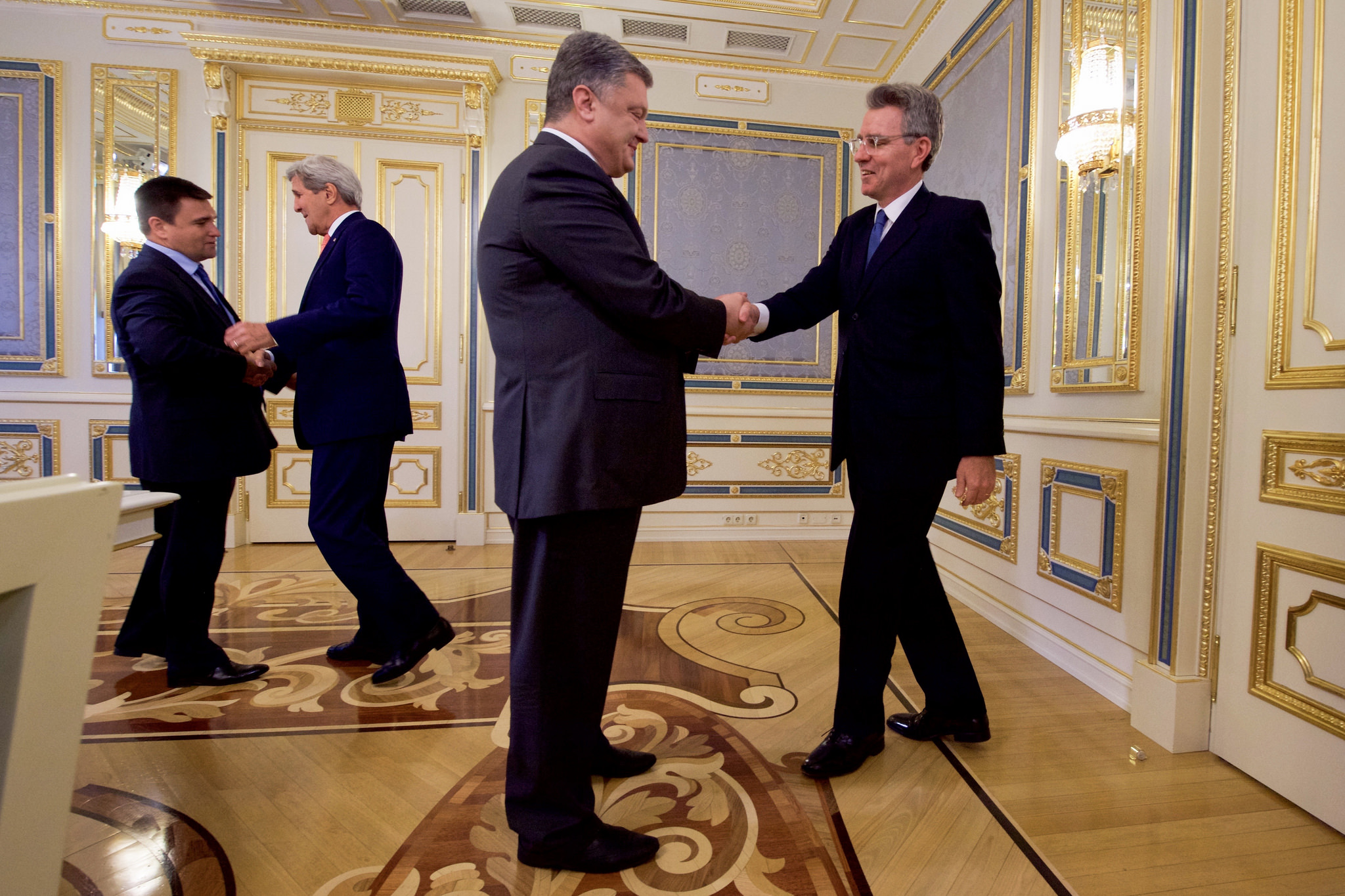
Ukrainian President Petro Poroshenko shakes hands with U.S. 
Ambassador to Ukraine Geoffrey Pyatt as U.S. Secretary of 
State John Kerry shakes hands with Ukrainian Foreign Minister 
Pavlo Klimkin in Kiev, Ukraine, on July 7, 2016.[State Department Photo)


Across the mainstream of politics and media, there are no longer the checks and balances that have protected democracy for generations. Those safeguards have been washed away by the flood of careerism.

The situation is made even more dangerous because there also exists a rapidly expanding cadre of skilled propagandists and psychological operations practitioners, sometimes operating under the umbrella of “strategic communications.” Under trendy theories of “smart power,” information has become simply another weapon in the geopolitical arsenal, with “strategic communications” sometimes praised as the preferable option to “hard power,” i.e. military force.

The thinking goes that if the United States can overthrow a troublesome government by exploiting media/propaganda assets, deploying trained activists and spreading selective stories about “corruption” or other misconduct, isn’t that better than sending in the Marines?

While that argument has the superficial appeal of humanitarianism – i.e., the avoidance of armed conflict – it ignores the corrosiveness of lies and smears, hollowing out the foundations of democracy, a structure that rests ultimately on an informed electorate. Plus, the clever use of propaganda to oust disfavored governments often leads to violence and war, as we have seen in targeted countries, such as Iraq, Syria and Ukraine.

Wider War


Regional conflicts also carry the risk of wider war, a danger compounded by the fact that the American public is fed a steady diet of dubious narratives designed to rile up the population and to give politicians an incentive to “do something.” Since these American narratives often deviate far from a reality that is well known to the people in the targeted countries, the contrasting storylines make the finding of common ground almost impossible.

If, for instance, you buy into the Western narrative that Syrian President Bashar al-Assad gleefully gases “beautiful babies,” you would tend to support the “regime change” plans of the neoconservatives and liberal interventionists. If, however, you reject that mainstream narrative – and believe that Al Qaeda and its friendly regional powers may be staging chemical attacks to bring the U.S. military in on their “regime change” project – you might favor a political settlement that leaves Assad’s fate to the later judgment of the Syrian people.

Similarly, if you accept the West’s storyline about Russia invading Ukraine and subjugating the people of Crimea by force – while also shooting down Malaysia Airlines Flight 17 for no particular reason – you might support aggressive countermoves against “Russian aggression,” even if that means risking nuclear war.

If, on the other hand, you know about the Nuland-Pyatt scheme for ousting Ukraine’s elected president in 2014 and realize that much of the other anti-Russian narrative is propaganda or disinformation – and that MH-17 might well have been shot down by some element of Ukrainian government forces and then blamed on the Russians [see here and here] – you might look for ways to avoid a new and dangerous Cold War.

Who to Trust?


But the question is: whom to trust? And this is no longer some rhetorical or philosophical point about whether one can ever know the complete truth. It is now a very practical question of life or death, not just for us as individuals but as a species and as a planet.


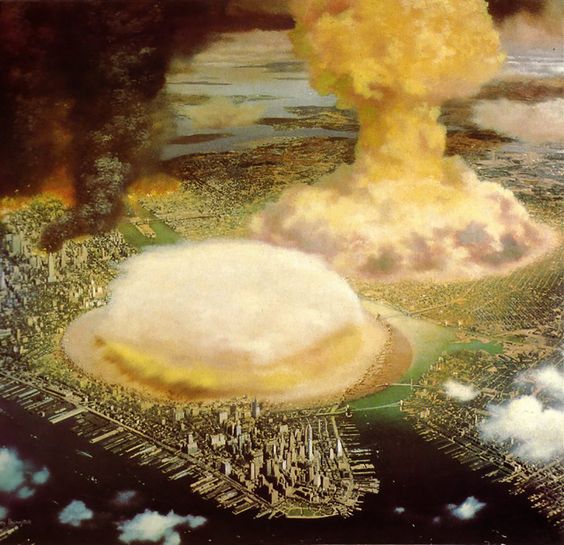
Illustration by Chesley Bonestell of nuclear bombs detonating over 
New York City, entitled “Hiroshima U.S.A.” Colliers, Aug. 5, 1950.

The existential issue before us is whether – blinded by propaganda and disinformation – we will stumble into a nuclear conflict between superpowers that could exterminate all life on earth or perhaps leave behind a radiated hulk of a planet suitable only for cockroaches and other hardy life forms.

You might think that with the stakes so high, the people in positions to head off such a catastrophe would behave more responsibly and professionally. But then there are events like Saturday night’s White House Correspondents Dinner with self-important media stars puffing about with their First Amendment pins. And there’s President Trump’s realization that by launching missiles and talking tough he can buy himself some political space from the Establishment (even as he sells out average Americans and kills some innocent foreigners). Those realities show that seriousness is the farthest thing from the minds of Washington’s insiders.

It’s just too much fun – and too profitable in the short-term – to keep playing the game and hauling in the goodies. If and when the mushroom clouds appear, these careerists can turn to the cameras and blame someone else.

Investigative reporter Robert Parry broke many of the Iran-Contra stories for The Associated Press and Newsweek in the 1980s. You can buy his latest book, America’s Stolen Narrative, either in print here or as an e-book (from Amazon and barnesandnoble.com).
Canada's Think Tank Militarists

Canadian Global Affairs Institute: A Think Tank Driving Militarist Foreign Policy

by Yves Engler - Dissident Voice


April 29th, 2017

A registered “charity” with buckets of donations from arms manufacturers and other corporate sources is aggressively trying to push Canadian foreign policy further towards militarism and the use of violence.

And the right wing Canadian Global Affairs Institute seems to be growing in influence, or at least media prominence.

Since last month’s federal budget senior CGAI analyst David Perry has been quoted throughout the media arguing for increased military spending.

I’m stunned this budget is actually taking money away from the military and pretending to give it back several decades in the future,” Perry told CBC.

In its reports, conferences and commentary the Calgary-based institute promotes aggressive, militarist positions. In the midst of a wave of criticism towards General Dynamics’s sale of Light Armoured Vehicles to Saudi Arabia, CGAI published a paper titled “Canada and Saudi Arabia: A Deeply Flawed but Necessary Partnership” that defended the $15-billion deal. At least four of the General Dynamics-funded institute’s “fellows” wrote columns justifying the sale, including an opinion Perry published in the Globe and Mail Report on Business titled “Without foreign sales, Canada’s defence industry would not survive.”

Previously, CGAI has called for Ottawa to set up a foreign spy service — think CIA, MI6 or Mossad. At the height of the war in Afghanistan they commissioned a survey claiming most “Canadians are willing to send troops into danger even if it leads to deaths and injuries as long as they believe in the military’s goals.”

Beyond the media work most think tanks pursue, the institute expends considerable effort influencing news agencies. Since 2002 the institute has operated an annual military journalism course together with the University of Calgary’s Centre for Military and Strategic Studies. A dozen Canadian journalism students receive scholarships to the 9-day program, which includes a media-military theory component and visits to armed forces units.

The stated objective of the course is “to enhance the military education of future Canadian journalists who will report on Canadian military activities.” But that description obscures the political objective. In an article titled “A student’s look inside the military journalism course” Lola Fakinlede writes:

“Between the excitement of shooting guns, driving in tanks, eating pre-packed lunches, investigating the insides of coyotes and leopards — armoured vehicles not animals — and visiting the messes, we were learning how the military operates. … Being able to see the human faces behind the uniform, being able to talk to them like regular people, being able to see them start losing the suspicion in their eyes and really start talking candidly to me — that was incredible.”

Captain David Williams was forthright concerning the broader political objective of the program. In 2010 he wrote,

the intent of this annual visit has always been to foster a familiarity and mutual understanding between the CF and the future media, two entities which require a symbiotic relationship in order to function.”

Along with the Conference of Defence Associations, the institute gives out the annual Ross Munro Media Award recognizing a “journalist who has made a significant contribution to understanding defence and security issues.” The winner receives a handsome statuette, a gala dinner attended by Ottawa VIPs and a $2,500 prize. The political objective of the award is to reinforce the militarist culture among reporters who cover the subject.

Journalist training, the Ross Munro award and institute reports/commentators are a positive way of shaping the discussion of military matters. But, CGAI also employs a stick. In detailing an attack against colleague Lee Berthiaume, Ottawa Citizen military reporter David Pugliese pointed out that it’s

not uncommon for the site to launch personal attacks on journalists covering defence issues. It seems some CDFAI [CGAI’s predecessor] ‘fellows’ don’t like journalists who ask the government or the Department of National Defence too many probing questions. … Last year I had one of the CDFAI ‘fellows’ write one of the editors at the Citizen to complain about my lack of professionalism on a particular issue. … the smear attempt was all done behind my back but I found out about it. That little stunt backfired big time when I showed the Citizen editor that the CDFAI ‘fellow’ had fabricated his claims about me.”

While it may not have succeeded in this instance, online criticism and complaints to journalists’ superiors do have an impact. If pursued consistently this type of ‘flack’ drives journalists to avoid topics or be more cautious when covering an issue.

While not exactly forthcoming about its funders, the institute has received some military backing. The Canadian Forces identified CGAI’s predecessor, the Canadian Defence and Foreign Affairs Institute, under the rubric of “defence-related organization and defence and foreign policy think tanks.” DND’s Security and Defence Forum provided funding to individuals who pursued a year-long internship with the Institute and CGAI has held numerous joint symposiums with DND, NATO and NORAD.

The institute has received financial backing from arms contractors. General Dynamics and Lockheed Martin Canada, as well as Edge Group, C4i, Com Dev, ENMAX, SMART Technologies, the Defense News Media Group and Canadian Council of Chief Executives have all supported CGAI.

Beyond weapons makers, the institute has wealthy patrons and ties within the corporate world. Rich militarist Frederick Mannix helped found the registered charity and recent directors include the CEO of IAMGOLD Steve Letwin, Royal Bank Financial Group executive Robert B. Hamilton and ATCO director Bob Booth.

A bastion of pro-corporate, militarist, thinking, the Canadian Global Affairs Institute is increasingly influential in shaping the foreign policy discussion in this country.

Canadians who disagree with militarism, who wish for diplomacy over war, and who support a Do Unto Others as We Would Have Them Do Unto Us foreign policy must raise their voices loudly and clearly so that we too are heard by government.

Yves Engler is the author of A Propaganda System: How Canada’s Government, Corporations, Media and Academia Sell War and Canada in Africa: 300 years of aid and exploitation.
Read other articles by Yves.

May Day in Victoria

May Day in Victoria

by Carlos Flores

April 30, 2017

Celebrating International Workers Day in Victoria by showing our support for the 4.000 hospital support service workers who are being hyper exploited by multinationals corporations owning the contracts for cleaning and dietary services in our hospitals.

Monday, May 1 at 4pm

corner of Richmond and Fort


VIHA plays an important and pivotal role in this exploitation, taking full advantage of it and hiding behind the multinationals.


Please wear “orange” so symbolize workers getting “squeezed” 

like oranges by multinationals in our city.


Carlos Flores

British Columbia, Canada
http://www.noesmeralda.com
https://www.facebook.com/vcasc

MORE MAY DAY EVENTS

Inspired by events held around the world in celebration of International Workers’ Day, MayWorks is a festival organized by a coalition of organizations. We will be co-hosting a series of fun, diverse events to celebrate social justice and workers' rights. All events are free or low cost, and no one will be turned away for lack of funds. The festival is organized on the territories of the Lkwungen, W̱SÁNEĆ, and T’Sou-ke peoples. (Facebook: https://www.facebook.com/pg/MayworksVictoria/events/?ref=page_internal)

Gagging Barrett Brown: Rearrested for...

Gagging Barrett Brown: Rearrested for...

by Barrett Brown


April 30, 2017

Statement from Barrett Brown–April 30, 2017

STATEMENT FROM BARRETT BROWN
Federal Correctional Institution
Seagoville, Texas
April 30, 2017

Last week I was re-arrested by the U.S. Marshals Service on the orders of the Bureau of Prisons, which still technically holds sway over my life until May 25th when my sentence officially ends. Contrary to BOP policy, and indeed federal law, I was not provided a written infraction report, much less given the disciplinary hearing that normally precedes punishment. When one is taken back to prison or put in the hole, the institution has 24 hours to give you the infraction sheet detailing your offense. After 72 hours, I have still received nothing.

Luckily, in the days leading up to my arrest, I managed to make audio recordings of BOP regional chieftain Luz Lujan and two halfway house staffers threatening me with a “refusal” or “refusing an order” charge if I did any further media interviews without seeking Lujan’s prior approval; Lujan also demanded that outlets seeking interviews first fill out and submit to her a form which is in fact only required for news representatives seeking to actually enter a federal prison. As I explained to Lujan and the halfway house staffers in those recordings, there is nothing in the BOP media program statements that requires even actual inmates to seek permission to communicate with press, much less those like myself, who have already been released to home confinement; as the policy is publicly available, anyone may verify this for themselves.

Anywho, D Magazine Publisher Wick Allison has been kind enough to enlist the services of David Siegal of the Haynes and Boone law firm for my defense; my attorneys Jay Leiderman and Marlo Cadeddu are also involved. In the meantime, I have agreed to briefly revive the Barrett Brown Review of Arts and Letters and Jail for D Magazine, and as The Intercept editor Roger Hodge has noted, I will have a column in to them presently, as well, IF ONLY I CAN THINK OF SOMETHING TO WRITE ABOUT.