Tuesday, May 09, 2017

The Silence of the Dems: Letting Civil Liberties Slide For Enemies

The McCarthyism of Russia-gate 

by Robert Parry  - Consortium News


May 7, 2017

Congressional demands for personal and business information from several of Donald Trump’s campaign advisers demonstrate how the Russia-gate investigation continues to spill over into a new breed of McCarthyism infringing on civil liberties, including freedom of speech and freedom of association.

The original thinking had been that congressional and other investigations would concentrate on specific concerns from alleged Russian meddling in the 2016 election, such as whether a Trump intermediary somehow conveyed purloined Democratic emails to WikiLeaks for publication on the Internet.

WikiLeaks denies getting the leaked emails from Russians and the Trump campaign denies colluding with Russians, but President Obama’s intelligence chiefs claimed that Russian agents hacked the emails and then used intermediaries to get the material to WikiLeaks – although no real evidence of that has been presented publicly.

However, instead of zeroing in on that central question, the Senate investigation appears engaged in a fishing expedition looking at virtually every contact between Trump advisers and Russians, who may or may not have ties to the government. The demands are so broad that they could entrap the targets for perceived obstruction of an official investigation if some name or contact is left off, intentionally or by accident.

For instance, the Senate Intelligence Committee has demanded from ex-Trump foreign policy adviser Carter Page, who has extensive business dealings and personal contacts in Russia, the names and details of pretty much anyone he contacted over an 18-month period who could be a Russian official or somehow connected to a Russian business.

In a letter dated April 28, the committee’s top Republican, Richard Burr of North Carolina, and top Democrat, Mark Warner of Virginia, gave Page until May 9 to provide:

“A list of all meetings between you and any Russian official or representative of Russian business interests which took place between June 16, 2015, and January 20, 2017.


Former Trump foreign policy adviser Carter Page

For each meeting listed, please include the date, location, all individuals present, and complete copies of any notes taken by you or on your behalf.”

Meetings with Campaign


Further, the committee set a deadline of May 19 for Page to also supply:

“A list of all meetings of which you are aware between any individual with the Trump campaign and any Russian official or representative of Russian business interests which took place between June 16, 2015, and January 20, 2017. For each meeting listed please include the date, location, and all individuals present.”


Donald Trump speaking with supporters at a campaignrally at Fountain Park
in Fountain Hills, Arizona. March 19, 2016. (Flickr Gage Skidmore)

By the same deadline, the committee demanded: “All communications records, including electronic communications records such as e-mail or text messages, written correspondence, and phone records of communications which took place between June 16, 2015, and January 20, 2017, to which you and any Russian official or representative of Russian business interests was a party.

“All communications records, including electronic communications records such as e-mail or text message, written correspondence, and phone records, of communications related in any way to Russia, conducted between you and members and advisors of the Trump campaign.

“All information regarding your financial and real estate holdings related to Russia between June 16, 2015, and January 20, 2017, including those financial securities or real estate holdings which you sold or from which you divested in that time period.”

Similar information requests reportedly have been sent to other Trump campaign advisers, including Roger Stone, Paul Manafort and Michael Flynn.

Given the extent of Page’s dealings in Russia, which included having lived there for several years, the broad information demand amounts to a perjury trap because even if Page tried his best to supply all the personal, phone and email contacts, he would be sure to miss something or someone, thus setting him up for prosecution for obstructing an investigation or lying to investigators.

A FISA Warrant


Also, since the Obama administration reportedly obtained a Foreign Intelligence Surveillance Act warrant against Page last summer, the U.S. government may well have more complete records of Page’s contacts and communications than he would, thus putting him into even greater legal jeopardy for an omission.
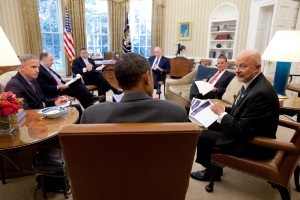


Director of National Intelligence James Clapper (right)
talks with President Barack Obama in the Oval Office,
with John Brennan and other national security aides
present. (Photo: Office of Director of National Intelligence)

The FISA warrant was allegedly obtained, in part, because of a speech that Page delivered in Russia on July 7, 2016, that was mildly critical of U.S. foreign policy toward the countries of the former Soviet Union. Beginning in late July, that FBI investigation then expanded into a much wider probe of people connected to Donald Trump’s presidential campaign with possible links to Russia.

In an article about the origins of the investigation of Page and other Trump advisers, The New York Times characterized Page’s July speech to the New Economic School in Moscow as critical of “American policy toward Russia in terms that echoed the position of President Vladimir V. Putin of Russia.”

The Times then quoted one line from the speech in which Page said, “Washington and other Western capitals have impeded potential progress through their often hypocritical focus on ideas such as democratization, inequality, corruption and regime change.”

The Times article by Scott Shane, Mark Mazzetti and Adam Goldman added:

“His [Page’s] remarks accorded with Mr. Trump’s positive view of the Russian president, which had prompted speculation about what Mr. Trump saw in Mr. Putin — more commonly denounced in the United States as a ruthless, anti-Western autocrat.”

In reality, Page’s speech was much more nuanced than the Times presented. His central point was that the hasty transformation of the former Soviet Union from state-controlled to free market economies led to unintended consequences, including increased corruption.

“As the state remained dominant and new markets were simultaneously established following the breakup of the Soviet Union, members of these societies devised other methods and means of survival through corruption,” Page said, adding that the West was not entirely innocent of similar problems:

“These approaches mirror several corrupt tendencies at times found in Western societies. Some may be clear-cut such as the Bernard Madoff scandal in financial markets and Enron in the energy sector, while others are more subtle such as the perceived societal injustices highlighted by the Occupy Wall Street movement.”

In other words, Page’s comments fell well within a reasonable assessment of the troubles that have occurred within the countries of the former Soviet Union. Page also recognized that the West – despite its sometimes holier-than-thou attitude toward less-developed nations – has its own problems with both criminal corruption and the more subtle variety of Wall Street machinations. After all, the 2008 financial crisis stripped common citizens of both America and Europe of trillions of dollars in lost assets and costs from government bailouts.

Echoing Putin?


But note how The New York Times characterized Page’s remarks as having “echoed the position of President Vladimir V. Putin of Russia,” suggesting that Page, a former U.S. Navy officer, was somehow demonstrating disloyalty.
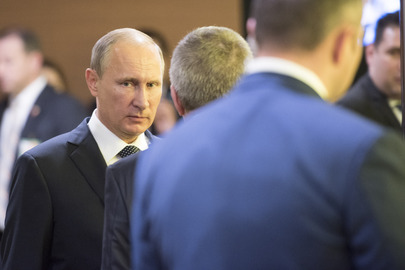

The Times also suggested that Page’s opinions as expressed in his speech contributed to the Obama administration’s decision to seek and obtain a FISA warrant that allowed the U.S. government to monitor his communications as a suspected foreign agent.

Vladimir Putin, following UN General Assembly address Sept. 28, 2015. (UN Photo)


Normally, such intrusive government action against a citizen for expressing his opinions – whether they “echoed” the views of President Putin or not – would alarm defenders of civil liberties. However, since Page briefly served as a foreign policy adviser to Trump – and much of the civil liberties community has enlisted in the #Resistance to Trump over his presumed threats to civil liberties – there has been extraordinary silence about the McCarthyistic treatment of Page and other Trump advisers.

Retired Lt. Gen. Michael Flynn, who served briefly as President Trump’s national security adviser, has already had a taste of how the U.S. government’s surveillance powers can entrap a citizen in a “process” crime, such as lying to investigators or obstructing justice.

On Dec. 29, 2016, several weeks before Trump’s inauguration, Flynn – while vacationing in the Dominican Republic – took a phone call from Russian Ambassador Sergey Kislyak in which they apparently discussed mounting tensions between Washington and Moscow, as U.S. intelligence officials surreptitiously listened in.

Because Flynn was not officially part of the government at the time of the call, Obama administration appointees at the Justice Department created a pretext for a criminal investigation by citing the Logan Act, a law enacted in 1799 to prohibit private citizens from negotiating with foreign adversaries but never used to convict anyone, ever. The law also is of dubious constitutionality and was surely never intended to apply to a president-elect’s advisers.

However, based on that flimsy pretext, FBI agents – with a transcript of the electronic intercept of the Kislyak-Flynn phone call in hand – tested Flynn’s memory of the conversation and found his recollections incomplete. Flynn also has come under criticism for giving a paid speech in 2015 to a dinner in Moscow honoring the tenth anniversary of the Russian television station, RT. Under mounting media and political pressure, President Trump fired Flynn.

The New McCarthyism


So, while one can legitimately criticize Flynn’s judgment, the larger civil-liberties issue surrounding the Russia-gate investigation is the prospect of criminalizing otherwise innocuous contacts with Russia and punishing American citizens for resisting the New Cold War.


Green Party leader Jill Stein and retired Lt. General
Michael Flynn attending a dinner marking the RT network’s
10-year anniversary in Moscow, December 2015, sitting
at the same table as Russian President Vladimir Putin.

Many Democrats, liberals and even some progressives appear excited over the prospect of wielding this new McCarthyism against Trump’s advisers with the hope that Russia-gate can be built up into a case for Trump’s impeachment.

But the precedents that are being set could be very dangerous for the long term. If Americans can be put under invasive FISA warrants for going abroad and criticizing U.S. policies or if intercepted phone calls can be used to test the memories of citizens during FBI interviews, many of the warnings from civil libertarians about the dangers of “war on terror” surveillance powers being applied more broadly may be coming true.

After receiving the sweeping congressional demands for documents and other data, Carter Page, who is an oil industry consultant with numerous foreign contacts including in Russia, responded by taking note of the reported FISA surveillance of him, writing to Senators Burr and Warner:

“I remain committed to helping the Senate Select Committee on Intelligence in any way that I can. But please note that any records I may have saved as a private citizen with limited technology capabilities will be miniscule in comparison to the full database of information which has already been collected under the direction of the Obama Administration during last year’s completely unjustified FISA warrant that targeted me for exercising my First Amendment rights, both in 2016 as well as in years prior.

“As a starting point for this latest step in the witch hunt which you suggested per the cumbersome chores defined in your … letter, I would request that you please begin by sharing [with me] the same information which you currently have … Based on the database of my personal information already collected during the Obama Administration’s domestic political intelligence operations which reportedly began at some point last year, it seems clear that many of the weighty task[s] you assigned will have already been largely completed.

“As a lone individual, I can assure you that my personal administrative capabilities pale in comparison to the clerical juggernaut represented by the numerous staff in the executive, legislative and judicial branches of the U.S. Government which have heretofore been allegedly involved in this unscrupulous surveillance for many months on end.”

Whether justified or not, the FISA surveillance of Page – and thus likely others whom he contacted – may create the basis for some kind of criminal charges against him. Other Trump advisers may be tripped up on various process crimes, such as failure to report properly under the Foreign Agents Registration Act, another law that gets enforced selectively mostly against people without political pull.

In an interview on Friday, Page told me that he was a small player who was innocent of violating any laws but who became an “obvious” target for the Obama administration’s effort to undermine the Trump campaign.

“I don’t have [political] protection and I have genuine, deep Russian connections,” he said, adding that compliance with the Senate’s demands would require him reviewing
“thousands of emails and hundreds of phone calls. … It defies all logic and common sense.”

But the reality of Official Washington is that once momentum builds up around a “scandal,” someone has to get convicted of something – or all the Important People who have weighed in on the “affair” will look stupid. In Russia-gate, however, important principles about the right to dissent, the right to privacy and the right to associate freely are getting trampled.

[For more on this topic, see Consortiumnews.com’s “The Did-You-Talk-to-Russians Witch-hunt.”]

Investigative reporter Robert Parry broke many of the Iran-Contra stories for The Associated Press and Newsweek in the 1980s. You can buy his latest book, America’s Stolen Narrative, either in print here or as an e-book (from Amazon and barnesandnoble.com).
image_pdf

Can These Technological Innovations Change the World Soon Enough?

5 Clean Energy Innovations That Could Transform Our World

by Zainab Calcuttawala  - Oilprice.com


May 9, 2017

Innovations in energy storage, smart grid, and electricity generation technologies will affect every part of the source-to-consumer supply chain for powering the planet. Energy storage tech improves the viability of wind and solar power – two energy sources that remain cost prohibitive due to expenses related to batteries that would store generated energy.

Smart grids will regulate the movement of energy throughout a city or state, insuring the areas from crippling blackouts. Developments in electricity generation make sure we make the most out of fossil fuels and other energy sources to improve efficiency.

What follows is a survey of progress in the development of five different technologies that promise to change the face of the energy industry in the next 20 years.

1. Fuel Cell: 


Truck manufacturers Kenworth, Toyota, and UPS have begun investing in fuel cell technologies, which would allow transport vehicles to run on hydrogen and oxygen, releasing only heat and water as emissions. Modern hydrogen production still requires copious fossil fuel use, but the process could soon be powered by renewable energies, making fuel cell vehicles extremely clean alternatives to current trucking solutions.

In Europe, fuel cell production facilities will begin pumping out 50,000 fuel cell stacks by the year 2020, making United Kingdom-based Intelligent Energy the market leader in bringing the green technology to the masses. “Hydrogen fuel cell powered vehicles are available now, but to continue to drive customer adoption, we need to ensure future fuel cell stacks are robustly industrialised and remain cost competitive in the future,” said the company’s Manufacturing Head Richard Peart. Related: Will Hedge Funds Drive Oil Prices Even Lower?

2. Lithium-air batteries: 


These storage units, also known as Lithium-oxygen fuel cells, have been gestating in scientific labs all over the world since the beginning of electric vehicles. Science Daily says two instabilities in the technology’s current form have prevented it from hitting mass markets: unpredictable short circuiting and speedy loss of battery power. Cornell University recently tackled the second capacity face problem, meaning we could be just one witty solution away from long-range electric cars.

3. First Generation Smart Grid: 


The first step in making a reliable and responsive smart grid system requires the installation of smart meters in every household and building. The new meters will send usage information in real time to your energy provider, allowing adjustments in availability to fluctuate according to the area’s latest needs. So far, countries like the United Kingdom are having trouble adjusting the technology to fit the national infrastructure and business norms. The United States jumped on the smart grid bandwagon in 2007 and set up a taskforce to ensure a synchronized adoption of the new technology. The process has been slow, but small communities have begun “microgrid” projects that will allow consumer demand to drive implementation.

This small company could be one of the biggest winners of the coming gold boom. Backed by a billionaire resource investor and management dream team they could be the next big thing in the space.

4. Tidal turbines: 


Much like wind turbines, these underwater pinwheels harness energy from wave movement. This green energy has had small-scale success so far, but objections from fishermen, as well as accidents, have set the technology back in California – tidal energy Ground Zero – in recent months. But the science behind tidal energy continues its march forward.

Scotrenewables Tidal Power announced the launch of a new low-cost turbine off the coast of Scotland. It’s also the “largest and most powerful” turbine of its kind in the world with a power generation capacity of two megawatts, according to its manufacturers. A retractable arm gives the facility a separate transport mode and an operation mode, which allows easy portability and an impermanence that would please local fishing industries.

5. Space-based Solar Power: 


Solar power captured from-the-beyond has been a sci-fi concept since the 1970s. The high cost of transporting the panels and other equipment into space has prevented the idea from becoming fruitful for commercial energy production. In addition, the transfer of generated energy back to Earth has been a concern. Solar power panels installed on the ground connect to the local power grid to deliver their harnessed goods, but it is comical to imagine a satellite in space hooked to the planet via cable for efficient energy delivery, prompting scientists to develop wireless energy transfer technologies akin to the iPhone 8’s anticipated wireless charging feature. None of the existing methods have proven to be feasible on a massive scale. Suggestions are welcome.

The advances mentioned above are inter-related: progress in the lithium-air battery efforts will pave the way for the success of electric cars, which could be recharged with energy hardheaded from the tides or space-based solar power. It's one small step for science, one giant leap for green energy-kind.

Zainab Calcuttawala is an American journalist based in Morocco. She completed her undergraduate coursework at the University of Texas at Austin (Hook ’em) and reports on international trade, human rights issues and more.

Brass Tax: Just How Much Money Is Perpetual War Costing Us?

The American Way of War Is a Budget-Breaker: Never Has a Society Spent More for Less

by William D. Hartung - TomDispatch


May 9, 2017   

When Donald Trump wanted to “do something” about the use of chemical weapons on civilians in Syria, he had the U.S. Navy lob 59 cruise missiles at a Syrian airfield (cost: $89 million). The strike was symbolic at best, as the Assad regime ran bombing missions from the same airfield the very next day, but it did underscore one thing: the immense costs of military action of just about any sort in our era.

While $89 million is a rounding error in the Pentagon’s $600 billion budget, it represents real money for other agencies. It’s more than twice the $38 million annual budget of the U.S. Institute of Peace and more than half the $149 million budget of the National Endowment of the Arts, both slated for elimination under Trump’s budget blueprint. If the strikes had somehow made us -- or anyone -- safer, perhaps they would have been worth it, but they did not.

In this century of nonstop military conflict, the American public has never fully confronted the immense costs of the wars being waged in its name. The human costs -- including an estimated 370,000 deaths, more than half of them civilians, and the millions who have been uprooted from their homes and sent into flight, often across national borders -- are surely the most devastating consequences of these conflicts.

But the economic costs of our recent wars should not be ignored, both because they are so massive in their own right and because of the many peaceable opportunities foregone to pay for them.

Tomgram: William Hartung, Ignoring the Costs of War

Wilbur Ross put the matter... well, mouth-wateringly. At a Milken Institute Global Conference in California, the commerce secretary recalled how President Trump was hosting a dinner for China’s president, Xi Jinping, at his Mar-a-Lago club at the moment when a bevy of Tomahawk missiles were being dispatched against an airfield in Syria. Ross described the moment this way: “Just as dessert was being served, the president explained to Mr. Xi he had something he wanted to tell him, which was the launching of 59 missiles into Syria. It was in lieu of after-dinner entertainment.” To laughter from the crowd, he then added, “The thing was, it didn’t cost the president anything to have that entertainment.”

The president himself recalled the same moment in an interview with Fox Business: “I was sitting at the table. We had finished dinner. We're now having dessert. And we had the most beautiful piece of chocolate cake that you've ever seen, and President Xi was enjoying it.” (Of course, Donald Trump is hardly the first person to, in essence, say, “Let them eat cake.”)

In the end, of course, someone did have to pick up the tab for that thrillingly militarized dessert and it just happened to be you and me. As TomDispatch regular William Hartung, author of Prophets of War, points out today in a piece on the true costs of war, American-style, the bill for that piece of cake and those Tomahawk missiles was $89 million dollars, admittedly a mere lagniappe by twenty-first-century U.S. military standards. (The tip for the meal naturally went to the maker of those Tomahawks, Raytheon). Rest assured that future desserts will undoubtedly be even more elaborate and expensive. After all, in a rare bipartisan show of unity, Republicans and Democrats just polished off a spending bill that will not only keep the government open through September, but give the Pentagon, an institution that happens to be historically incapable of even auditing itself, an extra little treat: $15 billion above and beyond its already vast budget to tide it over in its never-ending wars in Afghanistan, Iraq, and Syria, and “replenish equipment and pay for training and maintenance.”

We’re talking chocolate cake all the way to the bank when it comes to the Pentagon and the major weapons contractors it regularly offers its tastiest desserts. Admittedly, that $15 billion wasn’t quite what President Trump wanted, but call it an mouth-watering appetizer when it comes to a meal about which, unlike almost everything else on the table in Washington, Democrats and Republicans always see more or less eye to eye. And expect one thing: a lot more chocolate cake in President Trump’s future. After all, the generals are in charge. Tom

The American Way of War Is a Budget-Breaker: 

Never Has a Society Spent More for Less

by William D. Hartung


Even on the rare occasions when the costs of American war preparations and war making are actually covered in the media, they never receive the sort of attention that would be commensurate with their importance. Last September, for example, the Costs of War Project at Brown University’s Watson Institute released a paper demonstrating that, since 2001, the U.S. had racked up $4.79 trillion in current and future costs from its wars in Iraq, Afghanistan, Pakistan, and Syria, as well as in the war at home being waged by the Department of Homeland Security. That report was certainly covered in a number of major outlets, including the Boston Globe, the Los Angeles Times, the Atlantic, and U.S. News and World Report. Given its importance, however, it should have been on the front page of every newspaper in America, gone viral on social media, and been the subject of scores of editorials. Not a chance.

Yet the figures should stagger the imagination. Direct war spending accounted for “only” $1.7 trillion of that sum, or less than half of the total costs. The Pentagon disbursed those funds not through its regular budget but via a separate war account called Overseas Contingency Operations (OCO). Then there were the more than $900 billion in indirect war costs paid for from the regular budget and the budget of the Department of Veterans Affairs. And don’t forget to add in the more than half-trillion dollars for the budget of the Department of Homeland Security since 2001, as well as an expected $1 trillion in future costs for taking care of the veterans of this century’s wars throughout their lifetimes. If anyone were truly paying attention, what could more effectively bring home just how perpetual Washington’s post-9/11 war policies are likely to be?

That cost, in fact, deserves special attention. The Veterans Administration has chronic problems in delivering adequate care and paying out benefits in a timely fashion. Its biggest challenge: the sheer volume of veterans generated by Washington’s recent wars. An additional two million former military personnel have entered the VA system since the wars in Afghanistan and Iraq began. Fully half of them have already been awarded lifetime disability benefits. More than one in seven -- 327,000 -- suffer from traumatic brain injury. Not surprisingly, spending for the Veterans Administration has tripled since 2001. It has now reached more than $180 billion annually and yet the VA still can’t catch up with its backlog of cases or hire doctors and nurses fast enough to meet the need.

Now imagine another 15 years of such failing, yet endless wars and the flood of veterans they will produce and then imagine what a Cost of War Project report might look like in 2032. Given all this, you would think that the long-term price tag for caring for veterans would be taken into account when a president decides whether or not to continue to pursue America’s never-ending wars in the Greater Middle East and Africa, but that, of course, is never the case.

What a Military-First World Means in Budgetary Terms


Enter Donald Trump. Even before he launches a major war of his own -- if he does -- he’s loosed his generals to pursue with renewed energy just about all the wars that have been started in the last 15 years. In addition, he’s made it strikingly clear that he’s ready to throw hundreds of billions (eventually, of course, trillions) of additional tax dollars at the Pentagon in the years to come. As he put it in a September 2016 interview on Meet the Press, “I’m gonna build a military that’s so strong... nobody’s gonna mess with us.” As he makes plans to hike the Pentagon budget once more, however, here’s what he seems blissfully unaware of: at roughly $600 billion per year, current Pentagon spending is already close to its post-World War II peak and higher than it was at the height of the massive 1980s military buildup initiated by President Ronald Reagan.

On the dubious theory that more is always better when it comes to Pentagon spending (even if that means less is worse elsewhere in America), Trump is requesting a $54 billion increase in military spending for 2018. No small sum, it’s roughly equal to the entire annual military budget of France, larger than the defense budgets of the United Kingdom, Germany, and Japan, and only $12 billion less than the entire Russian military budget of 2015.

Trump and his budget director, Mick Mulvaney, have pledged to offset this sharp increase in Pentagon funding with corresponding cuts in domestic and State Department spending. (In a military-first world, who even cares about the ancient art of diplomacy?) If the president gets his way, that will mean, for instance, a 31% cut in the Environmental Protection Agency’s budget and a 29% cut in the State Department’s. Eliminated would also be $8 billion worth of block grants that provide services to low-income communities, including subsidies for seniors who can’t afford to heat their homes, as well as any support for 19 separate agencies engaged in purely peaceable activities, including the National Endowment for the Arts, the National Endowment for the Humanities, Legal Services, the Corporation for Public Broadcasting, AmeriCorps, and the Appalachian Regional Commission, which invests in economic development, education, and infrastructure projects in one of the nation’s poorest regions.

Overall, as presently imagined, the Trump budget would hike the Pentagon’s cut of the pie, and related spending on veterans' affairs, homeland security, and nuclear weapons to an astounding 68% of federal discretionary spending. And keep in mind that the discretionary budget includes virtually everything the government does outside of entitlement programs like Social Security, Medicare, and Medicaid. You undoubtedly won’t be surprised to learn that perpetual war and the urge to perpetuate yet more of it leaves little room for spending on the environment, diplomacy, alternative energy, housing, or other domestic investments, not to speak of infrastructure repair.

Put another way, preparations for and the pursuit of war will ensure that any future America is dirtier, sicker, poorer, more rickety, and less safe.

Taking the Gloves Off When It Comes to the Costs of War


The biggest beneficiaries of Pentagon largesse will, as always, be the major defense contractors like Lockheed Martin, which received more than $36 billion in defense-related contracts in fiscal 2015 (the most recent year for which full statistics are available). To put that figure in perspective, Lockheed Martin’s federal contracts are now larger than the budgets of 22 of the 50 states. The top 100 defense contractors received $175 billion from the Pentagon in fiscal year 2015, nearly one-third of the Department of Defense’s entire budget. These numbers will only grow if Trump gets the money he wants to build more ships, planes, tanks, and nuclear weapons.

The Trump administration has yet to reveal precisely what it plans to spend all that new Pentagon money it’s requesting, but the president’s past statements offer some clues. He has called for building up the Navy from its current level of 272 ships to 350 or more. The Congressional Budget Office estimates that the construction costs alone of such an effort would be $800 billion over the next three decades at an annual cost of $26.6 billion, which is 40% higher than the Navy’s present shipbuilding budget.

To put this in perspective, even before Trump’s proposed increases, the Navy was planning major expenditures on items like 12 new ballistic-missile-firing submarines at a development and building cost of more than $10 billion each. As for new surface ships, Trump wants to add two more aircraft carriers to the 10 already in active service. He made this clear in a speech on board the USS Gerald Ford, a new $13 billion carrier that, as with so much Pentagon weaponry, has been plagued with cost overruns and performance problems.

President Trump also wants to double down on the Pentagon’s preexisting program to spend $1 trillion over the next 30 years on a new generation of nuclear-armed bombers, submarines, and land-based missiles. While that plan is politely referred to as a “modernization” of the U.S. nuclear arsenal, it already essentially represents Washington’s bid to launch a new global arms race. So among a host of ill-considered plans for yet more expenditures, this one is a particular ringer, given that the United States already possesses massive nuclear overkill and that current nuclear delivery systems can last decades more with upgrades.

To give all of this a sense of scale, two Air Force strategists determined that the United States needs just 311 nuclear warheads to dissuade any other country from ever attacking it with nuclear weapons. At 4,000 nuclear warheads, the current U.S. stockpile is already more than 13 times that figure -- enough, that is, to destroy several planet Earths.

And don’t forget that Trump also wants to add tens of thousands more soldiers and Marines to the military’s ranks. By the most conservative estimate, the cost of equipping, training, paying, and deploying a single soldier annually is now close to $1 million (even leaving aside those future VA outlays), so every 10,000 additional troops means at least $10 billion more per year.

And don’t forget that the staggering potential costs already mentioned represent just the baseline for military spending -- the costs President Trump will set in motion even if he doesn’t get us into a major war. Not that we’re not at war already. After all, he inherited no less than seven conflicts from Barack Obama: Afghanistan, Iraq, Libya, Pakistan, Somalia, Syria, and Yemen. Each of them involves a different mix of tools, including combat troops, trainers, Special Operations forces, conventional bombing, drone strikes, and the arming of surrogate forces -- but conflicts they already are.

Based on his first 100-plus days in office, the real question isn’t whether Donald Trump will escalate these conflicts -- he will -- but how much more he will do. He’s already allowed his military commanders to “take the gloves off” by loosening the criteria for air attacks in Afghanistan, Syria, Iraq, Yemen, and Somalia, with an almost instant increase in civilian casualties as a result. He has also ceded to his commanders decision-making when it comes to how many troops to deploy in Iraq, Syria, Afghanistan and elsewhere, making it a reasonable probability that more U.S. personnel will be sent into action in the months and years to come.

It still seems unlikely that what must now be considered Trump’s wars will ever blow up into the kind of large-scale conflicts that the Bush administration sparked in Iraq. At the height of that disaster, more than 160,000 U.S. troops and a comparable number of U.S.-funded private contractors were deployed to Iraq (compared to 7,000 troops and more than 7,800 contractors there now). Nor does the talk of increasing the number of U.S. troops in Afghanistan by 3,000 to 5,000 suggest that the 8,400 troops now there will ever be returned to the level of roughly 100,000 of the Obama “surge” era of 2010 and 2011.

But don’t breathe a sigh of relief just yet. Given Trump’s pattern of erratic behavior so far -- one week threatening a preemptive strike on North Korea and the next suggesting talks to curb Pyongyang’s nuclear program -- anything is possible. For example, there could still be a sharp uptick in U.S. military personnel sent into Iraq and Syria when his pledge to “bomb the shit” out of ISIS doesn’t vanquish the group.

And if we learned anything from the Iraq experience (aside from the fact that attempting to use military force to remake another country is a formula for a humanitarian and security disaster), it’s that politicians and military leaders routinely underestimate the costs of war. Before the invasion of Iraq, Bush officials were, for instance, citing figures as low as $50 billion for the entire upcoming operation, beginning to end. According to figures compiled by the Congressional Research Service, however, direct budgetary costs for the Iraq intervention have been at least 16 times larger than that -- well over $800 billion -- and still counting.

One decision that could drive Trump’s already expansive military spending plans through the roof would be an incident that escalated into a full-scale conflict with Iran. If the Trump team -- a remarkable crew of Iranophobes -- were to attack that country, there’s no telling where things might end, or how high the costs might mount. As analyst Ali Vaez of the International Crisis Group has noted, a war with Iran could “make the Afghan and Iraqi conflicts look like a walk in the park.”

So before Congress and the public acquiesce in another military intervention or a sharp escalation of one of the U.S. wars already under way, perhaps it’s time to finally consider the true costs of war, American-style -- in lives lost, dollars spent, and opportunities squandered. It’s a reasonable bet that never in history has a society spent more on war and gotten less bang for its copious bucks.

William D. Hartung, a TomDispatch regular, is the director of the Arms and Security Project at the Center for International Policy and the author of Prophets of War: Lockheed Martin and the Making of the Military-Industrial Complex (Nation Books).

Follow TomDispatch on Twitter and join us on Facebook. Check out the newest Dispatch Book, John Dower's The Violent American Century: War and Terror Since World War II, as well as John Feffer's dystopian novel Splinterlands, Nick Turse’s Next Time They’ll Come to Count the Dead, and Tom Engelhardt's Shadow Government: Surveillance, Secret Wars, and a Global Security State in a Single-Superpower World.

Copyright 2017 William D. Hartung

Emergency Declared at Hanford Nuclear Site Following Tunnel Collapse

Emergency Declared At Nuclear-Contaminated Site In Washington State

by NPR


May 9, 2017
 
The Department of Energy has declared an emergency at a nuclear-contaminated site in Washington state, after soil caved in over a portion of a tunnel containing rail cars contaminated with nuclear waste.

"All personnel in the immediate are have been accounted for — they are safe — and there is no evidence of a radiological release," Destry Henderson, spokesperson for the Hanford site's emergency operations center, said in a brief statement on Facebook.

Some employees have been evacuated and others told to move indoors as a "precaution," officials say. Anna King of the Northwest News Network, a public radio station collaboration, reports that approximately 3,000 other workers in the area were originally taking cover indoors. Some have since been released home, but those closest to the tunnel remain indoors.

There are no reports of injuries.

The Hanford Site, about 150 miles southeast of Seattle, is a former nuclear production complex and home to a long-running, challenging and sometimes troubled cleanup operation.

It's generally regarded as the most contaminated nuclear site in America. The Department of Energy says it's the most challenging of the government's nuclear cleanup projects, with millions of tons and hundreds of billions of gallons of nuclear waste.

The Department of Energy says a 20-foot-by-20-foot section of soil caved in where two underground tunnels meet next to the Plutonium Uranium Extraction Facility, known as the PUREX plant.

The tunnels in question were storing rail cars that once carried radioactive nuclear fuel from reactors to production facilities, back when the site was still used to manufacture nuclear weapons. Each tunnel is hundreds of feet long, the Hanford Site says; a 20-foot section appears to have collapsed.

"There is no indication of a release of contamination at this point," the Department of Energy says. Workers are continuing to evaluate the situation, with the help of a remote-controlled device.

The site of the collapse had been previously identified as a potential hazard, the Northwest News Network writes:

"In 2015, a preliminary report identified the tunnels and the PUREX facility as a major risk area on the Hanford site. The report concluded if the tunnels collapsed, from an earthquake or another natural cause, it could pose a risk to workers because of the highly contaminated railcars stored inside.

"Between 1960 and 1965, eight rail cars were pushed inside one tunnel, full of radioactive waste. Another tunnel was constructed in 1964 to hold 40 additional railcars."

The governor of Washington Jay Inslee, says there are "many questions" about how the collapse happened, reports member station Oregon Public Broadcasting.

"We'll have to get to the bottom of that," he said.
"At the moment we're focusing on the safety of workers and making sure there's no release beyond [the] immediate site."


OPB described the Hanford site, and the challenges of cleaning up nuclear waste, late last year, as part of a project about the environmental impact of the U.S. military in the Northwest:

"Hanford is the nation's largest nuclear cleanup site, with 56 million gallons of radioactive waste sitting in old, leaky underground tanks just a few hours upriver from Portland. After more than 20 years and $19 billion[,] not a drop of waste has been treated.

"Hanford sits next to the Columbia River. It was one of the original Manhattan Project sites. Its nine nuclear reactors irradiated uranium fuel rods. That created plutonium, which was extracted with chemicals, processed and shipped to weapons factories. Each step produced radioactive waste. ...

"The stored waste has to be treated in special rooms called black cells, which are too radioactive for humans to enter. The machinery in these black cells is supposed to operate for 40 years with no direct human intervention. If something goes wrong, the cells could be damaged."

The treatment plant was originally supposed to be finished in 2007, but the deadline has been extended several times, OPB reports.

Gorilla Radio with Chris Cook, Andre Vltchek, Christina Nikolic May 10, 2017

This Week on GR

by C. L. Cook - Gorilla-Radio.com


May 10, 2017

When thinking of war, pictures of soldiers marching, bombs falling, and missiles launching may spring to mind. Less frequently imagined are the destinations of those departed soldiers, dropped bombs, and sent missiles and what they do upon arrival over there.

More rarely contemplated still, by those who do consider the ramifications of the whens and wheres of wars happened and happening, is the long aftermath suffered.

Whose mental picture includes the endless agonies of wounds that cannot be healed; who conjures in the mind's eye a portrait of the lives and lands irrevocably torn asunder?

Listen. Hear.

Andre Vltchek is an itinerant philosopher, novelist, filmmaker, investigative journalist, poet, playwright, and photographer He is a revolutionary internationalist globetrotter, who fights perpetually the Western Imperialist ethos, and the corrupt regimes it imposes around World.

There are very few war and conflict zones Andre has not covered, or dark corners where economic violence and gross injustice occur he has not dared venture into. Vltchek's numerous book titles include: 'Western Terror: From Potosi to Baghdad', 'Indonesia: Archipelago of Fear', 'Exile' (with Pramoedya Ananta Toer, and Rossie Indira), 'Oceania – Neocolonialism, Nukes & Bones', 'The World Order and Revolution! - Essays from the Resistance' (co-written with Christopher Black and Peter Koenig), 'Liberation Lit' (edited with Tony Christini), and his latest, 'Exposing Lies of the Empire', 'Fighting Against Western Imperialism', and 'On Western Terrorism: From Hiroshima to Drone Warfare' (written with Noam Chomsky).

Andre recently conducted a lengthy interview with trauma surgeon, Dr. Ghassan "Gus" Abu Sitta in Beirut about frontline medicine and his upcoming presentation to the 48th Middle East Medical Assembly, 'Conflict Medicine and the Ecology of War'.

Andre Vltchek in both segments today.


And; horticultural guru and intrepid green entrepreneur, Christina Nikolic will join us at the bottom of the hour with the Left Coast Events update, bringing us up to speed with some of the good things planned in and around our town for the coming week. But first, Andre Vltchek and the Ecology of War.

Chris Cook hosts Gorilla Radio, airing live every Wednesday, 1-2pm Pacific Time. In Victoria at 101.9FM, and on the internet at: http://cfuv.ca.  He also serves as a contributing editor to the web news site, http://www.pacificfreepress.com. Check out the GR blog at: https://gorillaradioblog.blogspot.ca/


G-Radio is dedicated to social justice, the environment, community, and providing a forum for people and issues not covered in the corporate media. 

Shades of Phoenix: Third Ferguson Black Activist Killed

Third Mysterious Death of a Black Ferguson Activist

by TRNN


May 9, 2017

Edward Crawford is the third mysterious death of a young Black activist man in Ferguson over the past three years. Glen Ford of the Black Agenda Report argues that this cannot be a coincidence.


Glen Ford is a distinguished radio-show host and commentator. In 1977, Ford co-launched, produced and hosted America's Black Forum, the first nationally syndicated Black news interview program on commercial television. In 1987, Ford launched Rap It Up, the first nationally syndicated Hip Hop music show, broadcast on 65 radio stations. Ford co-founded the Black Commentator in 2002 and in 2006 he launched the Black Agenda Report. Ford is also the author of The Big Lie: An Analysis of U.S. Media Coverage of the Grenada Invasion. 

Monday, May 08, 2017

Questioning Weaver's Green Cred

Green Party campaign manager quit over Andrew Weaver’s bullying, bad policies

by Damien Gillis  - Common Sense Canadian


May 8, 2017

On the eve of his candidate’s kick-off event, Green Party campaign manager Troy Grant reached his breaking point with Andrew Weaver, causing him to resign.

“I can’t support the BC Green Party because of Andrew Weaver,” Grant now admits. Here’s why.


Andrew Weaver attacks BCNDP Leader John
Horgan during the televised leaders’ debate

Troy Grant is a Vancouver Island resident and environmental activist who, up until a couple of months ago, was running the campaign of Green Party candidate Lia Versavel. As part of his early groundwork on the campaign, Grant reached out to Common Sense Canadian lead columnist Rafe Mair, a man whose opinions Grant says he has always respected.

Intrigued by what he heard about Versavel, Rafe proceeded to interview her, resulting in this relatively glowing review. Rafe being Rafe, though, couldn’t sign off on the piece without one caveat: his disdain for party leader Andrew Weaver’s ongoing support of IPPs (private power projects). After all, Rafe and this publication have been highly critical of IPPs going back to the Gordon Campbell era, when Weaver stumped for the BC Liberals as a UVic climate scientist.

By the time Grant showed up to a campaign launch for Versaevel in early February, he had already been berated over the phone by high level party operatives over the Mair article. They were incensed that Grant had reached out to Mair, a longtime critic of Weaver’s. Grant had no reason to expect what happened next, though. Weaver himself showed up to the event and proceeded to “rip into” Grant. So irate was the party leader that “minutes before the event was to start, I had to ask him to step outside,” Grant recalled for me in a phone interview this morning.

Two weeks later, Grant tendered his resignation from Versaevel’s campaign. Officially, it was for health reasons. Grant suffers from a serious disability and mobility challenges which, over the course of Versaevel’s early campaigning, grew worse.

Lia Versaevel (photo: BC Green Party)

But, privately, the incident with Weaver was a big motivating factor for his departure – “the last straw”, he acknowledged.

More than Weaver’s angry treatment of Grant, his policies were also a serious concern. “I resigned because of a difference of opinion with the way the leader was leading the party,” Grant added.

Writ large, Weaver’s strategy of sidling up to Liberal voters was a problem for Grant, who explained it this way:

Weaver believes he can pick up the Green Party, plop it in the middle, make it “Liberal Light” and draw votes from both sides. It makes me angry when people minimize the urgency of our environmental challenges for political gain – and that’s what he’s done. It’s a travesty.


Construction of a private power project on the Ashlu River 
(Photo: Range Life)

In terms of policy specifics, Grant shares many of the concerns Rafe and this publication have highlighted about Weaver, including his support for the Campbell/Clark private power program, which has meant widespread ecological devastation for many of BC’s rivers, but also resulted in well over $60 Billion worth of sweetheart contracts for private power players – many of them significant BC Liberal Party donors – unnecessarily driving up power bills for British Columbians and all but bankrupting our public utility. The Versaevel piece was far from the first time Rafe had taken on Weaver’s pro-IPP position.

In 2009, when Rafe I were both speaking out publicly against IPPs, we were dismayed to learn that Weaver wrote an op-ed and made robo-calls (listen for yourself) in favour of the Campbell Liberal Government, with supportive words for his energy program. Following that election, Weaver remained relatively silent about IPPs until, after becoming leader of the BC Greens, he was quizzed about his position by then-CFAX Radio host Ian Jessop. After hearing Weaver’s interview, Rafe wrote:

Dr. Weaver [is] still praising private power – only criticizing the Liberals’ lack of environmental monitoring and enforcement. What he fails to recognize or admit is that this industry has never been monitored, nor any protections enforced, since day one, which is precisely what we’ve been warning for nearly a decade now. This is not some mere wrinkle or oversight – it’s exactly how a privatized system is designed to work.

Later writing about Green candidate Versaevel, Rafe included this line, which appears to have sparked the dust-up between Weaver and campaign manager Grant: “…Dr. Weaver [remains] an unrepentant supporter of IPPs without concern for the damage they do or the monetary wreckage they have visited on BC Hydro. If he is a ‘Green’, he needs a new paint job.”

But for critics of Weaver’s within the environmental community, IPPs are just one in a long list of gripes. Others include:

  • His support for David Black’s proposed oil refinery in Kitimat, on the grounds that it would result in tankers carrying a less-destructive product than bitumen on the BC Coast. Lost on Weaver, apparently, was the fact that this would still require Tar Sands extraction, intense carbon emissions, and a bitumen pipeline crossing BC’s rugged northern landscape, much the same as Enbridge would have done.
  • Weaver’s grizzly hunt policy, which only requires that hunters pack their meat out (as if anyone actually hunts grizzlies for food!). This would likely stop foreign hunters, but do nothing to stem the larger resident hunt. Weaver’s position has been ridiculed by bear advocacy groups and leading biologists, including Chris Darimont, an associate professor at UVic. Addressing some of Weaver’s most absurd comments on the subject, Darimont recently told The Vancouver Sun, “He is not only on the wrong side of history on the grizzly hunt issue, but he is also ‘dead’ wrong.” Adds Grant, “Weaver’s position should have been, ‘We’re against it, period.'”

Grant also points Weaver’s bewildering relationship with the Liberal Party, as other critics have done of late. When Weaver distanced himself from popular federal party leader Elizabeth May over the BDS controversy, he told the media, “I’ve got a lot of federal Liberals on my team who are members of the federal Liberal party but also members of the B.C. Green Party.” If distance is what he sought, that’s apparently what he got. One would expect May to be all over the BC campaign trail, rallying her federal Green supporters in key ridings where the Greens are vying for seats on May 9. Aside from a few campaign stops early on, there’s been barely any mention of the country’s brightest Green star.

Then there’s the overt Liberal support for the Greens – which last election meant pro-Green ads paid for by the Liberal campaign. This time around, it’s more subtle. There’s Judi Tyabji – wife of Liberal LNG booster Gordon Wilson and mother of Liberal candidate Mathew Wilson – working with the Powell River Chamber of Commerce to host Andrew Weaver in the very riding her son’s campaigning in, then extolling the Green leader’s virtues on facebook.


Screen capture from Judi Tyabji’s facebook page.


And, of course, there’s Weaver portraying himself as ready to work with the Liberals – even ready to accept a cabinet position from them – yet dismissing John Horgan and the NDP. This particular incident drove ex-Liberal Chief of Staff Martyn Brown to come out publicly against Weaver and urge progressive voters to unite under the NDP:

It is beyond me how Weaver could ever contemplate supporting Clark’s government—a government that has eviscerated B.C.’s globally-lauded climate action plan and that is diametrically opposed to virtually every plank in the Green party’s platform.

For the life of me, I cannot fathom how the Green party leader could ever equivocate on which party he would support if he finds himself holding the balance of power, as he did in the televised leaders’ debate, and as he did again in Wednesday night’s interview on Global TV.

Which is why I will be casting my vote for the NDP — a party I spent nearly a quarter of a century fighting against.

For his part, Troy Grant is clearly still torn about his recent experience with the Green Party, noting how badly he feels about having to step away from the campaign of Versaevel, whom he holds in high regard. The same can be said for many of her fellow candidates and party supporters – but Weaver has jeopardized all that.

“All these people have done so much work over the years to build the Green Party,” he told me, “but now he’s turned it into the ‘Andrew Weaver Party’.”

Damien Gillis is a Vancouver-based documentary filmmaker with a focus on environmental and social justice issues - especially relating to water, energy, and saving Canada's wild salmon - working with many environmental organizations in BC and around the world. He is the co-founder, along with Rafe Mair, of The Common Sense Canadian, and a board member of both the BC Environmental Network and the Haig-Brown Institute.
More articles by

Parks Canada Shooting Spree: Springtime is Kill Time for Ministry of Natural Resources and Forestry

Shooting by Parks Canada: Spring Bear Hunt Boondoggle

by Barry Kent MacKay - Peaceful Parks Coalition


May 9, 2017

Spring time is killing time for Point Pelee National Park and the Ministry of Natural Resources and Forestry


All national parks are free this year because of Canada’s 150 birthday. Peaceful Parks will be organizing a full and dedicated campaign in southern Ontario, including Americans crossing into Canada at the Windsor border, to highlight Point Pelee National Park’s multi year and failed shooting program of Double-crested Cormorants.

Currently Point Pelee is hosting the Festival of Birds Event at the same time they are shooting hundreds of nesting cormorants killing both the parents and their eggs. Parks Canada has produced no reports measuring the effectiveness of their program.

Many of the people that visit Point Pelee during the spring have no idea that Point Pelee is shooting hundreds of nesting birds while at the same time celebrating the spring migration. Other more seasoned birders just don’t care and refuse to boycott Point Pelee for its reckless program.

This program not only kills cormorants, it is also driving away their nesting companions such at Great Blue Herons (currently in steep decline in Ontario) and more recently the threatened American White Pelican.

The American White Pelican was assessed as endangered when the Endangered Species Act took effect in 2008 and was re-assessed as threatened on February 18, 2009.

“Threatened” means the species lives in the wild in Ontario, is not endangered, but is likely to become endangered if steps are not taken to address factors threatening it.

Below is the blog from Barry Kent MacKay who is currently off the shore of Point Pelee’s Middle Island documenting the shooting by Parks Canada of Double-crested Cormorants.

PPC is launching its campaign against Point Pelee’s shooting program on Wednesday May 17 in London Ontario at a townhall meeting discussing the health of Lake Erie. Bird Studies Canada will be presenting – an agency that failed to defend cormorants and their nesting companions. Please let us know if you can join our campaign. We need boots to ground in southern Ontario.

BLOG By Barry Kent MacKay

From yesterday, May 3: While anchored off Middle Island, mid-day, yesterday, we were entertained by a magnificent fly-over of 15 American White Pelicans. I was able to get documentary photos (not high quality) of some of them. They broke up the flock and reformed several times, once at a time when I believe they were joined by three more, but of the 15 I am absolutely certain, and there probably was 18 in total. Some landed on the water. Parks Canada was shooting birds on the island so although the pelicans looked like they might want to land there (the two ends of the island and some of the shelf-limestone around the edge would be suitable roosting/nesting habitat.the sand spit is almost, entirely submerged.about three to five meters just breaking the surface. On one close fly-by we could clearly see the nuptial knobs on tops of some of the birds' beaks.

The egrets don't do well with the shooting but we did manage to see two flying away, one trailing lovely long nuptial plumes. I saw no night-herons although my two non-birding companions (both familiar with the species) say they saw one or two. Great Blue Herons, although not targeted for killing, continue to decline rather steeply as a nesting species and we saw a lot fewer of them than previous years, and also fewer Herring and Ring-billed Gulls and Canada Geese. The small list was rounded off with Barn and Tree Swallows, a Northern Cardinal heard singing from the island, Common Grackles, Gadwall, Bufflehead and several Common Mergansers, Canada Geese (down in numbers from the last few years) and Mallards.

Barry Kent MacKay
Bird Artist, Illustrator
www.barrykentmackay.ca

Point Pelee National Park, on Killing Spree, Chases Threatened Species in Senseless Act

by Barry Kent MacKay - Peaceful Parks Coalition

May 12/16

Unbelievable. That word describes what happened in early May in one of the world's most famous national parks for seeing birds at the height of the spring migration. The park is Point Pelee, a tapering point of land thrusting into Lake Erie at the southernmost tip of Canada. As of 2001, the park also includes Middle Island, hidden over the lake's southern horizon, a mere 18.5 hectares (46 acres) in size, and currently uninhabited. It is the southernmost land still part of Canada, thus home to several plant species reaching the northern tip of their ranges in southwestern Ontario, where they have largely been eliminated from the mainland by agriculture and urban sprawl.

Middle Island is also home to colonies of nesting ring-billed gulls, great egrets, black-crowned night-herons, great blue herons, and double-crested cormorants.

Cormorants have been deemed "hyper-abundant" by Parks Canada, concerned that cormorant excrement kills vegetation (including, perhaps, some of the species that have not been adequately protected on the mainland). These species are commonplace to the south, in the U.S., which starts literally a few meters away from Middle Island. (For more, click here and here.)

And so, each spring, as my Canadian colleagues and I take notes from a boat anchored near offshore, sharp-shooters armed with high-velocity .222 rifles slaughter thousands of cormorants as the birds try to nest.

Cormorants are devoted parents who assiduously attend their eggs. They are forever entwining their necks and displaying each other to reinforce strong pair bonds, while shooters pick them off, leaving the ground littered with thousands of rotting bodies. Park visitors are not allowed on the island—ironically "to protect" the nesting birds. Egret and heron numbers have also declined.

But, if all of this is not bizarre enough, the situation escalated into high surrealism this May with the arrival of 25 American white pelicans on the island while the cull was occurring. This is a threatened species in Ontario, whose nearest nesting site is north of Lake Superior, about 700-800 miles away. They nest in colonies with double-crested cormorants.

We foolishly believed that Parks Canada would want these birds to stay. Heavy-bodied and fish-dependent, there are few places better suited for "staging" (resting and feeding while migrating—essential to survival) than Middle Island.

But now, the response we got was from the Ontario Ministry of Natural Resources and Forestry, which administers the provincial Endangered Species Act, which said, in part: "Pelee Island National Park staff have documented no effects (e.g. extended or permanent displacement, mortality, etc.) of their management actions on American White Pelican. Additionally, Middle Island is not considered suitable nesting habitat and management actions do not take place within the area of the Island that American White Pelicans are using." Click here for the full text of the letter.

Of course, "management actions" (gunfire) chased the pelicans, and there's no way to know the effect on these birds. The legislation clearly states that threatened species are to be protected throughout their life cycle.

And, while they may not now nest on Middle Island, there's no way to know if they might. Much larger range extensions are commonplace, with such western bird species as the yellow-headed blackbird, Brewer's blackbird, black-billed magpie, common raven, and Forster's tern all now nesting in new regions east and south of "normal" breeding range. Some species have widely separated populations. That even includes the American white pelican, who has a series of "disjunct" nesting ranges separated by areas where it does not nest, and who is trying to expand its range.

Sadly, Parks Canada clings to a "museum" or "gardening" approach to management, trying to maintain an arbitrarily fixed state of ecological affairs through its relentless war on wildlife.

Following is the letter received from the Director of the Species Conservation Policy Branch of the Ontario Ministry of Natural Resources and Forestry:

I would like to thank you for reaching out to relay your concerns regarding Double-crested Cormorant management actions on Middle Island and possible adverse effects on American White Pelican.

As you are aware, American White Pelican is listed as a threatened species under the provincial Endangered Species Act, and receives both species and habitat protection. The most sensitive aspect of American White Pelican ecology is associated with breeding; and many of the provincial protection and recovery approaches are intended to address threats to nesting colonies.

To assist in the recovery of American White Pelican within Ontario, the Ministry of Natural Resources and Forestry (MNRF) has published a provincial recovery strategy (2011), which provides advice to government on recommended recovery approaches and habitat considerations; a government response statement (2011), which outlines the provincial government's policy direction on the recovery of the species; and a habitat regulation (2012), which provides a legal description of the area of habitat that is protected under the Endangered Species Act.

These documents may be found online at the following link: https://www.ontario.ca/page/american-white-pelican.

I have spoken with MNRF staff and they have informed me that, while individual American White Pelicans are often sighted across much of Ontario, there are two primary breeding localities; Lake of the Woods and Lake Nipigon. Secondary breeding localities include the north shore of Lake Superior.

American White Pelicans appear to be experiencing a range expansion within Ontario, and observations on Lake Erie have increased over the last four to five years, including on Pelee Island and Middle Island, as well as at Point Pelee National Park. These birds are in the process of migrating, likely to the Lake of the Woods breeding site, and are using the Lake Erie Islands and shoreline as migration stopover sites.

MNRF is aware of the cormorant management actions being undertaken on Middle Island by the Parks Canada Agency and is under the understanding that Pelee Island National Park staff have documented no effects (e.g. extended or permanent displacement, mortality, etc.) of their management actions on American White Pelican. Additionally, Middle Island is not considered suitable nesting habitat and management actions do not take place within the area of the Island that American White Pelicans are using.

I would like to thank you once again for your concern regarding the recovery of American White Pelican and for your commitment to conservation of Ontario's natural heritage.


Barry Kent MacKay, Senior Program Associate Born Free USA's Canadian Representative

Sunday, May 07, 2017

Kushner and the House of Steinmetz

New Conflicts of Interest Uncovered for Trump's Son-In-Law Jared Kushner

by TRNN


May 7, 2017

Shir Hever analyzes the financial ties that Jared Kushner has to the Steinmetz family, whose members have been accused of corruption in Africa.


Stone Recognized with Gary Webb Freedom of the Press Award

Oliver Stone Honored with Press Freedom Award

by Robert Parry  - Consortium News


May 4, 2017

Though most people know Oliver Stone as a famous screenwriter and movie director, he has also lent his talents and resources to a number of documentary films that embrace the core journalistic idea that there are usually two sides – if not more – to a story.

In doing so, Stone has taken on controversial subjects, both in challenging conventional history as with Showtime’s “Untold History of the United States” and daring to treat foreign leaders – who were undergoing demonization by the U.S. government and media – as complex figures who deserve to have their say as well.

Director Oliver Stone

Not surprisingly, Stone has faced intense criticism for deviating from mainstream U.S. groupthinks, which seek to portray international adversaries as cardboard villains deserving only of American hatred and bombs.

But Stone learned as a decorated young soldier in the Vietnam War how that propaganda process can lead to unspeakable horrors, including the unnecessary deaths of millions of people and the devastation of entire nations and regions.

The Vietnam War – and the U.S. government’s lies that justified it – taught Stone a powerful lesson that is as true now as it was then, that a healthy democracy should encourage a diversity of viewpoints, appreciate all sides of a conflict, and have the courage to engage in serious self-criticism, not simply assume that what the authorities are saying is true.

Stone’s documentaries have included close-up studies of Latin American leftist leaders challenging U.S. hegemony in the hemisphere, including Cuba’s Fidel and Raul Castro, Venezuela’s Hugo Chavez, Bolivia’s Evo Morales, Ecuador’s Rafael Correa, the Kirschners of Argentina, Brazil’s Lula da Silva and Paraguay’s Fernando Lugo.

Stone recently produced a documentary on the Ukraine crisis, entitled “Ukraine on Fire,” which offered a nuanced understanding of Ukraine’s modern history as well as explaining the behind-the-scenes story of the violent overthrow of elected President Viktor Yanukovych and the secret U.S. hand in turning Ukraine into a flashpoint for a new Cold War.

In June, Showtime is scheduled to release Stone’s series of interviews with Russian President Vladimir Putin, spanning two years, entitled “The Putin Interviews.”

Because of his courage and tenacity in presenting sides of important stories that many powerful interests in the United States would prefer the American people not hear, the Board of Directors for the Consortium for Independent Journalism (which publishes Consortiumnews.com) presents Oliver Stone with the Gary Webb Freedom of the Press Award for 2016.

Background of Award


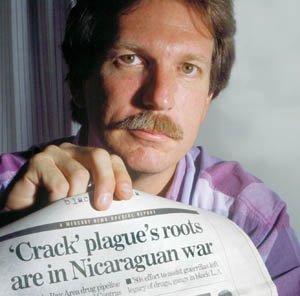
The award is named in honor of investigative reporter Gary Webb who in 1996 courageously revived interest in one of the darkest scandals of the 1980s, the Reagan administration’s tolerance of cocaine trafficking by the CIA-organized Nicaraguan Contra rebels who were fighting to overthrow Nicaragua’s leftist Sandinista government.


Journalist Gary Webb holding a copy of his Contra-cocaine article in the San Jose Mercury-News.

The Contra-Cocaine scandal was originally exposed by Associated Press reporters Robert Parry and Brian Barger in 1985, but the major U.S. newspapers accepted the Reagan administration’s denials and treated the story as a “conspiracy theory.”

So, when Webb revived the story in 1996 for the San Jose Mercury News and described how some of the Contra cocaine fueled the spread of crack across urban America, the major newspapers again rallied to the defense of the Contras and the Reagan administration’s legacy.

The assault on Webb was led by The New York Times, The Washington Post and the Los Angeles Times – and was so ferocious that Webb’s editors at the Mercury News sacrificed him to protect their own careers. Webb found himself cast out from the profession that he loved.

It didn’t even matter that an internal CIA investigation by Inspector General Frederick Hitz confirmed, in 1998, that the CIA was aware of the Contra cocaine trafficking but had put its goal of ousting the Sandinistas ahead of any responsibility to expose the Contra criminality.

Because of the false impression that Webb had manufactured a fake story, he remained unemployable in mainstream journalism. In 2004, with his life in tatters and his financial resources spent, Webb took his own life, a tragic casualty in the difficult fight for a truly free press in America, a press that doesn’t just rubber stamp government propaganda and accept official lies as truth.

[For more on that history, see Consortiumnews.com’s “The Sordid Contra-Cocaine Saga.”]

Investigative reporter Robert Parry broke many of the Iran-Contra stories for The Associated Press and Newsweek in the 1980s. You can buy his latest book, America’s Stolen Narrative, either in print here or as an e-book (from Amazon and barnesandnoble.com).

image_pdf

Syria Trigger: Remembered Beginnings

What Was the Trigger for Violence in Syria?

by Kim Petersen - Dissident Voice


May 6th, 2017

If the base upon which an edifice is arranged is defective, then the edifice will topple when the base crumples. In the case of the violence raging in Syria, western governments inimical to the Syrian government have blamed the violence, through their monopoly media organs, on the Syrian government security apparatus using lethal force to put down unarmed domestic protestors.

If this depiction is false, if it is disinformation, then the subsequent killing and the millions of refugees displaced by the violence is a monstrous crime — a crime for which western governments and their media bear criminal culpability.

Given the lethality of the crimes being perpetrated against Syria, it is a must that people of conscience scrutinize monopoly media skeptically (or better still abandon it. Other than being aware of the lies, why willingly subject oneself to disinformation?).1

One must also be aware of imperialist reverberations within purportedly independent media. I wrote of one example of this recently concerning the “independent” Democracy Now!

There are plenty of people who do combat the disinformation and for no pecuniary profit. One of them is Robert Roth, a former assistant attorney-general for New York (1981-1991) and Oregon (1993-2007), who has prepared a booklet What’s really happening in Syria (available for download here) that debunks much of the western corporate/state media disinformation on Syria, beginning with Syrian president Bashar al Assad being a “brutal dictator” who is “killing his own people.” (p.1)

One often hears or reads of leftists criticizing the US aggression against Syria, but many feel the need to add that Assad is horrible, brutal, or they don’t support the dictator Assad — all this without providing evidence to support their allegations. It seems very infrequent that similar addenda are voiced by pundits when describing American or other western “leaders.” How is it the master criminals behind the war on Iraq, George Bush and Tony Blair, still enjoy the perks of post-political life rather than sit in a prison cell?

Iraq was portrayed in the monopoly media as a civil war, and the same depiction is being applied to the fighting in Syria. On page 2, Roth nixes the notion of a civil war in Syria. Describing in-fighting as occurring in an enemy country is a method to distract from the fact the country is being invaded by outside forces. The fighting in Iraq was monotonously described as a Sunni-Shia sectarian war by monopoly media, despite it being a US war of aggression, a genocide, a war which saw the US-UK employing a divide-and-conquer strategy.

In “Part 3: Divide et Impera” of our 7-part series, “The Imperialist Violence in Syria,” BJ Sabri and I wrote:

The violence in Syria is not an accidental product of uncontrolled events, is not a result of a civil war, is not because the Syrian state is ruled by despotic elites—but it is a result of a combined American-Israeli geopolitical strategy to install a new Syrian regime at the order of Tel Aviv and Washington. Syria, therefore, is not but another link—after Iraq, Libya, and Yemen—in the US and Israeli quest to dismantle the Arab system of nation, and to end the Palestinian Question permanently.

What’s really happening in Syria counters the monopoly media narrative of peaceful, unarmed protests against the Assad government, citing figures such as Father Frans van der Lugt, a Dutch Jesuit priest who was murdered in Homs, Syria in early 2014 who depicted protestors as violent and with negligible support from Syrian people. (p.5)

The author likens this flashpoint to the US-orchestrated destabilization in Ukraine, albeit there are many other recent examples including Venezuela, Honduras, and Haiti.

Quoting Robert Kennedy Jr, Roth notes that this is not the first US attempt at a CIA-backed coup in Syria, as an earlier elected president, Shukri-al-Quwatli, was ousted and replaced by Husni al Za’in. (p.6)

This is a perennial ploy by the US, and several examples spring immediately to mind: Syngmann Rhee in Korea, Ngo Dinh Diem in South Viet Nam, the Shah in Iran, Augusto Pinochet in Chile, Iyad Allawi in Iraq, Hamid Karzai in Afghanistan, etc.

The US is presently staunchly supportive of Middle Eastern dictatorships in Saudi Arabia, Jordan, Bahrain, the Palestinian Authority and has an unwavering friendship with the overtly racist Israeli government. Conclusively, the US has zero moral currency to speak to democratic values or to carry out “regime change.”

The ongoing policy of “regime change” exposes another moral lacuna for which the US is, indeed, exceptional among nations: overthrowing governments contravenes international law.

As the former assistant attorney-general points out in his booklet, a change in government is not desired by Syrians. The 2014 Syrian election was open to international observers; it had a 73.4% turnout that garnered 88.7% support for Assad. (p.10)

Whatever objections there are are mitigated by the fact that even if 100% of Syrians had voted, Assad would still have had a clear majority.

That support for Assad was evident immediately following the so-called revolution against the Syrian government, as on 29 March 2011, 6 million Syrians marched in support of the Assad government. (p.11)

So what about the so-called trigger for the so-called civil war in Syria? Roth quotes from an article by Prem Shankar Jha, a journalist and author based in New Delhi, India: “Who Fired the First Shot?“:

Was there a spontaneous protest and was it peaceful? … Syrians I talked to in October 2012, and resident diplomats concurred, that there had been no spontaneous popular upsurge against the regime in Syria, and that the civil war was a fructification of plans for regime change that had been hatched much earlier and brought forward because the opportunity provided by the ‘Arab Spring’, and western liberals’ ecstatic response to it, was too good to miss.

If the “spontaneous protest” was not the trigger, then what was? Writer Stephen Gowans lectured to a much earlier timeline for the violence in Syria, captured in the title of his recently released book Washington’s Long War on Syria.

It is established that the US lied about the Tonkin Gulf Incident vis-à-vis North Viet Nam; that the US and UK concocted a lie about Saddam Hussein having weapons-of-mass-destruction; that contrary to the US government report about the East Ghouta chemical attack, it was not carried out by the Syrian government; and the most recent release of gas in Khan Sheikhoun being disinformation from the Trump administration. These lies were all repeated uncritically by the monopoly media. How many lies must be told before one starts doubting the source of the lies?

What’s really happening in Syria is important in that it is a mini-primer that calls into question the trigger and entire rationale for the violence that was unleashed in Syria. Imperialism is merciless. Imperialism is an institution; it is entwined with capitalism.

But there are people who are behind the institutions: western corporations, governments, militaries, and their media. These people have the blood of hundreds of thousands of Syrians on their hands.

War crimes demand prosecution. 


Kim Petersen is a former co-editor of Dissident Voice. He can be reached at: kimohp@gmail.com. Twitter: @kimpetersen.
Read other articles by Kim.

1. E.g., read Whitney Webb, “Al Jazeera, CNN & BBC Cover Up Genocidal Crimes of US – Backed Syrian Rebels,” Mint Press News, 19 April 2017.