Monday, April 30, 2018

Following the Skripal Narrative: Keeping Ones Eye on the Bouncing Ball

Where They Tell You Not to Look

by Craig Murray


30 Apr, 2018

At the very beginning of the of the Skripal incident, the security services blocked by D(SMA) notice any media mention of Pablo Miller and told the media not to look at Orbis and the Steele dossier on Trump, acting immediately to get out their message via trusties in the BBC and Guardian.

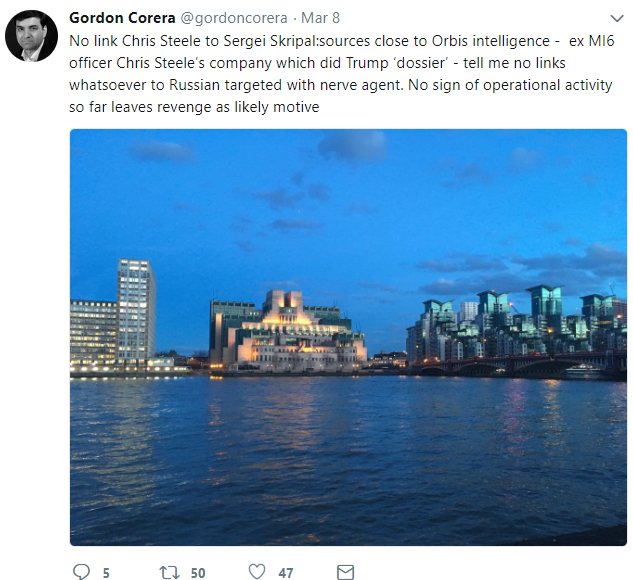
Gordon Corera, “BBC Security Correspondent”, did not name the source who told him to say this, but helpfully illustrated his tweet with a nice picture of MI6 Headquarters.


MI6’s most important media conduit (after Frank Gardner) is Luke Harding of the Guardian. 
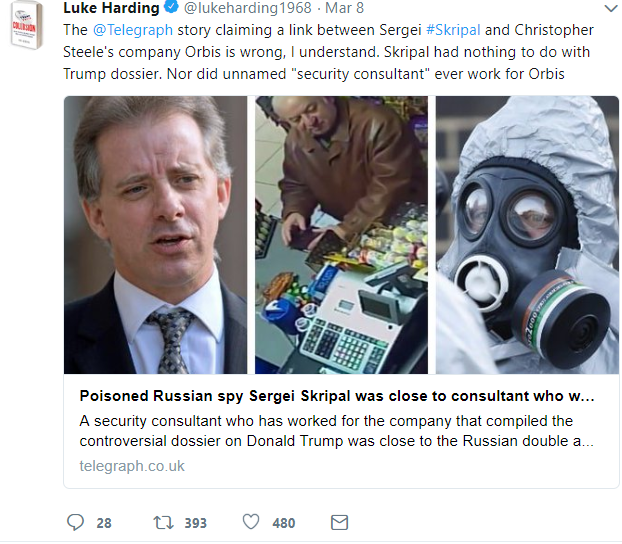


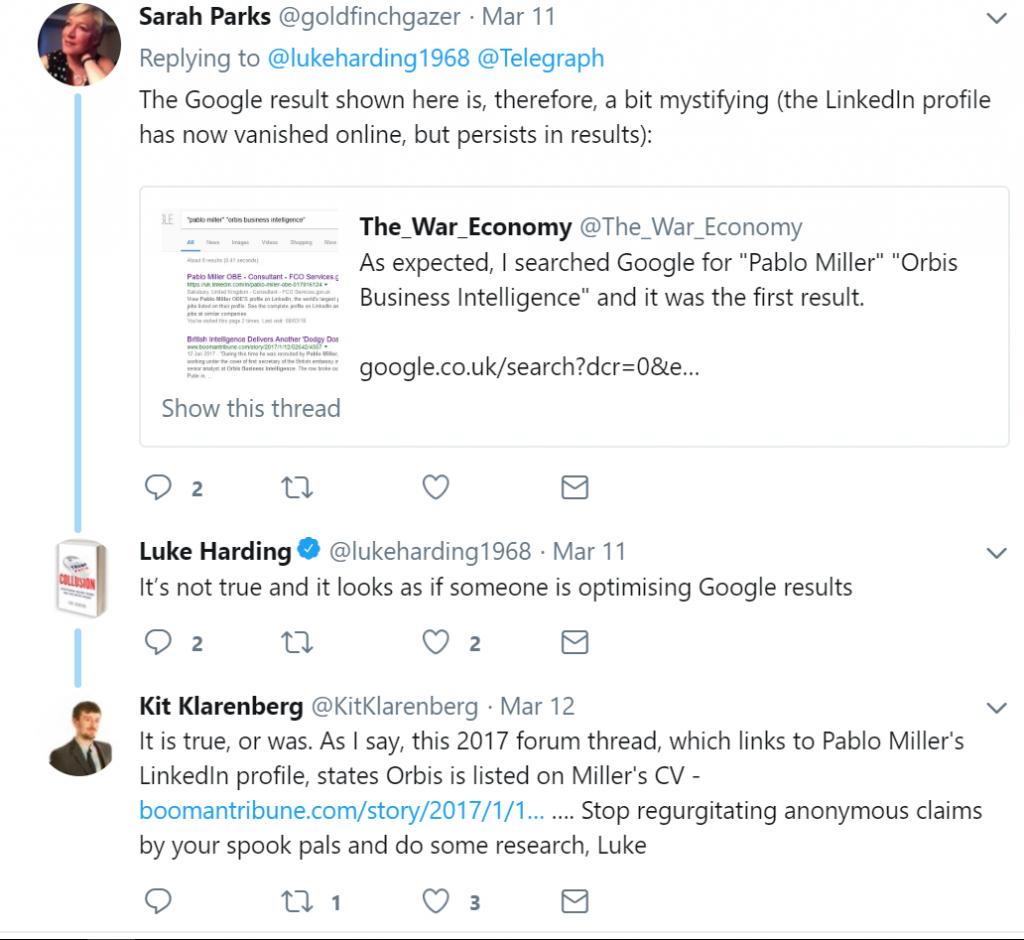
A number of people replied to Harding’s tweet to point out that this was demonstrably untrue, and Pablo Miller had listed his employment by Orbis Business Intelligence on his Linkedin profile. That profile had just been deleted, but a google search for “Pablo Miller” plus “Orbis Business Intelligence”, without Linkedin as a search term, brought up Miller’s Linkedin profile as the first result (although there are twelve other Pablo Millers on Linkedin and the search brought up none of them).

Plus a 2017 forum discussed Pablo Miller’s Orbis connection and it both cited and linked to his Linkedin entry.

You might think that any journalist worth his salt would want to consider this interesting counter-evidence. But Harding merely tweeted again the blank denials of the security services, without question.


This is an important trait of Harding. Last year we both appeared, separately, at the Jaipur Literature Festival. Harding was promoting a book and putting the boot into Wikileaks and Snowden. After his talk, I approached him in an entirely friendly manner, and told him there were a couple of factual errors in his presentation on matters to which I was an eye-witness, and I should be very happy to brief him, off the record, but we could discuss which bits he might use. He said he would talk later, and dashed off. Later I saw him in the author’s lounge, and as I walked towards him he hurriedly got up and left, looking at me.

Of course, nobody is obliged to talk to me. But at that period I had journalists from every major news agency contacting me daily wishing to interview me about Wikileaks, all of whom I was turning down, and there was no doubt of my inside knowledge and direct involvement with a number of the matters of which Harding was writing and speaking. A journalist who positively avoids knowledge of his subject is an interesting phenomenon.

But then Harding is that. From a wealthy family background, privately educated at Atlantic College and then Oxford, Harding became the editor of Oxford University’s Cherwell magazine without showing any leftwing or rebel characteristics. It was not a surprise to those who knew him as a student when he was employed at the very right wing “Daily Mail”. From there he moved to the Guardian. In 2003 Harding was embedded with US forces in Iraq and filing breathless reports of US special forces operations.

Moving to Moscow in 2007 as the Guardian’s Moscow correspondent, others in the Moscow press corps and in the British expatriate community found him to be a man of strongly hawkish neo-con views, extremely pro-British establishment, and much closer to the British Embassy and to MI6 than anybody else in the press corps. It was for this reason Harding was the only resident British journalist, to my knowledge, whose visa the Russians under Putin have refused to renew. They suspected he is actually an MI6 officer, although he is not.

With this background, people who knew Harding were dumbfounded when Harding appeared to be the supporter and insider of first Assange and then Snowden.

The reason for this dichotomy is that Harding was not – he wrote books on Wikileaks and on Snowden that claimed to be insider accounts, but in fact just carried on Harding’s long history of plagiarism, as Julian Assange makes clear. Harding’s books were just careful hatchet jobs pretending to be inside accounts.

The Guardian’s historical reputation for radicalism was already a sham under the editorship of Rusbridger, and has completely vanished under Viner, in favour of hardcore Clinton identity politics failing to disguise unbending neo-conservatism. The Guardian smashed the hard drives containing the Snowden files under GCHQ supervision, having already undertaken “not to even look at” the information on Iraq and Afghanistan. The fact the hard drives were not the only copies in the world does not excuse their cravenness.

We know, of course, what MI6 have fed to Harding, because it is reflected every day in his output. What we do not know, but may surmise, is what Harding fed back to the security services that he gleaned from the Guardian’s association with Wikileaks and Snowden.

Harding has since made his living from peddling a stream of anti-Assange, anti-Snowden and above all, anti-Russian books, with great commercial success, puffed by the entire mainstream media. But when challenged by the non-mainstream media about the numerous fact free assertions on behalf of the security services to be found in his books, Harding is not altogether convincing. You can watch this video, in which Harding outlines how emoticons convinced him someone was a Russian agent, together with this fascinating analysis which really is a must-read study of anti-Russian paranoia. There is a similar analysis here.

Perhaps still more revealing is this 2014 interview with his old student newspaper Cherwell, where he obvously felt comfortable enough to let the full extent of his monstrous boggle-eyed Russophobia become plain:

His analogies span the bulk of the 20th century and his predictions for the future are equally far-reaching. “This is the biggest crisis in Europe since the Cold War. It’s not the break-up of Yugoslavia, but the strategic consensus since 1945 has been ripped up. We now have an authoritarian state, with armies on the march.” 

What next?


“It’s clear to me that Putin intends to dismember Ukraine and join it up with Transnistria, then perhaps he’ll go as far as Moldova in one way or another,” Harding says. 

This is part of what he deems Putin’s over-arching project: an expansionist attempt to gather Russo-phones together under one yoke, which he terms ‘scary and Eurasian-ist’, and which he notes is darkly reminiscent of “another dictator of short stature” who concocted “a similarly irredentist project in the 1930s”.

But actually I think you can garner everything you want to know about Harding from looking at his twitter feed over the last two months. He has obsessively retweeted scores of stories churning out the government’s increasingly strained propaganda line on what occurred in Salisbury. Not one time had Harding ever questioned, even in the mildest way, a single one of the multiple inconsistencies in the government account or referred to anybody who does. He has acted, purely and simply, as a conduit for government propaganda, while abandoning all notion of a journalistic duty to investigate.

We still have no idea of who attacked Sergei Skripal and why. But the fact that, right from the start, the government blocked the media from mentioning Pablo Miller, and put out denials that this has anything to do with Christopher Steele and Orbis, including lying that Miller had never been connected to Orbis, convinces me that this is the most promising direction in which to look.

It never seemed likely to me that the Russians had decided to assassinate an inactive spy who they let out of prison many years ago, over something that happened in Moscow over a decade ago.

It seemed even less likely when Boris Johnson claimed intelligence showed this was the result of a decade long novichok programme involving training in secret assassination techniques. Why would they blow all that effort on old Skripal?

That the motive is the connection to the hottest issue in US politics today, and not something in Moscow a decade ago, always seemed to me much more probable.

Having now reviewed matters and seen that the government actively tried to shut down this line of inquiry, makes it still more probable this is right.

This does not tell us who did it. Possibly the Russians did, annoyed that Skripal was feeding information to the Steele dossier, against the terms of his release.

Given that the Steele dossier is demonstrably in large degree nonsense, it seems to me more probable the idea was to silence Skripal to close the danger that he would reveal his part in the concoction of this fraud. Remember he had sold out Russian agents to the British for cash and was a man of elastic loyalties. It is also worth noting that Luke Harding has a bestselling book currently on sale, in large part predicated on the truth of the Steele Dossier.

Steele, MI6 and the elements of the CIA which are out to get Trump, all would have a powerful motive to have the Skripal loose end tied.

Rule number one of real investigative journalism: look where they tell you not to look.

Syria: France's 'Bottes au Sol'

French troops in Syria!

by Kevork Almassian - Syriana Analysis


April 24, 2018

Kevork Almassian brings the latest reports on the incoming French troops to Hasakeh, Syria.


Israel's Missile Attacks Against Iranian Bases Produces More Than Casualties

Iranian missiles destroyed in 'bunker busting' Syria strikes: Report #SyriaWar

by Middle East Eye


April 29, 2018

Hama and Aleppo attacks destroy major arms depots and cause minor earthquake, according to reports, days after Israel threatened Iran


Missile attacks on Syrian government-held airbases overnight struck several arms depots, including some holding surface-to-surface missiles that Iran was preparing to deploy, according to reports.

Al-Akhbar, a Lebanese pro-Hezbollah newspaper, said the attacks in Hama and in the Aleppo countryside were apparently carried out with "bunker-busting" missiles, causing huge explosions which Syrian state television said caused a 2.6 magnitude earthquake.


The reported explosion at one of the
Syrian air bases (screengrab)

The origin of the attacks has not been confirmed, however it comes weeks after Israel bombed the T4 airbase in Syria and days after the defence minister, Avigdor Lieberman, said Israel would attack Iranian assets in Syria if they were deemed a threat.

The Israeli military said soon after the latest bombing raids that it did not comment on foreign reports and had no information at this time.

According to the Syrian army, the strikes targeted a base in Aleppo province and Salhab aiport, Hama, where the 46th Syrian army brigade and Iranian "consultants" were stationed. The blast at Hama sent a huge fireball into the air.

The Israeli newspaper Haaretz said "assessments" showed major arms caches, including Iranian surface-to-surface missiles, had been destroyed in that attack.

But Iran's Tasnim news agency said on Monday that reports of Iranian casualties were baseless and no Iranians had been killed in the attacks.

"All these reports over an attack on an Iranian military base in Syria and the martyrdom of several Iranian military advisers in Syria are baseless," an unnamed source told Iran's semi-official Tasnim news agency.

The Syrian army said late on Sunday that "enemy" rockets had struck several military bases in the Hama and Aleppo countryside in what it said was a new "aggression" by its enemies, state television said.

Syrian state television said the missile attacks took place at 10.30pm local time. Successive blasts were heard in rural Hama province and authorities were investigating the cause.

Israel has previously hit Iranian-backed militia outposts in Syria, mainly targeting arms convoys of the Iranian-backed Hezbollah. Israel regards the group, which is fighting alongside President Bashar al-Assad, as the biggest threat on its borders.

Earlier this month it struck a Syrian air base, killing seven Iranian personnel. Israel has warned it could hit Iranian bases in the war-torn country should tensions with Tehran escalate.

The Observatory said a Syrian army base was hit near the city of Salhab, west of Hama, where Iranian forces are also stationed.

It also said rockets hit Syrian government bases in the region surrounding Nairab military airport, which is close to Aleppo International Airport.

Israeli military spokesman Lieutenant Colonel Jonathon Conricus told Reuters:

"We don't comment on foreign reports and we have no information at this time."

On Sunday, the Israeli defence minister, Lieberman, said Israel would maintain freedom of operation in Syria, Haaretz reported.

“We have no intention to attack Russia or to interfere in domestic Syrian issues,” Lieberman said at the annual Jerusalem Post conference, according to Haaretz.

“But if somebody thinks that it is possible to launch missiles or to attack Israel or even our aircraft, no doubt we will respond and we will respond very forcefully,” Haaretz quoted him as saying.

In February, Israel said it launched multiple air strikes against air defences and Iranian targets inside Syria. Among the targets was the T4 airbase, after it said it had intercepted an Iranian drone on the Syria-Israel border.

Syria: Regime Change by Another Name Still Smells

Syria and Chemical Weapons: Debating the Regime-Change War in Syria

by Roger Annis - A Socialist In Canada


April 24, 2018

(with postscripts) 


Like the rest of Canada’s corporate media, the state-run CBC is virulently anti-Russia and a constant voice favouring the regime-change war in Syria.

So it was something of a surprise to hear its national radio news report on April 22 provide evidence that counters the claims of a chemical weapons attack against the town of Douma, Syria in the region east of Damascus on April 7.


Photo provided to Western media by the
Western-funded ‘White Helmets’ agency
purporting to show victims of a chemical
weapons attack in Douma, Syria on April 7, 2018

The CBC reported some of the information first reported by Robert Fisk of the UK Independent on April 17. Fisk spoke to medical personnel who treated what were later claimed by Western media to be victims of a chemical attack.

They explained to Fisk that the victims treated that day were suffering from respiratory ailments caused by the dust, debris and concussion symptoms of explosions. The medical personnel were interviewed separately and broadcast on a YouTube channel in Syria; you can view the video here.

Military clashes were still taking place on April 7 between the Syrian government and the right-wing militias in control of Douma since 2012. A ceasefire agreement has since provided for the withdrawal of the militias and re-assertion of control of Douma by the Syrian government.

As Nazareth-based journalist Jonathan Cook reported on April 18, Fisk’s reporting has been ignored or downplayed by Western media. The CBC reporting makes no specific mention of Fisk or his original reporting.

There is, of course, a long history of chemical weapons usage by the Western imperialist powers going back more than 100 years. The famed UK prime minister Winston Churchill was a firm proponent of chemical weapons usage during World War One and also in Britain’s colonial wars of the same era in the Middle East, Africa and India.

Britain also used chemical weapons in its military intervention into northern Russia in 1919. That intervention sought the overthrow of the revolutionary government which came to power in Russia and neighbouring republics during and after November 2017.

Chemical weapons were used with a vengeance by the U.S. and its allies during their brutal wars against the peoples of Korea and Vietnam. They have been used by NATO and allied countries as recently as in Iraq in 2003 (white phosphorus and depleted uranium) and in Gaza against Palestinians by Israel (white phosphorus).

In contrast to its one-off radio report on April 22, the CBC’s website continues to publish standard-fare Western news reports consisting of a mix of some news along with half truths and falsehoods. In this example on April 21, citations are provided from the Western-funded and promoted ‘White Helmets’ agency which mixes civil defense initiatives with propaganda favouring the violent overthrow of the Syrian government.

An April 10 report by U.S. antiwar activist and writer Rick Sterling provides a good overview of this latest chemical weapons accusation against the Syrian government. Sterling’s report was first published on Mint Press News and was then reprinted on Monthly Review‘s MR Online. Also on MR Online is an article reviewing the history of chemical weapons accusations against Syria.

The ‘World news’ page on my A Socialist In Canada website is following closely the unfolding situation in Syria. It contains headlines and weblinks to vital news and analysis of Syria, including of late by Gregory Shupak in Jacobin and Fairness and Accuracy In Reporting and by Scott Taylor, who writes a weekly column in the Halifax Chronicle Herald.

I view the broad outlines of the situation in Syria as follows:

* The Syrian government and its Russian and Iranian allies are retaking control much of the western parts of the country which have been under the control of right-wing militias supported by the U.S., Saudi Arabia and other Gulf states.

* At the same time, the U.S. and its NATO allies, including Turkey, are laying the groundwork for partitioning large parts of Syria, notably the northern strip along the border with Turkey and vast stretches of the eastern part of the country (where, coincidentally, most of Syria’s oil and gas reserves lie). This is the new and latest variant of their longstanding regime-change war in Syria.

* Syrian Kurdish political leaders are willing participants in the U.S. partition plans. (Kurds comprise some 2.5 million of Syria’s population of 18.5 million.)

* The supposed conflict between the U.S. and Turkey over Syria is typical theatre of the Trump era of U.S. politics designed to obscure and distract what is truly taking place in U.S. and NATO foreign policy. The two NATO allies see eye to eye in plans to weaken and divide the country and people of Syria. Their purported disputes are theatrics. Inside Turkey, a drive to an authoritarian state continues, accompanied by brutal crackdown against the rights of Turkey’s large Kurdish population. A particular target is the left wing People’s Democratic Party (HDP), the third largest party in the Turkish Parliament.

Debating the regime-change war in Syria


An April 24 commentary on Syria by writer Sonali Kolhaktar is published on CounterPunch: ‘The left, Syria and fake news‘. The commentary is re-posted from Truthdig, where it originally appeared on April 19 under the title ‘Why are some on the left falling for fake news on Syria?‘. Many such commentaries are being published by ostensible leftists condemning the antiwar and left wing voices in the West that are defending Syria’s national sovereignty in the face of the determined drive by U.S.-led imperialism to overthrow the Syrian government. Common to all the condemnations, including this latest one by Kolhatkar, is that they say and propose absolutely nothing by way of how the war in Syria could end. That’s because they favour the violent overthrow of the Syrian government and president. The rest is talk.

On April 23, Truthdig published a reply by U.S. writer and journalist Max Blumenthal to Kolhatkar’s original article. His reply is here: ‘Syria controversy: Don’t believe the official narrative‘. Truthdig published a brief rejoinder by Kolhatkar to Blumenthal on the same date.

Kolhatkar wrote in her rejoinder, “We need to get beyond the battle over Assad’s crimes to unite against U.S. militarism, but unfortunately, pro-Assad sentiment undermines the left’s credibility on this issue.” But we get no hint of how an antiwar left could “unite against U.S. militarism”.

An antiwar movement certainly should not “unite” in turning a blind eye to the U.S. regime change war in Syria. The same turning a blind eye is taking place over the civil war being waged for the past four years in eastern Ukraine by the extreme-right government in Ukraine with NATO backing.[1]

Nor should an antiwar movement make abstract calls for Russia to withdraw its military support to the Syrian government. A political agreement is required to end the war in Syria. This can open a process of national reconstruction, complete with political discussion and debate over the past and future paths of economic development for Syria. Certainly, the Syrian government’s past policies favouring the spread of globalized capitalism into the country should come under sharp scrutiny.

Presently, there is a dearth across the board of discussion in the West as to how a movement of solidarity with the Syrian people can assist a process of national ceasefire, dialogue and reconstruction. For example, nothing is known in the West of Russia’s longstanding proposals to the Syrian government and people that they modify the Syrian constitution in order to provide recognition to the country’s national minorities, notably the Syrian Kurds.

In the absence of a political agreement for ceasefire and peace, calls for withdrawal of Russian and Iranian support to Syria amount to calls for the people of Syria to surrender their sovereignty to imperialism. Thankfully, the people of Syria are not about to follow such counsel.

Note:
[1] The pro-NATO Atlantic Council recently published an article expressing unease over the continued ascendance of a violent, extreme-right movement in Ukraine and the decline in legitimacy of the governing regime in Kyiv. Russia analyst Mark Ames commented on Twitter on April 23 on the Atlantic Council article: “Now even NATO’s front group [the Atlantic Council] is worried about Ukraine’s Nazi problem. Until recently, these same hacks smeared anyone worried about Ukraine’s Nazi problem as ‘Russian disinformation’, ‘Putinist’, ‘Kremlin bot’ etc.”

Related:
The tragic fall of Afrin to NATO-member Turkey’s military intervention, and the dangerous aftermath, by Roger Annis, A Socialist In Canada, March 24, 2018

Postscripts:
1. Deception in plain sight: Douma, part one, report on Media Lens (UK), April 25, 2018

[This report on Media Lens examines the near-to universal, pro-war reaction of mainstream media in Britain to the false news that a chemical weapons attack was perpetrated by the Syrian government against the people of the town of Douma on April 7, 2018. The report also looks at Glenn Greenwald’s retractions and flounderings following his claim on Democracy Now! on April 9 that the Syrian government was responsible for the alleged attack. He told program host Amy Goodman, “I think that it’s—the evidence is quite overwhelming that the perpetrators of this chemical weapons attack, as well as previous ones, is the Assad government…”

[Media Lens explains to its readers that part two of this report will be published soon. From the ‘About’ page of the online publication: “Since 2001, we have been describing how mainstream newspapers and broadcasters operate as a propaganda system for the elite interests that dominate modern society…”]

2. ‘It just doesn’t ring true’, Douma part two, report on Media Lens (UK), April 26, 2018

3. The eclectic CounterPunch ups the ante on anti-Russia reporting

[CounterPunch has published a commentary on April 25 which accepts the unproven claim of a chemical weapons attack by the Syrian government on the town of Douma on April 7. Worse, it ups the ante by saying that Russian president Vladimir Putin schemed with the Donald Trump regime in Washington as the latter prepared its missile attacks launched together with Britain against Syria during the night of April 13/14. The CounterPunch commentary begins:

Not once, but twice, Donald Trump seized upon the specter of alleged chemical use, by Bashar al-Assad, to punish Syria with missile attacks. With predictable and expedient faux rage, he risked elevating a seven year horror into a cataclysmic nightmare; at least that’s the common political sentiment.

Perhaps, this calculation is more than a bit frayed given the certainty of a choreographed agreement between Trump and Putin before the attacks began.

To be sure, only a political novice would overlook the bargain that enabled Trump to stage his domestic political show and afford Putin ample time to move his forces to avoid his own domestic fallout should any of the U.S. missiles have missed their Syrian mark and fallen, instead, upon a Russian fighter jet or pilot.

Pardon my cynicism, but I have little doubt that when it comes to the Middle East, or elsewhere, neither of these autocrats sees much beyond their own political and economic self-interest no matter what flag their rhetoric comes draped in. It’s not just the way of the times, but the accomplished trait of each…

[The commentator ‘overlooks’ mentioning the fact that Russian-supplied air defenses allowed the Syrian armed forces to shoot down more than half the estimated 110 U.S. and UK missiles launched on April 13/14. The writers’s claim of a “choreographed agreement” between the U.S. and Russia thus takes left-wing conspiracy theorizing to a whole new level.]

4. No attack, no victims, no chemical weapons: Witnesses from Douma, Syria speak at OPCW briefing at The Hague, RT, April 26, 2018

5. Former weapons inspector Scott Ritter refutes U.S. chemical weapons claim in Syria, interview with Scott Ritter, on ‘Flashpoints Radio‘, KPFA station, with host Denis Bernstein, April 23, 2018 (Transcript of the interview is published here on Consortium News, April 27, 2018)

Introduction by Dennis Bernstein:
In the 1980’s, Scott Ritter was a commissioned officer in the United States Marine Corps, specializing in intelligence. In 1987, Ritter was assigned to the On-Site Inspection Agency, which was put together to go into the Soviet Union and oversee the implementation of the Intermediate Nuclear Forces Treaty. This was the first time that on-site inspection had been used as part of a disarmament verification process.

Ritter was one of the groundbreakers in developing on-site inspection techniques and methodologies. With this unique experience behind him, Ritter was asked in 1991, at the end of the Gulf War, to join the United Nations Special Commission, which was tasked by the Security Council to oversee the disarmament of Iraq’s weapons of mass destruction. From 1991 to 1998, Ritter served as a chief weapons inspector and led a number of teams into Iraq.

According to Ritter, in the following Flashpoints Radio interview with Dennis Bernstein conducted on April 23, US, British and French claims that the Syrian Government used chemical weapons against civilians last month appear to be totally bogus.

6. Kurds, the survivors of the Syrian wars, by Patrick Cockburn, London Review of Books, April 5, 2018 (available to subscribers only) 


Map of Syria, in London Review of Books April 2018


Comment by Roger Annis, April 28, 2018:


In his latest contribution to the London Review of Books (writing date March 23), Patrick Cockburn provides valuable information on the recent history and current, difficult circumstances facing Syria’s estimated Kurdish population of 2.5 million. Turkey has invaded the Kurdish region of Afrin in northwest Syria and is conducting an ethnic cleansing of the region. The U.S., meanwhile, is using the Kurdish forces of northern Syria in its plan to weaken and partition Syria.

Cockburn’s authority is based on his extensive travel and reporting from Syria. But he continues his habit of describing Syria using unproven allegations against Russia and the Syrian government. Thus, we read the following in this latest contribution to the London Review of Books: “Russia gave Turkey permission to use airpower freely over Afrin, withdrew its military contingent from the enclave and opened the door for Turkish forces to invade, which they did on 20 January [2018].”

This is how Cockburn describes Russia’s wise decision in January 2018 not to take NATO’s bait and engage militarily against NATO member Turkey in Afrin on behalf of Kurdish forces aligned with NATO member United States. For that decision, writers in the West such as Cockburn heap disparaging distortions of the truth on Russia’s head.

Furthermore, in typical fashion of those making such allegations, not a word is reported by Cockburn of Russia’s longstanding proposals to the Syrian government and people that they modify the Syrian constitution to provide recognition of Kurdish national (autonomous) rights. Nor is there any mention of the proposal by the Syrian and Russian armed forces to the Kurds of Afrin in December 2016 that the Kurds accept the entry of Syrian armed forces and allies into Afrin region in order to forestall the anticipated Turkish intervention.

Kurdish acceptance of the proposal would have stirred U.S. ire. In other words, for good or for bad, the Kurdish leadership in Afrin bowed to the Turkish intervention and inevitable ethnic cleansing that followed rather than jeopardize their alliance with the United States and its illegal intervention and occupation in oil-and-gas-rich eastern Syria.]

The plans by Turkey and the U.S. to partition Syria are passively described by Cockburn as follows:

“The country is now divided into three zones, each under a different authority and supported by a different foreign sponsor.” 

Note how NATO members Turkey and the U.S. are described as “different” from one another in their objectives in Syria and not at all described as the illegal, foreign invaders and occupiers that they are. Syria’s national government in Damascus is reduced to one of three “different authorities”, alongside the two illegal occupiers.

Sunday, April 29, 2018

Tech. Behemoths Fight for World Domination

Tech Giants Fight to Dominate Data of Developing Countries 

by TRNN


April 29, 2018

Apple, Amazon, Facebook and Microsoft are among high tech giants fighting to maintain an unregulated environment at the WTO that strengthens their monopolies and puts developing countries at an extreme disadvantage says Deborah James of CEPR.


Deborah James is the Director of the International Programs at the Center for Economic and Policy Research as representative of the Our World Is Not For Sale Network


Progressive War Logic: When Intervention Is O.K.

Chomsky Among “Progressives” Calling for US Military Involvement in Syria

by Whitney Webb  - MintPress News


April 26th, 2018

Since most progressive figures would never publicly call for extending a U.S.-led military occupation, this petition shows that the war propaganda in Syria – particularly as it relates to the Kurds – has been highly effective in subverting the progressive anti-war left as it relates to the Syrian conflict.


On Monday, the New York Review of Books published an open letter and petition aimed at securing Western support for putting pressure on Turkey to end its occupation of Afrin, opposing further Turkish incursions into Syria, and backing autonomy for Rojava — the region of Northern Syria that has functioned autonomously since 2012 after its administration was taken over by U.S-allied Kurdish factions.

Authored by the Emergency Committee for Rojava, it has since been signed by well-known progressive figures such as Noam Chomsky and Judith Butler in its bid to organize efforts for the fulfillment of the group’s demands.

Those demands are entirely focused on U.S. government policy.


Noam Chomsky (pictured) amongst other
"progressives" supporting intervention in Syria.
(Photo: Andrew Rusk/Flickr)

The petition asks the government to “impose economic and political sanctions on Turkey’s leadership, . . . embargo sales and delivery of weapons from NATO countries to Turkey, . . . insist upon Rojava’s representation in Syrian peace negotiations,” and – most paradoxically of all — “continue military support for the SDF [Syrian Democratic Forces],” the Kurdish-majority group that has acted as a U.S. proxy and has been accused of ethnic cleansing in its bid to construct a Kurdish ethnostate in Northern Syria.

The group’s first three demands are reasonable, in the sense of seeking to punish Turkey for its illegal invasion of Syrian territory. However, they are also rather fanciful, in the sense that the U.S. government is highly unlikely to stop weapons sales or to sanction Turkey, which it needs to court in order to prevent Ankara from pivoting towards Russia. Indeed, the U.S. — by refusing to support the Kurds during the battle for Afrin – made it clear that its “alliance” with Syrian Kurds is opportunistic and very much secondary to the U.S.’ relationship with Turkey.

The third demand is equally unlikely to come about, as Turkey has previously called the involvement of Syrian Kurds in peace talks unacceptable and has essentially issued an “it’s either us or them” ultimatum. In addition, past attempts to invite the Kurds to participate in the peace talks have been rejected by Western nations, including the United States, in order to please Turkey.

More recently, Kurds themselves refused to attend peace talks earlier this year over the Turkish occupation of Afrin in light of the lack of international response to that event. However, even prior to the occupation of Afrin, Syrian Kurds had declared they were “not bound” by any decisions made during Syrian peace talks, thereby weakening the peace process.

Yet, beyond the impractical nature of the petition’s first three demands, the final demand – that the U.S. continue military support for the Syrian Democratic Forces – is by far the most unusual, in the sense that well-known progressive figures, in signing this petition, are asking for the continued U.S. occupation of Syria and for increased military and financial support for the U.S. proxy forces, the SDF.

While most progressive figures, likely including those who signed the petition, would never publicly call for extending a U.S.-led military occupation, this petition shows that the war propaganda in Syria – particularly as it relates to the Kurds – has been highly effective in subverting the progressive anti-war left as it relates to the Syrian conflict.

Indeed, the Kurds in Syria have long been romanticized by Western media for having built “the world’s most progressive democracy” and for being trailblazers for gender equality and gay rights. While the Kurds have incorporated some progressive policies, the realities on the ground are more nuanced. Furthermore, the U.S.’ “support” for Rojava, which the petition seeks to extend, is hardly helping progressive or even Kurdish causes.


Distinguishing the Kurds and the SDF


Since the rise of Daesh (ISIS) in the Syrian conflict, Western media has placed the Kurds on a pedestal and has long treated them as the only “effective” fighters against the terrorist group. However, praising the local Kurdish militias for their fighting prowess has since given way to praising the Syrian Democratic Forces (SDF), even though the two could not be more different.

While the SDF does boast a significant portion of Kurds among its ranks, it is not expressly Kurdish and is an umbrella group of several militias. Though this itself is not concerning, the identities of many of its Arab fighters do give cause for concern. For instance, one of the groups operating under the SDF’s banner is the Deir Ezzor Military Council (DMC) — a group whose fighters were former members of Daesh and al-Nusra (Syria’s Al-Qaeda affiliate), who were “retrained” by U.S. forces in Northern Syria after surrendering to the SDF and U.S.-backed forces in Raqqa. In addition, tribes that were formerly allied with Daesh have joined forces with the SDF over the past year.


The loosely-knit coalition of Syrian rebel groups, including Kurdish factions, 
known as the Syrian Democratic Forces (SDF), are armed, trained and 
backed by the U.S. (SDF Photo)

In addition to hosting former members of Daesh and other terror organizations among its ranks, the SDF also regularly collaborates with Daesh in Northeastern Syria in targeting Syrian and Russian forces. Though the Kurds and Daesh are ostensible “enemies,” they have been shown to move amongst each other like allies, and Kurds have even worked alongside Daesh in coordination with U.S. special forces. Perhaps, then, it is little surprise that the SDF allowed Daesh terrorists to leave Raqqa peacefully last June as they took the city.

This collaboration with groups like Daesh, which the SDF has been praised in the West for fighting, has led to major defections of Kurds from the SDF — including SDF’s former spokesman Talal Silo, who accused the group of making secret deals with terrorists.

Along with their troubling ties and collaboration with Daesh, the SDF have participated in war crimes in Syria, in tandem with U.S. forces, and have been accused of ethnic cleansing in order to justify the establishment of a Kurdish ethnostate in Arab-majority areas of Northern Syria.

For instance, in the battle for Raqqa, the SDF — along with the U.S.-led coalition — committed war crimes, such as using chemical weapons and cutting off water supplies to Raqqa, which is still without water nearly a year after its “liberation.” The SDF also played a key role in the operation that left, by some estimates, as many as 8,000 dead and 160,000 more driven from their homes. The operation also left 80 percent of the city completely uninhabitable, and as many as 6,000 bodies are still believed to be buried in the rubble six months after the joint U.S-led coalition/SDF operation concluded.

Some journalists, such as Andrew Korybko, asserted that Raqqa’s civilian population was directly targeted because it was highly unlikely that any Arab, or non-Kurd for that matter, living in Arab-majority Raqqa would freely choose to live in a “Kurdish-dominated statelet” as a second-class citizen instead of choosing to have equal standing within the Syrian Arab Republic. In other words, the operation was, in part, targeting civilians who could resist Raqqa’s annexation by the U.S.-backed Kurds instead of Daesh forces, who were allowed to escape and were later re-assimilated into the SDF. The UN, however, has claimed that the SDF’s removal of Arab populations from Raqqa was done out of “military necessity” and thus did not constitute “ethnic cleansing.”

Have progressives thought through what they’re asking for?


Aside from the SDF, asking the U.S. to maintain its support of the group also means asking the U.S. to continue its illegal occupation of Syria. As MintPress has previously reported, the U.S.’ occupation of Syria is aimed at partitioning the country and preventing Syria’s Northeast from again coming under the control of the Syrian government.

Though partition has also been a goal of some U.S.-allied Kurdish nationalists, who have sought to use the division of Syria as a launching pad for an independent “Kurdistan,” the U.S. in recent months has made it clear that the partition of Northeastern Syria will not benefit the Kurds as much as Wahhabi Sunnis whose ideology is virtually indistinguishable from that of Daesh.

Early last week, the Wall Street Journal reported that Trump’s new National Security Advisor John Bolton was working with U.S.-allied Middle Eastern nations to form an “Islamic coalition” that would replace the U.S. troops currently present in Northeastern Syria with an army composed of soldiers from nations like Saudi Arabia, Qatar and Egypt. This coalition would be a permanent military “stabilizing force” in the region.

In addition to pushing for foreign Arab soldiers to police Rojava, the Trump administration has also sought Saudi commitment to funding the reconstruction of the region. Saudi Arabia — known for its deplorable treatment of religious and ethnic minorities, and funding terror groups like Daesh — and its Gulf allies are highly unlikely to support the Kurds’ nationalist aims as well as their “progressive” direct democracy and promotion of gender equality and gay rights. Indeed, Saudi Arabia is the complete opposite of the Western progressive view of the Kurds, as it is a dictatorial monarchy well known for its repression of women and minorities and execution of members of the LGBT community. However, it is also the country that the U.S. is seeking to give the leading role in governing the area of Syria it currently occupies.

In effect, by asking for the continuation of U.S. military presence in Syria in order to aid the SDF, the Emergency Committee for Rojava is actually undermining the “progressive” Kurds they seek to support — and aiding yet another U.S. government attempt at nation-building, which is likely to result in a Wahhabist enclave that would differ little from a Daesh-led “caliphate.”

The Emergency Committee for Rojava’s efforts come amid major attempts aimed at defending and extending the U.S.’ illegal involvement in Syria. However, this petition is aimed at Western progressives, the group that has historically opposed illegal U.S. military occupations and wars in the past. Given how it has enticed well-known members of the progressive community, the petition shows that the push for Western “humanitarian” intervention in Syria is stronger than ever.

Whitney Webb is a staff writer for MintPress News and a contributor to Ben Swann’s Truth in Media. Her work has appeared on Global Research, the Ron Paul Institute and 21st Century Wire, among others. She has also made radio and TV appearances on RT and Sputnik. She currently lives with her family in southern Chile. 

Republish our stories! MintPress News is licensed under a Creative Commons Attribution-NonCommercial-ShareAlike 3.0 International License. 

The Silencing of the Skripals

The Silence of the Skripals - Government Blocks Press Reports - Media Change The Record

by Moon of Alabama


April 28, 2018

There has been no recent reporting on the Skripal case in which a British-Russian double agent and his daughter were poisoned in Salisbury, England.

There even seem to be attempts to change the public record of the case.

The British government alleged that the Skripals were poisoned by Novichok, a deadly nerve agent, and blamed Russia for it.

There are still many open questions to ask but the British media, otherwise not afraid of 'door stepping', are curiously uninterested.

We already noted in early April that the British press was throwing Novi-Fog™ onto the public. It was repeating outrageous and illogical claims from "security services" but did no genuine reporting on the Skripal case.

Some photo editor made sense of what the "security services" said and introduced an April 5 London Times piece with a picture of a likely source of the alleged Novichok poison:


 via D'Aramitz - bigger

Now the former British ambassador Craig Murray quotes Clive Ponting, another former senior civil servant, who suspects that the British government issued a D-Notice. Such a notice forbids British media to report on an issue. Murray also points to a tweet by Channel 4 correspondent Alex Thomson from March 12 in which Thomsen mentions a D-Notice specifically related to Mr. Skripal's MI6 handler:


 bigger

The D-Notice attempt Thomsen mentioned was too late as some media had already reported the name of the Skripal's MI6 handler. We spelled it out on March 8.

One Pablo Miller, a British MI6 agent, had recruited Sergej Skripal. The former MI6 agent in Moscow, Christopher Steele, was also involved in the case. Skripal was caught by the Russian security services and went to jail. Pablo Miller, the MI6 recruiter, was also the handler of Sergej Skripal after he was released by Russia in a spy swap. He reportedly also lives in Salisbury. Both Christopher Steele and Pablo Miller work for Orbis Business Intelligence which created the "Dirty Dossier" about Donald Trump.

We early on suspected a relation between the "Dirty Dossier" and the Skripal affair:


Here are some questions: 


  • Did Skripal help Steele to make up the "dossier" about Trump?
  • Were Skripal's old connections used to contact other people in Russia to ask about Trump dirt?
  • Did Skripal threaten to talk about this?


If there is a connection between the dossier and Skripal, which seems very likely to me, then there are a number of people and organizations with potential motives to kill him. Lots of shady folks and officials on both sides of the Atlantic were involved in creating and running the anti-Trump/anti-Russia campaign.

There are several investigations and some very dirty laundry might one day come to light. Removing Skripal while putting the blame on Russia looks like a convenient way to get rid of a potential witness.

Whistleblower Clive Ponting, quoted by Murray, now also suspects that the Skripal case was an 'inside' job that followed from the 'dirty dossier' fakery:

If [Sergej Skripal] was also involved in the ‘golden showers’ dossier then elements in the US would have a reason to act as well. The whole incident was an inside job not to kill him, hence the use of BZ, but to give him a warning and a punishment. The whole thing is being treated as though the authorities know exactly what went on but have to cover it up.
...
I meant to add that the policeman who ‘just happened’ to be around was almost certainly the special branch ‘minder’ who was keeping Yulia under surveillance. The media are not allowed to mention the existence of a D notice.

There is not only a very curious silence in British media about the Skripal case, but there seem to be active attempts to remove certain material about the case from the public.

In 2017 investigative journalist Dilyana Gaytandzhiev reported about massive air transports of weapons to Syrian 'rebels' under diplomatic cover and got fired over it. On April 26 she made another interesting find:

Dilyana Gaytandzhiev @dgaytandzhieva - 21:24 UTC - 26 Apr 2018

The #Skripals were allegedly exposed to the drug #Fentanyl, not the #Novichok nerve agent, according to information obtained from the UK Clinical Services Journal https://www.clinicalservicesjournal.com/story/25262/...

The Clinical Services Journal piece Gaytandzhiev had found is from March 5 2018, the day after the Skripal incident in Salisbury. In its original version it read:

Salisbury District Hospital declared a “major incident” on Monday 5 March, after two patients were exposed to an opioid.
...
It followed an incident hours earlier in which a man and a woman were exposed to the drug Fentanyl in the city centre. The opioid is 10,000 times stronger than heroin.

On April 27, a day after the above tweet:

Dilyana Gaytandzhiev @dgaytandzhieva - 12:12 UTC - 27 Apr 2018

The #Skripals were exposed to #Fentanyl, not #Novichok. After I published this information yesterday (26.04.) the Clinical Services Journal redacted it today https://www.clinicalservicesjournal.com/story/25262/...

I personally read the CSJ story after Gaytandzhiev's first tweeted it on the 26th. I can confirm that it was changed.

The top line in the CSJ quote above now reads:

Salisbury District Hospital declared a “major incident” on Monday 5 March, after two patients were exposed to what is believed to be an opioid.

The second line has been changed to:

It followed an incident hours earlier in which a man and a woman were exposed to a substance in the city centre.

All reference to Fentanyl as cause of the Skripal illness in a March 5 article has been removed between April 26 and April 27.

Archive.org has the original version as collected on April 26:


The changed version as now available at the Clinical Services Journal site:


One wonders why such a tiny magazine would bother to change an old story after some journalist tweeted about it.

The CSJ was not the only outlet which mentioned Fentanyl. The local Salisbury Journal reported it on March 5 and the piece is still up:

Police declared a major incident after a man in his 60s and a woman in her 30s were found unconscious on a bench in the shopping centre on Sunday.

Emergency services at the scene suspected the substance may have been a powerful drug called fentanyl, but nothing has yet been confirmed.

They were taken to Salisbury District Hospital where they are in a critical condition in intensive care.

In November 2017 the Salisbury Journal had reported about an unrelated fenatanyl overdose case. In 2016 Salisbury had a spike in Fentanyl OD cases. The local emergency services were surely aware of the symptoms and effects of such a substance.

Another local news site, Devon Live, headlined on March 5: Major chemical incident declared after 10 people vomited fentanyl and two are critically ill
 
It is understood that police suspect fentanyl, a synthetic opiate many times stronger than heroin, may have been involved. A man and a woman are in a critical condition and up to 10 other people are involved.
Officers and paramedics were called to The Maltings shopping centre in Salisbury after the man and a woman fell ill. The woman, who was unconscious, was airlifted to Salisbury district hospital at about 4.15pm, while the man was taken by ambulance.
...
It was recently reported that fentanyl has claimed the lives of at least 60 people in the UK over the last eight months.

The Devon Live report is still in its original form. It links to the first Wiltshire Police statement on the case and quotes from it. Curiously the link is dead. The first official police statement on the Skripal case is "currently unavailable".

The British press is now totally silent on the Skripal case. Craig Murray and another former senior civil servant suspect that the government gave order to not report on the issue. They also suspect, as we did early on, that the case is related to the fake "Dirty Dossier" which the Clinton campaign ordered up to use it against Donald Trump.

It is not understandable why the British government would give a silencing order if, as the government alleges, Russia caused the incident.

Why is no public investigation by the media allowed? Where is Yulia Skripal and what is the health status of Sergej Skripal? Why have they been silenced?

Previous Moon of Alabama posts on the Skripal case:

March 8 - Poisioned British-Russian Double-Agent Has Links To Clinton Campaign
March 12 - Theresa May's "45 Minutes" Moment
March 14 - Are 'Novichok' Poisons Real? - May's Claims Fall Apart
March 16 - The British Government's 'Novichok' Drama Was Written By Whom?
March 18 - NHS Doctor: "No Patients Have Experienced Symptoms Of Nerve Agent Poisoning In Salisbury"
March 21 - Russian Scientists Explain 'Novichok' - High Time For Britain To Come Clean (Updated)
March 29 - Last Act Of 'Novichok' Drama Revealed - "The Skripals' Resurrection"
March 31 - Hillary Clinton Ordered Diplomats To Suppress 'Novichok' Discussions
April 3 - Operation Hades Blamed Russia - A Model For The 'Novichok' Claims?
April 4 - It's The Cover-Up" - UK Foreign Office Deletes Tweet, Posts False Transcript, Issues New Lies
April 5 - Novi-Fog™ In Fleet Street - Truth Cut Off
April 6 - The Best Explanation For The Skripal Drama Is Still ... Food Poisoning
April 7 - A Very British Farce
April 12 - New Developments In The Skripal Drama - Police Statement, OPCW Report Release
April 15 - Were the Skripals 'Buzzed', 'Novi-shocked' Or Neither? - May Has Some 'Splaining' To Do

First Shots and Second Shoes: One Step Removed from Russia, US/Israel Shooting War

The Samson Haircut Option - One Step Before Russia Opens Fire on American, Israeli Force

by John Helmer - Dances with Bears


April 28, 2018

Moscow - At the start of April President Vladimir Putin believed he could postpone Russia’s strategic and battlefield responses to the state of war which the US is escalating. He was to be disappointed.

On April 6, the US Treasury announced it is putting the state aluminium monopoly United Company Rusal out of business, not only in the US but worldwide.

Not since July 26, 1941, when President Franklin Roosevelt froze Japanese assets in the US and prohibited all US trade with Japan, especially metals and oil, as well as all US dollar transactions, has the American state attempted such a thing against a rival Great Power.

Roosevelt calculated it was one deterrent step short of US war with Japan. Everybody understands now that miscalculation led to Japan’s decision to make its preemptive strike against the US Navy at Pearl Harbor, five months later.

There is another, earlier precedent for the US Treasury’s act of war against Russia. That was on November 21, 1806, when Napoleon issued his Berlin Decree. That forbade the export of British goods to Europe or other states controlled by the French military, or the imports of goods on which Britain depended from its empire. Too weak to defeat the British Navy or invade the British islands, Napoleon opted for economic sanctions, retaliating for the trade blockade imposed by the British Navy around the French coastline, starting in May of that year. “It being right,” Napoleon had declared as the justification for his blockade, “to oppose to an enemy the same arms she makes use of, to combat as she does, when all ideas of justice and every liberal sentiment (the result of civilization among men) are discarded.”

The British had extended war beyond military operations, Napoleon added in his decree: “it cannot be extended to any private property whatever, nor to persons who are not military, and until the right of blockade be restrained to fortified places, actually invested by competent forces.” The Continental Blockade, thus launched, lasted until Napoleon’s first abdication in April 1814.

On the fourteenth of this month the US launched its assault on Syria, agreeing in advance with the Russian General Staff to avoid Russian forces and Russian-defended targets. That attack was a military failure. But with continuing Israeli operations from the air against Syrian, Iranian and Russian targets, Putin has been requested by the General Staff and Defence Minister Sergei Shoigu to authorize the deployment of Russian S-300 missile defences to deter and destroy fresh attacks. Putin has been delaying this decision.

Then on April 25 US forces broke into the Russian consulate at Seattle. This was the second such attack by the US on Russian diplomatic territory in the US; the earlier one was on September 2, 2017, when the Russian consulate in San Francisco and simultaneously, Russian trade mission offices in Washington and New York.

The Russian Foreign Ministry called the US actions “illegal invasion”, and violations of the Vienna Convention, but not acts of war.

In the past four weeks Putin has called his Security Council into session just twice. The first was on April 6, to discuss, according to the Kremlin communique, border control plans. The second Council meeting took place on April 19, which the Kremlin reported as discussing “the recent Western airstrikes…[and] measures to prevent floods and wildfires.”

Putin took several important decisions besides, but he did it out of sight at the Novo-Ogaryovo dacha, and for his own reasons kept them secret.

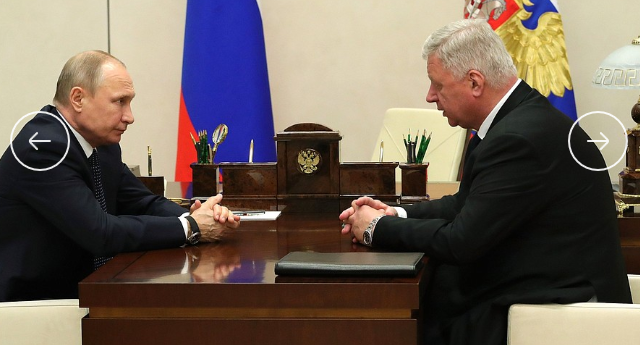
On Rusal it is now clear the President told his current spokesman, Dmitry Peskov, to call the attack on the company “illegal”, but not an act of war. Putin refused to agree to nationalization of Rusal when he met with one of the advocates of this option, the leader of Russia’s trade unions, Mikhail Shmakov.


At Novo-Ogaryovo on April 13, the President met with Mikhail Shmakov, 
Chairman of the Russian Federation of Independent Trade Unions. 

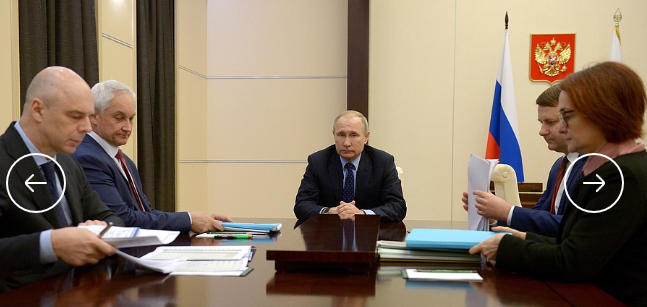
Instead, without revealing his contacts with Oleg Deripaska, Putin decided to delegate to him the initiative for responding to the April 6 sanctions. This was also confirmed with Finance Minister Anton Siluanov, whom Putin called to the dacha on April 17, along with the Kremlin economic adviser, the minister for economic development, and the chairman of the Central Bank.


At Novo-Ogaryovo on April 17, Putin met with presidential economic adviser 
Andrei Belousov (2nd left), Finance Minister Anton Siluanov (1st left) , Economic 
Development Minister Maxim Oreshkin (2nd from right) and Central Bank Governor 
Elvira Nabiullina (right). Source: http://en.kremlin.ru/events/president/news/57269

Siluanov was told to meet US Treasury Secretary Stephen Mnuchin in Washington and see what shareholding arrangement the US Government will accept for Deripaska and his shareholding associates in the Yeltsin family to keep control of Rusal; and at the same time release Rusal itself from the global trade embargo. For details of their negotiation on April 20, read this. For the shareholdings of the Yeltsin family in Deripaska’s stake, look at this. What has been concealed of the Rusal shareholding arrangements and beneficiaries can be followed in this backfile.

Siluanov returned from Washington and reported back to Deripaska. On April 26 Deripaska filed an application to the Office of Foreign Assets Control (OFAC) at the Treasury for extension of the time to reorganize; Mnuchin had already announced this three days earlier, on April 23. Mnuchin had told Siluanov the target of the sanction was not Rusal, but its “entanglement with Oleg Deripaska”, as the Treasury press release called it. They have yet to agree on what Mnuchin will accept as disentanglement.

Deripaska then announced through EN+ that he has “agreed in principle [sic]… to reduce his shareholding in the Company to below 50%. In addition, in conjunction with ‎efforts to engage with OFAC as described above, Mr. Deripaska has agreed… that he will resign from the Board and consent to the appointment of certain new Directors such that the Board will comprise a majority of new independent [sic] directors.”

Deripaska persuaded the Financial Times to headline the move: “Deripaska agrees to relinquish control of sanction-hit Rusal”. No-one in Moscow, including the President, believes this.

Silently, Putin has decided to protect Deripaska; not to call the US attack on Rusal an act of war; and to test the Americans with an offer of a limited armistice. International bankers close to Russian business believe it is a Russian illusion that an armistice with the US can be anything but temporary; pursuing it is a miscalculation of US intentions, the sources add. They warn that new attacks will come. “The oligarchs,” the sources say, “will be put out of business by the Americans unless they choose – either return to Russia and face a very different future from the one they have enjoyed until now; or leave Russia, join the American side; lose what they own in Russia to the state. There is no middle position. That’s what the US economic strategy means. There’s no modern precedent for an attack like this. Putin isn’t prepared.”

By deciding against nationalization of Rusal, one of the international sources claims, Putin has retreated from the Napoleon precedent on the economic front. In Syria, military sources in Moscow believe, Putin has opted for one step short of extending Russian missile defence beyond the Russian air and naval bases to cover the territory now controlled by the Bashar al-Assad government.

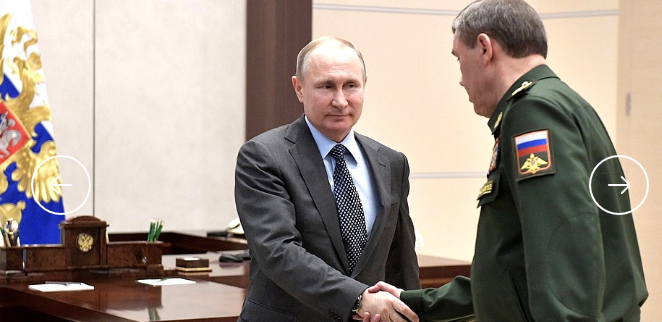
This was discussed by Putin with General Staff chief Valery Gerasimov and Defence Minister Sergei Shoigu on April 20. The Russian military, they told the President, want the go-ahead to deploy S-300 missile batteries to cover Syrian and Iranian forces against US and Israeli attack from the air. They believe Israeli threats to attack the S-300 batteries as soon as they are operational are a bluff which Russia must call if Russia’s positions in Syria, and Iran itself, are not to come under subsequent attack from the American-Israeli combination. Testing the threat in Syria, they argue, is the less threatening, less costly option than encouraging the Americans and Israelis to prepare their offensive against Iran. Putin won’t agree.


At Novo-Ogaryovo on April 20, Putin greets General Valery Gerasimov. 

To respond to Putin’s reluctance, the General Staff and the Defence Ministry have devised a step short of the S-300, but with potentially enough defensive power to intercept or deter American and Israeli air attacks. This is the deployment of more Russian electronic warfare systems with the capacity to jam the surveillance, targeting, fire control and command signals on which the attackers rely. It is the Samson Haircut option – deprive the giant of control of his firepower, blind him.

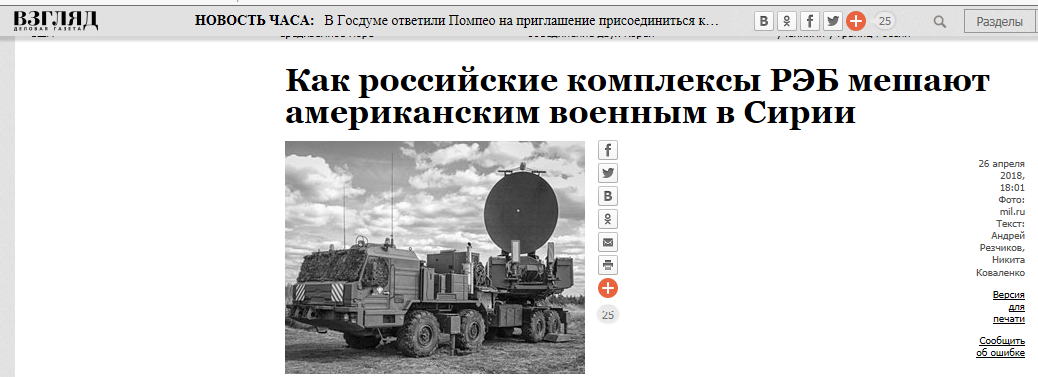
A publication on April 26 in Vzglyad, the Moscow online analytical website, reveals with open sources, including American ones, how this option would work. This is an unofficial translation into English.


How Russian electronic warfare systems interfere with the US military in Syria


The EW Krasukha systems well-tested in real combat in Syria

by Andrei Rezchikov and Nikita Kovalenko

“Because of the actions of our unidentified enemy today, our military in Syria are in the most aggressive electromagnetic environment on the planet," said the American general. It is clear that such an enemy means Russia, actively using the means of electronic warfare in Syria. What are Russian electronic warfare systems capable of and why are Americans so afraid of them?

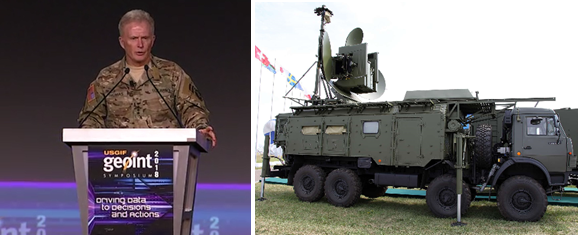
General Raymond Thomas, the head of the special operations command of the US armed forces complained at the closed Symposium GEOINT 2018 that “opponents” are jamming the system of American aircraft in Syria. He did not specify which “opponents” he means, but called the current situation in electronic warfare “the most aggressive in the world”. However, the publication Drive, quoting the general, expressed confidence that this is about Russia.


Left: General Raymond Thomas speaking at GEOPOINT 2018, April 22 and 25. 
Listen to his speech and read the DRIVE report of April 25 at 
-adversaries-are-jamming-ac-130-gunships-in-syria 
Right: DRIVE’s published photograph of the Russian Krasukha-4 electronic warfare system.

“They test us every day, suppress our communications, disable our (fire support aircraft) AC-130,” added Raymond Thomas.

Earlier, the NBC TV channel, citing unnamed US officials, reported that Russia has blocked the radio signals of US drones in Syria, which has significantly affected US military operations. The Russian military allegedly began to interfere with US drones “after a series of alleged chemical attacks in Eastern Ghouta.”

The editor of the magazine Arsenal of the Fatherland, Alexei Leonov, does not believe that in Syria there was an unprecedented situation in terms of the use of electronic warfare.

“In fact, it has not affected the habit of Americans to fight with a weak opponent. After 1991, the United States led all its military conflicts against states whose EW [Electronic Warfare systems] were very weak or not used at all,” he told Vzglyad.

In the assessment of Leonov, the US is now clearly inferior to Russia in the effectiveness of EW systems, primarily for the reason that the Americans stopped paying these technologies due attention. Back in the 1990s, during the first war in the Persian Gulf, the Americans actively used electronic warfare equipment because at the time the Iraqi army was quite developed, and it was necessary not to allow their air defense and intelligence to detect the accumulation of American troops in the main targeting direction, the expert recalled.

But they began to relax, and since then they have developed only one effective electronic warfare system based on the F-18 aircraft to cover aviation units, Leonov said. “Russia did not stand still. And now the Americans, when they have watched our electronic warfare systems, they have recognized that they are among the best in the world”, he added.

“The characteristic of American means of communication is that they work in the K-band. We know this range, so this range was configured in the electronic warfare systems that could be jamming the signal and to catch all the communications,” said Leonov. In addition, Americans in Syria mainly use airborne electronic warfare systems; in Russia they are deployed in ground systems.
“Ground systems will always be more powerful and stronger than air ones due to the energy supply,” the source says.

This has long been said by a former head of electronic warfare for the US Army Laurie Buckhout.

“Our most serious problem is that we have not fought for several decades in conditions of suppression of communication, so we do not know how to fight. We not only do not have tactics, techniques and procedures for their implementation, but even the preparation for the conduct of hostilities in the absence of communication.

In the Federation Council it was noted after the statements of General Thomas that Moscow has nothing to do with the failure of electronic systems of American aircraft in Syria. “I do not know who they mean by opponents, but Russia has nothing to do with this, these claims are unfounded”, RIA Novosti was told by the first Deputy Chairman of the Federation Council Committee on Defense and Security, Yevgeny Serebrennikov.

However, the fact that Moscow denies involvement in the impact on US military equipment does not mean that Russia does not use electronic warfare in Syria at all. In particular, to repel the recent raid of drones which tried to attack the Russian airbase at Khmeimim, along with Pantsir-S anti-aircraft missile and gun complexes, EW was extensively operated. According to a source of Izvestia in the Main Operational Directorate (GOU) of the General Staff, after detecting the danger at a distance of about 10 km, the electronic warfare system silenced the GPS signal over a certain area, disabling the navigation and control system of the drones.

A British expert on the Russian armed forces Roger McDermott sees the superior effectiveness of Russian electronic warfare in repelling the drone attack. He is convinced that Russia maximizes the ability of electronic warfare, achieving impressive results. According to him, unlike NATO, Russia has integrated military command, communications, intelligence, space, cyber and electronic warfare.

In early January, 13 drones with homemade bombs attacked the Khmeimim airbase and the naval base at Tartus; seven of them were destroyed by Pantsir-S, and another six were intercepted by EW units. Some experts have also assumed that during the recent US missile strike on Syria radio-electronic means of suppression were used to intercept some of the cruise missiles, as a consequence of which many missiles simply did not reach their targets. At the same time, some military experts have questioned this, given the complexity of the signal suppression systems of these Tomahawks.

What kind of electronic warfare means is Russia using in Syria? Detailed information about this is unavailable in the open press because of the increased secrecy surrounding this topic. However, the press has often received fragmentary information, much of it thanks to the activity of Syrian bloggers who have repeatedly photographed examples of Russian weapons. This is how the transfer to Khmeimim was reported of the ground-based jamming system Krasukha, along with Mi-8 helicopters equipped with active interception system Richag-AB. In late March, the Russian Defence Ministry transferred to Syria the latest model of electronic warfare helicopters, Mi-8 MTPR-1.


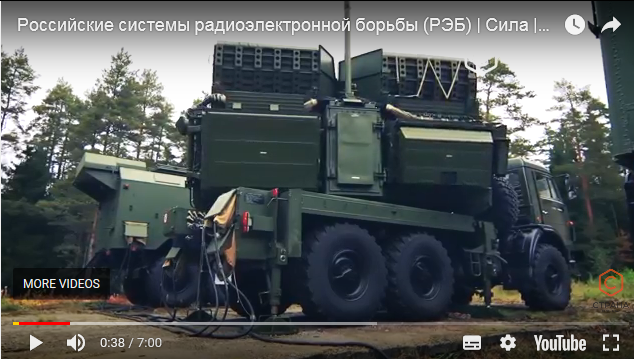
Official Defence Ministry video presentation of Russian EW equipment: 


 The Mi8 MTPR-1. For a detailed review from 2015, read this.

About the EW [operations in Syria] too little is known. The Krasukha was unveiled in 2011. Several modifications were created. The most powerful option – Krasukha-4 – ‘silences’ airborne aircraft radars, including drones and cruise missiles. A killer electronics system Richag-AB refers to the latest developments and entered service only in 2016. It disables not only the navigation devices of aircraft, but also drones and cruise missiles.

According to some observers, the EW intelligence complex Moskva-1 is designed for a detection and tracking range of 400 kilometers for overhead sources of radiation at different radio frequency ranges.

In addition, as Vzglyad has reported, EW-equipped SU [Sukhoi] aircraft are deployed in Syria in various modifications. In particular, there is the well-known myth about the suppression of [radar and fire-control] systems of the American destroyer USS Donald Cook by the Khibiny system, which has been designed to block radio-electronic signals. As noted by experts, in fact the capacity of this system is quite limited; it is not enough to ‘stun’ American destroyers.

What, then, can EW really do? Military expert Dmitry Drozdenko in an interview with RT noted that such means muffle the channels of communication, and introduce blockages in the frequencies used by the US military to exchange information.

“As a result, information is not received between the control centers and combat units; in fact, the armed forces are blinded. If a radar installation searches for a target and tracks the space around it, it sees not only the real targets, but also a large number of false ones,” he explained.

Lenkov said that all the electronic warfare systems work on one principle: perform the tasks of intelligence, that is, determine the frequency and modes of communication and navigation, and their whereabouts. After that, the signal begins to jam.

“The power of the signal is more than the transceiver, and therefore it makes for reliable jamming of communications, intelligence and navigation,” the expert said.

As pointed out by US General Thomas, the AC-130 aircraft is particularly vulnerable to our EW attack. The Lockheed AC-130 is a flying gunship for direct support of land force divisions on the battlefield, based on the transport plane C-130 and equipped with several artillery pieces. This aircraft is very dependent on backup from supporting units, and if you block its communication channels, at night it will not be able to identify its objective, or in the afternoon to distinguish other [hostile] forces from its own. This means that if [the AC-130] can attack, there will be a high risk of hitting the allied forces.

Moreover, according to the general, there is a danger of impact by Russian electronic warfare even on the EC-130H Compass Call. One of the tasks of the EC-130H is to detect the EW suppressors of the enemy and transfer data about them to the allies for counter-strikes. However, the electronic warfare equipment of the enemy is able to crack it in order to lure the American forces to attack their own.

Blocking with the help of EW signal transmitters and GPS receivers can not only make it impossible for aircraft and warships to attack targets, but also create problems with their navigation, said the American. In addition, radio-electronic weapons may interrupt the communication of operators with drones, which can lead to their loss.

In addition, General Thomas stressed that for the time being Russia is not operating EW in Syria at full capacity. If Russia starts [to do that], the United States will lose all its communication in the region. The former head of electronic warfare for the US Army Laurie Buckhout adds that the US does not have such extensive capabilities for electronic warfare as Russia has.

“We have very good radio intelligence, and we can listen to everything. But we do not have one- tenth of their capabilities to disable equipment,” she said.

Where and for what reason do American generals produce such self-criticism and such laudatory notes about the Russian systems? This may well be aimed, for example, at trying to extract additional funds for the military budget. Hearings on that in the Senate, by the way, were just held on Thursday.