Wednesday, October 24, 2018

Not So Peachy: Georgia’s Great Voter Purge

Palast Sues Georgia’s Brian Kemp for Purging 340,000 Voters 

by Greg Palast for Democracy Now!


Our investigation has found Georgia secretary of state and Republican gubernatorial candidate Brian Kemp has overseen the removal of more than 340,000 current Georgia residents from voting rolls.


How did Kemp wipe out the registrations of 550,000 voters? He used the postcard trick. Kemp sent out millions of these cards, requiring voters to confirm their addresses. Problem? They look like junk mail. Eight out of 10 voters who get them throw them away. Throw away the card, and Kemp can throw you off the rolls. The trick? Not everyone gets a postcard.

Germans into Frankfurt Streets for Housing Shortage/Rent Protests

Frankfurt, Germany: Thousands protest against housing shortage and high rents

by our correspondents


24 October 2018  

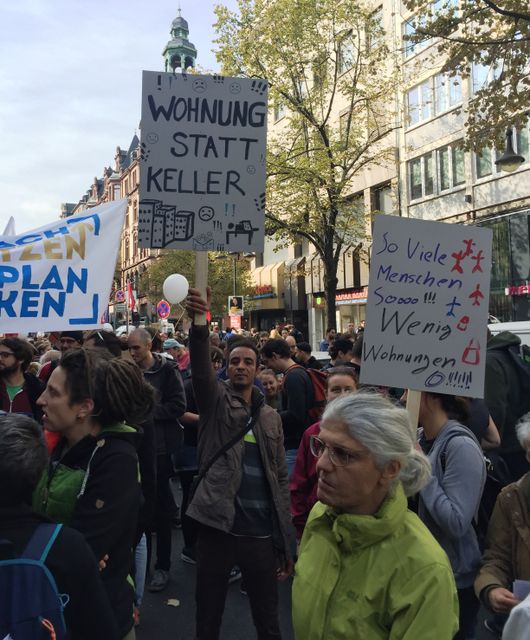
Last Saturday, several thousand people took to the streets of Frankfurt against the housing shortage and exploding rents. The “anti-rent-mania” demonstration, in which an alliance of over 30 initiatives participated, drew around 8,000 people.

Many wore banners and hand-painted signs with inscriptions such as “Stop building luxury properties,” “Houses to those who need them,” “Apartments instead of basements” and “No profit from rent.”

Other statements turned against the legal course in politics, such as “Nationalism is deadly” and “No to the AfD,” or ironically generalized the capitalist situation “Rich parents for all!” and called for [the] essentially socialist measures, “#expropriate”.


Demonstration banner reads "City for all"

The housing shortage is a growing problem nationwide. The right-wing housing policy of the federal and state governments has entailed privatization and luxury refurbishment on the one hand; with housing shortages, forced evictions and homelessness on the other. As the number of publicly subsidized social housing consistently sinks, about 1 million people are homeless in Germany today.

In the banking metropolis of Frankfurt, real estate sharks are preparing for the influx of wealthy bankers following Brexit. Whole districts are converted into chic apartment blocks and luxury properties, while old tenants are evicted from the former workers’ quarters in Gallus, Bockenheim and Rödelheim.

According to a study by the Regional Association Frankfurt/Rhine-Main, the Frankfurt metropolitan area will be short 200,000 affordable apartments within the next 12 years. In the surrounding cities of Offenbach, Wiesbaden, Darmstadt and Mainz rents are also exploding with a similar shortage of affordable housing. Many of the demonstrators came from these cities.


Signs read: “Apartments instead of basements” and 
“So many people, so few apartments!”

In the week before Hesse’s regional election, the leading candidate of the Social Democrats (SPD) tried to profit from the demonstration. However, when Thorsten Schäfer-Gümbel, the SPD faction leader in the Hesse State Parliament, tried to present himself as the voice of the people, he was booed and heckled.

Although the SPD has held the opposition in Hesse for 20 years, the party is hated among workers and young people. In recent polls, the SPD have garnered only 20 percent of the vote, which is over 10 percent less than in the last regional elections five years ago. The Social Democrats are identified not only with Germany’s brutal Hartz IV labor reforms, but also with the right-wing policies of the Grand Coalition (Christian Democratic Union/CDU, Christian Social Union/CSU and Social Democratic Party/SPD). Their name represents the implementation of inhuman refugee policies, state rearmament and militarism.

The complete collapse of the Grand Coalition parties—the CDU incumbent Prime Minister Volker Bouffier stands at 26 percent in the polls, which is 12 points less than their 2013 result—currently benefits the Greens. However, the Greens are no alternative to right-wing and anti-social policies. In Hesse, they have been governing together with the CDU for the last five years, with Tarik Al-Wazir as the minister of economic affairs and deputy prime minister. The Greens have supported deportations, police armaments, and deregulation. They have also driven the conversion of Frankfurt’s social housing into luxury properties. Their presence was almost nonexistent at the demonstration.

In contrast, prominent representatives of the Left Party (Die Linke) were at the demonstration, as was their top candidate Janine Wissler. Wissler, a leading member of the pseudo-left Marx21 tendency, however, abandoned her own speech in light of Schäfer-Gümbel’s fiasco.

The Left Party in Hesse is seeking a joint government with the SPD and Greens—the two parties that have propped-up the right-wing government. As Wissler repeatedly emphasized, a coalition between the three parties “on the left will not fail.” Such a coalition currently holds power in Berlin’s State Parliament and its policies are just as right-wing and anti-working-class as those of other state governments.

If the Left Party held power in Hesse, they would pursue the same policy as all other parties in the German Federal Parliament. In Hesse, Wissler tolerated the SPD-Green coalition under Andrea Ypsilanti (SPD) 10 years ago, and a few weeks ago she appeared in the campaign for the Ryanair strike side by side with SPD candidate Schäfer-Gümbel.

On the housing question, the Left Party, wherever it holds governmental responsibility, organizes brutal attacks. As part of the SPD-Left Party coalition in Berlin (2002-2011), Die Linke actively helped to privatize, smash and sell out the same non-commercial housing that they now demand in Hesse. The result can be seen in today’s rapidly rising rent crisis in Berlin.

Fight Google's censorship!


Google is blocking the World Socialist Web Site from search results.

To fight this blacklisting: Share this article with friends and coworkers

Mississippi Goddam

Mississippi Goddam

by Nina Simone

“Mississippi Goddam”

The name of this tune is Mississippi Goddam
And I mean every word of it....


Alabama’s gotten me so upset
Tennessee made me lose my rest
And everybody knows about Mississippi Goddam
Alabama’s gotten me so upset
Tennessee made me lose my rest
And everybody knows about Mississippi Goddam

Can’t you see it
Can’t you feel it
It’s all in the air
I can’t stand the pressure much longer
Somebody say a prayer

Alabama’s gotten me so upset
Tennessee made me lose my rest
And everybody knows about Mississippi Goddam

This is a show tune
But the show hasn’t been written for it, yet

Hound dogs on my trail
School children sitting in jail
Black cat cross my path
I think every day’s gonna be my last

Lord have mercy on this land of mine
We all gonna get it in due time
I don’t belong here
I don’t belong there
I’ve even stopped believing in prayer

Don’t tell me
I tell you
Me and my people just about due
I’ve been there so I know
They keep on saying “Go slow!”

But that’s just the trouble
“do it slow”
Washing the windows
“do it slow”
Picking the cotton
“do it slow”
You’re just plain rotten
“do it slow”
You’re too damn lazy
“do it slow”
The thinking’s crazy
“do it slow”
Where am I going
What am I doing
I don’t know
I don’t know

Just try to do your very best
Stand up be counted with all the rest
For everybody knows about Mississippi Goddam

I made you thought I was kiddin’
Picket lines
School boy cots
They try to say it’s a communist plot
All I want is equality
for my sister my brother my people and me

Yes you lied to me all these years
You told me to wash and clean my ears
And talk real fine just like a lady
And you’d stop calling me Sister Sadie

Oh but this whole country is full of lies
You’re all gonna die and die like flies
I don’t trust you any more
You keep on saying “Go slow!”
“Go slow!”

But that’s just the trouble
“do it slow”
Desegregation
“do it slow”
Mass participation
“do it slow”
Reunification
“do it slow”
Do things gradually
“do it slow”
But bring more tragedy
“do it slow”
Why don’t you see it
Why don’t you feel it
I don’t know
I don’t know

You don’t have to live next to me
Just give me my equality
Everybody knows about Mississippi
Everybody knows about Alabama
Everybody knows about Mississippi Goddam

That’s it!

Tuesday, October 23, 2018

Israel's "Popular Terror" and the Targeting of Palestinian School Children

‘A Cruel Choice’: Why Israel Targets Palestinian Schools

by Ramzy Baroud - Palestine Chronicle


October 23, 2018

Several Palestinian students, along with teachers and officials, were wounded in the Israeli army attack on a school south of Nablus in the West Bank on October 15.

The students of Al-Sawiya Al-Lebban Mixed School were challenging an Israeli military order to shut down their school based on the ever-versatile accusation of the school being a “site of popular terror and rioting.”

“Popular terror,” is an Israeli army code for protests.


Palestinian student Mohammed Abu Hussain from Gaza,
who lost his leg after being shot by an Israeli sniper during
"Great March of Return" demonstrations, plays football with
his crutches at the playground of his school in Gaza City, Gaza
on 3 September, 2018 [Ali Jadallah/Anadolu Agency]

The students, of course, have every right to protest, not just the Israeli military Occupation but also the encroaching colonization of the settlements of Alie and Ma’ale Levona. These two illegal Jewish settlements have unlawfully confiscated thousands of dunams of land belonging to the villages of As-Sawiya and Al-Lebban.

“The Israeli citizens”, that the Occupation army is set to protect by shutting down the school, are, in fact, the very armed Jewish settlers who have been terrorizing this West Bank region for years.

According to a 2016 study commissioned by the United Nations, at least 2,500 Palestinian students from 35 West Bank communities must cross through Israeli military checkpoints to reach their schools every day. About half of these students have reported army harassment and violence for merely attempting to get to their classes or back home.

However, this is only half of the story, as violent Jewish settlers are always on the lookout for Palestinian kids. These settlers, who “also set up their own checkpoints”, engage in regular violence as well, by “throwing stones” at children, or “physically pushing (Palestinian children) around.”

“UNICEF’s protective presence teams have reported that their volunteers have been subjected to physical attacks, harassment, arrest and detention, and death threats,” according to the same UN report.

In other words, even the ‘protectors’ themselves often fall victim to the army and Jewish settler terror tactics.

Add to this that Area C - a major part of the West Bank that is under full Israeli military control - represents the pinnacle of Palestinian suffering. An estimated 50,000 children face numerous hurdles, including the lack of facilities, access, violence, closure and unjustified demolition orders.

The school of Al Sawiya Al Lebban located in Area C is, therefore, under the total mercy of the Israeli military, which has no tolerance for any form of resistance, including non-violent popular protests by school children.

What is truly uplifting, however, is that, despite the Israeli military Occupation and ongoing restrictions on Palestinian freedom, the Palestinian population remains one of the most educated in the Middle East.

According to the United Nations Development Program (UNDP), the literacy rate in Palestine (estimated at 96.3%) is one of the highest in the Middle East and the illiteracy rate (3.7% among individuals over the age of 15) is one of the lowest in the world.

If these statistics are not heartening enough, bearing in mind the ongoing Israeli war on Palestinian school and curricula, consider this: the besieged and war-stricken Gaza Strip has an even higher literacy rate than the West Bank, as they both stand at 96.6% and 96% respectively.

In truth, this should not come as a total surprise. The first wave of Palestinian refugees that were ethnically-cleansed from historic Palestine were so keen on ensuring their children strive to continue their education, they established school tents, operated by volunteer teachers as early as 1948.

Palestinians understand well that education is their greatest weapon to obtain their long-denied freedom. Israel, too, is aware of this dichotomy, knowing that an empowered Palestinian population is far more capable of challenging Israeli dominance than a subdued one, thus the relentless and systematic targeting of the Palestinian educational system.

Israel’s strategy in destroying the infrastructure of Palestinian schooling system is centered on the allegation of ‘terror’: that is, Palestinians teach ‘terror’ in their schools; Palestinian school books celebrate ‘terrorists’; schools are sites for ‘popular terror’ and various other accusations that, per Israeli logic, compels the army to seal off schools, demolish facilities, arrest and shoot students.

Take for example, the recent comments made by the Israeli mayor of Jerusalem, Nir Barkat, who is now leading a government campaign aimed at shutting down operations by the UN organization that caters for Palestinian refugees, UNRWA.

“It is time to remove UNRWA from Jerusalem,” Barkat announced early October.

Without any evidence whatsoever, Barkat claimed that “UNRWA is strengthening terror,” and that “the children of Jerusalem are taught under their auspices, terror, and this must be stopped.”

Of course, Barkat is being dishonest. The jibe at UNRWA in Jerusalem is part of a larger Israeli-US campaign aimed at shutting down an organization that proved central to the status and welfare of Palestinian refugees.

According to this skewed thinking, without UNRWA, Palestinian refugees would have no legal platform, thus closing down UNRWA is closing down the chapter of Palestinian refugees and their Right of Return altogether.

The link between the shutting down of Al Sawiya Al Lebban, the targeting of UNRWA by Israel and the US, the numerous checkpoints separating students from their schools in the West Bank and more, have more in common than Israel’s false allegation of ‘terror.’

Israeli writer, Orly Noy, summed up the Israeli logic in one sentence. “By destroying schools in Palestinian villages in Area C and elsewhere, Israel is forcing Palestinians to make a cruel choice — between their land and their children’s futures,” she wrote earlier this year.

It is this brutal logic that has guided the Israeli government strategy regarding Palestinian education for 70 years. It is a war that cannot be discussed or understood outside the larger war on Palestinian identity, freedom, and, in fact, the very existence of the Palestinian people.

The students’ fight for their right to education in Al Sawiya Al Lebban Mixed School is by no means an isolated skirmish involving Palestinian school kids and trigger-happy Israeli soldiers. Rather, it is at the heart of the Palestinian people’s fight for their freedom.

Ramzy Baroud is a journalist, author and editor of Palestine Chronicle. His latest book is The Last Earth: A Palestinian Story (Pluto Press, London, 2018). He earned a Ph.D. in Palestine Studies from the University of Exeter and is a Non-Resident Scholar at Orfalea Center for Global and International Studies, UCSB.

Fracking's Failing Financials

U.S. Shale Has A Glaring Problem 

by Nick Cunningham - Oilprice


October 23, 2018

Oil prices are down a bit, but are still close to multi-year highs. That should leave the shale industry flush with cash. However, a long list of U.S. shale companies are still struggling to turn a profit.

A new report from the Institute for Energy Economics and Financial Analysis (IEEFA) and the Sightline Institute detail the “alarming volumes of red ink” within the shale industry.

“Even after two and a half years of rising oil prices and growing expectations for improved financial results, a review of 33 publicly traded oil and gas fracking companies shows the companies posting negative free cash flows through June,” the report’s authors write. 

The 33 small and medium-sized drillers posted a combined $3.9 billion in negative cash flow in the first half of 2018.

The glaring problem with the poor financial results is that 2018 was supposed to be the year that the shale industry finally turned a corner. Earlier this year, the International Energy Agency painted a rosy portrait of U.S. shale, arguing in a report that “higher prices and operational improvements are putting the US shale sector on track to achieve positive free cash flow in 2018 for the first time ever.”

The improved outlook came after years of mounting debt and negative cash flow. The IEA estimates that the U.S. shale industry generated cumulative negative free cash flow of over $200 billion between 2010 and 2014.

The oil market downturn that began in 2014 was supposed to have changed profligate spending, pushing out inefficient companies and leaving the sector as a whole much leaner and healthier.

“Current trends suggest that the shale industry as a whole may finally turn a profit in 2018, although downside risks remain,” the IEA wrote in July.
 “Several companies expect positive free cash flow based on an assumed oil price well below the levels seen so far in 2018 and there are clear indications that bond markets and banks are taking a more positive attitude to the sector, following encouraging financial results for the first quarter.” 

But the warning signs have been clear for some time. The Wall Street Journal reported in August that the second quarter was a disappointment. The WSJ analyzed 50 companies, finding that they spent a combined $2 billion more than they generated in the second quarter.

The new report from IEEFA  and the Sightline Institute add more detail the industry’s recent performance. Only seven out of the 33 companies analyzed in the report had positive cash flow in the first half of the year, and the whole group burned through a combined $5 billion in cash reserves over that time period.

Even more remarkable is the fact that the negative financials come amidst a production boom. The U.S. continues to break production records week after week, and at over 11 million barrels per day, the U.S. could soon become the world’s largest oil producer. Analysts differ over the trajectory of shale, but they only argue over how fast output will grow.

Yet, even as drillers extract ever greater volumes of oil from the ground, they still are not turning a profit. “To outward appearances, the U.S. oil and gas industry is in the midst of a decade-long boom,” IEEFA and the Sightline Institute write in their report. However, “America’s fracking boom has been a world-class bust.”

The ongoing struggles raises questions about the long-term. If the industry is still not profitable – after a decade of drilling, after major efficiency improvements since 2014, and after a sharp rebound in oil prices – when will it ever be profitable? Is there something fundamentally problematic about the nature of shale drilling, which suffers from steep decline rates over relatively short periods of time and requires constant spending and drilling to maintain?

Third quarter results will start trickling in over the next few days and weeks, which should provide more clues into the shale industry’s health. There is even more pressure on drillers to post profits because the third quarter saw much higher oil prices.

“Until the industry as a whole improves, producing both sustained profits and consistently positive cash flows, careful investors would be wise to view fracking companies as speculative investments,” the authors of the report concluded.
Nick Cunningham is a freelance writer on oil and gas, renewable energy, climate change, energy policy and geopolitics. He is based in Pittsburgh, PA.

Fraternal Order in the Court: Kavanaugh Wins One for the Pack

Trump and Kavanaugh Win One for the Pack: How Frats, Teams, and Gangs Divide, Conquer, and Now Judge America

by Robert Lipsyte - TomDispatch


October 23, 2018

Brett Kavanaugh’s hellish Supreme Court fraternity pledge week offered many lessons, but the most powerful, if least noted, was about the raising of boys in America -- all boys, not just the groomed Georgetown elite from which the judge emerged.

Too many boys are raised in packs, whether they’re called fraternities, sports teams, or gangs, all of which offer brotherhood in return for loyalty, obedience, and a dedicated contempt for the Other -- anyone, that is, who isn’t a member, above all women. Kavanaugh was raised (and raised up) by just such packs.

Frats, teams, and gangs have their differences, often involving social class and skill sets, but there’s one great similarity: the sense, often nurtured and reinforced by booze, battle, and group sex, that you are part of a special brotherhood.

The promise of that brotherhood is to defend boys against a supposedly hostile environment by isolating them from the rest of their world and indoctrinating them with a set of tribal values that must be upheld beyond reason.

Tomgram: Robert Lipsyte, Brett Kavanaugh, Raised by the Power of the Pack

I felt discouraged recently when it hit home: I’ll never be a Supreme Court justice. Reviewing my life, I came to the realization that I was in no way qualified -- and no, I’m not talking about my utter lack of legal experience (except as a juror). I was thinking instead of the qualifications that -- as TomDispatch regular and former New York Times sports columnist Robert Lipsyte lays out today -- the Kavanaugh hearings revealed for being the right sort of boy/man for the job.

I certainly spent parts of my 1950s childhood dreaming of joining the Brooklyn Dodgers on the field. (“Engelhardt darts to his right, picks up the hot grounder, and fires it to first!”) On an actual baseball diamond, however, I had a few problems fielding any grounder or, for that matter, judging the depth of fly balls (I always ran in), or doing much but whiffing at the plate. Unlike Brett K., sports, it turned out, was not my natural resting place. Worse yet, when I was at college, no fraternity ever tapped me, though I can still remember Saturday nights in my room listening to music pound away at a nearby frat house. And drinking? Well, give me credit there: I did get black-out drunk in high school. My best friend and I went into my parents’ liquor cabinet while they were away and downed much of a bottle of vodka. Brett K. would have been proud of me. I puked big time, passed out, woke up, and blamed the mess on my dog, and -- what could better indicate my lack of Supreme quality -- I thought it was so gross I never did it again.

And let’s not even turn to girls in those years. It was hard enough to approach one in the right spirit. Assault her? I couldn’t imagine.

So consider me hopeless. All of this only helped me in one small way in my life: when my daughter and son were young, I volunteered to coach their little league baseball teams. And being more or less grown-up by then, my heart went out to the kids on those teams who -- remembrance of things past -- weren’t especially good or skillful. Unlike a number of the other coaches, out of pity for my former self, I focused my efforts on them, gave them extra practice time, and you know what? Because of that, the teams I coached always did better than I expected.

Now, take a moment to check out Lipsyte’s account of the truly bizarre world of “successful” boys and men and then consider your own Supreme qualifications in this all-American world of ours. Tom

Trump and Kavanaugh Win One for the Pack: How Frats, Teams, and Gangs Divide, Conquer, and Now Judge America

by Robert Lipsyte 


For most boys, as was true for young Brett, it starts with making the sports team (or not), being discarded -- “cut” -- (or not), as a pyramid of talent narrows to travel teams, all-stars, and elite leagues in middle school, high school, college, and finally the pros. The prime lesson is always the same: winning is everything and doing so in a dominating way by crushing the opposition is the best of all. In the process, finding an edge by working the refs, purposely injuring opponents, taking drugs, or protecting bad boys become standard tactics in the quest for victory. As Kavanaugh reminded us often enough, being captain of his Georgetown Prep high school basketball team and a member of the football team made him the proudest of proud jocks.

Naturally, fraternities prize such products of Jock Culture, boys growing to manhood who are already popular, trained to take orders, and used to hanging out with their own while excluding others. Frats, in turn, offer the same rewards as teams do, especially a set of brothers who will have your back, no matter what kind of a “puker” you are -- as long as you’re loyal. At Yale, Kavanaugh pledged Delta Kappa Epsilon (or Deke), then well known as a hard-drinking frat for jocks, whose many famous members once included Presidents Gerald Ford and that father-and-son team, George H.W. and George W. Bush. Kavanaugh’s Deke connections may even have brought him to the attention of the younger Bush as he headed into his presidency and landed Brett his various jobs in that administration. Perhaps it also helped recommend him to one of the country’s most notorious and dangerous gangs of conservatives, the Federalist Society.

For the past four decades, much like gangs in minority neighborhoods drafting tough and vulnerable teenagers, the conservative Federalists have been recruiting ambitious students and lawyers with the potential to become judges. Their success reached a peak with Kavanaugh’s recent confirmation, a victory with a Trumpian touch. The judge’s diatribe about the Clintons and the rest of the left-wing conspiracy to take him out should have evoked the president’s pitch on the viciousness of MS-13, a gang of mostly young Central Americans that originated in Los Angeles and has spread into immigrant communities across the country.

Boys Will Be You Know What


Team, frat, or gang, the macho sensibility of the pack will never die as long as it’s applauded or at least tolerated in the culture at large as a boys-will-be-boys phenomenon -- as long as it’s a given that we need such boys raised up strong and straight, prepared to fight our wars, man (never woman) our teams, and of course run our country. If you are a boy and an outsider, you are likely to play along to avoid trouble. Growing up bookish in Queens, The Donald’s borough, so many years ago, I found myself feigning more interest than I had in New York’s major league baseball teams and didn’t protest too much when other boys misinterpreted a platonic relationship with a girl as something steamier. It kept my image on the male track, reasonably protected from the bullies who went after boys like me.

I was in a college fraternity, saw plenty of alcoholic aggression and sexual misbehavior, but never quite connected that to the code of the pack. Yes, there were drunk guys, horny guys, screwed-up guys, maybe even a few truly bad guys, but I didn’t grasp that it was all meant to be a brotherhood against the rest of the world (especially women). My teaching moment came at 24, a lesson (appropriately enough) directly from the locker room.

It was 1962. I was then a rookie baseball reporter for the New York Times, covering the Yankees on the road. The older sportswriters were, at best, warily sociable. Would I, they wondered, disrupt their easy lives with some kind of unexpected reporting?

The ballplayers were subtly hostile, especially stars like Mickey Mantle. Would I violate the covenant of the trade: that what happens on the road stays on the road? I felt like an interloper, outside the little bubble they were all traveling in. I was disconnected, lonely, and anxious that such social relations would affect my job, that mine would turn out to be a brief career in sports writing.

Then, one hot morning before a night game in Los Angeles, I met, chatted up, and took a swim in the hotel pool with a young female guest. I suggested lunch. As it was getting too hot for a poolside meal and we were hardly dressed for a restaurant, we left together for my room to order from room service, as some sportswriters and a few ballplayers hanging out at poolside nodded approvingly. No alcohol was ordered and nothing happened. We had lunch and that was that, but several Yankees saw her leave my room and smirked.

And lo and behold, I was in. The press box and the locker room were welcoming that evening. A winking word or two, a nod and a smile confirmed my acceptance. It took me a little while to figure it all out. Suddenly, I was one of them or at least nobody to worry about anymore because I had just marked myself as another frat brother following his dick. It was as easy and stupid as that. I was one of the guys.

Bystanders and Accomplices


I didn’t stay on the baseball beat long enough to see if my new brotherhood would pay off in scoops, but the lesson learned could make access easier when it came to reporting on other sports, the cops, city politics, more or less anything else I covered. The rule was simple enough: walk like a bad boy and don’t police bad-boy behavior or even point it out. That’s no way of making friends. Most in the brotherhood were then and probably still are simply bystanders, as I was at the time. Some, of course, are accomplices, while the bad boys all too often are the stars whom all the other boys in the pack both resent and admire as heroes.

I’ve been thinking about this for years, but Brett Kavanaugh, that quintessential frat-boy jock-bully, brought it all up in my throat again like so much bile. His belligerent, bleating, entitled, prevaricating, smart-ass Jock Culture posturing reminded me of the boys I had been trying to dodge all my life and, in the end, couldn’t help writing about. Now, to imagine the quintessential version of such a figure sitting in judgment on the rest of our lives for the rest of his life is chilling.

And here’s the sick joke of it all: by Jock Culture’s twisted standards, the judge was a loser. He struck out. He spent parties “holding up the walls” because he was too soused to play. The drunken braggart was disrespectful to women because he never got the girl, even the one everyone else supposedly got -- and what did it matter that they didn’t either? Decades later, when it was finally in his interest, he admitted the truth: that he was a virgin all those years. And in that lies a deeper truth: having sex back then was never as important as the guys thinking you did.

And now for that infamous 1985 bar fight, that quintessential test of manhood. As it happened, he didn’t clean out the joint with his fists, he threw ice cubes. He was an instigator, endangering his pals, including Chris Dudley, the 6'-11" Yale basketball player who took the fall and was evidently arrested. There is no evidence that Dudley suffered more than a brief detention, which tends to be standard treatment for a college jock near campus, even for far worse transgressions. Usually, some old white guys clean up afterward. In any case, Dudley went on to spend 16 years in the National Basketball Association and run unsuccessfully for governor of Oregon.

The Duke


Once cornered by Dr. Christine Blasey Ford’s testimony, Brett Kavanaugh turned in a performance that any frat boy would describe with the worst of pack put-downs: “acting like a little girl.” Whatever happened to the steady and stoic John Wayne-style “don’t complain, don’t explain” guy? Not for him, the classic football player’s mantra, “Suck it up, be a man.”

John Wayne, the Duke, that on-screen ultimate cowboy, was a movie fixture of my time and Donald Trump’s, too. I often get the feeling that the president is trying to channel Wayne with that rolling waddle of his and his pseudo-tough declarative sentences. Even as the Senate struggled with the confirmation of an accused sexual predator, he was out there mocking Al Franken, the former Democratic senator driven to resign by far less devastating (but still insufferable) charges, accusing him of weakness. “He was wacky,” Mr. Trump said at a campaign rally in Minnesota. “Boy, did he fold up like a wet rag, huh? Man. Man. He was gone so fast, O.K.?” Then, he added, “Oh, he did something. ‘Oh, oh, oh, I resign, I quit.’ I don’t want to mention Al Franken’s name, so I won’t mention [it].”

In that nightmarish display of the power of the pack in Congress recently, if there was some semblance of a Republican manly man, it seemed to be, however briefly, Arizona Senator Jeff Flake, who was willing to be open to two women he did not know when they confronted him in an elevator in the Capitol and so made a rare Republican compromise with the Other. He even demurred when the gang leader himself, Trump, mocked Dr. Ford’s pain. In the end, of course, Flake folded like a wet rag in the face of ultimate pack power and voted to confirm Kavanaugh, whose ascension will help normalize the kind of thuggish behavior that has long kept so many boys in thrall.

Loud and aggressive, fueled and excused by alcohol -- what a commercial for the mellowness of pot is Brother Brett! -- the frat-jock gang tries to push everyone else to the margins, drown out all discourse but theirs, and move the goal posts or, if necessary, simply tear them down. And they are so often cheered on by the bystanders, vicariously enjoying the violence, like the audience in a sports arena. It makes me think of extreme sports fandom, a form of tribalism that has given a pass to dozens of sexually predatory athletes over the years. Most recently and sadly typical of our never-ending moment, Ohio State suspended its winning coach, Urban Meyer, for just three games for his mishandling of repeated sexual assault claims by the wife of an assistant coach and friend.

And talk about mishandling: call them a frat or a gang, but the aging white male Republicans on the Senate Judiciary Committee moved Kavanaugh through his initiation with remarkable determination and then helped Trump cow the rest of the tribe into voting him onto the bench. The only shock in all of this was its blatancy. Otherwise it should have seemed beyond familiar to us all. In winning yet again, the big boys made their male tribalism transparent beyond question. It's beyond question that they believe bipartisanship, cooperation, common decency, and peace are antithetical to the brotherhood of the pack.

In fact, just one question remains: Will this finally mobilize a resistance movement or will it just further confirm the dominance of the pack?

The only appropriate four-letter word in all of this, of course, is VOTE, but even kicking the bullies out won't be enough for the long game. The manipulation of male tribalism occurs on many levels, but since we know where it starts for boys, isn’t it time to begin reforming the world of sports teams, get rid of those fraternities, and alleviate the conditions that breed gangs? It’s that or roll over forever for Brett and the pack.

Robert Lipsyte, a TomDispatch regular and author of the memoir An Accidental Sportswriter, was a sports and city columnist for the New York Times, a correspondent for CBS and NBC news, and host of WNET’s nightly public affairs show. His 1975 goodbye-to-all-that (before he came back), SportsWorld: An American Dreamland, has just been reissued with a new introduction.

Follow TomDispatch on Twitter and join us on Facebook. Check out the newest Dispatch Books, Beverly Gologorsky's novel Every Body Has a Story and Tom Engelhardt's A Nation Unmade by War, as well as Alfred McCoy's In the Shadows of the American Century: The Rise and Decline of U.S. Global Power, John Dower's The Violent American Century: War and Terror Since World War II, and John Feffer's dystopian novel Splinterlands.

Copyright 2018 Robert Lipsyte

Gorilla Radio with Chris Cook, Dr. Michael C. Klein, Ben Parfitt, Janine Bandcroft October 25, 2018

This Week on GR

by Chris Cook - Gorilla-Radio.com


October 25, 2018

Canadians are fortunate to live in a country possessing not only a thoroughly modern health care system, utilizing the best of 21st century technology, but also with legislated universal access to it. But, there's more to good medicine than universality, or the newest next thing, and as my first guest warns: when it comes to the ultimate primary care - how Canadians come into the World - the very progress we herald in Western medicine is making birth in this country less a natural process to be celebrated than "technological experience" to be endured.

Dr. Michael C. Klein's long, illustrious, and varied career in medicine both inside Canada and without includes serving as clinician, administrator, researcher, and educator.

Listen. Hear.

The Professor Emeritus of family practice at the University of British Columbia has practiced too in the United States, and cut his teeth in maternal medicine in exotic locales under surprising circumstances. It would take a book to do the scope of his career justice; so it's fortunate Michael Klein is also an author. His first book, 'Dissident Doctor: Catching Babies and Challenging the Medical Status Quo' tells his story, and much more besides.

Dr. Michael C. Klein in the first half.

And; last year, the Canadian Centre for Policy Alternatives' BC Office reported a subsidiary of Malaysian energy giant Petronas side-stepped the law, constructing at least 16 dams to support its fracking operations without approval of the province's Environmental Assessment Office. Now, that report's author has discovered, rather than suffering fine or censure for its breach of the law, Progress Energy asked for, and has had granted, retroactive exemptions from environmental review for two of the dams the EAO described as "illegal works".

Ben Parfitt is a journalist, author, and CCPA researcher specializing in energy, water, forest resources, and climate change. His just out article, 'Dangerous Precedent: Petronas subsidiary gets free pass after building unlicensed fracking dams' should, more than merely outrage, serve as clarion call to all who care about the future of the province.

Ben Parfitt and a free pass for Petronas frackers in the second half.

And; Victoria-based activist and CFUV Radio broadcaster at-large, Janine Bandcroft will be here at the bottom of the hour with the Left Coast Events Bulletin of some of the good things to be gotten up to in and around our town in the coming week. But first, dissident Dr. Michael C. Klein, catching babies and challenging the medical status quo.

Chris Cook hosts Gorilla Radio, airing live every Thursday between 11-Noon Pacific Time. In Victoria at 101.9FM, and on the internet at: http://cfuv.uvic.ca.  He also serves as a contributing editor to the web news site, http://www.pacificfreepress.com. Check out the GR blog at: http://gorillaradioblog.blogspot.ca/

Monday, October 22, 2018

'Russiagate' Run Continues Through November

Why Is Russiagate Rumbling into the 2018 Midterms?

by Alan Macleod - FAIR


October 22, 2018

The New Yorker (10/1/18) published a 7,000-word article headlined “How Russia Helped Swing the Election for Trump.” Considering other explanations for Trump’s victory and Clinton’s loss, such as her tactical campaign errors, gerrymandering, vote suppression, racism and the actions of James Comey for only a paragraph, it quotes one expert claiming, “It stretches credulity to think the Russians didn’t” win it for him.

Meanwhile, the New York Times (9/20/18) released an intensive 10,000-word history and analysis of the Trump/Russia story, explaining to its readers that it was Putin’s “seething” ambivalence towards the West and his “nostalgia for Russia’s lost superpower status” that were the driving forces behind Russia’s nefarious actions.

There is also a great deal of fear about supposed hacking of the upcoming midterms.

USA Today (10/9/18) warned, “As Russia and perhaps other foreign governments seek to undermine democratic elections, Congress and states need to get serious about defenses.”

The PBS NewsHour (10/11/18) quoted one official who noted, “Given our experiences of 2016 and what we saw the Russians attempt to do across the nation’s election equipment, the election infrastructure, we certainly have a degree of concern of what their capability is.”

Meanwhile, the Washington Post (9/26/18) writes, “While Russia is clearly trying to influence the 2018 elections, this time the United States is prepared and taking action to counter it.”


New York Times (9/20/18)

There is little concrete evidence offered in these reports; see Gareth Porter in Consortium News (10/10/18) for a dash of cold water on the New York Times’ narrative. Yet even the lack of evidence is an ominous sign for some. The Daily Beast (10/8/18) published an article headlined, “No Evidence That Russia Is Messing with Campaign 2018—Yet.”

Despite that lack of evidence, the article asserted that the US should brace itself: “Russia has an arsenal of disruption capabilities… to sow havoc on election day,” it said, and “everyone is expecting the 2016 shock and awe” again.

The concern of the media over Russian actions has not resonated with the public more generally; a July Gallup poll reported that the number of Americans who considered Russia a top problem for the country was less than 1 percent.

On the subject of the midterms and threats to their legitimacy, NPR (9/17/18) found that large majorities feel voter fraud or suppression to be a much greater danger to election integrity than foreign interference. Yet these concerns are not addressed nearly as thoroughly by the media.

A search for “Russia” and “election” in the New York Times database generates 4,489 stories since the start of 2017, as compared to just 234 for “voter suppression” and “election,” 306 “gerrymandering” and “election” and 727 “racism” and “election.”


Daily Beast (10/8/18)

The question is not whether Russia, like other countries with extensive intelligence apparatuses, seeks to influence the elections of foreign nations. The question is why corporate media are concentrating on foreign interference, and not the other threats to democracy.

In a previous article (FAIR.org, 7/27/18), I argued that the Democrats are using Russia to deflect anger and discontent away from their own failings. If Russia is to blame, there is no need for introspection, nor to address the deep race and class divides in the country that are addressed by surging political movements on the left, from Sanders to Black Lives Matter, and exploited by Trump and the alt-right.

The focus on Russia as the sole reason for Trump’s victory allows establishment Democrats to continue as normal, without need for radical internal or policy change. As Clinton said, “America is already great.” To deflect pressure from the left, they can construct a narrative to explain why they lost to the most unpopular candidate ever.

For corporate media, the story of Russia covertly influencing the country promotes a climate where they can re-tighten their grip on the means of communication by accusing alternative media on both left and right of being Russian-sponsored “fake news.”

As previously reported (FAIR.org, 8/22/18), under the guise of protecting readers, big media companies like Google, YouTube and Bing have changed their algorithms, resulting in devastating drops in traffic for reputable alternative media sites. Alternative media has been deleted, de-ranked, de-listed and de-monetized, effectively sidelining them.

In response to ostensible Russian meddling, media giant Facebook announced last week (Washington Post, 10/11/18) it had shut down over 800 US accounts and pages for “inauthentic behavior,” a term even more nebulous than “fake news.” Included in the 800 were several police accountability watchdog groups and other alternative media, adding to its recent (temporary) deleting of TeleSUR English.


USA Today (10/9/18)

However, the best example of fake news and “inauthentic behavior” by media outlets in the modern age remains the manufacture of consent for the Afghanistan and Iraq invasions, with the crucial assistance of corporate outlets like the New York Times, Washington Post and NBC (FAIR.org, 11/1/01; 3/18/03; 10/23/17). Forty-five percent of Americans get their news from Facebook, but it seems doubtful the tech giant will remove accounts belonging to those publications.

While it is clear that Moscow has an interest in who the US elects and doesn’t elect, the media’s focus on Russiagate through the midterm elections has as much to do with its political utility as with the evidence. With President Trump accusing China of midterm interference (CNN, 8/26/18), it appears that both major parties have sown doubt into the process and have a pre-made excuse if they fail on November 6.

Both sides undermining trust in the democratic process does not augur well for the future of US politics.

Alan MacLeod @AlanRMacLeod is a member of the Glasgow University Media Group. His latest book, Bad News From Venezuela: 20 Years of Fake News and Misreporting, was published by Routledge in April.

Honduras' Bad Hombres Are Trump Amigos

An Illegitimate, US-Backed Regime is Fueling the Honduran Refugee Crisis


October 22, 2018

Honduran and other Central American immigrants are refugees and therefore should be treated as such by U.S. immigration law, border patrol and ICE as well as the Mexican government.

Many are escaping weak neoliberal and militaristic governments, such as the one in Honduras, where narcotrafficking and narcomenudeo have thrived under the U.S.-backed Juan Orlando Hernandez’ regime and his military police.

Juan Orlando Hernandez (pictured) and the Nationalist party have stolen millions from public service agencies, such as Social Security Administration, to run their campaigns against the opposition and now people are suffering.

His presidency cannot provide jobs, healthcare, safety in their neighborhoods, and food. Eating in Honduras is a luxury.

For instance, minimum wage is under $400 dollars a month, but electricity, water and food, costs well over $500 a month for a household.

Maquiladoras, agro-export companies are benefiting from free trade laws which maintain the minimum wage below the governments minimum wage laws and do not allow unions to organize and protect workers.

Since Juan Orlando Hernandez took office in 2013 and since his fraudulent elections in 2017, the country has witnessed a decline in security, becoming one of the most dangerous countries in the world, where children, women and Transgender people are killed at the rate of a country in an active war.

Of the 200 LGBTI murders, only two cases have seen prosecution, over 600 women a year are killed, known as feminicides. These murders go unpunished; they are never prosecuted.

The exodus we are seeing in Honduras today is the direct result of U.S. foreign policies in the region for over 50 years, but the more recent U.S. State Department support of JOH’s presidency is perhaps the most devastating blow to the Honduran people and for democracy in Honduras.

The proposal by Trump to build a wall on the Southern and Northern Mexico border is outrageous and puts in danger the sovereignty and political diplomatic relationship between Mexico and Guatemala, as well as diplomatic relations with the other Central American nations. It is an absurd and miserable proposal which does not make diplomatic sense in the region. At the same time, it violates the rights of immigrants and Indigenous peoples who live in the region of Chiapas, and in Guatemala.

Transgender people are living under conditions similar to that of a genocide in Honduras. Right before our eyes, the eyes of the international community, many are murdered for just being Transgender. It is time that immigration movements across the Americans consider this vulnerable population and demand the Honduran government protect Transgender youth.

Honduras is a weak government that must use militarization, military police and national police to repress its people. It is clear that the illegitimate president Juan Orlando Hernandez must step down, it is the wish of the Honduran voters and the people now fleeing. He has failed to bring food, security and jobs to the working poor.

US aid to the Honduran military budget and the State Department’s diplomatic support for Honduras must stop if you want to see democracy and justice in Honduras.

Suyapa Portillo Villeda is an Associate Professor of Chicano/a-Latino/a Transnational Studies at Pitzer College.
More articles by:Suyapa Portillo Villeda

The Petronas Precedent: Frackers Get Free Pass for Illegal BC Dams

Dangerous precedent: Petronas subsidiary gets free pass after building unlicensed fracking dams

by Ben Parfitt - PolicyNotes


October 22, 2018

Dangerous precedent: Petronas subsidiary gets free pass after building unlicensed fracking dams

 In a decision without precedent in its 25 years of existence, British Columbia’s Environmental Assessment Office (EAO) has told Progress Energy that two massive unauthorized dams that it built will not have to undergo environmental assessments.


Image: The 20-million-gallon Lily Dam, one of the two
unlicensed dams for which Progress Energy received
retroactive exemption from environmental review. Photo: Ben Parfitt.

The decision comes after the company made an audacious request to the EAO to have the two dams declared retroactively exempt from review—a request that was quietly granted by the Province’s self-described “neutral” environmental regulator on July 17.

The exemption means Progress Energy is spared having the controversial dams subject to costly, public and potentially embarrassing reviews. The dams are described as “illegal works” in documents released by the EAO in response to a Freedom of Information request from the Canadian Centre for Policy Alternatives (CCPA).

The EAO decision is the latest development in a saga that came to light in May 2017, when the CCPA first reported on the existence of “dozens” of unlicensed dams. Many of the dams had been built by Progress Energy Canada Ltd., the Calgary-based subsidiary of Malaysian state-owned petro giant Petronas, a major player in BC’s fracking industry.

Had the EAO rejected Progress’ request, the company would almost certainly have faced questions about the numerous other dams that it built without permits and that were later found to have serious structural problems. Full environmental assessments would also have likely shone a critical light on how BC’s energy industry regulator, the Oil and Gas Commission, allowed all the dams to be built in the first place.

Green Party MLA Sonia Furstenau says the EAO’s decision to grant Progress’s extraordinary request fuels public distrust of the relationship between government and the powerful industries it regulates.

“Progress Energy being granted retroactive exemption is an example of how trust gets eroded,” Furstenau said.
“People want to see companies and industry being held to account and to see rules being followed and enforced.”
“We have a long way to go to resolve this.”

Furstenau added:

“A revised EA [environmental assessment process] will help, reform of professional reliance will help, but we also need enforcement and monitoring, and we need far more transparency and accountability.”

In granting the exemptions—albeit with some conditions attached—the EAO partially closes the file on one of the most extraordinary applications ever brought before it.

Since the EAO’s inception 25 years ago, there had never been a case where a company built not one, but two major projects in violation of the Environmental Assessment Act and then asked the agency to rule retroactively that the projects did not have to be assessed.

Among hundreds of pages of documents released by the EAO in response to a Freedom of Information request, is an email suggesting the agency initially hoped to fast-track the process, with an extremely short turnaround that would have given members of the public virtually no time to respond.

The same email also suggests that the EAO from the outset leaned toward granting Progress’s request rather than making an example of the company by ordering it to completely dismantle the illegal structures and restore the lands it had so dramatically altered.

“We are expecting the Request for Exemption to come this week, and then we will likely issue an exemption in March,” EAO project assessment officer, Amy Thede, wrote in the email dated January 25, 2017.

But the EAO’s hopes of putting a quiet end to the matter were undone when the CCPA published its first investigation in May 2017 on the existence of the two dams, which were part of a sprawling network of unlicensed dams that had been built by Progress Energy and its competitors across northeast BC.

(All of the unlicensed dams were built to trap large volumes of freshwater used in brute-force natural gas industry fracking operations that have triggered numerous earthquakes in northeast BC. Water use is up spectacularly at such operations, as documented recently by investigative journalist Andrew Nikiforuk.)

The CCPA investigation was widely covered by media outlets, and resulted in numerous emails and calls between government ministries and agencies including the EAO and the Oil and Gas Commission (OGC).

By this point, Progress was embroiled in a regulatory mess, having invested millions in dams it built without first obtaining the required permits and without the OGC once intervening to stop it. The company was responsible for roughly half of more than 50 unlicensed dams on public or Crown lands in the province, including the two structures for which it sought retroactive exemption from environmental review.

The largest of these two, the Lily Dam, topped out at the height of a seven-storey apartment building. The dam cost $3.42 million to build, according to documents released by the EAO in response to the CCPA’s FOI request. The second, the Town Dam, was as high as a five-storey building and cost $1.73 million. Just one year after that dam’s construction, however, serious structural problems surfaced.

“In 2013, sloughing had begun to occur along the west berm [an earthen wall of the dam] and Progress initiated a series of upgrades and repairs including the installation of lined concrete inlet pads. This required an additional $587,000 and was completed from June to September,” reads one document submitted by Progress to the EAO in March of last year.

By then, numerous problems had surfaced at other Progress dams. So extensive were the problems, that senior company personnel began holding regularly scheduled weekly meetings on the dams and the numerous water licences that the company had to apply for—also retroactively.

The most serious design flaws included either a complete lack of spillways or improperly built spillways. Spillways are critical components of properly built dams. Their absence can result in reservoirs overtopping and dam walls collapsing, as occurred with horrific consequences in 2010, when a small earthen dam near the Okanagan community of Oliver burst, triggering a mudslide. That dam was much smaller than some of the unlicensed dams built by Progress and its competitors.

Progress’ dams are part of a vast network of infrastructure that includes natural gas well pads, wastewater pits, compressor stations and pipelines that the company built in anticipation of Petronas proceeding with plans to invest in a large Liquefied Natural Gas plant in Prince Rupert, the Pacific Northwest LNG project.

At the time many of the dams were built, the provincial government, then headed by Premier Christy Clark, had staked a lot of political capital on the Petronas project. Shortly after the 2017 provincial election, Petronas announced it would not proceed with the project.

Petronas subsequently announced, however, that it was a 25 per cent partner in another project, LNG Canada, led by Royal Dutch Shell. That project officially got the green light at a signing ceremony in Vancouver on October 2 attended by company representatives, BC Premier John Horgan and Prime Minister Justin Trudeau. Horgan had enthusiastically courted the consortium saying his government would provide up to $6 billion in tax credits to Shell and its partners over a 40-year period should they proceed.

While LNG is not explicitly mentioned in the FOI documents, it is clear that the OGC flagged to the EAO how important the broader context of the dams was.

In one email, the EAO noted how the OGC had contacted it in the summer of 2016 to say that it knew of two dams that were “well over the trigger” for environmental assessments.

“Both belong to Progress Energy,” the email reads, “so OGC has communicated that this is a high priority.”

In another email, the EAO notes how the OGC again stressed the importance of the company involved, saying

“Progress is a significant proponent in oil and gas production and these two dams are part of large operations.”

Eventually after much delay, Progress submitted its formal exemption application to the EAO on July 20, 2017. A discussion then ensued about how much—or little—time to give the public to respond.

“It needs to be long enough for the public to have sufficient opportunity to comment/participate, amplified by end of summer/early fall timeline,” Denis noted in an email to Monica Perry, an EAO executive project director.

Denis’ email also noted that the EAO could order a consultation period of up to 75 days. But that did not happen. The EAO eventually settled on just a 29-day public comment period and issued no press release notifying the media or the public about the process. The consultation clock was set ticking on August 24, when most British Columbians were predictably turning their thoughts to the Labour Day weekend holiday and the busy start-of-school season to follow.

A number of organizations eventually learned of the EAO’s move and filed responses. Lengthy submissions were received from the Blueberry River First Nation, a Treaty 8 First Nation whose lands and waters were impacted by the dams; the environmental law firm Ecojustice, on behalf of its client Sierra Club BC; West Coast Environmental Law Association; and the CCPA.

The Ecojustice letter noted that the Lily and Town Dams had been built and were operating in contravention of the Environmental Assessment Act (EAA) and that the Sierra Club was also concerned that by allowing the dams to proceed, the Oil and Gas Commission itself may have contravened the EAA as well.

“This is a serious situation that should not simply be ‘papered over’ by the retroactive, unlawful issuance of exemptions. This should be addressed by the EAO through the referral of these projects to the Minister [George Heyman, Minister of Environment and Climate Change Strategy] for environmental assessments by commissions or panels,” the Ecojustice/Sierra Club submission read in part.

A little more than one month after public comments closed, the EAO’s senior compliance and enforcement officer, Chris Parks, issued two orders to Progress Energy. The orders clearly noted that the company had violated the EAA, which states that a company must not “construct, operate, modify, dismantle, or abandon” a major project, including tall dams, unless the company had first applied for and received a certificate.

Parks then ordered Progress to drain virtually all of the water impounded by both dams.

According to the EAO itself, “when a major project is proposed in British Columbia, it must undergo an environmental assessment. This process ensures that any potential environmental, economic, social, heritage and health effects that may occur during the lifetime of a major project are thoroughly assessed.”

The Act allows companies to request that major projects they wish to build be exempted from undergoing such assessments. But the clear intent is that such applications are made well before projects are built, not years after the fact.

In the ensuing months after Progress’s application was received, members of a large “working” group appointed by the EAO to evaluate Progress’s proposal met to consider the application. Group members included representatives from several Treaty 8 First Nations, the Ministry of Energy, whose deputy minister is a director on the OGC’s board, the OGC itself, and the City of Fort St. John, which is home to several energy company branch offices, including Progress Energy.

On July 17 of this year, the EAO issued its final decision and posted it online.

“I have determined that the project will not have any significant adverse environmental, economic, social, heritage or health effects and that therefore an environmental assessment certificate is not required,” Kevin Jardine, associate deputy minister in the EAO wrote in two letters to Jarred Anstett, Progress Energy’s regulatory advisor.

But the company had to meet a number of conditions before resuming operations at the dams. Among other things, it had to hire a “qualified professional” to come up with plans that the company would then have to implement, including plans to minimize erosion and to ensure that to the full extent possible the dam’s reservoirs were not allowed to overfill. (By then it was known that at another Progress Energy dam, the company’s jury-rigged efforts to drain an overfilled reservoir by pumping water onto the open ground below had almost triggered an environmental disaster at a nearby fish-bearing stream.)

The company was also required to file detailed water use reports once it resumed operation of the dams and to fully decommission the dams and rehabilitate lands when operations eventually ceased.

All of this was to be coordinated between the company and the OGC, the same agency that had allowed the dams to be built in the first place.

Following the decision, the CCPA spoke with EAO officials, including Teresa Morris, who was the lead official on the Progress file, Alex Denis, a project assessment officer, and Michael Shepard, an EAO executive project director.

Although the EAO received Progress’s request under the extraordinary circumstances of the dams already being built, the EAO insists that the same evaluation process was followed as if the dams had not yet been built.

On only two previous occasions has the EAO dealt with major projects being built or partially built without an environmental certificate first being received or an exemption being sought.

In one case—a municipal water supply dam expansion in Campbell River—the project was only partially built before coming to the EAO’s attention. An exemption was subsequently granted. In the other, a forest company in the Quesnel region, Dunkley Lumber, fully completed a new sawmill expansion without first notifying the EAO. It too later received an exemption.

The Progress file, however, is unique, not only because it involved two fully built structures, but because of the wider network of unlicensed dams built by the company. Had the EAO chosen to, it could have ordered the company to not only undergo full environmental assessments of both dams, but all the other “related” unlicensed dams that the company had built.

Asked whether it had powers to require Progress Energy to post bonds to fully cover all dam decommissioning and reclamation costs, the EAO said it did not and that it would fall to the OGC to make that call.

As for the dams being built in violation of the Act, it now falls to the EAO’s compliance and enforcement staff to decide whether to recommend to Crown Counsel that fines and/or jail terms be sought. Under current regulations, the EAO has up to three years to recommend to Crown counsel that penalties be sought.

Under the regulations, a company found guilty of violating the act by building major projects without approval is liable to a fine of up to $100,000 for a first offence and $200,000 for a second. Jail terms for company personnel of up to six months can also be sought.

The regulations stipulate that such penalties must be sought within three years of the EAO learning that possible offences had occurred. Since the EAO learned of the dams’ existence in the summer of 2016, less than one year remains to initiate such charges.

In the past decade, according to a compliance and enforcement database maintained by the provincial Ministry of Environment, there have been 19 instances where the EAO has ordered companies to take corrective action at projects where the agency has jurisdiction.

None of those orders were accompanied by fines and no company personnel were charged with wrongdoing as a result of violating the Act—an outcome that almost certainly has not gone unnoticed by Progress Energy and others.

This piece was published as part of the Corporate Mapping Project (CMP). The CMP is a six-year research and public engagement initiative jointly led by the University of Victoria, the Canadian Centre for Policy Alternatives’ BC and Saskatchewan Offices, and the Alberta-based Parkland Institute. This research was supported by the Social Science and Humanities Research Council of Canada (SSHRC).

Sunday, October 21, 2018

Double Dutch: More On May's & Holland's Skripal Poisoning Case

Where's the Corpus Delicti - The Skripal Case, the Gorilla Indictment

by John Helmer - Dances with Bears


October 18, 2018

Moscow - By the standards our police, prosecutors, and judges are required to follow, the cases presented so far by the British Government in the Skripal poisoning and the Dutch Government in the Malaysia Airlines MH17 shoot-down fall short by a long way. Worse than unprovable to the criminal standard of beyond reasonable doubt, they are unpresentable in a court of law.

So long as this is so, the particulars of the offence presented in the media are no more than guesswork with political objectives, local and international.

The recent Dutch Government presentation of evidence of Russian espionage around the headquarters of the Organisation for the Prevention of Chemical Weapons (OPCW) proves no more than that the Russians were looking for evidence of the weapon in the alleged poisoning. That was evidence which had been officially requested by the Russian Government from the British Government, and been refused.

The British refusal was a violation of Article IX of the OPCW’s Chemical Weapons Convention For details of what Russian espionage then found, read this.

At the civil court standard of proof on the balance of probabilities, the published British evidence proves there were Russian espionage agents in Skripal’s town on the fateful day.

That doesn’t prove what the agents or Skripal himself did in what may have been –speculation alert! unpresentable in court!– an accident in handling hazardous substances, Skripal’s mishandling; Russian spies monitoring a British spy operation with Skripal on the British side; or a crime against Skripal.

Until Skripal himself is cross-examined in court, or presents himself in front of the press, we aren’t getting closer to knowing which.

In the annals of true crime – that’s to say an indictment which the Director of Public Prosecutions will present with his or her name on it in court — the Skripal case is unique. No corpse or corpus delicti; no weapon; no witness; no culprit; no modus operandi; no chain of custody for the evidence.

For the discussion with Chris Cook, listen to today’s Gorilla Radio broadcast from Victoria, British Columbia, between Minute 00:00 and 27:13.


Gorilla Radio is broadcast every Thursday by Chris Cook on CFUV 101.9 FM from the University of Victoria. The radio station can be heard here. The Gorilla Radio transcripts are also published by the Pacific Free Press and on the blog. For Chris Cook’s broadcast archive, click to open.

Germany Bends Law to Breaking for Saudi Arms Sales

How Germany Breaks its Own Laws to Arm Saudi Arabia

by TRNN


October 21, 2018

The German government is pursuing the interests of the its arms industry, even as this means violating their own laws, their coalition agreement, and promises to the public.


Gregory Wilpert a German-American sociologist who earned a Ph.D. in sociology from Brandeis University in 1994. Between 2000 and 2008 he lived in Venezuela, where he taught at the Central University of Venezuela and then worked as a freelance journalist, writing on Venezuelan politics for a wide range of publications and also founded Venezuelanalysis.com, an english-langugage website about Venezuela.