Monday, November 05, 2018

Dead Precedents: Ali Raises Lenin to Bury Putin

Challenging a Kremlin Taboo - Resuscitating Lenin

by John Helmer - Dances with Bears


November 5, 2018

Moscow  - What better occasion can there be for a fresh assessment of Vladimir Lenin than the November day when the Russian Government claims to be celebrating the expulsion of the Poles from Moscow in 1612, although most Russians regard the date as the anniversary – the 101st this year – of the start of the Bolshevik revolution in 1917.

Tariq Ali, a prolific, veteran socialist based in London, has published a book entitled “The Dilemmas of Lenin”.

The dilemmas Lenin solved a century ago are spelled out in Ali’s subtitle – terrorism, war, empire, love, revolution.

Explicating Lenin’s solutions to those, Ali declares, is necessary to help “those who will come after: the gateway to the future can only be unlocked by the past.” With one eye on the future and the other on the past, Ali has entirely missed the present.

In his attempt to resuscitate Lenin, Ali has fixedly refused to consider Russia now, when the country faces as determined, armed and numerous an encirclement of hostile forces as threatened in Lenin’s time, or since. He has thus missed the particular combination of terrorism, imperial intervention, economic and propaganda war, and revolution which started inside the Russian federation in 1991, and continues in the Ukraine and Syria.

Ali’s reason for this blindsidedness is that he has joined the Anglo-American forces in their hatred of Vladimir Putin. Putin, according to Ali, is to be condemned for his antagonism towards Lenin, and his embrace of Stalin. Lenin repudiated the anti-regime terrorism of the pre-revolutionary period, not because he was in any doubt that political power depends on force, and can only be upturned (revolutionized) by armies, but because terrorism (Ali talking) “simply did not work. It was an inefficient substitute for mass action. It concentrated on individuals while leaving the system intact.”

Terrorists, in Lenin’s words of 1911, were “liberals with bombs”, reinforcing the tsarist regime instead of toppling it.

Ali’s account of how the collapse of the Russian Army in World War I was a crucial precondition of the Bolshevik seizure of power isn’t new. Nor is Ali uncovering for the first time how luck, tactical innovations, commander performance, and the Russian peasantry’s preference for the lesser evil in the countryside contributed to Lenin’s victory in the Civil War; for fresher archive evidence than Ali has examined, read this.

Lenin’s modest retrospective assessment in 1922, following his 50th birthday, is quoted by Ali:

“[O]ur Party may now find itself in a very dangerous position — the position of a man with a swollen head. It is a very stupid, shameful and ridiculous position. We know that the failure and decline of political parties have very often been preceded by a state of affairs in which a swollen head is possible.” 

What party leader dares admit this in Russia (or Europe) today?

Lenin’s resolution of the dilemma of love – his heart for Inessa Armand, his head for Nadezhda Krupskaya – reveals a discreet but clear record which no Russian political leader since, certainly none today, has acknowledged. Lenin’s uninhibited progressiveness on woman’s emancipation, cooking, sex and nudity are also included among the dilemmas Ali reports he addressed without coyness.


 Inessa Armand died of cholera on September 24, 1920. 
At her state funeral in Moscow, Lenin walked alone in the cortege, 
behind an honour guard of Russian women. 

Ali quotes an eyewitness close to Lenin.

“I never saw such a torment; I never saw any human being so completely absorbed by sorrow, by the effort to keep it to himself…He seemed to have shrunk; his cap almost covered his face, his eyes drowned in tears held back with effort.”

Nor is Ali’s preference for Mikhail Tukhachevsky as a military strategist and field commander a novel one. However, that Tukhachevsky was victimized, defamed, then murdered by Joseph Stalin in 1937 doesn’t add up to this judgement of Tukhachevsky above all other Russian commanders, victims as well as survivors of Stalin’s purges:

“If any one man was responsible for the eventual field victory of the Red Army over the Wehrmacht, it was, without doubt, him.”

Ali’s hypothetical is foolish – no one man was responsible. For this review of the evidence on Georgy Zhukov and his influence on current Russian war-fighting doctrine, read this.

In explaining how Lenin’s rejection of Marxist theories of preparing revolution led him to practical action, military action, Ali indulges in clichés and tautologies.
 
“In the last instance, the total complex of the state is always determined by its coercive function. Without this understanding [on Lenin’s part], no revolution is possible. The [Bolshevik] revolution’s triumph over the [tsarist] state is a theme to which Lenin returned during his last years, as he prepared a mental balance sheet of it failures.”

If Lenin was as right about that as Ali concludes, Ali ought to be able to offer a Leninist explanation himself for the revolution which ended the Soviet Union and brought Boris Yeltsin to power between 1989 and 1993. Instead, according to Ali,

“[O]ut-of-control military spending, foreign adventures in Ethiopia and Afghanistan, attempts to mimic US foreign policy, and a failure to deal with an obsolescence-racked [sic] economy finally brought the system to an end. Nobody in the leadership of the Communist Party or the army had foreseen such a rapid collapse. Lenin himself, as well as [Leon] Trotsky, [Ephraim] Sklyansky, Tukhachevsky and [Marshal Vasily] Blyukher would not have been totally surprised.”

This is the appearance of evidence without the real thing. Ali’s Lenin was much more up to the task than Ali. Lenin would not have missed the transformation of terrorism, “liberals with bombs”, by the US military, the Turks, Saudis, and NATO allies into ground forces for wars of regime change in the Middle East, and around Russia’s frontiers from the Caucasus, through Maidan Square, to the Baltic coast.

The war against terrorism which has engaged the Russian military for the past thirty years is recognizably an anti-imperialist war in Lenin’s terminology, but Ali can’t bring himself to say so. He thus joins the claque of Lenin-haters in the Russian and American media though Ali, echoing Trotsky and Lenin, calls them the “pimps of the bourgeoisie”.

Ali mentions Putin in passing just twice. Once to refer to his refusal to condone Church-led homophobia, and once to quote his refusal to mark the centenary celebration of the Revolution last year with state ceremonies. Ali also implies that Putin endorses the memory of Stalin “largely because of the ‘Great Patriotic War’ and partially because his methods of rule are envied by many Russian nationalists today.” These are mistakes. Ali admits he hasn’t been in Russia since 1986, “one of my last visits to old, pre-oligarch Moscow.”

In December 2016 Putin said in his annual address to the Federal Assembly (below):

“Next year, 2017, will mark the 100th anniversary of the February and October revolutions. This is a good moment for looking back on the causes and nature of these revolutions in Russia. Not just historians and scholars should do this; Russian society in general needs an objective, honest and deep-reaching analysis of these events.
“This is our common history and we need to treat it with respect. This is something that the outstanding Russian and Soviet philosopher Alexei Losev wrote about. ‘We know the thorny road our country has travelled,’he wrote. ‘We know the long and tiring years of struggle, want and suffering, but for our homeland’s sons, this is all their native, inalienable heritage.’”

“I am sure that the vast majority of our people have precisely this attitude towards their homeland, and we need history’s lessons primarily for reconciliation and for strengthening the social, political and civil concord that we have managed to achieve. It is unacceptable to drag the grudges, anger and bitterness of the past into our life today, and in pursuit of one’s own political and other interests to speculate on tragedies that concerned practically every family in Russia, no matter what side of the barricades our forebears were on. Let’s remember that we are a single people, a united people, and we have only one Russia.”

Subsequent opinion polls, carried out in 2017 and 2018 by the independent Levada agency, revealed that national sentiment has been growing more favourable towards Lenin with time; 56% positive to 22% negative in April 2017.

A year later, in another nationwide Levada survey, roughly the same percentage reported positive sentiment towards Stalin, while the negative sentiment was 44%. In other words, Lenin out-polls Stalin. But Ali’s interpretation is that of the US state media which reported the last Stalin poll as indicating a more or less stable positive rating, but a declining negative rating.

RUSSIAN ATTITUDE TOWARDS STALIN, 2001-2018 


 Key: blue=admiration+ respect+ sympathy; green=indifference; 
red=dislike+fear+disgust; yellow=unformed opinion.

It’s also clear that during 2017 Putin and his Kremlin re-election team wanted to avoid the polarization of voters which the Lenin and Stalin issues aroused. Putin said as much publicly. In June he told an American film-maker that Stalin was a “complex figure”, and that he was against “excessive demonization” if that was intended to revive anti-Russian sentiments of the German or American type.

“As for his demonization, in English history there was such a figure as Cromwell. He was a bloody man. He came [to power] on a wave of revolutionary transformations, he turned into a dictator and tyrant. His monuments still stand everywhere in the UK. Napoleon is also memorialized. He did what? He came to power on a wave of revolution and not only restored monarchy, but declared himself Emperor and led France to national catastrophe, to complete defeat. There are more enough such characters, such situations in world history.”

As for attacking Russia by attacking Stalin, “to show that today’s Russia bears some birthmarks of Stalinism — we all carry some birthmarks. So what? [Russia] has changed fundamentally. Of course, in the minds of some, that [birthmark] remains. But this does not mean that we should forget all the horrors of Stalinism associated with concentration camps and the destruction of millions of our compatriots.”

Everyone, Putin’s spokesman Dmitry Peskov has said, “including the president, has the right to have a relationship to the role of this or that personality in the history.” Peskov was defending Putin after he criticized Lenin for backing the multi-state Soviet Union to allow the members states the right to opt in and out. That, Putin told a group of scientists, had “laid an atomic bomb under the building which is called Russia, and then it exploded [in 1991].” Putin has also criticized the decision of Lenin and the Bolshevik leaders in March 1918 to sign the Brest-Litovsk treaty ending Russia’s war with Germany.

In parallel, Putin has objected to Church and other public demands for dismantling the Lenin Mausoleum in Red Square, and burying Lenin. “Lenin was put in the Mausoleum – how is that different from the relics of saints for the Orthodox”, he said in 2012. In August 2017, he told Gennady Zyuganov, head of the Communist Party, “while I’m sitting here, there will be no barbarity on Red Square. ” By barbarity Putin meant reburial. His rationale was political, not ideological or religious.

“As for reburials and other issues of this kind, you know, I think we need to approach this very carefully so as not to take any steps that would divide our society. It is necessary, on the contrary, to rally [the society]. That’s the most important thing.”

In October 1918, as the US landed troops in Russia to try to overthrow Lenin’s government in Moscow, Lenin wrote President Woodrow Wilson in a text Ali quotes. Lenin thanked Wilson for reviving “the Russian counterrevolution that had already become a corpse.” Is it conceivable for the Kremlin to pursue such a line, even a tweet, today? And what does the answer signify for the Kremlin’s prospects for surviving such US intervention today?

Ali’s book reveals he hasn’t the faintest clue. He is not interested in Russia today, nor its future, but in socialism somewhere else and quite a long time later.

Sunday, November 04, 2018

No One Left to Forgive: Trump Reinaugurates The "Practical" Nuclear Weapons Age

“They Will Not Forgive Us” - Donald Trump Welcomes in the Age of “Usable” Nuclear Weapons

by James Carroll - TomDispatch


November 4, 2018

It was only an announcement, but think of it as the beginning of a journey into hell. Last week, President Donald Trump made public his decision to abrogate the Intermediate-Range Nuclear Forces Treaty (INF), a 1987 agreement with the Soviet Union.

National Security Advisor John Bolton, a Cold Warrior in a post-Cold War world, promptly flaunted that announcement on a trip to Vladimir Putin’s Moscow. 
To grasp the import of that decision, however, quite another kind of voyage is necessary, a trip down memory lane.

That 1987 pact between Moscow and Washington was no small thing in a world that, during the Cuban Missile Crisis only 25 years earlier, had reached the edge of nuclear Armageddon. The INF Treaty led to the elimination of thousands of nuclear weapons, but its significance went far beyond that.

Tomgram: James Carroll, Entering the Second Nuclear Age?

He was the candidate who, while talking to a foreign policy expert, reportedly wondered “why we can’t use nuclear weapons.” He was the man who would never rule anything out or take any “cards,” including nuclear ones, off the proverbial table. He was the fellow who, as president-elect, was eager to expand the American nuclear arsenal and told Morning Joe host Mika Brzezinski, "Let it be an arms race. We will outmatch them at every pass and outlast them all." I’m referring, of course, to the president who, early on, spoke with his top national security officials of returning the country to a Cold War footing when it came to such weaponry and called for the equivalent of a tenfold expansion of the U.S. nuclear arsenal. I’m thinking of the president who once threatened North Korea with “fire and fury like the world has never seen” and proudly claimed that he had a “bigger nuclear button” than that country’s leader, Kim Jong-un.

Given his fascination with nuclear weaponry, it’s hardly surprising that the very same president would decide to pull the U.S. out of the Cold War-era 1987 Intermediate-Range Nuclear Forces Treaty (INF) or that his vice president would refuse to rule out -- another potentially treaty-busting act -- the deployment of nuclear weapons in space. It’s a gesture that, as TomDispatch regular and former Boston Globe columnist James Carroll explains today, could not be more devastating when it comes to creating a new nuclear arms race on this increasingly godforsaken planet of ours. Reading Carroll’s piece, I thought of a mobilizing nuclear moment in my own life. It was the time in 1982 when I read Jonathan Schell’s bestselling book The Fate of the Earth, which helped create a global anti-nuclear movement, millions of active citizens desiring a nuke-free world, that prepared the way for the INF Treaty. In that remarkable volume, Schell offered a stunning vision of what a ten-thousand-megaton nuclear strike on the U.S. might mean. (“In the ten seconds or so after each bomb hit, as blast waves swept outward from thousands of ground zeros, the physical plant of the United States would be swept away like leaves in a gust of wind.”) In the end, after radiation had also taken its toll, he wrote, the United States -- in a phrase that's haunted me ever since -- “would be a republic of insects and grass.”

That, in other words, is what it might mean, in the twenty-first century, as in the previous one, for a president to put all those nuclear “cards” back on the table and “outmatch... and outlast them all.” Tom  

“They Will Not Forgive Us” - Donald Trump Welcomes in the Age of “Usable” Nuclear Weapons

by James Carroll


As a start, it closed the books on the nightmare of a Europe caught between the world-ending strategies of the two superpowers, since most of those “intermediate-range” missiles were targeting that very continent. No wonder, last week, a European Union spokesperson, responding to Trump, fervently defended the treaty as a permanent “pillar” of international order.

To take that trip back three decades in time and remember how the INF came about should be an instant reminder of just how President Trump is playing havoc with something essential to human survival.

In October 1986 in Reykjavik, Iceland, the leaders of the United States and the Soviet Union, Ronald Reagan and Mikhail Gorbachev, briefly came close to fully freeing the planet from the horrifying prospect of nuclear annihilation. In his second inaugural address, a year and a half earlier, President Reagan had wishfully called for “the total elimination” of nuclear weapons. At that Reykjavik summit, Gorbachev, a pathbreaking Soviet leader, promptly took the president up on that dream, proposing -- to the dismay of the aides of both leaders -- a total nuclear disarmament pact that would take effect in the year 2000.

Reagan promptly agreed in principle. “Suits me fine,” he said. “That’s always been my goal.” But it didn’t happen. Reagan had another dream, too -- of a space-based missile defense system against just such weaponry, the Strategic Defense Initiative (SDI), also dubbed “Star Wars.” He refused to yield on the subject when Gorbachev rejected SDI as the superpower arms race transferred into space. “This meeting is over,” Reagan then said.

Of the failure of Reykjavik, Soviet Foreign Minister Eduard Shevardnadze would then comment: “When future generations read the transcripts of this meeting, they will not forgive us.” At that point, the nuclear arsenals of the U.S. and the USSR had hit a combined 60,000 weapons and were still growing. (Five new American nuclear weapons were being added each day.) A month after Reykjavik, in fact, the U.S. deployed a new B-52-based cruise missile system in violation of the 1979 SALT II Treaty. Hawks in Moscow were pressing for similar escalations. Elites on both sides -- weapons manufacturers, intelligence and political establishments, think tanks, military bureaucracies, and pundits -- were appalled at what the two leaders had almost agreed to. The national security priesthood, East and West, wanted to maintain what was termed “the stability of the strategic stalemate,” even if such stability, based on ever-expanding arsenals, could not have been less stable.

But a widespread popular longing for relief from four decades of nuclear dread had been growing on both sides of the Iron Curtain. In a surge of anti-nuclear activism, millions of ordinary citizens took to the streets of cities in the U.S. and Europe to protest the superpower nuclear establishments. Even behind the Iron Curtain, voices for peace could be heard. “Listen,” Gorbachev pleaded after Reykjavik, “to the demands of the American people, the Soviet people, the peoples of all countries.”

A Watershed Treaty


As it happened, the Soviet leader refused to settle for Reagan’s no. Four months after the Iceland summit, he proposed an agreement “without delay” to remove from Europe all intermediate missiles -- those with a range well under that of intercontinental ballistic missiles (ICBMs). When Pentagon officials tried to swat Gorbachev’s proposal aside by claiming that there could be no such agreement without on-site inspections, he said fine, inspect away! That was an unprecedented concession from the Soviet Union.

President Reagan was surrounded by men like then-Assistant Secretary of State Paul Wolfowitz (later to become infamous for his role in promoting a post-9/11 invasion of Iraq), who assumed Gorbachev was a typical Soviet “master of deceit.” But for all his hawkishness, the president had other instincts as well. Events would show that, on the subject of nukes (SDI notwithstanding), Reagan had indeed recognized the threat to the human future posed by the open-ended accumulation of ever more of those weapons and had become a kind of nuclear abolitionist. Even if ending that threat was inconceivable to him, his desire to mitigate it would prove genuine.

At the time, however, Reagan had other problems to deal with. Just as Gorbachev put forward his surprising initiative, the American president found himself engulfed in the Iran-Contra scandal -- a criminal conspiracy to trade arms for hostages with Iran, while illegally aiding right-wing paramilitaries in Central America. It threatened to become his Watergate. It would, in the end, lead to the indictments of 14 members of his administration. Beleaguered, he desperately wanted to change the subject. A statesman-like rescue of faltering arms-control negotiations might prove just the helping hand he was looking for. So the day before he went on television to abjectly offer repentance for Iran-Contra, he announced that he would accept Gorbachev’s INF proposal. His hawkish inner circle was thoroughly disgusted by the gesture. Secretary of Defense Casper Weinberger promptly resigned in protest. (He would later be indicted for Iran-Contra.)

On December 8, 1987, Reagan and Gorbachev would indeed meet in Washington and sign the INF Treaty, eliminating more than 2,000 ground-based warheads and giving Europe the reprieve its people had wanted. This would be the first actual reduction in nuclear weapons to occur since two atomic bombs were built at Los Alamos in 1945. The INF Treaty proved historic for turning back the tide of escalation. It showed that the arms race could be not just frozen but reversed, that negotiations could lead the two superpowers out of what seemed like the ultimate impasse -- a model that should be urgently applicable today.

In reality, the mutually reinforcing hair-trigger nuclear posture of the United States and the Soviet Union was not much altered by the treaty, since only land-based, not air- and submarine-launched missiles, were affected by it and longer range ICBMs were off the table. (Still, Europe could breathe a bit easier, even if, in operational terms, nuclear danger had not been much reduced.) Yet that treaty would prove a turning point, opening the way to a better future. It would be essential to the political transformation that quickly followed, the wholly unpredicted and surprisingly non-violent end to the Cold War that arrived not quite two years later. The treaty showed that the arms race itself could be ended -- and eventually, it nearly would be. That is the lesson that somehow needs to be preserved in the Trump era.

A Man for All Apocalypses


In reality, the Trump administration’s abandonment of the INF Treaty has little to do with the actual deployment of intermediate-range missiles, whether those that the Pentagon may now seek to emplace in Europe or those apparently already being put in place in Russia. In truth, such nuclear firepower will not add much to what submarine- and air-launched cruise missiles can already do. As for Vladimir Putin’s bellicosity, removing the restraints on arms control will only magnify the Russian leader’s threatening behavior. However, it should be clear by now that Donald Trump’s urge to trash the treaty comes from his own bellicosity, not from Russian (or, for that matter, Chinese) aggressiveness.

Trump seems to deplore the pact precisely because of what it meant to Ronald Reagan and Mikhail Gorbachev, as well as to the millions who cheered them on long ago: its repudiation of an apocalyptic future. (As his position on climate change indicates, the president is visibly a man for all apocalypses.)

Trump has launched a second nuclear age by rejecting the treaty that was meant to initiate the closing of the first one. The arms race was then slowed, but, alas, the competitors stumbled on through the end of the Cold War. Shutting that arms-contest down completely remained an unfinished task, in part because the dynamic of weapons reduction proved so reversible even before Donald Trump made it into the Oval Office. George W. Bush, for instance, struck a blow against arms control with his 2002 abrogation of the Anti-Ballistic Missile Treaty, which rekindled Reagan’s Star Wars fantasy. The way Washington subsequently promoted missile defense systems in Europe, especially in Poland, where a nearly $5 billion missile contract was agreed to this year, empowered the most hawkish wing of the Kremlin, guaranteeing just the sort of Russian build-up that has indeed occurred. If present Russian intermediate-range missile deployments are in violation of the INF Treaty, they did not happen in a vacuum.

Barack Obama, of course, won the Nobel Peace Prize in the early moments of his presidency for his vision of a nuclear-weapons-free world, yet not even he could curb the malevolent influence of nuclear planning in the Pentagon and elsewhere in Washington. To get approval of the 2010 New START Treaty, which was to further reduce the total number of strategic warheads and launchers on both sides, from the Republican Senate, the Peace Laureate president had to agree to an $80 billion renewal of America’s existing nuclear arsenal just when it was ripe for a fuller dismantling. That devil’s bargain with Washington’s diehard nuclear hawks further empowered Russia’s similarly hawkish militarists.

All of this reflects a pattern established relatively early in the Cold War years. U.S. arms escalations in that era -- from the long-range bomber and the hydrogen bomb to the nuclear-armed submarine and the cruise missile to the “high frontier” of space -- inevitably prompted the Kremlin to follow in lockstep (and these days, you would need to add the Chinese into the equation as well). Americans should recall that, since August 6, 1945, the ratcheting up of nuclear weapons competition has always begun in Washington. And so it has again.

By the time the Obama administration left office, the Defense Department was already planning to “modernize” the U.S. nuclear arsenal in a massively expensive way. Last February, with the release of the Pentagon’s 2018 Nuclear Posture Review, the Trump administration committed to that arsenal's full bore reinvention, big time, to the tune of at least $1.2 trillion and possibly $1.6 trillion over the next three decades. ICBM silos only recently slated for closing will be rebuilt. There will be new generations of nuclear-armed bombers and submarines, as well as nuclear cruise missiles. There will be wholly new nuclear weapons expressly designed to be “usable.” And in that context, American nuclear strategy is also being recast. For the first time, the United States is now explicitly threatening to launch those “usable” weapons in response to non-nuclear assaults.

The surviving lynchpin of arms control is that New START Treaty that mattered so to Obama in 2010. It capped deployed strategic nuclear warheads at 1,550 and implied that there would be further reductions to come. It must, however, be renewed in 2021. Trump is already on record calling it a bad deal, but he may not have to wait until possible reelection in 2020 to do it in. His INF Treaty abrogation might do the trick first. Limits on long-range strategic missiles may not survive the pressures that are sure to follow an arms race involving the intermediate variety.

No less worrisome, the Trump administration’s fervent support for the Pentagon’s modernization, and so reinvention, of the American nuclear arsenal amounts to a blatant violation of the 1968 Nuclear Non-Proliferation Treaty, which required nuclear powers to work toward “the cessation of the nuclear arms race at an early date.” The president’s explicit desire to maintain an ever more lethal nuclear arsenal into the indefinite future violates that requirement and will certainly undermine that treaty, too.

It’s no exaggeration to say that those arms control treaties, taken together, probably saved the world from a nuclear Armageddon. President Trump’s cavalier and supremely ignorant readiness to walk away from America’s most solemn international commitments should offer us all a grim reminder of just how precious that nuclear weapons treaty regime has been. The most decisive covenant of all was the 1987 INF Treaty, which demonstrated that nuclear reductions are possible, and that the movement toward nuclear abolition is, too. The INF Treaty was the pin that has held the mechanism of hope together all these years. Now, our nihilistic president has pulled the pin, apparently mistaking that structure of human survival for a grenade, sure to blow.

James Carroll, TomDispatch regular and former Boston Globe columnist, is the author of 20 books, most recently the novel The Cloister (Doubleday). His history of the Pentagon, House of War, won the PEN-Galbraith Award. His memoir, An American Requiem, won the National Book Award. He is a Fellow of the American Academy of Arts and Sciences.

Copyright 2018 James Carroll

Refusing to Celebrate "War Day"

Tell the Truth: Veterans Day Is A National Day of Lying

by David Swanson - World BEYOND War 


November 2, 2018

Some are inclined to recognize that Trumpies are dwelling in an alternative universe in which neither climate collapse nor nuclear apocalypse is a concern but terrifying wild hoards of Muslim Hondurans are skipping and dancing into the Fatherland armed with gang symbols, deadly rocks, and socialistic tendencies. Others are alert to the fact that the so-called “mainstream” — the viewpoint of pro-status-quo, anti-improvement institutions — is also fabricated in a wishful dream factory.

As exhibit one, I offer: Veterans Day.

A National Museum claiming to tell veterans’ stories and longing to become “the clearinghouse of veteran voices” where “producers or authors or podcasters in the future” come “for authentic from-the-veteran voices,” has just opened in Columbus, Ohio. The $82 million recruitment ad benefits from government funding and raises donations with this language:

“Your tax-deductible gift helps to honor, connect, inspire, and educate all on the story of those who bravely served our country.”
Not one word about accuracy, thoroughness, diversity of viewpoint, or independence of thought.

“What you are going to see and here are the stories – Why did someone decide to serve? What was it like to take the oath, serve in combat? What was it like to come home?” reports one newspaper. 

For example? Well:

“For example, there’s Deborah Sampson, a Massachusetts woman who disguised herself as a man in order to serve in the Revolutionary War (even pulling musket balls from her own thighs to avoid having to see a doctor, who might discover her true sex). Or Master Sergeant Roy Benavidez, who received the Medal of Honor for saving the lives of at least eight men during the Vietnam War in a six-hour battle, in which he sustained seven gunshot wounds and shrapnel throughout his body.”

Do visitors obtain information, education, challenged assumptions? Maybe, but what one can read about this museum says that one will be “inspired,” like this guy:

“For my own part, I find inspiration and opportunities for reflection in the ‘ultimate sacrifice’ exhibit honoring the fallen; in the sound of ‘Taps’ playing on the second floor; in the meal kits and other everyday objects carried during service and the letters sent home; in the windows striped with colors of military service ribbons through history; in the stories of transition to civilian life; in the leafy Memorial Grove outside.”

Arguably honoring is not the same thing as studying.

Without question, much participation in the military has involved bravery and much has involved cowardice. A very strong case can be made that militarism has not been a “service” in the sense of serving any useful purpose or benefiting people rather than endangering, killing, traumatizing, and impoverishing them.

Indisputably, millions have not “decided” to “serve” at all but have been compelled to participate, and millions more have “chosen” to sign up principally for lack of any better source of income. Of all the veterans I’ve spoken with, those pro- and anti-war, not a one that I recall has ever mentioned the taking of an oath as a major part of the experience of war.

The heartwarming stories of a woman sneaking into the military and a soldier saving lives in Vietnam can’t erase the larger story of soldiers having killed millions of people in Vietnam and tens of millions more all over the globe. Do people really “fall” in a “sacrifice,” or are they slaughtered in a stupid heartless machine? Do they “transition” to civilian life, or do they crash into an agonizing obstacle course of injury, guilt, PTSD, and culture shock? Are veterans more often disturbed by apocryphal tales of being spat on, or by naive gratitude for having committed moral atrocities?

A war museum that is also openly a war memorial constructed by a war-making society that has normalize permawar is not going to answer those questions. But they’ve long since been answered by poor people’s museums, also known as books, and there’s a new one of those just out that I’d put up against the toxic offerings of this new museum. The book is Guys Like Me by Michael A. Messner.

This book tells the stories of five veterans of five U.S. wars: WWII, Korea, Vietnam, and Iraq Parts I and II. We learn their stories from long before they entered the military through long after they left it. The stories are well-told, with subtlety and complexity, not museum-like propaganda. Patterns become evident without the book becoming repetitious. Each person is unique, but each confronts the same monster.

Recent veterans’ stories alone would not have sufficed in creating this book. The stories of past wars long-since enveloped in mythology are needed if the reader is to begin questioning war itself. Such stories are also more useful as typical stories of the wars they were part of. In more recent wars, the stories of U.S. veterans amount to a tiny percentage of the stories of those impacted by the wars. But older stories alone would not have sufficed either. Recognizing the eternal horror of war in its current guises completes the powerful case presented here. This is a book to give to young people.

The book’s first story is called “There Is No ‘Good War’” and tells the story of World War II veteran Ernie “Indio” Sanchez. Don’t take my assertion above that war involves cowardice as well as bravery from me. Read Sanchez’ story and take it from him. But cowardice was not the horror that lurked in Sanchez’ brain for decades while he kept busy and avoided it until he could avoid it no more.

Here’s an excerpt:

“All of this—the bone-chilling fear, the guilt, the moral shame—hid out in Ernie Sanchez’s body for the remaining seven decades of his life, ambushing him when he least expected it, jabbing him like that piece of shrapnel lodged near his spine. He could never make it go away, not entirely. Eventually he learned that talking about it—testifying to anyone who would listen to his stories of the stupidity of war, the burdens of having fought and killed, and the hope of peace—was the best salve for his wounds.”

This book is not only a model of telling the sorts of stories unwelcome in museums and NPR documentaries and Veterans Day parades, but also a model of writing about the perspective of an organization. Messner found his subjects through Veterans For Peace, on whose advisory board I serve, and accurately captures the wealth of moral and personal motivations behind the work of these veterans to rid the world of the means of creating yet more veterans.

Sanchez’s story begins with a tough, rough, gang and prison life. But that life contains nothing like the horror of war. He recalls:

“In two-and-a-half weeks, they had to pull out the 4th and 28th Infantry Divisions, because they were decimated. In two-and-a-half weeks, that Division lost 9,500 men, either killed or wounded. Two-and-a-half weeks I’m talking about. In this war we’re having [now] in Iraq, we haven’t killed 6,000 people yet. How many years we’ve been over there?”

The author does not step into the story to correct the idea that over a million dead people in Iraq aren’t actually “people,” but it is a way of thinking that many participants in war work to become aware of and overcome. Sanchez, in fact, spent many years telling himself that at least he had not personally killed people because he had shot at the front of trenches so that the “enemies” wouldn’t stick their heads and guns above them. When his life became less busy, he began to think about what he had actually done decades before:

“When I didn’t have all these other things I had to think about, they came back to me and then I found out. God, the psychiatrist told me that I killed between fifty and 100 Germans. But I didn’t shoot to kill. I shoot to keep the guys down from shooting back. My job was to shoot right in front of the trench so dust and rocks and everything was right over-head so the Germans [are] not gonna stick out their heads to shoot back. That was my job, to keep them down, and keep ’em from fighting back. That was my mentality. I wasn’t killing anybody. And that’s what I was saying all these years. But the goddamn Iraq War reminded me what a dirty SOB I was.”

The stories get harder, not easier, from there. The story of the war on Korea includes a U.S. veteran apologizing in-person to a woman who was the only survivor in her village of a massacre.

Don’t blame the veterans, we’re often told. But this is a cartoonish morality in which blaming someone bars you from also blaming someone else (such as top government and military officials and weapons makers). The fact is that many veterans blame themselves and would no matter what the rest of us did; and many move toward recovery by facing their guilt and working to balance it with work for peace and justice.

Messner explains his perspective with an account of a conversation with his grandfather, a World War I veteran:

“On the morning of Veterans Day in 1980, Gramps sat with his breakfast—a cup of watery coffee, a piece of burnt toast slathered with marmalade, and a single slice of cool liverwurst. A twenty-eight-year-old graduate student, I’d recently moved in with my grandparents in their Oakland, California, home. I tried to cut through Gramps’s cranky mood by wishing him a happy Veterans Day. Huge Mistake. ‘Veterans Day!’ he barked at me with the gravelly voice of a lifelong smoker. ‘It’s not Veterans Day! It’s Armistice Day. Those gawd . . . damned . . . politicians . . . changed it to Veterans Day. And they keep getting us into more wars.’ My grandfather was hyperventilating now, his liverwurst forgotten. ‘Buncha crooks! They don’t fight the wars, ya know. Guys like me fight the wars. We called it the “War to End All Wars,” and we believed it.’ He closed the conversation with a harrumph: ‘Veterans Day!’

“Armistice Day symbolized to Gramps not just the end of his war, but the end of all war, the dawning of a lasting peace. This was not an idle dream. In fact, a mass movement for peace had pressed the U.S. government, in 1928, to sign the Kellogg-Briand Pact, an international ‘Treaty for the Renunciation of War,’ sponsored by the United States and France and subsequently signed by most nations of the world. When President Dwight D. Eisenhower signed the law changing the name of the holiday to Veterans Day, to include veterans of World War II, it was a slap in the face for my grandfather. Hope evaporated, replaced with the ugly reality that politicians would continue to find reasons to send American boys— ‘guys like me’—to fight and die in wars.”

So they will until we stop them. Guys Like Me is a great tool for that cause — and for the restoration of Armistice Day. One error I hope will be corrected is this statement: “Obama slowed the wars in Iraq and Afghanistan.”

President Obama in reality tripled the U.S. occupation of Afghanistan and made it by every measure (death, destruction, troop count, dollars) his war more than a war of Bush or Trump or the two of them combined.

Veteran Gregory Ross read one of his poems at the 2016 Veterans For Peace Convention. It is quoted in Guys Like Me:

The Dead

do not require our silence to be honored

do not require our silence to be remembered.

do not accept our silence as remembrance, as honor.

do not expect our silence to end

the carnage of war

the child starved

the woman raped

the virulence of intolerance

the Earth desecrated

It is the living who require our silence

in a lifetime of fear and complicity
The Dead

do require our courage to defy the powerful and the greedy.

do require our lives to be loud, compassionate, courageous.

do require our anger at the continuance of war in their name.

do require our shock at the maiming of the Earth in their name.

do require our outrage to be honored, to be remembered.
The Dead

have no use for our silence

Manning the Balustrades: Trump's Promise to Shoot Stone-Throwing Migrants

Trump Threatens to Shoot Migrants Fleeing US-Fueled Violence and Instability

by TRNN


November 4, 2018  

As migrants and refugees in Central America flee violence, instability, and poverty, some of which has been fueled by the U.S. government itself, President Donald Trump has responded with threats of violence. Trump is sending up to 15,000 troops to the U.S.-Mexico border. That is roughly as many as the U.S. troops fighting in Afghanistan.

Trump has fearmongered about a caravan of migrants from Central America who are fleeing violence. The US president has repeatedly lied about this migrant caravan, spewing falsehoods to stoke racism and xenophobia before the soon-approaching midterm elections. And on November 1, Trump escalated his threats even further, telling U.S. soldiers that they should shoot any migrants in the caravan who throw stones.


While Donald Trump deploys troops to the Mexico border and orders them to shoot immigrants who throw rocks, many people in this migrant caravan in fact already fled US government-fueled violence in Central America. Eduardo García discusses impunity for Border Patrol killings and US-backed instability in Honduras and Guatemala.

The Exception Proving the Rulers: Why Free Speech Defenders Ignore Assange Case

Assange Case Shows Support for Free Speech Depends on Who’s Talking

by Joe Emersberger - FAIR


November 3, 2018


The UN Working Group on Arbitrary Detention concluded in February 2016 that the governments of the UK and Sweden had forced WikiLeaks publisher Julian Assange into a condition of arbitrary detention in the Ecuadorian embassy in London, where he has been since 2012.

The group’s press release stated:

"The expert panel called on the Swedish and British authorities to end Mr. Assange’s deprivation of liberty, respect his physical integrity and freedom of movement, and afford him the right to compensation."

Assange has never been charged with a crime in Sweden. At the secret urging of the UK government, Sweden refused for several years to question Assange in London regarding sexual assault allegations. That kept the case in “preliminary investigation” limbo, while Sweden also refused to guarantee that Assange would not be extradited to the United States, where he is likely to face prosecution for his work as a publisher.

Emails between UK and Swedish officials show that Swedish officials were getting “cold feet” in 2013, and were considering dropping the “preliminary investigation” into Assange, but the UK argued forcefully against it. Last year, Sweden finally dropped the investigation (shortly after it finally agreed to interrogate Assange in London, as it could easily have done years earlier), but the UK has been using the fact that Assange skipped bail as a way to hold the threat of extradition to the United States over his head.

In March of this year, Ecuadorian President Lenin Moreno made the conditions of Assange’s arbitrary detention much worse. For seven months, Assange has been without any means to directly communicate with the public—in other words, to defend himself from relentless attacks and ridicule in Western media.

Moreno has not only cut off Assange’s internet and telephone access, but also severely restricted visits. Moreno has openly stated that he silenced and isolated Assange because he objected to Assange’s political statements, but rather than blast Moreno for trampling Assange’s right to free expression and other basic rights, the international press and prominent “human rights” organizations have responded with silence, distortions and even smirks.


 NBC News‘ headline (10/19/18) finds the lighter side 
of being held incommunicado.

“Julian Assange Fights Asylum Terms Dictating He Has to Pay for Food, Cat Care,” chuckled an NBC News headline to a Reuters article (10/19/18) by Alexandra Valencia. The article reported inaccurately that

"Assange has not had access to the internet since it was cut off in March, [Assange lawyer Baltasar] Garzon added, despite a WikiLeaks statement this week that it had been restored."

In fact, Wikileaks said that Assange’s isolation was “to be partially lifted,” but then, days before this mocking NBC headline appeared, WikiLeaks had stated:

"Although Ecuador stated, hours after UN Special Rapporteurs on Press & Refugees met with its president on Friday, that @JulianASsange’s isolation would be lifted Monday, he remains isolated. A 2 pm appointment on Tuesday, with a legal advisor, was not let into the embassy."

Seems there is no time for accurate reporting about Assange’s treatment when you’re busy making a mean-spirited joke of it all. The Guardian (10/17/18) published an article prominently referring to Assange with the headline “How to Get Rid of an Unwanted Housemate.” Vice (10/22/18) similarly depicted Assange as a rude houseguest abusing the generosity of his hosts:

"The Ecuadorian embassy recently demanded that Assange clean his bathroom, feed his cat, and stay out of heated online debates. Now he’s suing them for it."

By “stay out of heated online debates,” Vice (10/22/18) means 
that Ecuador refuses to allow Assange access to the internet unless he 
agrees not to express political opinions.

How did all these journalists miss that Item 24 of Ecuador’s “recent demands” explicitly prohibits Assange from engaging in any speech that is “political and that could interfere the internal affairs of other states or damage Ecuador’s good relations with another state”? In September, Moreno told AP (9/27/18):

"If Mr Assange promises to stop emitting opinions on the politics of friendly nations like Spain or the United States, then we have no problem with him going online."

I have contacted the Committee to Protect Journalists (CPJ) several times by phone, email and through Twitter over the past few weeks, asking them why I have not found any comment from them denouncing Moreno’s silencing of Assange, explicitly on political grounds. When I finally reached a CPJ official by phone, I was told they have “reported” on Assange’s case. No kidding. What they haven’t ever done is denounce Moreno’s ruthlessness towards Assange.

In contrast, CPJ frequently criticized Moreno’s predecessor, Rafael Correa (who made the original decision to give Assange asylum) over alleged violations of press freedom. Moreno won the presidency in 2017 by running as a staunch Correa loyalist. Immediately after taking office, Moreno shifted dramatically to the right, disavowed the longstanding ties to Correa that he used to get elected, and, crucially, ensured that public media no longer provided a counterweight to Ecuador’s right-wing private media that always attacked Correa.

Ecuador’s private media is similar to Brazil’s, which did so much to bring an outright fascist to victory in its presidential election. An Ecuadorian journalist was just convicted in Belgium for threatening and harassing Rafael Correa and his daughter. Moreno’s alliance with the private media has enabled him to make audacious attacks on the constitution and judicial independence, while receiving flattering press coverage internationally.

As noted in an interview I did with Ecuadorian legal scholar Oswaldo Ruiz-Chiriboga (CounterPunch, 10/12/18), Jose Miguel Vivanco, the Americas director for Human Rights Watch, has frequently applauded Moreno for those attacks.

To be fair, another Human Rights Watch official, Dinah Pokempner, said in April:

"Whether it agrees or not with what Julian Assange says, Ecuador’s denying him access to the Internet as well as to visitors is incompatible with its grant of asylum. His refuge in the embassy looks more and more like solitary confinement."

In an op-ed in which Pokempner also criticized Moreno, she wrote that Human Rights Watch had been denied permission to visit Assange in May. That hasn’t stopped Vivanco from gushing over Moreno’s government since that visit was denied.

As mentioned above, Assange (who was made an Ecuadorian citizen by Moreno’s government in a failed tactical move to end his stay in the embassy) is suing Moreno’s government in Ecuadorian courts. However, Moreno has a handpicked body (the “transitory” CPCCS) sitting atop the entire judiciary (CounterPunch, 10/12/18).

It has illegally fired the Constitutional Court, the National Electoral Council and numerous other authorities. Winning against Moreno under these conditions will be very tough, given that judges who displease Moreno will likely be fired or otherwise disciplined—including by being smeared in Ecuador’s public and private media. You can count on the international press and “press freedom” organizations either saying nothing or laughing it off, unless truly independent voices speak up.

Stealing Julian: Ecuador's Embassy An Open Cage for Assange Enemies

Emergency Public Meeting Called After Break-In Attempt At Ecuadorian Embassy 

by Suzie Dawson - Contraspin


November 3, 2018

Christine Assange said that she doesn’t go to sleep and have nightmares, she wakes up to one every day.

Mother to Julian Assange, this generation’s most significant publisher – now a political prisoner – Christine lives with the daily terror of foreboding anticipation.

Only ever moments away from the next piece of terrible news, as she watches her son, born of her body, raised by her hand, die in slow motion from afar.

This week was full of nightmares for Christine.

Ink or blood?


I had intended to write a news bulletin and deliver important and timely tidings. Revelations unbroken by the mainstream, and exclusive to Consortium News. But to Christine, and to anyone with both an empathetic bone in their body and the ability to see through the haze of mainstream lies, Julian Assange is not just news. He is a human being. A human being who felt so strongly for other human beings, that he has laid his head on the chopping block time and again for us. It will likely cost him his life.

Given the irreversible damage his doctors warned is being inflicted upon him, it may have already.

His liberty is long gone. His public reputation, excoriated. A twisted caricature crafted by his persecutors, raised in its place. For peasants in the town square to throw rotten tomatoes at, while the puppet-masters who alternately starve them and send them to die in pointless wars, scoff and self-congratulate. Just as the well-to-do toasted themselves with champagne, high above Wall Street, as the Occupy movement marched below.

The Occupy movement who we were told needed showers. Lacked good hygiene. Smelled bad. Behold the language of the ignorant and the complicit: truth-tellers are unclean. The courageous should spend more time on domestic chores, and less on trying to save the lives of the masses exploited by a system that chews humans up and spits them out daily.

Julian who brought the world truthful information on a scale never before seen in human history, is the metaphorical newspaper that circling seagulls from corporate media platforms swoop to deliver their droppings on.

Their screeching crap etched in ink is the dripping of blood in our hourglass. “#EndImpunity!” they declare annually in commemoration of persecuted colleagues, while assassinating the character of a detained journalist on every other day of the year.

Each truth-teller snuffed out is like a droplet depicted in the WikiLeaks logo: with every drip, our collective clock ticks one minute closer to midnight.

This week the clock isn’t just ticking. It is sounding an urgent alarm.

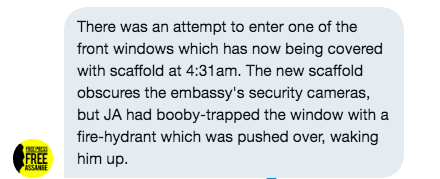
On the 29th of October, at 4:31am Julian Assange awoke to yet another nightmare of his own: a second attempted break-in at the Ecuadorian Embassy in London.

As his legal team confirmed to me:


The timing of the attempted breach was not insignificant. It was the early hours of the very day he was due to testify in Court in Ecuador by teleconference. A testimony that then was then plagued by constant technical interference, preventing Julian from fully imparting to the judge the extent of the human rights violations that he is being subjected to.

This confirmation by Julian’s legal team that a break-in occurred is a very big deal. But not the last alarming development to be revealed this week.

One would think, that after such an event as an attempted break-in, the Ecuadorian Embassy would have gone on high alert. Extra security might be called in. Every possible consideration would be made to secure the premises, surely.

To the contrary, as Yale University’s Sean O’Brien discovered, and thoroughly documented, that very same day – the Embassy was left quite literally wide open.

Julian Assange has been made a sitting duck.

A Lecturer in Law at Yale Law School, Sean O’Brien is a cybersecurity, privacy and forensics expert. He is the Assistant Director for Technology at Yale Office of International Students & Scholars and founded the Yale Privacy Lab.

I asked him to record his experiences himself, in first person, so that we can retrospectively walk with him through his visit to the Embassy last Monday. Sean’s story is below.

Sean’s Testimony – by Sean O’Brien


I arrived in London last week for Mozilla Festival, to present Yale Privacy Lab’s work on profiles of mobile app trackers. Mozfest was an amazing conference, but I didn’t get a chance to see the famous buildings and monuments in the city until Monday, Oct. 29, the day I was leaving Britain. I decided to walk toward the Thames from my hotel room in Soho.

In front of Parliament were a group of activists singing “We’re not gonna Brexit!” to the tune of Twisted Sister’s “We’re Not Gonna Take It”. I walked up to a member of the group and asked for directions to the Ecuadorean embassy. “Going to visit Julian are ya?” she said, as she directed me to Knightsbridge and the famous Harrod’s department store. “I probably won’t be able to get past the sidewalk,” I replied back. I was quite wrong.

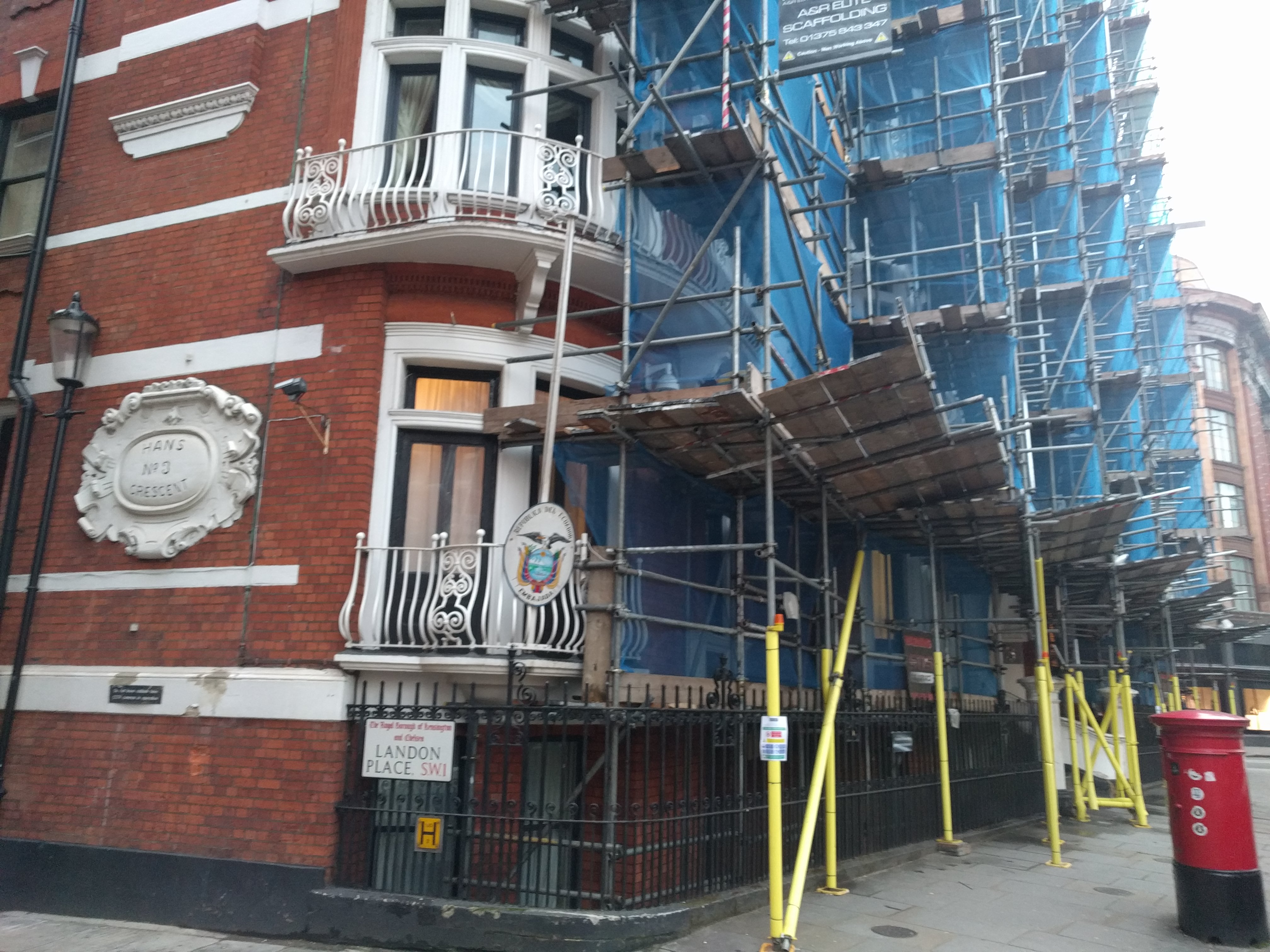
Prior to my visit, I couldn’t find any information online about visiting the Ecuadorean embassy. I had read that a strict new protocol had been put in place, so I expected high security and police. When I arrived at No. 3 Hans Crescent, however, I was met with absolutely no security.

There were no vehicles parked outside, no people on the sidewalk out front; nothing that would give a hint that a political prisoner, the world-famous Julian Assange of Wikileaks, was inside. I actually walked past the embassy more than once, thinking that perhaps my eyes were deceiving me and I had the wrong building.

Even more shocking: the door was wide open.

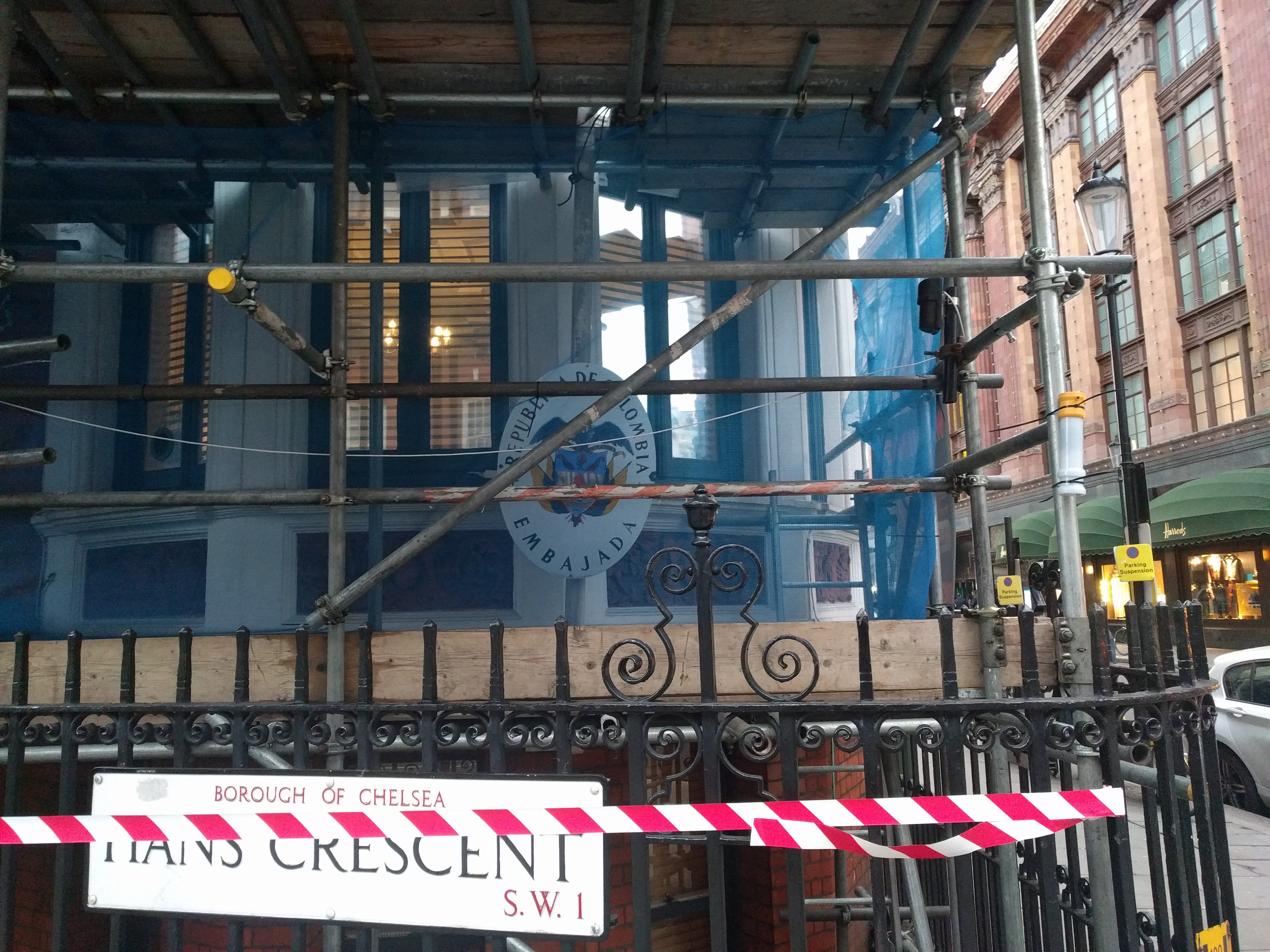
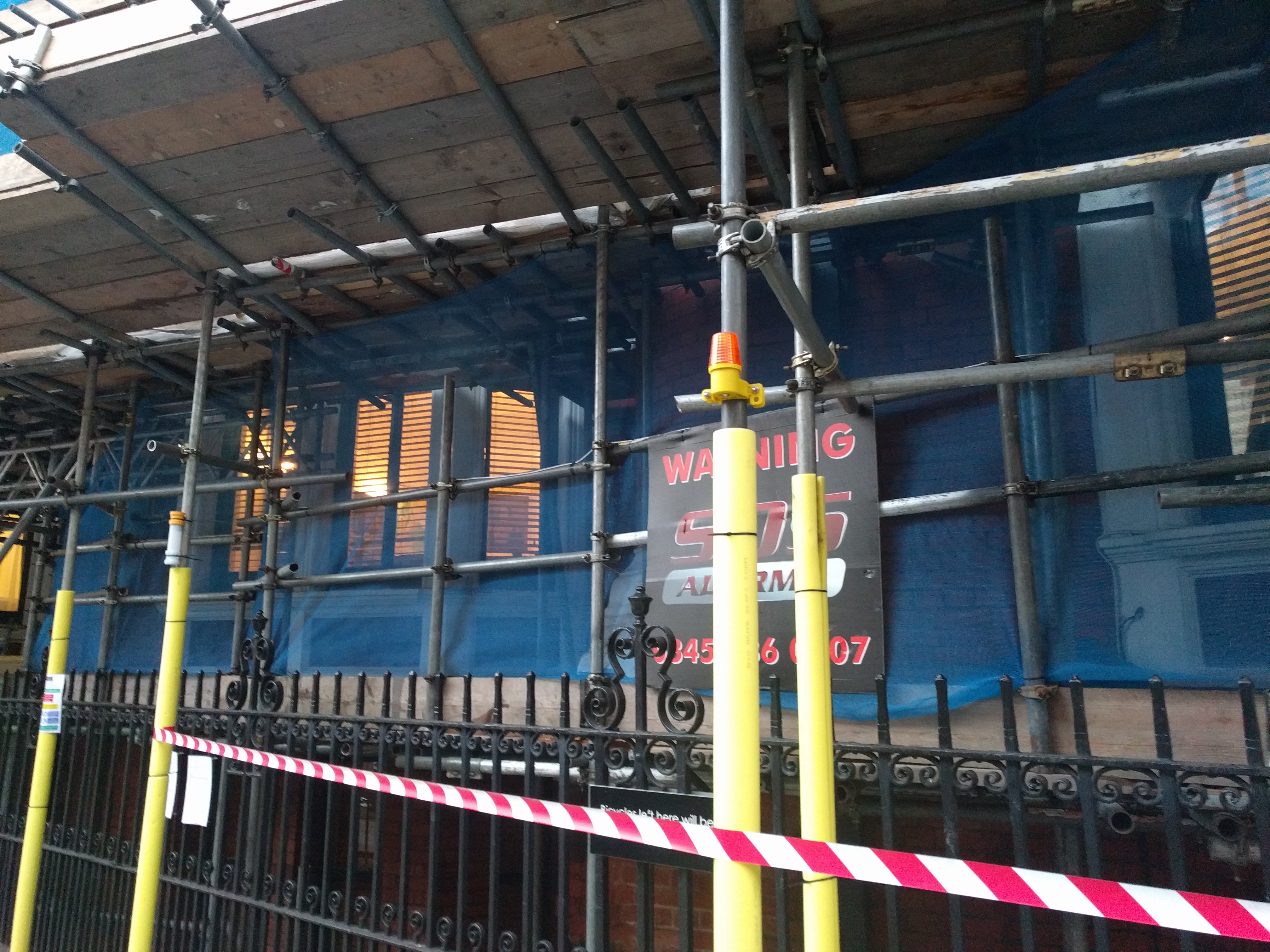
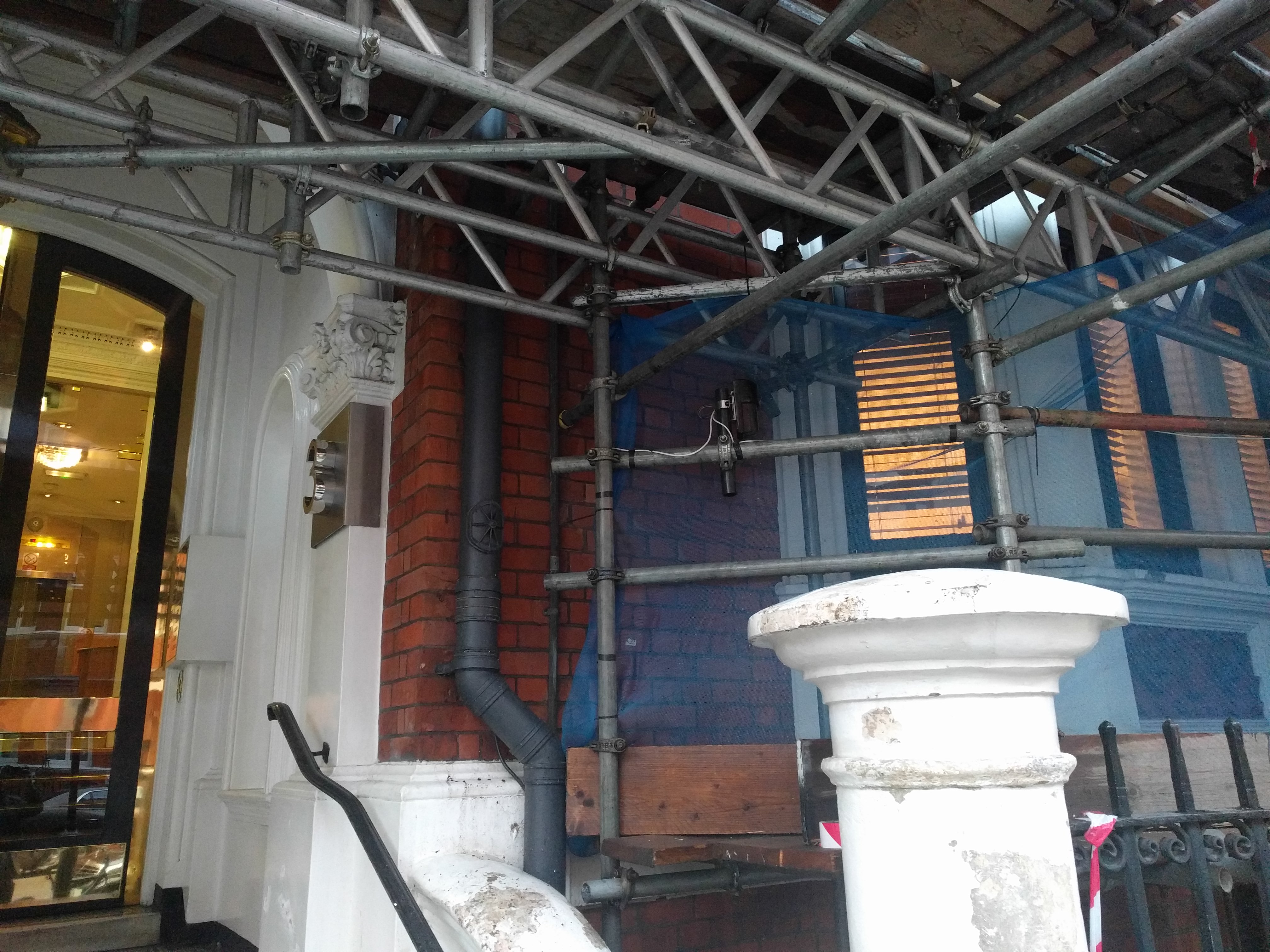
There was scaffolding around three quarters of the embassy and the flats above, and men in uniforms with bright yellow vests were walking across, seemingly washing the windows. The scaffolding stopped about halfway across the balcony I’d seen Julian standing on at press conferences, before he was banned from facing the public, sunlight, and the open air.

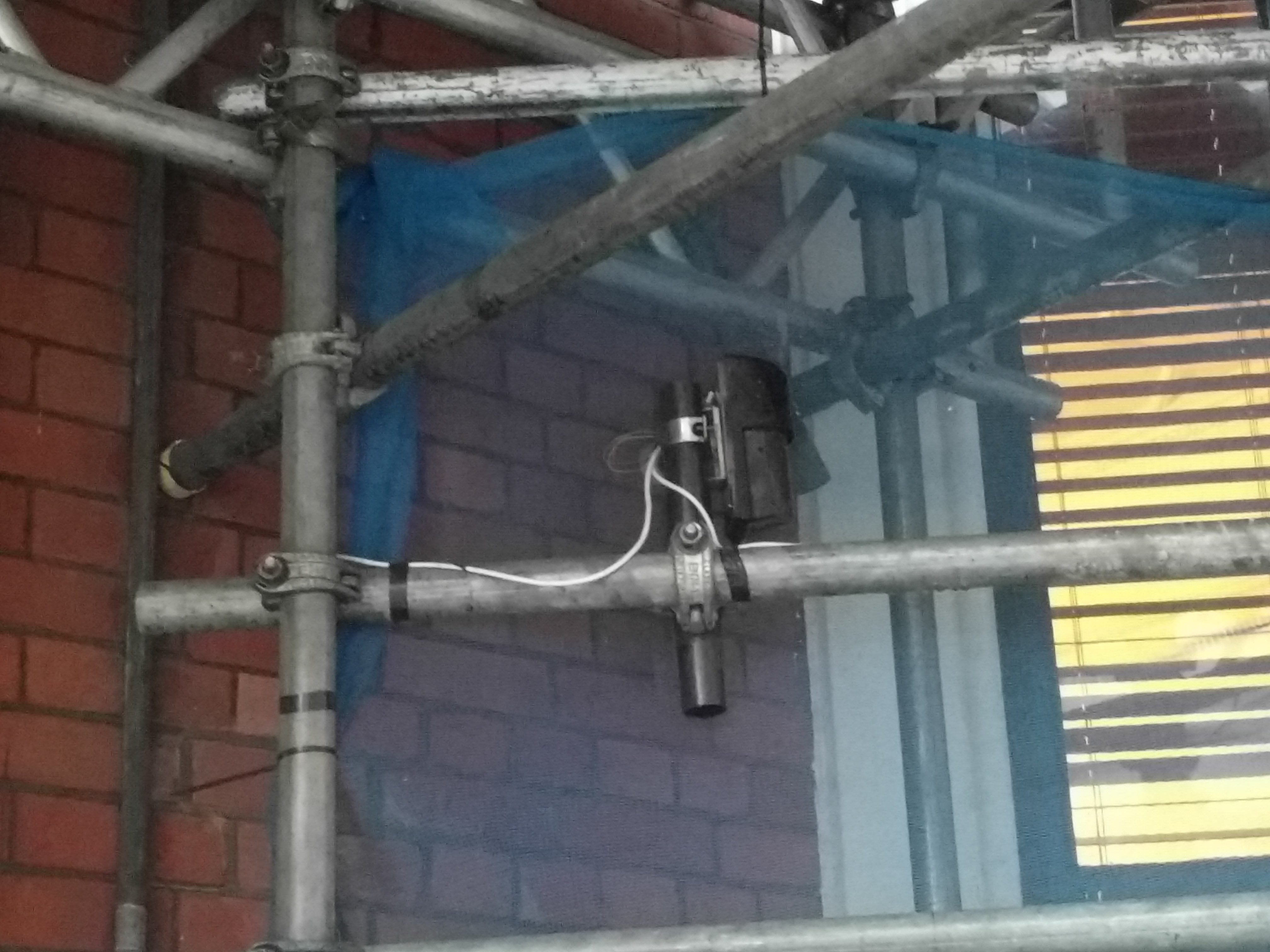
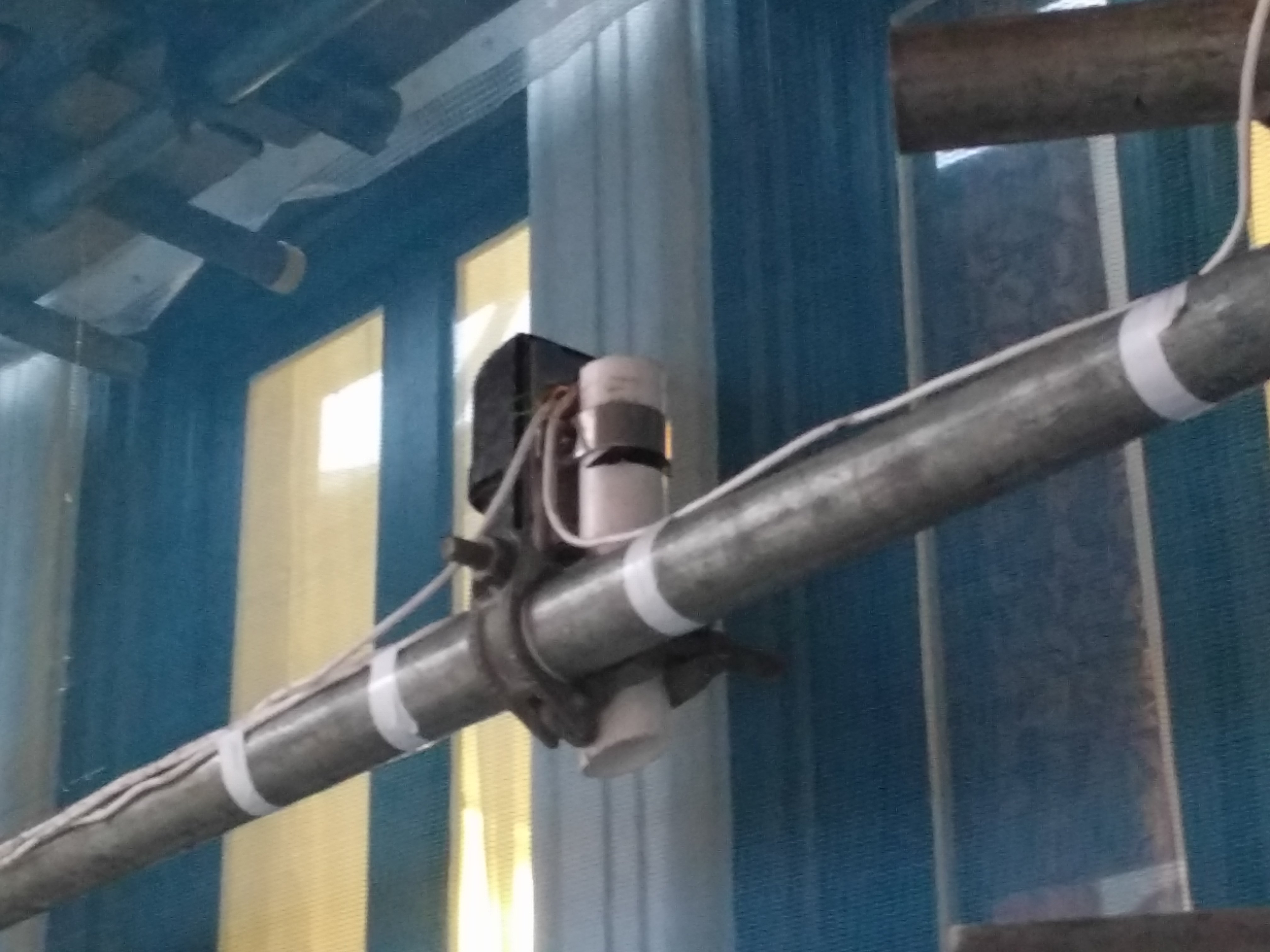
Near the crest in these photos, you can see what looks like a microphone bolted to a pipe, attached to the scaffolding and with a white wire running across. I didn’t think much of it until later, worried instead about entering the embassy building as politely and professionally as possible.

As it turns out, I didn’t need to worry. I walked up the steps, past the “Wet Floor” sign, into the open door, pulled the next door open, and entered a completely empty lobby. On the left was the door to the Ecuadorean embassy, and on my right was the Colombian embassy with a desk in front and no one manning it.

I stood and waited for someone to come and greet me, seeing that I was on camera in what should be a high-security area, before I realized no one was coming. I pressed an intercom button at the Ecuadorean door, and spoke to a man briefly who did, eventually, open the embassy door and step out.

The man advised me that there was a strict protocol for visiting Mr. Assange and grabbed a piece of scrap paper, writing a long e-mail address on the back. I needed to e-mail and request an appointment, I was told, and Mr. Assange would of course have to approve. Taking the paper, I hurried across the street to Harrod’s, where I knew there would be open wifi, e-mailing as soon as I could. 

Almost immediately, I received a bounce-back message that the e-mail address didn’t exist. I tried another spelling. Another bounceback. I entered the open door of No. 3 Hans Crescent again, ringing the bell. This time, a woman answered, opened the embassy door, and gave me another scrap paper with an address. This one I could read correctly: eecugranbretania@cancilleria.gob.ec


Once again, I hurried over to Harrod’s wifi and e-mailed. No bounceback. I waited a few minutes, walked back into the embassy, rang the bell again, and asked the same woman if the embassy had received my e-mail. She could not check, she said. Now I was getting on their nerves.

I decided to wait for a few hours and see if the e-mail came in, grabbing dinner around the corner. No reply came in.

I walked back into the open embassy building, and there were now two men and the Colombian embassy desk. I rang the Ecuadorean bell, spoke to the woman one last time, who repeated that they couldn’t check for receipt of my e-mail. Obviously, I wouldn’t be visiting Julian.

I stepped outside once more. There were men walking back and forth who seemed to take notice of me. One man , dressed like a stereotypical “man in black”, tried to look intimidating. He leaned on a black car and glared at me.

On each walk to and from the building that afternoon, I had begun to notice more and more scaffolding going up and more and more devices tied to the structure. Now that I knew I wasn’t going to get an audience at the embassy, I didn’t need to be polite. With what looked like plainclothes officer watching me, I walked around and took these photos.

This is the scaffolding where it ended on the Colombian side of the embassy, to the right of the Ecuadorean embassy. Notice what looks like a speaker/microphone on the right-hand side.


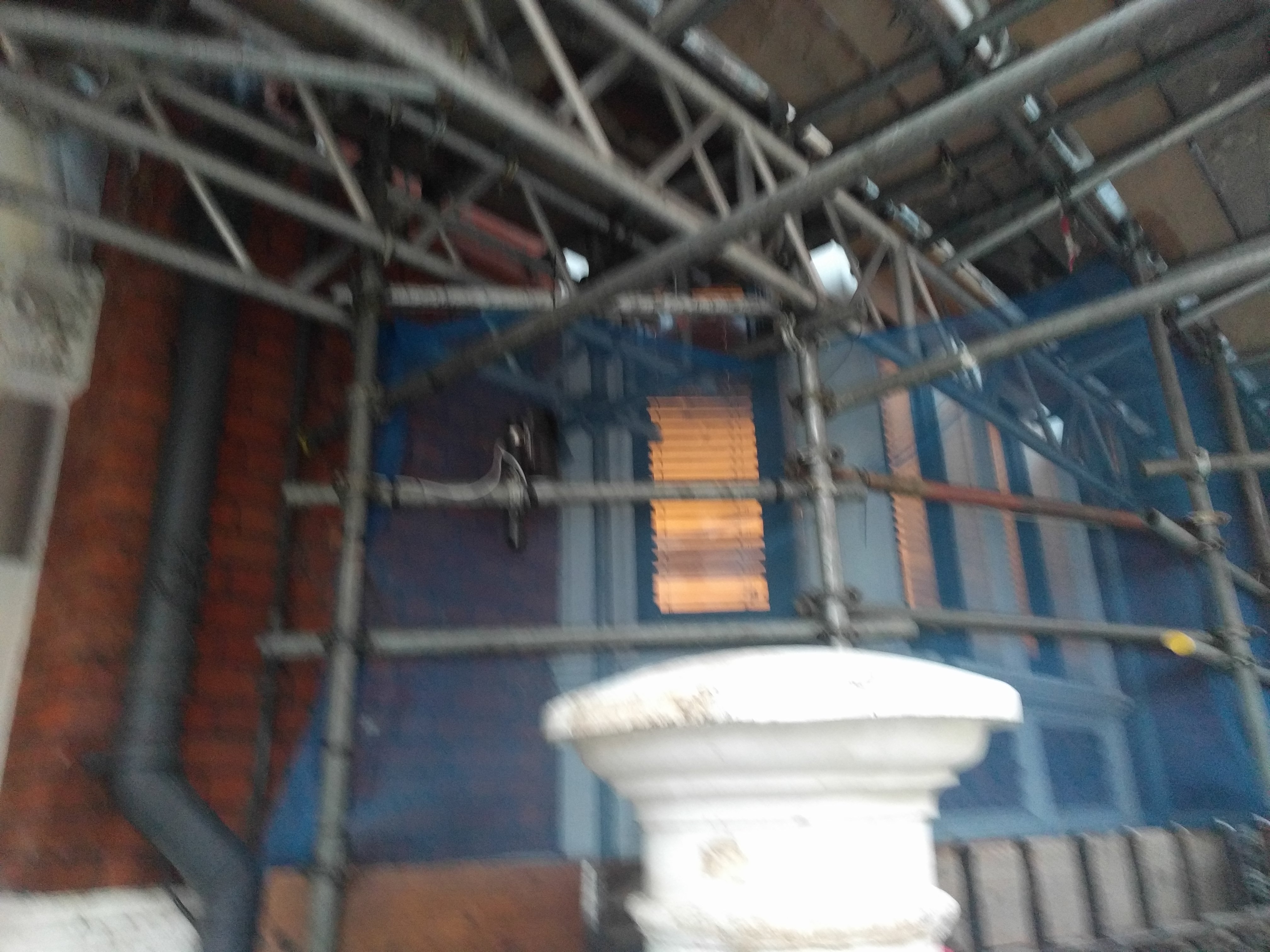
More photos of the same area. Notice the black devices, affixed to pipes, with wires coming from them. I’ve never seen devices quite like this, and I take photos of surveillance equipment often.


There were curious plastic tubes with yellow-orange caps, zip-tied to the front. I have no idea what these are but they seem to have equipment inside them; see the black shadow under the caps.


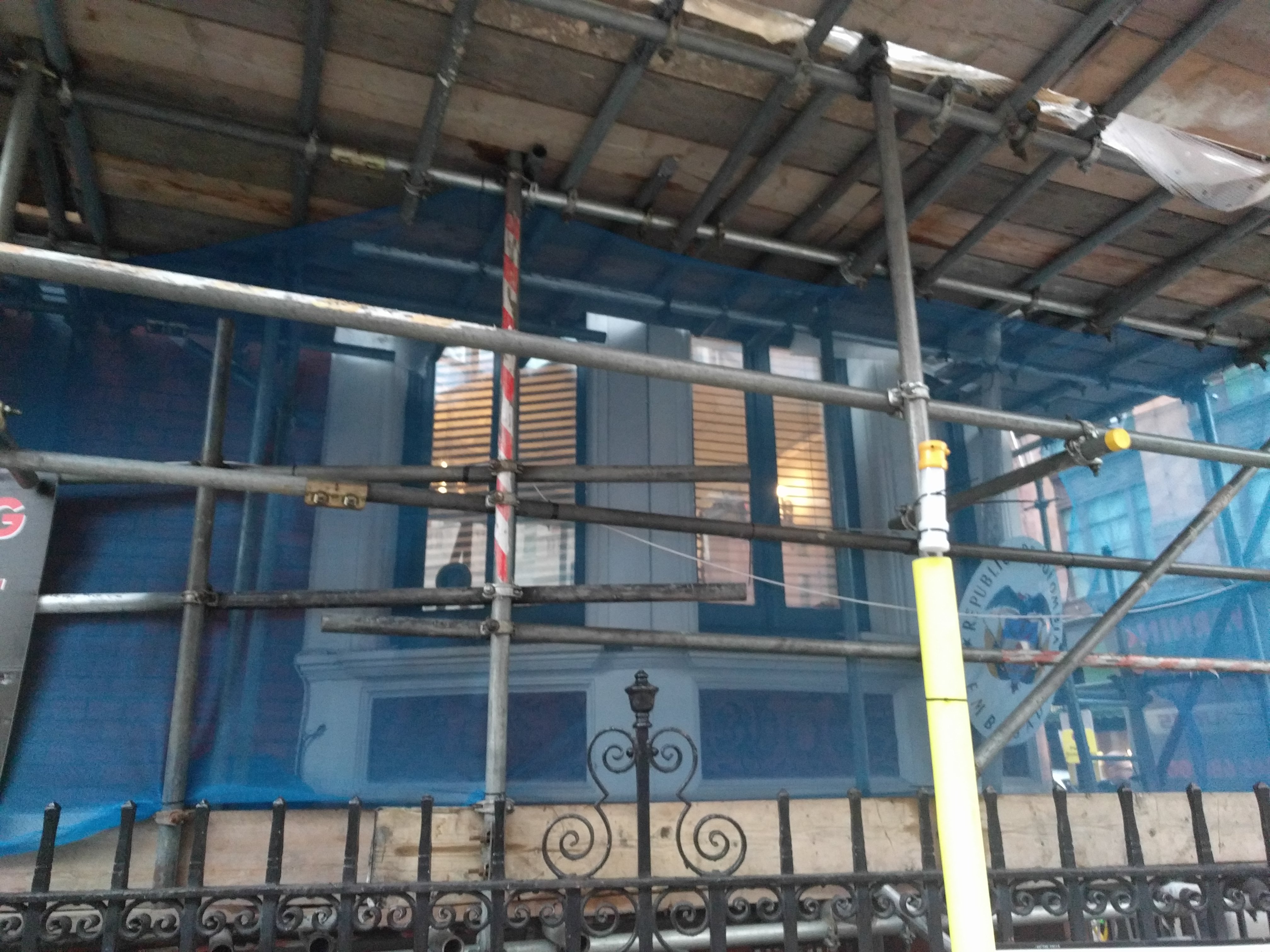
Another shot of the Ecuadorean side of the building, where the scaffolding stops abruptly at the balcony. Notice the embassy security is actually obstructed by the scaffolding: a camera dome affixed to the embassy is completely blocked.


Just outside the Ecuadorean windows, a hexagonal device that appears to be a wireless router. All cables lead to this, and an LED light was blinking green in the center of the black cap on the bottom.


Photos of devices outside the Ecuadorean windows. The devices are clearly pointing inward, not out toward the sidewalk, with wires neatly taped to the piping and leading toward the central, hexagonal device.


After these final shots, I walked back and forth across the sidewalk and peered into the Ecuadorean embassy. With the sun going down, it was obvious all the lights inside were on and the blinds were wide open. To say the whole experience was strange is a severe understatement, in light of Julian’s recent treatment.

Escalations


Sean’s above testimony is vital, as is his expertise and the information he gathered at the Embassy.

Close study of the surveillance devices in the photos reveals no manufacturer branding, serial numbers or visible device information. The metal piping used to secure them appears to have been cut by hand.

The combination of the obscuring of the street-facing surveillance cameras and the installation of surveillance equipment pointed into instead of away from the Embassy, is alarming. Whoever placed the equipment there appears to be focused on gaining the ability to hear and see what happens inside the open blinds, rather than monitoring the foot and street traffic outside the Embassy.

It would be impossible for such surveillance equipment to be installed against the wall of the Embassy without the knowledge of the Ecuadorian government. Ergo, it must have been done, or allowed to remain, with their cooperation.

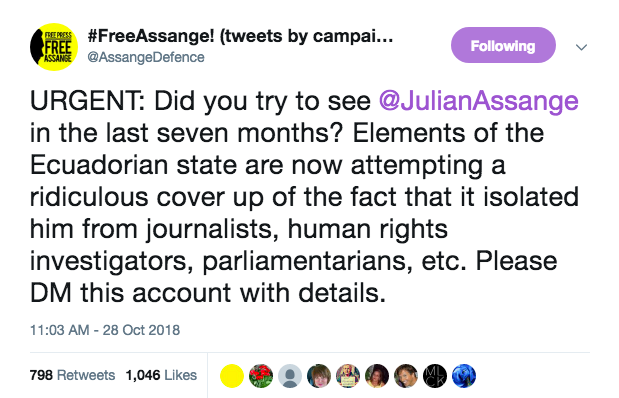
WikiLeaks has confirmed that Assange has had no visitors, and his legal team have been publicly calling for anyone who has been turned away to step forward.


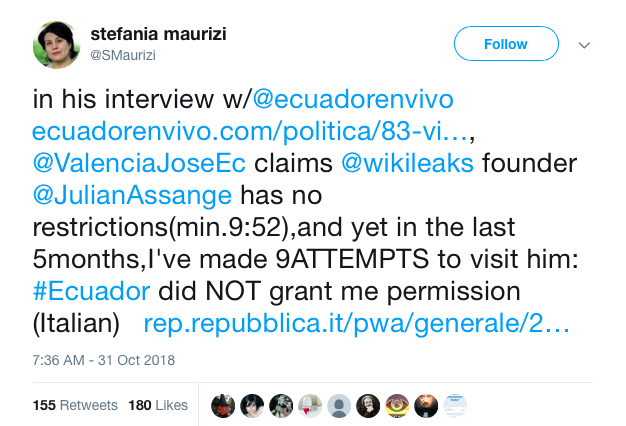
The long-time WikiLeaks media partner Italian journalist Stefania Maurizi complained of repeated denials of entry.


Until late 2015 there were uniformed officers from Scotland Yard at the door at all times.Previous visitors to the Embassy have told me of their experiences. They describe closed and locked doors. Security guards manning the desk at all times.

Privacy drapes, dark rooms with shuttered blinds.

For such a reversal of position to have occurred, there is only one conclusion: the Ecuadorian Embassy is open for business. Wide open.

But not to Julian Assange’s legal team.

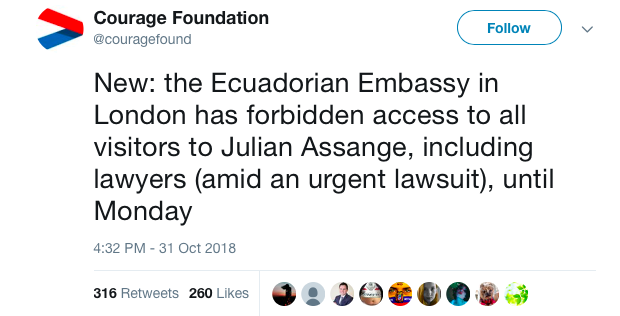
Perhaps the most alarming development of all came on Thursday: even the only people who had been able to visit Julian Assange, have now also been barred.


Once again, I am reminded of Occupy. Immediately prior to the simultaneous raids of the four Occupations in my home city of Auckland, and the mass arrests of media and protesters, malicious actors intervened to deny us access to warnings and advice from our legal counsel.

Is the Embassy being staged for an overt – or covert – raid on Julian? Is this why access to his closest advisors has been stripped from him?

Do Ecuador, the US and the UK hope to use the cover of the midterms, or of the Christmas season, to expedite the illegal handover of Assange?

An update from the Ecuadorian side is expected on Monday. Though you could probably put more stock in a chicken soup than in what they have to say, given the double play at hand.

For as Julian is isolated even further than before, the world’s media are being fed lies.

Establishment media across the world are leading people to believe that Julian has had his right to communication restored and that he is able to receive visitors. This couldn’t be further from the truth.

While Ecuador stated in court that their oppressive new protocols for reestablishing Julian’s rights to communication and visitation were effective as of the 5th of October, I have been unable to confirm that anyone close to Julian has heard from him at all, with the exception of his lawyers.

The protocols Ecuador was referring to, which establishment media are hyping as being about cat food and personal hygiene, in fact outrageously include the collection of IMEI/serial numbers for the devices of visitors and social media account information.

The conditions state outright that Ecuador reserves the right to supply UK security agencies with that information. This makes any visitor to Julian not only an intelligence target of those supposedly providing him safe harbour, but of those whom he was granted asylum to protect him from.

It is astounding to think Ecuador may be collaborating with Julian’s persecutors to surveil both the outside and the inside of the Embassy. Especially the UK is in breach of multiple UN decisions that it must allow Julian Assange safe passage to Ecuador, and compensate him.

Christine Assange will today wake to the same terrifying nightmare as she did yesterday, and several thousand days before. Except today she has some solace in knowing that people of conscience are rallying to intervene on her son’s behalf, and to protect him.

At 3pm Eastern Time on Saturday November 3rd (Midday Pacific) a group of Julian’s most high profile supporters will gather to discuss these issues and detail an immediate action plan, at an emergency online web conference to be broadcast by livestream. The meeting will include an exclusive statement from Christine Assange, as well as live testimony from Sean O’Brien about his visit to the Embassy and his findings.

The Unity4J movement started by internet entrepreneur Kim Dotcom, ex CIA analyst Ray McGovern, CIA Torture whistleblower John Kiriakou, journalists like Elizabeth Lea Vos, myself and many others has now blossomed to over 3,000 members. We are in a much better position to respond to these urgent developments than the last time Julian was reported to be moments from being seized. Together we can and will work to rebalance the scales of justice in his favour.

For as Newton discovered – every force has an equal and opposite reaction. If the US, UK and/or Ecuador think they can continue to mistreat Julian without experiencing blowback of epic proportions, they are mistaken.

The Unity4J emergency meeting will be broadcast live on the Unity4J website and at Consortium News. Please join us and help spread the word by sharing the event press release and urging others to attend too.

Author’s note: An abridged version of this article has been provided exclusively to Consortium News.

Written by Suzie Dawson

Twitter: @Suzi3D

Official Website: Suzi3d.com

Journalists who write truth pay a high price to do so. If you respect and value this work, please consider supporting Suzie’s efforts via donation. To support the incredible work that WikiLeaks does please donate to WikiLeaks here. To contribute to Julian Assange’s legal defence fund click here. Or donate to help the Courage Foundation save the lives of whistleblowers. Thank you!

'The Lobby' Proves Foreign Power Manipulating American Democracy

Watch the film the Israel lobby didn’t want you to see

by The Electronic Intifada 


2 November 2018 

The Electronic Intifada has obtained a complete copy of The Lobby – USA, a four-part undercover investigation by Al Jazeera into Israel’s covert influence campaign in the United States.

It is today publishing the first two episodes. The Paris-based Orient XXI has published the same episodes with French subtitles.

The film was made by Al Jazeera during 2016 and was completed in October 2017.

But it was censored after Qatar, the gas-rich Gulf emirate that funds Al Jazeera, came under intense Israel lobby pressure not to air the film.

Although Al Jazeera’s director-general claimed last month that there were outstanding legal issues with the film, his assertions have been flatly contradicted by his own journalists.

In March, The Electronic Intifada was the first to report on any of the film’s specific content. We followed this in August by publishing the first extract of the film, and shortly after Max Blumenthal at the Grayzone Project released others.

Since then, The Electronic Intifada has released three other extracts, and several other journalists have watched the entire film and written about it – including Alain Gresh and Antony Loewenstein.

Now The Electronic Intifada can reveal for the first time that it has obtained all four parts of the film.

[Watch the first two parts in the video embeds at EI.]


To get unprecedented access to the Israel lobby’s inner workings, undercover reporter “Tony” posed as a pro-Israel volunteer in Washington.

The resulting film exposes the efforts of Israel and its lobbyists to spy on, smear and intimidate US citizens who support Palestinian human rights, especially BDS – the boycott, divestment and sanctions movement.

It shows that Israel’s semi-covert black-ops government agency, the Ministry of Strategic Affairs, is operating this effort in collusion with an extensive network of US-based organizations.

These include the Israel on Campus Coalition, The Israel Project and the Foundation for Defense of Democracies.

Censored by Qatar


The film was suppressed after the government of Qatar came under intense pressure not to release it – ironically from the very same lobby whose influence and antics the film exposes.

Clayton Swisher, Al Jazeera’s head of investigations, revealed in an article for The Forward in March that Al Jazeera had sent more than 70 letters to individuals and organizations who appear in or are discussed in the film, providing them with an opportunity to respond.

Only three did so. Instead, pro-Israel groups have endeavored to suppress the film that exposes the lobby’s activities.

In April, Al Jazeera’s management was forced to deny a claim by the hard-right Zionist Organization of America that the film had been canceled altogether.

In June, The Electronic Intifada learned that a high level source in Doha had said the film’s indefinite delay was due to “national security” concerns of the Qatari government.
Covert action

As revealed in a clip published by The Electronic Intifada earlier this week, the film shows Julia Reifkind – then an Israeli embassy employee – describing her typical work day as “mainly gathering intel, reporting back to Israel … to report back to the Ministry of Foreign Affairs, the Ministry of Strategic Affairs.”

She discusses the Israeli government “giving our support” to front groups “in that behind-the-scenes way.”

Reifkind also admits to using fake Facebook profiles to infiltrate the circles of Palestine solidarity activists on campus.

The film also reveals that US-based groups coordinate their efforts directly with the Israeli government, particularly its Ministry of Strategic Affairs.

Run by a former military intelligence officer, the ministry is in charge of Israel’s global campaign of covert sabotage targeting the BDS movement.

The film shows footage of the very same ex-military intelligence officer, Sima Vaknin-Gil, claiming to have mapped Palestinian rights activism “globally. Not just the United States, not just campuses, but campuses and intersectionality and labor unions and churches.”

She promises to use this data for “offense activity” against Palestine activists.

Jacob Baime, executive director of the Israel on Campus Coalition, claims in the undercover footage that his organization uses “corporate level, enterprise-grade social media intelligence software” to gather lists of Palestine-related student events on campus, “generally within about 30 seconds or less” of them being posted online.

Baime also admits on hidden camera that his group “coordinates” with the Israeli Ministry of Strategic Affairs.

Baime states that his researchers “issue early warning alerts to our partners” – including Israeli ministries.

Baime’s colleague Ian Hersh admits in the film to adding Israel’s “Ministry of Strategic Affairs to our operations and intelligence brief.”

“Psychological warfare”


Baime describes how his group has used anonymous websites to target activists.


“With the anti-Israel people, what’s most effective, what we’ve found at least in the last year, is you do the opposition research, put up some anonymous website, and then put up targeted Facebook ads,” Baime explains in part three of the film.

“Canary Mission is a good example,” he states. “It’s psychological warfare.”

The film names, for the first time, convicted tax evader Adam Milstein as the multimillionaire funder and mastermind of Canary Mission – an anonymous smear site targeting student activists.

The Electronic Intifada revealed this in a clip in August.

Eric Gallagher, then fundraising director for The Israel Project, is seen in the undercover footage admitting that “Adam Milstein, he’s the guy who funds” Canary Mission.

Milstein also funds The Israel Project, Gallagher states.

Gallagher says that when he was working for AIPAC, Washington’s most powerful Israel lobby group, “I was literally emailing back and forth with [Adam Milstein] while he was in jail.”

Despite not replying to Al Jazeera’s request for comment, Milstein denied that he and his family foundation “are funders of Canary Mission” on the same day The Electronic Intifada published the clip.

Since then, Josh Nathan-Kazis of The Forward has identified several other groups in the US who fund Canary Mission.

Suppressed film


In March, The Electronic Intifada published the first details of what is in the film.

We reported that it showed Sima Vaknin-Gil claiming to have leading neoconservative think tank the Foundation for Defense of Democracies working for her ministry.

The undercover footage shows Vaknin-Gil claiming that “We have FDD. We have others working on” projects including “data gathering, information analysis, working on activist organizations, money trail. This is something that only a country, with its resources, can do the best.”

As noted in part one of the documentary, the existence of the film and the identity of the undercover reporter became known after footage he had shot for it was used in Al Jazeera’s The Lobby – about Israel’s covert influence campaign in the UK – aired in early 2017.

Since then, Israel lobbyists have heavily pressured Qatar to prevent the US film from airing.

“Foreign agent”


Clayton Swisher, Al Jazeera’s head of investigations, first confirmed in October 2017 that the network had run an undercover reporter in the US Israel lobby at the same time as in the UK.

Swisher promised the film would be released “very soon,” but it never came out.

Multiple Israel lobby sources told Israel’s Haaretz newspaper in February that they had received assurances from Qatari leaders late last year that the documentary would not be aired.

Qatar denied this, but the paper stood by its story.

Swisher’s op-ed in The Forward was his first public comment on the matter since he had announced the documentary.

In it, he refutes Israel lobby allegations about the film and expresses frustration that Al Jazeera had not aired it, apparently due to outside pressure.

Several pro-Israel lawmakers in Washington have piled on more pressure by pushing the Department of Justice to force Al Jazeera to register as a “foreign agent” under a counterespionage law dating from the 1930s.

The Israel lobby goes to Doha


While the film was delayed, a wave of prominent pro-Israel figures visited Qatar at the invitation of its ruler, Emir Tamim bin Hamad Al Thani.

They have included some of the most right-wing and extreme figures among Israel’s defenders in the US, such as Harvard law professor Alan Dershowitz and Morton Klein, the head of the Zionist Organization of America.

Swisher wrote in The Forward that he ran into Dershowitz at a Doha restaurant during one of these visits, and invited the professor to a private viewing of the film.

“I have no problem with any of the secret filming,” Swisher says Dershowitz told him afterwards. “And I can even see this being broadcast on PBS” – the US public broadcaster.

Yet it appears that Israel lobby efforts to quash the film were successful – until now.