Wednesday, March 13, 2019

Grief and Hope Alive and Well in Palestine

Grief and Hope Alive and Well in Palestine

by Mazin Qumsiyeh - palestinenature.org


March 13, 2019

Divina Levrini died last week; she was a friend and fellow traveler on the freedom flotilla. We are struck with grief. We will plant a tree in her name in our botanical garden [1].

Like our friend Reem Al-Banna she was a freedom singer who died young.

Israel high court ruled with government to block release of archives that expose Israel's role in the genocide in Bosnia.

In a separate ruling the high court rejected human righs groups petition to make it illegal for Israeli soldiers to shoot unarmed civilians.


...Meanwhile Israeli Prime Minister Netanyahu (originally Miliekowsky) [2] responded to an Instagram message that suggested Arabs are part of Israeli society by saying that Israel is not a state of its citizens but it is a Jewish state!

He is right; and to confirm the point, Israel election committee ruled against allowing the United Arab party to run in Knesset elections but allowed the terrorist Kahanists Jewish (ultra-right fascists) to run.

While there is significant pressure on many western politicians who dare to criticize Israeli apartheid policies, this is backfiring [3] and the delusions about our part of the world are dissipating. Empires do fall!

The world population is waking up: in France with the Yellow Vests, Haiti, Venezuela, Yemen, Palestine and elsewhere. Hundreds of thousands protested in Yemen after seeing the stooge, self-declared Yemeni "foreign minister" (Saudi appointed and living there) seated between Netranyahu and Pompeo at the failed conference organized by a failing US administration to create yet another war for oil and for Israel (this time on Iran)!

There will be other repercussions including bringing governments like China, Russia, Iran, Yemen, Syria, and Venezuela together against imperialism and Zionist colonialism. Soon other countries will follow (maybe even Britain and other European countries). Those who have bet on the maintenance of the US as a world imperial power (albeit guided in its foreign policy from Tel-Aviv) are beginning to realize they have bet on the wrong horse (even some Palestinian leaders). We must draw the right lessons but then also act responsibly.

We at Palestinian universities are under pressure.[4] We at the Palestine Institute for Biodiversity and Sustainability are grateful for the incredible support we are getting from so many people (volunteering, donating, collaborating).

We are rising to the challenge:

1) We work with hundreds of school children for empowerment.

2) We work with university students on areas like research (e.g. theses), education, and empowerment.

3) We are supporting 80 farmer families in areas of organic and ecological agriculture and we are working with local communities on resilience through ecotourism, agricultural, and cultural tourism.

4) We have dozens of collaborations around the world and we just hosted a workshop for 15 faculty from University of Notre Dame and another 20 Palestinians from various universities to expand collaborations.

5) We submit research papers almost weekly and two papers just got accepted (one is our first paper on fossils).

6) On Women's Day March 8, we took 65 people (mostly young women) on a hike through a world heritage site and they learned from women of Battir lots of information on cultural heritage, resilience, and more.

7) We have many international volunteers (this week from Ireland, UK, US, Israel) and continue building and growing our infrastructure of museum and garden (palestinenature.org).

8) We will soon open the exhibit on ethnography (connecting people and the land) and will launch a database of Palestinian cultural heritage (tangible like old agricultural tools and intangible like knowledge of medicinal plants, proverbs etc). 

Thus, stay tuned, continue to think globally but ACT LOCALLY. For daily postings of activities and action calls, visit our facebook page:
https://www.facebook.com/Palestine-Museum-of-Natural-History-1454309858180882/

Notes:
[1] https://kiaoragaza.wordpress.com/2019/03/09/the-world-has-lost-a-beautiful-soul/
https://jfp.freedomflotilla.org/participants/remembering-divina-levrini-shipmates-friends

[2] Here is a video of him thinking the camera was off explaining his true contributions during his first stint as Israeli prime minister in the 1990s https://youtu.be/JrtuBas3Ipw.
[3] The shameful attack that backfired https://lobelog.com/the-shameful-attack-that-backfired/ see also this video https://youtu.be/6kOtbJ33Y-8  Israel’s Stranglehold on American Politics By Chris Hedges. - http://www.informationclearinghouse.info/51255.htm
Israeli journalist Gideon Levy says: "What, after all, has Omar said? That pro-Israel activists demand “allegiance to a foreign country”; that U.S. politicians support Israel because of money they receive from the pro-Israel lobby group AIPAC, and that “Israel hypnotized the world.” What is incorrect in these statements? Why is describing reality considered anti-Semitic?"
[4] Palestinian universities on the front line by Sam Bahour
http://epalestine.blogspot.com/2016/10/palestinian-universities-on-frontline.html

Stay Human and come visit us in Palestine


Mazin Qumsiyeh
A bedouin in cyberspace, a villager at home
Professor, Founder, and (volunteer) Director
Palestine Museum of Natural History
Palestine Institute of Biodiversity and Sustainability
Bethlehem University
Occupied Palestine
http://qumsiyeh.org
http://palestinenature.org
facebook pages
Personal https://www.facebook.com/mazin.qumsiyeh.9
Museum
https://www.facebook.com/Palestine-Museum-of-Natural-History-1454309858180882/

Tuesday, March 12, 2019

Remembering Friends and Environmental Heroes Lost on Flight 302

Remembering the Victims of Flight 302

by Catherine Abreu - Climate Action Network Canada


March 12, 2019

Friends; early Sunday morning, Ethiopian Airlines flight 302 crashed 6 minutes after takeoff. All 157 passengers and crew on board died. These kinds of tragedies are always heartbreaking. Yet in the past 48 hours, it has been particularly devastating to learn that many of those who perished were our colleagues and friends: courageous activists, academics, and young people dedicated to the fight for justice and environmental protection who were on their way to the United Nations Environment Assembly taking place in Nairobi this week.

My heart is heavy thinking of all the families and communities who lost people they love, people tirelessly offering their energy and passion to protect our futures.

18 of the victims were Canadian. Some of them were my friends. Some of them were allies I never had the opportunity to meet, but whose names and work were familiar to many of us in this small and mighty movement we share.

Darcy Belanger, co-founder of Parvati.org, was genuinely one of the kindest, most inspiring people I’ve had the privilege to know in this work. In just a few short years, he and his colleagues - all employed full-time in other fields and working with Parvati on a volunteer-basis - have made the campaign to establish the Marine Arctic Peace Sanctuary (MAPS) a global phenomenon.

This morning I am remembering the last time I got to hang out with Darcy at COP24 in Poland. I was demoralized by the negotiations but with his usual bright, relentless determination, he cheered me up by sharing stories of the amazing wins he and his colleague Vandana had made on the MAPS campaign in Katowice. Darcy was exactly the kind of compassionate leader our movement needs and cannot afford to lose.

I met Stephanie Lacroix through her work with the United Nations Association in Canada (UNAC). Stephanie worked with her UNAC colleagues to develop the resources and capacity necessary to bring delegations of young environmental leaders like herself to UN conferences.

Having spent the last few years attending such conferences myself, I know that the youth who attend are often the most fierce force demanding ambition and progress from processes that can be crushingly incremental and marginalizing.

Again, I am reflecting on my most recent memories of Stephanie at COP24, where she and all the Canadian youth on the ground offered so much of themselves in a constant, awe-inspiring call for inclusion and action.

Stephanie was on her way to Nairobi with three other young people.

It seems that there’s no social justice cause Danielle Moore did not devote her amazing spirit to. I am thankful I met her in Halifax, where she volunteered on a number of environmental campaigns while completing her degree at Dal. I’m thinking about friends on the east coast who knew her, and in Winnipeg where she worked with our colleagues at the Manitoba Energy Justice Coalition (MEJC), along with so many others tackling important causes.

Indigenous youth are the heart of so many creative, challenging, uncompromising campaigns working to confront the destruction wrecked by colonist capitalism in Canada and around the world. I honour Micah Messent, a student at Vancouver Island University (VIU), for his work and his generosity.

Angela Rehhorn devoted herself to conservation, working with the Canadian Wildlife Federation (CWF). I am thinking of Angela’s friends in Halifax, Ontario, and Alberta.

The loss of these four people who were part of building the next generation of environmental justice activists in Canada stops my heart.

Our thoughts also go out to many of our colleagues who work in the fields of humanitarian justice and international development who are mourning the loss of Pius Adesanmi, literature professor and director of the Institute of African Studies at Carleton University. I wish I had gotten to know someone so clearly brilliant and committed.

I can only speak for myself, but I know that the whole CAN-Rac team is grieving this profound loss. The light that pierces through our sadness is the knowledge that, had they had the chance, every one of these beautiful humans would have told us that the best way to celebrate them is to hold their memory close as we forge ahead in our collective resolve to bring us into closer harmony with each other and with the non-human world.

Yours in love and grief,

Cat


Catherine Abreu, Executive Director
Climate Action Network Canada - Réseau action climat Canada
Twitter: @cat_abreu

Pushing String: Limp Palestine Leadership Reaction to Trump 'Deal of the Century'

Chasing Mirages: What Are Palestinians Doing to Combat the ‘Deal of the Century’?

by Ramzy Baroud - Palestine Chronicle


March 12, 2019

More US measures have been taken in recent weeks to further cement the Israeli position and isolate the Palestinian Authority (PA), before the official unveiling of President Donald Trump’s so-called ‘deal of the century’. But while attention is focused on spiteful US actions, little time has been spent discussing the PA’s own responses, options and strategies.

The last of Washington’s punitive measures came on March 3, when the US shut down its Consulate in Jerusalem, thus downgrading the status of its diplomatic mission in Palestine. The Consulate has long served as a de-facto American embassy to the Palestinians.

Now, the Consulate’s staff will merge into the US embassy in Israel, which was officially moved to Jerusalem last May - in violation of international consensus regarding the status of the occupied city.

Robert Palladino, US State Department spokesperson, explained the move in a statement, saying that “this decision was driven by our global efforts to increase the efficiency and effectiveness of our diplomatic engagements and operations.”

Diplomatic hogwash aside, ‘efficiency and effectiveness’ have nothing to do with the shutting of the Consulate. The decision is but a continuation of successive US measures aimed at “taking Jerusalem off the table” – as per Trump’s own words - of any future negotiations.

International law, which recognizes East Jerusalem as an occupied Palestinian city, is of no relevance to the Trump administration, which has fully shed any semblance of balance as it is now wholly embracing the Israeli position on Jerusalem.

To bring Palestinians into line, and to force their leadership to accept whatever bizarre version of ‘peace’ Trump’s son-in-law, Jared Kushner, has in mind, the US has already taken several steps aimed at intimidating the PA. These steps include the cutting of $200 million in direct aid to Gaza and the West Bank, and the freezing of another $300 million dollars that were provided annually to the UN agency for Palestinian refugees (UNRWA).

That, and the shutting down of the Palestine Liberation Organization (PLO) office in Washington DC, on September 10, were all the signs needed to fully fathom the nature of the US ultimatum to the Palestinian leadership: accept our terms or face the consequences.

It is no secret that various US governments have served as the financial and even political backers of the PA in Ramallah. While the PA has not always seen eye-to-eye with US foreign policy, its survival remained, till recently, a top American priority.

The PA has helped Washington sustain its claim to being an ‘honest peace broker’, thus enjoying a position of political leadership throughout the Middle East region.

Moreover, by agreeing to take part in assisting the Israeli military in policing the Occupied Territories through joint US-funded ‘security coordination’, the PA has proved its trustworthiness to its US benefactors.

While the PA remained committed to that arrangement, Washington reneged.

According to the far-right Israeli government coalition of Benjamin Netanyahu, PA leader, Mahmoud Abbas, is simply not doing enough.

‘Doing enough’, from an Israeli political perspective, is for Palestinians to drop any claims to occupied East Jerusalem as the future capital of Palestine, accept that illegal Jewish settlements in the West Bank would have to remain in place regardless of the nature of the future ‘peace agreement’, and to also drop any legal or moral claims pertaining to Palestinian refugees right of return.

While the PA has demonstrated its political and moral flexibility in the past, there are certain red lines that even Abbas himself cannot cross.

It remains to be seen how the PA position will evolve in the future as far as the soon-to-be announced ‘deal of the century’ is concerned.

Yet, considering that Trump’s blind support for Israel has been made quite clear over the course of the last two years, one is bewildered by the fact that Abbas and his government have done little by way of counteracting Washington’s new aggressive strategy targeting the Palestinians.

Save for a few symbolic ‘victories’ at the United Nations and UN-related bodies, Abbas has done little by way of a concrete and unified Palestinian action.

Frankly, recognizing a Palestinian state on paper is not a strategy, per se. The push for greater recognition has been in the making since the PLO Algiers conference in 1988, when the Palestine National Council declared a Palestinian state to the jubilation of millions around the world. Many countries, especially in the global south, quickly recognized the State of Palestine.

Yet, instead of using such a symbolic declaration as a component of a larger strategy aimed at realizing this independence on the ground, the PA simply saw the act of recognizing Palestine as an end in itself. Now, there are 137 countries that recognize the State of Palestine. Sadly, however, much more Palestinian land has been stolen by Israel to expand on or build new Jewish-only colonies on the land designated to be part of that future state.

It should have been clear, by now, that placing a Palestinian flag on a table at some international conference, or even having a Palestine chair at the G77 UN coalition of developing countries, is not a substitute for a real strategy of national liberation.

The two main Palestinian factions, Abbas’ own Fatah party and Hamas, are still as diverged as ever. In fact, Abbas seems to focus more energy on weakening his political rivals in Palestine than on combating the Israeli Occupation. In recent weeks, Abbas has taken yet more punitive financial measures targeting various sectors of Gaza society. The collective punishment is even reaching families of prisoners and those killed by the Israeli army.

Without a united front, a true strategy or any form of tangible resistance, Abbas is now vulnerable to more US pressure and manipulation. Yet, instead of moving quickly to solidify the Palestinian front, and to reach out to genuine allies in the Middle East and worldwide to counter the bitter US campaign, Abbas has done little.

Instead, the Palestinian leader continues to chase political mirages, taking every opportunity to declare more symbolic victories that he needs to sustain his legitimacy among Palestinians for a while longer.

The painful truth, however, is this: it is not just US bullying that has pushed the PA into this unenviable position, but, sadly, the self-serving nature and political bankruptcy of the Palestinian leadership itself.

Ramzy Baroud is a journalist, author and editor of Palestine Chronicle. His latest book is The Last Earth: A Palestinian Story (Pluto Press, 2018). He earned a Ph.D. in Palestine Studies from the University of Exeter (2015), and was a Non-Resident Scholar at Orfalea Center for Global and International Studies, UCSB.

Stunned and Angered: Canada's Abandonment of International Rule of Law for Venezuela

Canada’s policy toward Venezuela is shameful

by William S. Geimer - VIPDN


February 27, 2019


In the morning, I saw the Spanish nurses distributing milk to the youngest victims of the U.S. proxy war on Nicaragua. Later, I saw a half-naked child with the effects of dysentery flowing from his tiny body as he ran through the refugee camp outside San Juan Del Rio Coco, on the border with Honduras.

It was 1985, and I was there with a group called Witness for Peace. I was an American then and the idea was that if a bunch of U.S. civilians were put in the most active part of the war zone, violence might not come to people there, for a time. The U.S. proxy force, the Contra, might recognize the bad “optics” of killing their sponsor’s countrymen. In San Juan Del Rio Coco, it worked.

Elliott Abrams, (background):
Canada’s new Venezuela working partner.

The village had changed hands several times, and we could hear gunfire, but there were no Contra attacks during our stay.

I went to Nicaragua out of anger at my country’s blatant imperialism. I went to “do something for those people.” Instead, the families who took me into their homes did something immensely meaningful for me.

This is all by way of explaining why I am stunned and angered by the latest example of Canada’s blind obedience to the U.S. with regard to Venezuela. Our leaders are apparently unable to appreciate how rich it is to hear would-be dictator Donald Trump, of all people, claiming that a phony election produced a would-be dictator.

My experience in Nicaragua familiarized me with some of the major villains who have resurfaced in the Venezuela story. One is Elliott Abrams, Trump’s new special envoy for Venezuela. Abrams was a major architect and defender of the Contra war, and he publicly defended right-wing death squads in El Salvador, including one that murdered Archbishop Oscar Romero as he was saying mass in 1980.

An El Salvador government unit, the Atlacatl Battalion, committed mass rape, then murdered more than 100 children in a place called El Mozote. On a wall, soldiers wrote in blood:

“One dead child is one less guerrilla.” 

Abrams characterized first-hand reports of this massacre by U.S. journalists as propaganda:

El Mozote appears to be an incident that is at least being significantly misused … by the guerrillas.”

An “incident.”

Another figure from long ago that one might have hoped never to see again is Trump’s “national security” adviser, John Bolton. He cancelled a trip to Korea to focus on Venezuela. Bolton was recently seen holding a notepad with “5,000 troops to Colombia” on it. Bolton has threatened to invade Venezuela and imprison its president in the infamous Guantanamo gulag. John Bolton: Canada’s new Venezuela working partner.

Is anyone really having trouble understanding the reason for all this? Bolton observed:

“It will make a big difference economically if we could have American oil companies invest in and produce the oil capabilities of Venezuela.”

There is one newer player in this sorry saga: Foreign Affairs Minister Chrystia Freeland. She has been a leader in this unholy alliance that continues decades of Canada’s subservience to U.S. domination in Central and South America. Her recent justification that Venezuela is “in our neighbourhood” is just a Canadian variation of the standard U.S. characterization of sovereign countries as in its “backyard.”

The next time you hear Freeland or any government official prattle on about “the rule of law,” consider Art. 2, Sec. 4 of the Charter of the United Nations: “All members shall refrain in their international relations from the threat or use of force against the territorial integrity or political independence of any State, or in any manner inconsistent with the Purposes of the United Nations.”

It is up to Canadians to stand against this violation of what we so smugly like to call “Canadian values.” In my respectful submission, those responsible for the current policy should be sentenced to spend a few days in a South American refugee camp. Any camp, I am sure, will resemble San Juan Del Rio Coco.

William S. Geimer is a veteran of the U.S. 82d Airborne Division and a Canadian citizen and advises Green Party leader Elizabeth May on war and peace and international law. He is the author of Canada: The Case for Staying Out Of Other People’s Wars

Human Rights in Israel and Palestine: Canada's Response and Responsibility

Human Rights in Israel and Palestine: Canada's Response and Responsibility

by Vancouver Island Peace and Disarmament Network


March 12, 2019


Where: UVic David Turpin Building A102

When: March 13, 7-9 pm


Bring your questions and concerns


An expert panel discussion featuring:

- William Geimer, a US army veteran, retired trial lawyer and law professor; author of "Canada:The Case for Staying Out of Other People's Wars

- Adrian Fine, retired medical specialist: 11 years active member of Independent Jewish Voices(IJV)

- Michael J. Carpenter, a post-doctoral researcher at the Centre for Global Studies, UVic; author of "Palestinian Popular Struggle: Unarmed and participatory" (Routledte 2019)


Sponsors:
Social Justice Studies UVic
Independent Jewish Voices
Vancouver island Peace and disarmament Network
KAIROS Victoria

Monday, March 11, 2019

Putting Putin in a World Frame

Reflections on Putin as a Leader and on the World Situation in Which He Works

by John Chuckman - Aletho News


March 6, 2019

There is an immense amount of criticism of Putin, especially coming from America, most of it empty criticism which ignores realities and genuine analysis. For the more thoughtful, it represents only the stink and noise of propaganda, and not honest criticism in its true sense at all.

In politics, and especially in the direction of a country’s foreign affairs, there are certain behaviors, ideas, and attitudes which mark out a person as exceptional.

I think there can be no doubt, Putin is just such a person, and I am very much inclined to say, the preeminent one of our time.

Frankly, compared with Putin’s skills, Donald Trump comes off as a noisy circus act, a sideshow carnival barker, and not an appealing one. He has an outsized impact in the world only because he represents the most powerful country on earth and has embraced all the prejudices and desires of its power establishment, not because of the skillfulness of his actions or the insight of his mind.

Obama made a better public impression, but if you analyze his actions, you see a man of immense and unwarranted ego, a very secretive and unethical man, and a man who held no worthy ideals he promoted. He was superficial in many things. And he was completely compliant to the power establishment, leaving no mark of his own to speak of.

Putin is a man who advocates cooperation among states, who argues against exceptionalism, who wants his country to have peace so that it can grow and advance, a man lacking any frightening or tyrannical ideologies, a man who invariably refers to other countries abroad, even when they are being uncooperative, in respectful terms as “our partners,” a man who knows how to prioritize, as in defense spending, a man with a keen eye for talent who has some other exceptional people assisting him – men of the caliber of Lavrov or Shoygu, a man who supports worthy international organizations like the UN, a man who only reluctantly uses force but uses it effectively when required, a highly restrained man in almost everything he does, a man who loves his country and culture but does not try foisting them off on everyone else as we see almost continuously from American presidents, a man with a keen eye for developing trends and patterns in the world, a man with an eye, too, for the main chance, a man whose decisions are made calmly and in light of lot of understanding.

That’s quite a list.

The differences between recent American leaders, all truly mediocre, and Putin probably has something to do with the two counties’ relative situations over the last few decades. After all, if the support isn’t there for someone like Putin, you won’t get him. Russia’s huge Soviet empire collapsed in humiliation in 1991. The country was put through desperate straits, literally its own great depression with people begging or selling pathetic trinkets on the streets. And America made no real effort to assist. Indeed, quite the opposite, it kicked someone who was down and tried to shake all the loose change from his pockets. Out of Russia’s desperation came a man of remarkable skills, a rather obscure figure, but one who proved extremely popular and was obviously supported by enough powerful and important people to employ his skills for the county’s recovery and advance.

Putin showed no weakness or flinching when dealing with some of the extremely wealthy men who in fact became wealthy by stripping assets from the dying Soviet Union, men who then also used their wealth to challenge the country’s much-needed new leadership. He was, of course, excoriated by the United States, but to the best of my understanding, he did what was necessary for progress. The results are to be seen in a remarkably revitalized Russia. Everywhere, important projects are underway. New highways, new airports, major new bridges, new rail lines and subways, a new spaceport, new projects and cooperative efforts with a whole list of countries, new efforts in technology and science, and Russia has become the world’s largest exporter of wheat. Putin also has committed Russia to offering the world grain crops free of all GMOs and other contaminants, a very insightful effort to lock-in what have been growing premium markets for such products, even among Americans.

The military, which badly declined after the fall of the USSR, has been receiving new and remarkable weapons, the products of focused research efforts. New high-tech tanks, artillery, ships, and planes. In strategic weapons, Russia now produces several unprecedented ones, a great achievement which was done without spending unholy amounts of money, Russia’s military budget being less than a tenth that of the United States. Putin’s caution and pragmatism dictate that Russia’s first priority is to become as healthy as possibly, so it needs peace, for decades. Few Westerners appreciate the devastating impact of the USSR’s collapse, but even before that, the Soviet empire had its own slow debilitating impact. Russia’s economic system was not efficient and competitive. The effects of that accumulated over many years. The USSR always did maintain the ability to produce big engineering projects such as dams and space flight, but it was always sorely lacking in the small and refined things of life that an efficient economy automatically sees are provided.

The new strategic weapons are an unfortunate necessity, but the United States threatens Russia as perhaps never before with the expansion of NATO membership right to the Russian border, something breaking specific American promises of years back. And it has been running tanks all over Europe and then digging them in them right at the frontier just to make a point. It has deployed multiple-use covered missile launchers not far from the border which may as easily contain offensive intermediate-range ground-to-ground nuclear missiles as the defensive anti-missile missiles claimed to be their purpose. And it has torn up one of the most important nuclear-weapons treaties we had, the INF Treaty, pertaining to intermediate-range missiles. Intermediate-range nuclear missiles based in Europe give the United States the ability to strike Russia with little warning, their ten-minute flight path compares to a roughly thirty-minute flight path for an Intercontinental Ballistic Missile (ICBM) coming from America. These are extremely de-stabilizing, as are the counter-measures Russia felt it must take, Russian intermediate-range nuclear missile aimed at European centers. Everyone eventually recognized that, and that’s why the treaty was successfully completed. Europeans appreciated no longer becoming the immediate battlefield in a nuclear war.

But relations with the United States have now entered a new world, and it is not a brave one. America’s power establishment has assumed new goals and priorities, and in those, Russia is not viewed well, despite its new identity as a nation ready to participate and peacefully compete with everyone, a nation without the kind of extreme ideology communism was, a kind of secular religious faith. Despite its readiness to participate in all Western organizations, forums, and discussions, it is viewed with a new hostility by America. It is arbitrarily regarded as an opponent, as an ongoing threat. As I discuss below, America, too, has been kind of in a decline, and the response of its leadership to that fact involves flexing its muscles and extracting concessions and privileges and exerting a new dominance in the world, a response not based in economic competition and diplomatic leadership, a response carrying a great deal of danger.

And, very importantly, its response is one that involves not only bypassing international organizations, but, in many cases, working hard to bend them to its purposes. There are many examples, but America’s treatment of the UN has been foremost. It has in the recent past refused for considerable periods to pay its treaty-obliged dues until it saw changes it unilaterally demanded. It has dropped out of some important agencies completely, most notably UNESCO. In general, it has intimidated an international organization into better accommodating American priorities, including very much imperial ones opposed to what the UN is supposed to be about. And it has used this intimidation and non-cooperativeness to influence the nature of leadership at the UN, the last few Secretaries-General being timid on very important matters and ineffective in general. That’s just the way America likes them to be now. A harsh Neocon like Madeleine Albright won her government-service spurs at the UN by engineering the departure of an unwanted Secretary-General.

Promoting coups is not a new activity for the United States. There is a long postwar record, including Iran’s democratic government in the 1950s, Guatemala’s democratic government in the 1950s, and Chile’s democratic government in 1973. But the recent coup in Ukraine represented something rather new, a very provocative activity right on a major Russian border. It was also against an elected government and in a country which shares with Russia a history and culture going back more than a thousand years to the predecessor state of Kievan Rus. Yes, there are resentments in Ukraine from the Soviet era, and those are what the United States exploited, but the country was democratically governed. In any event, staging a coup in a large bordering country is a very serious provocation. You can just imagine the violent American reaction to one in Mexico or Canada.

The new, post-coup government in Ukraine also made many provocative and plainly untrue statements. The ineffective, and frequently ridiculous, President Poroshenko kept telling Europeans that Russian troops and armor were invading his country. Only his brave army was holding the hordes back. He was literally that silly at times. Of course, none of it was ever true. American spy satellites would quickly detect any Russian movement, and they never did. In an effort to put the wild claims into perspective, treating them with the contempt they deserved, Putin once said that if he wanted to, he could be in Kiev in two weeks. Undoubtedly true, too. Well, the statement was taken completely out of context, treated as a threat by America’s always-faithful-to-the-narrative press. Journalism in the service of government policy – all of it, from the most elevated newspapers and broadcasters to the humblest. And I think that nicely illustrates the absurdity of events in Ukraine and the way they have been used.

The United States paid for the coup in Ukraine. We even know how much money it spent, five billion dollars, thanks to the overheard words of one of America’s most unpleasant former diplomats, Victoria Nuland. The idea was to threaten Russia with the long Ukrainian border being put into genuinely hostile hands. Never mind that the government driven from office with gunfire in the streets from paid thugs was democratically elected. Never mind that many of the groups with which the United States cooperated in this effort were right-wing extremists, a few of them resembling outright Nazis, complete with armbands, symbols, and torchlight parades. And never mind that the government America installed was incompetent, not only sending Ukraine’s economy into a tailspin but promptly igniting a completely unnecessary civil war.

The large native, Russian-speaking population (roughly 30% of the country) is completely dominant in Eastern Ukraine and Crimea. Those two regions partly turned the tables by seceding from Ukraine with its government which early-on worked to suppress historic Russian-language rights and carried on a lot of activities to make those with any Russian associations feel very unwelcome. It’s a deliberately provocative environment, and, as we all know from our press, not a day goes by in Washington without anti-Russian rhetoric and unsupported charges. While Washington greatly failed in this effort, it nevertheless succeeded in generating instability and hostility along a major Russian border. It also gained talking points with which to pressure NATO into some new arrangements.

In the case of Crimea, it is important to remember that it has been Russian since the time of Catherine the Great. It only was in recent history that Crimea became part of Ukraine, and that happened with the stroke of a pen, an administrative adjustment during the days of the USSR, the very USSR the people now running Ukraine so despise, rejecting almost everything ever done, except for the administrative transfer of Crimea apparently. Just one of those little ironies of history. The people who live in Crimea speak Russian, and they did not welcome the new Ukrainian government’s heavy-handed, nationalist, anti-Russian drive around Ukrainian language and culture, necessarily a narrow, claustrophobic effort since the late USSR was a multi-national and multi-lingual state, and given Crimea’s much longer-term history as part of Russia. Even during Crimea’s recent past as part of Ukraine, Russia continued to maintain, under lease, its major naval base at Sevastopol on the Black Sea, so the connections with Russia have been continuous.

In virtually every newspaper story you read and in places like Wikipedia on the Internet, you will see the word “annexation” used to describe Crimea’s relationship with Russia. It simply is not an accurate description, but its constant use is a very good measure of America’s ability to saturate media with its desired version of events. The people of Crimea voted overwhelmingly to secede from an unfriendly new Ukraine, and they voted to petition Russia’s admitting them as part of the country. How can you call the results of free and open votes annexation? Well, only the same way you can tell the twice-elected President of Venezuela that he is not President and that another man, who did not even run in the election and administered the oath of office to himself, is the President. This is the kind of Alice-in-Wonderland stuff that comes as part of America’s new drive for dominance. It simply paints the roses red.

What is claimed to have happened in Crimea provides the only support for charges of Russian aggression, the laying on of all kinds of sanctions, and running around all over Europe tearing up road surfaces with tanks. This is the atmosphere within which Putin must work, trying to maintain as many sound relationships with Europe as he can, and he actually has been quite successful.

A number of prominent European politicians, especially retired ones who aren’t under the immediate pressures of politics and relations with America, have voiced support for Russia. Some have even visited Crimea by invitation and toured. And Russia’s major new gas pipeline into Europe, Nord Stream 2, proceeds despite constant American pressure against it. It is at this writing 70% complete. The Europeans cannot just abandon their long-term ally, the United States, even though I’m sure they understand the illusions and false claims of the current situation. The United States also retains considerable capacity to hurt Europe financially, so they rush into nothing, but I believe there can be no doubt that American words and actions have significantly weakened old and important relationships. No one likes being lied to, and they like even less having to pretend lies are truth.

Putin has been more cautious in the case of the secession of another Russian-speaking portion of Ukraine, an even larger one in population and in economic importance, the Eastern portion called Donbass. The people there declared two republics, Donetsk and Luhansk, and they petitioned to be admitted as part of Russia. But Russia does not officially recognize them although it has sent large volumes of aid as they were besieged by the new Ukrainian government. The government of Ukraine started a small civil war in the region. Russia supports the Minsk Accords, which it helped to write, accords to reunite the region with Ukraine but which require Ukraine to grant a degree of constitutional autonomy to the region.

This is a reasonable approach to ending the conflict, but it is not easy to implement. It is not something looked favorably upon by Ukraine’s right-wing extremists who push the government hard, having even threatened it at times. The entire business has been mired in difficulties from the start. Ukraine displayed remarkable military incompetence in this civil war against a much smaller opponent. It tried to increase the size of its forces with conscription in the West of Ukraine, but the number of no-shows and run-aways grew embarrassingly large. And, of course, none of this even needed to happen had the new government’s policies been sensible and fair in the first place.

 But you got no pressure from the United States over fairness. It is merely content to have caused a lot of difficulties on Russia’s border. And there is the matter of the shoot-down of Malaysian Airlines’ Flight MH-17, which my study of the circumstances suggests unequivocally was an act by Ukraine, whether accidental or deliberate. The United States has pushed hard to have this blamed on Russia, so as to not discredit its installed Ukrainian government, but the facts, as we know them, simply do not support that conclusion. The United States has shamefully pressured a NATO member, Holland, not even a central party to the event, to conduct a long and tortoise-paced investigation of the crash. It has ignored key evidence, and all of its interim conclusions can readily be seen as couched in the kind of suggestive but inexact language criminal lawyers advise their clients to use in court. What we see in Ukraine, is government incompetence, almost uniformly in all its activities, and again there is no concern expressed by the United States about all the difficulties – economic, military, and social – its efforts have caused for the Ukrainian people.

Putin’s adroit handling of the coup in Ukraine, frustrating many of America’s aims without getting Russia involved in conflict, determined Washington to further stoke-up anti-Russian feeling in Europe. You must always remember that NATO does represent a vehicle for the peaceful American occupation of Europe, Europe being an important economic competitor and potentially a major world power. The obsolescence of the original arguments for NATO – the threat of the USSR and the massive Red Army, now both long passed into history – had the potential to see America eventually lose its occupying perch in Europe.

Russian-threat hype added force to recent efforts over the last decade and a half to have inconsequential new states admitted to NATO, some of them having the attraction of borders with Russia and lots of simmering old anti-Soviet hostilities. Certainly, countries like Estonia or Latvia bring neither military nor economic strength to the organization. Other small states, such as Slovenia or Slovakia or Montenegro just fill holes in the map of Europe, so NATO is a contiguous mass. The small states are in fact potentially a serious drag. But for America, they were attractive new members because they are so grateful about being asked “to play with the big boys.” Their votes as part of the organization effectively dilute the influence of the larger, older states, such as France or Germany, who sometimes disagree with the United States, and some of whom have been developing new relationships with modern Russia. The entire series of American activities in Europe after the disappearance of the USSR represents absolutely nothing constructive, indeed, quite the opposite.

As I mentioned, America, too, has been in a kind of decline, but absolutely nothing resembling what Russia experienced. America’s establishment has come to realize that over the last couple of decades it is in a relative decline. It went from producing, after WWII, about forty percent of what the world used to twenty-something percent, and all signs point to the trend continuing. America was waking-up from an extended fantasy – a period when fluffy notions like “the American Dream” were embraced as real, a period explained by the simple fact that, after the war, all of America’s serious competitors had been flattened. America was waking to a time when those competitors were coming back and a time when fierce new competitors were rising. The “Dream” part of the advertising slogan, “the American Dream,” became all too apparent.

During that period of unique prosperity and power following WWII, a good deal of America’s leadership became what people who have been given too much often tend to become, spoiled and corrupt, unable to make good decisions in many cases, indulging in god-like notions of the planet being run for their benefit, and always, steadily leaving behind their own people’s welfare for imperial concerns abroad. The entire ethic of the New Deal period evaporated, and by the 1990s, a Democratic President like Clinton could actually make a speech bragging about “ending welfare as we know it.”

The people who really run the country, its power establishment, fixed on a new strategy to address uncomfortable realities. That strategy involves using America’s still great military and financial power to dominate international affairs in a more obvious and palpable way than ever. Dominance became an openly-discussed theme, as it rarely was before, in the hope, over time, of squeezing concessions and advantages from others to regain or at least hold on to its global position.

This is an openly aggressive posture that has been assumed. No more pretense of being a nice guy. And it was actively promoted by a new political faction in Washington, the Neocons, a group who share certain interests and see America’s use of power as serving those interests. They have been open advocates of using military force to get things you want, and they hold many important and influential posts. Perhaps their greatest common interest is the welfare of Israel, and they see an America perceived as aggressive best serving Israel’s security.

It is important to note that while Russia maintains excellent relations with Israel – Putin has been visited often by Israel’s Prime Minister – nevertheless, by virtue of its sheer size and geographical location and military power, Russia is seen as a barrier to America’s more unrestrained use of power. “Russia” is almost a dirty word for many of America’s Neocon faction and for many Israelis. Russia’s recent decisive assistance to Syria in fighting gangs of terrorists introduced and supported from outside was viewed about as negatively as is possible.

That is a war Israel wanted President Assad to lose, and it secretly gave a great deal of assistance to the terrorists. It was hoping to secure a permanent hold on the Golan, grab even another slice of Syria as a buffer for its illegal residents in Golan, all while seeing one of the region’s leaders it most dislikes eliminated. It worked closely in the effort with Saudi Arabia’s murderous Crown Prince, and America oversaw and encouraged all aspects of a dirty war to topple a legitimate government which has remained fairly popular with its people despite years of agonizing conflict and endless dishonest American claims about such matters as chemical weapons. Assad is seen as a defender of the rights of Syria’s diverse religious groups, including its many Christians.

So, there is a built-in powerful negative towards Russia in Washington power circles for which there is no clear possible remedy or correction, and, indeed, no matter how reasonably Putin behaves, his country faces this opposition. For some American politicians, and very notably Hillary Clinton, this has proved a handy tool, Clinton long having been a close-to fanatical supporter of Israeli interests. The fact has earned her a great deal of campaign funding and other support over the years. Clinton’s ego also just could not take the fact that she lost the election to the leader of “the deplorables,” as she once called Trump’s supporters, so in dark claims of Russian interference, supported by absolutely no proof whatsoever, she protects her ego. And long before election day, Clinton had a hand in exploiting attitudes about Russia in another way. She is known to have paid, at least in part, for the fraudulent Steele Dossier commissioned from an ex-British spy. It was used to try to discredit Trump over Russian connections.

This dislike for Russia by the Neocons and other boosters of resurgent American power really is what is at the heart of America’s current Russophobia obsession, not any threatening actions by Russia. It becomes a kind of vicious circle with new accusations piled on all the time by various actors each with their own motives, and it is clearly quite dangerous.

So, these are the positions of the two countries today, Russia having risen quite impressively from the depths under a remarkably able leader, extremely popular and well-supported by powerful elements of its society, versus America, now in a much different kind of decline than what Russia experienced, led by an establishment group with rather less-than-honorable intentions and with a political system virtually designed to produce no real leaders who might interfere with establishment plans.

Putin is further supported from the outside by the rising colossus of China, one of the great miracle stories of our time. In the past, the two countries have not always been friends, and America, in the time of Nixon, actually worked at playing one off against the other. But that is no more. The American establishment’s intentions for China are too clear. It is virtually reneging on many old promises such as those around Taiwan being an integral part of China, it is treating China as an unwanted competitor, accusing it of every nefarious activity you can think of to impede its economic progress and demanding trade concessions as though China had been an unfair competitor rather than just a new, more successful one. America is now attacking in every way possible – from questioning motives and methods to trying to generate opposition by participants – China’s unprecedented and magnificent global enterprise, the Silk Road Project, a project dwarfing the great canals of the past and destined to bring new prosperity to all participants through trade. It hardly represents a positive attitude to oppose and impede it.

Putin is exactly the kind of man to quickly recognize and embrace a project like that. Russia is also rushing to help China greatly increase its supply of natural gas from Siberia’s immense reserves in order to decrease its dependence on coal. The first great new pipeline is almost finished.

So, Vladimir Putin and Xi Jinping, both highly intelligent leaders, have a great many weighty common interests in working together as never before. America’s new policies have been a driving force in bringing them together, and there is no reason to expect any diminution in that force. Recent American international behavior requires others to accept what Putin likes to call America’s “exceptionalism,” its position first and above all other nations, its self-granted privilege of not having to play by the same rules as everyone else – its status of “the indispensable nation” as one of America’s more arrogant diplomats put it not very long ago – and it requires that from two major, proud, and ancient societies which cannot possibly grant it.

America’s dependence on its gigantic military and security establishment represents a serious long-term weakness in many ways, even though it provides the very foundation of the American establishment’s new strategy for dominance. Empires, after all, while benefiting the privileged segments of a society, are a drag on most of their citizens, depriving them of many benefits, including the simple, important benefit of good and caring national government. America spends more than ten times as much as Russia on its military. China, compared to not many years ago, has increased its military spending greatly, but for a country with such a huge economy, second only to the United States and likely to overtake it before long, it still spends less than a quarter of what the United States does. And America does not even have the money to pay for its atrociously large military. It borrows the money, and who do you think pays the stream of interest payments for those massive borrowings? You’d be right if you said all of its ordinary, tax-paying citizens without privileges. They also are “on the hook” for the ultimate negative economic consequences of all this debt and borrowing.

Of course, from a world perspective, America’s military represents an ongoing threat to peace and security, much the opposite of what is claimed for it inside the United States. Great standing armies have always represented threats, and here is the greatest standing army in history. Many historical analyses hold them largely responsible for such terrible conflicts as WWI (a war whose outcome made WWII inevitable also). When such power is at hand, the temptation to use it is constant, and its very presence distorts all attitudes and decisions. Many of America’s own Founders understood that, but it has been forgotten by the contemporary American establishment in its relentless pursuit of empire and influence.

Security expenses are hard to compare, so much is secretive, but the United States with its 17 separate national security agencies and such a vast enterprise as the NSA’s new archipelago of facilities stuffed with hi-tech gear and supercomputers which spy on and record every American plus others would put any other country out of the competition. Again, the demands of the American establishment utterly compromise the interests of the country’s own citizens at large. Indeed, now in security matters, ordinary Americans have been pretty much reduced to a herd, each with an identifying tag stapled to his ear.

Russia’s democracy may be quite imperfect, but America’s – what it had of one, it never from the beginning identified itself actually as a democracy – has been transformed into plutocracy with an elaborate window-dressing simulation of democracy, an arrangement in which the state’s resources are committed to its privileged class and the advance of empire. And, as I’ve written many times, you can have a decent country or you can have an empire, but you cannot have both.

Clinton Apparatchik's Book Faithfully Peddles the "Russia-Did-It" Line

Immaculate Deception - William Burns, Hillary Clinton's Secretary of State, Sells an Icon of US Innocence Towards Russia

by John Helmer - Dances With Bears


March 11, 2019

Moscow - O dear! O dear me! O dearie, dearie me!

William Burns is the man who might have been US Secretary of State if Hillary Clinton had been elected President in November 2016.

Since then he has been composing an apologia pro vita sua — a book of religious convictions describing what went wrong through no fault of his own or of God’s, explaining what a victim Burns and the United States have been of bad luck; bad timing; President Donald Trump’s “narcissism”, “erratic leadership” and “active sabotage”; and Russian malevolence.

To the ex-Ambassador to Russia and ex-Deputy Secretary of State, the Russian evil is a motiveless, psychopathological crime. Russians, especially the few high-ranking ones Burns met as a State Department apparatchik, can’t help themselves.

There is no cause and effect between action and reaction, between US offence and Russian defence. Nothing Christian Brothers alumni and missionary Americans like Burns have done explains (in Burns’s tract) why the Russians behave so badly, and why their souls must forever burn in hell unless they repent.

Five hundred pages of holier-than-thou, confessor to the wicked Russians — that’s been the Burns mission.

The book starts with a misnomer. The Back Channel is Burns’s title. Click to read. The Russian chapters of the book, one on Yeltsin and one and a bit on Putin, have been compacted in this magazine publication.

The back-of-the-book index is large, but revealingly, there are very few of the Russians Burns has met – Mikhail Gorbachev, Boris Yeltsin, Vladimir Putin, Dmitry Medvedev, Sergei Ivanov, Sergei Lavrov, Vladislav Surkov, and Anna Politkovskaya on her funeral bier. There is no sign at all of the back channel Burns and his counterparts at the Central Intelligence Agency (CIA) operated to their Russian targets – oligarchs, cabinet ministers, Kremlin advisors, journalists – in their campaign to bend Russian policy to US interests. If there was a “back channel”, and there was, Burns has kept it out of his book.

Burns mentions just two Russian oligarchs – Mikhail Khodorkovsky and Boris Berezovsky, both oppositionists in jail or in exile and haplessly committed to Russian regime change. The only cabinet minister he identifies, also approvingly, is Finance Minister Alexei Kudrin. About him, Burns confirms US planning to ply him with inducements – an “economic basket” was one — on a visit to Washington.

When Putin told Burns, according to Burns’s record, “outside interference in our elections will not be tolerated,” Burns replied, trying to contain his indignation and apparently expecting Putin to believe him:

“With the most even tone I could manage, I said that his accusations were baseless, and that the outcome of Russia’s elections was for Russians alone to decide. Putin listened, offered a tight-lipped smile, and replied, ‘Don’t think we won’t react to outside interference.’”

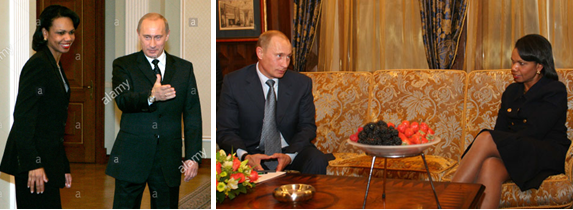
There is another incident which in the retelling, reveals how Burns’s righteous indignation turned into holy war against Putin. It was at a meeting in October 2006 at the presidential dacha near Moscow between then-Secretary of State Condoleezza Rice and Putin. According to Burns,

“the discussion meandered, until she [Rice] began to make a case against Russia’s escalation of tension with Georgia and its pro-NATO, pro-Western president, Mikheil Saakashvili. Like most of the Russian political elite, Putin expected deference from smaller neighbors, and Saakashvili was passionately undeferential. Putin’s intimidating aura is often reinforced by his controlled mannerisms, modulated tone, and steady gaze. 
But he can get quite animated if he wants to drive home a point, his eyes flashing and his voice rising in pitch. Standing before the fire, Putin wagged his index finger and warned, ‘If Saakashvili starts something, we will finish it.’ Rice stood at that point too, looming several inches taller than Putin in her heels. Having to look up at the secretary did not improve his disposition. ‘Saakashvili is nothing more than a puppet of the United States,’ Putin said sharply. ‘You need to pull back on the strings before there’s trouble.’ The fireplace exchange eventually ratcheted down, but tensions over Georgia and Ukraine never did. Putin kept up the pressure.”

To understand the psychopathology in this story, you need to disregard, as Burns means you to disregard, all the evidence on the Russia-Georgia War of August 2008 from US, Georgian, European Union and United Nations sources about who did what to whom, and in what sequence. What Burns wants you to know instead is that Rice is 1.72 metres tall; Putin 1.7 metres.


The 2-centimetre tete-a-tete. Left: Secretary Rice meets President Putin at 
the Novo-Ogarevo dacha, October 15, 2005; official Russian agency picture; 
Rice is not wearing high heels. Right: Putin and Rice at the Novo-Ogarevo 
meeting of October 6, 2006; State Department picture, high heels invisible.

Burns remembers, he wants everybody to understand that when Putin warned the US, two years in advance of the war, against preparing Saakashvili for his attack in the Russian Caucasus – a war which ended in Saakshvili’s defeat — the US Secretary of State used her high heels to try to intimidate the President of Russia. Were the high heels pre-planned by Burns and Rice so that she could “loom several inches taller than Putin”?

The answer to that question is Burns’s secret. What Burns can’t help but reveal is that this is how he and the first female Secretary of State believed they should conduct the preliminaries to war against Russia. And the cause of the war of August 2008? “Putin had baited Saakashvili into conflict, and Russia had invaded Georgia.”

There is more clichĂ©, innuendo, cheap shot psychology, and abiding hatred for Putin, all presented as if he were the only decision-maker in the country; and as if Burns had failed to engage with any other. In substantiation of this method of analysis, Burns quotes liberally from his own embassy cables and secret memoranda as if they are evidence; a selection of these papers, which Burns has had declassified, are at the back of the book. Otherwise, no evidence, no explanation, no Russian interpretation, not even a contrary American one has warranted a second thought by Burns. In five hundred pages, there is no mention of the CIA, the Federal Bureau of Investigation, or the US Treasury’s Office of Financial Intelligence.

“The collapse of Communism represents an historic triumph for democracy and free markets”, is the line with which Burns started his briefing for the new Secretary of State Warren Christopher in January 1993. In October of that year, President Yeltsin’s artillery bombardment of the Russian parliament was “a failed revolt” whose principal casualty, Yeltsin himself was a wounded figure.

“...[H]ere was Boris Yeltsin, who had so courageously defied the hard-liners in August 1991 and buried the Communist system for good, exposed as an infirm leader unable to restore order.”

Quoting old papers he had written, Burns says that,

“[W]hen I left Moscow after my first tour, in early 1996, I worried about the eventual resurgence of a Russia stewing in its own grievances and insecurities. I just had no idea that this would happen so quickly, or that Vladimir Putin—then an obscure bureaucrat—would emerge as the embodiment of that peculiarly Russian combination of qualities.”

When Putin did emerge (brimming with grievance stew), Burns has no explanation for the Russian forces which have kept him in power despite every American effort to do him in.

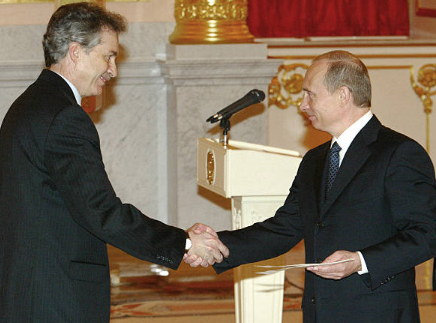
“ ‘You Americans need to listen more,’ President Putin said as I handed him my credentials as ambassador [December 2005], before I had gotten a word out of my mouth. ‘You can’t have everything your way anymore. We can have effective relations, but not just on your terms.’ It was 2005, and in the ensuing years I would hear that message again and again, as unsubtle and defiantly charmless as the man himself.” 


Ambassador Burns presented his credentials to President Putin on 
November 5, 2005. The photographic record shows no movement 
of their mouths during the handover.

Putin is also psycho-analyzed by Burns as simultaneously puerile and macho. In a meeting with President Barack Obama, Putin was “slouching a little in his chair, his legs spread wide, he looked every bit the sullen and surly kid in the back of the classroom”. With Hillary Clinton as Secretary of State, he showed off the “ bare-chested persona he obsessively cultivated.”

That semi-psychotic episode leads to more of the same. Watch as Burns accuses Putin of plotting the defeat of Clinton in November 2016, and the end of Burns’s career. Is this his own grievance stew Burns is serving up as reason of state?

“Putin has a remarkable capacity for storing up slights and grievances, and assembling them to fit his narrative of the West trying to keep Russia down. Clinton’s criticism would rank high in his litany—and help generate an animus that led directly to his meddling against her candidacy in the 2016 U.S. presidential election.”

Burns also uses innuendo to accuse Putin of ordering the murder of Politkovskaya on October 7, 2006:

“Some suspected it was no coincidence that the murder happened on Putin’s birthday [October 7, 1952].”

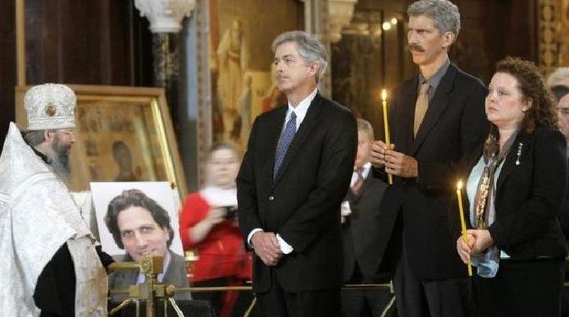
Burns at a memorial service in Moscow in 2009 to mark the 5th anniversary 
of the assassination of US reporter Paul Khlebnikov (beside Burns, Khlebnikov’s 
brother and widow Musa). Months later Burns ordered the US Embassies in 
Moscow and London to stop their investigations of the attempted assassination in 
December 2009 of US reporter, John Helmer.

Burns also claims Putin is fearful of being assassinated himself. “The upheavals of the Arab Spring unnerved Putin; he reportedly watched the grisly video of the demise of the Libyan leader Muammar Qaddafi—caught hiding in a drainage pipe and killed by Western-backed rebels—over and over again.” Burns wants the reader, Russian and American, to believe he has no idea who in the US Government had been trying to arrange Qaddafi’s assassination for the twenty-five years during which Burns was Executive Secretary of the State Department, Ambassador to Jordan, Assistant Secretary of State for Near Eastern Affairs. Natch.

On the fundamental security issue of NATO’s advance towards the Russian frontier, Burns blames Putin for “misreading”, not the President of the US for misleading. Putin, he claims,

“imagined a common front in the post-9/11 War on Terror, in return for acceptance of Russia’s special influence in the former Soviet Union, with no encroachment by NATO beyond the Baltics and no interference in Russia’s domestic politics. But this kind of transaction was never in the cards. Putin fundamentally misread American interests and politics. The Bush administration had no desire—and saw no reason—to trade anything for a Russian partnership against al‑Qaeda. It had little inclination to concede much to a declining power.”

This is a statement of the US strategy of permanent warmaking to ensure that all adversaries remain “declining powers”. The reason for war on the Ukraine front since 2014, according to Burns?

“After the pro-Russian president of Ukraine fled during widespread protests, Putin annexed Crimea and invaded the Donbass, in eastern Ukraine. If he couldn’t have a deferential government in Kiev, he wanted to engineer the next best thing: a dysfunctional Ukraine.”

More can be learned from what Burns omits to explain. In a memo for Rice, Burns proposed “a bold package of understandings with Putin. The first would be a security framework and the second would be a renewed commitment to economic cooperation”. Burns quickly explained that by the first he meant a cynical “deal on regional missile defence cooperation that would allow us to move ahead on Polish and Czech deployments [of the Aegis-Ashore anti-missile missile system]. This was calculated cynicism on Burns’s part because he knew the US deal offered nothing to the Russians, and would be rejected for that reason. Cynical too because Burns’s rationale was that “it’s still worth a try if only as a way to show the Allies that we’ve exhausted every avenue.”

The Burns idea for “renewed commitment to economic cooperation” was cynical in a fashion Burns doesn’t reveal because it is the key to understanding when and why Putin decided that Hillary Clinton was a corrupt liar, who would take bribes and then betray the promises she had made. This is one of many stories which were part of the Clinton-Burns campaign to cultivate the Russian oligarchs and turn them against Putin as US agents of regime change in Moscow. Khodorkovsky and Berezovsky had turned out to be failures, so Clinton and Burns tried with Oleg Deripaska, Mikhail Friedman, Vladimir Potanin, Mikhail Prokhorov, and many others. They were the real back channel Burns tried to open in Moscow.

The story of Deripaska’s million-dollar bid to bribe Clinton through her family foundation, and retain her staff, along with Burns and his subordinates at State, in order to win US agreement to Deripaska’s acquisition of the Opel and Vauxhall divisions of then-bankrupt General Motors (GM), has been told here in retrospect. The first reports were published as the action unfolded between July and November of 2009.

At the time I was the only reporter in Russia and the US to break the story that Clinton and Burns had joined the CIA and the Treasury to stop the Opel deal. I also warned that Washington’s repudiation of Deripaska’s Opel takeover was a bad omen. While no US or GM official amplified their reasons in public, then or later, I reported it was increasingly doubtful that Deripaska would be able to achieve the international share listing for Rusal planned for January 2010.

At that moment in the autumn of 2009, Deripaska was the biggest debtor in Russia, and his aluminium enterprise Rusal the most indebted company. Deripaska acknowledged his total indebtedness was then “slightly” under $20 billion. Read the book on what Deripaska did next — first the offer of a bribe, then an assassination attempt – in order to make sure his Rusal listing would go according to plan.

In his memoir, Burns makes sure his readers know that in July 2009 he was at President Obama’s side when Obama met Putin in Moscow. He then conceals what happened. According to Burns,

“Obama’s initial question produced an unbroken 55-minute monologue filled with grievances, sharp asides, and acerbic commentary. I sat wondering about the wisdom of my advice and my future in the new administration.”
“Obama listened patiently, and then delivered his own firm message on the possibilities of a “reset” of the relationship. He was matter-of-fact about the two countries’ differences, and didn’t gloss over the profound problems that Russia’s actions in Georgia had caused. He said it was in neither of our interests to let our disagreements obscure those areas where we could each benefit by working together, and where U.S.-Russian leadership could contribute to international order. We should explore the possibilities of cooperation, he explained, without inflating expectations. Putin was wary, but said he was willing to try.”

Mind the word “cooperation”, and Putin’s offer that he was “willing to try”. But Burns knew then what was not disclosed until later. That was the decision which Clinton had recommended to Obama, on Burns’s advice, that the “cooperation” between GM and the Russian car industry, which had been agreed earlier, was now prohibited.

When this became public several weeks later, Deripaska was explicit about where the blame lay: “in the Opel case, the US Department of State’s prejudices are also a problem,” he told the BBC.

Putin was more subtle; also more damning:

“The last-minute refusal to complete the Opel deal is not harmful to our interests, but it shows that our American partners have a very original culture when dealing with counterparties. We will have to take into account this style of dealing with partners in the future, though this scornful approach toward partners mainly affects the Europeans, not us. GM did not warn anyone, did not speak to anyone… despite all the agreements reached and documents signed. Well, I think it is a good lesson.” 

That the Clinton family had trousered money, and then failed to deliver, was what Putin meant when he referred the “very original culture” of American dealmaking.

This was when Putin decided that Hillary Clinton was contemptible. It was also the moment when the Russian Government concluded there was no trusting any undertaking, oral or written, which US officials like Burns would negotiate and sign. Burns, a career liar in the Russian assessment and in a grievance stew of his own making, is still covering this up.

His hope is that after Election Day, November 3, 2020, at the age of 63 Burns will still be believable in Washington, and therefore a candidate, once again, to be Secretary of State.

Sunday, March 10, 2019

Unhappy Returns: Peace Delegation to Iran Greeted Home by FBI

U.S. Peace Delegation to Iran Welcomed by Foreign Minister, Met by FBI Agents on Return

by TRNN


March 10, 2019


Code Pink delegation members Medea Benjamin, Margaret Flowers and Kevin Zeese, speak about the highlights of their trip, a 90 min meeting with Foreign Minister Javad Zarif and more.

Manning Jailed by War Criminals

Judging U.S. War Crimes

by Kathy Kelly - VCNV.org


March 10, 2019  

Chelsea Manning, who bravely exposed atrocities committed by the U.S. military, is again imprisoned in a U.S. jail. On International Women’s Day, March 8, 2019, she was incarcerated in the Alexandria, VA federal detention center for refusing to testify in front of a secretive Grand Jury.

Her imprisonment can extend through the term of the Grand Jury, possibly 18 months, and the U.S. courts could allow formation of future Grand Juries, potentially jailing her again.

Chelsea Manning has already paid an extraordinarily high price for educating the U.S. public about atrocities committed in the wars of choice the U.S. waged in Iraq and Afghanistan. 


Former U.S. soldier, Chelsea Manning
Photo: www.out.com

 Chelsea Manning was a U.S. Army soldier and former U.S. intelligence analyst. She already testified, in court, how she downloaded and disseminated government documents revealing classified information she believed represented possible war crimes. In 2013, she was convicted by court martial and sentenced to 35 years in prison for leaking government documents to Wikileaks.

On January 17, 2017, President Obama commuted her sentence. In May of 2017, she was released from military prison having served seven years.

“Where you stand determines what you see.” 

Chelsea Manning, by virtue of her past work as an analyst with the U.S. military, carefully studied footage of what could only be described as atrocities against human beings. She saw civilians killed, on her screen, and conscience didn’t allow her to ignore what she witnessed, to more or less change the channel.

One scene of carnage occurred on July 12, 2007, in Iraq. Chelsea Manning made available to the world the black and white grainy footage and audio content which depicted a U.S. helicopter gunship indiscriminately firing on Iraqi civilians. Twelve people were killed, including two Reuters journalists.

What follows is part of the dialogue from the classified US military video footage from July 12th:


US SOLDIER 1: Alright, firing.

US SOLDIER 4: Let me know when you’ve got them.

US SOLDIER 2: Let’s shoot. Light 'em all up.

US SOLDIER 1: Come on, fire!

US SOLDIER 2: Keep shootin’. Keep shootin’. Keep shootin’. Keep shootin’.

US SOLDIER 2: Alright, we just engaged all eight individuals.


Amy Goodman described the next portion of the video:


AMY GOODMAN: Minutes later, the video shows US forces watching as a van pulls up to evacuate the wounded. They again open fire, killing several more people, wounding two children inside the van.

US SOLDIER 2: Bushmaster, Crazy Horse. We have individuals going to the scene, looks like possibly picking up bodies and weapons.

US SOLDIER 1: Let me engage. Can I shoot?

US SOLDIER 2: Roger. Break. Crazy Horse one-eight, request permission to engage.

US SOLDIER 3: Picking up the wounded?

US SOLDIER 1: Yeah, we’re trying to get permission to engage. Come on, let us shoot!

US SOLDIER 2: Bushmaster, Crazy Horse one-eight.

US SOLDIER 1: They’re taking him.

US SOLDIER 2: Bushmaster, Crazy Horse one-eight.

US SOLDIER 4: This is Bushmaster seven, go ahead.

US SOLDIER 2: Roger. We have a black SUV —- or Bongo truck picking up the bodies. Request permission to engage.

US SOLDIER 4: Bushmaster seven, roger. This is Bushmaster seven, roger. Engage.

US SOLDIER 2: One-eight, engage. Clear.

US SOLDIER 1: Come on!

US SOLDIER 2: Clear. Clear.

US SOLDIER 1: We’re engaging.

US SOLDIER 3: I got ’em.

US SOLDIER 2: Should have a van in the middle of the road with about twelve to fifteen bodies.

US SOLDIER 1: Oh yeah, look at that. Right through the windshield! Ha!

Democracy Now, in the same segment, asked former U.S. whistleblower Dan Ellsberg for comments about releasing the video.

“What were the criteria,” Ellsberg asked, “that led to denying this to the public? And how do they stand up when we actually see the results? Is anybody going to be held accountable for wrongly withholding evidence of war crimes in this case…?”

Chelsea Manning’s disclosures also led to public awareness of the Granai massacre in Afghanistan. On May 4, 2009, Taliban forces attacked U.S. and Afghan forces in Afghanistan’s Farah province. The U.S. military called for U.S. airstrikes on buildings in the village of Granai. A U.S. Air Force B-1 bomber was used to drop 2,000 lb. and 500 lb. bombs, killing an estimated 86 to 147 women and children.

The U.S. Air Force has videotape of the Granai massacre. Ellsberg called for President Obama to post the videotape rather than wait to see if Wikileaks would release it. To this day, the video hasn’t been released. Apparently, a disgruntled Wikileaks employee destroyed the footage.

Were it not for Chelsea Manning’s courageous disclosures, certain U.S. military atrocities might have been kept secret. Her revelations were also key to exposing U.S. approval of the 2008 coup against the elected government in Honduras and U.S. dealings with dictators and oligarchs across the Middle East, which helped spark the Arab Spring rebellions.

Prior to her arrest in 2010, Chelsea Manning wrote:

“I want people to see the truth, regardless of who they are. Because without information, you cannot make informed decisions as a public.”

Chelsea Manning’s principled and courageous actions provide guidance for us to control our fears. We must seek an end to war crimes in Afghanistan, Iraq and other areas where the U.S. terrifies and kills civilians.

Kathy Kelly (kathy@vcnv.org) co-coordinates Voices for Creative Nonviolence (www.vcnv.org)