Tuesday, December 23, 2014

A Year of Irreversible Change in Palestine

Five Reasons Why 2014 Was a Game Changer in Palestine

by Ramzy Baroud - Dissident Voice

In terms of losses in human lives, 2014 has been a horrific year for Palestinians, surpassing the horrors of both 2008 and 2009, when an Israeli war against the Gaza Strip killed and wounded thousands.

While some aspects of the conflict are stagnating between a corrupt, ineffectual Palestinian Authority (PA), and the criminality of Israeli wars and occupation, it would also be fair to argue that 2014 was also a game changer to some degree – and it is not all bad news.

To an extent, 2014 has been a year of clarity for those keen to understand the reality of the ‘Palestinian-Israeli conflict’ but were sincerely confused by the contrasting narratives.

Here are some reasons that support the argument that things are changing.

1. A Different Kind of Palestinian Unity


Although the two leading Palestinian parties Hamas and Fatah agreed to a unity government in April, little has changed on the ground. Yes, a government was officially established in June, and held its first meeting in October. But Gaza is effectively still managed by Hamas, which has been largely left alone managing the affairs of the Strip after the Israeli war in July-August. Perhaps Mahmoud Abbas’s authority is hoping that the massive destruction would weaken Hamas into political submission, especially as Egypt continues to seal shut the Rafah border.

But while the factions are failing to unite, the Israeli war on Gaza has inspired a new impetus of struggle in the West Bank. Israeli plans of targeting holy sites in Jerusalem, particularly the al-Aqsa Mosque, coupled with the deep anguish felt by most Palestinians over the massacres carried out by Israel in Gaza, are slowly reverberating into a wave of mini-uprisings. Some speculate the situation will eventually lead to a massive Intifada that will engulf all of the territories. Whether a third intifada takes place in 2015 or not, is a different question. What matters is that the long-orchestrated plot to divide Palestinians is breaking apart and a new collective narrative of a common struggle against occupation is finally forming.

2. A New Resistance Paradigm


The debate regarding what form of resistance Palestinians should or should not adopt is being sidelined and settled, not by international do-gooders, but by Palestinians themselves. They are opting to use whatever effective form of resistance they can that could deter Israeli military advances, as resistance groups have actively done in Gaza. Although Israel’s latest war killed nearly 2,200 and wounded over 11,000 Palestinians that were mostly civilians, nevertheless, it has still failed to achieve any of its declared or implied objectives. It was another reminder that sheer military strength is no longer the only overriding factor in Israel’s conduct towards Palestinians. While Israel brutalized civilians, the resistance killed 70 Israelis, over 60 of whom were soldiers; this was also an important step testifying to the maturity of Palestinian resistance, which had previously targeted civilians during the second intifada and reflected more desperation rather than a winning strategy. The legitimization of the resistance was to a degree, reflected in the recent decision by the European court to remove Hamas from its list of terrorist organizations.

Resistance in the West Bank is taking on other forms. Although it is yet to mature into a steady campaign of anti-occupation activities, it seems to be forming an identity of its own that takes into account what is possible and what is practical. The fact is that the ‘one size fits all’ modes of resistance debate is becoming less relevant, giving way to an organic approach to resistance devised by Palestinians themselves.

3. BDS Normalizes Debate on Israeli Crimes


Another form of resistance is crystalizing in the Boycott, Divestment and Sanctions Movement (BDS) which continues to grow, gathering steam, supporters and constant achievements. Not only was 2014 a year in which BDS managed to win the support of numerous civil society organizations, academicians, scientists, celebrities and to reach out to people from all walks of life, it did something else that is equally important: It normalized the debate on Israel in many circles around the world. While any criticism of Israel was considered a taboo in yesteryears, it has been forever broken. Questioning the morality and practicality of boycotting Israel is no longer a frightening subject, but is open for debate in numerous media outlets, universities and other platforms.

2014 has been a year that made the discussion of boycotting Israel more mainstream than ever before. While a critical mass is yet to be achieved in the US, the momentum is constantly building up being led by students, clergy men and women, celebrities and ordinary people. In Europe, the movement has been hugely successful.

4. Parliaments are Feeling the Heat


While, traditionally, much of the southern hemisphere offered unconditional support for Palestinians, the West conceitedly stood with Israel. Following the Oslo accords, a bewildering European position evolved, where they flirted with finding the ‘balance’ between an occupied nation and the occupier. At times, the European Union (EU) timidly criticized the Israeli occupation, while continuing to be one of Israel’s largest trade partner, providing weapons to the Israeli army, who then use them to carry out war crimes in Gaza and sustain its military occupation in the West Bank.

This debauched policy is being challenged by citizens of various European countries. The Israeli summer war on Gaza exposed Israel’s human rights violations and war crimes like never before, revealing along the way EU hypocrisy. To relieve some of the pressure, some EU countries appear to be taking stronger stances against Israel, reviewing their military cooperation, and more boldly questioning the rightwing policies of Israeli Prime Minister Benjamin Netanyahu. A spate of parliamentary votes followed, overwhelmingly voting to recognize Palestine as a state. While these decisions remain largely symbolic, they represent an unmistakable shift in EU attitude towards Israel. Netanyahu continues to rail against European ‘hypocrisy’, assured, perhaps, by Washington’s unconditional support. But with the US losing control over the tumultuous Middle East, the Israeli prime minister might soon be forced to rethink his obstinate attitude.

5. Israel’s Democracy Exposed


For decades, Israel defined itself as both a democratic and Jewish state. The objective was clear: to maintain Jewish superiority over Palestinian Arabs, while continuing to present itself as a modern ‘western’ democracy – in fact, the ‘only democracy in the Middle East.’ While Palestinians and many others were never sold on the democracy charade, many accepted the dichotomy with little questioning.

While Israel doesn’t have a constitution, it has a ‘code’, called the Basic Law. Since there is no Israeli equivalent to a ‘constitutional amendment’ – the Netanyahu government is pushing for a new law at the Israeli parliament, the Knesset. This will basically put forth new principals under which Israel will define itself. One of these principals will define Israel as ‘the national state of the Jewish people’, thus casting all non-Jewish citizens of Israel as lesser citizens. While, for all intents and purposes, Palestinian citizens of Israel have been treated as an outcast, and discriminating against in many ways, the new Basic Law will be a constitutional confirmation of their state-enforced inferiority. The Jewish and democratic paradigm is dying for good, exposing Israel’s reality the way it is.

The Year Ahead


Certainly 2015 will bring much of the same: The PA will fight for its own existence, and try to maintain its privileges, bestowed by Israel, the US and others by using every tool available; Israel will also remain emboldened by American funds and unconditional support and military backing. Yes, the next year will also prove frustratingly familiar in that regard. But the new, real and opposing momentum will unlikely cease, challenging and exposing the Israeli occupation, on one hand, and sidestepping the ineffectual, self-serving Palestinian Authority on the other.

2014 was a very painful year for Palestine, but also a year in which the collective resistance of the Palestinian people, and their supporters, proved too strong to bend or break. And in that, there can be much solace.

Ramzy Baroud is an author and a journalist. His latest volume is The Second Palestinian Intifada: A Chronicle of a People's Struggle (Pluto Press, London). He can be reached at ramzybaroud@hotmail.com. Read other articles by Ramzy.

China Moving Between Russia and US Sanctions

China challenges US economic war against Russia

by Alex Lantier -  WSWS

23 December 2014

Directly challenging the NATO powers’ policy of cutting off credit to Russia to undermine the ruble and bankrupt the Russian economy, China is pledging to extend financial aid to Moscow.

On Saturday, Chinese Foreign Minister Wang Yi stressed the need for mutual aid between China and Russia in remarks on the ruble crisis, which has seen a drastic 45 percent fall in its value against the dollar this year. “Russia has the capability and the wisdom to overcome the existing hardship in the economic situation,” Wang said. “If the Russian side needs it, we will provide necessary assistance within our capacity.”

On Sunday, Chinese Commerce Minister Gao Hucheng told Hong Kong’s Phoenix TV that Beijing would strengthen ties with Moscow in energy and manufacturing, predicting that Chinese-Russian trade would hit its target of $100 billion this year despite the ruble crisis. As the ruble’s value in dollars or euros swings wildly, Gao proposed moving away from the dollar in financing Chinese-Russian trade and instead using the Chinese currency, the yuan or renminbi.

Gao said China would focus on “fundamental factors such as how the two economies complement each other,” Reuters reported. “Capital investors may be more interested in a volatile stock or foreign exchange market. But in terms of concrete cooperation between the two nations, we shall have a balanced mentality and push forward those cooperations,” Gao said.

Yesterday, China Daily cited Li Jianmin of the Chinese Academy of Social Sciences saying that aid to Russia could pass through channels like the Shanghai Cooperation Organization (SCO) or the BRICS forum. Significantly, both the SCO (an alliance of China, Russia, and Central Asian states) and the BRICS (Brazil, Russia, India, China, South Africa) exclude the United States and Europe.

Li noted that already last month, when Chinese and Russian premiers Li Keqiang and Dmitry Medvedev met in Kazakhstan, they signed extensive deals on railways, infrastructure and development in Russia’s Far East region, north of China. “Loans, cooperation in major projects, and participation in domestic infrastructure investment in Russia are options on the table,” he added. In one such deal last month, China signed a $400-billion, 30-year deal to buy Russian gas.

These offers of assistance cut across the economic war on Russia launched by US and European imperialism to punish Moscow for opposing their neo-colonial restructuring of Eurasia.

In retaliation for Russian support for President Bashar al-Assad against NATO’s proxy war in Syria and Russian opposition to the NATO-backed Ukrainian regime in Kiev, the NATO powers sought to financially strangle Russia. As Russian oil revenues fell in line with the fall in world oil prices and the ruble collapsed, they worked to cut off credit to Russia and demanded that Russia acquiesce to the Kiev regime. (See: Imperialism and the ruble crisis)

The basic financial mechanism of this strategy was laid out in London’s Financial Times by Anders Aslund of the Petersen Institute for International Economics. “Russia has received no significant international financing—not even from Chinese state banks—because everybody is afraid of US financial regulators,” he wrote. With a yearly capital outflow of $125 billion, liquid foreign currency reserves of only $200 billion, and total foreign debts of $600 billion, Russia would run out of dollars and be bankrupted in as little as two years, Aslund calculated.

Now, however, Beijing appears to be accepting the risk of a showdown with the United States and publicly preparing to throw a financial lifeline to Russia. Chinese currency reserves of $3.89 trillion are the world’s largest and, on paper at least, allow Beijing to easily repay Russia’s debts.

Significantly, the calls of Wang and Gao to aid Russia came a day after a divided European Union (EU) summit on Russia last week. Though the EU supported US sanctions against Russia, German Foreign Minister Frank-Walter Steinmeier, French President François Hollande and Italian Prime Minister Matteo Renzi all publicly opposed calls for more sanctions. Leading European newspapers also warned of the risk of a collapse of the Russian state.


As it weighs its response to the ruble crisis, the Chinese regime, facing a cooling economy and rising social protests in the working class and peasant masses, doubtless also fears the consequences of an outright economic and political implosion of its northern neighbor.

The economic conflicts erupting between the major powers over the oil crisis and the imperialist war drive in Eurasia testifies to the advanced state of the crisis of world capitalism, and the rising risk of world war.

Chinese aid to Russia, should it materialize, will exacerbate US conflict with China. Washington has tried to militarily encircle it through the “pivot to Asia,” allying with Japan, Australia, and India. Plans for war with China, both economic and military, are doubtless being pored over on Wall Street and in the Pentagon.

A year ago, in an article titled “China must not copy the Kaiser’s errors,” Financial Times columnist Martin Wolf warned China against any action that could be construed as a challenge to US global hegemony. He indicated that a Chinese policy replicating the German Kaiser’s challenge to British hegemony before the outbreak of World War I in 1914 would lead to a similar outcome: all-out conflict.

“If open conflict arrived, the US could cut off the world’s trade with China. It could also sequester a good part of China’s liquid foreign assets,” Wolf wrote, recalling that China’s “foreign currency reserves, equal to 40 percent of GDP are, by definition, held abroad.” Such naked theft of trillions of dollars that China has earned from trade with the United States and Europe would directly raise the prospect of a collapse of global trade and preparation for war between nuclear-armed powers.

With its ever more reckless and violent policies, US imperialism is vastly overplaying its hand, discrediting itself at home and fueling opposition from rival states. By driving Russia and China together, in particular, Washington is undoing what was long seen as a major achievement of US imperialist statecraft: the 1972 rapprochement between US President Richard Nixon and Chinese leader Mao Zedong, which turned China into a US ally against the former Soviet Union.

“Many Chinese people still view Russia as the big brother, and the two countries are strategically important to each other,” Renmin University Associate Dean Jin Canrong said, referring to Soviet backing for China as it fought the United States in the Korean War, shortly after the Stalinist Chinese Communist Party (CCP) came to power in 1949.

“For the sake of national interests, China should deepen cooperation with Russia when such cooperation is in need.”

“Russia is an irreplaceable partner on the international stage,” the CCP-linked Global Times wrote in an editorial yesterday. 
 “China must take a proactive attitude in helping Russia walk out of the current crisis.”

Another "Cultural" Revolution for China: Moralizing Capitalist Piggishness

China’s Second ‘Cultural Revolution’

by James Petras

China is in the midst of its second ‘cultural revolution’ in a half century. While the first (under Chairman Mao Tse Tung) was intended to ‘revitalize socialism’; the current is directed to ‘moralizing’ capitalism.

The first CR was a frontal attack on the hierarchy of power and privilege inside and outside of the Communist Party, launched from above by Mao Tse Tung, but taken up from below by Red Guards in order to bring about a more egalitarian society.

The current ‘cultural revolution’, launched by President Xi Jinping, is directed at ending widespread corruption, theft and pillage of the Chinese economy and society by high and low officials in government and the capitalist sector.

The two cultural revolutions are linked by Deng Xiaoping, the Chinese leader who officially put closure on the first and set in motion the policies and slogans (“Getting Rich is Good!”), necessitating a second cultural revolution three decades later.

The Socio-Economic Roots of the Cultural Revolution Today


Deng’s call to ‘get rich’ was directed at the Communist Party elite, their family, friends and overseas backers; it was an open invitation to the multi-nationals of the world to freely exploit China’s resources, infrastructure and labor – educated, nurtured and organized through the collective efforts of the preceding Communist regime. Deng ‘liberated’- or privatized - the means of production and rapidly turned public control and appropriation of earnings over to emerging private capitalists. The corollary was the elimination of all social rights, benefits and protections of labor. The dual incentives were designed to maximize private profits in order to attract long-term, large-scale investments and to achieve high growth in the shortest time possible. Deng telescoped a century of growth and exploitation into a few decades.

His strategy succeeded.

Profits soared. By the late 1980’s and early 1990’s millionaires multiplied like mushrooms after a downpour. Then came the billionaires. Aided and abetted by the wholesale privatization of lucrative industries and public lands, a new class of real estate speculators and so-called ‘developers’ emerged , closely linked to corrupt local municipal, regional and national state officials. Millions of peasants were dispossessed and barely (if ever) compensated; hundreds of millions of workers were employed at starvation wages without the free housing, medical care, education, recreational benefits and lifetime employment of the past, socialist system.

China’s GNP exploded at a double-digit rate for three decades - an unprecedented performance. Most of the profits circulated among a narrow elite of party – state officials and capitalists, while a smaller share ‘trickled down’ to middle and low level functionaries. The seizure of public wealth, followed by three decades of intense exploitation of labor and the private land grabbing of farmland and homesteads, spurred the boom in real estate profits and laid the basis for all pervasive and large-scale corruption .The pillage of the public treasury led to large-scale conspicuous consumption – of imported luxury goods, multi-tiered mansions in gated communities, multiple purchases of luxury condos for offspring, mistresses and bribe-takers and givers.

By the mid 2000’s the concentration of wealth, property and privilege had reached astronomical heights: hundreds of billions accrued to the top 2%, millions to the top 10%, and hundreds of thousands to the top 15% - the self-styled ‘middle class’ who thrived on lesser but equally pervasive corruption and theft and who aped the elite and imitated their life style of luxury consumerism.

Beginning in the mid-2000s, hundreds of strikes by exploited factory workers demanded and secured higher wages; millions of households, farmers and peasants fought against municipal party officials, linked to real estate capitalists, who were attempting to ‘grab’ their land, homes and neighborhoods. Hundreds of millions of Chinese in the countryside protested exorbitant medical and educational costs, induced by the privatized health and educational system, which had bankrupted millions of households. They quickly became aware of the luxurious private medical facilities and specialized clinics for the rich -capitalists and corrupt officials. The internal migrant workers, who built the hyper-luxury condos and mansions, lived in paper shacks, far from the twelve-course banquets celebrating the ‘grand openings’ by business swindlers and ‘bought officials’. As wealth grew among the elite, so did the people’s hostility and rejection of the Party and the State, which they personified.

The ever-cautious klepto-capitalists and public pillagers, fearing for their illicit fortunes, smuggled out enormous wealth. Big swindlers, with big fortunes engaged in massive money laundering while publicly demanding the ‘de-regulation” of the financial sector (i.e. to make it easier to launder and hide their fortunes in overseas accounts). Between 2005-2011 China hemorrhaged over $2.83 trillion in illegal overseas financial outflows.

Part II: The Consequences of Corruption, Pillage and Exploitation


The illicit flow of Chinese wealth overseas resulted from the elite’s savage and illegal exploitation of labor (failure to meet minimum official standards concerning pay, work safety, child labor, excessive hours) .Wealth from bribes, kickbacks on government contracts, speculation on illicit seizures of land, and making false invoices overpricing imports and underpricing exports, flowed upward and outward. While China was profiting from double-digit growth the regime could ‘tolerate’ corruption and illicit outflows. However, by the beginning of the second decade of the 21st century, when China’s economy de-accelerated to about 7 – 7.5%, the regime became less tolerant of wholesale corruption accompanied by capital flight.

Moreover, the new billionaires, millionaires and affluent middle class indulged in what Thorsten Veblen described as “conspicuous consumption”, the purchase and ostentatious display of superfluous luxury products as status symbols of “success”. According to a Special Report on “Luxury” in the Economist (12/13/14, p.8 -10) “nearly one-third of all personal luxury goods sold worldwide are bought by Chinese consumers.” Since the global crises of 2009, 70 – 80% of global growth in the (luxury) sector has come from China.

China’s emerging private-public ruling class has advanced from concentrating wealth, to consolidating political power to seeking prestige and social status – recognition from their domestic and foreign peers. Ideologically, they are decidedly neo-liberal and pro-Western – as evidenced by the billions they spend in the top-end real estate markets of North America, Europe and Australia as well as the millions they spend on their pampered offspring for ‘elite’ private education. Their children live in half-million dollar condos in Cambridge, Massachusetts, Oxford and Cambridge (England), Toronto and Vancouver (Canada), Sydney and Melbourne Australia. The Chinese oligarchs “make the market” for six-figure Swiss watches, five figure handbags and four digit French cognac.

Corruption, conspicuous consumption and class polarization has delegitimized the ruling Communist Party elite in the eyes of the great mass of the Chinese working class, as well as the professionals and salaried employees who make-up the lower middle class.

The ‘political rot’- the privileged social networks derived from kinship ties-is leading to a relative closed ruling class – excluding the mass of urban workers and rural peasants, with potentially explosive social consequences.

Already thousands of local protests, strikes and other forms of direct action occur every year, even as they are repressed or resolved.

In addition to the social and political dangers resulting from the massive illegal, ‘squandering and theft of wealth’, the illicit outflow of wealth is undermining domestic investment and productive overseas investments, and corruption is preparing the way for stagnation and financial crisis.

The stars are lining up for a ‘perfect political storm’ – which has unfolded in the form of President Xi Jingping’s launch of China’s second cultural revolution (CR).

Xi Jingping’s Cultural Revolution


From the start of the 2nd CR in 2012 to mid-2014, the Chinese Communist Party’s internal corruption body has prosecuted and punished 270,000 cadres. That figure includes both the “tigers” (high officials) and the “flies” (low level functionaries). “Over three dozen officials with ranks of ministers or above, including former security Tsar and Politburo Standing Committee member Zhou Yongkang”, have been arrested and jailed (Financial Times 12/4/14, p. 4). Earlier, the former Railways Minister was arrested and sentenced to death for rigging contracts worth about $26 billion dollars over his seven-year tenure. Hundreds of thousands of private business people, paying bribes, have been arrested and sentenced.

President Xi’s campaign has attacked bribes, ‘gift giving’, frequent ostentatious banquets serving expensive delicacies, and high Party officials’ lodging in five star hotels for weeks on end, ostensibly “tending to business”, but more frequently ‘cavorting with their mistresses’.

To be precise, President Xi is attacking the triple evils of corruption, conspicuous consumption, and pillage of public wealth. The new austerity agenda and the public revelations of ill-gained wealth are focused on exposing public officials and private business people in order to regain public legitimacy. And it is succeeding,…. as far as it goes. Public indignation at the revelations is matched by high approval for the Xi leadership’s anti –corruption campaign.

What makes this far more than just a “power struggle among privileged elites” as the Wall Street Journal and the Financial Times have routinely claimed, are: 1. the duration of the campaign of over 2 years, 2. the scope of the campaign, covering top officials and Chinese business equivalents of Wall Street moguls, 3. The nature of the punishment including long prison terms and even death sentences (rather than the mere ‘slap on the wrists and paltry fines’ that US regulators have given to Wall Street’s billion-dollar swindlers), and 4. the ongoing nature of the process. The sweep and magnitude of Xi’s campaign has all the makings of a ‘cultural revolution’ – not the episodic ‘blowing off steam’ or ‘scapegoating of rivals’ described in the Western press.

The Nature of Xi’s Cultural Revolution


Xi’s ‘cultural revolution’ is directed and driven from above – established legal authorities are in charge – the masses are excluded, and preemptory justice is eschewed: regular court proceedings decide guilt and sentencing.

Secondly, Xi’s ‘cultural revolution’ does not, in any way or place, call into question capitalist property relations, foreign investors, or large-scale inflows and outflows of investment or legally registered speculative capital. Nor has Xi called into question existing capital-labor relations.

Xi’s ‘cultural revolution’ is an attempt to sanitize existing capitalist relations, and to infuse a new capitalist ethic. He wants to ‘revise’ Deng’s famous precept “Getting Rich is Good” to read “Get Rich Lawfully . . . or Face Jail”. China is rated number 100 out of 175, on a corruption scale published by Transparency in 2014 (Financial Times 12/4/14, p. 4). Xi’s war on corruption is based on the premise that corruption undermines China’s status as a global power – it ranks with Algeria and Surinam. Secondly, Xi hopes that he can ‘reform’ the public sector in order to privatize it and he wants the sale to go to the highest bidder, not the biggest bribe giver.

His campaign attacks privileged elites, who accumulate and dispose of wealth illegally but he has never sought to diminish the class system, the hierarchy and inequalities which concentrate political power and forms the basis of corrupt bribe giving and taking.

Xi’s ‘cultural revolution’ is continuing and corruption may lessen. Ostentatious public spending is declining. But this layer of ‘new morality’ is spread thinly over a system of power that can easily revert to the ‘old system’ once the ‘revolution’ ends.

Xi’s noteworthy ‘cultural revolution’, the moralization of public administration and private capitalism, can only succeed if it is accompanied by a social transformation: ethics at the service of social justice and equality and by a democratization of the economic decision-making process. The problem is that Xi, by family, social ties and political allegiances is deeply embedded in a milieu which absolutely rejects any such ‘deepening’ of Xi’s ‘cultural revolution’.

His cultural revolution is strictly guided by a singular objective: to force ‘morality’ on the ‘captains of capital’ in order to facilitate the smooth transition to fully liberalizing China’s economy. President Xi, along with his anti-corruption campaign, is steadily loosening state control over foreign financial investments in Chinese stocks and financial sector; he is moving strongly to expand China’s overseas investments; he is accelerating the privatization of public enterprises and increasingly opening financial services to Wall Street and the City of London. He is also internationalizing the use of the yuan-the Chinese currency- in global transactions, displacing the dollar.

In other words, his cultural revolution is a bridge to a new stage of Chinese capitalist expansion; it will lessen the crude open plunder of the public treasury, but it will not lessen the exploitation of labor nor slow the increasing concentration of wealth and privilege. That will require a different kind of ‘cultural’ revolution- one led from below by workers, peasants and salaried employees. A real ‘cultural revolution’ that realizes the ethical ideals of ‘good government’ through a transformation of class relations.

Xi’s anti-corruption campaign confirms what many workers already knew – but it also unmasks the systemic decay and forges an elementary class consciousness: counter-posing honest, hardworking workers to corrupt privileged oligarchs. Xi is aware of the danger that his campaign could ignite a popular fire: That is why he has kept a tight hold on the process. He is trying to navigate the liberal capitalist transition around the shoals of existing capitalist rot without arousing mass unrest.

Monday, December 22, 2014

Happy Christmas from the Western Empire

Season of Goodwill… West Delivers Sanctions, Suffering and Conflict

by Finian Cunningham  ICH - SCF

It’s the Season of Goodwill – and Western governments are showering us with a medley of their «gifts». Sanctions, austerity, lethal military aid and red-hot coals of conflict.

Meanwhile, the contrast of Russian humanitarian aid to Ukraine could not be greater or more telling. This week another convoy of trucks from Russia – at least the tenth so far in recent months – is due to arrive in eastern Ukraine, bearing food, clothing, heating and toys for the war-torn children of Luhansk and Donetsk.

Only in the cynical, mean-spirited West would such a juxtaposition of very different Russian conduct be misconstrued.

As the world prepares to celebrate Christmas – an occasion of peace, joy and salvation for humanity – Washington and its allies in Canada and the European Union see fit to unleash more sanctions on Russia, fuel further misery and suffering in Ukraine, and perhaps most perniciously, to stoke conditions for larger war.

Hard-hearted Western rulers just don’t seem to have a redeeming bone in their bodies or cell in their brains. At least in Charles Dickens’ classic novel ‘A Christmas Carol’, a story of redemption and hope, his horrible miserable character Ebenezer Scrooge was able to recognise the meanness of his ways and, in the end, repent. No such change for Western governments, it seems, who press on in their destructive, blind arrogance.

As US President Barack Obama departed from the White House last Friday for Christmas holidays with his family in sunny Hawaii, he bequeathed his signature to a Congress «present» for the Kiev regime. Among the «goodies» are millions of dollars worth of lethal military aid for the regime that seized power in an illegal coup in February this year. That’s not an pejorative opinion about this regime: it is simply an objective fact. Of course, the Western governments and their media would disagree because they are inebriated on their own cocktails of propaganda.

One wonders if Obama will remember when he is pulling crackers with his daughters around the Christmas dining table that the children of Ukraine will be cringing in fear from the crackle and thud of weapons that his government is funnelling into that country.

Obama also signed off on new sanctions to hit the people of Crimea, for their audacity to vote in a referendum in March to secede from the neo-Nazi regime that his CIA shunted into power. The executive order from the White House prohibits the export and import of goods, technology, services and investment because of, as Obama put it, Russia’s «annexation and occupation of Crimea».

Similar punitive measures were also forthcoming in the same week from the European Union and the Canadian government of Stephen Harper.

These latest Western moves come on top of previous rounds of economic and diplomatic sanctions imposed on Russia. This week – on the eve of the Christmas holidays – the Russian rouble hit new lows, partly as a result of Western sanctions, thus bringing uncertainty and anxiety to many Russian citizens.

Moscow deplored the new round of sanctions as a reckless provocation, and in particular the approval by Washington to open the floodgate for weapons supply into Ukraine. The country has already seen nearly 5,000 deaths over the past eight months since the Western-backed Kiev regime launched a military offensive on the eastern Donbas regions against the Russian-speaking civilian population, simply because the latter, much like their compatriots in Crimea, refuse to recognise the CIA-backed coup that ousted the elected government of Viktor Yanukovych.

Under the subsequent «leadership» of oligarch Petro Poroshenko and CIA protégé Arseniy Yatsenyuk, along with a cabinet of foreign impostors, the regime has imposed an economic blockade on the people of Luhansk and Donetsk. Unable to win the military war against the people’s self-defence militia, the Kiev Reich has now resorted to a tactic of attrition and collective punishment. That is, more crimes against humanity.

Western sanctions this week on Russia and promises of further military support will only embolden the already illegal regime in Kiev and its criminal conduct against the civilians of eastern Ukraine. Spare a thought for the children of Donbas who have to huddle around stoves in the midst of electricity black-outs and the constant fear of the Kiev military breaking the tentative ceasefire, as it has routinely flouted over the past two months.

However, the benevolence of the Brussels plutocrats to their rogue progeny in Kiev is being strained. This week the unelected president of the European Council Jean-Claude Juncker warned that further financial aid is no longer possible. Already the Brussels elite has forked out some €1,800 million to the coup-regime. Petulant demands for «more money» from the Brussels cash cow by Poroshenko and Yatsenyuk are becoming unbearable.

The largesse showered on this criminal regime (a UN human rights report last week cited systematic violations against civilians, including indiscriminate shelling of residential areas) is at the expense of EU citizens who are facing relentless austerity, unemployment, homelessness and welfare cuts. How is that for brazen cold blood among the Brussels bureaucrats? Unelected mandarins shovel public money to a neo-Nazi regime outside of the EU that is killing their own people and yet EU citizens are being denied basic human needs from austerity cutbacks – and at Christmas too!

But, as noted, the EU plutocrats seem to be realising that the entity Washington and Brussels have sired in Kiev is a runaway train wreck, an insatiable Frankenstein monster.

At the latest EU summit at the end of this week, Kiev’s tycoon-president Poroshenko was not invited to attend – a sharp change in tack from the customary indulgence afforded by Brussels.

Also, when the arrogant Yatsenyuk was asked earlier this week when Kiev expected a further tranche of €200 million from the EU public purse, he snapped: «Let me put in a nutshell: yesterday!» To which European Commissioner Yohannes Hahn retorted that there would be no more money from EU taxpayers «until Kiev implemented certain reforms».

Undeterred in his whining, Yatensyuk later told media: «We will do everything that was promised... but to overcome this period Ukraine needs to get some kind of cushion and this cushion is a new package of financial aid. It is difficult for us to fight with a nuclear state [Russia] which is armed to the teeth.» It was the usual shrill excuse-making, blaming everyone else, and expecting something for nothing.

And what reforms does the EU want from Kiev? More neo-liberal economic reforms, privatisation, austerity, and general capitalist raping of the country. Nowhere in the EU-mandated reforms are an end to war, violations and crimes against humanity.

A Christmas Carol? The EU is not only Scrooge unrepentant. It is also the biggest Stooge for American war-making.

Happy Christmas everyone.

A War to Start a Century of Wars: Revisiting Panama


The War to Start All Wars: The 25th Anniversary of the Forgotten Invasion of Panama 

by Greg Grandin  - TomDispatch

As we end another year of endless war in Washington, it might be the perfect time to reflect on the War That Started All Wars -- or at least the war that started all of Washington’s post-Cold War wars: the invasion of Panama.

Twenty-five years ago this month, early on the morning of December 20, 1989, President George H.W. Bush launched Operation Just Cause, sending tens of thousands of troops and hundreds of aircraft into Panama to execute a warrant of arrest against its leader, Manuel Noriega, on charges of drug trafficking.

Those troops quickly secured all important strategic installations, including the main airport in Panama City, various military bases, and ports.

Noriega went into hiding before surrendering on January 3rd and was then officially extradited to the United States to stand trial. Soon after, most of the U.S. invaders withdrew from the country.

In and out. Fast and simple. An entrance plan and an exit strategy all wrapped in one. And it worked, making Operation Just Cause one of the most successful military actions in U.S. history. At least in tactical terms.


Tomgram: Greg Grandin, How the Iraq War Began in Panama

[Note for TomDispatch Readers: Wow! What a crew you are! So many of you responded to my once-a-year email to TD subscribers asking for... what else in the holiday season? Money. You’re champs and your contributions really do ensure that this website will be sticking around for the grim surprises, expectable Washington-style wars, and even the hopeful moments of 2015. I thank you all. Those of you who meant to give but were swept away by seasonal distractions, rest assured that there’s always still time. Just visit our donation page where, for $100 (or more), signed, personalized copies of my new book, Shadow Government: Surveillance, Secret Wars, and a Global Security State in a Single Superpower World, and various other books are available. And again, many thanks to you all! It’s genuinely great to feel supported when you work as hard as we do. Tom]

So many years and wars later, it’s easy to forget what a total television hit the first Gulf War of 1991 was. Just in case you no longer remember -- and why should you? -- that was the war that was to bury America’s defeat in Vietnam forever and signal the arrival of the greatest Great Power the planet had ever known, the soon-to-be-Soviet-Union-less United States. That first partial invasion of Iraq, with its million or more uniformed extras, its vast sets, and its six-month preproduction schedule filled with logistical miracles, was something to behold. All through the winter of 1990, the production had its built-in “coming attractions,” the many variations on “showdown in the Gulf” with Saddam Hussein, the glowering guy with the black mustache who had, until more or less the previous night, been Washington’s man in Baghdad.

Those previews of the war-to-come teased American viewers with a possible January opening in domestic multiplexes nationwide. And when it arrived, the production didn’t disappoint. It had its dazzling Star Wars-style graphics, its own theme music and logos, and its stunningly prime-timed first moments (Disneyesque fireworks over Baghdad). As a show, it was calibrated for controlled thrills, anxiety, and relief from its opening laser-guided, son et lumière spectacular to its final triumphant helicopter descent on the U.S. embassy in Kuwait (which was meant to replay in reverse indelible final images of helicopters fleeing Saigon).

And what a show that war was, a kind of program-length commercial similar to those pioneered by toy companies in the previous decade that had turned TV cartoons into animated toy catalogs. It was as if the whole post-Vietnam era had been building toward nothing but that 43-day-long ad, intent on selling domestic and foreign markets on the renewal of American power as well as on the specific weapons systems that were renewing that power. In this way, the Gulf War of 1991 hawked the leading-edge aspects of the country’s two foremost exports: arms and entertainment.

Almost a quarter of a century later, amid the rubble of a chaotic Greater Middle East, America’s third Iraq war drags on, as Washington officials insist that it has years still to go. Meanwhile, Iraq itself, having experienced two American invasions, a prolonged occupation, and an era of “reconstruction” (which proved to be largely an era of deconstruction), as well as the birth of a jihadist oil-mini-state in its midst, now threatens to split into Shiite, Sunni, and Kurdish cantonments. Given what’s happened in the 24 years since, who now remembers any of the triumphalist glories of that first conflict in the Gulf? And here’s a guarantee: no matter how few still remember the highlight reels from that moment, even fewer remember the American war that, in a sense, began it all, the one that TomDispatch regular Greg Grandin, author of The Empire of Necessity: Slavery, Freedom, and Deception in the New World, recalls today: the invasion of Panama. Tom 

The War to Start All Wars: 

The 25th Anniversary of the Forgotten Invasion of Panama 

by Greg Grandin

There were casualties. More than 20 U.S. soldiers were killed and 300-500 Panamanian combatants died as well. Disagreement exists over how many civilians perished. Washington claimed that few died. In the “low hundreds,” the Pentagon’s Southern Command said. But others charged that U.S. officials didn’t bother to count the dead in El Chorrillo, a poor Panama City barrio that U.S. planes indiscriminately bombed because it was thought to be a bastion of support for Noriega. Grassroots human-rights organizations claimed thousands of civilians were killed and tens of thousands displaced.

As Human Rights Watch wrote, even conservative estimates of civilian fatalities suggested “that the rule of proportionality and the duty to minimize harm to civilians… were not faithfully observed by the invading U.S. forces.” That may have been putting it mildly when it came to the indiscriminant bombing of a civilian population, but the point at least was made. Civilians were given no notice. The Cobra and Apache helicopters that came over the ridge didn’t bother to announce their pending arrival by blasting Wagner’s "Ride of the Valkyries" (as in Apocalypse Now). The University of Panama’s seismograph marked 442 major explosions in the first 12 hours of the invasion, about one major bomb blast every two minutes. Fires engulfed the mostly wooden homes, destroying about 4,000 residences. Some residents began to call El Chorrillo “Guernica” or “little Hiroshima.” Shortly after hostilities ended, bulldozers excavated mass graves and shoveled in the bodies. “Buried like dogs,” said the mother of one of the civilian dead.

Sandwiched between the fall of the Berlin Wall on November 9, 1989, and the commencement of the first Gulf War on January 17, 1991, Operation Just Cause might seem a curio from a nearly forgotten era, its anniversary hardly worth a mention. So many earth-shattering events have happened since. But the invasion of Panama should be remembered in a big way. After all, it helps explain many of those events. In fact, you can’t begin to fully grasp the slippery slope of American militarism in the post-9/11 era -- how unilateral, preemptory “regime change” became an acceptable foreign policy option, how “democracy promotion” became a staple of defense strategy, and how war became a branded public spectacle -- without understanding Panama.

Our Man in Panama


Operation Just Cause was carried out unilaterally, sanctioned neither by the United Nations nor the Organization of American States (OAS). In addition, the invasion was the first post-Cold War military operation justified in the name of democracy -- “militant democracy,” as George Will approvingly called what the Pentagon would unilaterally install in Panama.

The campaign to capture Noriega, however, didn’t start with such grand ambitions. For years, as Saddam Hussein had been Washington’s man in Iraq, so Noriega was a CIA asset and Washington ally in Panama. He was a key player in the shadowy network of anti-communists, tyrants, and drug runners that made up what would become Iran-Contra. That, in case you’ve forgotten, was a conspiracy involving President Ronald Reagan’s National Security Council to sell high-tech missiles to the Ayatollahs in Iran and then divert their payments to support anti-communist rebels in Nicaragua in order to destabilize the Sandinista government there. Noriega’s usefulness to Washington came to an end in 1986, after journalist Seymour Hersh published an investigation in the New York Times linking him to drug trafficking. It turned out that the Panamanian autocrat had been working both sides. He was “our man,” but apparently was also passing on intelligence about us to Cuba.

Still, when George H.W. Bush was inaugurated president in January 1989, Panama was not high on his foreign policy agenda. Referring to the process by which Noriega, in less than a year, would become America’s most wanted autocrat, Bush’s National Security Advisor Brent Scowcroft said: “I can’t really describe the course of events that led us this way... Noriega, was he running drugs and stuff? Sure, but so were a lot of other people. Was he thumbing his nose at the United States? Yeah, yeah.”

The Keystone Kops...


Domestic politics provided the tipping point to military action. For most of 1989, Bush administration officials had been half-heartedly calling for a coup against Noriega. Still, they were caught completely caught off guard when, in October, just such a coup started unfolding. The White House was, at that moment, remarkably in the dark. It had no clear intel about what was actually happening. ''All of us agreed at that point that we simply had very little to go on,'' Secretary of Defense Dick Cheney later reported. “There was a lot of confusion at the time because there was a lot of confusion in Panama.''

“We were sort of the Keystone Kops,” was the way Scowcroft remembered it, not knowing what to do or whom to support. When Noriega regained the upper hand, Bush came under intense criticism in Congress and the media. This, in turn, spurred him to act. Scowcroft recalls the momentum that led to the invasion: “Maybe we were looking for an opportunity to show that we were not as messed up as the Congress kept saying we were, or as timid as a number of people said.” The administration had to find a way to respond, as Scowcroft put it, to the “whole wimp factor.”

Momentum built for action, and so did the pressure to find a suitable justification for action after the fact. Shortly after the failed coup, Cheney claimed on PBS’s Newshour that the only objectives the U.S. had in Panama were to “safeguard American lives” and “protect American interests” by defending that crucial passageway from the Atlantic to the Pacific Oceans, the Panama Canal. “We are not there,” he emphasized, “to remake the Panamanian government.” He also noted that the White House had no plans to act unilaterally against the wishes of the Organization of American States to extract Noriega from the country. The “hue and cry and the outrage that we would hear from one end of the hemisphere to the other,” he said, “…raises serious doubts about the course of that action.”

That was mid-October. What a difference two months would make. By December 20th, the campaign against Noriega had gone from accidental -- Keystone Kops bumbling in the dark -- to transformative: the Bush administration would end up remaking the Panamanian government and, in the process, international law.

...Start a Wild Fire


Cheney wasn’t wrong about the “hue and cry.” Every single country other than the United States in the Organization of American States voted against the invasion of Panama, but by then it couldn’t have mattered less. Bush acted anyway.

What changed everything was the fall of the Berlin Wall just over a month before the invasion. Paradoxically, as the Soviet Union’s influence in its backyard (eastern Europe) unraveled, it left Washington with more room to maneuver in its backyard (Latin America). The collapse of Soviet-style Communism also gave the White House an opportunity to go on the ideological and moral offense. And at that moment, the invasion of Panama happened to stand at the head of the line.

As with most military actions, the invaders had a number of justifications to offer, but at that moment the goal of installing a “democratic” regime in power suddenly flipped to the top of the list. In adopting that rationale for making war, Washington was in effect radically revising the terms of international diplomacy. At the heart of its argument was the idea that democracy (as defined by the Bush administration) trumped the principle of national sovereignty.

Latin American nations immediately recognized the threat. After all, according to historian John Coatsworth, the U.S. overthrew 41 governments in Latin America between 1898 and 1994, and many of those regime changes were ostensibly carried out, as Woodrow Wilson once put it in reference to Mexico, to teach Latin Americans “to elect good men.” Their resistance only gave Bush’s ambassador to the OAS, Luigi Einaudi, a chance to up the ethical ante. He quickly and explicitly tied the assault on Panama to the wave of democracy movements then sweeping Eastern Europe. “Today we are... living in historic times,” he lectured his fellow OAS delegates, two days after the invasion, “a time when a great principle is spreading across the world like wildfire. That principle, as we all know, is the revolutionary idea that people, not governments, are sovereign.”

Einaudi’s remarks hit on all the points that would become so familiar early in the next century in George W. Bush’s “Freedom Agenda”: the idea that democracy, as defined by Washington, was a universal value; that “history” represented a movement toward the fulfillment of that value; and that any nation or person who stood in the path of such fulfillment would be swept away.

With the fall of the Berlin Wall, Einaudi said, democracy had acquired the “force of historical necessity.” It went without saying that the United States, within a year the official victor in the Cold War and the “sole superpower” left on Planet Earth, would be the executor of that necessity. Bush’s ambassador reminded his fellow delegates that the “great democratic tide which is now sweeping the globe” had actually started in Latin America, with human rights movements working to end abuses by military juntas and dictators. The fact that Latin American’s freedom fighters had largely been fighting against U.S.-backed anti-communist rightwing death-squad states was lost on the ambassador.

In the case of Panama, “democracy” quickly worked its way up the shortlist of casus belli.

In his December 20th address to the nation announcing the invasion, President Bush gave “democracy” as his second reason for going to war, just behind safeguarding American lives but ahead of combatting drug trafficking or protecting the Panama Canal. By the next day, at a press conference, democracy had leapt to the top of the list and so the president began his opening remarks this way: “Our efforts to support the democratic processes in Panama and to ensure continued safety of American citizens is now moving into its second day.”

George Will, the conservative pundit, was quick to realize the significance of this new post-Cold War rationale for military action. In a syndicated column headlined, “Drugs and Canal Are Secondary: Restoring Democracy Was Reason Enough to Act,” he praised the invasion for “stressing… the restoration of democracy,” adding that, by doing so, “the president put himself squarely in a tradition with a distinguished pedigree. It holds that America’s fundamental national interest is to be America, and the nation’s identity (its sense of its self, its peculiar purposefulness) is inseparable from a commitment to the spread -- not the aggressive universalization, but the civilized advancement -- of the proposition to which we, unique among nations, are, as the greatest American said, dedicated.”

That was fast. From Keystone Kops to Thomas Paine in just two months, as the White House seized the moment to radically revise the terms by which the U.S. engaged the world. In so doing, it overthrew not just Manuel Noriega but what, for half a century, had been the bedrock foundation of the liberal multilateral order: the ideal of national sovereignty.

Darkness Unto Light


The way the invasion was reported represented a qualitative leap in scale, intensity, and visibility when compared to past military actions. Think of the illegal bombing of Cambodia ordered by Richard Nixon and his National Security Advisor Henry Kissinger in 1969 and conducted for more than five years in complete secrecy, or of the time lag between actual fighting in South Vietnam and the moment, often a day later, when it was reported.

In contrast, the war in Panama was covered with a you-are-there immediacy, a remarkable burst of shock-and-awe journalism (before the phrase “shock and awe” was even invented) meant to capture and keep the public’s attention. Operation Just Cause was “one of the shortest armed conflicts in American military history,” writes Brigadier General John Brown, a historian at the United States Army Center of Military History. It was also “extraordinarily complex, involving the deployment of thousands of personnel and equipment from distant military installations and striking almost two-dozen objectives within a 24-hour period of time… Just Cause represented a bold new era in American military force projection: speed, mass, and precision, coupled with immediate public visibility.”

Well, a certain kind of visibility at least. The devastation of El Chorrillo was, of course, ignored by the U.S. media.

In this sense, the invasion of Panama was the forgotten warm-up for the first Gulf War, which took place a little over a year later. That assault was specifically designed for all the world to see. “Smart bombs” lit up the sky over Baghdad as the TV cameras rolled. Featured were new night-vision equipment, real-time satellite communications, and cable TV (as well as former U.S. commanders ready to narrate the war in the style of football announcers, right down to instant replays). All of this allowed for public consumption of a techno-display of apparent omnipotence that, at least for a short time, helped consolidate mass approval and was meant as both a lesson and a warning for the rest of the world. “By God,” Bush said in triumph, “we’ve kicked the Vietnam syndrome once and for all.”

It was a heady form of triumphalism that would teach those in Washington exactly the wrong lessons about war and the world.

Justice Is Our Brand


In the mythology of American militarism that has taken hold since George W. Bush’s disastrous wars in Afghanistan and Iraq, his father, George H.W. Bush, is often held up as a paragon of prudence -- especially when compared to the later reckless lunacy of Vice President Dick Cheney, Secretary of Defense Donald Rumsfeld, and Deputy Secretary of Defense Paul Wolfowitz. After all, their agenda held that it was the messianic duty of the United States to rid the world not just of “evil-doers” but “evil” itself. In contrast, Bush Senior, we are told, recognized the limits of American power. He was a realist and his circumscribed Gulf War was a “war of necessity” where his son’s 2003 invasion of Iraq was a catastrophic “war of choice.” But it was H.W. who first rolled out a “freedom agenda” to legitimize the illegal invasion of Panama.

Likewise, the moderation of George W. Bush’s Secretary of Defense, Colin Powell, has often been contrasted favorably with the rashness of the neocons in the post-9/11 years. As the chairman of the Joint Chiefs of Staff in 1989, however, Powell was hot for getting Noriega. In discussions leading up to the invasion, he advocated forcefully for military action, believing it offered an opportunity to try out what would later become known as “the Powell Doctrine.” Meant to ensure that there would never again be another Vietnam or any kind of American military defeat, that doctrine was to rely on a set of test questions for any potential operation involving ground troops that would limit military operations to defined objectives. Among them were: Is the action in response to a direct threat to national security? Do we have a clear goal? Is there an exit strategy?

It was Powell who first let the new style of American war go to his head and pushed for a more exalted name to brand the war with, one that undermined the very idea of those “limits” he was theoretically trying to establish. Following Pentagon practice, the operational plan to capture Noriega was to go by the meaningless name of “Blue Spoon.” That, Powell wrote in My American Journey, was “hardly a rousing call to arms… [So] we kicked around a number of ideas and finally settled on... Just Cause. Along with the inspirational ring, I liked something else about it. Even our severest critics would have to utter ‘Just Cause’ while denouncing us.”

Since the pursuit of justice is infinite, it’s hard to see what your exit strategy is once you claim it as your “cause.” Remember, George W. Bush’s original name for his Global War on Terror was to be the less-than-modest Operation Infinite Justice.

Powell says he hesitated on the eve of the invasion, wondering if it really was the best course of action, but let out a “whoop and a holler” when he learned that Noriega had been found. A new Panamanian president had already been sworn in at Fort Clayton, a U.S. military base in the Canal Zone, hours before the invasion began.

Here’s the lesson Powell took from Panama: the invasion, he wrote, confirmed all his “convictions over the preceding twenty years, since the days of doubt over Vietnam. Have a clear political objective and stick to it. Use all the force necessary, and do not apologize for going in big if that is what it takes... As I write these words, almost six years after Just Cause, Mr. Noriega, convicted on the drug charges contained in the indictments, sits in an American prison cell. Panama has a new security force, and the country is still a democracy.”

That assessment was made in 1995. From a later vantage point, history’s judgment is not so sanguine. As George H.W. Bush’s ambassador to the United Nations, Thomas Pickering said about Operation Just Cause: “Having used force in Panama... there was a propensity in Washington to think that force could provide a result more rapidly, more effectively, more surgically than diplomacy.” The easy capture of Noriega meant "the notion that the international community had to be engaged... was ignored."

"Iraq in 2003 was all of that shortsightedness in spades,” Pickering said. “We were going to do it all ourselves." And we did.

The road to Baghdad, in other words, ran through Panama City. It was George H.W. Bush’s invasion of that small, poor country 25 years ago that inaugurated the age of preemptive unilateralism, using “democracy” and “freedom” as both justifications for war and a branding opportunity. Later, after 9/11, when George W. insisted that the ideal of national sovereignty was a thing of the past, when he said nothing -- certainly not the opinion of the international community -- could stand in the way of the “great mission” of the United States to “extend the benefits of freedom across the globe,” all he was doing was throwing more fuel on the “wildfire” sparked by his father. A wildfire some in Panama likened to a “little Hiroshima.”

Greg Grandin, a TomDispatch regular, is the author of a number of books including, most recently, The Empire of Necessity: Slavery, Freedom, and Deception in the New World, which was a finalist for the Samuel Johnson Prize, was anointed by Fresh Air’s Maureen Corrigan as the best book of the year, and was also on the “best of” lists of the Wall Street Journal, the Boston Globe, and the Financial Times. He blogs for the Nation magazine and teaches at New York University.

Follow TomDispatch on Twitter and join us on Facebook. Check out the newest Dispatch Book, Rebecca Solnit's Men Explain Things to Me, and Tom Engelhardt's latest book, Shadow Government: Surveillance, Secret Wars, and a Global Security State in a Single-Superpower World.

Copyright 2014 Greg Grandin

European Farmed Salmon Label Laws Blatantly Disregarded

Farmed Salmon: The Nightmare for Xmas!

by GAAIA

Buyer beware: farmed salmon is toxic waste not healthy food!

Read more about the "Shopped: Fishy Salmon Labelling" campaign online via http://salmonfarmingkills.com/shopped


Watch another video explaining the new European Union laws tightening labelling on farmed salmon - online via https://www.youtube.com/watch?v=piVbp...

Support the campaign by donating online via http://salmonfarmingkills.com/donate

GAAIA is seeking salmon spies to visit supermarkets and restaurants across the European Union - we need photos and case reports to compile a dossier of non-compliance with the new labelling laws.

If you are interested in assisting please email Don Staniford at salmonfarmingkills@gmail.com


Sunday, December 21, 2014

subMedia's Decade of Subversion


A Decade of Subversion Free DVD Download

by subMedia.tv

A Decade of Subversion is a loving collection of foul-mouthed anarchy from subMedia.tv, creators of It’s the End of the World As We Know It and I Feel Fine, END:CIV, and Join the Resistance: Fall in Love!

Buy or download your copy now and own a full decade of flaming subversion with two hours of subMedia.tv’s best videos and a fold-out printable booklet. The DVD includes subtitles in Spanish, Portuguese, German, Czech, Dutch, Romanian, Slovene and Arabic. You can find the PDF of the booklet in the DVD files. Just navigate to the Z_FILES folder.


A Decade of Subversion collection also includes films about indigenous struggles, films about the Olympics, films about environmental issues and even films about stealing.

Proceeds from A Decade of Subversion are going to help fund subMedia.tv’s upcoming projects which include a series called What We Are Fighting For, about anarchists and other freedom fighters telling the stories of their struggles, and a feature film about the story of Anarchy with the working title of ¡Libertad!

Download Torrent (4.2gb)Download via Mega.co.nz (4.2gb)Buy DVD

Status Quo of Gaza Today "Uninhabitable"

UN predictions fall short: Gaza uninhabitable today

by Eva Bartlett - RT

Five months ago the world watched in horror as the bully of the Middle East, Israel, launched the most brutal massacre on the Palestinians of Gaza since the Nakba (perhaps more brutal, Palestinian friends in Gaza have said).

Lasting over twice as long as the 2008-09 war on Gaza (formerly the most-brutal massacre since the Nakba), and killing over 800 more Palestinians than in the attack six years ago, the July-August 51-day offensive killed 2,131 Palestinians and injured over 11,000, and destroyed tens of thousands of homes, buildings, businesses, hospitals, Gaza's only power plant and other key components of Gaza's infrastructure.

Palestinian and foreign activists and journalists within the 40 kilometer-long strip of open-air prison tweeted and live-streamed images more horrific than the best Hollywood productions. Weathered journalists broke down sobbing at the sight of Palestinian civilians, especially children being targeted like prey by one of the world's most wickedly powerful armies and navies. Doctors who have seen the mutilated corpses and scarcely-living bodies of Palestinian elderly, men, women and children many times before were yet still appalled by the brutality of these latest attacks.

Worldwide, protesters, journalists of integrity called the bombardment of Gaza genocidal (as Israeli officials and politicians called for genocide). One of the most shocking of many images was that of 4-year-old Saher Abu Namous's half blown-off head, his father cradling him and wailing. Entire families were murdered in this latest Israeli offensive. Not for the first time, the Israeli army bombed schools hosting internally displaced, hospitals (including a rehabilitation hospital for disabled and invalid), and entire neighborhoods.

As with prior military operations, the Israelis in 2014 targeted water and sewage lines, electricity networks, hospitals, primary health centers, ambulances and medics, bridges and major roads, key governmental buildings, schools and universities.They went further and attacked water, electricity and sanitation personnel, killing at least 14, the UN's Office for the Coordination of Humanitarian Affairs (OCHA) noted. The resulting electricity, water and sanitation crises are such that until November, power was out 18 hours a day, and just 10 percent of the 1.8 million Palestinians get water once a day (for a matter of hours). As of mid-November, Oxfam reported, power cuts were 12 hours per day in some areas.

While the bombs rained down, some Israelis pulled up seats to watch the bloodshed, as 21st Century Wire noted:

“Old sofas, garden chairs, battered car seats and upturned crates provide seating for the spectators. ...Some bring bottles of beer or soft drinks and snacks. ...Nearly all hold up smartphones to record the explosions or to pose grinning, perhaps with thumbs up, for selfies against a backdrop of black smoke.”

The Israeli army used the same banned weapons on Palestinians this summer that they've used in the past two massacres, as well as "armour piercing bombs" which have “high explosive capabilities” and were used on Palestinian homes. Weapons-seekers flocked to Israel after seeing the effects of its weaponry and technology. Israel's weapons industry thrives with each massacre of the Gaza testing ground.


Strangling and starving Gaza


In September 2005, the 8,500 Israeli colonists finally, unwillingly leave their homes on stolen land. With no Jewish colonists in Gaza, Israel has since been free to lock-down all of Gaza and bomb whenever the whim occurs, with no fear of any Israeli loss of life. The Israelis have waged wars against Gaza every year or two since pulling their colonists out.

Since the June 28, 2006 Israeli repeating bombing of Gaza's sole power plant—destroying all six transformers – Palestinians in Gaza have neither been allowed to import the transformers and materials needed to rehabilitate the plant, nor offered an alternative solution. Through the now-destroyed tunnels, Palestinians did import smaller transformers and got the power plant hobbling again, but never to full capacity.

In a 2006 report on Israel's bombing of Gaza's power plant, B'Tselem called for Israel to:

“Cover the expenses needed to return the power plant to full capacity; Finance the upgrading of the infrastructure to transfer electricity from Israel to the Gaza Strip; Permit the entry of the equipment needed to rehabilitate the power plant, without delay.”

However, Israel did none of the obliged, nor has it ever paid (in any sense of the word) for the reconstruction of buildings and infrastructure it has repeatedly targeted over the years.

The supply of electricity bought from Israel and Egypt doesn't suffice for Gaza's now 1.8 million Palestinians. The crisis impacts on every facet of life: hospital functions, sanitation, water supply, refrigerators and appliances, and education.


Photo by Eva Bartlett

In 2006, B'Tselem noted: “The sewage system is on the verge of collapse.” Mohammed Omer's photos of the village of Um al-Nasser, flooded with overflown sewage in 2007, should have been a wakeup-call if official institutional and NGO warnings are not. At least five drowned in their own sewage, including an infant. A year ago, reports from Gaza showed the misery of Palestinians' homes flooded with a combination of that same overflown sewage compounded by heavy rains. Kids waded through sewage to get to school; elderly were, if lucky, paddled by small fishing boats. This, save the rains, was entirely preventable...if the UN and influential world bodies and leaders truly cared and dared to face up to the Israeli lobby.

In 2010, it was revealed that the Israeli authorities were implementing a plan to starve Palestinians. “The security establishment had calculated the number of calories consumed by Gaza residents and used it to establish a 'humanitarian minimum', a bottom line to which it was possible to reduce food supply to Gaza without causing hunger or malnutrition....These procedures included mathematical formulas for calculating the quantities of food and the basic products Israel would allow into the Gaza Strip.” The idea was mentioned back in 2006, when Dov Weissglass said, “The idea is to put the Palestinians on a diet, but not to make them die of hunger.”

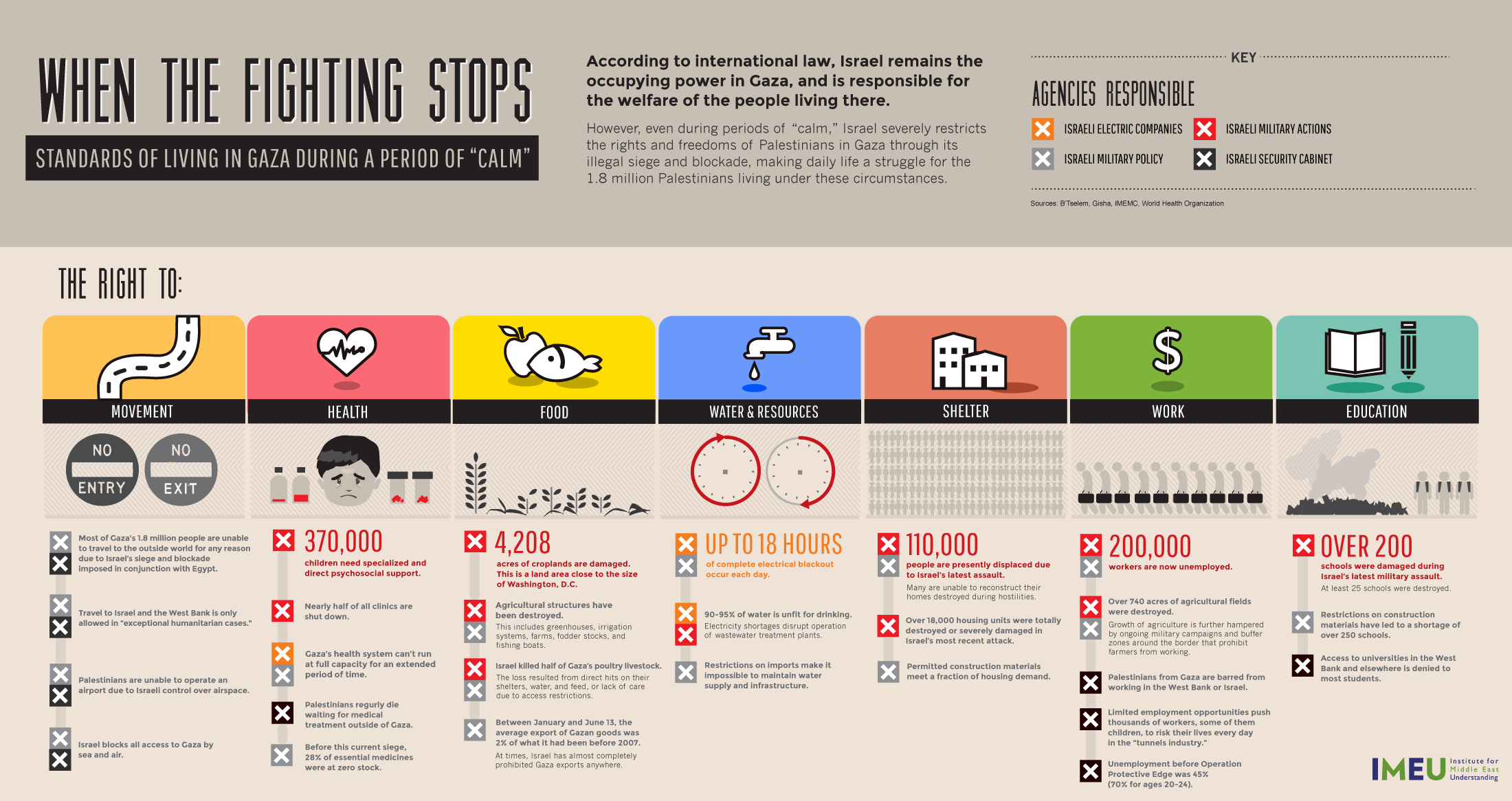
Power outages, 95 percent undrinkable water, constant fuel and cooking gas shortages, sewage and sanitation crises, a shattered economy (unemployment at 45 percent) and manufactured poverty rendering 80 percent of the population dependent on inadequate and dignity-shattering food aid hand-outs (no vegetables or fruit, high carb, almost no protein); food insecurity (72 percent insecure or vulnerable to food insecurity), stunting (31.4 percent) and anemia (72.8 percent) among children. This is Gaza, and with each passing month, even each day, life is less and less tolerable. In August, 2012, UNRWA questioned if by 2020 Gaza would be a livable place. We don't have to wait till 2020 for Gaza to be declared unlivable: it already is unlivable by any standards.


No crossing them


Since 2008, Israel has incrementally closed down three of Gaza's four commercial crossings, depriving Palestinians of adequate means for import and export. At present, the only operating (I use that term lightly) crossings are: Karem Abu Salem (commercial), Erez (transit), and Rafah (transit). The closure of Karni crossing, closed in March 2011, dramatically impacted on Gaza's economy. The Palestinian Centre for Human Rights (PCHR) noted that Karni “is the biggest crossing in the Gaza Strip, in terms of its capacity to absorb the flow of imports and exports.” Gisha noted that Karni, the “main transit point (via truck) for goods” was “partially closed in 2007 save for the movement of grain and animal feed via conveyer belt. The conveyer belt was shut down in 2011.”

Nahal Oz crossing, closed in 2010, was the primary point for entry of gas and other fuel. And the closed Sufa crossing was notably the main point of entry of construction materials. The sole remaining commercial crossing, Karem Abu Salem, does not have the capacity to allow in the amount of goods needed, assuming the Israelis were to allow them entrance in the first place.

Al Akhbar reported: “Karm Abu Salem crossing has a maximum capacity to receive 450 trucks a day while the Gaza Strip needs a total of 1,000 trucks every day of the year without any interruptions. Today, the crossing is not working in full capacity, allowing only about 320 trucks to pass through each day. ...According to the Gaza Chamber of Commerce, the crossing closed down for 130 days in 2014, which means it was not operational for 35 per cent of the year.”

PCHR noted that closure of Karem Abu Salem has meant a cooking gas crisis. “Israeli authorities only allow an average of 98 tons of cooking gas into Gaza per day. This limited quantity is less than half of the daily needs, which is 200 tons per day of the civilian population in the Gaza Strip during winter. The crisis has unprecedentedly aggravated for around six weeks due to cold weather and overconsumption in addition to the power outage and using gas as an alternative in many instances of electricity. The lack of diesel and benzene led to the aggravation of the crisis as a result of using the gas cylinder for cars or as an alternative for benzene to run generators.”

Before ever visiting Gaza, I recall reading on how Palestinians overcame these fuel crises. At one point, they used cooking oil as fuel for their vehicles (“Gaza smelled like one big falafel shop,” I was told). They also used their kerosene lanterns (baboor) to cook over, that one I saw. The Israelis learned of their ingenuity and added kerosene to the banned items list.


Photo by Eva Bartlett

Israel has shattered Gaza's economy in a variety of clever ways: firing on farmers and bulldozing and burning their land; firing on fishers and stealing their fishing boats and equipment; bombing businesses and factories and preventing the materials needed to rebuild; drastically restricting imports. And banning exports save a token few trucks when Israelis need palm leaves for Jewish holidays. Oxfam in December 2014 noted: “Under the blockade, exports from Gaza have fallen to around 2 percent of pre-blockade levels, with devastating impact on the economy. While some extremely limited exports to international markets have been approved, the transfer of produce to Palestinian markets in the West Bank - and markets in Israel - has been banned since 2007. These were traditionally the most important markets for producers in Gaza.” And it isn't only produce. Furniture, clothing, and a surprising number of other goods which once flowed from Gaza's borders are banned from being exported.


Art of war


Norwegian doctor Mads Gilbert has shared the last three major wars with the Palestinians in Gaza. Recently, Israeli authorities banned him from entering Gaza, in spite of him maintaining a professional neutrality. Gilbert said: “I think the truth is the security risk because when I, as a white medical doctor with blue eyes and white hair, tell the real story of the realities in the sharp end of the Israeli attacks, the Palestinians change from being terrorists to being humans, the numbers change from being numbers to being people, and the children appear as yours and my children. ...this is actually a danger to the Israeli narrative and, in a way, the global reputation of Israel, which is partially falling apart now.”

Aside from Gilbert's heart-breaking observations on the slaughter of Palestinians, he notes poignantly, “The average age is 17.6 years, ...a child ghetto of 1.2 million children and young people are being denied the right to escape the bombs, to fly, because they cannot get out.” This, incidentally, was the third major massacre for Palestinians six years or older in Gaza since December 2008.


Photo by Eva Bartlett

Six years ago, I was a month into what would be a year and a half stay in Gaza (followed by another cumulative year and a half over the years). In December 2008, the situation in Gaza was already desperate. Back then, Palestinians in Gaza were already feeling the choke of closed borders, no exports, sadistically-limited imports (between 30-40 items), and the beginning of cold winter months during which they would suffer in darkness without the means to even heat water.

The 23-day in 2008-09 offensive killed over 1,400 Palestinians. I shared the three plus weeks of hell, losing my own fiends to Israeli bombs and bullets, meeting tortured parents and families whose children had been shot dead point blank by Israeli soldiers. Like Amer al Helu's infant daughter Farah; like 4-year-old Ahmed al-Samouni with two bullets to his chest; like KhaledAbed Rabbo's 2 and 7 year old children, shot dead by soldiers casually snacking on junk food.

Canada's CBC interviewed then-frantic me some days after my medic friend Arafa was murdered by an Israeli dart-bomb shot directly at his ambulance, after the media building I was in was bombed, and after I had seen more mutilated bodies and white-phosphorous-charred skin than I could have imagined. My interview-balancing counterpart, a Canadian volunteering at an Israeli base, gushed about the weather and what a relaxed time he was having... and, oh yes (to the prompting of the CBC host), he did have to run down to the bomb shelter the other day. I'd just finished saying there were no bomb shelters in Gaza, everything was a target, the Israelis were even bombing schools, kindergartens, hospitals.


Photo by Eva Bartlett

The white phosphorus was a first for Gaza. The flechette bombs (shells packed with thousands of razor-sharp dart-nails) were old news. Reuters cameraman Fadel Shana was martyred by such a shell while filming victims of Israeli shelling in Johr ad-Dik in April 2008. Shana, like other Palestinian journalist maimed and martyred by Israeli attacks, wore the markings of a journalist when targeted.

Post-massacre, as I'd walked through the ruins of Ezbet Abed Rabbo to the east of Jabaliya, my friend from the neighborhood (whose mother was killed in the very first minutes of bombings as she walked to buy bread), joked in the way oppressed people do when getting on with life, “they make like art here,” gesturing to the graveyard of houses surrounding us.

In November 2012, the Israelis “mowed the lawn” again, murdering over 170 Palestinians. During the 8 days of slaughter, Israeli figures called to “blow Gaza back to the Middle Ages, destroying all the infrastructure including roads and water,” and to “Flatten all of Gaza. There should be no electricity in Gaza, no gasoline or moving vehicles, nothing,” said the deputy Israeli Prime Minister Eli Yishai and Gilad Sharon respectively.

But these massacres haven't been without a fight. In spite of the massive power imbalance, Palestinian resistance have fought back by any means possible, as is their right, as noted in the UN General Assembly. For those who call for Palestinians to be non-violent (they are, the media just doesn't speak of the murdered, Bassem Abu Rahmes of Palestine), I quote political analyst Sukant Chandan:

"What we have is a largely defenseless population who has been usurped historically, who have been boxed into a ghetto of nearly 2 million people, in a tiny strip of land... and these people haven't got the right to resist? Absolutely Palestinians have the right to resist, and they should have more rockets, they should have better rockets, and they should have a Resistance that can match conventionally one of the biggest genocidal entities on the planet, which is the white, colonial state of 'Israel'."


Status Quo and 2015?


There are daily mini-massacres that go largely unnoticed, whether on the sea, in the Israeli-imposed “buffer zone” or by denying Palestinians the right to exit for health care unattainable within the confines of Gaza.

On December 6, Israeli gunboats machine-gunned Palestinian fishers 2-3 miles off the coast, surrounded and abducted 12 fishers, and stole their boats. A few days prior On Dec 3, a Palestinian fisherman was critically injured by shrapnel to his head after Israeli navy shelling, Maan News reported.

On November 22, an Israeli soldier shot and killed a Palestinian bird hunter 500 metres from the border, east of Jabaliya, shooting him in the back. The same day, in southeastern Gaza, an Israeli soldier shot a 17-year-old Palestinian in the chest. He was 1500 meters from the border. The combination of Israeli jeeps present at the border and the remotely-controlled machine gun towers make Gaza's border region – the most fertile area of Gaza – a killing field.

Naturally, these incidents, daily realities for Palestinians, didn't make the headlines.

Now, nearing the end of 2014, the reports coming out of Gaza are even more dismal than one could imagine. After lofty 5.4 billion pledges of rebuilding Gaza, virtually none of the 20, 000 homes destroyed or badly damaged, including entire neighborhoods like Sheyjaiyee, have been rebuilt. Palestinians stand blinking, wondering when and if that promise will materialize. At the end of October, the NY Times reported, “Officials say they have yet to collect a dime of the $5.4 billion that international donors have pledged to the effort.”


Photo by Eva Bartlett

The 106,000 Palestinians rendered homeless (40,000 of whom are staying in emergency shelters; many others living in the shells of their homes or in ramshackle tents) face cold rains and flooding. In its latest situation report, UNRWA noted extreme weather in Gaza and said a state of emergency was declared on November 27 “in Gaza City after severe flooding over a 48 hour period,” noting the evacuation of hundreds in flooded areas in Sheikh Radwan district.

Sara Roy notes the insidious nature of what rebuilding plans there are: Israel gets to decide who (if any) receive cement and building materials, and a “permanent and complex permit and planning system similar to the one Israel uses in Area C of the West Bank, which is under total Israeli control,” is being planned for Gaza.

Oxfam's December 2014 report notes that Gaza needs “at least 89,000 new homes, 226 new schools, as well as massive repairs to other infrastructure.” Even prior to the summer IDF military operation, Gaza faced a deficit of 71,000 housing units, OCHA noted. Gisha reported that “around 5 million tons of construction materials are required just for the most immediate needs. With 52,351 tons - or 1% - entering since the ceasefire, at this rate it would take more than 23 years to meet "immediate" needs alone.” According to PCHR, “For almost 8 consecutive years, Israeli forces have continued to prevent the delivery of construction materials to the Gaza Strip.”

Egypt has kept the Rafah crossing closed since October 25, justifying this after a suicide bomb killed 33 Egyptian soldiers, even though there is no evidence linking the bombing and Gaza. Only as of November 26 was the crossing briefly opened (for 2 days), allowing just 300 Palestinians in Egypt to return to Gaza, and briefly again from November 30 to December 2. A reported 6,000 more Palestinians remain stranded in Egypt or third countries. In early December, OCHA reported that 10,000 Palestinians wait to exit Gaza, including over 1,000 medical patients.


Photo by Eva Bartlett

Egypt has also long-since destroyed the network of tunnels which were known as Gaza's “lifeline” for a very good reason: they imported the goods, including building materials, that Palestinians needed and Israel bans. They also served as an alternative conduit to the normally closed Rafah crossing, and having seen them I can attest they were far more efficient than the bureaucracy of the Egyptians' border crossing terminal. But they are largely extinct, and reports have Egypt creating a buffer zone extending 1 km to ensure the tunnels don't re-manifest, and to tighten the already strangling noose on Palestinians in Gaza.

During the summer Operation Protective Edge in Gaza, protests raged around the world. Indian peace activist and journalist, Feroze Mithiborwali, noted at a recent Beirut conference in solidarity with Palestine, “In practically every town and city across India, there were pro-Gaza, pro-Palestine demonstrations. There was a continuous spate of protests across India.”South African delegate Firoz Osman, of Media Review Network said, “Two hundred thousand people came out to demonstrations to support Gaza. That's even more than when Mandela was released.”

So there is an increased awareness of the unjust plight of Palestinians in Gaza and throughout occupied Palestine. But as we approach the end of the year, a time when much of the West will be preoccupied by holiday shopping and celebrations, will this awareness be enough to sustain pressure on Israel and prevent a new massacre of Gaza? Will it be enough to pressure both Israel and Egypt into allowing building materials into Gaza and opening the Rafah crossing to Palestinians needing to re-enter or to exit Gaza? Will it be enough for American citizens to call for an end to the billions of dollars of aid given to Israel, let alone munitions, including a reported 3,000 more precision-guided munitions of the type used over the summer? Or for British citizens to demand Britain end arms export to Israel?

Mads Gilbert said it spot on: “As a doctor, I say don’t send more bandages, don’t send more drugs, and don’t send equipment. Stop the bombing, lift the siege, treat the Palestinians as humans, include them in the human family, protect them by international law and find a peaceful political solution to the occupation of Palestine. That’s the preventative medicine of this mayhem that is going on.”

The status quo of Palestinian suffering in Gaza cannot continue as it has these past 8 years.


Eva Bartlett is a freelance journalist and rights activist who has lived in the Gaza Strip since late 2008.