Wednesday, December 07, 2016

Anti-Semitism in Canada Today: Nazi Holocaust as Oppression Reinforcer

The Nazi Holocaust and Anti-Semitism in Canada Today

by Yves Engler  - Dissident Voice


December 5th, 2016

Is “remembering the Nazi Holocaust and where anti-Semitism can lead” a good thing? Unfortunately, thanks to people who constantly cite this horrible genocide in order to justify the illegal, immoral and anti-human behaviour of the Israeli state, one must answer, “it depends.”

Drawing attention to the Nazi Holocaust and anti-Semitism in Canada today often reinforces, rather than undermines, oppression and discrimination.

This perverse reality was on display at two recent events in Toronto.

At a semi-annual Ryerson Student Union meeting a Hillel member pushed a resolution calling on the union to promote Holocaust Education Week in conjunction with United Jewish Appeal-Toronto, which marked Israel’s 2014 slaughter in Gaza by adding $2.25 million to its annual aid to that wealthy country.

The motion stated, “this week is not in dedication to anti-Zionist propaganda” and called for the Week to “focu[s] solely on the education of the Holocaust and not on other genocides.”

Objecting to this brazen attempt to use the decimation of European Jewry to protect an aggressive, apartheid state many students left the meeting. When quorum was lost before the vote pro-Israel activists cried — wait for it — “anti-Semitism”. “Tonight I experienced true and evil anti-Semitism”, complained Tamar Lyons, vice president of communications for Students Supporting Israel at Ryerson University, in a racist social media post republished by B’nai B’rith. In it the StandWithUs Emerson Fellow, which trains university students to advance Israel’s interests, bemoaned how “a Muslim student ‘goy-splained’ me”.

After the meeting Lyons linked the purported anti-Jewish incident to the Ryerson Student Union endorsing the BDS movement two years earlier. She told the Canadian Jewish News it was “a direct result of [the] boycott, divestment and sanctions movement and the anti-Israel sentiment that’s so prevalent on campus.”

Taking place on the eve of an Ontario legislature vote to condemn BDS activism, the national director of B’nai Brith jumped on the Ryerson affair. “What starts with BDS does not end with BDS,” said Amanda Hohmann. “More often than not, BDS is simply a gateway drug to more blatant forms of antisemitism.”

(Yup, take a toke of that leftist–internationalist ‘pressure Israel to follow international law’ bud and soon you’re longing for some Neo-Nazi ‘get-the-Jews’ smack.)

As B’nai B’rith hyped the Ryerson affair, the Centre for Israel and Jewish Affairs pushed the Ontario legislature to pass a motion in support of the spurious “Ottawa Protocol on Combating Anti-Semitism” and to reject “the differential treatment of Israel, including the boycott, divestment and sanctions movement.” Passed 49 to 5 (with 53 absent), motion sponsor Gila Martow told the legislature: “We would not be here supporting the Ku Klux Klan on our campuses, so why are we allowing [the] BDS movement and other anti-Jewish and anti-Israel organizations to have demonstrations and use our campuses, which are taxpayer-funded?”

In an interview with the Toronto Sun after the vote the Thornhill MPP described BDS as “psychological terrorism on the campuses … The motive behind BDS is to hurt the Jewish community by attacking Israel.”

The only MPP who spoke against the motion was the NDP’s Jagmeet Singh. But, even this defender of the right to criticize Israel spent much of his speech talking about how anti-Semitism “must be denounced.”

Notwithstanding the anti-Semitism hullabaloo, the BDS vote and Ryerson affair have little to do with combating anti-Jewishness. As is obvious to anybody who thinks about it for a second, comparing internationalist and social justice minded individuals to the KKK will elicit, not lessen, anti-Jewish animus. Similarly, labeling a nonviolent movement “psychological terrorism” and writing about “Muslim … goy-splaining” isn’t likely to endear Jewish groups to those concerned with Palestinian dispossession and building a just world.

The major Jewish organizations and trained Israeli nationalist activists scream “anti-Semitism” to protect Israel from censure, of course. But they also do so because few are willing to challenge them on it. As such, the “anti-Semitism” smears should be seen as a simple assertion of CIJA and B’nai B’rith’s political, economic and cultural clout.

Possibly the best placed of any in the world, the Toronto Jewish community faces almost no discernible economic, social or cultural discrimination. Describing it as “the envy of the UJA federation world”, Alan Dershowitz told its 2014 Toronto Major Gifts dinner: “You must never be ashamed to use your power and strength. Never be afraid that people will say, ‘You’re too strong and powerful.’ Jews need power and strength. Without this strength – economically, morally, militarily – we can’t have peace.”

But, UJA-Toronto, CIJA, B’nai B’rith, etc. aren’t seeking “peace”. Rather, they’re working to strengthen a Sparta-like, Jewish-supremacist state in the Middle East.

The Ryerson affair and vote at the provincial legislature reflect a Toronto Jewish establishment drunk with its power. But the sober reality of constantly justifying oppression by citing the Holocaust/anti-Semitism is that it undermines the power of that memory and is an insult to all those who suffered and died at the hands of the Nazis.

Yves Engler is the author of Canada in Africa: 300 years of aid and exploitation.
Read other articles by Yves.

As Hurricane Stricken Haiti Hastens to Famine, UN Admits 2010 Cholera Culpability

UN Admits Fault in Haiti's Cholera Outbreak as Country Faces Prospect of Famine

by TRNN


Haitians continue to endure the aftermath of the forgotten disaster 

of Hurricane Matthew, says lawyer Brian Concannon

Tuesday, December 06, 2016

Insinuations But No Answers in Serial Vancouver Aquarium Whale Deaths

Vancouver Aquarium's Case for Captive Whales Flounders

by Jeff Mathews  - Pacific Free Press


December 6, 2016

Talk about a whale of a tale.

At least, that seems to be what Vancouver Aquarium's headline-grabbing suggestion that activists poisoned its whales was designed to have you do.

Unable to pinpoint a specific cause for the deaths of their last two remaining belugas, the aquarium was left to speculate.

And speculate they did, deftly pointing their finger at the critics of whale captivity that have been an ever-present thorn in their side.

Then, perhaps just to make it all seem a little more real, they stated that police had been contacted in the matter.

It was a possibility, the aquarium was keen to emphasize, that they weren't ruling out.

Except, there was never any evidence for it.

There have been over 40 whales and dolphins die at the aquarium over the years, not one of them caused by a murderous gang of animal lovers. No suspicious characters on their surveillance video. No traces of a toxin in their pools or in their dead whales. No evidence whatsoever to indicate foul play, say Vancouver Police.

With zero evidence of beluga-cide and several far more likely explanations, it is hard not to see this make-believe beluga murder mystery as nothing more than PR sleight-of-hand -- a purposeful misdirection, designed to deflect responsibility for the deaths of whales in their care and discredit their most vocal opponents.

To do so amid emotional pleas for time to grieve is cynical in the extreme.

Ask yourself: Are these the actions one expects from a world-class science-based conservation charity? Or are they the public relations tactics more typical of people with something to hide?

After all, it is increasingly difficult to reconcile the aquarium's carefully crafted public image as world-leaders in whale and dolphin care with their mounting death toll. Aurora and Qila are but the latest of five deaths in just the past two years.

Many of the 40+ whales that have died at Vancouver Aquarium reached only a fraction of the lifespan they are capable of in the wild. Captive-bred belugas - whales they say are 'ideally suited for captivity' - have fared the worst.

There have been five belugas born at the aquarium. Tuaq (the first captive-born beluga at the aquarium) died at age 6 months; Tuvaq, just before his third birthday; Tiqa a little past age 3; and Nala, barely a year. Qila was the only one to survive beyond age 3.

Is this what we get from world-class care?


Perhaps not. Compared to other marine parks, Vancouver Aquarium's record of young deaths of captive-born belugas is arguably worse than any other active facility in North America, including SeaWorld (see figure below).

One has to wonder whether the five belugas the aquarium has said it intends to import from its partners like SeaWorld would be better off staying where they are.

One might also be tempted to ask, given that they have such a hard time keeping these animals alive in captivity, how this practice helps the survival of wild beluga populations. Conservation is after all, one of the primary justifications given for keeping and breeding whales at many facilities, including SeaWorld.

There is little doubt that in 50 years, aquarium researchers have learned something new about belugas. It is often said, however, that research on whales in captivity mostly benefits whales in captivity.

Perhaps that is why, after five decades of research, results from the aquarium's captive research program have not saved, or even measurably improved the life of even a single wild beluga.

Beluga populations from Hudson's Bay to the St. Lawrence are, today, in worse shape than when their research program began.

What exactly makes the aquarium so confident that ten, twenty, thirty or even fifty more years will do the trick? History does not appear to be on their side.


Why then, the rush to spend $50 million dollars (much of it from taxpayers) on bigger tanks and import 5 new belugas to continue the same approach?

Researching whales confined to tanks is by no means the only way to study them. In fact, many argue there are far better, more humane ways to learn about wild whales.

There are also easier ways to help save whales, if that's what you do.

At this very moment, our beloved Southern resident killer whales - whales that often pass within metres of the aquarium's steps - are facing what may be their greatest existential threat ever.

Scientists have warned that the approval of the Kinder Morgan pipeline will likely mean the extinction of this unique population of orcas. If ever there were an emergency for a legitimate Vancouver-based marine conservation organization - especially one focused on whales -- this would be it. But Vancouver Aquarium has remained silent on the issue. They have no official position on the pipeline, nor on its grave consequences for our orcas.

Why in the world would Vancouver Aquarium choose to sit by and silently accept the likely extinction of our entire local subpopulation of orcas? The same group of whales, incidentally, upon which they built their international reputation.

I really can't say.

Taking a cue from Vancouver Aquarium leadership, however, it seems I am allowed to speculate. Although this list is not comprehensive and I have no direct evidence to support any of them, I have not ruled out the following possible reasons:

  • They are unwilling to speak out against an oil and gas industry that has helped fill their coffers for so many years.
  • They view the increased oil tanker traffic accompanying the pipeline as an opportunity to resume killer whale shows in Stanley Park (oil tankers + orcas = collisions = injured orcas = 'rescue' opportunities = orcas that can be taught tricks for food in Stanley Park)


What activists have been saying for years is true - science and conservation are secondary to selling tickets to whale shows.

You are free to come to your own conclusions, of course. Or, better still, ask them yourself.

Faking It: Media's Performance Pyramid

Fake News About “Fake News”: The Media Performance Pyramid

by Media Lens 


December 5th, 2016 

In the wake of Brexit and Trump, “mainstream” media have done the formerly unthinkable by focusing on media bias. The intensity of focus has been such that the Oxford Dictionaries have announced that ‘post-truth’ is their ‘Word of the Year 2016’.

‘Post-truth’ refers to ‘circumstances in which objective facts are less influential in shaping public opinion than appeals to emotion and personal belief’.

Students of ‘brainwashing under freedom’ will notice that this bears a striking resemblance to 20th century US policy advisor Reinhold Niebuhr’s insistence on the use of ’emotionally potent over-simplifications’ to control the public mind. It’s nothing new, in other words.

We learn from a lengthy article on Wikipedia that ‘post-truth politics’ is driven by ‘fake news’:

Fake news websites publish hoaxes, propaganda, and disinformation to drive web traffic inflamed by social media.

This ‘fake news’ is being harvested by social media that seal unwitting users in airtight ‘filter bubbles‘:

A filter bubble is a result of a personalized search in which a website algorithm selectively guesses what information a user would like to see based on information about the user (such as location, past click behavior and search history) and, as a result, users become separated from information that disagrees with their viewpoints, effectively isolating them in their own cultural or ideological bubbles.

The results are terrifying indeed. Author Andrew Smith argued in the Guardian that, post-Trump and Brexit, future historians will decide ‘whether this will go down as the year democracy revealed itself unworkable in the age of the internet’. The forecast is grim:

One day, I suspect, we will look back in disbelief that we let the net-induced friction on civil society reach this pitch, because if we didn’t know before, we know now that our stark choice is between social networks’ bottom line and democracy. I know which I prefer.

These words appeared less than two years after the January 2015 Charlie Hebdo massacre, when a Guardian editorial had opined:

Any society that’s serious about liberty has to defend the free flow of ugly words, even ugly sentiments.

Now, it seems, anyone ‘serious about liberty’ has to resist the free flow of ugly words for fear of ‘net-induced friction on civil society’. Whatever that means.

Smith was reacting to ‘the accidental or deliberate propagation of misinformation via social media’. Many millions of people ‘saw and believed fake reports that the pope had endorsed Trump; Democrats had paid and bussed anti-Trump protesters…’; and so on.

Curiously, Smith made no mention of the relentless ‘mainstream’ and social media efforts to link Trump with Putin seen by many millions of people around the globe. Nor did Smith mention the upside of social media – the democratisation of outreach, the related growth in popular support for Jeremy Corbyn and Bernie Sanders, and for left-wing movements like Spain’s Podemos.

Like the rest of ‘mainstream’ journalism, Smith had nothing to say about the leading role played by traditional corporate media in the ‘deliberate propagation of misinformation’. A remarkable omission, given the unprecedented ferocity of the smear campaign against Jeremy Corbyn.

In one news report, seven different Guardian journalists discussed the rise of ‘fake news’ around the world without mentioning the key role of ‘mainstream’ media. This led to conclusions such as:

Fake news is not a problem of any scale in Australia: the media market, dominated by a handful of key players serving a population of just over 21 million people, does not seem fragmented enough.

Some perspective was provided by former CIA counterterrorism official Philip Giraldi in 2009:

The Rupert Murdoch chain has been used extensively to publish false intelligence from the Israelis and occasionally from the British government.

Another Guardian piece was titled:

Bursting the Facebook bubble: we asked voters on the left and right to swap feeds – Social media has made it easy to live in filter bubbles, sheltered from opposing viewpoints. So what happens when liberals and conservatives trade realities?

The problem being:

Facebook users are increasingly sheltered from opposing viewpoints – and reliable news sources [sic] – and the viciously polarized state of our national politics appears to be one of the results.

Facebook readers, then, are sheltered from the giant, global corporate media that dominate our newspapers, magazines, publishing companies, cinema, TVs, radios and computer screens – even though social media are themselves corporate media. And presumably we are to believe that readers of ‘reliable news sources’ – the BBC, Guardian, The Times, Telegraph and other traditional outlets – are forever being exposed to ‘opposing viewpoints’ by these media.

If we beg to differ, having studied the media intensively for two decades, it may be because we belong on a list of 200 websites that ‘are at the very least acting as bona-fide “useful idiots” of the Russian intelligence services, and are worthy of further scrutiny’, according to the PropOrNot group. The Washington Post reports:

PropOrNot’s monitoring report, which was provided to The Washington Post in advance of its public release, identifies more than 200 websites as routine peddlers of Russian propaganda during the election season, with combined audiences of at least 15 million Americans. On Facebook, PropOrNot estimates that stories planted or promoted by the disinformation campaign were viewed more than 213 million times.

Matt Taibbi notes in Rolling Stone that outlets as diverse as AntiWar.com, LewRockwell.com and the Ron Paul Institute are on the list, although the Washington Post offered no information about the PropOrNot group, ‘which offered zero concrete evidence of coordination with Russian intelligence agencies’. Chris Hedges of Truthdig, which is on the list, describes the Post’s report as an ‘updated form of Red-Baiting.’ He added:

This attack signals an open war on the independent press. Those who do not spew the official line will be increasingly demonized in corporate echo chambers such as the Post or CNN as useful idiots or fifth columnists.

Significantly, the Guardian experiment in swapping social media concluded with this extraordinary comment from one of the participants, again just two years after Charlie Hebdo:

Maybe we should stop having social media. For all the things that social media has done in terms of making it easier for me to stay in touch with someone that I was vaguely friends with in college, maybe the ability with social media for people to construct their own reality to create a mob is not worth it.

A Liberal Breaks Bad


Reporting from the ‘fake news’ frontline, a Guardian piece titled, ‘”Alt-right'” online poison nearly turned me into a racist’, described the experience of an anonymous commentator: outwardly, a normal, sane liberal:

I am a happily married, young white man. I grew up in a happy, Conservative household. I’ve spent my entire life – save the last four months – as a progressive liberal. All of my friends are very liberal or left-leaning centrists.

It sounds idyllic – presumably he was a Guardian reader and helped the elderly cross the road. But then things started to go wrong:

This, I think, is where YouTube’s “suggested videos” can lead you down a rabbit hole… I unlocked the Pandora’s box of “It’s not racist to criticise Islam!” content.

Despite his virtuous liberal heart, ‘Anonymous’ started to drift to the dark side:

I’d started to roll my eyes when my friends talked about liberal, progressive things. What was wrong with them?

Eventually, realising he was becoming an intolerant racist, he confronted himself:

What you’re doing is turning you into a terrible, hateful person.

This is a close copy of material that appeared during the original version of McCarthyite hysteria. Between 1948 and 1954, Hollywood made more than forty propaganda films with titles like, I Married A Communist, and I Was A Communist For The FBI. Large-circulation magazines were titled, ‘How Communists Get That Way’ and ‘Communists Are After Your Child.’1

With perfect irony, this attack on ‘fake news’ may itself have been faked. Satirist Godfrey Elfwick has since claimed authorship of the Guardian story. Elfwick certainly has form, having previously hoaxed several national news organisations on related issues.

Elsewhere, The Sun newspaper, no less, warned against ‘fake news’ in an article titled, ‘Don’t believe the hyperlink’:

Fake news is on the rise. In the past three months of the White House race the top 20 false stories about it were bigger on Facebook than the top 20 from the world’s most reputable news outlets.2

The key word here is ‘reputable’. In 2012, The Sun wrote of the Hillsborough football disaster:

Nothing can excuse The Sun’s Page One presentation, under the headline The Truth.

It was inaccurate, grossly insensitive and offensive. This version of events was NOT the truth.

Fake news, in other words.

In the Mirror, Pat Flanagan helped clarify the meaning of ‘reputable’: ‘the top 20 fake news stories during the presidential campaign collectively outperformed the top 20 legitimate stories’.3

So the ‘reputable’ outlets (the BBC calls them ‘legitimate news outlets’) were those producing ‘legitimate stories’.

In May 2004, the BBC reported of Flanagan’s newspaper:

Daily Mirror editor Piers Morgan has been sacked after the newspaper conceded photos of British soldiers abusing an Iraqi were fake.

In a statement the Mirror said it had fallen victim to a “calculated and malicious hoax” and that it would be “inappropriate” for Morgan to continue.

As John Hilley notes on his Zenpolitics blog, the most fantastic moment of post-real irony was reached when the BBC hosted Tony Blair’s Iraq spin doctor, Alastair Campbell, defending the term ‘post-truth’. Campbell said:

It’s acknowledging that politics, which has always been rough, has moved to a different phase where politicians who lie now appear to get rewarded for it.4

The Performance Pyramid: Conformity Without Design


To reiterate, ‘fake news’ is said to refer to ‘websites [that] publish hoaxes, propaganda, and disinformation to drive web traffic’. A simple, table-top experiment can help us understand why this definition can be generalised to all corporate media, not just social media.

Place a square wooden framework on a flat surface and pour into it a stream of ball bearings, marbles, or other round objects. Some of the balls may bounce out, but many will form a layer within the wooden framework; others will then find a place atop this first layer. In this way, the flow of ball bearings steadily builds new layers that inevitably produce a pyramid-style shape.

This experiment is used to demonstrate how near-perfect crystalline structures such as snowflakes arise in nature without conscious design. We will use it here as a way of understanding Edward Herman and Noam Chomsky’s ‘propaganda model‘ of ‘mainstream’ performance.

Imagine now that the four sides of the wooden framework are labelled to indicate the framing conditions shaping the corporate media:

1) Corporate nature, elite/parent company ownership and profit-maximising orientation
2) Dependence on allied corporate advertisers for 50% or more of revenues
3) Dependence on cheap, subsidised news supplied by state-corporate allies
4) Political, economic, legal carrots and sticks rewarding corporate media conformity and punishing dissent

When facts, ideas, journalists and managers are poured into this framework, the result is a highly filtered, power-friendly ‘pyramid’ of media performance. Every aspect of corporate media output is shaped by these framing conditions. Consider media coverage of the recent death of Fidel Castro. In his book, ‘Inventing Reality’ (1993), political analyst Michael Parenti wrote:

References may occasionally appear in the press about the great disparities of wealth and poverty in Third World nations, but US corporate imperialism is never treated as one of the causes of such poverty. Indeed, it seems the US press has never heard of US imperialism. Imperialism, the process by which the dominant interests of one country expropriate the land, labor, markets, capital, and natural resources of another, and neo-imperialism, the process of expropriation that occurs without direct colonization, are both unmentionables. Anyone who might try to introduce the subject would be quickly dismissed as “ideological”. Media people, like mainstream academics and others, might recognize that the US went through a brief imperialist period around the Spanish-American War. And they would probably acknowledge that there once existed ancient Roman imperialism and nineteenth-century British imperialism and certainly twentieth-century “Soviet imperialism.” But not many, if any, mainstream editors and commentators would consider the existence of US imperialism (or neo-imperialism), let alone entertain criticisms of it.

Media commentators, like political leaders, treat corporate investment as a solution to Third World poverty and indebtedness rather than as a cause. What US corporations do in the Third World is a story largely untold…

What capitalism as a transnational system does to impoverish people throughout the world is simply not a fit subject for the US news media. Instead, poverty is treated as its own cause. We are asked to believe that Third World people are poor because that has long been their condition; they live in countries that are overpopulated, or there is something about their land, culture, or temperament that makes them unable to cope. Subsistence wages, forced displacement from homesteads, the plunder of natural resources, the lack of public education and public health programs, the suppression of independent labor unions and other democratic forces by US-supported police states, such things – if we were to believe the way they remain untreated in the media – have nothing much to do with poverty in Latin America, Africa, and Asia.5

Given the four framing conditions described above, it is easy to understand why Parenti’s facts and arguments find no place in the corporate media performance ‘pyramid’. This means that everything that appears in the ‘pyramid’ about the West’s relations with the Third World is either fake news, or half-truth presented in a fake context.

Thus a leading article after the death of Fidel Castro in The Times blamed ‘the clumsiness of American diplomacy that, in trying to rid the world of an opportunistic agitator, built up his global image as a plucky opponent of Yankee imperialism’.6

Parenti’s accurate analysis of US imperial violence is replaced by a mocking, fake reference to US ‘clumsiness’. The fakery is such that The Times actually reverses the truth of history:

Washington now has a chance to coax Cuba down the road to liberty.

In a Guardian leader, Parenti’s version of truth was replaced by another fake take:

Castro’s international reputation was built partly on a foreign policy of supporting other third world struggles that, while not perfect, has certainly been far more impressive than most of the west.

Cuba’s foreign policy is thus compared to that of the less ‘impressive’ West, rather than presented as a desperate attempt to escape and survive Western imperialism. When the Guardian says that, in Castro, some ‘see a dictator who trampled human rights’, it fails to mention how the British government curtailed democratic freedoms at home when threatened by a far more evenly matched enemy from 1939-1945.

With the truth nowhere in sight, an Independent leader can deliver fake news of fake hope:

Cuba has no reason to fear a free media, free-trade unions and free trade with her neighbours (assuming her neighbours want it).

The superpower’s long, terrible history of subordinating Latin American people to US profit and power – most recently helping to overthrow democracy in Haiti and Honduras, and supporting a failed coup attempt in Venezuela – is replaced by a faked discussion of Cuba’s ‘uneasy relationship with its powerful superpower neighbour’. The editors added:

It would be tragic if misunderstandings and diplomatic blunders wrecked what would be a transformative rebuilding of relations between two nations who have more in common than they care to admit.

A comment from Noam Chomsky puts all of this in perspective:

Terrorist activities continued under Nixon, peaking in the mid- 1970s, with attacks on fishing boats, embassies, and Cuban offices overseas, and the bombing of a Cubana airliner, killing all seventy-three passengers…

So matters proceeded, while Castro was condemned by [Western] editors for maintaining an “armed camp, despite the security from attack promised by Washington in 1962.” The promise should have sufficed, despite what followed…

Put simply, it is not reasonable to expect corporate media to report honestly on a world dominated by corporations. With perfect irony, the latest focus on ‘fake news’ is itself fake news because the corporate media never have discussed and never will discuss the framing conditions that make it a leading purveyor of ‘hoaxes, propaganda, and disinformation’. 

Notes:

Howard Zinn, A People’s History of the United States, Harper Colophon, 1990, pp.427-8
Robert Colvile, The Sun, November 19, 2016
Flanagan, ‘Web of lies shows net is strangling democracy’, Mirror, November 25, 2016
BBC2 Jeremy Vine Show, November 16, 2016 
Parenti, Inventing Reality, 2nd edition, St. Martin’s Press, 1993, pp.175-6
Leading article, ‘Cuba Libre; For half a century Fidel Castro’s country has stagnated under his repressive rule. Now the island has a chance to free itself from his malign shadow,’ The Times, November 28, 2016


Media Lens is a UK-based media watchdog group headed by David Edwards and David Cromwell. The second Media Lens book, Newspeak: In the 21st Century by David Edwards and David Cromwell, was published in 2009 by Pluto Press.
Read other articles by Media Lens, or visit Media Lens's website.

Gorilla Radio with Chris Cook, Melvin A. Goodman, Dave Lindorff, Janine Bandcroft Dec. 7, 2016

This Week on GR

by C. L. Cook - Gorilla-Radio.com


December 7, 2016

If November was the "stepping off" point, then December is the "hurtling towards the hard landing" of January's Trump presidency. Libertarians, and what remains of the Left who took cold comfort in the candidate's expressed wish to draw in America's military talons must today be nervously eyeing Mr. T.'s Manhattan aerie as one after another military man is added to his foreign policy cast of hawks; even as the bellicose Commander-in-Chief to be runs roughshod over diplomatic norms and protocol niceties.

Melvin A. Goodman is an essayist and author whose articles are featured online at such "usefully idiotic" sites as Consortium News, GlobalResearch, and CounterPunch.org, where he serves as in-house national security columnist.

Mel is too a senior fellow at the Center for International Policy, and professor of government at Johns Hopkins University.

Listen. Hear.

A former CIA analyst, Goodman's book titles include: 'Failure of Intelligence: The Decline and Fall of the CIA,' 'National Insecurity: The Cost of American Militarism,' and his latest, 'A Whistleblower at the CIA: An Insider's Account of the Politics of Intelligence'. His recent article at CounterPunch, 'Trump’s Campaign of Militarization' may prove a splash of cold water in the face of hopes for a Trump ebb in America's militarist tide.

Melvin A. Goodman in the first half.

And; while "fake news" is in the news lately, you may have missed investigative reports on the Secretary of State's office utilizing the hype over Putin's alleged mass manipulation of the American electorate to hive off a $160 million amendment to the 2017 National Defense funding Act to "investigate foreign propaganda in US media." It all adds to a chilling international atmosphere, reminding of those not so good old McCarthyite days.

Dave Lindorff is an award-winning journalist, author, broadcaster, and founder of the award-winning web news site, This Can't Be Happening.net. His book titles include: ‘This Can’t Be Happening! Resisting the Disintegration of American Democracy,’ ‘Marketplace Medicine: The Rise of the For Profit Hospital Chains,’ and ‘Killing Time: An Investigation into the Death Row Case of Mumia Abu-Jamal.’ You can tune in Dave's This Can't Be Happening radio program Wednesdays at 5pm eastern time on PRN, the Progressive Radio Network.

Dave Lindorff and, "Is it just me, or is it getting a little Cold Warish in here?" in the second half.

And; Victoria Street Newz publisher emeritus and CFUV Radio broadcaster, Janine Bandcroft will join us at the bottom of the hour to bring us newz of some of the good things planned in the coming week for our town and beyond. But first, Mel Goodman and Trump’s Campaign of Militarization.
Chris Cook hosts Gorilla Radio, airing live every Wednesday, 1-2pm Pacific Time. In Victoria at 101.9FM, and on the internet at: http://cfuv.uvic.ca.  He also serves as a contributing editor to the web news site, http://www.pacificfreepress.com. Check out the GR blog at: http://gorillaradioblog.blogspot.ca/

Military Madness: Trump Army's Up

Trump’s Campaign of Militarization

by Melvin Goodman - CounterPunch


November 23, 2016  
 
President-elect Donald Trump’s authoritarian style and personality, which attracted an overwhelmingly authoritarian following, is manifesting itself in the selection of his national security team.

Photo by DonkeyHotey | CC BY 2.0

The appointment of Lt. Gen. Michael Flynn as the national security adviser is particularly worrisome because of the general’s lack of experience in strategic policy and his controversial stewardship as the director of the Defense Intelligence Agency.

More recently, we have learned that general officers are being given consideration as secretaries of state, defense, and homeland security. Trump is putting at risk the Constitution’s support for civilian control of the military as well as decision-making in the use of force as well as national security policy in general.

W
hat is at stake in this case is the deepening cultural divide between the military and civilian worlds, particularly the increased militarization of national security policy that has taken place over the past two decades. the administrations of Bill Clinton, George W. Bush, and Barack Obama have catered to the military, and have appointed too many general and flag officers to positions that should be in the hands of civilians. President Obama was particularly guilty in this regard, rewarding general officers with ambassadorial positions and naming a retired marine general to the post of national security adviser. The general, James Jones, was a poor fit in terms of both management and substantive support, and was soon forced out of the White House.

With the exception of the first appointment to the post of director of national intelligence, John Negroponte, all of Bush’s and Obama’s intelligence stars have been general and flag officers, and during this period we have witnessed a significant decline in the production and usefulness of strategic intelligence. Obama also demonstrated too much deference to the military when he retained Bush’s secretary of defense, Robert Gates, as his own in order not to create concerns about reform of the military within the Pentagon.

On the basis of my experience at the National War College, where I was on the faculty for 18 years, I believe the all-volunteer military has drifted too far away from the norms of American society, being inordinately right-wing politically, and much more fundamentalist than America as a whole. The “Republicanization” of the officer corps is well established and recognized. As far back as 1997, senior Defense Department officials, including then secretary of defense, William Cohen, a Republican serving in a Democratic administration, warned about a “chasm developing between the military and civilian worlds, where…“the military doesn’t understand…why criticism (of the military) is so quick and unrelenting.” Others have noted a “gap” in values between the armed forces and civilian society, which could threaten civil-military cooperation as well as the military’s loyalty to civilian authority.

The imbalance in civilian-military influence is more threatening to the interests of the United States over the long term than developments in Afghanistan. President Richard Nixon’s ending of the draft created a professional military, and the Goldwater-Nichols Act in 1986 created regional commanders-in-chief (CINCs) who expanded the martial reach of the United States in the post-Cold War world. CINCs have become far more influential than U.S. ambassadors and assistant secretaries of state. Presently, the Department of Defense is far more influential in national security decision-making that the Department of State. The Act also created a powerful Chairman of the Joint Chiefs of Staff, and during the Desert Storm war in 1991 the chairman often ignored the secretary of defense and personally briefed the president on war plans. It is noteworthy that the Act passed the Senate without one vote in opposition.

There is no more important risk in political governance than making sure that civilian control of the military is not compromised, and that the military remains subordinate to political authority. In the 1990s, the Pentagon ignored President Clinton’s efforts to get the Joint Chiefs to think about military engagement in Afghanistan; more recently, the Pentagon has dragged its heels in response to President Obama’s efforts to finally disengage from Afghanistan. During a delicate period in decision-making regarding withdrawal from Afghanistan, General Stanley McChrystal—whose Army nickname was “The Pope”—demonstrated his contempt for civilian leadership, which led to his dismissal over the opposition of Secretary of Defense Gates.

Fortunately, the president recognized the McChrystal affair as a challenge to civilian control and leadership. Unfortunately, President-elect Trump believes that military leaders—particularly those who were criticized by President Obama—should hold key positions in the Trump administration. The New York Times’ David Brooks, who is now calling for patience in judging the early actions of Donald Trump, minimized General McChrystal’s remarks as mere “kvetching.” With the possibility of increased defense spending, a return to the worst of the global war on terror, and increased militarization of the defense and intelligence communities, perhaps the time for serious kvetching is here.


See also: Trump’s Inner Circle: Here Come the Troglodytes
November 21, 2016 by Melvin Goodman

And: Mad Dog Mattis and Trump’s “Seven Days in May”
by Mel Goodman

Melvin A. Goodman is a senior fellow at the Center for International Policy and a professor of government at Johns Hopkins University. A former CIA analyst, Goodman is the author of “Failure of Intelligence: The Decline and Fall of the CIA,” “National Insecurity: The Cost of American Militarism,” and the forthcoming “The Path to Dissent: A Whistleblower at CIA” (City Lights Publishers, 2015). Goodman is the national security columnist for counterpunch.org.
More articles by:Melvin Goodman

Monday, December 05, 2016

Palestine Resistance: Action in Politics and in Building

Actions in Politics & Actions in Building

by Mazin Qumsiyeh - palestinenature.org


December 5, 2016

It is sometimes hard to know how many people receiving these messages read them. It would be great to get more feedback on what is useful and what is not. As a simple experiment and since some people do respond I am going to send two messages back to back: this one on politics (including actions you can take), the second one will be on Action in Building (positive things not directly political). I will see how many reply to each and will report to you the results of this experiment next week :-)

Message 1. Action in Politics


“Israel’s official position is that this is not an area under belligerent occupation [1967 areas]. Go onto the Foreign Ministry’s websites and you’ll see. We did not accept the Geneva Convention, because we knew it would be against us…When Joshua ben Nun [the biblical prophet] entered the land, he sent three messages to its inhabitants: those who want to accept [our rule] will accept; those who want to leave, will leave; those who want to fight, will fight. The basis of his strategy was: We are here, we have come, this is ours. Now too, three doors will be open, there is no fourth door. Those who want to leave – and there will be those  who leave – I will help them. When they have no hope and no vision, they will go. As they did in 1948. Those who do not go will either accept the rule of the Jewish state, in which case they can remain, and as for those who do not, we will fight them and defeat them.”  - Knesset Member Bezalel Smotrich interview in Haaretz

Senate Passes a Dumb and Dangerous Bill by James J. Zogby This week, without debate or an actual vote, the US Senate stealthily passed a disturbing and dangerous piece of legislation introduced by Senators Tim Scott (R-SC) and Bob Casey (D-PA). Called “The Anti-Semitism Awareness Act of 2016” (AAA), the Scott-Casey bill requires the Department of Education (DOE) to apply the State Department’s (DOS) definition of anti-Semitism in evaluating complaints of discrimination on US campuses… more at.
http://lobelog.com/senate-passes-a-dumb-and-dangerous-bill/#more-36971

(The bill we allow the Israel lobby to outlaw criticism of Israeli apartheid?) Senate Passed Anti-Free Speech Bill; House Considers Bill: It targets human rights activists, not hatred.
https://www.fcnl.org/updates/senate-passed-anti-free-speech-bill-house-considers-bill-483

10 Zionist Arguments You’ve Encountered, But Didn’t Have Answers To

http://www.foreignpolicyjournal.com/2016/11/28/10-zionist-arguments-youve-encountered-but-didnt-have-answers-to/

Endorse the academic and cultural boycott campaign in your own country:
Britain: http://www.bricup.org.UK
France: http://www.aurdip.org
Spain: http://pebai.wordpress.com
Italy: http://bdsitalia.org/
US: http://www.usacbi.org
Global: http://bdsmovement.net
And search for BDS campaigns in your country here:
https://bdsmovement.net/get-involved/join-a-bds-campaign

Message 2: Actions in Building


The Christmas season is here in Bethlehem and the “Holy Land”. Already the Christmas tree in Bethlehem Nativity square is lit. It is beautiful to see people of all faiths here in occupied Palestine share joys and share sadness (ie. share life). We already attended two concerts/choirs (one led by Germans, the other by Swedes). It is most inspiring to see Muslims and Jews in the Christmas spirit here. Like all holidays it becomes part of our native Palestinian culture as different faith communities join hands and sing together and celebrate together. Friends of ours lost their son and hundreds of all faiths came to pay respect on the day of burial Friday (it was heart-wrenching to watch this beautiful family mourn this special child). Sunday we attended services for six who died earlier (40 day or 6 month rituals) which included my Aunt Amal and my uncle Sami. We miss them all.

We are in the midst of an environmental conference (networking with really good people) and thinking out loud how we make a difference. We finally had rains here in good quantity and even though we are cold, we are happy. We try to live our life despite the horrors of the occupation and the incitement against us. We even had rainbows and great food. We are still lucky to be alive and in good health.

Life carries on and forces us to think of what legacy we leave in it. Will we be destructive or productive? How much time do we spend to challenge destructive forces and how much to build (I try to balance but it is very hard). For me the most rewarding is seeing positive change in eyes of children coming to our museum and botanical garden.

To see it in the increased critical thinking and questioning by my students at the three colleges/universities I teach at (Bethlehem, Birzeit, Dar Al-Kalima). As the semester closes soon, I can’t help but marvel at where they were at the beginning of the semester and where they are now (well at least the majority of them ;-).  I could not help but think of the lyrics of Louis Armstrong’s song:

"What A Wonderful World"
I see trees of green, red roses too.
I see them bloom, for me and you.
And I think to myself, what a wonderful world.

I see skies of blue, And clouds of white.
The bright blessed day,  The dark sacred night.
And I think to myself, What a wonderful world.

The colors of the rainbow, So pretty in the sky.
Are also on the faces, Of people going by,
I see friends shaking hands.  Saying, "How do you do?"
They're really saying,  "I love you".

I hear babies cry,  I watch them grow,
They'll learn much more, Than I'll ever know.
And I think to myself, What a wonderful world.
Yes, I think to myself, What a wonderful world.

The Best Magazine in Palestine: This Week in Palestine will now be available by subscription. Please visit this link to see the latest/December issue (still free for now and a wonderful issue on celebrations/holidays) and ALSO to subscribe:
http://thisweekinpalestine.com/

Kairos Palestine Christmas Alert
http://www.kairospalestine.ps/images/Kairos%20Palestine%20Christmas%20Alert%202016%20Email.pdf
And if you have not seen our holiday message of hope and call to
action, please visit
https://www.palestinenature.org/2016-christmas-message/

Stay human and come visit us in occupied Palestine

Mazin Qumsiyeh
A bedouin in cyberspace, a villager at home
Professor and (volunteer) Director
Palestine Museum of Natural History
Palestine Institute of Biodiversity and Sustainability
Bethlehem University
Occupied Palestine
_______________________________________________

http://qumsiyeh.org
http://palestinenature.org
_______________________________________________
HumanRights newsletter
http://lists.qumsiyeh.org/listinfo/humanrights

Silence! Press Freedom "Champion" Martineau Slaps Lawsuit on Ricochet

We’re Being Sued, and We Need Your Help

by Ricochet


December 5, 2016  


Hello; let us get right to the point: Ricochet’s existence is threatened by a defamation lawsuit filed by Richard Martineau, a columnist with the Quebecor-owned Journal de Montréal. He’s seeking $350,000 in damages from Ricochet, contributor Marc-André Cyr and illustrator Alexandre Fatta for the publication of a satirical piece that made fun of his polemical style.

Mr. Martineau may hope to see Ricochet go bankrupt paying for a legal defence, which would silence one of the very few progressive outlets in Quebec and one of a handful across Canada.

But we have news for him. Ricochet is here to stay, and we will fight to the end. But we can’t do it without your help.

We founded Ricochet in 2014 with a crowdfunding campaign that raised $83,000 from individuals.

This time we are fundraising without fanfare, without perks. We need $50,000 to cover our legal needs and defend the freedom of the press.

Bills for court fees and legal expenses related to our defence are already piling up. We are confident that we can win this case, but the court process will be extremely long and costly. It could very well shut down the organization.

Can you donate $25, $50 or $100 to help us defend ourselves against Richard Martineau?


Yes, I want to contribute the amount of my choice to Ricochet’s defence.

Thanks to your support and lots of goodwill, we have published over 1,500 articles read over three million times by readers across Canada and from as far away as Saudi Arabia (we were one of the first to report on the Saudi arms deal in 2014) and Hong Kong (where our exclusive interview with Edward Snowden ignited a media firestorm last week).

It is with a heavy heart that we prepare to go to court. We would much rather focus on Ricochet’s mission of bilingual journalism in the public interest. But this case is about more than just us. The principle of freedom of expression is on trial.

Richard Martineau is well versed in freedom of expression. In a column from March of this year, he wrote that “freedom of expression is ALSO the freedom to say what is shocking, detestable and unpopular.” His “Je suis Charlie” series includes 45 columns praising the satirical work of cartoonists Cabu, Charb, Tignous and Wolinski. When far-right British politician Paul Weston — who proudly describes himself as a racist — was invited to Montreal, Martineau campaigned against the cancellation of his conference.

Despite all this, today Martineau is attacking the freedom of expression by going after a small independent media outlet. We cannot let him succeed.

Are you ready to contribute to Ricochet’s victory?


Yes, I want to contribute the amount of my choice to Ricochet’s defence.

We appreciate your support, whether you donate, express support on social media, or share this news with your circles. It is with your help that we built Ricochet, and it is with your help that we will win this case.


Erin Seatter and Jahanzeb Hussain, editors

On behalf of the entire Ricochet team

The Post-Democratic Age: Recognizing Language, Pseudo-Concepts, and Subterfuges for Manipulated Choices

Chosen Leaders, Proven Failures and Political Debacles

by James Petras  - Information Clearing House


December 05, 2016

With a few notable exceptions, political leaders are chosen by political leaders, and not by electorates or community-based organizations or popular assemblies. Popular media figures and the so-called ‘pundits’, including academics and self-declared experts and ‘think-tank’ analysts reinforce and propagate these choices.

A collection of terms and pseudo concepts are essential in validating what is really an oligarchical process. These concepts are tagged onto whoever is chosen by the elite for electoral candidates or for the seizure of political power. With this framework in mind, we have to critically analyze the symbols and signs used by popular opinion-makers as they promote political elites. We will conclude by posing an alternative to the ‘propaganda of choice’, which has so far resulted in broken pre-election promises and political debacles.

Language and Pseudo-Concepts: Subterfuges for Manipulated Choices


The usual suspects in the business of mass-manipulation describe their political leaders in the same folksy or pseudo-serious terms that they attribute to themselves: Experts/intuitive improvisers/trial and error ‘muddlers’. The ‘experts’ often mean wrong-headed policymakers and advisers whose decisions usually reflect the demands of their current paymasters. Their stated or unstated assumptions are rarely questioned and almost never placed in the context of the contemporary power structures. The experts determine the future trajectory for their political choices. In this way, the views expressed by ‘experts’ are primarily ideological and not some disembodied scholarly entity floating in an indeterminate space and time.

Pundits often promote ‘experience’ in describing the ‘experienced’ leader, adviser or cabinet member. They denigrate the opposition candidate adversary as ‘lacking experience’. The obvious questions to this platitude should be: ‘What kind of experience? What were the political results of this experience? Who did this experience serve?

We know that Secretaries of Defense William Gates and Donald Rumsfeld and their leading assistants, Paul Wolfowitz and Douglas Feith were appointed to their high positions and praised for their ‘experience’. This ‘experience’ drove the country into repeated disastrous military engagements, political debacles and unending wars. It would be better to reject officials who are highly ‘experienced’ in creating disasters and appoint those officials experienced in conciliation and reconciliation. Unfortunately the ‘experts’ never discuss these matters in any historical context.

Many political choices are adorned with ‘titles’, such as ‘successful entrepreneur’ and/or ‘prize winning journalist’. This ignores the fact that those ‘bestowing titles’ come from a narrow band of inbred organizations with financial, military or ideological interests looking for near-future rewards from their now titled, prize winning political choice.

Highly certified candidates, we are told, are those eminently qualified to lead, whether they are university academics with prestigious degrees, or doctors, lawyers, or investors who work for leading groups. The most highly vetted officials coming from Harvard University have implemented economic policies leading to the worst crises in the shortest time in world history.

Lawrence Summers, PhD and Harvard University President-turned Treasury Secretary participated in the pillage of Russia in the 1990’s and then brought his talent for sowing international chaos home by joining Federal Reserve Chairman Alan Greenspan. These two ‘experts’ promoted enormous financial swindles, which led to the worst economic crash in the US in seven decades.

Money laundering by the big banks flourished under Princeton Summa Cum Laude and US Treasury ‘Under-Secretary for Terrorism and Financial Intelligence’, Stuart Levey. Levey concentrated on implementing brutal economic sanctions against Iran shutting US businesses out of multi-billion-dollar oil deals with Tehran, promoting a huge annual $4 billion-dollar giveaway to Israel and a granting a uniquely privileged trade status for the Jewish state – which cost the US taxpayers additional billions.

Receiving ‘prestigious awards’ does not predict a successful policymaker in contemporary US politics. The underlying ideological commitments and political allegiances determine the appointment of these ‘prize-winning’ leaders. From an objective perspective, any obscure college economics graduate, eager to increase high tech US exports and sign profitable trade agreements with Iran, would have been far more successful political choice as Secretary of Treasury.

Frequently ‘identity’ colors the choice of appointees, especially favoring an ‘oppressed’ minority, even if their field of competence and their political allegiances run counter to the real interests and political needs of the vast majority of American citizens. Some ‘ethnic’ groups wear their identity on their shirt sleeves as a point of entry into lucrative or influential appointments: “Hello, I’m a Jewish graduate of Yale Law school, which makes me the best choice for an appointment to the Supreme Court … where there are already three Jews out of the ten Justices… and only an anti-Semite would consider a fourth to be an ‘over-representation’ of our tiny national minority…whereas the total absence of any WASPs (white Anglo-Protestants) on ‘The Court’ only confirms their historical degeneracy…” Who could object to that?

‘Identity’ appointees are not reluctant to employ scare tactics, including citing old historical grievances and claiming special suffering unique to their heritage, to justify their appointment to privileged, lucrative positions. Their identity also seems to insulate them from any fall-out from their policy catastrophes such as disastrous wars and economic crises, as well as providing impunity for their personal involvement in financial mega-swindles.

Race and claims of victimization often serves as a justification for being a political ‘chosen one’. We are told repeatedly that some appointee, even with a tangential link to skin color, must have suffered past indignities and is therefore uniquely qualified to represent the aspirations of an entire group, promising to eliminate all inequality, right injustices and promote peace and prosperity. Racial identity never prevented three of the worst Caribbean tyrants from robbing and torturing their people: The two Haitian dictators, ‘Papa Doc’ and ‘Baby Doc’ Duvalier murdered tens of thousands Haitians, especially among mixed race educated elites. Cuban dictator Fulgencio Batista had to slaughter hundreds of Afro-Caribbean sugar workers in Santiago de Cuba before he could enter the exclusive ‘whites only’ Havana Golf and Country Club.

In the United States, it was a ‘man of color’, General Colin Powell, Secretary of State under President George W. Bush, who bombed and invaded black African Somalia and implemented the policy of invading and destroying Iraq and Afghanistan. The carefully groomed ‘First Black President-To-Be’ Barack Obama, was the protégé of a Chicago-based millionaire lobby led by the fanatical ‘Israel-First’ mob, to bring ‘identity’ to its highest level. This charade culminated in the ‘First Black President’ and promoter of seven devastating wars against the poorest people of the world receiving the Nobel Peace Prize from the hands of the King of Sweden and a committee composed of mostly white Swedish Christians. Such is the power of identity. It was of little comfort to the hundreds of thousands of Libyans and South Sahara Africans murdered, pillaged, raped and forced to flee in rotting boats to Europe, that the NATO bombs destroying their country had been sent by the ‘Historic Black US President and Nobel Peace Prize Winner’. When the wounded captive President Libya Gadhafi, the greatest proponent of Pan-African integration, was brutalized and slaughtered, was he aware that his tormentors were armed and supported by ‘America’s First Black President’? A video of Gadhafi’s gruesome end became a source of gleeful entertainment for the ‘Feminist’ US Secretary of State, Hillary Clinton, who would go on to cite her ‘victory’ over the Libyan President in her bid to become ‘The First Female President of the US”.

The question is not about one’s race or identity, but whose interests are served by the Afro-American leader in question. US President Barack Obama served Wall Street and the Pentagon, whereas Malcolm X and Martin Luther King had a long and arduous history of leading peoples’ movements. MLK joined the striking Afro-American garbage workers in Memphis and the autoworkers in Detroit. Malcolm X organized and spoke for the Harlem community – while inspiring millions.

Gender labels covered the fact that a politically chosen woman ruled on behalf of a family-led tyranny, as in the case of Indira Gandhi in India. The financial lords of the City of London financiers, and the mining and factory bosses in Great Britain chose the very female Prime Minister Margaret Thatcher, who launched multiple wars abroad and smashed trade unions at home. Madame Secretary of State, Hillary Clinton, who promoted seven wars resulting in the deaths, injuries, displacement and rape of 5 million African and Middle Eastern women and destruction of their families, had the unconditional support of the top 20 Wall Street banks when she ran to become the ‘First Woman President of the United States’.

In other words, political appointments chosen for their ‘gender identity’ bring no special qualities or experience that would recommend them as progressive. When political and business elites choose a female for a high political office, they do so because it serves their interests to put a progressive political gloss on their reactionary policies. The ‘gender emphasis’ is most effective on liberals and the advocates of ‘identity over class politics’. In reality it is a vacuous symbol rather than real power and highlights elite upward mobility.

Often media moguls, publicists and corporate leaders laud the ‘social background’ of a candidate. They use such criteria to groom and coopt upwardly mobile workers, trade union officials and community militants. ‘Chosen leaders’ from minority or oppressed backgrounds are put in charge of discipline, work-place speed-ups and lay-offs. They sometimes adopt ‘workers’ language, splicing rough anti-establishment curses with their abuses as they fire workers and cut wages. One’s past social background is a far less useful criterion than current social commitments. As Karl Marx long ago noted, the ruling class is not a closed caste: It is always open to co-opting bright and influential new members among upwardly mobile labor leaders and activists.

Labor leaders receive ‘special favors’, including invitations to political inaugurations and corporate meetings with all the travel and luxury accommodations paid. Elites frequently transform past militant leaders into corporate policemen, ready to identify, exclude and expel any genuine emerging local and shop floor militants. Public and private labor relations experts frequently describe a labor militant’s ascent to the elite as an ‘up by his own bootstraps operation’ – putting a virtuous gloss on the ‘self-made worker’ ready to serve the interests of the corporate elite! The primary feature that characterizes these ‘boot-strappers’ is how their sense of ‘solidarity’ turns upward and forward toward the bosses, and not backward and downward toward the working masses, as they transform into ‘boot-lickers’.

Many examples of these ‘upward and forward’-looking political choices are found among entertainment celebrities, sports heroes, media figures and pop musicians. Rap singers become ghetto millionaires. And ‘working-class hero’ rock musicians, the well-wrinkled as well as the young, charge hundreds of dollars a seat for their rasping and grasping performances while refusing to play on behalf of striking workers…

The popular music, promoted by the elite, contain country and working class lyrics, sung with phony regional twangs to entertain mass audiences even as the successful performers flaunt their Presidential awards, luxury mansions and limos. The political and corporate elite frequently choose phony working class or ethnic identity celebrities to endorse their products, as the gullible public is encouraged to purchase useless commodities, electronic gadgets and gimmicks, and to support reactionary politicians and politics. There are a few celebrities who protest or maintain real mass solidarity but they are blacklisted, ostracized or past their peak earning power. Most celebrities prefer to shake their backsides, mouth raunchy language, snort or smoke dope and slum a bit with their bodyguards, but the political elite have chosen them to distract and depoliticize the young and discontented. They are paid well for their services.

Conclusion


The concepts, symbols and signs of the ruling class determine who will be the political ‘choices’ for leaders and officials. Political elites co-opt upwardly mobile ‘identities’, among minorities and workers, carefully assessing which of their qualities will contribute to the desired elite outcomes. This is how working class and community-based electorates are seduced into voting against their real class, national, community, gender and racial economic interests.

Renegades, demagogues, soothsayers and other charlatans of many races, ethnicities, genders and proclivities run for office and win on that basis.

The elite pay a relatively small fee for procuring the services of prestigious, certified, titled and diversified candidates to elect or appoint as leaders.

Elite power only partially depends on the mass media, money and power. It also needs the services of the concept and language masters, identity promoters and propagandists of the embellished deed.

Stripping away the phony veneer of the ‘chosen’ politicians requires a forceful critique of the signs and symbols that cloak the real identity of the makers and breakers of these leaders. And it requires that they be exposed for their proven failures and disasters, especially their role in leading America into an unending series of political, military and economic debacles.

James Petras is a Bartle Professor (Emeritus) of Sociology at Binghamton University, New York.

The views expressed in this article are the author's own and do not necessarily reflect Information Clearing House editorial policy.

Obama's Last Stand: Blocking Dakota Access - for Now

After Historic Protests, Obama Blocks Current Route of the Dakota Access Pipeline

by TRNN


December 5, 2016


The $4 billion dollar project could still be approved by President-elect 

Donald Trump who is heavily invested in the pipeline 


Stand By Your Smear: Wash. Post Won't Come Clean on McCarthyite Misstep

WPost Won’t Retract McCarthyistic Smear

by Norman Solomon  - Consortium News


December 5, 2016

We still don’t have any sort of apology or retraction from the Washington Post for promoting “The List” — the highly dangerous blacklist that got a huge boost from the newspaper’s fawning coverage on Nov. 24. The project of smearing 200 websites with one broad brush wouldn’t have gotten far without the avid complicity of high-profile media outlets, starting with the Post.

On Thursday — a week after the Post published its front-page news article hyping the blacklist that was put out by a group of unidentified people called PropOrNot — I sent a petition statement to the newspaper’s executive editor Martin Baron.
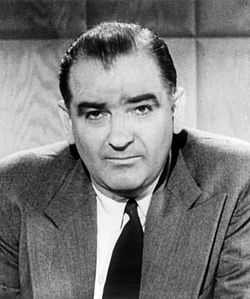
Sen. Joseph McCarthy, R-Wisconsin, who
led the “Red Scare” hearings of the 1950s.

“Smearing is not reporting,” the RootsAction petition says.

“The Washington Post’s recent descent into McCarthyism — promoting anonymous and shoddy claims that a vast range of some 200 websites are all accomplices or tools of the Russian government — violates basic journalistic standards and does real harm to democratic discourse in our country. We urge the Washington Post to prominently retract the article and apologize for publishing it.”

After mentioning that 6,000 people had signed the petition (the number has doubled since then), my email to Baron added: “If you skim through the comments that many of the signers added to the petition online, I think you might find them to be of interest. I wonder if you see a basis for dialogue on the issues raised by critics of the Post piece in question.”

The reply came from the newspaper’s vice president for public relations, Kristine Coratti Kelly, who thanked me “for reaching out to us” before presenting the Post’s response, quoted here in full:

“The Post reported on the work of four separate sets of researchers, as well as independent experts, who have examined Russian attempts to influence American democracy. PropOrNot was one. The Post did not name any of the sites on PropOrNot’s list of organizations that it said had — wittingly or unwittingly — published or echoed Russian propaganda. The Post reviewed PropOrNot’s findings and our questions about them were answered satisfactorily during the course of multiple interviews.”

Full of Holes


But that damage-control response was as full of holes as the news story it tried to defend.

For one thing, PropOrNot wasn’t just another source for the Post’s story. As The New Yorker noted in a devastating article on Dec. 1, the story “prominently cited the PropOrNot research.” The Post’s account “had the force of revelation, thanks in large part to the apparent scientific authority of PropOrNot’s work: the group released a 32-page report detailing its methodology, and named names with its list of 200 suspect news outlets…. But a close look at the report showed that it was a mess.”

Contrary to the PR message from the Post vice president, PropOrNot did not merely say that the sites on its list had “published or echoed Russian propaganda.” Without a word of the slightest doubt or skepticism in the entire story, the Post summarized PropOrNot’s characterization of all the websites on its list as falling into two categories: “Some players in this online echo chamber were knowingly part of the propaganda campaign, the researchers concluded, while others were ‘useful idiots’ — a term born of the Cold War to describe people or institutions that unknowingly assisted Soviet Union propaganda efforts.”

As The New Yorker pointed out, PropOrNot’s criteria for incriminating content were broad enough to include “nearly every news outlet in the world, including the Post itself.” Yet “The List” is not a random list by any means — it’s a targeted mish-mash, naming websites that are not within shouting distance of the U.S. corporate and foreign policy establishment.

And so the list includes a few overtly Russian-funded outlets; some other sites generally aligned with Kremlin outlooks; many pro-Trump sites, often unacquainted with what it means to be factual and sometimes overtly racist; and other websites that are quite different — solid, factual, reasonable — but too progressive or too anti-capitalist or too libertarian or too right-wing or just plain too independent-minded for the evident tastes of whoever is behind PropOrNot.

As The New Yorker’s writer Adrian Chen put it:

“To PropOrNot, simply exhibiting a pattern of beliefs outside the political mainstream is enough to risk being labeled a Russian propagandist.” 

And he concluded: “Despite the impressive-looking diagrams and figures in its report, PropOrNot’s findings rest largely on innuendo and conspiracy thinking.”

As for the Post vice president’s defensive phrasing that “the Post did not name any of the sites on PropOrNot’s list,” the fact is that the Post unequivocally promoted PropOrNot, driving web traffic to its site and adding a hotlink to the anonymous group’s 32-page report soon after the newspaper’s story first appeared. As I mentioned in my reply to her: “Unfortunately, it’s kind of like a newspaper saying that it didn’t name any of the people on the Red Channels blacklist in 1950 while promoting it in news coverage, so no problem.”

Pushing McCarthyism


As much as the Post news management might want to weasel out of the comparison, the parallels to the advent of the McCarthy Era are chilling. For instance, the Red Channels list, with 151 names on it, was successful as a weapon against dissent and free speech in large part because, early on, so many media outlets of the day actively aided and abetted blacklisting, as the Post has done for “The List.”

Consider how the Post story described the personnel of PropOrNot in favorable terms even while hiding all of their identities and thus shielding them from any scrutiny — calling them “a nonpartisan collection of researchers with foreign policy, military and technology backgrounds.”

So far The New Yorker has been the largest media outlet to directly confront the Post’s egregious story. Cogent assessments can also be found at The Intercept, Consortium News, Common Dreams, AlterNet, Rolling Stone, Fortune, CounterPunch, The Nation and numerous other sites.

But many mainline journalists and outlets jumped at the chance to amplify the Post’s piece of work. A sampling of the cheers from prominent journalists and liberal partisans was published by FAIR.org under the apt headline “Why Are Media Outlets Still Citing Discredited ‘Fake News’ Blacklist?”

FAIR’s media analyst Adam Johnson cited enthusiastic responses to the bogus story from journalists like Bloomberg’s Sahil Kupar and MSNBC’s Joy Reid — and such outlets as USA Today, Gizmodo, the PBS NewsHour, The Daily Beast, Slate, AP, The Verge and NPR, which “all uncritically wrote up the Post’s most incendiary claims with little or minimal pushback.” On the MSNBC site, the Rachel Maddow Show’s blog “added another breathless write-up hours later, repeating the catchy talking point that ‘it was like Russia was running a super PAC for Trump’s campaign.’”

With so many people understandably upset about Trump’s victory, there’s an evident attraction to blaming the Kremlin, a convenient scapegoat for Hillary Clinton’s loss. But the Post’s blacklisting story and the media’s amplification of it — and the overall political environment that it helps to create — are all building blocks for a reactionary order, threatening the First Amendment and a range of civil liberties.

When liberals have green-lighted a witch-hunt, right wingers have been pleased to run with it. President Harry Truman issued an executive order in March 1947 to establish “loyalty” investigations in every agency of the federal government. Joe McCarthy and the era named after him were soon to follow.

In media and government, the journalists and officials who enable blacklisting are cravenly siding with conformity instead of democracy.
Norman Solomon is co-founder of the online activist group RootsAction.org. His books include War Made Easy: How Presidents and Pundits Keep Spinning Us to Death. He is the executive director of the Institute for Public Accuracy.