Wednesday, March 29, 2017

Running Back Russia-gate's Sleazy Beginnings

The Sleazy Origins of Russia-gate 

by Robert Parry - Consortium News


March 29, 2017

An irony of the escalating hysteria about the Trump camp’s contacts with Russians is that one presidential campaign in 2016 did exploit political dirt that supposedly came from the Kremlin and other Russian sources.

Friends of that political campaign paid for this anonymous hearsay material, shared it with American journalists and urged them to publish it to gain an electoral advantage.

But this campaign was not Donald Trump’s; it was Hillary Clinton’s.


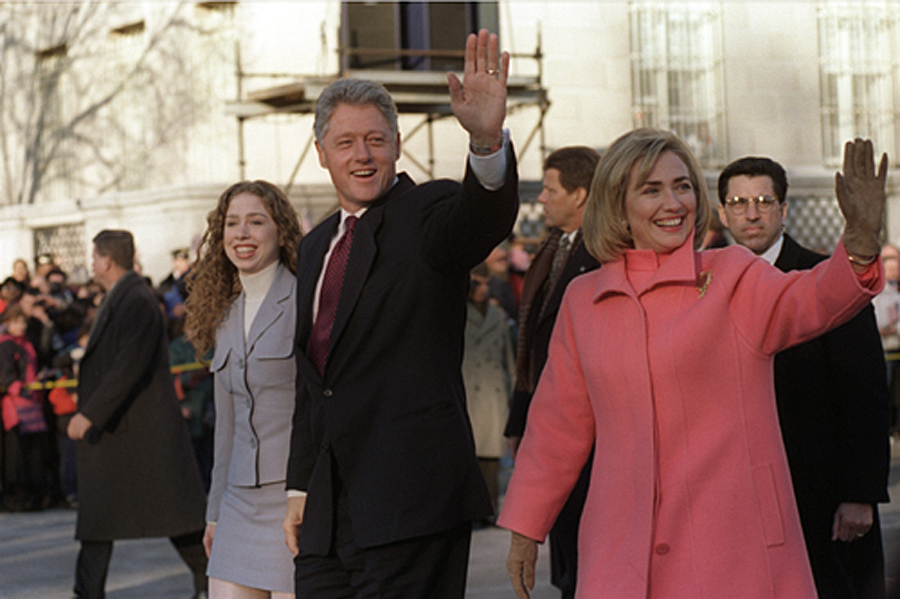
Former Secretary of State Hillary Clinton.

And, awareness of this activity doesn’t require you to spin conspiracy theories about what may or may not have been said during some seemingly innocuous conversation. In this case, you have open admissions about how these Russian/Kremlin claims were used.

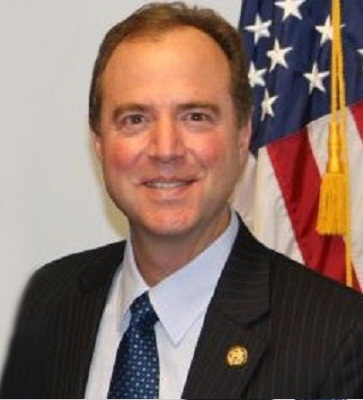
Indeed, you have the words of Rep. Adam Schiff, the ranking Democratic member of the House Intelligence Committee, in his opening statement at last week’s public hearing on so-called “Russia-gate.” Schiff’s seamless 15-minute narrative of the Trump campaign’s alleged collaboration with Russia followed the script prepared by former British intelligence officer Christopher Steele who was hired as an opposition researcher last June to dig up derogatory information on Donald Trump.

Steele, who had worked for Britain’s MI-6 in Russia, said he tapped into ex-colleagues and unnamed sources inside Russia, including leadership figures in the Kremlin, to piece together a series of sensational reports that became the basis of the current congressional and FBI investigations into Trump’s alleged ties to Moscow.

Since he was not able to go to Russia himself, Steele based his reports mostly on multiple hearsay from anonymous Russians who claim to have heard some information from their government contacts before passing it on to Steele’s associates who then gave it to Steele who compiled this mix of rumors and alleged inside dope into “raw” intelligence reports.

Lewd Allegations


Besides the anonymous sourcing and the sources’ financial incentives to dig up dirt, Steele’s reports had numerous other problems, including the inability of a variety of investigators to confirm key elements, such as the salacious claim that several years ago Russian intelligence operatives secretly videotaped Trump having prostitutes urinate on him while he lay in the same bed in Moscow’s Ritz-Carlton used by President Obama and First Lady Michelle Obama.

That tantalizing tidbit was included in Steele’s opening report to his new clients, dated June 20, 2016. Apparently, it proved irresistible in whetting the appetite of Clinton’s mysterious benefactors who were financing Steele’s dirt digging and who have kept their identities (and the amounts paid) hidden. Also in that first report were the basic outlines of what has become the scandal that is now threatening the survival of Trump’s embattled presidency.

But Steele’s June report also reflected the telephone-tag aspects of these allegations:

“Speaking to a trusted compatriot in June 2016 sources A and B, a senior Russian Foreign Ministry figure and a former top level Russian intelligence officer still active inside the Kremlin respectively, the Russian authorities had been cultivating and supporting US Republican presidential candidate, Donald TRUMP for a least 5 years.
“Source B asserted that the TRUMP operation was both supported and directed by Russian President Vladimir PUTIN. Its aim was to sow discord and disunity both within the US itself, but more especially within the Transatlantic alliance which was viewed as inimical to Russia’s interests. … In terms of specifics, Source A confided that the Kremlin had been feeding TRUMP and his team valuable intelligence on his opponents, including Democratic presidential candidate Hillary CLINTON, for several years. …
“The Kremlin’s cultivation operation on TRUMP also had comprised offering him various lucrative real estate development business deals in Russia, especially in relation to the ongoing 2018 World Cup soccer tournament. However, so far, for reasons unknown, TRUMP had not taken up any of these.”

Besides the anonymous and hearsay quality of the allegations, there are obvious logical problems, especially the point that five years ago, you could have gotten astronomical odds about Trump’s chances to win the U.S. presidency, although perhaps there is more an astrological explanation. Maybe the seemingly logical Putin went to some stargazing soothsayer to see the future.

There also may have been a more mundane reason why Trump’s hotel deal fell through. A source familiar with those negotiations told me that Trump had hoped to get a half interest in the $2 billion project but that Russian-Israeli investor Mikhail Fridman, a founder of Russia’s Alfa Bank, balked because Trump was unwilling to commit a significant investment beyond the branding value of the Trump name.

Yet, one would assume that if the supposedly all-powerful Putin wanted to give a $1 billion or so payoff to his golden boy, Donald Trump, whom Putin just knew would become President in five years, the deal would have happened.

Whetting the Appetite


Despite the dubious quality of Steele’s second- and third-hand information, the June report appears to have won the breathless attention of Team Clinton. And once the bait was taken, Steele continued to produce his conspiracy-laden reports, totaling at least 17 through Dec. 13, 2016.

The reports not only captivated the Clinton political operatives but influenced the assessments of Obama’s appointees in the U.S. intelligence community. In the last weeks of the Obama administration, I was told that the outgoing intelligence chiefs had found no evidence to verify Steele’s claims but nevertheless believed them to be true.

Still, a careful analysis of Steele’s reports would have discovered not only apparent factual inaccuracies, such as putting Trump lawyer Michael Cohen at a meeting with a Russian official in Prague (when Cohen says he’s never been to Prague), but also the sort of broad conspiracy-mongering that the mainstream U.S. news media usually loves to ridicule.

For instance, Steele’s reports pin a range of U.S. political attitudes on Russian manipulation rather than the notion that Americans can reach reasonable conclusions on their own. In one report dated Sept. 14, 2016, Steele claimed that an unnamed senior official in President Vladimir Putin’s Presidential Administration (or PA) explained how Putin used the alleged Russian influence operation to generate opposition to Obama’s Pacific trade deals.

Steele wrote that Putin’s intention was “pushing candidate CLINTON away from President OBAMA’s policies. The best example of this was that both candidates [Clinton and Trump] now openly opposed the draft trade agreements, TPP and TTIP, which were assessed by Moscow as detrimental to Russian interests.”

In other words, the Russians supposedly intervened in the U.S. presidential campaign to turn the leading candidates against Obama’s trade deals. But how credible is that? Are we to believe that American politicians – running the gamut from Senators Bernie Sanders and Elizabeth Warren through former Secretary of State Hillary Clinton to President Donald Trump – have all been tricked by the Kremlin to oppose those controversial trade deals, which are also broadly unpopular with the American people who are sick and tired of trade agreements that cost them jobs?

Steele’s investigative dossier suggests that we can’t really think for ourselves. We are all Putin’s puppets.

Greater Skepticism?


Normally, such a ludicrous claim – along with the haziness of the sourcing – would demand greater skepticism about the rest of Steele’s feverish charges, but a curious aspect of the investigations into Russia’s alleged “meddling” in Election 2016 is that neither Steele nor the “oppo research” company, Fusion GPS, that hired him – reportedly with funding from Clinton allies – has been summoned to testify.

Usually, official investigations begin with testimony from the people who are making the allegations, so their credibility and motives can be tested in an adversarial setting. Plus, some baseline information should be established: Who, for instance, paid for the contract? How much was the total and how much went to Steele? How much did Steele then pay his Russian contacts and did they, in turn, pay the alleged Russian insiders for information? Or are we supposed to believe that these “insiders” risked being identified as spies out of a commitment to the truth?

None of these answers would necessarily discredit the information, but they could provide important context as to whether this “oppo” team had a financial motive to sex-up the reports to keep Clinton’s friends coming back for more. Arguably the funders of this “oppo” research should be called to testify as well regarding whether they would have kept ponying up more money if Steele’s reports had concluded that there were no meaningful contacts between Trump’s people and the Russians. Were they seeking the truth or just dirt to help Hillary Clinton win?

Since last November’s election, Steele has ducked public inquiries and Glenn Simpson, the former Wall Street Journal journalist who heads Fusion GPS, has refused to divulge who hired his firm or answer other relevant questions. That means we still don’t know which Clinton friends paid for the dirt and how much money was given to subcontractors like Steele and his Russian associates. (One source told me it may have totaled around $1 million.)

According to various press reports, Fusion GPS first worked for a Republican opponent of Trump’s, but then switched over to the Clinton side after Trump won the Republican race. With Steele generating his reports every few days or every few weeks, people close to Clinton’s campaign saw the Russia allegations as a potential game-changer. They reached out to reporters to persuade them to publish Steele’s allegations even if they could not be verified.

Before the election, a longtime Clinton operative briefed me on aspects of Steele’s investigation, including the “golden shower” allegations, and urged me to at least publish the accusations as a rumor citing the fact that some major news organizations were looking into the charges, an offer that I declined.

In a different setting – when Gov. Bill Clinton was seeking the presidency and Republican “oppo” researchers were pushing various wild and salacious allegations about him – the Clinton team dismissed such claims and the motivations of the people behind them as “cash for trash.”

Following the Storyline 


Yet, Schiff’s opening statement at the hearing on March 20 relied heavily on Steele’s narrative and the supposed credibility of the ex-British spy and his anonymous Russian sources, even to the point of naming Americans who presumably joined in a scheme to collaborate with the Russians to help rig the U.S. election, an act that some commenters have compared to treason.

The California Democrat said, 


“Russian sources tell [Steele] that [Carter] Page [a Trump foreign policy adviser who made a public trip to Russia in early July 2016] also had a secret meeting with Igor Sechin, CEO of Russian gas giant Rosneft. … According to Steele’s Russian sources, Page is offered brokerage fees by Sechin on a deal involving a 19 percent share of the company.”

These “Russian sources” also tell Steele, according to Schiff, that “the Trump campaign is offered documents damaging to Hillary Clinton, which the Russians would publish through an outlet that gives them deniability, like Wikileaks. The hacked documents would be in exchange for a Trump Administration policy that de-emphasizes Russia’s invasion of Ukraine and instead focuses on criticizing NATO countries for not paying their fare share.”

Schiff continued:

“Is it a coincidence that the Russian gas company Rosneft sold a 19 percent share after former British Intelligence Officer Steele was told by Russian sources that Carter Page was offered fees on a deal of just that size? Is it a coincidence that Steele’s Russian sources also affirmed that Russia had stolen documents hurtful to Secretary Clinton that it would utilize in exchange for pro-Russian policies that would later come to pass?”

However, is it also not possible that Steele and his profit-making colleagues made their reports conform to details that already were known or that they had reason to believe would occur, in other words, to match up their claims with independently known facts to give them greater credibility? That is a classic way for conmen to establish “credibility” with marks who are either gullible or simply want to believe.

Also, clever prosecutors in presenting a “circumstantial case” – as Schiff was doing on March 20 – can make innocent coincidences look suspicious. For instance, though Trump’s resistance to escalating tensions with Russia were well known through the primary campaign, Schiff made a big deal out of the fact that Trump’s people opposed a plank in the Republican platform that called for shipping lethal military supplies to Ukraine for the government’s war against ethnic Russian rebels in the east. Schiff presents that as the quo for the quid of the Russians supplying purloined emails from the Democratic National Committee to WikiLeaks (although WikiLeaks denies getting the emails from the Russians).

In his opening statement, Schiff said:

“In the middle of July, Paul Manafort, the Trump campaign manager and someone who was long on the payroll of pro-Russian Ukrainian interests, attends the Republican Party convention. Carter Page, back from [a business meeting in] Moscow, also attends the convention.
“According to Steele, it was Manafort who chose Page to serve as a go-between for the Trump campaign and Russian interests. [Russian] Ambassador [Sergey] Kislyak, who presides over a Russian embassy in which diplomatic personnel would later be expelled as likely spies, also attends the Republican Party convention and meets with Carter Page and additional Trump Advisors J.D. Gordon and Walid Phares. It was J.D. Gordon who approved Page’s trip to Moscow.
“Ambassador Kislyak also meets with Trump campaign national security chair and now Attorney General Jeff Sessions. Sessions would later deny meeting with Russian officials during his Senate confirmation hearing. Just prior to the convention, the Republican Party platform is changed, removing a section that supports the provision of ‘lethal defensive weapons’ to Ukraine, an action that would be contrary to Russian interests.
“Manafort categorically denies involvement by the Trump campaign in altering the platform. But the Republican Party delegate who offered the language in support of providing defensive weapons to Ukraine states that it was removed at the insistence of the Trump campaign. Later, J.D. Gordon admits opposing the inclusion of the provision at the time it was being debated and prior to its being removed.”

Problems with the Conspiracy


So, not only is Schiff relying on Steele to provide key links in the conspiracy chain but Schiff ignores the surrounding reality that Trump had long opposed the idea of escalating the confrontation with Russia in Ukraine – as, by the way, did President Obama who resisted pressure to send lethal military hardware to Ukraine.

Plus, Schiff ignores other logical points, including that party platforms are essentially meaningless and that the savvy Putin would not likely take the huge risk of offending the odds-on winner of the presidential race, Hillary Clinton, for something as pointless as a word change in the GOP platform.

There is also the point that if Trump were a true “Manchurian candidate,” he would have taken the more politically popular position of bashing Russia during the campaign and only reverse course after he got into the White House. That’s how the scheme is supposed to work. (And, of course, all embassies including American ones have spies assigned to them, so there is nothing unusual about Ambassador Kislyak presiding at an embassy with spies.)

Other independent-minded journalists have noted various chronological problems with Steele’s narrative, such as Marcy Wheeler at her emptywheel.net Web site.

In other words, there are huge holes in both the evidence and the logic of Schiff’s conspiracy theory. But you wouldn’t know that from watching and reading the fawning commentary about Schiff’s presentation in the mainstream U.S. news media, which has been almost universally hostile to Trump (which is not to say that there aren’t sound reasons to consider the narcissistic, poorly prepared Trump to be unfit to serve as President of the United States).

The journalistic problem is that everyone deserves to get a fair shot from reporters who are supposed to be objective and fair regardless of a person’s popularity or notoriety or what the reporter may personally feel. That standard should apply to everyone, whether you’re a foreign leader despised by the U.S. government or a politician detested for your obnoxious behavior.

There is no professional justification for journalists joining in a TV-and-print lynch mob. We also have seen too often where such wrongheaded attitudes lead, such as to the groupthink that Iraq’s hated dictator Saddam Hussein was hiding WMDs, or in an earlier time to the McCarthyism that destroyed the lives of Americans who were smeared as unpatriotic because of their dissident political views.

So, yes, even Donald Trump deserves not to be railroaded by a mainstream media that wants desperately – along with other powerful forces in Official Washington – to see him run out of town on a rail and will use any pretext to do so, even if it means escalating the risks of a nuclear war with Russia.

And, if mainstream media commentators truly want a thorough and independent investigation, they should be demanding that it start by summoning the people who first made the allegations.

Investigative reporter Robert Parry broke many of the Iran-Contra stories for The Associated Press and Newsweek in the 1980s. You can buy his latest book, America’s Stolen Narrative, either in print here or as an e-book (from Amazon and barnesandnoble.com).

US Senate Approve NATO Expansion to Montenegro

US Senate approves Montenegro NATO accession bid ‘to stand up to Kremlin’

by RT


29 Mar, 2017
 
In an almost unanimous vote, the US Senate supported further expansion of NATO, allowing Montenegro – a country bombed by the bloc during the 1999 war in Yugoslavia – to enter the alliance and “send a clear message” to Russia.

The long-delayed Senate vote was 97-2 in favor of Montenegro's accession. The number of ‘yes’ votes was well above the two-thirds majority necessary to green-light Montenegro's membership bid.

The vote to allow the tiny Balkan country to enter NATO was directed at Moscow, according to remarks by some Senators.

“With Russia's resurgence and quest for renewed great power status, NATO has given notice that it will stand up for Western democracies too — and has continued to do so," Senate Majority Leader Mitch McConnell (R-Kentucky) said.

"With a nearly unanimous vote, the Senate has sent a clear message that it stands firmly with Montenegro and against the Kremlin's bullying," said Senator Jeanne Shaheen, a Democratic member of the Senate Foreign Relations Committee, as cited by Reuters.

All 28 NATO members must ratify Montenegro's accession bid, and Washington is among the last to do so.

The two votes against were cast by Republican Senators Mike Lee of Utah and Rand Paul of Kentucky. Critics in the US questioned the benefits a country with just 650,000 residents might bring to the alliance. Arguing that Montenegro has a military with just 2,000 personnel, Rand Paul said its membership would "add another country to the welfare wagon of NATO."

In Montenegro, joining the military bloc is deemed controversial as the country was bombed several times during the 1999 NATO campaign in Yugoslavia. The bombing, conducted without the authorization of the UN Security Council, left hundreds of civilians killed, with many public buildings, bridges, industrial facilities and cultural heritage sites damaged or destroyed in airstrikes.

READ MORE: The US plan for Macedonia: Keep Serbia down and Russia out

Over the past few months, massive anti-NATO rallies were held in the Montenegrin capital, Podgorica, with protesters carrying photographs of people killed in the 1999 bombings. Notably, according to a survey released in December 2016 by the Podgorica-based pollster CEDEM, 50.12 percent of Montenegrins opposed NATO membership.

Russia has consistently opposed NATO expansion, saying it will have negative ramifications on European security. In June last year, Russian President Vladimir Putin said Montenegro does not face any military threats, describing its accession bid as unfounded.

“Reasons for Montenegro to enter the alliance are unclear. Is someone threatening it?” Putin said at the Saint Petersburg International Economic Forum, also mentioning “the bloc’s blatant disregard of our position.” The Russian president added that NATO is continuing its drive eastwards even in the absence of military adversaries.

READ MORE: NATO, Russia hold Balkan drills amid growing Eastern European tensions

Speaking at the Munich Security Conference in February, Russian Foreign Minister Sergey Lavrov said “NATO expansion has led to tensions unseen in Europe for the last 30 years,” adding that “the Cold War did not end, judging by some remarks made during the conference.”

In December last year, Lavrov told Sputnik news agency that Montenegro’s leadership had “betrayed all [their] commitments and promises, betrayed Russia, although Russia did not do anything to [them],” referring to Montenegro’s signing of the NATO Accession Protocol in May 2016.

Philippines Governor Crosses Pacific to Warn El Salvador Off OceanaGold

As Salvadoran congress prepares to vote on unprecedented bill to end metal mining, governor from the Philippines crisscrosses El Salvador to reveal impact of OceanaGold’s operations in his province

by MiningWatch Canada


29 March 2017

San Salvador/Ottawa - Visiting this Central American nation on the eve of a historic vote on legislation to ban metallic mining, a government official from the Philippines is warning Salvadoran political leaders that the mining company trying to gain a foothold here has wreaked social and environmental havoc with its operations in the Philippines.

Governor Carlos Padilla speaks at public forum in 
El Salvador; Photo: Robin Broad

“The reality of OceanaGold's so-called 'responsible mining' in the Philippines has been an environmental disaster. Judge it by the reality of its mining operations in my country not by its words or promises,” remarked the Governor of the province of Nueva Vizcaya, the Honourable Carlos Padilla.

While in El Salvador, Governor Padilla has testified before members of the public and in legislative forums about the serious impacts of Australian-Canadian mining company OceanaGold’s operations in the Philippines, calling on the Salvadoran legislators to take action on a bill that may take El Salvador further than any nation in banning mining.

“With photos, videos & very clear data, Governor Padilla and his engineer have demonstrated how OceanaGold has flaunted rules & regulations in the Philippines -- from environmental regulations to labour laws,” said Robin Broad, Professor of International Development at American University in Washington, who is accompanying the delegation from the Philippines in El Salvador.

On the topic of water—a crucial matter in this parched Central American nation—Padilla observes that OceanaGold’s open-pit mining in his province of Nueva Vizcaya has put a critical watershed at risk, and exhausted wells and rice irrigation reservoirs, harming in particular the communities around the company's Didipio mine.

According to the Governor, the mining company's Didipio gold and copper mine has destroyed 975 acres of grasslands, forests and species habitats and incited strife, theft and respiratory problems in neighbouring communities.

In El Salvador, OceanaGold has unsuccessfully sought to pressure the government into granting it a mining permit. The company acquired the El Dorado project in the northern province of Cabañas when it purchased Pacific Rim Mining in 2013, whose principal asset was a US$250 million dollar arbitration suit against El Salvador.

Six months ago, in an important ruling for affected communities and the Salvadoran government, the World Bank Group’s international arbitration panel found that El Salvador did not have to pay compensation to the mining company, given that the company never met regulatory requirements to obtain a permit.

According to Broad, the American University professor, the company's case proved to be so weak that the three-person panel ruled unanimously against it. The company had never acquired the rights to all the land in the area it sought to mine, nor had it completed a feasibility study or gotten its environmental license approved.

“The company’s suit against El Salvador and stubborn insistence on sticking around, seem to have worked against it,” Broad said.

“Here in El Salvador, there is broad-based opposition to mining linked to concerns about already stressed water supplies.”

Broad noted that the government of the Philippines recently suspended OceanaGold’s Didipio mine on environmental and social grounds.

In the Philippines, the company has also faced complaints of forcible and illegal demolitions of homes, as well as harassment of residents and violation of indigenous cultural rights, in addition to the effects on the regional water supply. Two community members involved in anti-mining activities were murdered in 2012 in connection with conflict over the mine.

Just after the Governor’s presentation to a Salvadoran legislative committee on Tuesday, members of the Committee on the Environment and Climate Change voted to approve the proposed ban on metallic mining, which goes before the full legislature later today.

In its October ruling, in the seven-year dispute between El Salvador and OceanaGold, the World Bank panel at the International Centre for Settlement of Investment Disputes in Washington ordered the company to pay El Salvador US$8 million in legal costs.

The company has not shown any indication that it will pay. Rather, it has stepped up a public relations campaign in El Salvador to try to persuade the government and the public that it is a responsible company. Yesterday, the World Bank tribunal ruled that the company must pay interest on the money owed.

“Out of respect for the self-determination of the Salvadoran people, it is time for OceanaGold to pay up the $8 million that it owes and pack up from El Salvador,” said Jen Moore, Latin America Program Coordinator for MiningWatch Canada, an Ottawa-based group advocating for communities affected by Canadian mining worldwide.

“The company has tried to bully around the country for long enough with its costly suit, which it should never have been able to bring in the first place."


News Release
29 March 2017

Contact:
Jen Moore, Latin America Program Coordinator, MiningWatch Canada,
jen(at)miningwatch.ca

MiningWatch Canada is a member of the International Allies coalition that acts in solidarity with the National Roundtable against Metallic Mining in El Salvador.


Related
Blog Entry In El Salvador, OceanaGold Must ‘Pay Up and Pack Up’ 23.02.2017
News 280 Organizations with over 180 Million Members Worldwide Tell OceanaGold to Abandon Assault on El Salvador and to “Pack Up and Pay Up” 21.02.2017
News There Are No Winners: After Seven Years and Millions of Dollars, Pac Rim Mining Loses Suit Against El Salvador 14.10.2016
News OceanaGold Not Welcome in El Salvador and the Philippines, Company Told During Toronto Meeting 09.06.2016
News OceanaGold 'persona non grata' en El Salvador y las Filipinas, escucha la empresa durante su reunión en Toronto 08.06.2016

Tuesday, March 28, 2017

Gorilla Radio with Chris Cook, Matt Eisenbrandt, John Helmer, Janine Bandcroft March 29, 2017

This Week on GR

by C. L. Cook - Gorilla-Radio.com


March 29, 2017

37 years have passed since the brutal assassination of Salvadoran Archbishop Óscar Romero, and while Romero's murder is ancient history in the modern media context, it hasn't been allowed to rest forgotten entirely.

There are still those seeking justice for the Archbishop, and it's that search chronicled in the newly released book, 'Assassination of a Saint: The Plot to Murder Óscar Romero and the Quest to Bring His Killers to Justice'.

Matt Eisenbrandt is a Victoria-based human-rights attorney and Legal Director of the Canadian Centre for International Justice.


Listen. Hear.

In addition to the prosecution of war crimes, Matt also focuses on corporate accountability. He's a member of the legal team involved in bringing lawsuits against Nevsun Resources and Tahoe Resources, cases involving the alleged use of slave labour in Eritrean mines, and human rights abuses in Guatemala, to Canadian courts.

Matt will be at Friday's Cafe Simpatico to launch his book, 'Assassination of a Saint' in commemoration of the anniversary of Archbishop Romero's death, and to discuss his human rights work with CCIJ.

Matt Eisenbrandt in the first half.

And; as the crimes and criminals of Latin America's Dirty War are yet to be addressed and arrested, so too the embers of the Cold War have smoldered unchecked. Nearly thirty years past George H. W. Bush's declaration of a "peace dividend" to follow the end of the Soviet empire, a new generation of political opportunist has rediscovered the "Red Menace" and is busy now fanning the flame of a new, and hotter Cold War.

John Helmer is a long-time, Moscow-based journalist, author, and essayist. The Australian says his website, Dances with Bears is the only news bureau “independent of single national or commercial ties.” He’s also a former political science professor who has served as an advisor to governments on three continents and regularly lectures on Russian topics. Helmer's book titles include: ‘Uncovering Russia,’ ‘Urbanman: The Psychology of Urban Survival,’ ‘Bringing the War Home: The American Soldier in Vietnam and After,’ and ‘Drugs and Minority Oppression’ among others.

John’s recent article, 'The US War Had Been Good for President Vladimir Putin, and the Russian Economy Looks Stable Through the Presidential Election. So If You Are a US Warfighter, What Is the Regime Change Opportunity Now?' flies in the face of the latest Western press narrative.

John Helmer and depictions of an unpopular Putin perilously perched atop a precarious Kremlin in the second half.

And; CFUV Radio broadcaster, Janine Bandcroft will be here at the bottom of the hour with the Left Coast Events update of some of the good things going planned around here in the coming week. But first, Matt Eisenbrandt and requiem for an Assassinated Saint.

Chris Cook hosts Gorilla Radio, airing live every Wednesday, 1-2pm Pacific Time. In Victoria at 101.9FM, and on the internet at: http://cfuv.ca.  He also serves as a contributing editor to the web news site, http://www.pacificfreepress.com. Check out the GR blog at: https://gorillaradioblog.blogspot.ca/

G-Radio is dedicated to social justice, the environment, community, and providing a forum for people and issues not covered in the corporate media.

TrumpCare Doesn't (and Neither Does He)

TrumpCare dies, XL flies and the Secret Winner is…

by Greg Palast - OpedNews


March 28, 2017

When RyanCare-TrumpCare finally ended up face-down in the swimming pool, triumphalist Democrats whooped and partied and congratulated themselves on defeating the Trump-Ryan monstrosity.

But deep in their counting house, counting their gold, three brothers cackled with private jubilation. David and Charles Koch knew the day was theirs. 


Koch Brothers celebrate their victory 
(from The Best Democracy Money Can Buy) 

Joining them in the celebration was Brother Billy, William Koch, who will share in their $21 billion windfall that the President arranged for them only hours before TrumpCare crashed—when Trump announced his State Department had formally approved the Keystone XL Pipeline.

Let's start with that $21 billion


The XL Keystone Pipeline would take the world's heaviest, filthiest crude from Canada's tar sands, and snake with it all the way down to Texas.


From Greg Palast’s film The Best Democracy Money Can Buy: 
A Tale of Billionaires and Ballot Bandits


Now here's a question I never hear from our sleep-walking media: Exactly why are we sending oil all the way across the United States to Texas. I mean, doesn't Texas already have a little oil?

In fact, Texas is drowning in oil, choking in it. But the Kochs' Texas refinery can't use much local crude. The Koch Industries Flint Hills refinery on the Texas Gulf Coast was designed specifically to crack only the world's "heaviest" (i.e. filthiest) crude.

Texas crude ain't heavy enough, ain't dirty enough, for the Kochs' Gulf Coast operation, originally designed for imports for the world's major source of heavy crude: Venezuela. The price the Kochs paid for Venezuela's oil was set by its President Hugo Chavez, and now, by Chavez' chosen successor, Nicolas Maduro.

Chavez and Maduro both told me they'd squeeze the Kochs by their tankers.
They have.

Enter the Mounties: Canadians sell their super-heavy crude at a $12 to $30 a barrel discount to the Venezuelan price. If the XL Pipeline is complete, the Kochs can suck down Canada's cheap cruddy crude for a minimum savings of $1.27 billion in a single year.

The Kochs pocket billions while we fry: burning the Canadian tar sands reserve will, all by itself, raise the temperature of the entire planet by 0.7 degrees Fahrenheit.

Over the life of the XL Keystone Pipeline, the various Koch operations will put at minimum, $21 billion in Koch family pockets. Because we have to add in not only Charles' and David's gains, but Brother Billy's windfall as well"

Brother Billy's Filth Factory


Koch Carbon pet-coke dust cloud, Detroit 

The third, lesser-known Koch is Brother William, now principal of Oxbow Carbon. The name itself gives environmentalists the heebee-jeebies.

To keep the tar sands gunk flowing through the Keystone pipeline, the worst of the tar must be extracted and processed as "petcoke," stuff so filthy and toxic it is illegal to burn in the USA. So Billy Koch sells the compressed filth to China and Mexico.

And Billy's bro's have joined the "petcoke" game too. David and Charles' subsidiary, Koch Carbon, already pulls the gunk from the current Keystone pipe where in Detroit it's accumulating in piles bigger than the pyramids. Here's a photo of Koch's coke wafting over Detroit's city parks.

Which explains why the Koch's political front operation, Americans for Prosperity, named approval of the XL Pipeline the number one priority for the Trump presidency.

KochDon'tCare


When TrumpCare breathed its last, the President blamed Democrats for its untimely demise.

A stunned by-stander, Democratic Minority leader Nancy Pelosi, went for it: "We'll take credit for that."

Sorry, Nancy, you can't.

Because it was the Kochs' brownshirts, the self-styled "Freedom Caucus," that, in a bestial assault, crushed a sitting President and their own leader of Congress, Paul Ryan. The thugs' secret weapon: heavy bags of cash, Koch cash.

Koch front groups, including Americans for Prosperity (the XL promoter, promised unlimited funds to any far-right Congressman who would vote against the bill. The Kochs' Freedom Partners Executive Director told members of the uber-right Congressional Freedom Caucus, "We will stand with lawmakers who keep their promise and oppose this legislation" with a "seven-figure" war chest. In the old days, that was called "bribery." But today it's called, "Koch."

Blow-hard Trump threatened them, but Koch's money protected them.

The Kochs don't want ObamaCare, TrumpCare, nor any care at all for Americans that add to their tax bill. Call it KochDon'tCare.

Billionaires versus Billionaires


But keen observers of TrumpCare would note that it was not really a health care bill, but a tax bill–specifically, a tax cut of some $157 billion that has been charged to the richest Americans to fund ObamaCare through a 3.75% tax on passive investment income—that is, money earned, not by working, but by speculating.

Because behind the public creator of the bill, Speaker Paul Ryan, stood Ryan's number one funder, a billionaire known as The Vulture. The Vulture, aka Paul Singer, makes all his money by nasty methods excoriated even in the Wall Street Journal.


Paul 'The Vulture' Singer, from The Best Democracy Money Can Buy 
(Image by Keith Tucker)


In Trump's weird psycho-babbling press conference last month, he said, "So I want to thank Paul Singer for being here and for coming up to the office." Reporters scratched their head, not knowing who this "Singer" is nor why Trump brought it up. Now, you know what that was about.

Singer makes all his money from speculation income. The Ryan-Trump "healthcare" bill was first and foremost a tax cut for Singer, likely worth billions to The Vulture (and more to his cohort including Treasury Secretary Steve Mnuchin).

But to the Kochs, this tax break is nearly worthless. So, behind the curtain, this was a fight of billionaires versus billionaires.

The Kochs, having built up their army of useful idiots—the Koch-funded Tea Party and Freedom Caucus, won this one. (Hey, no hard feelings. The Vulture still dines with the Kochs in Vail and donates to their super-PACs.)

Sure, let's breathe a sigh of relief that, with ObamaCare momentarily saved, we won't have more amputees begging in the subway, meth addicts croaking in New Hampshire and my bank account emptied for my next heart surgery.

It's not Trump's victory that portends fascism—it is the bending of Trump by the hands of the poisonously greedy Brothers Koch that brings the fascist corporatist state one day closer.

And that is nothing to celebrate.


Greg Palast (Rolling Stone, Guardian, BBC) is the author of The New York Times bestsellers, The Best Democracy Money Can Buy and Billionaires & Ballot Bandits, now out as major motion non-fiction movie.
Follow Palast on Twitter | Like Palast on Facebook | Forward to a friend
Subscribe to Palast's Newsletter | Podcasts

Morally Bankrupt, Israel Targets Boycott Leader for "Tax Fraud"

Arrest of Omar Barghouti Comes Amidst Upsurge in International Support for Boycott of Israel

by TRNN

March 28, 2017

One of the founders and best-known promoters of the Boycott, Divestment and Sanctions against Israel, has been arrested last week on charges of tax fraud.

Omar Barghouti is one of the best-known Palestinian activists. His name is mentioned in countless articles about BDS and even Israel's Minister of the Interior, Aryeh Deri, revealed private information about Omar publicly in order to smear him.


After the P5+1 nuclear deal made it difficult for the Israeli government to continue to appeal to the right-wing through casting Iran as the bogeyman, depicting BDS as a 'delegitimization' campaign became its next means of generating fear and paranoia among voters, says journalist Richard Silverstein 


The Interior Minister has also said that he considers revoking Omar's residency status in Israel. Back in May of 2016 Israeli authorities denied Barghouti the right to leave the country and last week Omar was arrested. He was granted bail but actually posted bail and yet he was held for five additional days before he was actually released. This is according to the Boycott National Committee. He was again denied the right to leave the country and is under a gag order precluded from discussing his case publicly. Here is a clip of Omar Barghouti speaking to The Real News back in 2010 to our senior editor, Paul Jay.

Meltdown: What Toshiba's Westinghouse Bankruptcy Means for Future of Nuclear Power

What a Westinghouse Bankruptcy Could Mean for U.S. Utilities

by Leonard Hyman and Bill Tilles - Oilprice.com


March 24, 2017

International news services now report that Japan’s Toshiba Corporation (9502.T) is preparing to make a chapter 11 bankruptcy filing for its Westinghouse Electric subsidiary as soon as this Monday, March 27.*

For most of our readers this news evokes little surprise. This is merely another chapter of a slow moving financial and accounting train wreck involving nuclear design and construction firm Westinghouse and its troubled Japanese parent, Toshiba.

But like an old, leaky garbage scow there is much to clean up in its wake.

The two U.S. utilities with the most at risk are Southern Company and SCANA Corp. Westinghouse is presently constructing two unit, AP 1000 nuclear power stations for each utility. These projects are over-budget and behind schedule.

It appears that Westinghouse offered both utilities a fixed price contract for these new nuclear plants. Our best guess is that this fixed price construction guarantee has doomed Westinghouse and prevented other potentially willing buyers from stepping in. No one it seems is willing to take on this seemingly open-ended nuclear construction liability.

What does this mean for the two domestic utilities embroiled in this international financial quagmire?


  • First, we expect that they will complete both nuclear construction projects. The bulk of heavy capital expenditures for both utilities seem to be in the 2017-2019 period.
  • Second, it is in the interest of all potential litigants to see these plants completed. 

Westinghouse/Toshiba, for one, would at least get to showcase the AP 1000 design and its successor entity could advocate for additional sales of this reactor design. A working design has value. (What happens in the UK is another matter where Toshiba hoped to build several plants). The utilities, which need new power stations, get large, rate based, non-fossil base load power generating resources for the next 40-60 years.

The worst case scenario for utility investors would be if the utilities had to cancel the projects and take big write offs. But we assign a very low probability to this scenario. Perhaps, more likely, a Westinghouse bankruptcy means abrogation of the fixed price contracts signed with Southern and SCANA.

News reports this week indicated that both utilities had hired bankruptcy counsel.

As these plants are brought on line, presumably in the 2020-2021 time frame, the matter will go before the state utility commissions of Georgia and South Carolina. Both commissions approved these nuclear projects. It’s just that the plants will cost more than expected.

Unfortunately for investors, they will have to live with uncertainty until the regulators make their decisions. There are no clear precedents for the decisions, other than that commissions typically allocate or split unexpected financial burdens like these between shareholders and consumers. And that the amounts at risk won’t be modest given the size of the projects.


[*UPDATE: Toshiba Wants Westinghouse to File for  Bankruptcy as Early as Tuesday March 27, 2017 (Reuters)]

American Booty: A Century of Carnage

An American Century of Carnage: Measuring Violence in a Single Superpower World

by John W. Dower - TomDispatch

 
March 28, 2017
 
[This essay is adapted from “Measuring Violence,” the first chapter of John Dower’s new book, The Violent American Century: War and Terror Since World War Two.]  

On February 17, 1941, almost 10 months before Japan’s attack on Pearl Harbor, Life magazine carried a lengthy essay by its publisher, Henry Luce, entitled “The American Century.” The son of Presbyterian missionaries, born in China in 1898 and raised there until the age of 15, Luce essentially transposed the certainty of religious dogma into the certainty of a nationalistic mission couched in the name of internationalism.

Luce acknowledged that the United States could not police the whole world or attempt to impose democratic institutions on all of mankind. Nonetheless, “the world of the 20th Century,” he wrote, “if it is to come to life in any nobility of health and vigor, must be to a significant degree an American Century.” 
 
The essay called on all Americans “to accept wholeheartedly our duty and our opportunity as the most powerful and vital nation in the world and in consequence to exert upon the world the full impact of our influence, for such purposes as we see fit and by such measures as we see fit.”

Tomgram: John Dower, Body Count for the American Century
 
[Note for TomDispatch Readers: With some pride, I’m announcing today the newest Dispatch Book. It’s also the capstone on eminent historian John Dower’s work on America’s wars, including his National Book Critics Circle Award-winning War Without Mercy and his Pulitzer Prize-winning Embracing Defeat. His new book, The Violent American Century: War and Terror Since World War Two, is about to be published. Given the deluge of “news” that is the Trump era and everyone’s sudden lack of reading time, it’s a mercifully short, sharp, timely, and definitive look at what “the American Century” has really meant in terms of violence. I consider it a true must-read for our moment. And I’m not alone.

Among a crowd of people who have praised the book, Noam Chomsky says: “John Dower ends this grim recounting of 75 years of constant war, intervention, assassination, and other crimes by calling for ‘serious consideration’ of why the most powerful nation in world history is so dedicated to these practices while ignoring the nature of its actions and their consequences -- an injunction that could hardly be more timely or necessary as the Pentagon’s ‘arc of instability’ expands to an ‘ocean of instability’ and even an 'atomic arc of instability' in Dower’s perceptive reflections on today’s frightening world." Andrew Bacevich adds: “A timely, compact, and utterly compelling exposé of the myriad contradictions besetting U.S. national security policy... a powerful book.” And Seymour Hersh writes: “No historian understands the human cost of war, with its paranoia, madness, and violence, as does John Dower, and in this deeply researched volume he tells how America, since the end of World War II, has turned away from its ideals and goodness to become a match setting the world on fire.”

I hope all TomDispatch readers will pick-up a copy. You can go to Amazon.com and pre-order one now (and make TD a few cents at no cost to you) by clicking on this link or you can order a copy directly from Haymarket Books at an exclusive discount for TD readers of 50%, simply by clicking on this link and following the checkout instructions you’ll see there. However you do it, buy The Violent American Century and support our new book publishing program! Tom]

Recently, the historian Marilyn Young, an old friend, died. She spent her life writing about America’s wars and a country at war. Her New York Times obituary quoted this telling passage from a speech she gave to the Society for Historians of American Foreign Relations:
 
“I find that I have spent most of my life as a teacher and scholar thinking and writing about war. I moved from war to war, from the War of 1898 and U.S. participation in the Boxer Expedition and the Chinese civil war, to the Vietnam War, back to the Korean War, then further back to World War II and forward to the wars of the twentieth and early twenty-first centuries. Initially, I wrote about all these as if war and peace were discrete: prewar, war, peace, or postwar. Over time, this progression of wars has looked to me less like a progression than a continuation: as if between one war and the next, the country was on hold.”

Curiously enough, with the exception of World War II and Vietnam (for quite different reasons), Americans have lived through our many wars of the last century, years drenched in blood and suffering when this country became the most dominant power on the planet, in a state of relative obliviousness. Nonetheless, peaceable as the United States seemed in those decades domestically, its wars did come home in all sorts of ways or you would have a hard time explaining the militarization of this country, the growth of the Pentagon budget to staggering proportions, and the rise of the national security state (and its surveillance systems).

That’s why John Dower’s new book, The Violent American Century: War and Terror Since World War Two, arrives at such an opportune moment, just as the era of Donald Trump begins with a visible ramping up (yet again) of America’s wars across the Greater Middle East. It offers a rare assessment of what that century’s human toll actually looks like and of our country’s involvement in it. In his article today, adapted from that book’s first chapter, Dower offers some striking thoughts on how to begin to measure the toll of the last 75 years of global war and conflict. And I must admit that, under the circumstances, it seems particularly fitting to me that Marilyn Young gave what must have been the last blurb of her life to his book, writing, “In The Violent American Century, John Dower has produced a sharply eloquent account of the use of U.S. military power since World War II. From ‘hot’ Cold War conflicts to drone strikes, Dower examines the machinery of American violence and its staggering toll. This is an indispensable book.” Tom
 

An American Century of Carnage: Measuring Violence in a Single Superpower World

by John W. Dower


Japan’s attack on Pearl Harbor propelled the United States wholeheartedly onto the international stage Luce believed it was destined to dominate, and the ringing title of his cri de coeur became a staple of patriotic Cold War and post-Cold War rhetoric. Central to this appeal was the affirmation of a virtuous calling. Luce’s essay singled out almost every professed ideal that would become a staple of wartime and Cold War propaganda: freedom, democracy, equality of opportunity, self-reliance and independence, cooperation, justice, charity -- all coupled with a vision of economic abundance inspired by “our magnificent industrial products, our technical skills.” In present-day patriotic incantations, this is referred to as “American exceptionalism.”

The other, harder side of America’s manifest destiny was, of course, muscularity. Power. Possessing absolute and never-ending superiority in developing and deploying the world’s most advanced and destructive arsenal of war. Luce did not dwell on this dimension of “internationalism” in his famous essay, but once the world war had been entered and won, he became its fervent apostle -- an outspoken advocate of “liberating” China from its new communist rulers, taking over from the beleaguered French colonial military in Vietnam, turning both the Korean and Vietnam conflicts from “limited wars” into opportunities for a wider virtuous war against and in China, and pursuing the rollback of the Iron Curtain with “tactical atomic weapons.” As Luce’s incisive biographer Alan Brinkley documents, at one point Luce even mulled the possibility of “plastering Russia with 500 (or 1,000) A bombs” -- a terrifying scenario, but one that the keepers of the U.S. nuclear arsenal actually mapped out in expansive and appalling detail in the 1950s and 1960s, before Luce’s death in 1967.

The “American Century” catchphrase is hyperbole, the slogan never more than a myth, a fantasy, a delusion. Military victory in any traditional sense was largely a chimera after World War II. The so-called Pax Americana itself was riddled with conflict and oppression and egregious betrayals of the professed catechism of American values. At the same time, postwar U.S. hegemony obviously never extended to more than a portion of the globe. Much that took place in the world, including disorder and mayhem, was beyond America’s control.

Yet, not unreasonably, Luce’s catchphrase persists. The twenty-first-century world may be chaotic, with violence erupting from innumerable sources and causes, but the United States does remain the planet’s “sole superpower.” The myth of exceptionalism still holds most Americans in its thrall. U.S. hegemony, however frayed at the edges, continues to be taken for granted in ruling circles, and not only in Washington. And Pentagon planners still emphatically define their mission as “full-spectrum dominance” globally.

Washington’s commitment to modernizing its nuclear arsenal rather than focusing on achieving the thoroughgoing abolition of nuclear weapons has proven unshakable. So has the country’s almost religious devotion to leading the way in developing and deploying ever more “smart” and sophisticated conventional weapons of mass destruction.

Welcome to Henry Luce’s -- and America’s -- violent century, even if thus far it’s lasted only 75 years. The question is just what to make of it these days.

Counting the Dead


We live in times of bewildering violence. In 2013, the chairman of the Joint Chiefs of Staff told a Senate committee that the world is “more dangerous than it has ever been.” Statisticians, however, tell a different story: that war and lethal conflict have declined steadily, significantly, even precipitously since World War II.

Much mainstream scholarship now endorses the declinists. In his influential 2011 book, The Better Angels of Our Nature: Why Violence Has Declined, Harvard psychologist Steven Pinker adopted the labels “the Long Peace” for the four-plus decades of the Cold War (1945-1991), and “the New Peace” for the post-Cold War years to the present. In that book, as well as in post-publication articles, postings, and interviews, he has taken the doomsayers to task. The statistics suggest, he declares, that “today we may be living in the most peaceable era in our species’s existence.”

Clearly, the number and deadliness of global conflicts have indeed declined since World War II. This so-called postwar peace was, and still is, however, saturated in blood and wracked with suffering.

It is reasonable to argue that total war-related fatalities during the Cold War decades were lower than in the six years of World War II (1939–1945) and certainly far less than the toll for the twentieth century’s two world wars combined. It is also undeniable that overall death tolls have declined further since then. The five most devastating intrastate or interstate conflicts of the postwar decades -- in China, Korea, Vietnam, Afghanistan, and between Iran and Iraq -- took place during the Cold War. So did a majority of the most deadly politicides, or political mass killings, and genocides: in the Soviet Union, China (again), Yugoslavia, North Korea, North Vietnam, Sudan, Nigeria, Indonesia, Pakistan/Bangladesh, Ethiopia, Angola, Mozambique, and Cambodia, among other countries. The end of the Cold War certainly did not signal the end of such atrocities (as witness Rwanda, the Congo, and the implosion of Syria). As with major wars, however, the trajectory has been downward.

Unsurprisingly, the declinist argument celebrates the Cold War as less violent than the global conflicts that preceded it, and the decades that followed as statistically less violent than the Cold War. But what motivates the sanitizing of these years, now amounting to three-quarters of a century, with the label “peace”? The answer lies largely in a fixation on major powers. The great Cold War antagonists, the United States and the Soviet Union, bristling with their nuclear arsenals, never came to blows. Indeed, wars between major powers or developed states have become (in Pinker’s words) “all but obsolete.” There has been no World War III, nor is there likely to be.

Such upbeat quantification invites complacent forms of self-congratulation. (How comparatively virtuous we mortals have become!) In the United States, where we-won-the-Cold-War sentiment still runs strong, the relative decline in global violence after 1945 is commonly attributed to the wisdom, virtue, and firepower of U.S. “peacekeeping.” In hawkish circles, nuclear deterrence -- the Cold War’s MAD (mutually assured destruction) doctrine that was described early on as a “delicate balance of terror” -- is still canonized as an enlightened policy that prevented catastrophic global conflict.

What Doesn’t Get Counted


Branding the long postwar era as an epoch of relative peace is disingenuous, and not just because it deflects attention from the significant death and agony that actually did occur and still does. It also obscures the degree to which the United States bears responsibility for contributing to, rather than impeding, militarization and mayhem after 1945. Ceaseless U.S.-led transformations of the instruments of mass destruction -- and the provocative global impact of this technological obsession -- are by and large ignored.

Continuities in American-style “warfighting” (a popular Pentagon word) such as heavy reliance on airpower and other forms of brute force are downplayed. So is U.S. support for repressive foreign regimes, as well as the destabilizing impact of many of the nation’s overt and covert overseas interventions. The more subtle and insidious dimension of postwar U.S. militarization -- namely, the violence done to civil society by funneling resources into a gargantuan, intrusive, and ever-expanding national security state -- goes largely unaddressed in arguments fixated on numerical declines in violence since World War II.

Beyond this, trying to quantify war, conflict, and devastation poses daunting methodological challenges. Data advanced in support of the decline-of-violence argument is dense and often compelling, and derives from a range of respectable sources. Still, it must be kept in mind that the precise quantification of death and violence is almost always impossible. When a source offers fairly exact estimates of something like “war-related excess deaths,” you usually are dealing with investigators deficient in humility and imagination.

Take, for example, World War II, about which countless tens of thousands of studies have been written. Estimates of total “war-related” deaths from that global conflict range from roughly 50 million to more than 80 million. One explanation for such variation is the sheer chaos of armed violence. Another is what the counters choose to count and how they count it. Battle deaths of uniformed combatants are easiest to determine, especially on the winning side. Military bureaucrats can be relied upon to keep careful records of their own killed-in-action -- but not, of course, of the enemy they kill. War-related civilian fatalities are even more difficult to assess, although -- as in World War II -- they commonly are far greater than deaths in combat.

Does the data source go beyond so-called battle-related collateral damage to include deaths caused by war-related famine and disease? Does it take into account deaths that may have occurred long after the conflict itself was over (as from radiation poisoning after Hiroshima and Nagasaki, or from the U.S. use of Agent Orange in the Vietnam War)? The difficulty of assessing the toll of civil, tribal, ethnic, and religious conflicts with any exactitude is obvious.

Concentrating on fatalities and their averred downward trajectory also draws attention away from broader humanitarian catastrophes. In mid-2015, for instance, the Office of the United Nations High Commissioner for Refugees reported that the number of individuals “forcibly displaced worldwide as a result of persecution, conflict, generalized violence, or human rights violations” had surpassed 60 million and was the highest level recorded since World War II and its immediate aftermath. Roughly two-thirds of these men, women, and children were displaced inside their own countries. The remainder were refugees, and over half of these refugees were children.

Here, then, is a trend line intimately connected to global violence that is not heading downward. In 1996, the U.N.’s estimate was that there were 37.3 million forcibly displaced individuals on the planet. Twenty years later, as 2015 ended, this had risen to 65.3 million -- a 75% increase over the last two post-Cold War decades that the declinist literature refers to as the “new peace.”

Other disasters inflicted on civilians are less visible than uprooted populations. Harsh conflict-related economic sanctions, which often cripple hygiene and health-care systems and may precipitate a sharp spike in infant mortality, usually do not find a place in itemizations of military violence. U.S.-led U.N. sanctions imposed against Iraq for 13 years beginning in 1990 in conjunction with the first Gulf War are a stark example of this. An account published in the New York Times Magazine in July 2003 accepted the fact that “at least several hundred thousand children who could reasonably have been expected to live died before their fifth birthday.” And after all-out wars, who counts the maimed, or the orphans and widows, or those the Japanese in the wake of World War II referred to as the “elderly orphaned” -- parents bereft of their children?

Figures and tables, moreover, can only hint at the psychological and social violence suffered by combatants and noncombatants alike. It has been suggested, for instance, that one in six people in areas afflicted by war may suffer from mental disorder (as opposed to one in ten in normal times). Even where American military personnel are concerned, trauma did not become a serious focus of concern until 1980, seven years after the U.S. retreat from Vietnam, when post-traumatic stress disorder (PTSD) was officially recognized as a mental-health issue.

In 2008, a massive sampling study of 1.64 million U.S. troops deployed to Afghanistan and Iraq between October 2001 and October 2007 estimated “that approximately 300,000 individuals currently suffer from PTSD or major depression and that 320,000 individuals experienced a probable TBI [traumatic brain injury] during deployment.” As these wars dragged on, the numbers naturally increased. To extend the ramifications of such data to wider circles of family and community -- or, indeed, to populations traumatized by violence worldwide -- defies statistical enumeration.

Terror Counts and Terror Fears


Largely unmeasurable, too, is violence in a different register: the damage that war, conflict, militarization, and plain existential fear inflict upon civil society and democratic practice. This is true everywhere but has been especially conspicuous in the United States since Washington launched its “global war on terror” in response to the attacks of September 11, 2001.

Here, numbers are perversely provocative, for the lives claimed in twenty-first-century terrorist incidents can be interpreted as confirming the decline-in-violence argument. From 2000 through 2014, according to the widely cited Global Terrorism Index, “more than 61,000 incidents of terrorism claiming over 140,000 lives have been recorded.” Including September 11th, countries in the West experienced less than 5% of these incidents and 3% of the deaths. The Chicago Project on Security and Terrorism, another minutely documented tabulation based on combing global media reports in many languages, puts the number of suicide bombings from 2000 through 2015 at 4,787 attacks in more than 40 countries, resulting in 47,274 deaths.

These atrocities are incontestably horrendous and alarming. Grim as they are, however, the numbers themselves are comparatively low when set against earlier conflicts. For specialists in World War II, the “140,000 lives” estimate carries an almost eerie resonance, since this is the rough figure usually accepted for the death toll from a single act of terror bombing, the atomic bomb dropped on Hiroshima. The tally is also low compared to contemporary deaths from other causes. Globally, for example, more than 400,000 people are murdered annually. In the United States, the danger of being killed by falling objects or lightning is at least as great as the threat from Islamist militants.

This leaves us with a perplexing question: If the overall incidence of violence, including twenty-first-century terrorism, is relatively low compared to earlier global threats and conflicts, why has the United States responded by becoming an increasingly militarized, secretive, unaccountable, and intrusive “national security state”? Is it really possible that a patchwork of non-state adversaries that do not possess massive firepower or follow traditional rules of engagement has, as the chairman of the Joint Chiefs of Staff declared in 2013, made the world more threatening than ever?

For those who do not believe this to be the case, possible explanations for the accelerating militarization of the United States come from many directions. Paranoia may be part of the American DNA -- or, indeed, hardwired into the human species. Or perhaps the anticommunist hysteria of the Cold War simply metastasized into a post-9/11 pathological fear of terrorism. Machiavellian fear-mongering certainly enters the picture, led by conservative and neoconservative civilian and military officials of the national security state, along with opportunistic politicians and war profiteers of the usual sort. Cultural critics predictably point an accusing finger as well at the mass media’s addiction to sensationalism and catastrophe, now intensified by the proliferation of digital social media.

To all this must be added the peculiar psychological burden of being a “superpower” and, from the 1990s on, the planet’s “sole superpower” -- a situation in which “credibility” is measured mainly in terms of massive cutting-edge military might. It might be argued that this mindset helped “contain Communism” during the Cold War and provides a sense of security to U.S. allies. What it has not done is ensure victory in actual war, although not for want of trying. With some exceptions (Grenada, Panama, the brief 1991 Gulf War, and the Balkans), the U.S. military has not tasted victory since World War II -- Korea, Vietnam, and recent and current conflicts in the Greater Middle East being boldface examples of this failure. This, however, has had no impact on the hubris attached to superpower status. Brute force remains the ultimate measure of credibility.

The traditional American way of war has tended to emphasize the “three Ds” (defeat, destroy, devastate). Since 1996, the Pentagon’s proclaimed mission is to maintain “full-spectrum dominance” in every domain (land, sea, air, space, and information) and, in practice, in every accessible part of the world. The Air Force Global Strike Command, activated in 2009 and responsible for managing two-thirds of the U.S. nuclear arsenal, typically publicizes its readiness for “Global Strike... Any Target, Any Time.”

In 2015, the Department of Defense acknowledged maintaining 4,855 physical “sites” -- meaning bases ranging in size from huge contained communities to tiny installations -- of which 587 were located overseas in 42 foreign countries. An unofficial investigation that includes small and sometimes impermanent facilities puts the number at around 800 in 80 countries. Over the course of 2015, to cite yet another example of the overwhelming nature of America’s global presence, elite U.S. special operations forces were deployed to around 150 countries, and Washington provided assistance in arming and training security forces in an even larger number of nations.

America’s overseas bases reflect, in part, an enduring inheritance from World War II and the Korean War. The majority of these sites are located in Germany (181), Japan (122), and South Korea (83) and were retained after their original mission of containing communism disappeared with the end of the Cold War. Deployment of elite special operations forces is also a Cold War legacy (exemplified most famously by the Army’s “Green Berets” in Vietnam) that expanded after the demise of the Soviet Union. Dispatching covert missions to three-quarters of the world’s nations, however, is largely a product of the war on terror.

Many of these present-day undertakings require maintaining overseas “lily pad” facilities that are small, temporary, and unpublicized. And many, moreover, are integrated with covert CIA “black operations.” Combating terror involves practicing terror -- including, since 2002, an expanding campaign of targeted assassinations by unmanned drones. For the moment, this latest mode of killing remains dominated by the CIA and the U.S. military (with the United Kingdom and Israel following some distance behind).

Counting Nukes


The “delicate balance of terror” that characterized nuclear strategy during the Cold War has not disappeared. Rather, it has been reconfigured. The U.S. and Soviet arsenals that reached a peak of insanity in the 1980s have been reduced by about two-thirds -- a praiseworthy accomplishment but one that still leaves the world with around 15,400 nuclear weapons as of January 2016, 93% of them in U.S. and Russian hands. Close to two thousand of the latter on each side are still actively deployed on missiles or at bases with operational forces.

This downsizing, in other words, has not removed the wherewithal to destroy the Earth as we know it many times over. Such destruction could come about indirectly as well as directly, with even a relatively “modest” nuclear exchange between, say, India and Pakistan triggering a cataclysmic climate shift -- a “nuclear winter” -- that could result in massive global starvation and death. Nor does the fact that seven additional nations now possess nuclear weapons (and more than 40 others are deemed “nuclear weapons capable”) mean that “deterrence” has been enhanced. The future use of nuclear weapons, whether by deliberate decision or by accident, remains an ominous possibility. That threat is intensified by the possibility that nonstate terrorists may somehow obtain and use nuclear devices.

What is striking at this moment in history is that paranoia couched as strategic realism continues to guide U.S. nuclear policy and, following America’s lead, that of the other nuclear powers. As announced by the Obama administration in 2014, the potential for nuclear violence is to be “modernized.” In concrete terms, this translates as a 30-year project that will cost the United States an estimated $1 trillion (not including the usual future cost overruns for producing such weapons), perfect a new arsenal of “smart” and smaller nuclear weapons, and extensively refurbish the existing delivery “triad” of long-range manned bombers, nuclear-armed submarines, and land-based intercontinental ballistic missiles carrying nuclear warheads.

Nuclear modernization, of course, is but a small portion of the full spectrum of American might -- a military machine so massive that it inspired President Obama to speak with unusual emphasis in his State of the Union address in January 2016. “The United States of America is the most powerful nation on Earth,” he declared. “Period. Period. It’s not even close. It’s not even close. It’s not even close. We spend more on our military than the next eight nations combined.”

Official budgetary expenditures and projections provide a snapshot of this enormous military machine, but here again numbers can be misleading. Thus, the “base budget” for defense announced in early 2016 for fiscal year 2017 amounts to roughly $600 billion, but this falls far short of what the actual outlay will be. When all other discretionary military- and defense-related costs are taken into account -- nuclear maintenance and modernization, the “war budget” that pays for so-called overseas contingency operations like military engagements in the Greater Middle East, “black budgets” that fund intelligence operations by agencies including the CIA and the National Security Agency, appropriations for secret high-tech military activities, “veterans affairs” costs (including disability payments), military aid to other countries, huge interest costs on the military-related part of the national debt, and so on -- the actual total annual expenditure is close to $1 trillion.

Such stratospheric numbers defy easy comprehension, but one does not need training in statistics to bring them closer to home. Simple arithmetic suffices. The projected bill for just the 30-year nuclear modernization agenda comes to over $90 million a day, or almost $4 million an hour. The $1 trillion price tag for maintaining the nation’s status as “the most powerful nation on Earth” for a single year amounts to roughly $2.74 billion a day, over $114 million an hour.

Creating a capacity for violence greater than the world has ever seen is costly -- and remunerative.

So an era of a “new peace”? Think again. We’re only three quarters of the way through America’s violent century and there’s more to come.

John W. Dower is professor emeritus of history at Massachusetts Institute of Technology. He is the author of the National Book Critics Circle Award-winning War Without Mercy and the Pulitzer Prize-winning Embracing Defeat. His new book, The Violent American Century: War and Terror Since World War Two (Dispatch Books), has just been published. This essay is adapted from chapter one of that densely annotated book. (Sources for the information above appear in the footnotes in that book.)

Follow TomDispatch on Twitter and join us on Facebook. Check out the newest Dispatch Book, John Feffer's dystopian novel Splinterlands, as well as Nick Turse’s Next Time They’ll Come to Count the Dead, and Tom Engelhardt's latest book, Shadow Government: Surveillance, Secret Wars, and a Global Security State in a Single-Superpower World.

Copyright 2017 John W. Dower

Monday, March 27, 2017

How American Warfighting Prospers Putin

The US War Had Been Good for President Vladimir Putin, and the Russian Economy Looks Stable Through the Presidential Election. So If You Are a US Warfighter, What Is the Regime Change Opportunity Now?

by John Helmer - Dances with Bears


March 22, 2017


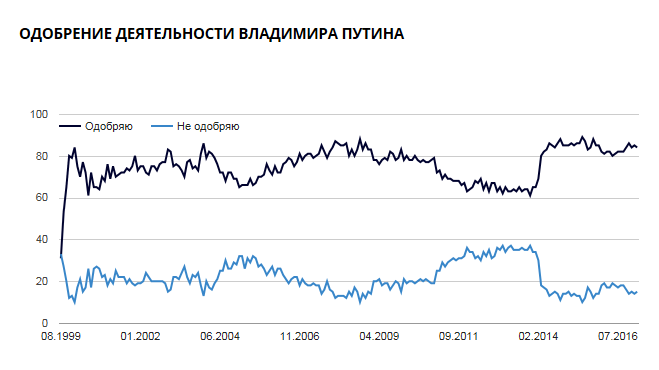
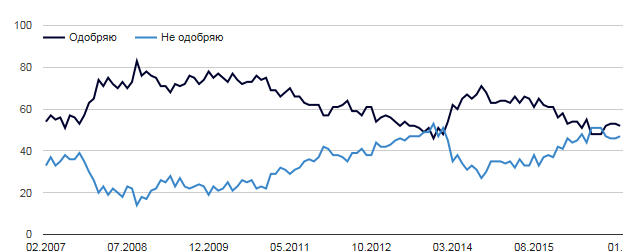
Moscow - The Russian economic recovery went sharply into reverse in February, according to the latest report from Rosstat, the federal state statistics service. But voter approval for President Vladimir Putin remains super-stable at a level unknown in Europe or the rest the world.

So if you are bent on fighting Russia, as the generals now in charge of US policy in Washington say and do, what opportunity is there for toppling Putin before the presidential election due in March 2018? One veteran of high-level Russian policy in Europe predicts:

“The trouble for Putin will come when the World Cup starts in June of next year. But that’s after he is elected in March. No-one realizes, not yet, how much trouble the football competition will cause, with thousands of visa-free foreign agitators in the country calling themselves fans, and half a billion people watching on TV.”

An analysis just released by Uralsib Bank analyst, Alexei Devyatov, of the latest economic results shows that for most Russians real income growth has not only stalled — the indicator has started to fall again from positive 8.1% in January to minus 4.1% in February.

THE SITUATION IN THE ECONOMY HAS WORSENED IN FEBRUARY
Growth rates of key indicators, percent change compared to the same period of 2016

KEY: Row 1=GDP; row 2=industrial production; row 3=mining sector; row 4=processing sector; row-12=real salaries.
Source: Uralsib Bank, report of March 22, 2017, by Alexei Devyatov: devyatovae@uralsib.ru


The current income data for January and February, writes Devyatov, show that January’s growth was driven by the Finance Ministry’s large lump-sum payment of pensions. Gross Domestic Product (GDP) was boosted by 1.3%, compared to January 2016, by this payment. The statistic helped reinforce most Moscow analyst forecasts for GDP growth this year of between 1% and 2%.

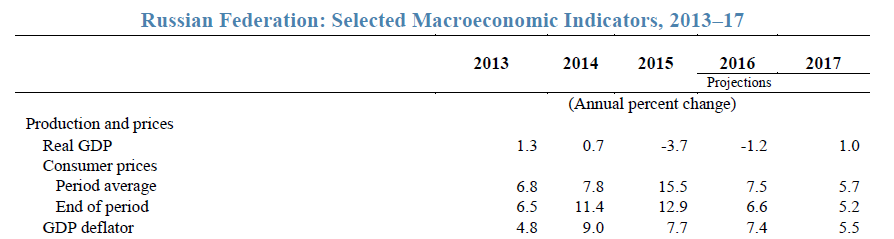
The last staff report on the Russian economy from the International Monetary Fund (IMF) summarized the bad news since 2014, and also the modestly good news predicted for this year.


A month ago Russian analysts were reporting to clients that they are anticipating this year’s recovery rate will accelerate faster than the IMF’s 1% forecast.


The Gaidar Institute of St. Petersburg, which is generally hostile to Putin, is reporting “the early phase of a cyclical upturn in the economy from the bottom point of the business cycle”. Before the February statistics were out, the institute was predicting GDP growth this year of 1.4%, accelerating next year to between 1.7% to 2.2%.

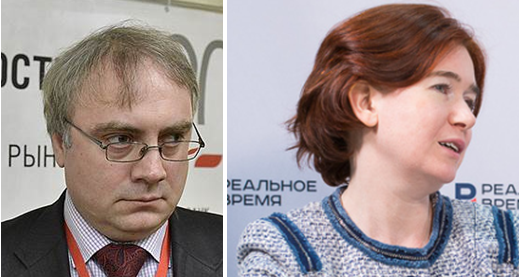
Devyatov (pictured below left) warns: “it is necessary to recognize that the economy still cannot reach a trajectory of sustainable development. We confirm our forecast of growth of real GDP at the level of 1.9% in 2017, but we see the risk that actual growth in the current year will turn out to be slightly less.”


Natalia Orlova (above right), Alfa Bank’s chief economist, is pessimistic, but for the period after the presidential election, not before. “The main risk for real income is the state budget policy. Before sanctions in 2014 the salaries of employees of state-owned organizations had been raised regularly. But after 2014 they were frozen. In 2018 there will be the election of the president in Russia and if the government raises the salaries of state employees, the companies will have to do it too, in order to compete for employees with the state as the unemployment level is low now. That will have a positive effect for people in the short run, but after that it will cause inflation to increase.”


Russian wage-earners are apprehensive. The most sensitive indicator of their expectations of growth, or worse, is the monthly release of the wage arrears statistic. This measures the salary amounts owed to workers but unpaid by the state, and by private or commercial employers.

Wage arrears were invented in the 1990s by the Yeltsin administration as a confiscatory tax. The wage arrears trend indicates loss of confidence on the part of domestic investors, who have stopped paying their employees, as well as their suppliers and the tax authorities. A rising wage arrears figure triggers apprehension throughout the electorate. Two years ago, 96.6% of the wage arrears were owed by private, commercial and non-government enterprises. Though government at the federal, regional and municipal or local levels generally pays on time, here is how to calculate that a 1% increase in wage arrears owed by business turns into a 0.5% decline in the approval ratings of the president and prime minister.

DYNAMICS OF WAGE PAYMENT ARREARS
In millions of roubles on the first day of the month


A year later, in March 2016, wage arrears were heading above the Rb4 billion level; the story looked like this.

Consider what the latest wage arrears chart shows for January 1, February 1, and March 1 of this year. The sharp decline in January below the Rb3 billion mark pulled the indicator back to where it was at the start of 2015. The government proportion of the arrears total is now even smaller than earlier measurements; 99.6% of the arrears aggregate is now owed by the private sector. Since January, however, the total figure has been rising back up again. In comparative terms, the arrears indicator for January turns out to be no harbinger of accelerating economic recovery – more a flash in the pan.

Public approval of Putin’s performance as president went up in January, but not by as much as the November score of 86%. A year ago, the Levada Centre in Moscow measured public approval and disapproval of Putin at 82% positive, 17% negative. The current measures are 84% positive, 15% negative. This means public disapproval has been shrinking as wartime conditions get worse, while approval is stable within the margin for statistical error.

IN GENERAL DO YOU APPROVE OR DISAPPROVE OF VLADIMIR PUTIN’S PERFORMANCE AS PRESIDENT?


The line chart (below) illustrates how Putin’s ratings have been moving since February 2014, when the US started the war in Ukraine. It is clear the approval line has stabilized above 80% and disapproval below 20%.


TRAJECTORY OF PRESIDENT PUTIN’S RATINGS

KEY: Black=approval; blue=disapproval


Putin’s achievement cannot be exaggerated — no political leader of a major country in the world is recording such durably high approval ratings. But the achievement is qualified. Without the US war in Ukraine, then US and European Union (EU) sanctions, the approval line for Putin would have continued downwards as the collapse of the oil price and the rouble tipped the economy into recession, and as Russian voters lost trust in their future.


The Credit Suisse consumer confidence report for 2017 illustrates what has happened:


In 2014, before war, oil price collapse, devaluation and US-EU sanctions were felt in earnest, Russian consumers were optimistic, though not quite as much so as their emerging market (EM) peers. The subsequent impact in 2015 was more negative than for the other EM countries; although the impact softened in 2016, it remains negative.


From the domestic point of view, Credit Suisse’s chart of real wealth growth in Russia reveals the driver of voter approval for Putin administration since 2000 has been rising income, rising savings, rising net worth:


Most of the asset value in this figure has been contributed by the Russian real estate bubble. Devaluation has done more than prick this bubble, flattening the grey line and driving it downwards this year. Devaluation, accompanied by cutbacks in corporate investment and state budget outlays, are also driving the cash element of wealth downwards, and thus the net worth figure for Russians. 


Early this month Credit Suisse finalized a fresh report on consumer expectations in Russia and other emerging markets. The Swiss bank’s forecast for Russia is a two-way bet. “The potential turnaround point will still depend on the direction of oil prices, the Central Bank of Russia’s stance on monetary policy and the government’s potential decision to increase pensions and public sector employee salaries as the elections approach. A further strengthening of the ruble would pave the way for increased purchasing of consumer electronics and other durable items, although we expect a lag between macroeconomic stabilization and a sustainable recovery of consumption until wage inflation improves more robustly.”


Russian analysts interviewed this week say approval for Putin does not translate into either consumer confidence, or expectation of growth in real income. Russian consumers don’t run up bigger bills in cash or on credit at smartphone outlets or car dealers as a consequence of their view that Putin is the country’s best hope in present and foreseeable circumstances.

On the other hand, there is consensus among the analysts that deterioration of income, living standards, and real income does turn into voter disapproval of the performance of Prime Minister Dmitry Medvedev and also of government ministries:

TRAJECTORY OF PRIME MINISTER DMITRY MEDVEDEV’S RATINGS

KEY: Black=approval; blue=disapproval


TRAJECTORY OF THE GOVERNMENT’S RATINGS

KEY: Black=approval; blue=disapproval


As can be seen from the charts, the Medvedev rating at the moment is net positive, 52% to 47%, while the government rating is equally divided, 49% and 49%. The payment of the lump-sum pension in January, and the subsequent indexation of pensions, have neutralized the negative approval trend for Medvedev and the government. But not by much, and not for long.


The reason Putin isn’t blamed for the reversals in the economy, but Medvedev and the government are, is the regime change strategy of the US and EU. If the Americans hadn’t been trying so hard to overthrow him, as Russians perceive this, domestic public opinion would have moved against the president. Instead, Putin has been able to wrap himself in the flag. Opposition to him inside the country, and criticism outside the country, make no obvious dent, because the rating is, in practice, approval of the country itself

So, is there an opportunity for US warfighters like General James ‘Mad Dog’ Mattis, the new Secretary of Defense (below, left), to upset Putin?


By intervening in the domestic economy, the consensus of Russian analysts is no. Among the political opposition, no. What about fresh US military moves on the Ukrainian and Syrian fronts, in the Black and Baltic Seas, or in cyber warfare? It is already clear that US military tactics turn out to be a boomerang – they trigger more, not less support for Putin.