Monday, November 24, 2014

What Augers Iran Nuke Agreement Failure and Hagel's Sudden Departure?


Possible Motives for Ousting Hagel

by Robert Parry - Consortium News

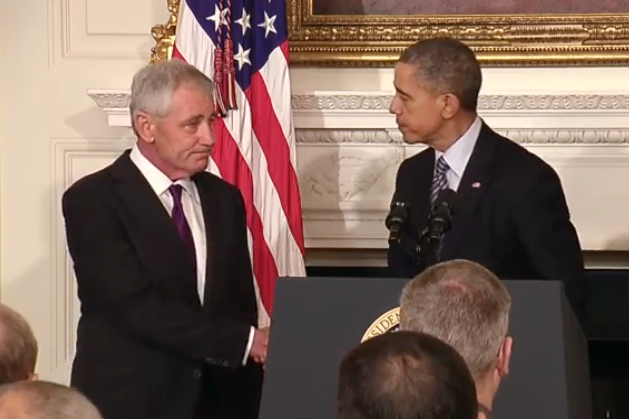
The abrupt resignation of Defense Secretary Chuck Hagel – along with the failure to reach a final agreement on Iran’s nuclear program on the same day – does not augur well for the last quarter of Barack Obama’s presidency, reflecting his continuing tendency to let the neocons have their way.

Defense Secretary Chuck Hagel shakes hands with President Barack Obama at the White House on Nov. 24, 2014, as the President announces that Hagel is resigning. (U.S..government photo)

Not that Hagel had distinguished himself as a sterling leader of the Pentagon – nor has all hope disappeared that a sensible resolution of the impasse with Iran might be achieved before the next “deadline” in June – but Obama still does not appear to have escaped the spell of the neocons who continue to dominate American geopolitical thought despite the bloody disasters that they helped cause in Iraq, Afghanistan and elsewhere.

Six years into his presidency, Obama still doesn’t seem to understand that just because some people have impressive credentials doesn’t mean they know what they’re doing. Indeed, in a profoundly corrupted system – like the one that now controls Official Washington – rewards are handed out to people who serve the corrupt interests or at least don’t get in the way.

In a time of corruption, the countervailing forces of wisdom and courage will never be found among the credentialed, but rather among the outcasts of the establishment, those who were forced to the margins because they objected to the venality, because they stood up against misguided “group think.”

But Obama has been unwilling – or possibly unable – to come to grips with this reality. Despite his personal intelligence and rhetorical skills, Obama never has been willing to challenge people cloaked in credentials – those who went to the best schools, worked at big-name firms, won prestigious awards or held fellowships at famous think tanks.

The tragedy of Obama is that I’m told that he understands the stupidity of the modern U.S. establishment and does sometimes consult with “realists” who offer practical advice for how he can resolve some of the most nettlesome problems facing the United States around the world. But he does so virtually in secret, with what politicians like to call “deniability.”

Obama operates one foreign policy above the table – pounding his fist along with the neocons against Syria, Iran and Russia – and another foreign policy below the table, dealing with adversaries in ways necessary to confront global challenges, such as collaborating with Iran to counter the Islamic State in Iraq and Syria and with Russia to address challenges with Iran, Syria, Libya and elsewhere.

Yet, while keeping such pragmatic overtures under the table, Obama reaches out publicly to neocons who have been implicated in some of the worst disasters in the history of U.S. foreign policy — but who have “credentials.” For instance, earlier this year, Obama was stung by criticism from neocon ideologue Robert Kagan, who had published a long essay in The New Republic promoting the need for more U.S. interventionism around the world.

Obama could have dismissed Kagan’s New Republic article as the pretentious pontifications of a blowhard whose career began as a propagandist for Ronald Reagan’s Central American policies in the 1980s and included, in the 1990s, co-founding the Project for the New American Century, which called for invading Iraq, an illegal war that was launched in 2003, propelling America into the current catastrophes now swirling around the Middle East.

But Obama apparently couldn’t get past all of Kagan’s “credentials,” including his current work at the prestigious Brookings Institution and his writing for the oh-so-impressive New Republic. So, Obama invited Kagan to lunch at the White House, a cozy get-together that one observer described as a “meeting of equals.”

Yes, the twice-elected President of the United States and his “equal,” one of the co-founders of the neocon Project for the New American Century. The New York Times reported that Obama even shaped his foreign policy speech at the West Point graduation in May to address criticism from Kagan’s New Republic essay, “Superpowers Don’t Get to Retire.”

Off to The Hague


You might think that the only reason to invite one of the Iraq War architects to the White House would be as a “sting operation” to arrest him and trundle him off to The Hague for prosecution for war crimes. After all, the justices at the post-World War II Nuremberg Tribunals deemed aggression – starting an unprovoked war – “the supreme international crime differing only from other war crimes in that it contains within itself the accumulated evil of the whole.” And we have certainly seen that “accumulated evil” get unpacked.

Yet, Obama courted Kagan as a respected “equal,” according to one source familiar with the behavior of the two men at lunch. Although as a journalist I try not to react viscerally to what I hear, the phrase “a meeting of equals” brought the taste of vomit to the back of my throat.

I couldn’t help but recall the reported outburst by President Abraham Lincoln after his reelection as he struggled to secure the necessary votes for passing the Thirteenth Amendment to abolish slavery: “I am the President of the United States, clothed with immense power, and I expect you to procure those votes” (as recounted years later by Congressman James Alley).

However, after also winning the presidency a second time, President Obama couldn’t seem to find his inner Lincoln.

In trying to understand what makes Obama tick, I have often been struck by how he seems awed by credentials, perhaps because credentials were the key to his unlikely rise from an obscure and exotic background to edit the Harvard Law Review, to build an academic career, to gain a U.S. Senate seat, and to win the presidency of the United States. Along the way, he got “blessed” by many of the “right” people and never strayed too far from the safety of the “establishment.”

Even as a twice-elected president, Obama seems captive to this high regard for people with credentials, even when the system awarding those credentials daily demonstrates its extraordinary levels of corruption, cruelty and outright stupidity.

Which brings us back to the apparently forced resignation of Chuck Hagel, who earned the enmity of Official Washington because he was an early Republican turning against the Iraq War and because he offered some mild criticism of the Israel Lobby.

On the surface, Obama’s abandonment of Hagel – while retaining the bombastic neocon-approved Secretary of State John Kerry and other war hawks like U.S. Ambassador to the United Nations Samantha Power and Assistant Secretary of State for European Affairs Victoria Nuland (Kagan’s wife) – suggests that Obama may be again bending his foreign policy in directions favored by the neocons and their sidekicks, the “liberal interventionists.”

That could presage further disasters if Obama adopts the neocon strategy of ratcheting up tensions with Iran over its nuclear program and bombing the Syrian military in a move to overthrow President Bashar al-Assad – with both “regime change” goals high on the agenda of Israel’s right-wing government.

Yet, since Iran has been playing a key role in taking on the Islamic State militants in both Iraq and Syria – and since Assad’s army is the only force capable of holding back Islamic extremists inside Syria – the neocon “regime change” plan is reckless in the extreme. A very possible result from such a U.S. intervention against Assad would be a military victory for Al-Qaeda’s Nusra Front or the even more extreme Islamic State.

There’s also the neocon desire for a new Cold War with Russia over Ukraine. It’s possible that Hagel, a Vietnam veteran who understands the ugliness of war and has no fondness for the neocons, is being sidelined because he isn’t willing to throw more young American men and women into the blood and horror of more neocon-inspired adventures, not to mention wasting hundreds of billions of dollars in taxpayers’ money.

But Hagel’s erratic performance as Defense Secretary – often coming across as inarticulate and imprecise – could represent a less consequential reason for the change at the Pentagon. Perhaps, Obama simply wants someone who is more skilled at the job.

[For more on the neocons and U.S. foreign policy, see Consortiumnews.com’s “Delusional US ‘Group Think’ on Syria and Ukaine.”] Investigative reporter

Robert Parry broke many of the Iran-Contra stories for The Associated Press and Newsweek in the 1980s. You can buy his latest book, America’s Stolen Narrative, either in print here or as an e-book (from Amazon and barnesandnoble.com). For a limited time, you also can order Robert Parry’s trilogy on the Bush Family and its connections to various right-wing operatives for only $34. The trilogy includes America’s Stolen Narrative. For details on this offer, click here.

Getting the Make on Ballot Bandits

The Hunt Continues...A personal note from Greg Palast

by Greg Palast

Three weeks ago, we blew the lid off “Interstate Crosscheck”—the 6.9 million voter purge list put together by 27 wannabe Katherine Harrises.

It took us six months of detective work to get our hands on these lists of millions of Americans tagged as 'suspected double-voters' – and the sneaky and sick method used to disenfranchise more voters of color.


But the Purge’n Generals are not done. So far, they’ve only knocked off a few hundred thousand voters. That was enough to flip the Senate; but they’re in the process of removing nearly a million voters by 2016 to get the White House.

We’re not done either: We are still digging, still uncovering more games like Crosscheck—and the billionaires behind the vote swindles.

We need your support to continue the investigation of these ballot bandits – and expose all their tricks.


We are halfway through our production of Billionaires & Ballot Bandits - The Movie, based on my New York Times bestseller.

Let me be blunt: We’ve depleted our funds—but we can’t stop now.

I rarely ask – but I have to ask now...

Help us complete the film by making a tax-deductible donation of $100 or more and you will get an on-screen credit as a Supporter plus the signed DVD once the film has wrapped.

Or make a tax-deductible donation of $50 –– and, once the film has wrapped, you will receive the signed DVD.


Or chip in whatever you can to help us get it done.

For those with deeper pockets, we really need Producers.

For a tax-deductible donation of $1,000 or more you will get an on-screen Producer credit, or a Co-Producer credit for a donation of $500. (You can, of course, choose to remain anonymous.)

Or, for a donation or $40 get a signed DVD of my investigations compendium Vultures and Vote Rustlers (Palast Investigates Vol. 2).

Better yet, get the signed DVD combo of Palast Investigates Vol. 1 & 2 for a donation of $65.

Or donate $50 and get a signed copy of my New York Times bestseller Billionaires & Ballot Bandits.

You can also visit our store and check out our Gift Packs, Books, DVDs and Downloads – or simply support our work by making a no-gift donation for whatever amount you can spare.

Our Crosscheck exposé got big applause and re-telling in the New York Times, LA Times—indeed, media all over the planet.

Esquire wrote: “Palast has been on the voter-caging story ever since people like Pastor Whiting got screwed 14 years ago. And, this week, writing for the Al Jazeera America news site, Palast dropped a bomb into [the Mid-Term] elections that has left credibility shrapnel all over the democratic process, if anyone cares to look for it.”

Thank you. But that don’t pay the bills. “Greg Palast” is not a person but a team of investigators and journalists including the Academy Award nominee Richard Rowley, gonzo photojournalist Zach D. Roberts and the extraordinary Ms. Badpenny and others. They all need food, shelter and memory chips.

[If you haven’t seen the Crosscheck report, watch the Democracy Now replay; and read it here.]

Will you support our efforts? Yes, our TV and print outlets cover some costs. And we are grateful for crucial support from Puffin and Cloud Mountain foundations. But we are, ultimately, citizen funded: without your help there is just no way we can do the unique, deep detective work that makes our reports like no one else’s.

And it’s not just ballot trickery that we expose. We have the investigative skills to crawl into the file drawers of the rich and shameless: the billionaires who fund the ballot-bending shenanigans. (Wait until you hear my Koch Brothers tape.)

Whether it’s exposing disenfranchisement games, the vulture financiers or petroleum porkers behind the poisoning of the body politic, no other news team has produced so many investigative bombshells year after year.

We’re ready to keep digging: please hand us the shovels by donating right now.

And, on behalf of a tired, hungry crew, our true thanks for your years of support.

Yours, with gratitude,


* * * * * *
For 15 years, Greg Palast has been uncovering voter suppression tactics in investigative reports for BBC Television, The Guardian, Harper’s and Rolling Stone.

Greg Palast is the author of several New York Times bestsellers including The Best Democracy Money Can Buy and Billionaires & Ballot Bandits.

Get a signed copy of Palast's latest film Vultures and Vote Rustlers.

Make a tax-deductible donation and support our ongoing investigation into voter suppression.

Subscribe to Palast's Newsletter and podcasts.
Follow Palast on Facebook and Twitter.

www.GregPalast.com

Parting Shots: Linden McIntyre on CBC's "Toxic" Culture of Celebrity

Why I Left The CBC And Its Toxic Atmosphere

by Linden McIntyre - HuffPost

[Below is the full text of remarks delivered by Linden MacIntyre as part of the Vic One guest lecture series at U of T on Nov. 19, 2014]

More than 50 years ago I became a "journalist" by the simple act of riding an elevator to the third floor of an office building in Halifax. I was shown to a desk in the far corner of a large newsroom and presented with the tools of my new trade -- a rotary dial telephone, an ancient typewriter, a massive roll of carbon-separated copy paper, and the largest ashtray that I'd ever seen.

The atmosphere was unique -- the reek of printers' ink and fresh newsprint and cigar smoke (my desk was on the edge of the sports department where everybody seemed to smoke cigars and wear suspenders).

And there was noise -- typewriters, people shouting, the clatter of teletype machines, bells ringing, and the regular bang of pneumatic tubes that were the vehicles for delivering copy from the third floor news desk to the composing room upstairs where everything was set in type. By noon that day I was addicted to the atmosphere and I remember someone telling me to go home when I'd over-stayed my shift by a couple of hours.

I wasn't entirely inexperienced. I had attended evening courses at King's College where I learned the basics of journalism -- how to write a lead; the importance of finding the tiny details that reveal the larger more important aspects of the news, the fundamentals of reporting news in radio, television and print. I suppose the most important lesson that I learned in those evening courses was that I definitely wasn't cut out for television.

The revelation came after a hands-on learning session at the local CBC studios, where one of my instructors, a television producer, was deeply amused by my attempt to read a newscast. My presentation skills were okay for a beginner, but the producer told me I had a fatal disability for a broadcaster -- I had an accent that was distinctly regional.

Stay away from microphones, he advised.


I got some slightly more diplomatic guidance -- that turned out to be mostly true -- from a radio producer who told me that I should start out on a newspaper where I'd learn more about reporting in a day than I'd learn on radio or television in a year. In broadcast news I'd basically be rewriting other people's stories to be read on air by better-looking people whose accents had been refined somewhere half way between Halifax and England.

It would be 12 years before I got into television -- by accident it would turn out -- the accident of being fired by a newspaper for what management believed to be an unacceptable streak of editorial independence.

But I never forgot the humbling experience of that evening instruction in a broadcast studio -- being told that I could never make it in a medium that depended on my looks and voice. Even later, when I did find myself in television, and not behind the scenes but actually out front for all to see and hear, I would regularly be described as "idiosyncratic". Happily I've always considered that word to be a compliment -- a synonym, in my mind, for originality which, when I was growing up, was regarded as a virtue even if it meant exclusion from what would be regarded as "mainstream" culture.

I'll get around to explaining why I think this is important and why I owe so much to that TV producer back in the '60s -- who, by the way had a lovely velvet voice and was, I believe, the inspiration for a later character in a satire, a radio announcer named Marvin Mellowbell. In the very early days of what turned into a long career he made me skeptical, if not suspicious, of superficial qualities that contribute to media popularity and, for many, power. And I'll tell you later why I think that power bestowed by celebrity is potentially dangerous -- if you don't already know.

I found myself with a television job in 1976 and it couldn't have happened at a better time -- the early days of an era we now look back on as the high-water mark of television journalism, a time when there was a serious effort to demonstrate that television could deliver journalistic substance with clarity and impact at least as credibly as any newspaper or magazine or book.

A new kind of journalism -- what was known as television current affairs -- would thrive. New programs emerged: The fifth estate, W5, 60 Minutes, Marketplace, The Journal on CBC every night throughout the '80s. These programs and others established television as a major vehicle for what the CBC's mandate would call "information and enlightenment".

Radio was no less vibrant. The programming was powerful -- This Country in the Morning, later to be called Morningside; As It Happens; Sunday Morning, now called Sunday Edition -- they all had a reach that gathered information from around the world, more often than not by sending teams of Canadian reporters to wherever important news was happening -- and delivering it to Canadians with professionalism and production values equal to any in the world.

Times have changed.


The business of journalism is in serious decline. The business model doesn't work anymore but the emphasis on profit is probably even more acute now than it ever was. That and the growth of technology that makes it possible to produce things without people have led to a crisis in employment opportunities in the news media. Young people are lined up begging to become slaves, also known as interns, to work hard without compensation, just for the opportunity to be noticed by a potential employer.

In the private sector, the emphasis on profit margins trumps public service and journalism every time -- and I firmly believe that journalism, whether practiced in the private or public sectors, is an essential public service and should be nurtured for that reason. But as an example of the thinking in the private sector, my friends over at the CTV investigative program W5 learned this fall that, because of sagging profits, seven jobs were being axed and that the program will cut back its episodes from 21 per season to 14.

It is, in a sense, worse in the public sector where I've worked as a CBC journalist for the past 38 years. Canadians decided, through political consensus, 78 years ago that there should be a public sector presence in the airwaves -- a public institution at arms-length from politics where programming reflecting the world to Canadians, and Canadians to one another, could flourish without dependence on the marketplace.

And for a long time it worked out that way. Politicians and the private sector media never liked the CBC because of its independence from political and market influences and its reliance on the public purse. But the institution thrived, became a mainstay of Canadian culture and a world-class delivery system for information.

That started to change in a big way about 40 years ago as a new ideology began to take root in North America. At the essence of this ideology there is a hostility to public institutions based on the belief that market economics are perfectly attuned to people's needs and capable of delivering anything that people want -- from news to transportation to health care. In that time, public institutions came under constant pressure to move out of the way and to let private enterprise, motivated by self-interest and disciplined to efficiency by the need to earn profits, run the system.

I would argue that no public institution in Canada has suffered more from this ideology than the CBC. And one fine day about six months ago, I decided to end a 50-year career in journalism mostly because of what hostile politicians with widespread public acquiescence are doing to destroy the place I worked in.

After a public announcement that there would be another round of job cuts totalling nearly 700 positions, after decades of budget and personnel cuts, I thought maybe it's time for me to make a move. Make room for someone else. And also make a statement to the public, that there are real people affected by these cuts. And to my colleagues at the CBC, where there are about a thousand people who could take their pensions and retire if they wanted to. A thousand positions that could be filled by bright, motivated, sophisticated young people who would bring much needed fresh blood and talent into an organization that has been diminished and dispirited by years and years of political hostility and public apathy.

Something just suddenly clicked in my mind. A kind of an epiphany, if you will. The public sector is under attack which might or might not be a good thing -- but the public doesn't seem to know about it or, if they do, the public doesn't care. Public broadcasters. Public health care providers. People who provide essential services -- we've heard a lot lately about the Mounties, how ill-equipped they are to safely do their work. We're even nickel and dime-ing veterans of our wars. And nobody seems to give a damn.

Weigh this stinginess when it comes to public services against the generosity to private sector businesses -- the policy protection and financial incentives to keep them happy doing what they make a lot of money doing. When we take into account the subsidies to private broadcasters like CTV and Global, and independent television producers, to generate Canadian programming it adds up to the same billion-dollar figure that keeps the CBC afloat.

Fair enough, except the public money by law entitles the public to make programming demands on the CBC -- like providing a variety of services over radio and three television networks, in both official languages and a host of aboriginal dialects. Plus we have to grin and bear it every time some right-winger calls us a "state broadcaster" and throws the billion-dollar funding in our faces. And that billion dollars in public money is, by the way, a pittance compared to what other enlightened countries invest to support their public broadcasters.

Canada is one of the most expensive countries in the world to service because of its cultural diversity and vast geography. I'm using figures that are a few years old, but they still make the important point. Per capita spending by Canadians to support the CBC is a fraction of what other countries spend: $33, compared to $154 in Switzerland, $134 in Germany or $67 in Ireland. Among the 18 western countries that consider a publicly owned broadcaster to be worth a share of public money, we rank sixteenth.

Critics argue that the quality of the service offered by the CBC has deteriorated to the point where it's hard to justify even the measly $33. But it takes us to that old chicken and egg dilemma: which comes first, stingy funding or mediocre programs. I can tell you because I was there for 38 years. The CBC I'm leaving is a shadow of the CBC I joined. In 1976, I joined an institution which was a place for young Canadians to grow and, eventually, contribute to the country in diverse ways. I'm leaving a place where people struggle to survive professionally and, sad to say in many cases -- psychologically and emotionally. The difference can be explained to a very great extent by funding cutbacks driven largely by political hostility which has resulted in a hemorrhage of brains and talent from the corporation.

Since the announcement that sparked my decision to leave the CBC -- the loss of 657 jobs -- 400 more people have received redundancy notices and there will be 400 more positions lost in 2016 and that will not be the end of it, not by a long shot. The active abuse and the passive neglect have been going on for a long time and will continue until politicians get a clear signal from Canadians that a broadcaster dedicated to the service of Canadians is worth supporting.

***

A few months after I started working on a newspaper in 1964, I was assigned to cover Parliament in Ottawa. The parliamentary press gallery: At the time it was one of the plum assignments in the business. I was being sent up there as, essentially, a gofer to work with the correspondent who was one of the senior people on the paper.

I remember the first day, sitting in the gallery above the floor of the House of Commons -- I was so excited that I got a nosebleed and had to be taken to a hospital to get it stopped. And I recall that a constant topic of debate in Ottawa, even then, was the CBC -- its content was too controversial or elitist, its budget was an unnecessary drain on the public purse.

Later, in the '70s and '80s, Pierre Trudeau's hostility toward the CBC took the form of direct interference with the budget and the television schedule with the upshot that the CBC's top news anchor at the time, Peter Kent, publicly spoke out about it and swiftly lost his job. Mulroney, in the early '90s, famously appointed a western hog farmer as minister of culture with responsibility for the CBC.

In the mid-'90s, in a drastic exercise at deficit control, the Chretien government cut the CBC's budget by 25 per cent. Everybody in the public sector took a hit but it was revealing that as economic circumstances turned around, most public services, especially in culture, got their funding back -- but not the CBC.

Chretien didn't like the CBC, I'm told, because, like Trudeau, he saw it as a nest of English-speaking radicals and French-speaking separatists. And in the early days of his career, snobby CBC reporters seemed to think of him as kind of dim, compared to the other bright lights from Quebec -- Marchand, Pelletier, Trudeau. It was payback time in 1995.

And so we arrive at 2006 and Stephen Harper, ideologically hostile to the public sector in general and, in particular, the CBC. Backed up by a party which considers the CBC to be dominated by left-wingers and closet Liberals. Eight years later, oversight of the CBC is by a board of directors made up of people with partisan Conservative credentials and little or no understanding of the ethos or the mission of a public broadcaster like the CBC. So I don't think it overstates the contemporary situation much to say that the CBC -- once one of Canada's most important and successful public institutions -- is on the cusp of a disaster.

But the politicians will respond: there's still nearly a billion dollars flowing into the CBC from the public coffers every year. What's your problem? A billion dollars is a lot of money.

But Canada is a lot of country and Canadians are deeply interested in the world. Covering the cultural, political and social life of Canada and the wider world competently and usefully costs a lot more than a billion dollars a year. And the imperative that keeps senior CBC managers awake at night is how to sustain, with diminishing resources, the public's confidence that what they're getting for the billion bucks is actually competent and relevant. There's a growing uncertainty about the value of the CBC, driven I believe by ideology and envy -- private sector broadcasters basically don't like publicly funded competition even though most of them would be out of business in the absence of public policy and subsidies.

So what do people get that matters from the CBC?


I think there is a broad consensus that the French network, Radio-Canada, is vitally important to the whole country. It is a mainstay of Francophone culture and information and has deep and faithful backing from its audiences.

The English side presents a more ambiguous picture. There is great nostalgia for CBC radio -- people respond viscerally to any perception of diminished programming and quality but the cuts in radio, while less conspicuous than television, are equally damaging. Important programs rely to an unprecedented extent on people with little or no job security and minimal prospects for developing careers.

Needless to say, things are worse in television where production is more expensive and where diminished quality is more conspicuous.

As is often the case in times of existential crisis it becomes a challenge for people running countries or institutions to project the kind of leadership that fosters confidence and morale -- two qualities without which no troubled institution can survive. And so we have the understandable impulse to make small achievements seem large and to go overboard in praising anything that seems to be successful.

When news comes up with a story that's original we tend to hype the originality regardless of the substance or the significance of the story. A genuine success -- like the CBC's incomparable coverage of sports and news -- becomes a defining source of pride when we can afford to do it. Which we can't, much, anymore even though we bravely try.

The popularity of programs and personalities will be always be loudly hailed as evidence of institutional vitality, and never more than when that vitality is in question or illusory. Celebrity, in times of crisis, becomes a crucial part of a façade that masks the deeper problems. Which brings me to a radio program called Q ... and a celebrity named Jian Ghomeshi.

It's never been much of a secret that popularity and celebrity are potentially dangerous because, along with the illusions of success, they foster artificial hierarchies of power and influence. When egotism and narcissism become factors in success we will invariably find abuse. But abuse is often difficult to deal with. Abuse is part of a continuum. At the extreme manifestations of abuse -- say, assault or homicide -- there's no debate: sooner or later, there will be accountability.

But what about the rest of the abusive continuum? Abuse is never acceptable. But we are all programmed to put up with it, to a point, in the interests of avoiding worse -- or in the interests of advancement, or for the sake of economic security. In a workplace rife with insecurity the impulse to tolerate abuse can compel a victim to silently allow it to advance along the continuum into a darker zone where it becomes perilous to mental and emotional well-being and physical security.

The CBC is not unique in the celebration of celebrity -- of fostering celebrity with all the entitlement and power that it bestows -- in order to enhance the prestige of the institution and the reflected fame and reputations of the people with the real power, the managers. But when an institution is in trouble -- with diminished job security in a workforce that is often young and vulnerable -- celebrity, infected as it often is by egotism and narcissism, creates a workplace atmosphere that is toxic for the many people who feel they must put up with it.

And unfortunately, when the abuse continuum results in the kind of behaviour that normal people normally abhor, the normal people in charge of institutions, and who feel responsible for the appearance of institutional success and integrity, will far too often feel inclined to minimize and tolerate, condone -- and in the worst-case scenario -- cover up behaviour that is abusive.

The history of the Catholic Church offers the most tragic evidence of what can happen when the hierarchy in an institution abandon personal moral standards to protect the institution from the stain of scandal and, collaterally of course, protect their own entitlements and jobs.

The CBC is not the Catholic Church. The church hierarchy covered up a scandalous situation for many centuries until isolated cases of perversion and abuse became a plague that eventually threatened to consume the very institution that the systemic cover-up was intended to protect. At the CBC a few managers may have dithered about Jian Ghomeshi, even after they knew some of the gory details of his alleged abusiveness, for a few months. And then they canned him.

But the deeper problem isn't what happened when it seemed to be obvious to management -- especially after Jian laid it out for them -- that the abusiveness on his program and in his personal life had crossed into that dark place where criminal prosecution might be warranted.

The deeper problem lies in the quiet acquiescence to what went on before that -- for years -- not just by managers, but by colleagues, friends, maybe even family. Jian was a celebrity -- a source of pride for Persians, model of success and possible support for aspiring celebrities and stars -- or people who just wanted a shot at a career.

But his popularity, his celebrity, was also evidence of institutional vitality that could be attributed to the quality of management at the corporation. So a celebrity can be obnoxious. What else is new? They are fragile people. Great gifts come embedded in complex and often difficult personas. Ego-driven temper tantrums can easily be attributed to professional standards that are admirably rigorous. Demands for personal service -- get me coffee, park my car, do my laundry -- can become acceptable viewed in the context of the heavy schedules imposed on the important life of a media celebrity.

Year after year, it was no secret at the CBC that Jian Ghomeshi was difficult; that his attitudes and many of his demands made the program, Q, an unpleasant, stressful place to work.

But he was a celebrity and his program was a success, two valuable and increasingly rare assets at the CBC. And so for years good people tolerated what was a dark side of the star persona. This is not unprecedented. As a matter of fact it is more common than not -- I think celebrity in all but exceptional cases of personal integrity and a healthy measure of humility always has a dark side.

But the twilight begins at the point where the lucky star forgets (if he or she ever knew it) that nobody ever achieves celebrity without a lot of help and sacrifice by friends and colleagues. Which is where vigilance must kick in -- and the responsibility for vigilance lies with management. Otherwise twilight becomes darkness where all kinds of bad things happen.

Whatever will be revealed as fact in the Ghomeshi scandal, there are important lessons to be learned about the nature of workplace abuse and the consequences of ignoring it, even at the low end of commonplace bad manners. Instead of tolerating bad behaviour by people who are recognized as "stars," they should be held to a higher standard of professionalism and collegiality. And the standard has to be enforced by managers with the guts to act anytime the standards of collegiality and civility are violated -- no matter how important the abusive person has become.

As in the case of the abusive priests -- when scandalous abuse is known to have crossed over into criminal behaviour, the appropriate response is obvious: Prosecution.

The harder part is coming to terms with the individual and institutional blindness that let "normal" obnoxiousness proceed along the abuse continuum to a place where it became a peril to both individuals and the institution itself. This is where the serious and potentially restorative accountability must begin. And it must include a serious attempt to understand what the Ghomeshi scandal has revealed about the toxicity of celebrity, egotism, narcissism and abuse and their effect on good people working in an institution that's in the middle of a breakdown.

It will now fall to managers not to simply attribute blame for what caused the Ghomeshi scandal -- but to create a workplace environment in which there is zero tolerance for abuse of any kind -- and that for victims of abuse, or even those who know about it second-hand, blowing the whistle on an abuser isn't just a right, but a responsibility.

I worked at the CBC for 38 years. My job was always up-front, on the air whether it was radio or television. For 24 of those years I worked on one of the most successful and well-regarded programs in the corporation's history, The fifth estate. If I had moved down to the States as many of my friends and colleagues did back in the '70s and '80s I might even have become rich and famous notwithstanding all my idiosyncrasies.

In Canada I became "prominent" -- and not so rich. In the States I might have been a star. In Canada I'm just stared at quite a lot. But prominent is good enough for me.

In addition to the television producer who caused me to get my basic journalism training in the world of newspapers, I owe a great deal to a crusty newspaper editor who one night about 40 years ago -- when he was more deeply into his cups than I was into mine -- offered up a simple bit of wisdom that I managed to remember. The most important thing to keep in mind in the course of my career, wherever it might take me, was that nobody -- nobody -- is indispensable. Ever.

That, incidentally, was the boss who a few years later fired me.

Oddly enough, I never got around to thanking him for propelling me into what turned out to be a rewarding journalism career in, of all unlikely places, television. A career throughout which I've never forgotten his all-important guidance: I might become important, prominent, even famous -- even a celebrity -- but never indispensable.
10 Years of Zinn’s ‘Voices of a People’s History’ Celebrated

Viggo Mortensen Marks 10 Years of Zinn’s ‘Voices of a People’s History’

by DemocracyNow!

Actors including Viggo Mortensen, Peter Sarsgaard and Kelly Macdonald gathered in New York on Friday, the 10th anniversary of the publication of “Voices of a People’s History of the United States”—a work based on the late historian Howard Zinn’s million-title selling book “A People’s History of the United States”—for a reading of “Voices.” Mortensen spoke with “Democracy Now!” about “history’s corporate takeover[s].”

In particular, Mortensen discussed a selection from Zinn’s work that he read during a 2005 reading of “Voices.” The author was the 16th century Spanish historian Bartolome de las Casas, who wrote a short account of the destruction of the Indes.

“Into this sheepfold,” wrote de las Casas of the people who once populated the island of Hispaniola, “into this land of meek outcasts there came some Spaniards who immediately behaved like ravening wild beasts, wolves, tigers, or lions that had been starved for many days—killing, terrorizing, afflicting, torturing, and destroying the native peoples, doing all this with the strangest and most varied new methods of cruelty, never seen or heard of before, and to such a degree that this Island of Hispaniola, once so populous (having a population that I estimated to be more than three million), has now a population of barely two hundred persons.”


Mortensen went on:

Bartolomé de las Casas was a priest, a religious man, who accompanied some of the first Iberian expeditions to what we call the New World, you know, and what he’s talking about in that text, where he talks about extreme cruelty and basically that period in history’s corporate takeover of what we now call Haiti, Dominican Republic, Cuba, Jamaica, that region, it’s really–it is very disturbing, what he describes. And he wrote these texts and presented them to the court, to the king in Spain, and complained about it. Nothing really changed, because economic interests are what they are, just as they are in this country and other places. Citizens have to do something, have to demand change, you know.

And, you know, this book, Voices of a People’s History of the United States, is unusual in that it has to do with firsthand accounts, contemporary accounts, throughout this nation’s history by people that maybe we’ve never heard of, events that we’ve never heard of, unfortunately. You know, I think that all tribes, all nations have what some call foundation myths, you know, which are—foundation myths, I think, are—well, Anthony can correct me, he’s the scholar here, but they are stories that we like to tell, or that governments like to tell, to protect, to further, to enforce a status quo, you know, established states of affairs. And what this book presents, however, are texts that are, as I say, firsthand historical accounts, reactions by more or less regular people to real social, political events. I think what I call this is foundation facts, you know, which is, I think, what you guys deal with or try to every day here.

Read a transcript of Mortensen’s remarks, and remarks by “Voices” co-editor Anthony Arnove, here.

Geothermal Energy: The Renewable and Cost Effective Alternative to Site C?

CanGEA to Release Major Report on Geothermal Energy in BC: 'Geothermal Energy: The Renewable and Cost Effective Alternative to Site C?'

by CanGea

VICTORIA , BRITISH COLUMBIA - Members of the media and the public are invited to attend a one-hour briefing hosted by Alison Thompson, Chair and Managing Director of the Canadian Geothermal Energy Association (CanGEA).

Thompson will release the findings of an important new CanGEA report on geothermal energy in British Columbia.

New information and analysis contained in the CanGEA report addresses whether geothermal energy is a low cost, clean, viable alternative to the proposed Site C Dam project ("Site C").

The report was prepared to fill the information gap identified by the Site C Joint Review Panel: The Panel concludes that a failure to pursue research over the last 30 years into B.C.'s geothermal resources has left BC Hydro without information about a resource that BC Hydro thinks may offer up to 700 megawatts of firm, economic power with low environmental costs. [Page 299 of the Joint Review Panel Report]

The new report is timely since the BC Cabinet is expected to decide whether or not to proceed with Site C before Christmas.

Additional information will be issued on November 25th at 11:45 am.

Thompson will be available following the press conference for interviews.


CanGEA Geothermal Energy Report Release 

Tuesday, November 25th, 2014 12:00pm - 1:00pm
 
Hotel Grand Pacific, North Pender Island Room, 
463 Belleville Street, Victoria, BC


Media Contact: Alison Thompson


MEDIA ADVISORY
November 24th, 2014
For Immediate Release

Sunday, November 23, 2014

A Nation Afeared: A Made in Canada Epidemic

Manufacturing Fear: A Canadian Epidemic

by Ray Grigg - Shades of Green

Canada is becoming a nation of fear. Threat is lurking everywhere. But the source is not terrorism. The fear now haunting Canada is a creeping and insidious sense of unease that has been rising almost unnoticed for a decade. It is now infecting the mood of the whole country.

Much of this fear is invented and unjustified, manufactured for political purposes. The Russians are going to claim the natural resources of our country's Arctic so we need a strong and resolute national government to protect our interests. Crime is making Canada a dangerous place to live — even though statistics show the crime rate has been falling for decades, attributed almost exclusively to fewer youth as our demographics shift to an aging population. Addiction, of course, is profiled as destroying society so the perennially ineffective “war on drugs” must be intensified, punishment increased, incarceration mandatory, and socially beneficial injection facilities such as Vancouver's In-Site subjected to exhaustive government legal challenges. An economically vulnerable Canada must rush to finalize those few multinational trade agreements that are still available. And any celebration or declaration of war, together with any publicity about a lurking enemy, always raises the level of useful fear.

The fear eroding Canadian comfort is difficult to articulate because it is the gradual accumulation of multiple events. In Parliament, it has been the cavalier use of prorogation, the omnibus bills that prevent the adequate examination of hidden legislation, the unprecedented closure on important debates, the so-called “Fair Elections Act” that makes a mockery of both “fair” and “elections”, the evisceration of the Fisheries Act, and the wholesale gutting of the country's other environmental safeguards. Related to these events are the hidden layers of the senate scandal, and the robo-call fiasco threatening the electoral process itself. Meanwhile, the government's numerous failed appeals to the Supreme Court suggest that only an apolitical judiciary stands between Canada's Charter and enacted laws that contradict Canadians' rights and freedoms.

Fear also haunts civil servants. Any escaped and uncontrolled information is deemed dangerous to a government that is attempting to micromanage message and image. Federally employed scientists are muzzled, their interviews curtailed, their movements supervised, their communication with the press carefully vetted, their scientific conclusions adjusted to be more ideologically appropriate, and their collaboration with other scientists handicapped by implicit or explicit censure. In federal ministries, the climate of anxiety and threat is so pervasive that employees are afraid to discuss their work, to innovate, or to deviate from explicit managerial directions. Closed research facilities and libraries create fear by propagating ignorance. Even librarians of federal institutions are fearful of speaking openly lest they divulge knowledge or opinion that conflicts with official objectives. An atmosphere of stringent control from the political top to the bottom of civil servants has now created sufficient intimidation that the result is self-censure, contagious fear and oppressive silence — a model demonstration of fear's political usefulness.

As for the public, innocuous non-profit organizations such as bird-watchers are being monitored to ensure they don't engage in political activity incompatible with the current government's agenda. Canada's spy agency has been collaborating with industry to thwart protesters who might object to federally sanctioned projects such as Alberta's tar sands and its associated pipelines of Northern Gateway, Trans Mountain and Keystone XL. The National Energy Board has been granted powers to promote these projects by overriding provincial, city and municipal laws. In the process, the NEB has set evidence parameters that are so dysfunctionally narrow as to prevent an adequate examination of the “public interest”, has allowed the proponents to avoid answering pertinent questions, and has compounded its conspicuous bias by eliminating the critical cross-examination of evidence.

Andrew Coyne, a noted Canadian political columnist, summarizes the situation nicely.

“There is certainly plenty that is objectionable, even disturbing about this government: the unceasing partisanship, the peculiar nastiness, the crudeness, the expediency, the chronic secrecy and dishonesty. It picks fights needlessly, sees enemies everywhere, casts aside ancient parliamentary prerogatives as lightly as it does its own convictions, all for the single-minded, indeed obsessive pursuit of power.”

“The one thing it has not been is radical or transformative,” Coyne adds. “If the nastiness of its politics is the dominant impression of this government, it is in part for lack of anything else to identify it. It seems so pointless, all this poisonous effort for so little actual accomplishment, until you realize that is the point: the partisanship is in place of the policy, not in pursuit of it. The end is only power, and power is, with few exceptions, the only thing of consequence that this government has achieved” (The Vancouver Sun, Oct. 21/14).

A government that pursues power for power's sake manufactures fear. When power is its only objective, such a government becomes paranoid, devious and ruthless, so anxious for its own survival that it spreads its fear everywhere, so fixated on its own security that it is incapable of recognizing or responding to the real fears haunting Canadians.

The principal fear now seems to be environmental, a deep and creeping dread that is casting doubt and controversy on almost everything we are attempting to accomplish in this country. When this dread is not addressed or even recognized, people become restive, trust erodes, confidence falters, institutions are questioned, laws are challenged, social order is shaken, and the fear feeds more fear.

Murderers in High Places: Washington Consensus on Death of Democracy

Yonder Comes Sin: More Terror From the Top

by Chris Floyd - Empire Burlesque


"My brother's blood is crying from the grave
but you can't hear the voice
I stand in jeopardy every hour,
Wonderin' what reason you have to rejoice.

Look at your feet see where they've been to
Look at your hands, see what they've been into…
Yonder comes sin..."


Patrick Smith, man on fire, takes on a theme we were were discussing here the other day -- the true nature and origin of terrorism in our benighted Age of Terror. In his piece for Salon.com, Smith focuses on the outrageous and brazen lies of the American political and media establishment concerning the "Arab Spring" and its disastrous aftermath.

As Smith points out, in every case where Washington took a hand in events, the outcome has been catastrophe, chaos, repression and -- terror. The whole piece is worth reading in full, especially the detail on the American-led imposition of a horrific tyranny in Egypt, where the people had foolishly elected the wrong person in an open democratic vote and needed to have the proper leader installed for them. From "We are the terrorists too":

Take this apart. Everywhere there is crisis, violence and suffering, Washington has been active. Syria, Libya, Egypt, Iraq: All these fall into this category. Where the Obama administration and its covey of neoliberal evangelists in the State Department have allowed the events set in motion during the Arab Spring to take their course, there is at least some semblance of calm, if not better. Let Tunisia, now developing as a secular democracy, stand as the control in this experiment.

And let Egypt stand as the most grotesque, boldest-faced display of Washington’s anti-democratic intent to be found anywhere in the region. Here the lines are most clearly drawn. Here the generals within and the meddlers without got the subversion work done in front of our eyes. And here neither Secretary of State Kerry nor National Security Adviser Susan Rice nor President Obama has anything to say as Egyptians surrender all hope of a return to elected government in exchange for a reign of terror worse than those of the dictators who provoked the Tahrir Square protests.

A reign of terror. One grows heartily sick of this term in all its forms — terrorists, terrorism and so on. All movements opposed to Western interventions in the Middle East are terrorist. The Muslim Brotherhood, explicitly opposed to terror and violence and with a long record attesting to this, is terrorist. The dissident populations of eastern Ukraine are terrorists, for that matter. The word is deployed now merely to deprive those so named of any dimensionality or purpose that requires understanding. It cancels all historical perspective and altogether any recognition of causality. As a standing rule I never use it.

But I do in the case of Abdel Fattah al-Sisi’s Egypt, advisedly. This guy may sit in the presidential palace, but if Egypt since he overthrew Mohammad Morsi in July 2013 is not a horror house of terror, we better call in the lexicographers.

There is simply no other way to describe Egypt as he rules it. … Mass murders in public places, middle-of-the-night arrests, show trials, the en masse sentencing of hundreds of innocent people, the blanket muzzling of the press, the coercion of an entire society into a silence Stalin could not improve upon — the list is long.

Yes, once again, in Egypt as elsewhere, the chickens have come home, the blowback has arrived, and it's time to pay the piper:

Vox Populi Failing to Fool All the People on Putin

Vox Populi

by Mike Whitney - CounterPunch

Anyone who follows the news regularly, knows that the media has done everything in its power to smear Vladimir Putin and to demonize him as a tyrant and a thug.

Fortunately, most people aren’t buying it.

Yes, I’ve seen the polls that say that Putin and Russia are viewed “less favorably” than they were prior to the crisis in Ukraine.

In fact, here’s a clip from a recent PEW survey which seems to prove that I’m wrong:

“Across the 44 countries surveyed, a median percentage of 43% have unfavorable opinions of Russia, compared with 34% who are positive.

Negative ratings of Russia have increased significantly since 2013 in 20 of the 36 countries surveyed…

Americans and Europeans in particular have soured on Russia over the past 12 months. More than six-in-ten in Poland, Germany, Italy, Spain, France, the U.S. and the UK have an unfavorable image of Russia. And in all but one of these countries negative reviews are up by double digits since last year, including by 29 percentage points in the U.S., 27 points in Poland, 24 points in the UK and 23 points in Spain.” (Russia’s Global Image Negative amid Crisis in Ukraine: Americans’ and Europeans’ Views Sour Dramatically, PEW Research)

These results strongly suggest that the public blames Moscow for the fighting in Ukraine and (presumably)agrees with the prevailing storyline that Putin is a vicious aggressor who seized Crimea in order to rebuild the Soviet Empire. The problem with the PEW survey is that the results are based random samples of nationwide face-to-face or telephone interviews.

Why is that a problem?


It’s a problem because the man-on-the-street hasn’t the foggiest idea of what’s going on in Ukraine. All he knows is what he’s heard on TV. So, naturally, when he’s asked to offer his opinion on the matter, he’s going to regurgitate some variation of the official version, which is that Putin is responsible.

But try asking someone who’s actually been following events in Ukraine that same question, and you’re going to get an entirely different answer. Among the people who follow the daily developments in Ukraine, roughly two out of three support the Russian position. This isn’t something you’re going to find in the survey data, but if you take the time to comb the comments lines in the international media, you’ll see what I’m saying is true.

I hadn’t figured this out until last week’s G-20 Summit in Brisbane when Canada’s PM Stephen Harper brusquely greeted Putin saying, “I guess I’ll shake your hand, but I only have one thing to say to you: You need to get out of Ukraine.”

The incident immediately became headline news around the world as journalists for all the major media heaped praise on Harper for courageously “shirt-fronting” the dastardly Putin. What was left out in the media’s account of the exchange, was Putin’s crisp retort, which was, “Unfortunately it is impossible, (for us to leave Ukraine) because we are not there.”

Touché. As you might expect, Putin’s response did not fit with the media’s narrative, so it was scrubbed from the coverage altogether.

The Harper incident was a particularly big deal in Canada where all the newspapers ran gushing articles lauding the prime minister for his righteousness and fortitude. Oddly enough, however, only a small percentage of the people who commented on the dust-up, saw Harper as the hero. Here’s a few samples of what ordinary people had to say. This is from BobsOpinion:

“Harper embarrasses Canadians again on the international stage. It will take years for Canadians to re-build our international relationships and to re-build our reputation.”

This comment is from redondex:

“Harper made a childish and baseless remark to Putin and walked off with a grin of a proud five year old spoilt kid. All Harper achieved was to ridicule himself in front of the rest of the world. That is our leaders usual behavior.”

This is from Makman1:

“I was under the impression that a proper democracy would first use negotiating as a way to understand the divergent groups involved in the Ukrainian revolution and then apply a political solution, if possible. The present Ukrainian government immediately used force. PERIOD! The Harper government, instead of using its “influence” to attempt to defuse a complex situation blindly followed the actions of the USA. If Harper really cared at all he would ask his foreign minister to get directly involved with Russian and Ukrainian counterparts and help reach a compromise…. Hopefully, Harper is not supporting Ukrainian right wing fascists?”

This is from Jörð:

“It’s not wise for Harper to follow America’s lead on every foreign policy. The USA government has a terrible track record when it comes to getting things right in foreign lands. Also Putin was correct when he responded to Harper’s comment by saying “It’s impossible, we are not there.” Technically Russia is not “In” the Ukraine.”

This is Time4Change:

“This is another example of Harper BLUSTERING backed with NO SUBSTANCE! Why are there NO SANCTIONS on the Russian Energy Giants Rosneft and Rostec? Could it be the hundreds of billions of $s the Russians have invested in the tar sands have caused Harper to be the SOFTEST on ACTIONS while shouting the loudest.”

And this is from Mt Athabaska:

“ …one day Harper will reach puberty on global affairs.”

It’s worth noting that these comments were lifted from article that was published by the Canadian Broadcasting Corporation. I was shocked at how harshly Harper was criticized by his own countrymen. I was also surprised that the author’s obvious anti-Putin bias had virtually no impact on the opinions of the people who commented on the incident. In fact, it appeared to make many of them mad.

I should also mention that I omitted all of the comments that lambasted Harper for hiding in a broom closet “while a gun battle ensued in a nearby hallway of the Parliament building in Ottawa” in early October. (See here: Needless to say, Harper’s comical performance at the G-20 hasn’t convinced anyone that he’s the courageous leader he imagines himself to be.)

The media is increasingly worried that it’s losing its ability to persuade people to support policies that only serve the interests of elites. The media has rolled out all the heavy artillery in its campaign to demonize Putin, but the strategy hasn’t worked. In fact, it’s backfired quite badly leading some publications to cancel their comments section altogether.

And the response from readers has been huge too, mainly because the standoff between two nuclear-armed adversaries has galvanized the publics’ attention. For example, in the CBC article I cited above, more than 2,500 comments have been posted already, while many of the other articles on Ukraine or Putin have exceeded 6,000 comments. This just shows how closely people are following events and how passionate they feel about the policy.

And, as we said earlier, this isn’t just a Canadian phenom either. For example, here are a few of the comments I picked up from an article in the conservative UK Telegraph in an article titled Global economy to suffer as Putin quits G20 early.

Zeug Gezeugt:

“The US supports the neo-Nazi ethnic cleansing campaign in east Ukraine, Russia supports the Russian speaking Ukrainian majority in the east against it. Pretty simple really, and the US enforced sanctions can only harm EU Russian relations, a win-win all round for the neoconservative hawks.”

Pamela Cohen:

“So, the media tells us in the Title that Putin is to blame when the Global economy suffers, because he left the G20 early. What stupidity. And what a statement in bringing warships as their targeted President attends yet another meeting. Good for Putin. Blame the US-backed coup and looting and 4000 deaths on Putin, and blame the Ukrainian plane that shot down a passenger flight on him, too. Then shun him at a world meeting, as if he doesn’t have the right and responsibility to defend his country’s borders, Naval base, pipeline and brothers in the Ukraine as they are shelled and killed by US manipulation.

Instead of shock and awe and intruding where they didn’t belong like the US in all the Mid-Eastern countries according to long-ago made plans, Putin sends humanitarian aid and the people vote in Donetsk and Luhansk.

Putin-not all Americans are stupid sheep. My apologies for the onslaught of ignorance and imperialism. You are standing up to bullies of the worst kind. The world needs peaceful solutions to restore the harm of NWO fanaticism and corrupt bankers. Hold the line.”

MP Jones: “The US never ended the cold war and the ‘useful idiots’ in this context are us in Europe and the UK.”

Richard N:

“Most British people are deeply unconvinced by the flood of US and EU propaganda over Ukraine, trying to cast Russia as the villain – when the civil war there was caused directly by the US and their EU side kicks backing a coup to overthrow the elected government of a sovereign country, Ukraine.”

timepass:

“With due respect to the author, you say that his (Putin’s) popularity will rise at home as a consequence of this. Please read the message boards North American and European, you will find his popularity seems to have increased everywhere.

Guess the Brains behind 5 eyes and snooping will now have to move into the new reality of the power of the internet to provide information which they would not like others to get. Just a question of time before they make their next move – Censorship!”

Busufi:

“If, the ‘Seven Dwarfs’ (US, UK, EU, Japan, Australia, Canada, and South Africa) like bullies, weren’t so obsessed with beating Russia or China into a corner, rather than bringing Russia or China into their corner; the world would be a better place. Co-operation works better than devastation.”

John Derbyshire:

“Why all this Anti Russian propaganda. The fools who run the West keep creating bogeymen Bin Laden, ISIS, oddly both had connections to Western Powers. So as we face an economic down in the world economy we need another bogeyman, and up pops Putin in the Capitalist controlled media!

People seem to have short memories of pre Putin era, when Yeltsin backed by the West led the country to economic meltdown. Maybe he has scant regard for democratic institutions, but do Western governments support the views of the people!

All of this came about when the United States pushed Nato’s borders eastward and involved themselves in the Ukraine, particularly Mr Kerry. Russia felt itself threatened not by demands of democracy a device used by the worlds superpower, but the growing influence of the United States in the region. The fact that the USA exploited ethnic tensions only shows what was their intention in the region.”

petergardener:

“If the objective is to make Mr Putin appear isolated on the world stage in order to make him less popular at home, it isn’t working and also shows a profound misunderstanding of the Russian mind-set. ‘

Our Western political leaders also have a profound misunderstanding of strategy. Just about everything they do in relation to Russia is wrong and gains the West nothing. But they do like willy waving. Just a pity they do so much damage while they are at it.”

RedBaron9495: “With the public, the effect is rebounding and probably starting to gain Putin more support and worldwide sympathy. This British news forum is good example of that. They made the mistake of going into overkill…..and the public are wising up to the propaganda. They seen this all before prior to Iraq 2003 invasion…and again with Gaddafi.”

Circle of DNA :

“Well, the lives of average folks in Russia has been drastically improved since Putin took the reins of power. He defends Russian interests, fights the empire of chaos, and is massively supported by his people. He is also well educated and a first class statesmen. What is there not to like about him?”

Alltaxationistheft: “The Russian people appreciate how lucky they’ve been for Vladimir Putin to be around at the right time to resist the Neocon supremacist Wolfowitz doctrine…

Since the 1990s , the war mongering maniacs in the West have been planning to asset strip, and plunder Russia via ”liberal democracy”, claiming its natural resources while funding serial inter-ethnic tribal wars via US allies Qatar and Saudi Arabia…

In the 1990s, Russian people were driven into starvation ,prostitution and suicide under pro American ”Liberal” US corporate puppet Yeltsin… but Putin kicked the CIA EU Mossad lunatics out and has been re-building a Russia into a world power ever since.”

anonymous:

“The classless western free (loading) world that produces very little except paper currency, lies and bullshit. I am surprised Mr. Putin came and surrounded himself with such low life scum.
When all the western oligarchs hate someone as much as they hate President Putin, you know he has to be doing something right.”

There’s no need to be selective. Curious readers should go to any editorial platform that covers the crisis in Ukraine and judge for themselves if what I’m saying is true or not. The comments above are in no way extraordinary. What they do show, however, is that the media is losing the propaganda war in pretty stunning fashion, and that’s a huge victory for ordinary people. It’s very difficult for elites to prosecute their criminal wars or implement their rip-off economic policies when people can clearly see what they’re up to.

Now check out this article in the German paper Zeit Online where the author bemoans the media’s loss of influence. The article is titled “How Putin Divides”:

“Why do so many German citizens judge the crisis in Crimea in a completely different way than politicians and the media?

In my 30 years of experience with debates, I have never seen anything like what is now happening in Germany in the dispute over Russia and Crimea….

Unless surveys are misleading, two-thirds of German citizens, voters and readers stand opposed to four-fifths of the political class – in other words, to the government, to the overwhelming majority of members of parliament and to most newspapers and broadcasters. But what does “stand” mean? Many are downright up in arms. And from what one can gauge from letters to the editor, the share of critics seems significantly higher now than what was triggered by Sarrazin’s inflammatory book back then.”
(Zeit Online)

Did you catch that part about the “two-thirds of German citizens.. stand opposed to four-fifths of the political class…and to most newspapers and broadcasters”?

That’s a triumph in itself, isn’t it? And what is the issue they disagree about?

They disagree “about the conflict between an aggressive autocrat (Bad Vlad) and Western democracies.”(the Washington-led troublemakers)

Here’s more from the same article:

“…the legitimacy of international law is being questioned in an offensive manner, while the legitimacy of Putin’s nationalist-imperialist ideology is being seriously considered….. It doesn’t do any good to accuse the majority of sheepishness or base economic selfishness, even if that seems to be the driving motive of some business leaders… The issue goes deeper, much deeper.” (How Putin Divides, Von Bernd Ulrich, Zeit Online)

“The legitimacy of international law is being questioned”?!?

Have you ever read such crybaby gibberish in your life?

Why is “the legitimacy of international law is being questioned”? Because people don’t accept blindly what they read the papers and hear on the news anymore? Because corporate editors no longer control how people think about issues? Because people are using their critical thinking skills to see through the lies and bullshit that idiots like the author ladle out in heaping doses every day? Is that why?

It seems to me that that’s a positive development, that people should question whatever they read in the papers and look for other sources of information before they form an opinion.

The bottom line is that no one believes the goofy propaganda the western media is trying to ram down the everyone’s throat anymore.

As kyle555 at Zero Hedge says: “India, China, Brazil and a host of other countries, representing more than half the world’s population, aren’t buying the western imperialist narrative on Ukraine. Nor are major segments of the domestic populations of the countries that are warmongering against Russia.”

Nor do they believe that US wars are a force for good in the world. Here’s strannick at Zero Hedge:

“Russia has seen firsthand the American dream for other nations, as American backed Oligarchs pillaged Russia while it’s people starved and were impoverished. Putin loves his country, and won’t sit on his thumbs while America attempts to encircle it through proxies while rationalizing its actions through corrupt MSMedia propaganda.”

Nor are they buying the “Putin is Hitler” crappola.

This is from smacker:

“People see in Putin a proud national leader who has the guts to stand up to our own criminals and who has over 80% support from his own population. That is enough to admire the guy, whatever else he might be.”

This is from Gaius frakkin':

“A lot of the hatred from the political puppets in the West is due to Putin’s popularity. They’re jealous sociopaths who yearn to be respected and admired as much as him. The fact that Putin’s popularity is never mentioned is the key tell.”

And this from Joe Tierney:

“Vladdy-Poot is hammering home the point that the euros need to stop being America’s bitches, think for themselves, consider the terrible “costs” accruing to them for “wearing the blue dress” for America.

…America’s “global chaos ploy” is failing. Its cynical, “throw everyone under the bus” strategy just to cut across the rise of Russia-China is exposed for what it is – America cares nothing about the euros or anyone else. All it cares about is its own global dominance in perpetuity, no matter the “costs” to the rest of the world, including its friends and allies.

Putin has balls the size of the moon, and you can damn well bet that right now Russia and Putin are secretly being cheered on a grand scale around the globe.”

There’s a reason why, according to Gallup, Trust in Media (is at an) All-Time Low. It’s because the corporate media is the most perfidious, double-dealing, hypocritical institution in the country today. That’s why the anti-Putin propaganda has fallen on deaf ears. It’s because most people know you can’t believe anything you read in the news.

Mike Whitney lives in Washington state. He is a contributor to Hopeless: Barack Obama and the Politics of Illusion (AK Press). Hopeless is also available in a Kindle edition. He can be reached at fergiewhitney@msn.com.

Denying Russia's Anti-Nazi Motion, Appeasing the Kiev Coup at the UN

US, Canada, and Ukraine Vote Against Russia's Anti-Nazi Motion at UN

by RT

UN General Assembly’s Third Committee passed a Russia-proposed resolution condemning attempts to glorify Nazism ideology and denial of German Nazi war crimes. The US, Canada and Ukraine were the only countries to vote against it.

Azov battalion soldiers take an oath of allegiance to Ukraine in Kiev's Sophia Square before being sent to the Donbass region. (RIA Novosti /Alexandr Maksimenko) 

The resolution was passed on Friday by the committee, which is tasked with tackling social and humanitarian issues and human rights abuses, by 115 votes against three, with 55 nations abstaining, Tass news agency reported.

The document voiced concern over the rise of racism-driven crimes around the world and the influence that parties with extremist agendas are gaining.

It called for a universal adoption of the International Convention on the Elimination of All Forms of Racial Discrimination. Many nations including the US, the UK, China and India, signed the convention but did not recognize a mechanism resolving individual complaints it establishes, which makes the convention unenforceable in their jurisdictions.

The resolution also decried attempts to whitewash Nazi collaborators by depicting them as fighters of nationalist resistance movements and honoring them as such.

It condemned any form of denial of Nazi war crimes, including the Jewish Holocaust.

Russia, which submitted the draft resolution, said it regretted that it could not be adopted anonymously.

“The fact that the US, Canada and Ukraine voted against, while delegations from EU member states abstained in the vote on this draft resolution, which was supported by an overwhelming majority of the UN member states, is extremely regrettable,” the Russian Foreign Ministry said in a statement.
“Ukraine’s position is particularly dispiriting and alarming. One can hardly understand how a country, the people of which suffered their full share of the horrors of Nazism and contributed significantly to our common victory against it, can vote against a resolution condemning its glorification,” the ministry said.

Moscow proposes similar documents to the UN General Assembly annually, but the US and Canada have consistently voted against them. Ukraine is a new nation among the opponents, as in previous years it has abstained.

Kiev’s representative at the session, Andrey Tsymbalyuk, said that while Ukraine did condemn Nazism and neo-Nazism, it could not endorse the Russian resolution, because it suffered not only from Nazism, but also from Stalinism in the past.

“As long as Stalinism and neo-Stalinism are not condemned as strongly as Nazism, neo-Nazism and other forms of hatred, Ukraine would not be able to back this document,” the diplomat said.

The resolution is to be formally adopted by the UN General Assembly as a body in December.

Joining the Biden World Regime Change Tour in Ukraine

Biden in Kiev on US Regime-Change Victory Tour

by Finian Cunningham - SCF

US vice president Joe Biden flew into Kiev this week to celebrate the anniversary of the Maidan protests that led to the overthrow of Ukraine’s government.

With arms waving and his wife in tow, as he stepped off Air Force One, the spectacle was tantamount to an unctuous victory lap for American regime change in the former Soviet republic. 

The fact that Biden’s son, Hunter, was also appointed as a board member of Ukrainian gas company Burisma since the regime took over adds a certain personal dimension to the American celebrations of this coup.

The next US planes to follow Biden’s will be loaded with weapons and other non-lethal munitions, as earlier this week Washington announced for the first time that it is to start supplying the Kiev regime with military hardware. Those weapons are to include anti-tank and air defence systems, sniper rifles and machine-guns. 
Up to now, the US has been maintaining the fiction that it is only sending «non-lethal aid» – although unofficially it is understood that military materiel and private American «security» contractors have already been flowing to prop up the ultra rightwing regime that the American CIA helped seize power earlier this year.

Russia this week condemned the dangerous escalation of US military involvement in Ukraine. Moscow’s foreign ministry spokesman Alexander Lukashevich said the arms announcement «broke all agreements» and that it would further destabilise the country and make a political resolution of the conflict less likely.
Biden’s celebratory arrival in Kiev could hardly be more provocative. 

The Kiev regime, headed up by president Petro Poroshenko and his prime minister Arseniy Yatsenyuk, is preparing to scale up its military offensive in the eastern regions of Ukraine. Last week it announced that it was cutting off vital public services, including hospitals and energy, to the breakaway self-declared republics of Donetsk and Luhansk. That move can be seen as a form of collective punishment paving the way for military attack.

The largely ethnic Russian people of the eastern Donetsk and Luhansk regions have refused to recognise the Western-backed junta in Kiev that came to power in an illegal coup last February. For the past seven months, the Kiev regime has been conducting a blitzkrieg in the dissident east, which has resulted in more than 4,300 deaths – mostly civilians – and up to one million people displaced from their homes. 

That lethal military onslaught has been fully backed by the US and its European allies, even though it has been carried out by neo-Nazi paramilitaries and battalions working alongside regular armed forces. A ceasefire called on September 5 has been largely ignored by Kiev’s military units, which have continued laying siege to cities and towns with indiscriminate shelling of civilian areas. Up to 1,000 people have been killed over the past two months since the ceasefire brokered in Minsk was officially declared, according to the latest figures from the United Nations.

Biden was instrumental in pushing the regime-change operation in Ukraine. He led international calls for the elected government of Victor Yanukovych to stand down, and it was Biden and State Department officials who whipped up the Maidan anti-government protests that began last November. The protests were ostensibly sparked by Yanukovych rejecting a proposed European Union association agreement in favour of maintaining historic trade ties with Russia. 

No doubt many of the protesters who flocked to Kiev’s Maidan Square had genuine aspirations for their country to embark on a process of EU integration and they felt disgruntled by Yanukovych’s spurning of the association agreement. But, more importantly, there is ample evidence that Washington had laid the groundwork to hijack the protests with a «colour revolution» involving rightwing extremists. Paramilitaries belonging to the neo-Nazi Right Sector and Svoboda (Freedom) organisations, who had been trained in Poland months before the Maidan rallies touched off, followed the script for regime change. Their use of street violence and forcible occupations of government buildings culminated in the February 20 sniper shootings in which more than 80 people, including police and protesters, were killed. With the help of Western media, the massacre was blamed on the Ukrainian government. But forensic and medical evidence shows that the snipers were operated by the CIA-backed paramilitaries.

In the final hours of Yanukovych’s presidency – before he was routed by the Right Sector and Svoboda shock-troops – Biden phoned the doomed Ukrainian leader and told him that belated reform efforts «were a day late and a dollar too short», as reported in the New York Times. Yanukovych fled his office on February 22 and the regime took over. The cynical indifference of German, French and Polish governments in the face of this coup also make them complicit in the illegal overthrow of Ukraine’s constitution and the withering violence that has ensued in that country.

To be sure, Moscow is rightly alarmed by the brazen regime change in a neighbouring country, which has centuries of close cultural, political and economic ties. Ukraine was a member of the Soviet Union until the latter’s dissolution in the early 1990s. 

The ongoing violence of the Kiev regime, which adulates the Second World War Nazi collaborators from the western Ukrainian regions, is motivated by a visceral hatred of Russian-speaking people in the east and of Russia. It openly uses Nazi terminology of «sub-humans» and «cleansing» when referring to the Slavic east. 

Washington’s script for regime change did not stop with the usurpation of the Ukrainian government. The conflict that the US-backed regime has fuelled in the eastern regions is aimed at destabilising Russia itself. This is part of a long-term geopolitical game that US planners have been working on since the early 1990s, as set out by such strategists as Zbigniew Brzezinski and like-minded imperialists in the US State Department. For them the Cold War did not end; it was merely a change in tactics to subdue Russia and gain access to that country’s awesome natural resources, in particular Russian oil and gas. 

The plan to turn Ukraine into a political, economic and military penetration point into Russia’s heartland is a very real existential threat to Moscow. It follows two decades of encroachment on Russia’s borders by the US-led NATO military alliance in contravention of previous American legally binding agreements not to do so. 

The propaganda war has involved turning reality on its head by accusing Russia of stoking violence in Ukraine, when it should be glaringly obvious that the past year of deadly unrest has resulted from Washington and Europe’s intervention in that country.

Earlier this week, German foreign minister Frank-Walter Steinmeier was in Moscow to hold discussions with Russian President Vladimir Putin on how to end the violence in Ukraine. Steinmeier appeared to be nonplussed by Russia’s position that the conflict stems from the illegal overthrow of the Ukrainian government by a hostile regime. The German diplomat reiterated the Western trope that Russian subversion is to blame. What bubble has Steinmeier been living in for the past year?

Even US government-owned broadcaster Voice of America inadvertently acknowledged this week that Russia is not supplying weapons or troops into eastern Ukraine to help the anti-Kiev militia there. In a report based on interviews with militia members, the VOA noted that «most arms used by the separatist fighters were looted from Ukrainian weapons stores». If Russia were sponsoring the rebels, then where are Russian-supplied weapons?

Similar inadvertent admissions of Russia’s non-involvement have been reported previously by the New York Times and CIA-linked Radio Free Europe. 

Yet, in spite of a dearth of evidence, Western governments, NATO and the Western mainstream media continue to assert that Moscow is the guilty party for the conflict in Ukraine.

Joe Biden’s victory lap of honour this week in Kiev, bearing news of a US weapons bonanza, is proof – if ever proof was needed – of Washington’s regime change in Ukraine and its hostile anti-Russian agenda. 
Washington and to a lesser extent its European allies are to blame for the conflict in that country and now its anticipated escalation.

Suzuki and family on Burnaby Mountain

David Suzuki and family on Burnaby Mountain today 2:30pm

by ForestEthics Advocacy

More arrests as protests against Kinder Morgan continue

VANCOUVER - Despite four straight days of arrests, and now an indefinite closure of Centennial Way by the RCMP, people continue to gather in support of the caretakers of Burnaby Mountain opposing Kinder Morgan's push for a new tar sands pipeline.

Today at 2:30pm, beginning at the foot of Centennial Way at the Burnaby Mountain Parkway, David Suzuki and members of his family will be speaking together in support of the protest. On Thursday Suzuki's grandson, Tamo Campos, was arrested for challenging police lines facilitating the drilling work by Kinder Morgan.

Also today, a bus of supporters from Victoria, BC is arriving with supplies and people to support the protests against Kinder Morgan.

As of Noon today, a total of approximately 60 people have been arrested so far. Supporters of the caretakers of Burnaby Mountain say they are undaunted by the mass arrests and will continue to gather in opposition to Kinder Morgan.

For updates on the situation: https://www.facebook.com/burnabymountain

- 30 -


MEDIA ADVISORY

Sunday, November 23, 2014

Media contacts:

Maryam Adrangi
Kaleb Morrison