Monday, June 08, 2015

Toronto's Refuseniks’ Campaign to Resist Police Street Harassment

“Am I free to go?”: The Refuseniks’ Campaign to Resist Police Street Harassment

by Ajamu Nangwaya - Toronto Media Co-op


"Injustice anywhere is a threat to justice everywhere. We are caught in an inescapable network of mutuality, tied in a single garment of destiny. Whatever affects one directly, affects all indirectly." - Martin Luther King

The cops’ repressive carding practice of stopping, questioning and documenting the personal information of Torontonians who are not suspected of committing a crime is an instrument that makes permanent suspects of Afrikan-Canadians, other racialized peoples and the general working-class. Carding is not substantively different in practice from New York City’s “stop and frisk” policy.

After years of suffering under the carding regime, the Afrikan-Canadian community and other affected peoples should initiate a mass campaign aimed at refusing to share their personal information with the cops. When they are stopped in these non-criminal encounters, they should ask the police, “Am I free to go?” If they are not being detained or arrested, they should inform the cops that they will be leaving the scene.

In spite of the people’s right to not share their personal information with the cops, many members of the public do not believe that they have the option of rejecting the request of these armed agents of the state. In fact, Afrikans and other peoples feel psychologically detained and are often fearful of exercising their rights.

In Toronto, the cops use the carding regime to amass information on the working-class, especially Afrikans and other racialized groups. The civilian policy-making and police oversight body the Toronto Police Services Board (TPSB) has given the cops a virtual licence to carry out street harassment and racial profiling.

The two main weekly Afrikan-Canadian newspapers Share and Pride have been featuring stories and opinion columns that are opposed to carding. The mass circulation daily the Toronto Star has been rolling out a steady stream of news and op-eds on carding.

These stories are certainly helping to build mass opposition to carding and are likely cultivating a positive reception to an active carding resistance campaign.

The surveillance policy is so outrageous that people who, by no stretch of the imagination are wild-eyed radicals, are calling for active opposition to this policy. Toronto Star columnist Royson James is boldly advising resistance to the carding regime by Afrikan youth, “Don’t stop. Don’t talk. Ask them to arrest you or leave you alone.”

James has acknowledged the fact that moderate elements from the Afrikan community have been collaborating with “the police to tame the most damaging aspects” of carding in spite of the “the risk of ridicule from more strident citizens and groups who want the practice banned outright.”

James offers a set of anti-carding resistance tactics to “reform or enable its collapse under its immoral weight.” This mainstream journalist is the consummate moderate who justifies his proposal on the following basis, “Better to employ these tactics now, not after frustration erupts into Baltimore and Ferguson-like violence.”

Even a retired Afrikan-Canadian Superior Court judge, Romaine Pitt, is calling on the people of Toronto to “put a stop to this, before it goes any further.”

Desmond Cole, a journalist and activist, is calling on the citizens of Toronto to resist carding of Afrikan people by intervening when they observe this repressive practice being carried out. Cole offers this recommendation to the public, “I propose a simple but revolutionary intervention that nearly anyone can take up: if you see a black person being stopped in public by Toronto police, simply approach that person and ask, “Are you OK?””

A recently formed group of moderate political notables from Toronto, Concerned Citizens to End Carding, are also pushing Mayor John Tory and Police Chief Mark Saunders to end carding. They are calling on the people of Toronto to “step forward and make known their distaste of this fear-mongering practice.”


These prominent members of the petty bourgeoisie and their politically tame demand are apparently oblivious of the polls, numerous deputations before the TPSB, press conferences, rallies, demonstration and marches, and political education meetings calling for an end to carding. Some members of this high powered group were stronger supporters of Mayor Tory in last October’s municipal election.

This well-heeled group needs to openly call on Torontonians to resist carding by simply not sharing their personal information with the police. This act of resistance was studiously ignored at its widely reported and discussed June 3, 2015 press conference.

With the mass pressure from below and sections of Toronto’s petty bourgeois elements publicly calling for an end to carding, Mayor Tory announced on June 7th that he will be calling for “the permanent cancellation of carding once and for all” at the June 18th meeting of the TPSB.

However, he is still supportive of a carding regime by another name that gathers information in non-criminal encounters. Mayor Tory asserts that he will put “in place strict measures dealing with the treatment of collected data” and shall endeavour to significantly limit the number of “random encounters with innocent citizens.”

The mayor is now a supreme master of the art of policy optical illusion. And very much like the Pied Piper, Tory has been able to get a large number of Torontonians to march and dance to his seductive, soothing and mesmerizing “diversity and inclusion” apartheid policing beats.

The diversity of tactics is alright in the fight to end carding. However, in order to stop carding by way of the people refusing to dole out information about themselves to the cops, time and other resources must be invested into developing the capacity of neighbourhoods to permanently organize against the violent behaviour and street harassment of the cops.

We need to embrace an organizing approach to fight carding and the general brutality of the cops against the Afrikan community and other socially marginalized groups.

The following elements should be used in any neighbourhood-based, grassroots led and organized anti-carding campaign:

Create neighbourhood based organizations: Each racialized, working-class neighbourhood should establish a participatory democratic organization to plan, direct, manage and coordinate the campaign to refuse cooperating with the carding regime and to push back against police violence in general.

Develop Cop Watch programmes: Each neighbourhood should create a Cop Watch programme to patrol, monitor, record, film and resist the violent behaviour of the cops. Dating back to the days of the Black Panther Party’s cop watch patrol to today’s Cop Watch projects, it is evident that the police do not want to be observed and documented by residents. The Network for the Elimination of Police Violence (NEPV) has produced a guide on the dos and don’ts of filming the cops.

Use smartphone app to record the cops: NEVP has created the Cop Watch Video Recorder app that records and uploads your interaction with the police. Encourage all members of your neighbourhood to download the Cop Watch app and be ready to use it to document you and your neighbours’ dealings with the police. Generally, cops do not like to be filmed. It tends to moderate their use of force as revealed by a Canadian research project.


Educate the people: Critically and politically educate residents and the wider public on the fact that the role of the police in a society with exploitation is to serve and protect the interests of the most powerful and wealthy groups in society. The campaign should also develop know your rights training and provide people with the knowledge, skills and attitude needed to carry out the tasks of resisting carding and other forms of routinized police violence and violation of the people’s rights.

Develop a communication and outreach strategy: We must strive to win the active support of the neighbourhood’s residents and people of good conscience across the city to not cooperate with the carding regime. The campaign should use traditional media outlets as well as social media to communicate its message. Social expression products such as T-shirts, fridge magnets, mugs, bookmarks and calendars could be produced to educate the people and generate income for this initiative.

Most importantly, the campaign’s communication and outreach strategy should develop the capacity to mobilize the people into the street when they see the police harassing or
brutalizing their neighbours.

Develop a roster of lawyers: If residents exercise their right to remain silent by not giving the requested information to the cops, the latter might behave violently. The campaign should create a roster of lawyers to serve as first responders when people are detained or arrested on trumped up charges to cover or justified police violence.

The fabrication of charges or incident reports by the cops has happened with the Neptune Four in Lawrence Heights and the recently concluded lawsuit of Mutaz Elmardy. Mutaz was brutalized for refusing to cooperate during a carding encounter.

The contact information of available lawyers should be provided to the people on business-sized cards. A 24-hour hotline should be established to support the police violence resistance campaign.

Develop a pool of bail sureties: This grassroots campaign will likely lead to some refuseniks being arrested for not consenting to being carded.

A pool of bail bond sureties should be created to assist people who cannot get bail from other sources. The campaign may recruit people in the neighbourhoods, progressive trade unions, faculty unions and associations and faith groups, and enlightened members of the petty bourgeoisie as sureties.

We cannot abandon any refuseniks in the prison industrial complex after they resist being carded. Bailing them out of jail is a concrete expression of our political commitment and solidarity.

Sue the city and cops: We must strive to make the cost of police violence financially costly by flooding the courts with lawsuits and bringing complaints before the Human Rights Tribunal of Ontario. The campaign needs to bring attention to the fact that punitive damages for police brutality and violence is unacceptably low in Canada when compared to the United States. There is a need for national and provincial campaigns to change this state of affairs.

Create or join a network: The neighbourhood organizations across Toronto will need a network to coordinate their local resistance activities, and develop material resources. The Network for the Elimination of Police Violence could serve as such an entity.


Provide jail or prison support to refuseniks: The campaign should anticipate the need to create a fund to provide financial assistance to the carding refuseniks who are arrested or convicted on trumped up charges for not giving their personal information to the cops. The refuseniks will be faced with legitimate needs while in captivity. The campaign should strive to assist these political prisoners within the limits of its resources.

Expose police violence in the international arena: Countries are sensitive to their international image and Canada is generally seen as a positive global actor, notwithstanding its more recent overt aggressive posturing in the Middle East and elsewhere. The campaign should expose the existence of police violence against Indigenous peoples, Afrikans and other racialized peoples, sex workers and the working-class in general.

The Pan American Games will be in the Toronto region from early July to mid-August. All efforts should be made to expose police violence during this “bread and circuses” event.

NEPV will be working with other organizations and individuals to develop a neighbourhood based campaign to resist carding and police violence in general. If you would like to connect with NEPV about this initiative, please visit the organization’s website (http://nepv.org/contact-us).

We need to create the enabling environment to allow the people to appear on the stage of history as the dramatic actors who put an end to carding and street harassment by the cops.

Ajamu Nangwaya, Ph.D., is an educator, organizer and writer. He is an organizer with the Network for the Elimination of Police Violence.

Magna Garden Celebrates Common Law History and Human Rights Restoration at Hampton Court

Hampton Court garden celebrates Magna Carta as Human Rights Act under threat

by Amnesty International (UK)

Eight hundred years since Magna Carta a commemorative garden will mark the historic anniversary at the RHS Hampton Court Palace Flower Show, at a time when modern-day human rights protections are under threat as never before. 

Illustration of garden

The “Amnesty International: Magna Carta 800 Garden”, celebrates the history of human rights with horticultural design elements showing how the Magna Carta is the parent of human rights protections leading all the way up to the Human Rights Act of today. The garden is designed and created by award-winning garden and landscape designer Frederic Whyte.

A tree at the heart of the garden represents the Ankerwycke Yew in Runnymede under which Magna Carta was signed in 1215. In Mr Whyte’s garden the yew is surrounded by five cypress trees which represent the Magna Carta’s “offspring”: The Bill of Rights (1689); The Slavery Abolition Act (1833); The Universal Declaration of Human Rights (1948), described by Eleanor Roosevelt as the “international Magna Carta for all mankind”; The European Convention on Human Rights (1950), and The Human Rights Act (UK 1998).

In the Hampton Court garden a modern English version of the Magna Carta can be read by visitors on huge stone panels which surround the garden. As well as Amnesty’s trademark yellow, burgundy plants represent the wax seal of the original Magna Carta.

The garden will be open to the public from Tuesday 30 June – Sunday 5 July with a press day on Monday 29 June.

Laura Trevelyan, Amnesty UK’s Human Rights Act Campaign Manager, said:

“Eight hundred years ago, the rights of individuals to challenge the power of the state were set down for the first time.

“Eight hundred years on, our government is seeking to rip that legacy up by the roots.

“Amnesty will continue to fight to protect the Human Rights Act and we hope visitors to this lovely garden will stand under the Yew and think of how precious our hard-won human rights continue to be.”

To call for the Human Rights Act to be protected, visit www.savetheact.com

For tickets to the Hampton Court Flower Show go to www.RHS.org.uk

View latest press releases

“No Dam Way!” to Site C Megadam

RAVEN - Join Treaty 8 Nations and say “No Dam Way!” to Site C

by Treaty 8 Nations 

Join Treaty 8 Nations and say “No Dam Way!” to Site C - The Site-C Dam is the most expensive and largest industrial project ever planned for BC.


  • Experts say we don’t need it. 
  • Landowners say they don’t want it. 
  • And First Nations say they don’t consent to it. 

Do you? - nosite-c.com

    Selling the American People on War - And, the Fire This Time Is: China

    Did “China” Really Say “War” With the United States is “Inevitable”?

    by Peter Lee - CounterPunch

    Spoiler: No.

    It would seem a certain amount of foreign affairs reporting starts out as pabulum fed by the government and its loyal allies to available journos, who further if incompletely digest it and then crap it out on the digital pages of various newspapers, magazines, and think tank white papers for the delectation of a somewhat undiscriminating public.

    In other words, the media is often just the messenger, and there’s no point in getting aggravated about crappy coverage and blaming the messenger when the real problem is crappy policy.

    But sometimes, especially in the runup to a big foreign policy show—which the U.S. South China Sea gambit certainly has become—the evolution and devolution of media coverage provides useful insights into who’s pushing what and why.

    I currently have a piece up at Asia Times, “China Hawks crosshair Obama on South China Sea” on a rather important example. It extensively fisks an interesting and rather ugly op-ed by Bloomberg View’s Josh Rogin, which seems to represent only the most recent iteration of sustained a campaign by China hawks to ensure that President Obama has no political alternative but to greenlight a yearned-for act of escalation: a US Navy Freedom of Navigation sail-by within 12 miles of one of the PRC’s reclaimed “island” features in the South China Sea.

    I might add that the PRC’s views on the 12 mile limit in the SCS are rather ambiguous since it claims everything down there, water as well as land, under the Nine Dash Line formula. When the US military surveillance plane did its flyby with CNN on board in late May (which was labeled as “a challenge” even though the report makes it clear these flights go on continually and the only difference was this time a news crew was on board to publicize them), the PRC apparently accosted it on the grounds that it was approaching a “military alert zone”, not specifically because it was violating a 12-mile limit. So whether the PRC will decide to treat a close-in sailby as a unique outrage remains to be seen.

    The Western media fully engaged on multiple fronts to make the case for the China threat to provide the suitable atmospherics for Secretary of Defense Ash Carter’s Shangri La Dialogue appearance.

    If your news or twitter feed coughs up China-related stuff, you might have seen this from Reuters on May 25: War “inevitable” unless Washington stops demanding Beijing halt building of artificial islands in S.China Sea

    Reuters (and subsequently the Western media en masse) was making hay with a laboriously parsed op-ed in China’s Global Times that purported to lay out the PRC bottom line– that the PRC was totally committed to the island expansion program and there would be trouble, localized but uglier than we’ve been used to, if the United States was totally committed to stopping it–so that US planners and the global audience would be fully aware of the PRC’s position and dangerous misunderstandings and nasty clashes could be avoided.

    Mission unaccomplished on the “misunderstanding” end at least, as we shall see.

    The English language version of the GT op-ed stated:

    For China, one bottom line is that the reclamation of these islands must be finished no matter what. If the US sets its bottom line on the condition that China must stop its construction work, then military confrontation will start sooner or later.

    For understandable reasons, Reuters decided to run with the more detailed and somewhat more menacing Chinese language version:

    如果美国的底线就是中国必须停工,那么中美南海一战将无可避免而且冲突的烈度会高于人们通常理解的“摩擦

    If the US bottom line is that China must stop construction, then a clash between US & PRC is unavoidable and the degree of severity of the conflict will be higher than what people usually understand as “friction”.

    A 100% accurate, boring, and convoluted rendering of this paragraph as a headline might be PRC state-affiliated newspaper warns clashes ‘more than friction’ unavoidable if US insists PRC back down on island construction.

    Instead, Reuters reduced and pureed these lumpy sentiments into the easy-to-digest China state paper warns of war over South China Sea unless U.S. backs down

    An outlet that takes the Reuter feed improved it to War inevitable unless the US backs down – China state media

    Not to be outdone, Quartz went with China Warns of ‘Inevitable’ War with US Over South China Sea

    Huffington Post: China-US War ‘Inevitable’, According to State-Run Newspaper

    And a little further down the food chain: China Warns of World War 3 Unless the US Backs Down on South China Sea

    CNN’s Christiane Amanpour offered the reading “If the United States’ bottom line is that China has to halt its activities, then a US-China war is inevitable in the South China Sea” in order to get into PRC ambassador Cui Tiankai’s grill during her show, and showed the sentence over the Global Times logo as if it were a direct quote. [3 minute mark]

    For extra credit points, Amanpour also confounded an ADIZ (Air Defense Identification Zone) with, first an “air defense zone” and then an “exclusion zone”.

    But what really took the biscuit was Amanpour’s statement that a US military reconnaissance plane “had to turn back when they were challenged”. The point of the whole exercise was that the US did not “turn back”, indeed it flies and sails wherever it wants to, as Secretary of Defense Ash Carter had declared in Honolulu.

    And the US commitment to uphold freedom of navigation in the South China Sea for US military equipment, anyway, was carefully documented by putting a CNN reporter on the flight so that America’s unwavering resolve in the face of PRC threats could be instantaneously conveyed, if not to Amanpour and her fellow toilers in the CNN vineyard, at least to the rest of the world.

    Maybe chalk up the “inevitable war” furor to the desperate quest for clickbait by Western outlets who know on what side their access, advertising, and readership bread is buttered (hint: it’s not the China side, at least not…mostly…yet).

    I dunno. But worth documenting. The original Reuters story disappeared from the feed of the reporter who first generated it (not implying anything sinister here; the story was updated and rewritten so maybe it ends up somewhere else), so I have put the text of the two versions of the Reuters story and the Chinese and English version of the Global Times op-ed below the fold at China Matters for the sake of an indifferent posterity.

    The US government subsequently stepped up and gave outlets an opportunity to do more to hype the China threat than fiddle with boring op-eds.

    Just before Carter’s appearance at Shangri La, the US backgrounded that surveillance equipment had spotted two self-propelled guns on a Chinese-controlled island in the South China Sea …drum roll, maestro, if you please…

    “The artillery was spotted by satellites and surveillance aircraft about a month ago on one of the new islands China has built, and the two vehicles have since either been hidden or removed, according to another American official who spoke about intelligence matters on the condition of anonymity.

    That’s per the New York Times.

    The Pentagon didn’t release any photos even though it had previously agreed to declassify other surveillance aircraft video and radio traffic for the CNN crew for their report on the end-May overflight.

    However, Asia now apparently has its own Bellingcat, an Indian gentleperson who tweets under the handle @rajfortyseven and posts and parses commercial satellite imagery.

    On the basis of this:


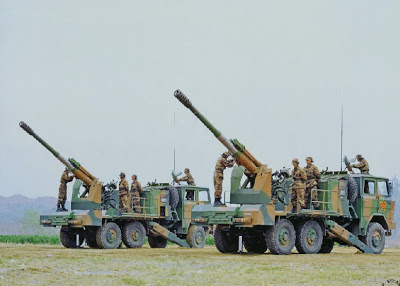
    @rajfortyseven apparently divined the presence of this: two units of the self-propelled LC-09 howitzer:


    It should be noted that the US and PLA navies both operate routinely in the South China Sea, so the easiest way to put the onus on the PRC for “escalating tensions” by further militarizing the region is to claim they have started to put weapons on the islands, and not just in the water.

    I grant it is possible that for some reason the PRC decided that two howitzers (which I believe are the business of the PLA Ground Forces artillery people and would be of little practical use to the PLA Navy, which is in charge of the actual defense of the islands and would be expected to rely on its shipboard armament) should be exhibited to ubiquitous US surveillance and provide the US with grounds to condemn the PRC for militarizing the islands.

    I also think it’s possible that there were two truck-mounted construction cranes out there, maybe with tarps on them to reduce corrosion from the salty air, and the dialogue at the Pentagon went like this:

    “Ya know, those things, I think they’re cranes but they look a lot like howitzers.”

    “I heard you say ‘howitzers’. Tell the journos it looks like they’ve got howitzers on that island.”

    I guess I have a longer memory than most, because I vividly remember how the US and British papers occasionally engaged in unquestioning stenography during the Iraq War. The immortal example was non-stop reporting on the capture of Saddam’s purported mobile bioweapons labs which, as the Anglophone establishment knew very well, were portable hydrogen generators used to inflate weather balloons for artillery practice.

    How did they know, do you ask?

    Because the units had been sold to Iraq in the first place by Britain’s Marconi Command & Control. And the US Army had identical units in its own inventory [see pp. 24-25]

    In fact, the US approach to the SCS public relations campaign reminds me eerily of the runup to the Iraq War. There’s the energetic campaign run out of the Defense Department with only grudging help from the State Department to manufacture a plausible pretext for US action (WMD for Iraq, FoN for SCS); the reliance on the “threat” narrative to overcome an embarrassing shortage of overtly hostile acts by the target; sudden spates of advantageous but perhaps not quite truthful leaks that get reported, misreported, and misunderstood…

    …and the exploitation of obliging media in an allied country to float, feedback, and amplify allegations leaked by the United States.

    In 2002-3, this role was loyally filled by media outlets in the United Kingdom. This time around, it looks like Australia, at least a part of it, is auditioning for the job of America’s Poodle in the Pacific (hereinafter APP).

    The “gun” story seems to have appeared first in Australia, in the Sydney Morning Herald (hereinafter SMH), courtesy of John Garnaut (whose journalistic motto may well be “My Transom Is Always Open to My Friends and to Enemies of the PRC”), with the explosive headline & lede:

    China moves weapons on to artificial islands in South China Sea

    China has moved weaponry onto artificial islands that it is building in contested areas of the South China Sea, adding to the risks of a confrontation with the Unitedtes and its regional security partners including Australia.

    That’s it. No detail, no sourcing, no documentation.

    The subsequent New York Times story makes it clear there were supposed to be two guns (though a tantalizing Philippine report indicated that the Asian Maritime Transparency Initiative of the Center for Strategic and International Studies had claimed its analysts detected guns on two reefs claimed by the Philippines, Kagitingan and Burgos); the source was the Pentagon, the documentation (which the Pentagon has declined to release) surveillance photos. And that the official story was that the guns were no longer there.

    Maybe the SMH got a garbled version through the milsec jungle telegraph; maybe it was given the story with the understanding it would be deployed as table-setter for Shangri La, wanted to scoop the world, & broke the embargo but in a half-assed kinda-sorta way by not revealing the US sourcing.

    On a less salubrious note, I believe there are significant divisions within the Australian establishment concerning the advisability of joining the US to yank China’s chain in the SCS, given the shortage of genuine Australian skin in the game. So it is possible that the revelation was informally backchanneled from the US down to Australia to wrongfoot troublesome China doves and smooth the way for China hawks, who I believe are well-represented in the Australian and US defense establishments.

    And, in fact, one of the things I think we can look forward to is tag-teaming between mil-sec China hawks in the US, Philippines, Australia, and Japan to direct events & massage the media in order to neutralize public opposition and box in less aggressive civilian leadership, a tactic I believe was illustrated by the Josh Rogin piece I parsed over at Asia Times.

    There are arguably good reasons to resist the PRC in the SCS. One is to succor the Philippines, whose access to hydrocarbon and fisheries resources within what can reasonably be construed as its 200-mile EEZ is blocked by the PRC. Another is to escalate tensions so that the US can bolster its local presence (and threaten the PRC’s sea lines of communication and its submarine assets on Hainan in case the Big One (i.e. WW3 actually does roll around) and strengthen the China-containment alliance.

    But none of them relate to the stated concern with freedom of navigation and the steps the US and its allies are taking in order to, ostensibly, ensure it.

    Which means the South China Sea movie has to get, you know, scary and emotional, so that the US can fast-forward over the awkward, boring, and contradictory or illogical parts and keep the audience from walking out of the show.

    And, rest assured, the media is here to help.

    Peter Lee edits China Matters and writes about Asia for CounterPunch.

    After the War, Before the Battle: Wilderness Committee Discovers Logging Maps for Walbran

    War in the Woods could return as logging company targets Walbran Valley

    by Wilderness Committee


    Some of Canada's most ecologically significant old-growth cedar threatened by Teal Jones

    VICTORIAOne of Canada's most important old-growth rainforests is under direct threat of clearcut logging. New maps obtained by the Wilderness Committee show logging company Teal Jones has laid out eight new cutblocks in the central Walbran Valley on Vancouver Island, a focal point of the War in the Woods for decades.

    In recent years, Teal Jones' logging operations have been targeting old-growth and edging closer to the iconic Castle Grove, the finest stand of monumental cedar trees in the Walbran Valley. The new proposed cutblocks surround Castle Grove in an unprotected area on the north side of the Walbran River, near the boundary of Carmanah-Walbran Provincial Park.

    "Intact old-growth forests of this size are incredibly rare and endangered – so much has been cut, and we have a moral responsibility to protect the little that's left," said Torrance Coste, Vancouver Island Campaigner with the Wilderness Committee.
    "The north side of the Walbran River should be completely off-limits to industrial logging."
    "This area has been ground zero for the War in the Woods in the past, and that's exactly the level of conflict Teal Jones is choosing by moving into this area now," Coste added.

    The Wilderness Committee contacted Teal Jones last fall, after finding new surveying tape in the Walbran Valley. The environmental group highlighted the importance and scarcity of old-growth forests of this type, and asked Teal Jones to shift its operations into less contentious areas elsewhere in its large forest tenure (TFL 46).

    "Teal Jones disregarded our request and set its proposed cutblocks in the worst possible locations," Coste explained.
    "This company has proven it cares about nothing but its profits. It's time for the provincial government to step in before Teal Jones does more damage in the Walbran Valley."

    Intact old-growth forests provide habitat for endangered species, act as a storage sink for climate-changing carbon and possess irreplaceable cultural and recreational values. These values far surpass the forests' value as wood products.

    The central Walbran Valley is in unceded Nuu-chah-nulth territories. The Wilderness Committee is calling for a solution that protects the extremely rare old-growth ecosystems and ensures First Nations' access to traditional resources.

                                                                            –30–

    For Immediate Release - June 8, 2015
    For more information, contact:

    Torrance Coste | Vancouver Island Campaigner, Wilderness Committee
    (250) 516-9900, [torrance@wildernesscommittee.org]

    Additional resources:

    Central Walbran Valley map showing proposed logging - June 2015 [https://www.wildernesscommittee.org/sites/all/files/CentralWalbran_Map_June2015_0.pdf]

    Walbran Valley photos from unprotected areas [https://www.wildernesscommittee.org/victoria/walbran_valley_photos_2015]

    Old-growth logging photos from Walbran Valley - March 2013 [https://www.wildernesscommittee.org/victoria/walbran_valley_old_growth_logging_photos_march_2013]

    The Wilderness Committee is Canada's largest membership-based, citizen-funded wilderness preservation organization. We work for the preservation of Canadian and international wilderness through research and grassroots education. The Wilderness Committee works on the ground to achieve ecologically sustainable communities.

    Click here to unsubscribe http://wildernesscommittee-mediareleases.cmail1.com/t/y-u-iuhdkdy-pullyykiy-d/ from this list.

    Follow us: [http://www.wildernesscommittee.org]

    The Wilderness Committee is Canada's largest membership-based, citizen-funded wilderness preservation organization. We work for the preservation of Canadian and international wilderness through research and grassroots education. The Wilderness Committee works on the ground to achieve ecologically sustainable communities.

    Sunday, June 07, 2015

    "Imprisoned" - Experience of Displacement Made New for Perennial Refugee Palestinians Fleeing Syria

    It’s like a prison!: A chance encounter with a Palestinian refugee from Syria forced to flee to Lebanon

    by Louisa Lamb

    Baddawi Palestinian Camp, Tripoli, Lebanon - Lebanon’s 12 refugee camps have become more crowded since March of 2011, but in large numbers starting in mid-December 2012, when Yarmouk Palestinian  refugee camp was heavily bombed. Between 70,000 and 90,000 Syrian-Palestinians have entered Lebanon and are staying mainly in Lebanon’s 12 refugee camps. Most were forced out of Syria because of persistent and accelerating civil-sectarian war, while others have left because of the lack of resources.
     
    This young American had the privilege of speaking with Wisam, who has been living as a refugee in Lebanon since 2012. Wisam was born in 1986 in Damascus, Syria. Unlike many Syrian-Palestinians, who are often  born in refugee camps, he was born in a hospital in Damascus. He is the middle-child of five, with three brothers and one sister. His father worked a bureaucratic position in the Syrian government, and his mother
    stayed at home with the children at their two flats in Almshtel near Seyeda Zeinab south of Damascus.

    In Syria, Wisam did not face any discrimination for being Palestinian. He remembers being treated as an equal by Syrians and by governmental agencies. Like almost all Palestinians however, he did attend UNRWA schools and reminisced, with seeming nostalgia, about what he considers was a good education, reciting the general public view that UNRWA schools were often better Syrian state schools.  In Syria, Wisam received no financial assistance for college, but tuition was amazingly affordable costing only $30 a year and between $50 and $100 a year for books. Wisam graduated from Damascus University in 2009 and earned his degree in English. Two months after graduating, he obtained a job at a hotel in Damascus, working as a receptionist.

    With tensions building in Syria, Wisam considered leaving in March 2012, after receiving “Dafter Khedmet el Alam”—summoning him to join the Palestinian Liberation Army (PLA). This prompted him to apply for a declaration to enter Lebanon.  He explained to me: “Syrians are able to enter Lebanon without tourist visas, but Syrian-Palestinians do need ID documents.” Within a month, on April 19th 2012, he left Syria for  Lebanon.

    Getting through the Syrian-Lebanese border was not difficult at the time that he crossed, but Wisam waited before the Masnaa entrance to Lebanon for two hours while the border officials questioned people. At first, he didn’t tell his parents what he was doing, because he knew they would disapprove since they wanted him to join the military. When they found out, they refused to speak to him for a month before coming to terms with his choice, deciding “that’s Allah”. Forty days after Wisam left, his family left Almshtel to stay with his grandmother, due to the eruption of fighting in their neighborhood between the Syrian Army and the Free  Syrian Army.

    “Compared to Syria, life in Lebanon is disgusting. Life is different in every way: with housing, schools, visas and work—especially work, since Palestinians are not permitted to work, and the majority relies on UNRWA’s modest hand-outs. Upon arriving to Lebanon, Wisam stayed in the north, as Baddawi Camp near Tripoli. After two and a half years, he moved to Shatilla hoping to get a job. At first, he was able to work at Shatilla Camp’s IRC (International Rescue Committee) as a social worker. As with many NGO’s in this region of conflict, the program he worked for was cancelled due to lack of funding. Wisam expressed liking his work very much. He worked with kids and had them participate in educational and fun activities. The program really helped the children, because they could socialize with peers and enjoy themselves instead of focusing on being separated from their families and their terrible current living situation.

    Living in Baddawi camp for two and a half years, where he stayed among friends and their families, Wissam discovered many people staying in Baddawi camp have also fled Syria in the past four years, making it easier to connect to one another. For everyone living in Lebanon’s camps, friends and family are the most important part of enduring the hardship.  Love, compassion, and unity are what sustains these communities as well as the desire to one day travel abroad and live with dignity. Besides friends, Wisam preferred Baddawi camp because it is less crowded and less chaotic than Shatila, quieter, cleaner, has better food and healthcare services and programs for children. He even thinks people overall, are nicer up north. He added, laughing, even the nargile (water pipes) are better.

    Shatilla, Wisam says, is repulsive, because of the narrow streets filled with trash and puddles, higher rent for small apartments, and no fresh water, but instead salt water for showering. “But friends make it easier to endure,” and that seems to be true for anyone living in poverty. When first leaving Baddawi and venturing to Shatilla, Wisam thought it was horrible but gradually, after several months, he has adjusted to the “bad situation.”


    Wisam is one of hundreds of thousands of people who have fled Syria. Manyof his friends have also left Syria, having travelled to Lebanon, Turkey, Jordan, Iraq, Denmark, Sweden, Austria, Germany, and  Malaysia. Some are able to work—especially in Europe—but the majority of his friends remain in refugee camps in this region.

    I asked how his friends were able to get to Europe, as that is nearly impossible for most Palestinians. His response was “death boats” where people sneak onto boats and into the country they’re traveling to. It’s an uncertain adventure for those who try, but those who arrive safely approach a more optimistic life.

    Regarding the turmoil in his birth country, I was curious about Wisam’s views on his president, Bashar al Assad. Wisam stated before he left Syria, he supported Assad, but now he doesn’t. Wisam believes that
    every group in Syria fighting for power is wrong, resulting in nothing but unimaginable civilian deaths. As for Palestinian politics, he hates all parties because they “play with people like toys” and never achieve anything. He provided an example about the well-known Yarmouk camp in Syria, explaining that no party serves the people; at least one person dies a day and children don’t have food or water.

    When I asked Wisam about the future, he sighed and said it was unsure and obscure. Wisam is pessimistic about ever going to Palestine because he doesn’t think it’s realistic. Instead he dreams of immigrating to  Europe, specifically Germany, because it’s an industrial nation and he wants to find a job.

    At first, during the first two years after leaving Syria, Wassim wanted to go back, but because he would have to serve in the military, Europe is the better alternative. “Of course I made the right choice by leaving Syria,” he responded when I asked him, adding that he did not want to come to Lebanon, but it was his only option. Wisam hopes to find a job and leave Shatilla Camp, and just knowing he will eventually get out of Lebanon,
    sustains him.

    Louisa Lamb has her B.A. in Psychology and is an independent researcher and journalist reporting on the underclass and marginalized. She can be reached c/o louisaalamb@gmail.com

    June Vancouver, Hamilton, Toronto Public Forae on Ukraine Humanitarian Emergency

    Nuclear precipice: Ukraine, Russia, and patterns of U.S. hegemony

    by New Cold War.org

    Three public forums on the political situation in eastern Ukraine and surrounding region will take place in Canada in June.


    Vancouver, Friday, June 12
    Toronto, Friday, June 12
    Hamilton, Monday, June 22


    Below are full details.

    Toronto, June 12: Nuclear precipice: Ukraine, Russia, and patterns of U.S. hegemony


    Friday, June 12, 7 pm
    At Beit Zatoun Community Center, 612 Markham St., Toronto

    Speakers: Judy Deutsch (University of Toronto), Halyna Mokrushyna (University of Ottawa), Sergei Plekhanov (York University)

    Sponsor: Centre for Social Justice

    What is the background of the conflict in Ukraine? Can the Ukraine situation lead to a Russia/U.S. confrontation involving nuclear weapons? According to the Bulletin of Atomic Scientists, the world is again at a precipice with threats of nuclear war and climate disaster. Join a panel of three speakers exploring these questions and in context of Western/U.S. hegemony.

    Information online: Beit Zatoun Community Center

    * * *

    Vancouver, June 12

    Eyewitness report from the war zone of eastern Ukraine

    Friday, June 12, 7 pm to 9 pm
    At: Harbour Center, 515 W Hastings St, Rm 1700

    Speaker: Roger Annis

    Sponsor: Institute for the Humanities, Simon Fraser University

    The war in eastern Ukraine is at a crossroads. A ceasefire has been in place since February 12, 2015 but violations are frequent. The underlying political and economic issues that sparked the war are unresolved. Ukraine does not recognize or talk to the rebel, pro-autonomy movement in the east. The NATO countries are pushing a ‘blame Russia’ narrative, and three of them-the U.S., UK and Canada-have soldiers in western Ukraine providing training to the Ukrainian army. Roger Annis visited the city and region of Donetsk, Eastern Ukraine in mid-April 2015. He is an editor and writer at the website, The New Cold War: Ukraine and beyond.

    Free admission
    Information online: http://www.sfu.ca/humanities-institute/
    Facebook: https://www.facebook.com/events/393848344073067/

    * * *

    Hamilton, June 22


    Canada’s mistaken foreign policy in Ukraine

    Featuring: James Bissett, former Canadian ambassador to Yugoslavia

    Monday, June 22, 7pm
    At: New Vision United Church (formerly Centenary Church),
    24 Main St. West, across from Hamilton City Hall

    Sponsor: Hamilton and District Labour Council. Co-hosted by Unifor Local 5555, CUPW Local 548 and OSSTF Local 21.

    The crisis in Ukraine could easily become a flash point for war in Europe. Canadians, whose government has recently sent ships, fighter planes, and troops to the area, need to hear this experienced diplomat’s analysis.

    Free admission. New Vision is completely accessible to wheelchairs.

    Facebook: https://www.facebook.com/events/711493018977272/

    Moving Forward with an Empire Declining

    The Geopolitics of American Global Decline: Washington Versus China in the Twenty-First Century

    by Alfred W. McCoy  - TomDispatch


    For even the greatest of empires, geography is often destiny. You wouldn’t know it in Washington, though. America’s political, national security, and foreign policy elites continue to ignore the basics of geopolitics that have shaped the fate of world empires for the past 500 years. Consequently, they have missed the significance of the rapid global changes in Eurasia that are in the process of undermining the grand strategy for world dominion that Washington has pursued these past seven decades.

    A glance at what passes for insider “wisdom” in Washington these days reveals a worldview of stunning insularity. Take Harvard political scientist Joseph Nye, Jr., known for his concept of “soft power,” as an example. Offering a simple list of ways in which he believes U.S. military, economic, and cultural power remains singular and superior, he recently argued that there was no force, internal or global, capable of eclipsing America’s future as the world’s premier power.

    For those pointing to Beijing’s surging economy and proclaiming this “the Chinese century,” Nye offered up a roster of negatives: China’s per capita income “will take decades to catch up (if ever)” with America’s; it has myopically “focused its policies primarily on its region”; and it has “not developed any significant capabilities for global force projection.” Above all, Nye claimed, China suffers “geopolitical disadvantages in the internal Asian balance of power, compared to America.”

    Or put it this way (and in this Nye is typical of a whole world of Washington thinking): with more allies, ships, fighters, missiles, money, patents, and blockbuster movies than any other power, Washington wins hands down.

    Tomgram: Alfred McCoy, Washington's Great Game and Why It's Failing

    It might have been the most influential single sentence of that era: “In these circumstances it is clear that the main element of any United States policy toward the Soviet Union must be that of long-term, patient but firm and vigilant containment of Russian expansive tendencies.” And it originated in an 8,000 word telegram -- yes, in those days, unbelievably enough, there was no email, no Internet, no Snapchat, no Facebook -- sent back to Washington in February 1946 by George F. Kennan, the U.S. chargé d’affaires in Moscow, at a moment when the Cold War between the United States and the Soviet Union was just gaining traction.

    The next year, a reworked version of Kennan’s “Long Telegram” with that sentence would be published as “The Sources of Soviet Conduct” in the prestigious magazine Foreign Affairs under the pseudonym “Mr. X” (though it was common knowledge in Washington who had written it). From that moment on, “containment” of what, until the Sino-Soviet split, was called the Soviet bloc, would be Washington’s signature foreign and military policy of the era. The idea was to ring the Soviet Union and China with bases and then militarily, economically, and diplomatically hem in a gaggle of communist states from Hungary and Czechoslovakia in Eastern Europe to North Korea on the Pacific and from Siberia south to the Central Asian SSRs of the Soviet Union. In other words, much of the Eurasian land mass.

    And then, when the Berlin Wall came down in 1989 and the Soviet Union collapsed and disappeared from the face of the Earth in 1991, that was that. Along with the former Communist world, containment as policy was dispatched to the dustbin of history -- or was it? Strangely enough, as historian and TomDispatch regular Alfred McCoy points out today, if you look at Washington’s military bases (which, if anything, were expanded in the post-Soviet era), its conflicts, and the focus of its foreign policy, American attempts to “contain” the heartlands of Eurasia, especially Russia and China, have never ended. Given the passage of almost a quarter of a century since the Cold War era, the map of those garrisons and the conflicts that go with them still looks eerily familiar.

    And here’s an even stranger thing, as McCoy again makes clear: the U.S. was not the first imperial power to put its energy into “containing” Eurasia. In 1945, when World War II ended with Great Britain and its empire hollowed out and in a state of exhaustion, the U.S. inherited a no-name version of “containment” policy from the British before Kennan even thought to use the term. It’s odd to realize that “containment” as imperial policy has a history that is now, in a sense, more than two centuries old. It’s strange enough, in fact, that McCoy turns his attention to the subject to help make sense of the edgy U.S.-China relationship for the rest of this century. Tom


    The Geopolitics of American Global Decline: Washington Versus China in the Twenty-First Century

    by Alfred W. McCoy 


    If Professor Nye paints power by the numbers, former Secretary of State Henry Kissinger’s latest tome, modestly titled World Order and hailed in reviews as nothing less than a revelation, adopts a Nietzschean perspective. The ageless Kissinger portrays global politics as plastic and so highly susceptible to shaping by great leaders with a will to power. By this measure, in the tradition of master European diplomats Charles de Talleyrand and Prince Metternich, President Theodore Roosevelt was a bold visionary who launched “an American role in managing the Asia-Pacific equilibrium.” On the other hand, Woodrow Wilson’s idealistic dream of national self-determination rendered him geopolitically inept and Franklin Roosevelt was blind to Soviet dictator Joseph Stalin’s steely “global strategy.” Harry Truman, in contrast, overcame national ambivalence to commit “America to the shaping of a new international order,” a policy wisely followed by the next 12 presidents.

    Among the most “courageous” of them, Kissinger insists, was that leader of “courage, dignity, and conviction,” George W. Bush, whose resolute bid for the “transformation of Iraq from among the Middle East’s most repressive states to a multiparty democracy” would have succeeded, had it not been for the “ruthless” subversion of his work by Syria and Iran. In such a view, geopolitics has no place; only the bold vision of “statesmen” and kings really matters.

    And perhaps that’s a comforting perspective in Washington at a moment when America’s hegemony is visibly crumbling amid a tectonic shift in global power.

    With Washington’s anointed seers strikingly obtuse on the subject of geopolitical power, perhaps it’s time to get back to basics. That means returning to the foundational text of modern geopolitics, which remains an indispensible guide even though it was published in an obscure British geography journal well over a century ago.

    Sir Halford Invents Geopolitics


    On a cold London evening in January 1904, Sir Halford Mackinder, the director of the London School of Economics, “entranced” an audience at the Royal Geographical Society on Savile Row with a paper boldly titled “The Geographical Pivot of History.” This presentation evinced, said the society’s president, “a brilliancy of description... we have seldom had equaled in this room.”

    Mackinder argued that the future of global power lay not, as most British then imagined, in controlling the global sea lanes, but in controlling a vast land mass he called “Euro-Asia.” By turning the globe away from America to place central Asia at the planet’s epicenter, and then tilting the Earth’s axis northward just a bit beyond Mercator’s equatorial projection, Mackinder redrew and thus reconceptualized the world map.

    His new map showed Africa, Asia, and Europe not as three separate continents, but as a unitary land mass, a veritable “world island.” Its broad, deep “heartland” -- 4,000 miles from the Persian Gulf to the Siberian Sea -- was so enormous that it could only be controlled from its “rimlands” in Eastern Europe or what he called its maritime “marginal” in the surrounding seas.


    Mackinder’s Concept of the World Island, From The Geographical Journal (1904)

    The “discovery of the Cape road to the Indies” in the sixteenth century, Mackinder wrote, “endowed Christendom with the widest possible mobility of power... wrapping her influence round the Euro-Asiatic land-power which had hitherto threatened her very existence.” This greater mobility, he later explained, gave Europe’s seamen “superiority for some four centuries over the landsmen of Africa and Asia.”

    Yet the “heartland” of this vast landmass, a “pivot area” stretching from the Persian Gulf to China’s Yangtze River, remained nothing less than the Archimedean fulcrum for future world power. “Who rules the Heartland commands the World-Island,” went Mackinder’s later summary of the situation. “Who rules the World-Island commands the world.” Beyond the vast mass of that world island, which made up nearly 60% of the Earth’s land area, lay a less consequential hemisphere covered with broad oceans and a few outlying “smaller islands.” He meant, of course, Australia and the Americas.

    For an earlier generation, the opening of the Suez Canal and the advent of steam shipping had “increased the mobility of sea-power [relative] to land power.” But future railways could “work the greater wonder in the steppe,” Mackinder claimed, undercutting the cost of sea transport and shifting the locus of geopolitical power inland. In the fullness of time, the “pivot state” of Russia might, in alliance with another power like Germany, expand “over the marginal lands of Euro-Asia,” allowing “the use of vast continental resources for fleet-building, and the empire of the world would be in sight.”

    For the next two hours, as he read through a text thick with the convoluted syntax and classical references expected of a former Oxford don, his audience knew that they were privy to something extraordinary. Several stayed after to offer extended commentaries. For instance, the renowned military analyst Spenser Wilkinson, the first to hold a chair in military history at Oxford, pronounced himself unconvinced about “the modern expansion of Russia,” insisting that British and Japanese naval power would continue the historic function of holding “the balance between the divided forces... on the continental area.”

    Pressed by his learned listeners to consider other facts or factors, including “air as a means of locomotion,” Mackinder responded: “My aim is not to predict a great future for this or that country, but to make a geographical formula into which you could fit any political balance.” Instead of specific events, Mackinder was reaching for a general theory about the causal connection between geography and global power. “The future of the world,” he insisted, “depends on the maintenance of [a] balance of power” between sea powers such as Britain or Japan operating from the maritime marginal and “the expansive internal forces” within the Euro-Asian heartland they were intent on containing.

    Not only did Mackinder give voice to a worldview that would influence Britain’s foreign policy for several decades, but he had, in that moment, created the modern science of “geopolitics” -- the study of how geography can, under certain circumstances, shape the destiny of whole peoples, nations, and empires.

    That night in London was, of course, more than a long time ago. It was another age. England was still mourning the death of Queen Victoria. Teddy Roosevelt was president. Henry Ford had just opened a small auto plant in Detroit to make his Model-A, an automobile with a top speed of 28 miles per hour. Only a month earlier, the Wright brothers’ “Flyer” had taken to the air for the first time -- 120 feet of air, to be exact.

    Yet, for the next 110 years, Sir Halford Mackinder’s words would offer a prism of exceptional precision when it came to understanding the often obscure geopolitics driving the world’s major conflicts -- two world wars, a Cold War, America’s Asian wars (Korea and Vietnam), two Persian Gulf wars, and even the endless pacification of Afghanistan. The question today is: How can Sir Halford help us understand not only centuries past, but the half-century still to come?

    Britannia Rules the Waves


    In the age of sea power that lasted just over 400 years -- from 1602 to the Washington Disarmament Conference of 1922 -- the great powers competed to control the Eurasian world island via the surrounding sea lanes that stretched for 15,000 miles from London to Tokyo. The instrument of power was, of course, the ship -- first men-o’-war, then battleships, submarines, and aircraft carriers. While land armies slogged through the mud of Manchuria or France in battles with mind-numbing casualties, imperial navies skimmed over the seas, maneuvering for the control of whole coasts and continents.

    At the peak of its imperial power circa 1900, Great Britain ruled the waves with a fleet of 300 capital ships and 30 naval bastions, bases that ringed the world island from the North Atlantic at Scapa Flow through the Mediterranean at Malta and Suez to Bombay, Singapore, and Hong Kong. Just as the Roman Empire enclosed the Mediterranean, making it Mare Nostrum (“Our Sea”), British power would make the Indian Ocean its own “closed sea,” securing its flanks with army forces on India’s Northwest Frontier and barring both Persians and Ottomans from building naval bases on the Persian Gulf.

    By that maneuver, Britain also secured control over Arabia and Mesopotamia, strategic terrain that Mackinder had termed “the passage-land from Europe to the Indies” and the gateway to the world island’s “heartland.” From this geopolitical perspective, the nineteenth century was, at heart, a strategic rivalry, often called “the Great Game,” between Russia “in command of nearly the whole of the Heartland... knocking at the landward gates of the Indies,” and Britain “advancing inland from the sea gates of India to meet the menace from the northwest.” In other words, Mackinder concluded, “the final Geographical Realities” of the modern age were sea power versus land power or “the World-Island and the Heartland.”

    Intense rivalries, first between England and France, then England and Germany, helped drive a relentless European naval arms race that raised the price of sea power to unsustainable levels. In 1805, Admiral Nelson’s flagship, the HMS Victory, with its oaken hull weighing just 3,500 tons, sailed into the battle of Trafalgar against Napoleon’s navy at nine knots, its 100 smooth-bore cannon firing 42-pound balls at a range of no more than 400 yards.

    In 1906, just a century later, Britain launched the world’s first modern battleship, the HMS Dreadnought, its foot-thick steel hull weighing 20,000 tons, its steam turbines allowing speeds of 21 knots, and its mechanized 12-inch guns rapid-firing 850-pound shells up to 12 miles. The cost for this leviathan was £1.8 million, equivalent to nearly $300 million today. Within a decade, half-a-dozen powers had emptied their treasuries to build whole fleets of these lethal, lavishly expensive battleships.

    Thanks to a combination of technological superiority, global reach, and naval alliances with the U.S. and Japan, a Pax Britannica would last a full century, 1815 to 1914. In the end, however, this global system was marked by an accelerating naval arms race, volatile great-power diplomacy, and a bitter competition for overseas empire that imploded into the mindless slaughter of World War I, leaving 16 million dead by 1918.

    Mackinder’s Century


    As the eminent imperial historian Paul Kennedy once observed, “the rest of the twentieth century bore witness to Mackinder's thesis,” with two world wars fought over his “rimlands” running from Eastern Europe through the Middle East to East Asia. Indeed, World War I was, as Mackinder himself later observed, “a straight duel between land-power and sea-power.” At war’s end in 1918, the sea powers -- Britain, America, and Japan -- sent naval expeditions to Archangel, the Black Sea, and Siberia to contain Russia’s revolution inside its “heartland.”

    Reflecting Mackinder’s influence on geopolitical thinking in Germany, Adolf Hitler would risk his Reich in a misbegotten effort to capture the Russian heartland as Lebensraum, or living space, for his “master race.” Sir Halford’s work helped shape the ideas of German geographer Karl Haushofer, founder of the journal Zeitschrift für Geopolitik, proponent of the concept of Lebensraum, and adviser to Adolf Hitler and his deputy führer, Rudolf Hess. In 1942, the Führer dispatched a million men, 10,000 artillery pieces, and 500 tanks to breach the Volga River at Stalingrad. In the end, his forces suffered 850,000 wounded, killed, and captured in a vain attempt to break through the East European rimland into the world island’s pivotal region.

    A century after Mackinder’s seminal treatise, another British scholar, imperial historian John Darwin, argued in his magisterial survey After Tamerlane that the United States had achieved its “colossal Imperium... on an unprecedented scale” in the wake of World War II by becoming the first power in history to control the strategic axial points “at both ends of Eurasia” (his rendering of Mackinder’s “Euro-Asia”). With fears of Chinese and Russian expansion serving as the “catalyst for collaboration,” the U.S. won imperial bastions in both Western Europe and Japan. With these axial points as anchors, Washington then built an arc of military bases that followed Britain’s maritime template and were visibly meant to encircle the world island.

    America’s Axial Geopolitics


    Having seized the axial ends of the world island from Nazi Germany and Imperial Japan in 1945, for the next 70 years the United States relied on ever-thickening layers of military power to contain China and Russia inside that Eurasian heartland. Stripped of its ideological foliage, Washington’s grand strategy of Cold War-era anticommunist “containment” was little more than a process of imperial succession. A hollowed-out Britain was replaced astride the maritime “marginal,” but the strategic realities remained essentially the same.

    Indeed, in 1943, two years before World War II ended, an aging Mackinder published his last article, “The Round World and the Winning of the Peace,” in the influential U.S. journal Foreign Affairs. In it, he reminded Americans aspiring to a “grand strategy” for an unprecedented version of planetary hegemony that even their “dream of a global air power” would not change geopolitical basics. “If the Soviet Union emerges from this war as conqueror of Germany,” he warned, “she must rank as the greatest land power on the globe,” controlling the “greatest natural fortress on earth.”

    When it came to the establishment of a new post-war Pax Americana, first and foundational for the containment of Soviet land power would be the U.S. Navy. Its fleets would come to surround the Eurasian continent, supplementing and then supplanting the British navy: the Sixth Fleet was based at Naples in 1946 for control of the Atlantic Ocean and the Mediterranean Sea; the Seventh Fleet at Subic Bay, Philippines, in 1947, for the Western Pacific; and the Fifth Fleet at Bahrain in the Persian Gulf since 1995.

    Next, American diplomats added layers of encircling military alliances -- the North Atlantic Treaty Organization (1949), the Middle East Treaty Organization (1955), the Southeast Asia Treaty Organization (1954), and the U.S.-Japan Security Treaty (1951).

    By 1955, the U.S. also had a global network of 450 military bases in 36 countries aimed, in large part, at containing the Sino-Soviet bloc behind an Iron Curtain that coincided to a surprising degree with Mackinder’s “rimlands” around the Eurasian landmass. By the Cold War’s end in 1990, the encirclement of communist China and Russia required 700 overseas bases, an air force of 1,763 jet fighters, a vast nuclear arsenal, more than 1,000 ballistic missiles, and a navy of 600 ships, including 15 nuclear carrier battle groups -- all linked by the world's only global system of communications satellites.

    As the fulcrum for Washington’s strategic perimeter around the world island, the Persian Gulf region has for nearly 40 years been the site of constant American intervention, overt and covert. The 1979 revolution in Iran meant the loss of a keystone country in the arch of U.S. power around the Gulf and left Washington struggling to rebuild its presence in the region. To that end, it would simultaneously back Saddam Hussein’s Iraq in its war against revolutionary Iran and arm the most extreme of the Afghan mujahedeen against the Soviet occupation of Afghanistan.

    It was in this context that Zbigniew Brzezinski, national security adviser to President Jimmy Carter, unleashed his strategy for the defeat of the Soviet Union with a sheer geopolitical agility still little understood even today. In 1979, Brzezinski, a déclassé Polish aristocrat uniquely attuned to his native continent’s geopolitical realities, persuaded Carter to launch Operation Cyclone with massive funding that reached $500 million annually by the late 1980s. Its goal: to mobilize Muslim militants to attack the Soviet Union’s soft Central Asian underbelly and drive a wedge of radical Islam deep into the Soviet heartland. It was to simultaneously inflict a demoralizing defeat on the Red Army in Afghanistan and cut Eastern Europe’s “rimland” free from Moscow’s orbit. “We didn’t push the Russians to intervene [in Afghanistan],” Brzezinski said in 1998, explaining his geopolitical masterstroke in this Cold War edition of the Great Game, “but we knowingly increased the probability that they would... That secret operation was an excellent idea. Its effect was to draw the Russians into the Afghan trap.”

    Asked about this operation’s legacy when it came to creating a militant Islam hostile to the U.S., Brzezinski, who studied and frequently cited Mackinder, was coolly unapologetic. “What is most important to the history of the world?” he asked. “The Taliban or the collapse of the Soviet empire? Some stirred-up Moslems or the liberation of Central Europe and the end of the Cold War?”

    Yet even America’s stunning victory in the Cold War with the implosion of the Soviet Union would not transform the geopolitical fundamentals of the world island. As a result, after the fall of the Berlin Wall in 1989, Washington’s first foreign foray in the new era would involve an attempt to reestablish its dominant position in the Persian Gulf, using Saddam Hussein’s occupation of Kuwait as a pretext.

    In 2003, when the U.S. invaded Iraq, imperial historian Paul Kennedy returned to Mackinder’s century-old treatise to explain this seemingly inexplicable misadventure. “Right now, with hundreds of thousands of U.S. troops in the Eurasian rimlands,” Kennedy wrote in the Guardian, “it looks as if Washington is taking seriously Mackinder’s injunction to ensure control of ‘the geographical pivot of history.’” If we interpret these remarks expansively, the sudden proliferation of U.S. bases across Afghanistan and Iraq should be seen as yet another imperial bid for a pivotal position at the edge of the Eurasian heartland, akin to those old British colonial forts along India’s Northwest Frontier.

    In the ensuing years, Washington attempted to replace some of its ineffective boots on the ground with drones in the air. By 2011, the Air Force and the CIA had ringed the Eurasian landmass with 60 bases for its armada of drones. By then, its workhorse Reaper, armed with Hellfire missiles and GBU-30 bombs, had a range of 1,150 miles, which meant that from those bases it could strike targets almost anywhere in Africa and Asia.

    Significantly, drone bases now dot the maritime margins around the world island -- from Sigonella, Sicily, to Icerlik, Turkey; Djibouti on the Red Sea; Qatar and Abu Dhabi on the Persian Gulf; the Seychelles Islands in the Indian Ocean; Jalalabad, Khost, Kandahar, and Shindand in Afghanistan; and in the Pacific, Zamboanga in the Philippines and Andersen Air Base on the island of Guam, among other places. To patrol this sweeping periphery, the Pentagon is spending $10 billion to build an armada of 99 Global Hawk drones equipped with high-resolution cameras capable of surveilling all terrain within a hundred-mile radius, electronic sensors that can sweep up communications, and efficient engines capable of 35 hours of continuous flight and a range of 8,700 miles.

    China’s Strategy


    Washington’s moves, in other words, represent something old, even if on a previously unimaginable scale. But the rise of China as the world’s largest economy, inconceivable a century ago, represents something new and so threatens to overturn the maritime geopolitics that have shaped world power for the past 400 years. Instead of focusing purely on building a blue-water navy like the British or a global aerospace armada akin to America’s, China is reaching deep within the world island in an attempt to thoroughly reshape the geopolitical fundamentals of global power. It is using a subtle strategy that has so far eluded Washington’s power elites.

    After decades of quiet preparation, Beijing has recently begun revealing its grand strategy for global power, move by careful move. Its two-step plan is designed to build a transcontinental infrastructure for the economic integration of the world island from within, while mobilizing military forces to surgically slice through Washington’s encircling containment.

    The initial step has involved a breathtaking project to put in place an infrastructure for the continent’s economic integration. By laying down an elaborate and enormously expensive network of high-speed, high-volume railroads as well as oil and natural gas pipelines across the vast breadth of Eurasia, China may realize Mackinder’s vision in a new way. For the first time in history, the rapid transcontinental movement of critical cargo -- oil, minerals, and manufactured goods -- will be possible on a massive scale, thereby potentially unifying that vast landmass into a single economic zone stretching 6,500 miles from Shanghai to Madrid. In this way, the leadership in Beijing hopes to shift the locus of geopolitical power away from the maritime periphery and deep into the continent’s heartland.

    “Trans-continental railways are now transmuting the conditions of land power,” wrote Mackinder back in 1904 as the “precarious” single track of the Trans-Siberian Railway, the world’s longest, reached across the continent for 5,700 miles from Moscow toward Vladivostok. “But the century will not be old before all Asia is covered with railways,” he added. “The spaces within the Russian Empire and Mongolia are so vast, and their potentialities in... fuel and metals so incalculably great that a vast economic world, more or less apart, will there develop inaccessible to oceanic commerce.”

    Mackinder was a bit premature in his prediction. The Russian revolution of 1917, the Chinese revolution of 1949, and the subsequent 40 years of the Cold War slowed any real development for decades. In this way, the Euro-Asian “heartland” was denied economic growth and integration, thanks in part to artificial ideological barriers -- the Iron Curtain and then the Sino-Soviet split -- that stalled any infrastructure construction across the vast Eurasian land mass. No longer.

    Only a few years after the Cold War ended, former National Security Adviser Brzezinski, by then a contrarian sharply critical of the global views of both Republican and Democratic policy elites, began raising warning flags about Washington’s inept style of geopolitics. “Ever since the continents started interacting politically, some five hundred years ago,” he wrote in 1998, essentially paraphrasing Mackinder, “Eurasia has been the center of world power. A power that dominates ‘Eurasia’ would control two of the world’s three most advanced and economically productive regions... rendering the Western Hemisphere and Oceania geopolitically peripheral to the world’s central continent.”

    While such a geopolitical logic has eluded Washington, it’s been well understood in Beijing. Indeed, in the last decade China has launched the world’s largest burst of infrastructure investment, already a trillion dollars and counting, since Washington started the U.S. Interstate Highway System back in the 1950s. The numbers for the rails and pipelines it’s been building are mind numbing. Between 2007 and 2014, China criss-crossed its countryside with 9,000 miles of new high-speed rail, more than the rest of the world combined. The system now carries 2.5 million passengers daily at top speeds of 240 miles per hour. By the time the system is complete in 2030, it will have added up to 16,000 miles of high-speed track at a cost of $300 billion, linking all of China’s major cities.


    China-Central Asia Infrastructure Integrates the World Island (Source: Stratfor)

    Simultaneously, China’s leadership began collaborating with surrounding states on a massive project to integrate the country’s national rail network into a transcontinental grid. Starting in 2008, the Germans and Russians joined with the Chinese in launching the “Eurasian Land Bridge.” Two east-west routes, the old Trans-Siberian in the north and a new southern route along the ancient Silk Road through Kazakhstan are meant to bind all of Eurasia together. On the quicker southern route, containers of high-value manufactured goods, computers, and auto parts started travelling 6,700 miles from Leipzig, Germany, to Chongqing, China, in just 20 days, about half the 35 days such goods now take via ship.

    In 2013, Deutsche Bahn AG (German Rail) began preparing a third route between Hamburg and Zhengzhou that has now cut travel time to just 15 days, while Kazakh Rail opened a Chongqing-Duisburg link with similar times. In October 2014, China announced plans for the construction of the world’s longest high-speed rail line at a cost of $230 billion. According to plans, trains will traverse the 4,300 miles between Beijing and Moscow in just two days.

    In addition, China is building two spur lines running southwest and due south toward the world island’s maritime “marginal.” In April, President Xi Jinping signed an agreement with Pakistan to spend $46 billion on a China-Pakistan Economic Corridor. Highway, rail links, and pipelines will stretch nearly 2,000 miles from Kashgar in Xinjiang, China’s westernmost province, to a joint port facility at Gwadar, Pakistan, opened back in 2007. China has invested more than $200 billion in the building of this strategic port at Gwadar on the Arabian Sea, just 370 miles from the Persian Gulf. Starting in 2011, China also began extending its rail lines through Laos into Southeast Asia at an initial cost of $6.2 billion. In the end, a high-speed line is expected to take passengers and goods on a trip of just 10 hours from Kunming to Singapore.

    In this same dynamic decade, China has constructed a comprehensive network of trans-continental gas and oil pipelines to import fuels from the whole of Eurasia for its population centers -- in the north, center, and southeast. In 2009, after a decade of construction, the state-owned China National Petroleum Corporation (CNPC) opened the final stage of the Kazakhstan-China Oil Pipeline. It stretches 1,400 miles from the Caspian Sea to Xinjiang.

    Simultaneously, CNPC collaborated with Turkmenistan to inaugurate the Central Asia-China gas pipeline. Running for 1,200 miles largely parallel to the Kazakhstan-China Oil Pipeline, it is the first to bring the region’s natural gas to China. To bypass the Straits of Malacca controlled by the U.S Navy, CNPC opened a Sino-Myanmar pipeline in 2013 to carry both Middle Eastern oil and Burmese natural gas 1,500 miles from the Bay of Bengal to China’s remote southwestern region. In May 2014, the company signed a $400 billion, 30-year deal with the privatized Russian energy giant Gazprom to deliver 38 billion cubic meters of natural gas annually by 2018 via a still-to-be-completed northern network of pipelines across Siberia and into Manchuria.


    Click here to see a larger version

    Sino-Myanmar Oil Pipeline Evades the U.S. Navy
    in the Straits of Malacca (Source: Stratfor)

    Though massive, these projects are just part of an ongoing construction boom that, over the past five years, has woven a cat’s cradle of oil and gas lines across Central Asia and south into Iran and Pakistan. The result will soon be an integrated inland energy infrastructure, including Russia’s own vast network of pipelines, extending across the whole of Eurasia, from the Atlantic to the South China Sea.

    To capitalize such staggering regional growth plans, in October 2014 Beijing announced the establishment of the Asian Infrastructure Investment Bank. China’s leadership sees this institution as a future regional and, in the end, Eurasian alternative to the U.S.-dominated World Bank. So far, despite pressure from Washington not to join, 14 key countries, including close U.S. allies like Germany, Great Britain, Australia, and South Korea, have signed on. Simultaneously, China has begun building long-term trade relations with resource-rich areas of Africa, as well as with Australia and Southeast Asia, as part of its plan to economically integrate the world island.

    Finally, Beijing has only recently revealed a deftly designed strategy for neutralizing the military forces Washington has arrayed around the continent’s perimeter. In April, President Xi Jinping announced construction of that massive road-rail-pipeline corridor direct from western China to its new port at Gwadar, Pakistan, creating the logistics for future naval deployments in the energy-rich Arabian Sea.

    In May, Beijing escalated its claim to exclusive control over the South China Sea, expanding Longpo Naval Base on Hainan Island for the region's first nuclear submarine facility, accelerating its dredging to create three new atolls that could become military airfields in the disputed Spratley Islands, and formally warning off U.S. Navy overflights. By building the infrastructure for military bases in the South China and Arabian seas, Beijing is forging the future capacity to surgically and strategically impair U.S. military containment.

    At the same time, Beijing is developing plans to challenge Washington’s dominion over space and cyberspace. It expects, for instance, to complete its own global satellite system by 2020, offering the first challenge to Washington’s dominion over space since the U.S. launched its system of 26 defense communication satellites back in 1967. Simultaneously, Beijing is building a formidable capacity for cyber warfare.

    In a decade or two, should the need arise, China will be ready to surgically slice through Washington’s continental encirclement at a few strategic points without having to confront the full global might of the U.S. military, potentially rendering the vast American armada of carriers, cruisers, drones, fighters, and submarines redundant.

    Lacking the geopolitical vision of Mackinder and his generation of British imperialists, America’s current leadership has failed to grasp the significance of a radical global change underway inside the Eurasian land mass. If China succeeds in linking its rising industries to the vast natural resources of the Eurasian heartland, then quite possibly, as Sir Halford Mackinder predicted on that cold London night in 1904, “the empire of the world would be in sight.”

    Alfred W. McCoy, a TomDispatch regular, holds the Harrington Chair in History at the University of Wisconsin-Madison. He is the editor of Endless Empire: Spain’s Retreat, Europe’s Eclipse, America’s Decline and the author of Policing America’s Empire: The United States, the Philippines, and the Rise of the Surveillance State, among other works.

    Follow TomDispatch on Twitter and join us on Facebook. Check out the newest Dispatch Book, Nick Turse’s Tomorrow’s Battlefield: U.S. Proxy Wars and Secret Ops in Africa, and Tom Engelhardt's latest book, Shadow Government: Surveillance, Secret Wars, and a Global Security State in a Single-Superpower World.

    Copyright 2015 Alfred McCoy

    Syria: Disaster by Design, or Blithely Strolling into Another Humanitarian Catastrophe?


    Sleepwalking to Another Mideast Disaster

    by Robert Parry - Consortium News

    June 4, 2015

    If sanity ruled U.S. foreign policy, American diplomats would be pushing frantically for serious power-sharing negotiations between Syria’s secular government and whatever rational people remain in the opposition – and then hope that the combination could turn back the military advances of the Islamic State and/or Al-Qaeda’s Nusra Front.

    U.S. Secretary of State John Kerry on Aug. 30, 2013, 
    claims to have proof that the Syrian government was 
    responsible for a chemical weapons attack on Aug. 21, 
    but that evidence failed to materialize 
    or was later discredited. [State Department photo]

    But sanity doesn’t rule. Instead, the ever-influential neocons and their liberal-hawk allies can’t get beyond the idea of a U.S. military campaign to destroy President Bashar al-Assad’s army and force “regime change” – even if the almost certain outcome would be the black flag of Islamic nihilism flying over Damascus.

    As much as one may criticize the neocons for their reckless scheming, you can’t call them fickle. Once they come up with an idea – no matter how hare-brained – they stick with it. Syrian “regime change” has been near the top of their to-do list since the mid-1990s and they aren’t about to let it go now. [See Consortiumnews.com’s “The Mysterious Why of the Iraq War.”]

    That’s one reason why – if you read recent New York Times stories by correspondent Anne Barnard – no matter how they start, they will wind their way to a conclusion that President Barack Obama must bomb Assad’s forces, somehow conflating Assad’s secular government with the success of the fundamentalist Islamic State.

    On Wednesday, Barnard published, on the front page, fact-free allegations that Assad was in cahoots with the Islamic State (also known as ISIS or ISIL) in its offensive near Aleppo, thus suggesting that both Assad’s forces and the Islamic State deserved to be targets of U.S. bombing attacks inside Syria. [See Consortiumnews.com’s “NYT’s New Propaganda on Syria.”]

    On Thursday, Barnard was back on the front page co-authoring an analysis favorably citing the views of political analyst Ibrahim Hamidi, arguing that the only way to blunt the political appeal of the Islamic State is to take “more forceful international action against the Syrian president” – code words for “regime change.”

    But Barnard lamented, “Mr. Assad remains in power, backed by Iran and the militant group Hezbollah. … That, Mr. Hamidi and other analysts said, has left some Sunnis willing to tolerate the Islamic State in areas where they lack another defender. … By attacking ISIS in Syria while doing nothing to stop Mr. Assad from bombing Sunni areas that have rebelled, he added, the United States-led campaign was driving some Syrians into the Islamic State camp.”

    In other words, if one follows Barnard’s logic, the United States should expand its military strikes inside Syria to include attacks on the Syrian government’s forces, even though they have been the primary obstacle to the conquest of Syria by Al-Qaeda’s Nusra Front and/or Al-Qaeda’s spinoff, the Islamic State. (Another unprofessional thing about Barnard’s articles is that they don’t bother to seek out what the Syrian government thinks or to get the regime’s response to accusations.)

    The Sarin Story


    So, “regime change” remains the neocon prescription for Syria, one that was almost fulfilled in summer 2013 after a mysterious sarin gas attack on Aug. 21, 2013, outside Damascus – that the U.S. government and mainstream media rushed to blame on Assad, although some U.S. intelligence analysts suspected early on that it was a provocation by rebel extremists.

    According to intelligence sources, that suspicion of a rebel “false-flag” operation has gained more credence inside the U.S. intelligence community although the Director of National Intelligence refuses to provide an update beyond the sketchy “government assessment” that was issued nine days after the incident, blaming Assad’s forces but presenting no verifiable evidence.

    Because DNI James Clapper has balked at refining or correcting the initial rush to judgment, senior U.S. officials and the mainstream media have been spared the embarrassment of having to retract their initial claims – and they also are free to continue accusing Assad. [See Consortiumnews.com’s “A Fact-Resistant Group Think on Syria.”]

    Yet, the DNI’s refusal to update the nine-days-after-the-attack white paper undermines any hope of getting serious about power-sharing negotiations between Assad and his “moderate” opponents. It may be fun to repeat accusations about Assad “gassing his own people,” a reprise of a favorite line used against Iraq’s Saddam Hussein, but it leaves little space for talks.

    There has been a similar problem in the DNI’s stubbornness about revealing what the U.S. intelligence community has learned about the Malaysia Airlines Flight 17 shoot-down over eastern Ukraine killing 298 people on July 17, 2014. DNI Clapper released a hasty report five days after the tragedy, citing mostly “social media” and pointing the blame at ethnic Russian rebels and the Russian government.

    Though I’m told that U.S intelligence analysts have vastly expanded their understanding of what happened and who was responsible, the Obama administration has refused to release the information, letting stand the public perception that Russian President Vladimir Putin was somehow at fault. That, in turn, has limited Putin’s willingness to cooperate fully with Obama on strategies for reining in hard-charging crises in the Middle East and elsewhere. [See Consortiumnews.com’s “US Intel Stands Pat on MH-17 Shoot-down.”]

    From the Russian perspective, Putin feels he is being falsely accused of mass murder even as Obama seeks his help on Syria, Iran and other hotspots. As U.S. president, Obama could order the U.S. intelligence community to declassify what it has learned about both incidents, the 2013 sarin gas attack in Syria and the 2014 MH-17 shoot-down in eastern Ukraine, but he won’t.

    Instead, the Obama administration has used these propaganda clubs to continue pounding on Assad and Putin – and Obama’s team shows no willingness to put down the clubs even if they were fashioned from premature or wrongheaded analyses. While Obama withholds the facts, the neocons and liberal hawks are leading the American people to the cliffs of two potentially catastrophic wars in Syria and Ukraine.

    Though Obama claims that his administration is committed to “transparency,” the reality is that it has been one of the most opaque in American history, made much worse by his unprecedented prosecution of national security whistleblowers.

    Even in the propaganda-crazy days of the Reagan administration, I found it easier to consult with intelligence analysts than I do now. While those Reagan-era analysts might have had orders to spin me, they also would give up some valuable insights in the process. Today, there is much more fear among analysts that they might stray an inch too far and get prosecuted.

    The danger from Obama’s elitist – and manipulative – attitude toward information is that it eviscerates the American people’s fundamental right to know what is going on in the world and thus denies them a meaningful say in matters of war or peace.

    This problem is made worse by a mainstream U.S. news media that marches in lockstep with neoconservatives and their “liberal interventionist” sidekicks, narrowing the permitted policy options and guiding an enfeebled public to a preordained conclusion – as New York Times correspondent Anne Barnard has done over the past two days.

    In the case of Syria, the only “acceptable” approach is the reckless idea that the U.S. government must militarily damage the principal force – the Syrian army – that is holding back the rising tide of Sunni terrorism and then must take its chances on what comes next. [For more on this topic, see Consortiumnews.com’s “The Day After Damascus Falls” and “Holes in the Neocons’ Syrian Story.”]

    Investigative reporter Robert Parry broke many of the Iran-Contra stories for The Associated Press and Newsweek in the 1980s. You can buy his latest book, America’s Stolen Narrative, either in print here or as an e-book (from Amazon and barnesandnoble.com). You also can order Robert Parry’s trilogy on the Bush Family and its connections to various right-wing operatives for only $34. The trilogy includes America’s Stolen Narrative. For details on this offer, click here.