Wednesday, February 20, 2019

China Stands In for 'Russia' in Down Under Electoral Hacking Narrative

Alleged hacking of Australian parliament feeds anti-China frenzy

by Peter Symonds - WSWS


20 February 2019  

Unsubstantiated claims that a “sophisticated state actor” hacked into the Australian parliament’s computer network this month make clear that the upcoming national elections due in May will take place in a political climate poisoned by xenophobia, directed above all against China.

In a statement on Monday, Prime Minister Scott Morrison relayed allegations by the intelligence agencies that the Parliament House computers and all three major parties—the ruling Liberal and National parties, and opposition Labor Party—had been targeted.
“Our cyber experts believe that a sophisticated state actor is responsible for this malicious activity,” he said.
Retired Major General, Senator Jim Molan
(Photo - Hansard)

Alistair McGibbon, head of the Australian Cyber Security Centre, provided few details of the alleged breach. He said it was too early to tell what information had been accessed but declared that it had been the right decision “in terms of risk management, to go publicly with this issue before we knew the full extent.”

Neither Morrison nor McGibbon explained why their statements would assist in “risk management” given that so little is known about the hacking. Moreover, parliament and all parliamentarians, as well as presumably the entire intelligence-defence-police apparatus and other state agencies, would have been informed of the breach when it was identified on February 8.

The decision to go public was made not on security grounds but as part of the intensifying campaign to brand China’s alleged interference in Australian politics as a national security threat in the lead up to the election. McGibbon declared that the sophistication of the hacking was such that only a “state actor” from “a limited list of countries” could have carried it out. He admitted, however, that,

“we have low confidence at being able to publicly state who we think it is.”

Other “security experts” quickly filled in the blank for the breathless media accounts of the hacking—it had to be China.

A comment in yesterday’s Australian by Peter Jennings, executive director of the Australian Strategic Policy Institute, for example, was headlined “Suspicion for parliamentary hack must fall on China.” On the basis of no additional evidence, Jennings concluded,

“China is the one country with the means and the motive to take on the risk of attacking Australia’s political parties.”

Jennings simply cited previous unsubstantiated allegations of hacking and “seeking to suborn Australian political parties through donations and otherwise engage in bullying tactics to shut opponents up.” A former deputy defence secretary with close ties to intelligence/military agencies in Canberra and Washington, Jennings has been in the forefront of the hysterical campaign denouncing alleged Chinese “interference” in Australian politics.

This campaign is a component of Australia’s involvement with the Trump administration’s escalating confrontation with China over trade and economic issues, as well as the continuing military build-up in the Indo-Pacific, begun under Obama, in preparation for war.

Last year the Morrison government and the Labor opposition joined forces to enact draconian “foreign interference” legislation last year, which vastly expands police powers that are the basis for war-time measures to crack down on anti-war opponents, “enemy aliens” and any industrial action.

In a foretaste of what is being prepared, billionaire Chinese entrepreneur Huang Xiangmo was stripped of his permanent residency status this month and prevented from returning to Australia after being deemed an agent of foreign interference. (see: “Chinese billionaire stripped of Australian residency as “foreign interference” campaign ramps up”)

Significantly, the hacking allegations have been prominently published in the US and international press, including the New York Times, Wall Street Journal and Financial Times, to feed the growing frenzy of anti-Chinese propaganda. Unsubstantiated claims of Chinese interference in Australian politics over the past two years have been picked up by the American political establishment and media to justify their own aggressive actions towards China.

China has vigorously denied the allegations. Chinese foreign ministry spokesman Geng Shuang told the media: “One should present abundant evidence when investigating and determining the nature of a cyberspace activity, instead of making baseless speculations and firing indiscriminate shots at others.”

Geng warned:

“Irresponsible reports, accusations, pressurising and sanctions will only heighten tensions and confrontation in cyberspace and poison the atmosphere for cooperation.” 

He called for international cooperation to deal with cybersecurity threats—an appeal that will be ignored in Canberra and Washington

Significantly, top cybersecurity adviser MacGibbon told the New York Times that Australian agencies had blocked the hacking activities before determining the identity of the hacker. That defensive action, he said, “also does other unpleasant things, like remove some of the forensic evidence we’re interested in.” In other words, who carried out the hacking can no longer be determined with any certainty.

The accusations being made against China are utterly hypocritical. Edward Snowden, a former employee of the US National Security Agency (NSA), revealed the vast extent of its spying operations not only on rivals like China and Russia, but on its allies, international organisations, such as the UN and European Union, as well as on tens of millions of its own citizens.

The NSA collects and stores many billions of emails, phone calls, texts, videoconference and webcam recordings, facial images and credit card records. As part of the “Five Eyes” network, Australia together with Britain, Canada and New Zealand, is a key component of US mass surveillance operations.

Australia and other key US allies have banned Chinese corporations like Huawei from any involvement in the new 5G networks that are being rolled out around the world. While the stated pretext is to guard against the China’s spying and other malevolent cyber activities, it is far more likely that the NSA is deeply concerned that Chinese equipment will compromise its surveillance activities. It collaborates closely with American tech corporations.

Despite the many unanswered questions about the reported hacking attack, the Australian media and political establishment has uncritically echoed the allegations presented by the government and intelligence agencies. Labor opposition leader Bill Shorten immediately supported the government’s claims, declaring that other countries such as the US had been subject to electoral interference and “we are not exempt or immune.”

As Morrison admitted in his statement “there is no evidence of any electoral interference.” Nor have the intelligence agencies provided any indication of accessed by the hacker or for what purpose. None of this, however, will halt the rising drum beat of anti-Chinese propaganda as the federal election draws closer.

Tuesday, February 19, 2019

Gorilla Radio with Chris Cook, Pablo Ouziel, Timothy A. Wise, Janine Bandcroft February 21, 2019

This Week on GR

by C. L. Cook - Gorilla-Radio.com


February 21, 2019

Last week, Spain's political path followed its European neighbours into uncertain territory. The young Socialist Party government of Pedro Sánchez, the shortest-lived government since the fall of Franco, lost coalition support over the continued prosecution of Catalan separatists involved with the "illegal" October 1, 2017 independence referendum.

Elections have been called for April 28th.

Saturday, hundreds of thousands came into the streets of Barcelona to demonstrate against the trials, started just more than a week ago, and show support for the twelve defendants, ten former members of the former Puigdumont government and two grassroots activists, they believe are being prosecuted falsely.

The court didn't help its credibility, ruling testimony from the former president, currently living in exile, would not be allowed.

Listen. Hear.

Dr. Pablo Ouziel is Postdoctoral fellow at the University of Victoria's Political Science Department and Centre for Global Studies. He's a native of Barcelona, and his Post-Doctoral Fellowship project at UVic, 'Democracy Here and Now: The Exemplary Case of Spain' couldn't be more timely.

Pablo Ouziel in the first half.

And; were he alive today, Walt Disney might sing, "It's a small planet afterall." The World's population has more than doubled since old Walt's death in 1966, and the exponential increase in human numbers is the number one reason cited by proponents of the Green Revolution of that era, and reiterated by transnational agribusiness behemoths today, for the continued expansion of industrial scale agriculture and necessity of increasing the scope of genetically modified food crop organisms across the globe. It's a no-brainer, right?

Timothy A. Wise is senior researcher at the Small Planet Institute and director of its Land and Food Rights Program. He's also a senior research fellow at Tufts University's Global Development and Environment Institute and founded its Globalization and Sustainable Development Program.

Wise is too author of the book, 'Confronting Globalization: Economic Integration and Popular Resistance in Mexico', and the recently released, 'Eating Tomorrow: Agribusiness, Family Farmers, and the Battle for the Future of Food'.

Timothy A. Wise and the politics on your plate in the second half.

And; Victoria-based activist and long-time Gorilla Radio contributor, Janine Bandcroft will be here at the bottom of the hour with the Left Coast Events Bulletin of some of the good things to be gotten up to in and around our town in the coming week. But first, Pablo Ouziel and Catalans taking to Barcelona's streets again.  

Chris Cook hosts Gorilla Radio, airing live every Thursday between 11-Noon Pacific Time. In Victoria at 101.9FM, and on the internet at: http://cfuv.uvic.ca.  He also serves as a contributing editor to the web news site, http://www.pacificfreepress.com. Check out the GR blog at: http://gorillaradioblog.blogspot.ca/

Atlantic Council Declares World Marching Orders

Declaration of Principles for Freedom, Prosperity, and Peace 

by The Atlantic Council


February 2019


We, citizens, former officials, and representatives of governments and private entities, united by common values, have agreed as follows: 


THE PRESENT CHALLENGE


For seven decades, free nations have drawn upon common principles to advance freedom, increase prosperity, and secure peace. The resulting order, built on the foundation of democratic values and human dignity, has brought better lives for our citizens and billions of people around the world.

But the international system must rise to meet new challenges. New technologies are transforming societies. In many of our nations, stagnant wages, income disparities, and uneven benefits from global trade are leading many to question free market economics and the value of engagement in the world. Increased migration is fueling concerns about job security and national identity.

Around the world, politicians are exploiting these challenges, denigrating the rule of law, and undermining faith in democracy. Autocrats and extremists are attacking these principles, oppressing their own people, threatening security, and contending that might makes right.

Yet, free peoples have met greater challenges in the past, and we can master those in our time.

Innovations in communications, energy, health, and more yet to come are opening possibilities unimaginable before. Entrepreneurship based on freedom and new ideas can drive prosperity. Empowered men and women can address social problems from the bottom up. Governments that answer to their citizens and respect the rule of law can best address inequity, correct injustice, and serve the good of all.

Free nations must adapt and change. Yet our principles remain sound because they reflect the common aspirations of the human spirit. Societies that respect these principles are better placed to produce security and prosperity. Nations that uphold them are more likely to work together in peace. And authoritarians who stifle enterprise, dispense arbitrary justice, and abuse their people ultimately will fail.

Inspired by the inalienable rights derived from our ethics, traditions, and faiths, we commit ourselves to seek a better future for our citizens and our nations. We will defend our values, overcome past failures with new ideas, answer lies with truth, confront aggression with strength, and go forward with the confidence that our principles will prevail.

We call on all who are willing to join us in this common cause.


SEVEN STATEMENTS


1. Freedom and Justice

We affirm the right of all people to live in free and just societies, where fundamental rights are protected under the rule of law.

  • Governments, as well as private entities and individuals where they are able, have a responsibility to:
  • respect and protect the freedoms of speech, conscience, religion, the press, expression, association, and assembly
  • allow for the free flow of information and ideas, while protecting personal information and individual privacy
  • ensure equal protection and non-discrimination with regard to race, religion, ethnicity, tribe, culture, nationality, language, gender, disability, and sexual identity
  • combat corruption, hold public officials accountable, and uphold the rule of law


2. Democracy and Self-Determination

We affirm the right of all people to make decisions about their own affairs through elected governments that reflect their consent, free from foreign interference.

  • Governments, as well as private entities and individuals where they are able, have a responsibility to:
  • respect and protect the right of all people to choose their own leaders through a free, fair, and competitive democratic process
  • refrain from threats, coercion, intimidation, violence, election meddling, or other undue interference in the internal or external affairs of free nations
  • respect the right of peaceful self-determination and seek the settlement of disputes over political status without threats, violence, or oppression


3. Peace and Security

We affirm the right of all people to live in peace, free from threats of aggression, terrorism, oppression, crimes against humanity, and the proliferation of weapons of mass destruction.

  • Governments, as well as private entities and individuals where they are able, have a responsibility to:
  • refrain from engaging in or providing support for such actions
  • seek to prevent such violence and cut off material or financial support or safe haven to governments, groups, or individuals engaged in such actions
  • support the peaceful settlement of disputes, including civil conflicts, and refrain from the use of force, except as just and necessary to advance these principles


4. Free Markets and Equal Opportunity

We affirm the right of all people to engage in economic activity based on free market principles, with equal opportunity to contribute to and the ability to share in the benefits of national prosperity.

  • Governments, as well as private entities and individuals where they are able, have a responsibility to:
  • protect the right of people to own property, purchase goods and services, and invest in free and open markets
  • promote the free and fair flow of trade and investment; protect intellectual property; respect agreements; and support an open global economy
  • protect the rights of workers, including the right to seek gainful employment; seek to mitigate the adverse impacts of global trade; and encourage inclusive, equitable, and well-regulated economies
  • seek to mitigate poverty, eradicate disease, and facilitate access to food, water, shelter, medical services, and education for their own citizens and others in need


5. An Open and Healthy Planet

We affirm the right of all people to enjoy free and open access to the global commons and a safe and healthy planet.

  • Governments, as well as private entities and individuals where they are able, have a responsibility to:
  • reduce the risk of damage to the global climate or environment caused by nature or human activity
  • refrain from undue interference with freedom of navigation in the air, seas, and outer space, or with access to cyberspace
  • while harnessing their benefits, seek to mitigate potentially dangerous or unethical applications of advanced technology
  • while protecting their national identity and controlling migration over their borders, provide refuge for those fleeing from persecution or violence, and respect the rights of all people living and working in their nations


6. The Right of Assistance

We affirm the right of national sovereignty, while recognizing that sovereignty obligates governments to uphold these principles.

  • Governments, as well as private entities and individuals where they are able, have a responsibility to:
  • allow their citizens to receive assistance from others to advance these principles, including, in non-free societies, support to non-violent groups, political parties, and individuals aiming to foster democracy or human rights
  • assist those adversely impacted by violations of these principles, and where governments or other actors are unwilling or unable to cease or remedy flagrant or systematic violations, take such actions just and necessary to prevent them


7. Collective Action


We affirm the right of all people to cooperate in support of these principles and to work together to advance them.

  • Governments, private entities, and individuals should seek to advance these principles by supporting:
  • partnerships, coalitions, and alliances that bring together likeminded governments, including a potential new alliance of free nations
  • public-private partnerships and coalitions that bring together governments, private entities, and other stakeholders
  • international institutions and agencies, including the United Nations, that aim to foster dialogue, cooperation, and shared responsibility between nations

THE TASKS AHEAD


Principles are not self-executing. Working with all who are ready to join us, we will develop a plan of action to implement these principles and advance our common goals.

We call on individuals, institutions, corporations, and governments in our own nations and around the world to advance these principles and create a more effective and responsive set of global rules. Our responsibilities rise commensurate with our influence.

We will advocate for these principles within our own nations, reaching out as broadly as possible to build public support.

We will seek to revise and strengthen the international system to reflect these principles and advance them on the basis of international law.

We will reach out to all nations to seek common ground, enlisting all those willing to help build an adapted international order based on these principles.

We will forge creative solutions to address the just claims of nations underrepresented in the current system, the needs of those left behind in our societies, and the impact of revolutionary technology so that it becomes an agent of sustainable development and positive, rather than destructive, change.

We will establish a standing mechanism to track compliance with these principles and call out those that are seeking to undermine them. We will urge our governments to act when these principles are violated.

We will stand firm behind our principles and work together to advance freedom, prosperity, justice, security and peace for all nations.

SIGNATORIES

Co-Chairs Madeleine Albright, former secretary of state, United States

Carl Bildt, former prime minister, Sweden

Stephen Hadley, former national security advisor, United States

Yoriko Kawaguchi, former minister of foreign affairs, Japan


Distinguished Former Officials

Roberto Abdenur, former deputy minister of foreign affairs, Brazil
Lloyd Axworthy, former minister of foreign affairs, Canada
Dino Patti Djalal, former deputy minister of foreign affairs, Indonesia
Alexander Downer, former minister of foreign affairs, Australia
Gareth Evans, former minister of foreign affairs, Australia
Han SungJoo, former minister of foreign affairs, South Korea
Toomas Hendrik Ilves, former president, Estonia
Wolfgang Ischinger, former deputy minister of foreign affairs, Germany
Mehdi Jomaa, former prime minister, Tunisia
Jean-David Levitte, former national security advisor, France
Tzipi Livni, former minister of foreign affairs, Israel
David Miliband, former foreign secretary, United Kingdom
Ana Palacio, former minister of foreign affairs, Spain
Nirupama Rao, former foreign secretary, India
Anders Fogh Rasmussen, former prime minister, Denmark
Malcolm Rifkind, former foreign secretary, United Kingdom
Allan Rock, former minister of justice, Canada
Claudia Ruiz Massieu, former secretary of foreign affairs, Mexico
Radek Sikorski, former minister of foreign affairs, Poland

Former Officials, Strategists, and Experts

Goli Ameri, former assistant secretary of state, US Department of State
Colleen Bell, former US ambassador to Hungary
John Bellinger, former legal adviser, US Department of State
Antony Blinken, former deputy secretary of state, US Department of State
Esther Brimmer, former assistant secretary of state, US Department of State
Ivo Daalder, former US ambassador to NATO
Eileen Donahoe, former US ambassador to the UN Human Rights Council
Alan Dowd, Sagamore Institute
Daniel Fried, former assistant secretary of state, US Department of State
Jamie Fly, German Marshall Fund
Carl Gershman, National Endowment for Democracy
David Gordon, former director of policy planning, US Department of State
Ettore Greco, Institute of International Affairs (Italy)
Marc Grossman, former under secretary of state, US Department of State
Nikolas Gvosev, US Naval War College
Hahm Chaibong, Asan Institute for Policy Studies
Fen Olser Hampson, Centre for International Governance Innovation
William Inboden, former senior director, National Security Council
Ash Jain, Atlantic Council
Robert Kagan, Brookings
Frederick Kempe, Atlantic Council
Paul Miller, Georgetown
Derek Mitchell, National Democratic Institute
Joseph Nye, Harvard
Nicole Bibbins Sedaca, Georgetown
Anne-Marie Slaughter, former director of policy planning, US Department of State
Jake Sullivan, former director of policy planning, US Department of State
Daniel Twining, International Republican Institute
Andrew Wilson, Center for International Private Enterprise
Damon Wilson, former senior director, National Security Council
Affiliations are Listed for Identification Purposes Only

Democracy's Defectors: Corbyn and the Seven Dwarfs

Democracy and the Corrupt Seven

by Craig Murrray


February 19, 2019

I have heard it argued again and again on television this last 48 hours that it is deeply undemocratic for the electorate to be offered a choice that is any more complicated than between Red Tories and Blue Tories. It is apparently unthinkable and deeply wrong that Corbyn’s standard German style social democracy – which is routinely labeled “hard left” and “communist” – should be proffered to voters for them to support, or not.

The overwhelmingly Blairite MPs have put this case again and again to Labour Party members in repeated leadership elections, and have been roundly and repeatedly defeated.

But now, according to no less a person than Tom Watson, Deputy Leader of the party, the losers’ policies must be embraced by the Party and adopted by its leadership, as to do otherwise is an affront to democracy.

I confess I find this argument impossible to follow.

Corbyn has compromised already to a huge extent, even accepting that a Labour government will retain massive WMDs, in deference both to the imperialist pretensions of the Blairites and the personal greed of the demented Strangeloves who comprise the membership of the GMB Union. Labour’s pro-Trident stance will persist, until such time as enough Blairites join this forced march, or rather chauffeur driven drive, across their personal caviar and champagne strewn desert to their promised land of media contracts, massively remunerated charity executive jobs, and non-executive directorships.

Democracy is a strange thing. This episode has revealed that it is apparently a democratic necessity that we have another referendum on Brexit, while being a democratic necessity not to have another referendum on Scottish Independence, while the notion that the MPs, who now have abandoned the party and manifesto on which they stood, might face their electorates again, is so disregarded that none of the fawning MSM journalists are asking about it. In rejecting this option, the Corrupt Seven are managing the incredible feat of being less honorable than Tory MPs defecting to UKIP, who did have the basic decency to resign and fight again on their new prospectus.

Dick Taverne is a more directly relevant precedent, particularly as he was deselected as sitting Labour MP precisely because of his support for the EU. Taverne resigned, and fought and won his seat in a by-election in 1973, before losing it in the second 1974 election. There are also precedents for crossing the floor and not resigning and fighting under your new banner, but then there are also precedents for mugging old ladies. It is deeply dishonorable.

Luciana Berger is a one trick pony and it is worth noting that her complaints about anti-Semitism in the Labour Party date back to at least 2005, while Tony Blair was still Prime Minister.

Berger had already by April 2005 spotted anti-Semitism in the National Union of Students, in the Labour Party and in her student union newspaper, those being merely the examples cited in this single Daily Telegraph article. I am extremely sorry and somewhat shocked to hear of the swamp of anti-semitism in which we were all already mired in 2005, but I do find it rather difficult to understand why the fault is therefore that of Jeremy Corbyn. And given that Tony Blair was at that time Prime Minister for eight years, I cannot understand why it is all Corbyn’s fault and responsibility now, but it was not Blair’s fault then.

On the contrary, the Telegraph puff piece states that Berger had met Blair several times and was Euan Blair’s girlfriend. This was of course before the privately educated Londoner was foisted on the unfortunate people of Liverpool Wavetree, doubtless completely unfacilitated by her relationship with Euan Blair.

The kind of abuse Berger has evidently been attracting since at least 2005 is of course a crime. Two people have quite rightly been convicted of it. Joshua Bonehill-Paine and John Nimmo sent a series of truly disgusting tweets and both were jailed. Both are committed long term neo-nazis. Yet I have repeatedly heard media references to the convictions squarely in the context of Labour Party anti-semitism. I have never heard on broadcast media it explained that neither had anything to do with the Labour Party. Like the left wing anti-semitism Berger has been reporting since at least 2005, this Nazi abuse too is all somehow Jeremy Corbyn’s fault.

It is further worth noting that in that 2005 article Berger claims a 47% increase in attacks on Jews, which is highly reminiscent of recent claims from community groups, such as the 44% increase claimed 2015 to 2017 or the 78% increase in violent crimes against Jews in the UK in 2017 alone claimed by the government of Israel.

One antisemitic attack is too many and all anti-semitism is to be deplored and rooted out. But if all these claims repeated again and again over decades of 30, 40, 50, 60 or 70% increases in attacks per year were true, then we would be now talking of at least 12,000 violent attacks on Jews per year, if we take Ms Berger’s 2005 claim as the baseline.

Yet we are not seeing that. The average number of convictions per year for violent, racially motivated attacks on Jewish people in the UK is less than one.

If we add in non-violent crimes, the number of people convicted per year for anti-semitic hate crime still remains under 20. And I am not aware of a single such conviction related in any way to the Labour Party.

Let me be perfectly plain. I want everybody convicted and imprisoned who is involved in anti-semitic hate crime. But the facts given above would cause any honest journalist to treat with more scepticism than they do, the repeated old chestnut claims of huge year on year increases in anti-semitic incidents.

There really are in logic only two choices; either anti-semitism is, contrary to all the hype, thankfully rare, or the entire British police, prosecutorial and judicial system must be systematically protecting the anti-semites. And I hardly see how they could blame Jeremy Corbyn for that.

None of this will stop the relentless promotion of the “Corbyn anti-semitism” theme, as the idea of a leader not completely behind the slow extirpation of the Palestinian people is unthinkable to the mainstream media class. The Corbyn anti-semitism meme is possibly the most remarkable example of evidence free journalism I have ever encountered.

Still more fascinating is the way the broadcasters are going to devote an astonishing amount of time to these political puppets. Of one thing I can assure you – these seven MPs will get more airtime than the 35 MPs of the SNP, with at least twice as many Question Time and Today programme appearances.

At some stage they will have to form a new party, in order to get airtime in elections. At what stage Blair declares for them is an interesting question. It is also a crucial test of just how horribly degraded the Lib Dems have now become. My old friend Charlie Kennedy will be spinning in his grave at an alliance with the Blairite warmonger faction, but the modern party appears bereft of any of the old Liberal values, cleared away by Clegg and his fellow orange Tories. If the party members do not revolt at association with Mike Gapes and Angela Smith, it really is time to wind the party up.

That the Corrupt Seven are some of the most unpleasant people in British politics is not entirely relevant, nor is the question of which interest groups are funding them. They are just an emission of puss, a symptom of the rottenness of the British body politic. They have nothing interesting to say and are feeble tools of the wealthy, thrown out as protection for a crumbling political system. The end of the UK is not pretty, and this is one of its uglier moments. It really is beyond time to crack on with Scottish Independence and the reunification of Ireland.

—————————————————

Unlike our adversaries including the Integrity Initiative, the 77th Brigade, Bellingcat, the Atlantic Council and hundreds of other warmongering propaganda operations, this blog has no source of state, corporate or institutional finance whatsoever. It runs entirely on voluntary subscriptions from its readers – many of whom do not necessarily agree with the articles, but welcome the alternative voice, insider information and debate.

Subscriptions to keep this blog going are gratefully received.

Chiens de Guerre: Internationals Join Haiti Uprising

Uprising

by Alexander Rubinstein - MintPress News


“President Jovenel Moise has brought home mercenaries to assassinate not only a desperate people who are clamoring for his resignation by demonstrating peacefully but especially his political opponents.” — Haitian online publication Vedeth

February 18th, 2019

PORT-AU-PRINCE, HAITI — Even as U.S. President Donald Trump seeks to inspire a military coup against the elected president of Venezuela, Nicolas Maduro, evidence is mounting that the U.S. government is enabling American mercenaries to violently quell a popular uprising in Haiti.

MintPress News previously examined the parallels between the uprising in Haiti and the Yellow Vest movement in France: both explicitly take aim at the economic oligarchy and government austerity policies; both have been the subject of violent crackdowns by the police; and the governments of both countries have gotten a free pass from Washington and its sympathetic media.

Five Americans and three others were arrested in Haiti on Sunday after they were discovered transporting a cache of weapons.

Haitians have been engaged in an all-out uprising against the government for the past 10 days. 

Earlier this month, MintPress News reported on an arms shipment from the United States uncovered by Venezuelan authorities. Later, it was revealed that the plane that transported the weapons was linked to the Central Intelligence Agency.

Now, in Haiti, which has been in an all-out uprising for the past 10 days against corruption and fuel prices, another cache of arms has been discovered with its own links to the U.S. Haitian police reportedly arrested five Americans, one Serb, one Russian, and one Haitian who were heavily armed on Sunday, though conflicting reports indicate that six or seven Americans and one Serb were arrested, however.

Pictures of what are believed to be some of their passports viewed online by MintPress News include multiple American ones and one from the Republic of Serbia. As journalists Dan Cohen and Max Blumenthal recently uncovered, Juan Guaidó, the leader of the U.S.-backed coup in Venezuela, was trained in Serbia.

In total, authorities discovered six assault rifles, six pistols, ammunition, bullet-proof vests, drones, telecommunications equipment and two vehicles, according to the U.S.-funded Voice of America. Video reportedly showing the men to whom the weapons belonged in custody has surfaced online.

For nearly two weeks, Haitians have been taking to the streets, vowing to continue protesting until President Joven Moise vacates his office. Like the Yellow Vests in France, the intense protests seem aimed at neoliberal austerity policies. Similarly, the Venezuelan opposition now headed by Juan Guaidó promises to usher in neoliberal shock remedies.

According to the Haiti Information Project, a number of Haitians believe the arrested men are “part of a team of mercenaries hired by Joven Moise and working with [The General Security Unit of the National Palace special police unit] to extinguish protests.” According to the online publication Vedeth — which appears, like the majority of Haitians, to be pro-opposition —

“President Jovenel Moise has brought home mercenaries to assassinate not only a desperate people who are clamoring for his resignation by demonstrating peacefully but especially his political opponents.”

Haitians have complained about heavily armed foreign mercenaries patrolling in the capital, Port-au-Prince.

The country, like its neighbor to the south, Venezuela, is in the throes of a hard-hitting economic crisis. But while the U.S. meddling machine has found a cause for concern in Venezuela, it is perfectly happy with Haiti’s leadership as it puts down unrest in the country with shocking violence.

President Trump’s Venezuela regime-change deputy, John Bolton, issued a condemnatory statement, but it was, unsurprisingly, aimed at the opposition.

A Tale of Two Uprisings: Washington’s astroturfed nation-building from Venezuela to Haiti


In an article entitled “Haiti’s Unfolding Revolution Is Directly Linked to Venezuela’s,” journalist and author Kim Ives, who focuses on Haiti, highlights even more parallels between the nations. Ives examines the history of U.S. involvement with the two countries, revealing political dynamics that inform Washington’s hostility towards Venezuela’s leadership and its open embrace of Haiti’s.

Ives returns to the 1990 election of anti-imperialist Jean-Bertrand Aristide, whose victory followed a period in which Haitians were subjected to “fierce repressesion, massacres, a bogus election, and three coups d’état.”

The U.S. fomented a coup attempt one year after Aristide’s victory, and another in 2004. This Ives compares to the 2002 coup attempt against Venezuelan leader Hugo Chavez, who was elected in 1998.

In a bid to foster stronger alliances against U.S. aggression, Chavez leveraged Venezuela’s unrivaled oil reserves, starting the PetroCaribe Alliance in 2005. The program saw Venezuela offering extremely generous deals on petroleum products to friendly governments.

“Aristide’s successor and ally, René Préval, attempted to take Venezuela up on the deal on his first day in office — to Washington’s consternation. Two years later, Washington made sure to punish him,” Ives wrote. He continued:

“Following the Jan. 12, 2010 earthquake, the Pentagon, State Department, and then-head of the Interim Haiti Recovery Commission Bill Clinton, with some flunkies from the Haitian elite, virtually took over the Haitian government.”

It was basically downhill for Haiti from there. The U.S. puppet leaders tanked the government’s PetroCaribe account “which had basically kept Haiti afloat since its creation in 2008.” In the years since, huge sums have completely disappeared or been embezzled.

The post-Préval government that began with the presidency of singer Michel Martelly, who campaigned after the disastrous earthquake in 2010 on a promise to restore the military after it was abolished by Aristide, continues its line of succession through President Moise, whom Martelly endorsed.

Within his first year in office after what was described as an “electoral coup,” Moise ended the Haitian government’s PetroCaribe deal. Accordingly, the International Monetary Fund (IMF) told him raise gas prices, which he then tried to do. That led to a popular uprising last year, which forced him to reverse the decision.

MintPress News recently uncovered that leaked U.S. military documents list the IMF and World Bank organization as “Financial Instruments and Diplomatic Instruments of U.S. National Power.”

After Haiti voted in early January, at a conference of the Organization of American States, to declare Venezuelan President Maduro “illegitimate,” it was the “straw that broke the camel’s back.”

The deep solidarities between the people of Venezuela and Haiti, Ives argued, inspired Haitians to rise up and refuse to allow Washington to pit their neighbors against them.


Alexander Rubinstein is a staff writer for MintPress News based in Washington, DC. He reports on police, prisons and protests in the United States and the United States’ policing of the world. He previously reported for RT and Sputnik News. 


Republish our stories! MintPress News is licensed under a Creative Commons Attribution-NonCommercial-ShareAlike 3.0 International License.

Revisiting the Fall of Athens: Forever War Old News

Literature and Theater During War: Why Euripides Still Matters 

by Evaggelos Vallianatos - CounterPunch


February 19, 2019

We live under perpetual war. Yet the media and other cultural institutions are silent. They thrive on violence and trivia. I travelled to ancient Greece for an alternative model.

Rereading Euripides’ play, Hippolytus, was gratifying. The play brought together 800 years of Athenian history. The heat of the Peloponnesian War became the mirror for reexamining the past.

I enjoyed the drama of Euripides in my student days, but did not think much about the tragic characters, the myth-history embedded in the play or its implications for Athenians, much less us.

But now, decades later, the tragic play spoke to me directly.

The Death of Hippolytus by
Lawrence Alma-Tadema. (Wiki Commons.)

The heat of war


Euripides’ play reached the theater in 428 BCE, three years after the start of the Peloponnesian War and one year after the death of Pericles, Athens’ preeminent political leader. The Peloponnesian War shook Greece, and Athens in particular, to the core. But why the war? What happened to the leadership of Pericles, the teaching of philosophy and science, the practice of democracy, all that gorgeous art, and the victory over the Persians?

Athens in the fifth century BCE stood at the center of the Golden Age of Greece. Indeed, in some way, Periclean Athens was the Golden Age.

According to the great Athenian historian Thucydides, Pericles bragged that Athens was the school of Hellas – not much different than the claim of American exceptionalism.

Nevertheless, Athens was, if not exceptional, different. Its magnificent city planning and classical art and architecture, philosophy schools, and the Parthenon made it the jewel of the Greek world.

So, why almost half of the city states in mainland Greece joined Sparta spearheading the war against Athens? What went wrong? Had power corrupted Athens?

Euripides lived in Athens. He enjoyed its privileges and power. But the Peloponnesian War was the final Earthquake. He grasped the danger all around Athens. He understood his was a perilous times. Civilization was like a phantasm. It did not take many barbarians to wipe it out. So, he put his talent to work to save Athens. He wanted to boost the national sentiment and examine virtues of long standing. What better way to help reexamine the status quo than tempting the Athenians to look at their origins. Theseus represented the historical beginnings of Athens. No wonder one of the protagonists in Euripides’ play was Theseus, the greatest hero and king of Athens.

Theseus: the king of Athens


Theseus was born in Troezen, a town in the Argolid of southeastern Peloponnesos. He was the son of the Athenian king Aegeus or Poseidon, god of the seas. His mother was Aethra, daughter of Pittheos, king of Troezen. Apparently, Aegeus was childless. He stopped at Pittheos’ palace to try to make sense of the advice he received from the Oracle of Apollo at Delphi.

The old king Pittheos admired Aegeus. He wanted a grandson connected to Aegeus. He feasted the Athenian king, an opportunity that led Aegeus making love to Aethra. Aegeus told her if she had a son, she should send him to Athens carrying a sword and sandals he placed under a heavy stone outside her home.

Another tradition has it that Poseidon made love to Aethra just before Aegeus went to bed with her.

Aethra gave birth to Theseus. She brought him up in Troezen and eventually revealed the stone his father had hidden a sword and sandals for him. Theseus lifted the stone and took the gifts from his father.

His model was Herakles, the supreme Greek hero. Like Herakles, Theseus dedicated his life to improving human wellbeing and building the power of Athens. He killed the bandits and threatening beasts in Attica. He went home to Athens and lived with Aegeus. He flourished a generation before the Trojan War, sometime in the thirteenth century BCE. He considered himself son of Poseidon.

Minoan Crete


Theseus broke the dominance of Minoan Crete over Athens with his killing of the Minotaur, a monster with a man’s body and the head of a bull. Ariadne, daughter of Minos, assisted Theseus in getting in and out of the labyrinth where the monster lived. Yet Theseus left Crete without Ariadne who ended marrying god Dionysos.

The first wife of Theseus was the Amazon queen Hippolyte. She gave birth to Hippolytus. However, Hippolyte did not live long.

Theseus’ second wife was a princess from Crete named


Phaedra (beaming with joy). She was the daughter of Minos and Pasiphae and sister of Ariadne. This was a big deal for Theseus and Athens. Minos was the son of Zeus. He was so great and powerful a king he gave his name to an entire historical period in the second millennium BCE: Minoan Age.

However, Minos got in trouble with Poseidon because he did nor sacrifice a handsome bull to honor him, sacrificing instead a bull of secondary quality. Poseidon revenged this disrespect by making Pasiphae madly in love with the handsome bull.

Pasiphae instructed Daidalos, a genius in art and engineering at the service of Minos, to construct a cow machine she could use to fulfill her lust with the bull. The outcome was the monster Minotaur, which Theseus slew.

Phaedra: madly in love with Hippolytus


Hippolytus probably heard these stories from his father. The Minoan background of his family played a decisive and tragic role in his short life.

While living in Troezen, he found solace in his piety for Artemis, goddess of nature. He led a life of chastity and had no interest in women, in fact, he hated women.

We don’t know why Hippolytus despised women. We know even less if Theseus was aware of the commitment of his son to stay single and be a faithful follower of Artemis. But just the same, once he brought the young and beautiful Minoan princess Phaedra to his home in Athens, he sent Hippolytus to Troezen with his grandfather Pittheos and grandmother Aethra.

Nevertheless, the inevitable happened. Phaedra saw Hippolytus and she was thunderstruck with passionate love for him. She wanted Hippolytus so badly that she became ill and started thinking of suicide and death. She stopped eating and consumed herself with visions of fulfilled and failed love with Hippolytus.

Phaedra’s nurse, an old wise woman from Crete who had brought her up, immediately figured out the disease eating Phaedra alive. She kept talking to her until Phaedra admitted her disease was Hippolytus. The nurse told her how she could transform Hippolytus from a disease to a drug. Stop destroying yourself, she told Phaedra. Stop acting like a goddess: accept the truth, and seek a solution in a secret love affair with Hippolytus.

The nurse, in fact, went further. She spoke to Hippolytus under oath, that Phaedra was so much in love with him, she was practically dying for his attention. However, Hippolytus would have nothing to do with Phaedra or, for that matter, with any other woman. His celibacy and obsession for Artemis was divorcing him from reality.

Hippolytus cursed and threaten the nurse who had the temerity to offend him with such a preposterous idea he should make love to Phaedra in order to save her life. His misogynism was overwhelming.

Phaedra secretly listened to the bitter exchange between Hippolytus and her nurse. There was no hope now. This news, that she was in love with Hippolytus, would inevitably reach her husband, and that she could not tolerate under any circumstances. She hanged herself, but not before she wrote a poisoned letter to Theseus that Hippolytus seduced her.

The price of hate


Theseus came home and found a dead wife and her letter. Immediately, and without any inquiry, he turned his anger at Hippolytus. He wanted him to suffer and die. In fact, Theseus was so caught up in hate he prayed to his father Poseidon to kill Hippolytus.

Hippolytus in vain defended his innocence. He said to his father he was so removed from love making, he would not even know how to go to bed with a woman. Theseus, however, would have none of that. He wanted him dead. He banished him from Athens.

Hippolytus left with his friends and, not much later, Poseidon did the bidding of Theseus and attacked Hippolytus.

A servant of Hippolytus rushed to Theseus and reported how a bull from the sea scared the horses of Hippolytus, throwing him from the smashed chariot car on rocks. King, the messenger said, your son is on the verge of death. Should we bring him to you?

These tragedies, one after another, traumatized Theseus. Yes, he said to the messenger, bring Hippolytus to me.

At that moment, Artemis entered the palace of Theseus, accusing him for the tragedy of his innocent son. The nearly dead Hippolytus heard the goddess and thanked her for her love. And Theseus, by now convinced Phaedra lied to him, asks forgiveness from his son – who paid with his life for being a model of goodness, piety and virtue, though his hatred for women diminished him. Hippolytus freed his father of all guilt.

Consequences


Euripides says all Athenians mourned Hippolytus.

This was an unexpected tragedy that challenged Athens and its institutions. The pain was no more acute in the age of Theseus than Euripides’ own time blighted by the Peloponnesian War and the plague, which took the life of Pericles. In both times, politics failed.

Was Pericles acting like Theseus? Shooting first and asking questions later? Did the power of leading the Delian League of Greek allies in protecting Greece from Persia go to his head? Yes, Athens kept the Persians at bay. Yes, the Parthenon was an unmatched masterpiece of art and power. However, the agrarian but war society of Sparta was jealous of shining Athens. Pericles foolishly thought that might makes right: his strong navy could keep Sparta relatively harmless.

And where did the pollution of piety come from? Why should gods compete with each other over mortals? This theology was telling of a broken political contract. It simply did not make sense to have Aphrodite, goddess of love, strike at Hippolytus (through the madness of Phaedra) because he cared less for women and sex and was devoted to another goddess, Artemis.

We don’t know if Euripides’ play made a political difference in post-Periclean Athens at a time of bitter war. It probably didn’t. But it was a statement that rush decisions, much less hate, are bad ingredients for state policies and civilization.

Euripides was a bright light in Greek culture. He balanced Hippolytus’ misogyny with his criticism of young men in love. He felt for the powerless. He was a daring voice of reason speaking in defense of freedom, democracy and virtues. His play weaved Athenian myth-early history to the priorities of his time at war, giving Athenians a chance to understand their opportunities and predicament.

Hippolytus remains a model of literature and theater under the stress of war. Euripides is paradigmatic of a responsible intellectual who did not allow war to cow him into a propagandist. That’s why his plays, like Greek science, literature, art and thought, are timeless.


More articles by: Evaggelos Vallianatos

Monday, February 18, 2019

Catalan "Show Trials" Threaten Spanish Unity

Two hundred thousand protest in Barcelona against show trial of Catalan separatists

by Alejandro López  - WSWS


18 February 2019


At least 200,000 people—500,000 according to the organizers—marched in Barcelona on Saturday against the show trial of 12 Catalan nationalist leaders, which began last week in Madrid. The trial is being held in the aftermath of last Wednesday’s collapse of the Spanish government. The defendants are being prosecuted on fraudulent charges of sedition and rebellion for organizing the 2017 referendum on Catalan independence from Spain. They face a possible sentence of up to 25 years in prison.

The march was called by the pro-secessionist National Catalan Assembly (ANC) and Òmnium Cultural, as well as a number of political parties. These include Together for Catalonia, Republican Left of Catalonia (ERC), Popular Unity Candidacy (CUP) and the Podemos-backed Catalonia in Common. Several trade unions also endorsed the demonstration.

Demonstrators marched peacefully under banners reading “Self-determination is a right, not a crime,” “They are judging us all,” and “J’accuse.” Catalan Regional Premier Quim Torra led the march.

The mass participation was an indication of far broader opposition, centered above all in the working class, to the bourgeoisie’s drive to establish a police state in Spain. This is proceeding now with European Union support, based on anti-Catalan propaganda that employs the political falsifications that form the basis for the show trial in Madrid.

The Catalan nationalist parties are bourgeois, pro-austerity parties oriented to the European Union. They tacitly back NATO wars. Their perspective cuts across the struggle to unify workers on the Iberian Peninsula against the drive towards authoritarian rule.

Despite these parties’ reactionary character, however, the show trial in Madrid must be unequivocally opposed.

Like Saturday’s protest, the 2017 secession referendum was conducted peacefully. Whatever violence occurred was perpetrated by the Spanish police, who assaulted peaceful voters. Bringing charges of rebellion—legally defined as a violent, insurrectionary uprising—on this basis means effectively outlawing protest and political opposition to the state and taking a major step toward authoritarian rule.

Prosecutor Javier Zaragoza, speaking at the Supreme Court on the second day of the trial, denounced Catalan voters as “human shields impeding the legitimate police operation.” He added,

“I don’t think the responsibility for the violence on referendum day can be attributed to Spanish law enforcement, but to those who, knowing the law, mobilised thousands of citizens.”

In fact, the police assaulted voters while seeking to seize ballots at 92 polling stations across Catalonia, injuring over 1,000 people. Responsibility lies with the Popular Party (PP) government in power at the time, which sent 16,000 policemen to Catalonia. It is shared by the Socialist Party (PSOE), which backed this move, and by Podemos, which refused to oppose it. Police arrested top Catalan regional officials, shut down 144 websites, seized millions of posters and leaflets, searched print shops, banned meetings and threatened over 700 mayors for having supported the referendum.

One indication of the fraudulent character of the charges of rebellion is that the courts in Belgium, Britain and Germany have declined to extradite Catalan officials who fled Spain and send them back to Madrid to stand trial. This includes the regional premier, Carles Puigdemont,

The Spanish government aims to politically decapitate the Catalan nationalist parties. A total of 29 people, seven of whom, including Puigdemont, are in exile, are wanted or under indictment. Beyond the 12 currently indicted, four Catalan regional police officials face a separate case, as do six Catalan parliamentarians charged with disobedience.

From the start it has been clear that the defendants will not be allowed a fair trial. The Spanish Supreme Court, not the High Court of Justice of Catalonia, is handling the case. Madrid is arguing that this is because websites set up for the referendum were hosted outside of Catalonia, ballot boxes came from France, and international observers were present at the referendum.

In fact, the Spanish state is using its Supreme Court in order to control the proceedings. Supreme Court judges are nominated by the General Council of the Judiciary, which is staffed by individuals nominated by the PP and the PSOE. Recently it was leaked that the PP’s Senate spokesperson, Ignacio Cosidó, wrote on WhatsApp that the PP would “control” the court “behind the scenes” thanks to these nominations.

The European Democratic Lawyers (EDL) association, among other groups of legal experts, has warned that the defendants have not been given sufficient time to prepare their cases. EDL posted a statement noting that their pre-trial detention for over a year without having been charged had “negative consequences for their ability to defend themselves.”

Over the three months the trial is expected to last, detainees will have to rise every day at 6 a.m. and spend at least two hours traveling to court and back. They will be locked up in separate rooms during the breaks.

The panel of seven judges, headed by Manuel Marchena, has rejected 50 defense witnesses, including Puigdemont himself, as well as further expert witnesses and vital pieces of evidence that would allow the defendants to counter the prosecutors’ version of events. The panel agreed to virtually all the witnesses and evidence put forward by the public prosecutor, Spain’s solicitor general (controlled by the PSOE government) and the pro-fascist, anti-Catalan party Vox.

The only force that can halt the drive towards authoritarian rule is the working class. Discredited, isolated and afraid of growing opposition, seen in the strike waves in Portugal and the “yellow vest” protests in France, the ruling elite is determined to erect a police state. Attempts by the Catalan nationalists to appeal for dialogue and profess their love of peace are politically bankrupt efforts to work out a deal with the rest of the capitalist class. This will not halt the drive to authoritarian rule.

On Thursday, the former regional vice premier, Oriol Junqueras, declared that he is a political prisoner: “I’m convinced that I’m being accused for my ideas and not for my actions,” he said. At the same time, he called for a “political solution” with the Spanish state. He added that “dialogue has always been denied. The chair opposite ours has always been empty.” He concluded, “I have said it many times: I love Spain and the peoples of Spain and the Spanish language and culture.”

Despite the pleas from Junqueras, the EU is backing the judicial lynching in Madrid. Last week, European Commission Vice President Jyrki Katainen endorsed the trial, stating,

“We fully trust the legal system in Spain.”

On Friday, the EU banned a conference titled “Catalonia and the trial on the referendum: A challenge for the EU.” The event was organised by the Flemish separatist party N-VA, in collaboration with Puigdemont and Quim Torra, the former and current premiers of Catalonia, respectively. The EU claimed that security officials had warned it could “pose a threat to the maintenance of public order on Parliament’s premises.” It cited a peaceful occupation of European Commission buildings in Barcelona by secessionist protesters, as well as “tensions linked to the start of the trial against pro-independence leaders.”

European Parliament official Heidi Hautala tweeted that the EU Parliament cancelled the event under pressure from the main Spanish parties.

Meanwhile, the interim government of PSOE leader Pedro Sánchez, who on Friday called for snap elections after losing the vote on his government’s budget, has called on Spain’s embassies to defend the Madrid show trial. The Global Spain project is preparing an international smear campaign using video and social media and targeting the Catalan secessionists.

The junior minister for Global Spain, Irene Lozano, said there is “widespread concern in the government” of the trial’s impact on Spain’s reputation. She continued:

“I am aware that the judiciary is very well prepared to explain to the Spanish and foreign press what is really happening, legally and technically, because predictably there will be attempts to misinform, to make incorrect interpretations of procedural questions in order to increase the victimization.” 

She added that the Prime Minister’s Office and the Foreign Affairs Ministry would handle the “most political” information.


The author also recommends:

The show trial of the Catalan nationalists and the far-right danger in Spain
[14 February 2019]

Warsaw War Saws: Trumpeting for Less Peace and Security in the Middle East

Sending Positive Vibes

by Mazin Qumsiyeh - palestinenature.org


February 17, 2019

The fig leaves are falling. Crooked puppet dictators with no dignity obeyed US/Israel dictats and lost credibility by attending the failed PR/Hasbara conference drumming up for war in Iran (held in Warsaw last week) but really is for Netanyahu's election campaign and Trump's end-of-times doomsday Christian Zionist supporters.

Acting against the wishes of their people, they openly embraced the apartheid regime of Israel and got only black-face to show for it [1,2].

Meanwhile, hypocritical US politicians and mainstream media supposedly opposed to Trumpian policies applauded the march for war against Iran and the attacks on Russia and China (not toeing the Israeli line to liquidate the Palestinian cause).

Like the failure of the US/Israeli terrorists (ISIS) in Syria, imperial designs on Venezuela and Iran will fail because both of them have more democracy than any of the US led stooge governments and even the US itself which is run by monied interests [3].

They assume people have short memories about genocidal zio-imperialistic wars on Libya, Syria, Iraq, Yemen, and Afghanistan.

We even remember Iran 1953 and Chile 1973. That is why people laugh when they hear Zionist and American politicians speak about democracy in Venezuela when standing next to Gulf Monarchs (and I am not talking about butterflies here). Meanwhile Israel daily violates international law and human rights [4] and even crimes against humanity and against nature.

I drive on segregated roads and cannot even visit my city of Jerusalem 3 miles away while any Jew or convert to Judaism can come and get automatic citizenship and live on land stolen from my friends and relatives right here and travel freely anywhere! Can this be any clearer to billions of people?

Zionist lobbies around the world try to stifle any criticism of Israel, divert attention (e.g. to Iran) and are especially focused on stifling two things: any exposure of the Israel lobby [5] and the BDS movement [6]. The very well managed PR/media coverage (Hasbara) ensures distorting reality to serve colonization [7] by vilifying and lobbying so that human rights are not discussed. But the tide is clearly shifting and the media and politician hypocrisy is becoming glaringly obvious.

I sometime think that letting them do foolish things like the Warsaw conference and sanctions on Russia, China, etc is the best to accelerate the demise of empire.

Yet empires need and must be challenged. Every day we struggle thinking of whether we are living and acting in line with our conscience and beliefs. All humans do this but some compromise their principles for sake of convenience, money, avoiding difficulties etc. Others are more pure and principled and some sacrifice their lives to stay true to those principles.

I lost 19 friends killed by Israeli occupation forces in the past 10 years. Each one of them was true to principles. We also lose friends true to their principles by natural causes, friends especially from abroad. People like Hedy Epstein, Hajo Meyer, Gale Toensing,

Qavi and many more. Last week we lost the poet Khalil Touma and we lost Jeremy Hardy of Medical Aid for Palestine. Below [8] is a short film of Jeremy when he visited us investigating medical conditions under colonial occupation. But we should not wait till people die to be grateful for their actions. Millions are acting.

Notes:
[1] In clip leaked by Netanyahu, Arab ministers seen defending Israel,
attacking Iran
https://www.timesofisrael.com/in-clip-leaked-by-pmo-arab-ministers-seen-defending-israel-attacking-iran/
[2] Hate Fest In Warsaw http://www.informationclearinghouse.info/51123.htm
[3] https://en.wikipedia.org/wiki/Lobbying_in_the_United_States
but wikepedia is heavily influenced by a well funded hasbara campaign of
editors to steer away from talking about the Israel lobby, see
https://ifamericaknew.org/us_ints/lobby.html
[4] Leaked report based on 20 years of monitoring: Israel regularly
violates international law
https://israelpalestinenews.org/watch-leaked-report-based-on-20-years-of-monitoring-israel-regularly-violates-international-law
It is all about money. A report by Human Rights Watch details how the
colonial settlement enterprises are profiting from human rights violations.
https://www.hrw.org/report/2016/01/19/occupation-inc/how-settlement-businesses-contribute-israels-violations-palestinian
[5] see as example
https://www.theguardian.com/us-news/2019/feb/18/ilhan-omar-congress-minnesota-democrat-antisemitism-isreal-apology-elliott-abrams
the reason they hate her is that she challenges the deep state and
Israel-firsters like this zionist:
https://www.youtube.com/watch?v=AV9BEpgbr4w
[6] US federal judge dismisses lawsuit against BDS supporters
https://www.middleeastmonitor.com/20190207-us-federal-judge-dismisses-lawsuit-against-bds-supporters/
[7] https://ifamericaknew.org/media/bias.html
[8] https://www.map.org.uk/campaigns/new-map-film-health-under-occupation

Stay Human and come visit us in Palestine


Mazin Qumsiyeh
A bedouin in cyberspace, a villager at home
Professor, Founder, and (volunteer) Director
Palestine Museum of Natural History
Palestine Institute of Biodiversity and Sustainability
Bethlehem University
Occupied Palestine
http://qumsiyeh.org
http://palestinenature.org
facebook pages
Personal https://www.facebook.com/mazin.qumsiyeh.9
Museum
https://www.facebook.com/Palestine-Museum-of-Natural-History-1454309858180882/

Media Fictions Unraveling: Venezuela's Colours Will Not Run

The Trump-Trudeau Venezuela ‘Lima Group’ Policy and Its Nemesis

by Arnold August  - MintPress News


February 18th, 2019

Hot on the heels of a trip to Caracas, Arnold August looks at the reality in Venezuela, the civil-military union, and press freedoms in the country.

After spending two days in Caracas February 3 and 4, including a semi-private meeting with President Maduro, what follows is my basic impression. It coincides with the documented, virtually daily on-the-ground reporting by Venezuelanalysis reporters including among the opposition.

My perception has more recently been buttressed by the current on-the-spot reporting by, among others, American journalist Max Blumenthal.

The situation in Caracas is the opposite of what is portrayed in the international corporate media in the U.S., Canada and other countries in the West.

It is calm.

There are no people starving to death, nor “civil war” violence as the media repeat.

That is not to say that there is not an economic crisis, but this is largely caused by the crippling economic sanctions and threats that the U.S. has imposed on Venezuela over the last few years. The sanctions and threats began under Obama in March 2015 and were continued by Trump, the Justin Trudeau Liberal government and others.

Many valuable articles have already been published in Venezuelanalysis concerning the legitimate election of Maduro in the last elections of May 2018 on the one hand and, on the other, regarding the violation of Venezuelan and international law, including the United Nations in “recognizing” its man in Caracas.

Furthermore, the main issue now is the right of Venezuela to its sovereignty and to choosing its own path without foreign interference, irrespective of any other consideration. Moreover, within this optic, the principal reality – ignored by the international media – is the civilian-military union as a key component of Venezuelan democracy.

It is not recognized either by ignorance or by mere wishful thinking, as those who want to eliminate the Bolivarian Revolution know very well it is this union that blocks their plan. 

Participatory and Protagonist Democracy


One of the main features of the civilian-military union is that by its very nature it defines Venezuela’s socialist experience as being anchored in a participatory democracy irrespective of how imperfect it is.

On February 23rd, 2014, Venezuelanalysis published one of my articles on Venezuela, this one entitled “Obama’s Arrogant Interference in Venezuela and Resistance by A Participatory Democracy.” What has happened over the last five years? The U.S. has not been able to conquer Venezuela. One of the main reasons is the yet further development of the civilian-military union which is pushing Venezuelan democracy from the participatory stage to the higher protagonist level.

Millions of Venezuelan revolutionaries are once again facing off directly with the U.S. They are politically conscious and consider themselves to be the author of their own revolution. This is what I witnessed once again in Venezuela. This movement has been and will continue to be, the nemesis of the U.S. game plan. It is very far from the notion of having voted in favor of someone, for example, the President or members of the Constituent Assembly or Governors and expecting them to “deliver the goods” and defend the country’s sovereignty on their own.

What is this Civilian Military Union?


Although February 4, 2019, was not the first time that I had heard Maduro speak, his February 4 talk in that semi-private meeting with Venezuelans and foreign guests was a clincher. Among other points, he outlined in detail how he and the other leaders (whom I also met briefly in that meeting) have been and are today still working to organize and inspire – and in turn are being inspired by – all the sections of the armed forces all over the country, from pilots, navy to the army to the people’s militia. He pointed out that this civilian-military union has been developing in the country over several decades.

To flesh this out, I would add that more recently in the 1990s Chávez spent considerable time and effort to build a civilian military union. The goal was to overthrow the U.S.- backed de facto dictatorship that had ruled for many decades through the “two-party system” – all too familiar to Americans – alternating from one discredited party to another… that also soon became disgraced and so on.

On February 4, 1992, Chávez and other officers and civilian revolutionary leaders organized a coup to overthrow the corrupt wealthy political elite to be replaced by the Bolivarian principles of independence and social justice. It failed, but then Chávez returned from prison to declare to the people on state TV that “for the moment” [por ahora] the rebellion had failed. This now iconic image and perspective words had further cemented the union between the military and the civilian population who had never before seen a political-military leader ready to give his life for a new Venezuela.

Chávez said that he found the idea of the civilian-military alliance in the political thought of the Venezuelan intellectual, guerrilla leader, Fabricio Ojeda, who wrote in his 1966 book La guerra del pueblo (The People’s War):

“The anti-feudal and anti-imperialist basis of our revolutionary process suggests a form of alliance that can accommodate differences in background, political credo, philosophical conception, religious convictions, economic or professional status, or party affiliation among Venezuelans.
“The strength and might of the common enemy calls for a united struggle to defeat it… The forces most inclined to fight for national liberation are the workers, peasants, petty bourgeoisie, students, intellectuals, and professionals as well as the majority of officials, Non-Commissioned Officers (NCOs), and soldiers of the air, sea, and land forces…” 

In Ojeda’s vision, which Chávez shared, all these civilian and military sectors are called upon to come together in a genuine national revolutionary alliance. (Ramonet, Ignacio, Hugo Chávez: Mi primera vida. Conversaciones con Ignacio Ramonet, Vintage Español, Nueva York, 2013. [Translation by Arnold August]).

While Maduro declared in his February 4 speech to us that his government is ready to participate in any efforts at mediation, he also made clear that Venezuela is ready to defend its country:

“Not one Yaqui soldier will enter Venezuela.”

The Issue Today 


The threat of U.S.-led military intervention is more real than ever. The issue is as follows: no to military intervention in Venezuela and full support for the right of Venezuela to defend itself in the worst-case scenario. Polls in Europe and other countries show support for this position, while the main unions in Canada have issued and are issuing statements rejecting the pro-Trump position of the Justin Trudeau Liberal government, while demonstrations are taking place in the U.S.

The Justin Trudeau government hosted the so-called Lima Group in Ottawa on that same day, February 4, when we were in Caracas meeting with the Madura government leadership.

The official Ottawa communiqué reaffirmed its support for the Trump position on Venezuela, consisting of foreign interference in the internal affairs of that country with the full support of its puppet as the so-called president.

The position of the Justin Trudeau government is a major and historical (in the very negative sense of the term) change in Canadian foreign policy, including within his own Liberal Party. In contrast for example, on the occasion of the 10th anniversary of the Iraq War (March 2013) former Liberal Party Prime Minister Jean Chrétien said in an interview regarding Canada’s position to NOT support the U.S. war in Iraq, that [Chrétien] has no regrets about rejecting Canada’s participation in the U.S.-led mission.

It was a very important decision, no doubt about it. It was, in fact, the first time ever that there was a war that the Brits and the Americans were involved and Canada was not there, Chrétien told CTV’s [Canadian national news network] Power Play.

The move also helped assert Canada’s independence on the world stage, he said. Unfortunately, a lot of people thought sometimes Canada was the 51st state of America. It was clear that day it was not.

Chrétien said he refused to commit to military action in Iraq without a resolution from the UN Security Council. He said Canada always followed the UN and intervened in other conflicts when asked to. Chrétien also said he was not convinced that Iraq had weapons of mass destruction – the threat that fuelled support for a U.S.-led invasion of the country – and that turned out to be true.

Chrétien also addressed his visit to Venezuela last week [March 2013] (to attend President Hugo Chávez’s funeral). He said he went because he knew Chávez personally and “never had any problem” with the controversial leader, even though he didn’t agree with him “on many things.” He also wanted to show his respect for the people of Venezuela. He had the support of the people and he was loved by the poor of his country. He was kind of a Robin Hood, Chrétien said.

Prime Minister Stephen Harper [of the Canadian Conservative Party] angered the Venezuelan administration by saying in a statement that he hoped the country can have a better, brighter future after Chávez’s death. Chrétien said the Venezuelan authorities were very, very happy to see him at the funeral because they were very unhappy with Harper’s remarks.

Let us recall what everyone in Cuba, many in Venezuela, much of Latin America, and Canada knows: Justin Trudeau’s own father (Pierre-Elliot Trudeau), as the then Liberal Party Prime Minister of Canada, went to Cuba when he stood next to Fidel Castro in June 1976 and shouted in a public meeting “Long live Prime Minister Fidel Castro!” and had taken other positions independent of the U.S.

Like Father, Like Son?


In whatever system, over time and generations, family relations and characteristics change. The powerful revolutionary Bolivarian movement recognizes this, judging from the very favorable and spontaneous reaction to my short presentation to them last February 4, in Caracas. I drew a clear line of distinction between on the one hand the millions of Canadian workers who are taking an anti-imperialist stand and on the other hand the Trudeau government.

The international press can quote this Canadian as the author of these lines: “Justin Trudeau’s father would turn over in his grave if he knew what his own son was doing.” Everyone in Canada hates Trump for all his policies, yet Justin Trudeau is aligned with him.

Freedom of the Press in Canada? Ask TeleSur


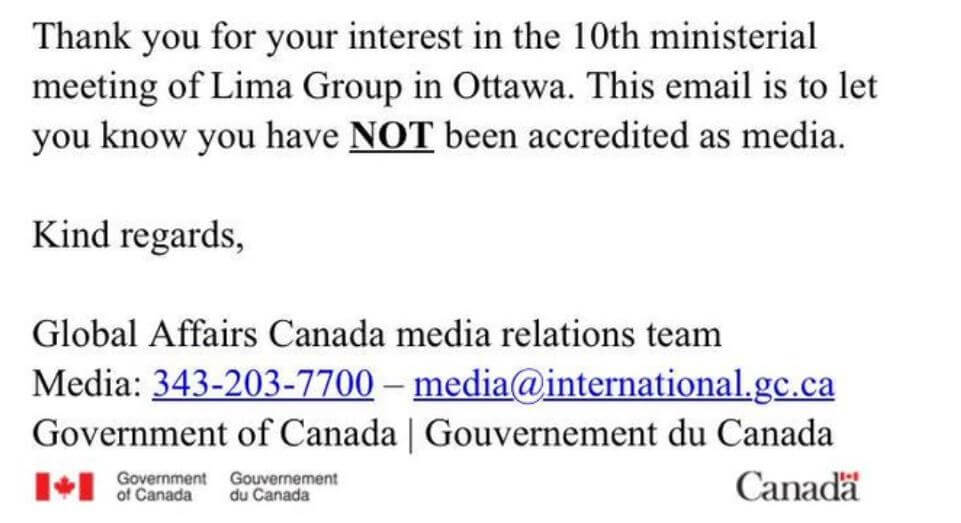
The Trudeau government, while giving lessons to Venezuela about democracy and freedom of the press for example in the February 4, Ottawa Lima Group meeting, denied access to Telesur. This is the email that Patricia Villegas, President of teleSur, received following the request to cover the Lima Ottawa meeting (a screenshot taken by the author from Villegas’ Twitter account):


 TeleSur was denied entry into a recent Lima Group 
meeting in Canada. Twitter | @pvillegas_tlSUR


Venezuelanalyis has its own experience with Western-style “freedom of the press” when Facebook temporarily shut down its site. As we say in Quebec, “plus ça change, plus c’est pareil” (The more things change, the more they stay the same.)

Arnold August is a Canadian journalist and lecturer, the author of Democracy in Cuba and the 1997–98 Elections, Cuba and Its Neighbours: Democracy in Motion and the recently released Cuba–U.S. Relations: Obama and Beyond. As a journalist, he collaborates with many websites in Latin America, Europe, and North America. He is an occasional contributor to Venezuelanalysis.Reach him on his website: www.arnoldaugust.com

Source | Venezuelanalysis

Republish our stories! MintPress News is licensed under a Creative Commons Attribution-NonCommercial-ShareAlike 3.0 International License.